In short
Here are 66 free spring coloring pages to print on US Letter paper, with no email or sign-up. There are flowers, butterflies and caterpillars, bunnies, baby farm animals, birds and nests, ladybugs, bees and frogs, rain and rainbows, gardens, St. Patrick's Day, Holi and Earth Day, Mother's Day, and six detailed pattern pages for adults. Each subject comes at three levels: easy pages are one big shape in thick lines for ages 2 to 4, medium pages add a simple scene for ages 4 to 7, and detailed pages are realistic for ages 8 to adult. There are no Easter eggs or baskets, so the set works from March 1 to Mother's Day. Tap a page's title to open the full-size file, then print at 100% or Actual size.
Before drawing a single page, we read 13 of the spring coloring pages that rank on Google, from small printable blogs to Crayola and Twinkl. Ten of the 13 mix Easter pictures into the spring set, from egg hunts to chicks hatching out of decorated eggs, usually with no label. Several borrow cartoon characters from big studios, a few pad the count with off-season pages like a squirrel with an acorn, and only one links a single fact to a source. Most don't sort by age at all, and none has a dated section for St. Patrick's Day, Earth Day or Mother's Day.
So every page here is new, drawn for this post with the image model behind our free photo-to-coloring-page tool and checked by hand. The ladybug has six legs and the same spots on both wing covers, the shamrock has three leaves, the monarch caterpillar sits on milkweed, and no egg on any page is painted or decorated. Each section has one true story to tell while the crayons are out, linked to where it comes from, and the holiday pages sit in their own section with their 2027 dates. Print as many as you like for home or a classroom. Please don't sell them.
Which spring coloring page suits which age?
Easy pages suit most children from two to four, medium pages four to seven, and detailed pages eight and up; the last section is drawn for teens and adults. The levels follow how coloring grows: toddlers scribble across a shape, preschoolers start aiming for it, and school-age children fill small areas on purpose.
The CDC lists scribbling as a milestone most children reach by 18 months, and by 4 years most hold a crayon between fingers and thumb instead of in a fist. When Huang and colleagues had 239 children aged 3 to 6 color a picture, most 3- and 4-year-olds colored in a "transitional" way, between scribbling and staying inside the lines, and mature coloring usually came after 5. So a 3-year-old going over the edge of the tulip is right on time. The children's occupational therapists at Aneurin Bevan health board in Wales suggest keeping the areas to color "small and achievable". Our dinosaur coloring pages go further into grip and crayon sizes by age.
| Level | Usually suits | What's on the page | Good first picks |
|---|---|---|---|
| Easy | 2 to 4 | One big shape, very thick lines, almost no background | Tulip in a pot, big butterfly, ladybug, shamrock |
| Medium | 4 to 7 | The subject in a simple scene, bold lines, a few details | Puddle jumping, ducklings in a row, butterfly life cycle |
| Detailed | 8 to adult | A realistic scene with many small areas | Double rainbow, boxing hares, life in the pond |
| For adults | Teens and adults | Intricate patterns and botanical drawings | Flower mandala, stained-glass garden, folk-art hare |
The ages are starting points, not rules. Let a child who loves frogs color the pond page badly and happily.
How do you print these coloring pages?
Tap a page's title under any preview to open the full-size file, 2,550 by 3,300 pixels, which is 8.5 by 11 inches at 300 dpi, and print it at 100% or Actual size on US Letter paper. Each title opens the picture itself, with no PDF bundle, cloud drive or sign-in in the way. Adobe's print help explains the setting: Fit "reduces or enlarges each page to fit the printable area", while Actual size prints at full scale. On A4 paper (a little narrower than Letter), choose Fit.
Plain 20 lb copy paper (75 g/m²) is fine for crayons and colored pencils. For markers, slide a scrap sheet underneath: Strathmore notes that most papers eventually let markers bleed through, and lighter ones sooner. Printing for a class? The dates table near the end shows which pages fit St. Patrick's Day, Holi, Earth Day, Arbor Day and Mother's Day.
Flower coloring pages
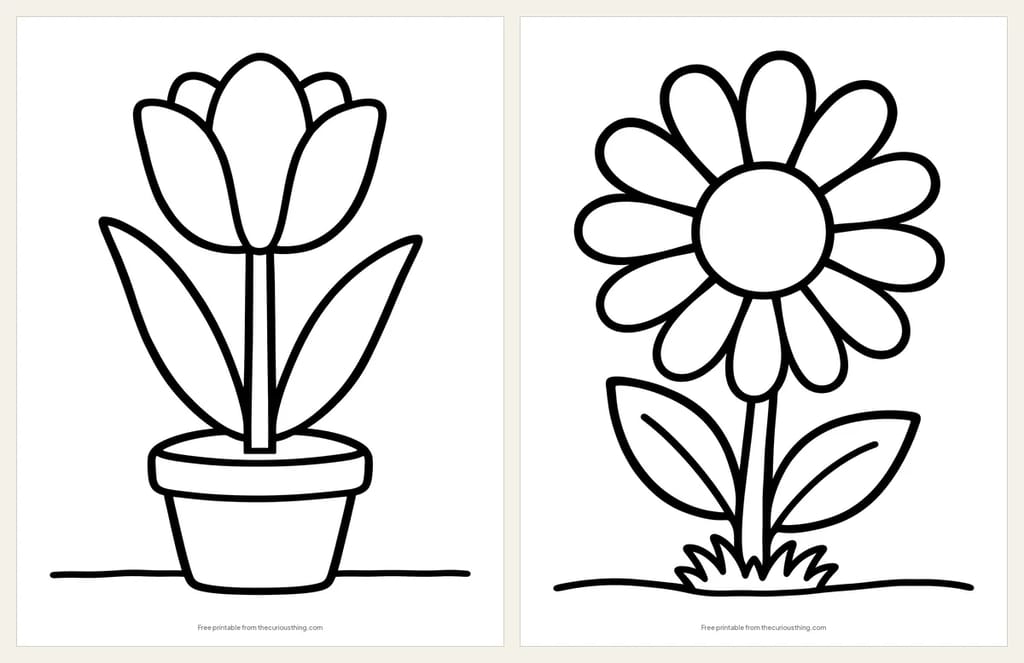
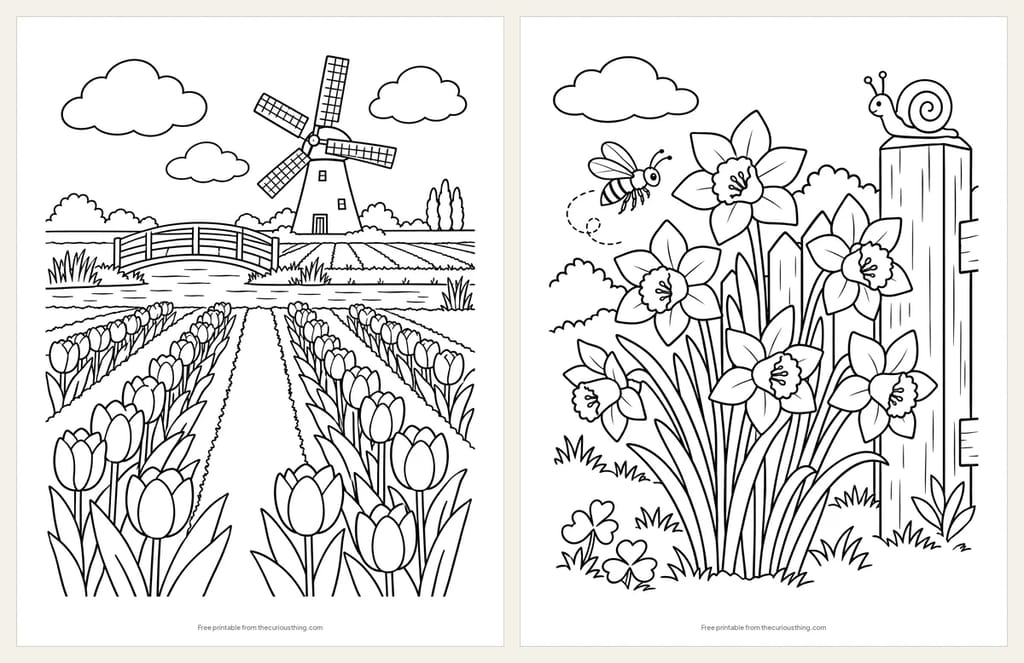
These six flower coloring pages run from a single tulip in a pot for toddlers to a Dutch tulip field, daffodils by a fence, a path under cherry trees in blossom and a realistic spring bouquet. Tulips come with the best story. Their name comes from the Turkish word for turban, and in the 1630s the Dutch paid fortunes for "broken" tulips with flame-like stripes, which turned out to be caused by a virus that made the bulbs sickly. The ruin said to follow the crash of 1637 is mostly legend, though. Historian Anne Goldgar went through Dutch archives and could find only 37 people who spent more than 300 guilders on bulbs, no one who drowned, and not one bankruptcy she could pin on the crash. For a petal-counting game: a tulip looks like it has six petals, but botanically it has three petals and three sepals that look alike. Keep real daffodils away from pets, since they're toxic to dogs, cats and horses, and the bulb is the worst part.
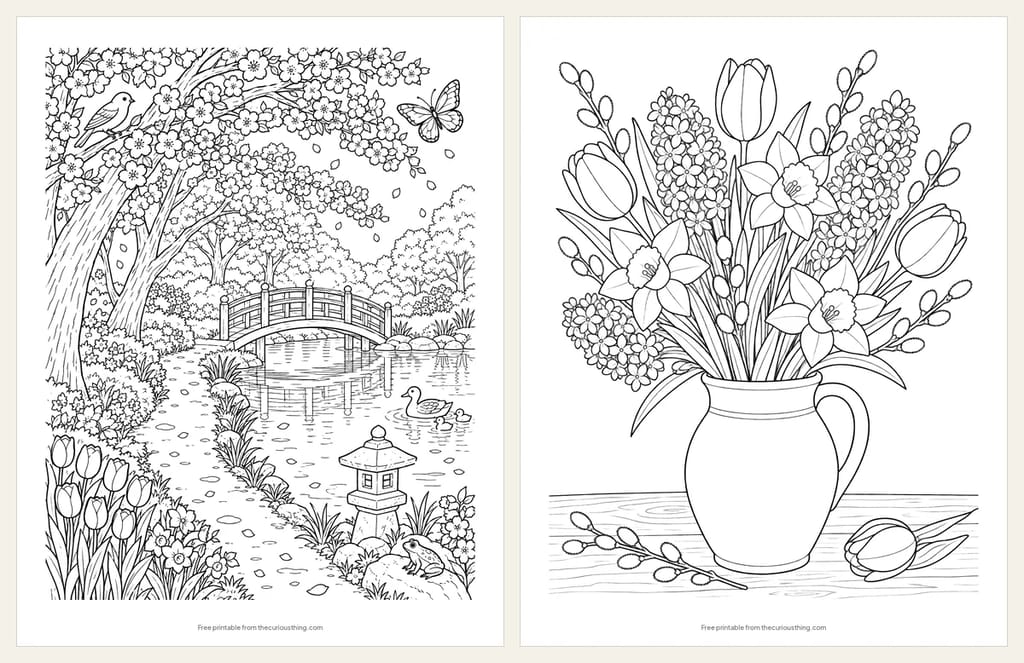
Where did Washington's cherry trees come from?
From Tokyo, on the second try. Japan's first gift of 2,000 trees reached Washington in January 1910, but inspectors found insects, nematodes and disease, and President Taft approved burning them. Tokyo sent a bigger gift in 1912: 3,020 trees of twelve varieties. On March 27, 1912, First Lady Helen Herron Taft and Viscountess Chinda, the wife of Japan's ambassador, planted the first two by the Tidal Basin, and those two trees are still standing. A cluster of old trees on the East Potomac Golf Course may even be survivors of the 1910 shipment: their DNA doesn't match the 1912 trees, and the Park Service named them Witness Trees in 2006.
Butterfly and caterpillar coloring pages
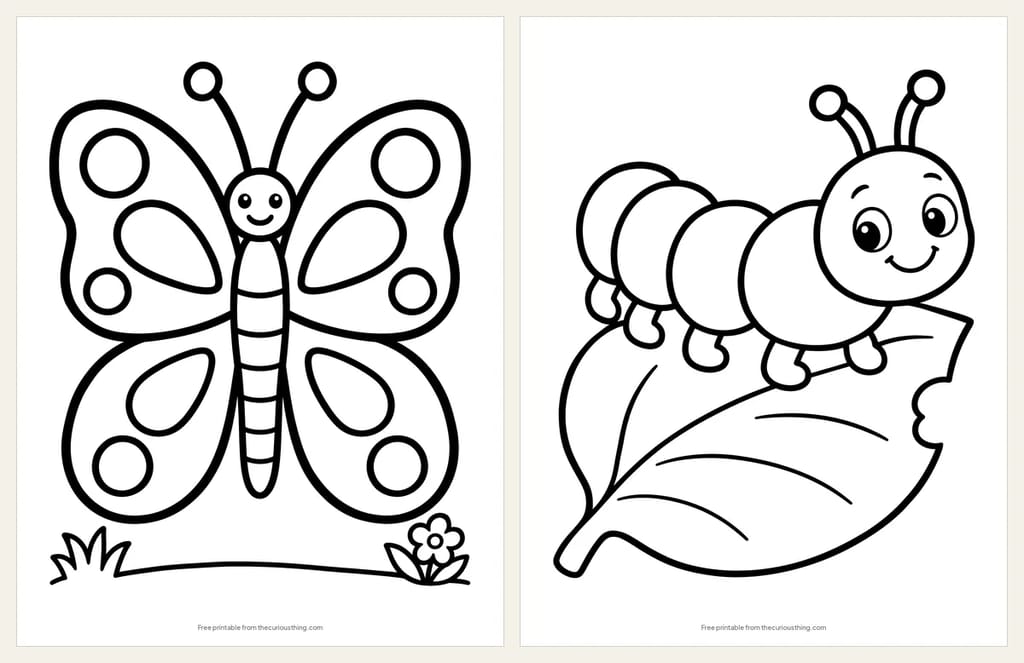
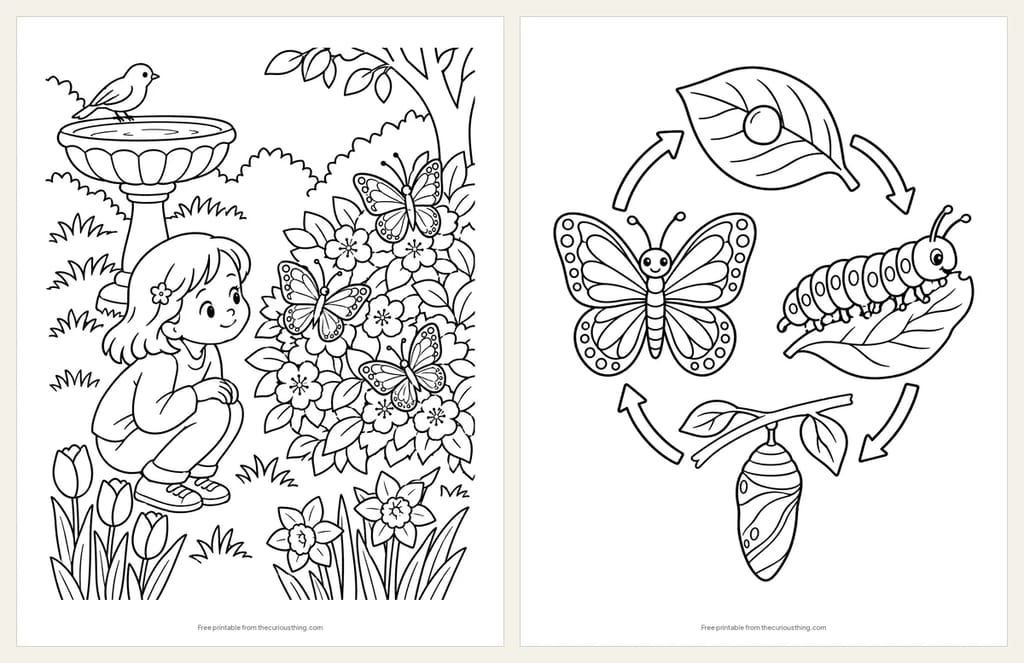
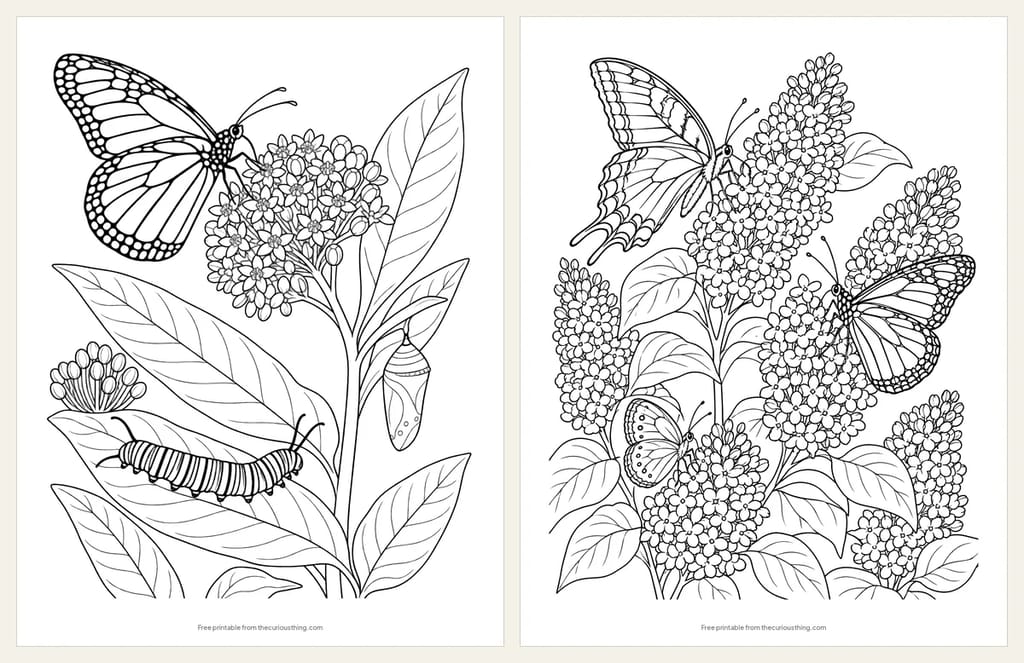
These six butterfly coloring pages go from one big spotted butterfly and a caterpillar on a nibbled leaf to the whole life cycle, a monarch on milkweed and three butterflies on a lilac. The monarch makes the best spring story, because no single monarch flies the whole way north. The butterflies that spent the winter in Mexico head north in March and lay eggs in northern Mexico and the southern US; their offspring carry on, laying eggs as they go, and begin reaching the northern US and southern Canada in late May. A summer monarch lives only two to six weeks, while the generation that flies to Mexico can live as long as nine months.
Its caterpillar eats only milkweed, grows to almost 2,000 times its starting weight, then spends about 8 to 15 days in its chrysalis. Its mother picked that milkweed with her feet: a female monarch drums her legs on a leaf to taste it before she lays an egg. And it's a chrysalis, not a cocoon; cocoons are silk cases spun by many moth caterpillars.
Can a butterfly still fly if you touch its wings?
Yes. The powder that comes off on your fingers is tiny scales, and losing some doesn't ground a butterfly. A butterfly biologist at the University of Chicago, whose lab handles butterflies all the time, says they "fly fine" afterward. Looking is still kinder than catching, which is why the girl on the garden page is crouched down watching, with no net and no jar.
Make them a coloring book for spring
One photo of your child, your pet or the family, drawn into 24 worlds, one to a page with a blank back, in a coil-bound 8.5 by 11 inch book for $29 with the printable PDF included. See the cover and two pages free first, swap any world you don't want, and approve every page before anything prints.
Bunny coloring pages
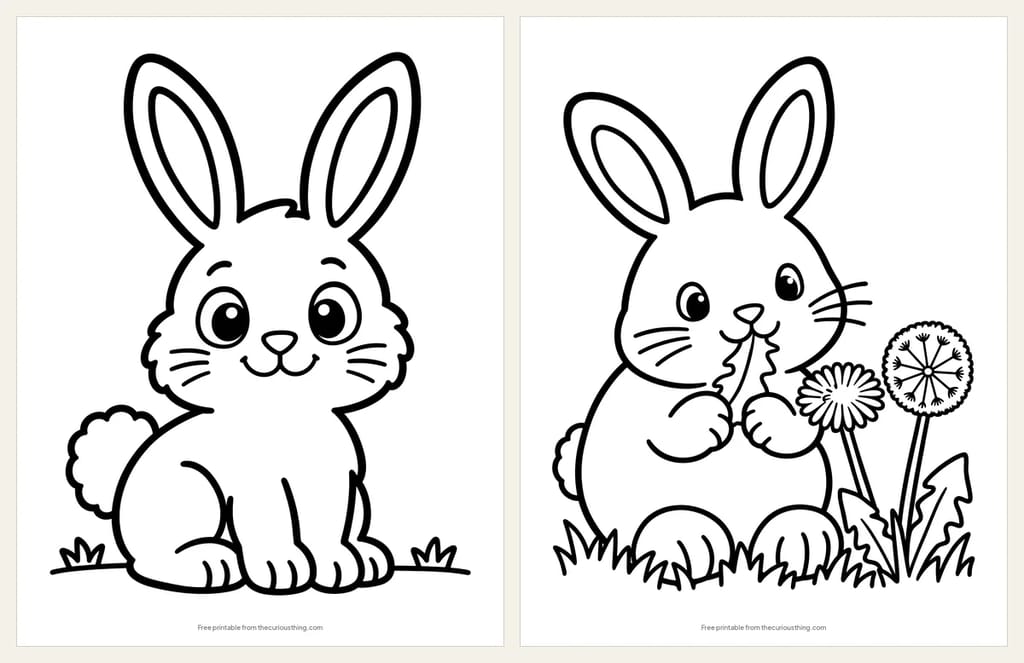
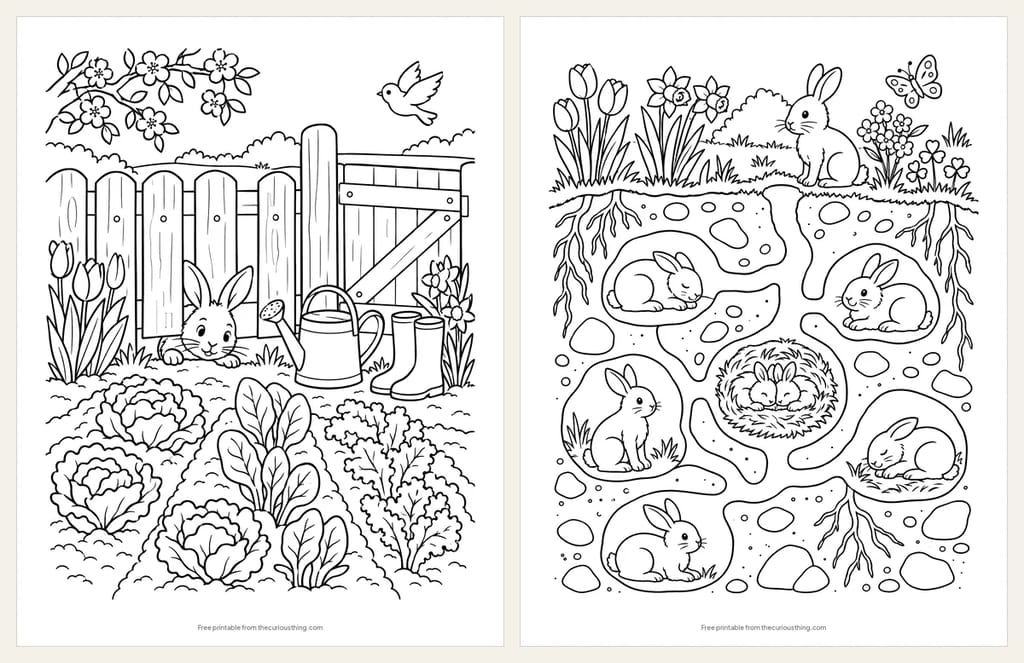
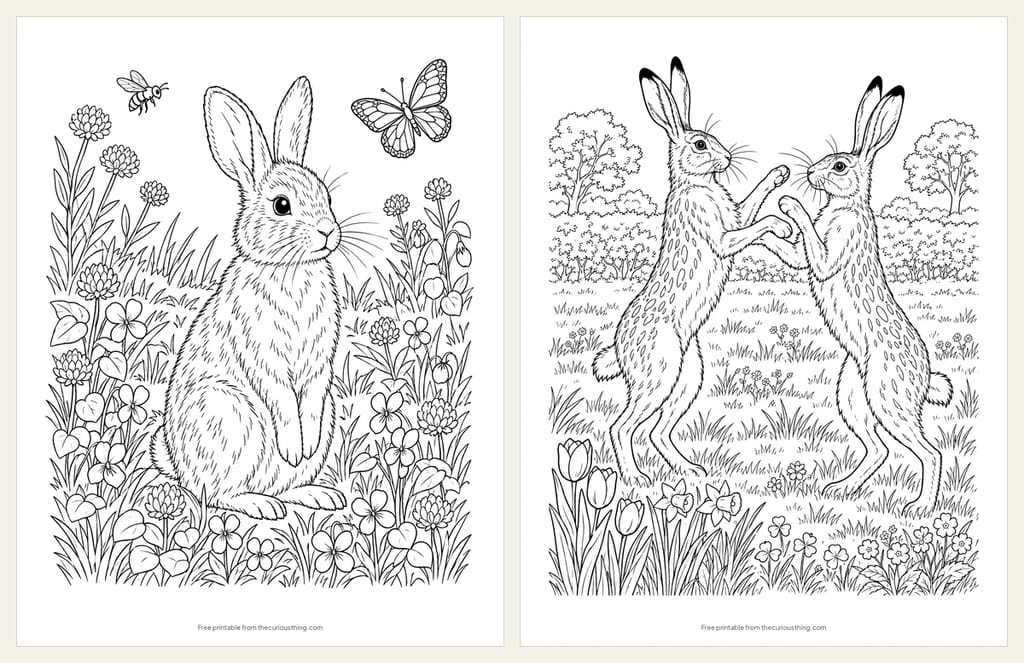
These six bunny coloring pages go from a fluffy bunny and a bunny with a dandelion to a rabbit raiding a vegetable garden, an underground warren, a wild cottontail and two hares boxing in a field. They're spring rabbits, not Easter ones, so nobody carries a basket. Wild baby cottontails are called kits. They're born with no fur and their eyes closed, yet they can look after themselves at about 4 weeks old. Their mother doesn't stay with them: so predators don't find the nest, she visits only briefly at dawn and dusk to feed them, then covers them back up with fur and dry grass. That's why a nest that looks abandoned usually isn't. Cottontails don't dig burrows either. They nest in a shallow scrape and borrow holes dug by woodchucks when the weather turns bad. The rabbits on the warren page are European rabbits, the wild ancestor of pet rabbits, whose burrows can run about 10 feet deep and 150 feet long.
Why do hares box in spring?
The boxing behind "mad as a March hare" usually isn't two males fighting. A 1984 study in Nature found it's mostly a female fending off a male who's pushing to mate, and that hares are no madder in March than in the rest of their long breeding season. Hares start life differently from rabbits, too: a baby hare, called a leveret, is born with a full coat of fur and can move around soon after birth.
Baby farm animal coloring pages
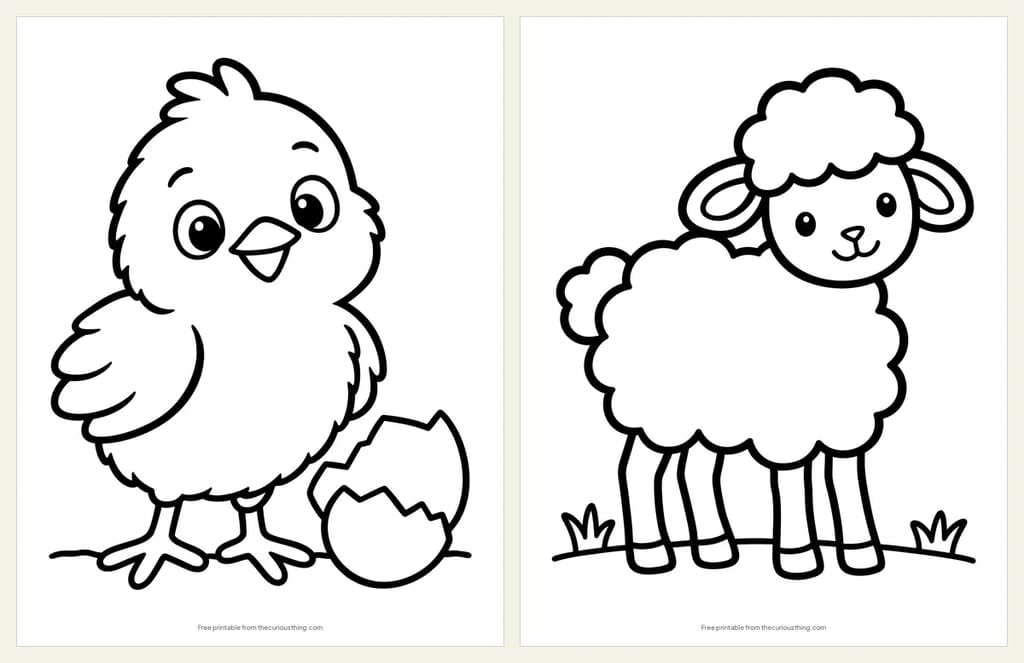
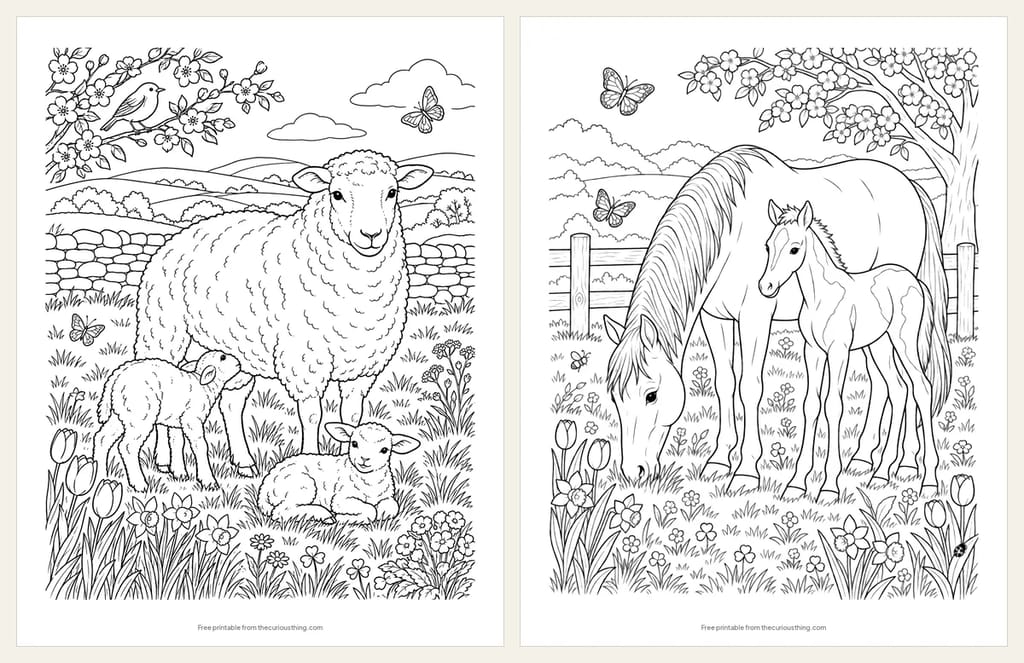
These six baby animal coloring pages run from a chick beside its eggshell and a woolly lamb to ducklings in a row, a hen with her chicks, a ewe with twin lambs and a mare with her new foal. Farm babies start talking early. Chicks begin calling from inside the egg 2 to 3 days before they hatch, and when one gives a loud call, the hen answers by clucking or shifting on the nest.
Lambs often come in pairs; in many well-managed flocks, twins are the most usual birth. Sheep aren't silly, either: in a 2001 study in Nature, they remembered the faces of 50 other sheep for more than two years. A newborn foal should stand within about an hour and nurse within about two, the start of what horse vets call the 1-2-3 rule.
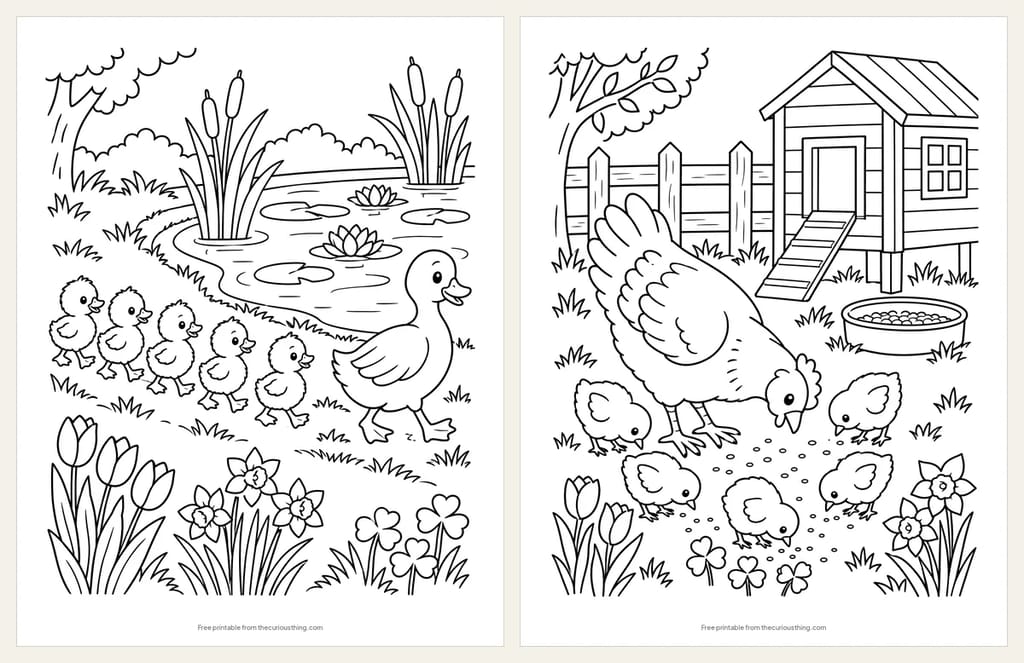
Why do ducklings follow the first thing they see?
Because they imprint on it. Newly hatched ducklings and goslings follow the first moving thing they see. Konrad Lorenz, who later shared a Nobel Prize, remembered getting a one-day-old duckling from a neighbor as a boy and finding, to his joy, that it followed him around. In the 1930s he was often that first moving thing himself, and he was trailed around his Austrian estate by a line of geese. The window is short. In mallard ducklings, imprinting can happen within a few hours of hatching, and it closes at about 30 hours.
Bird and nest coloring pages
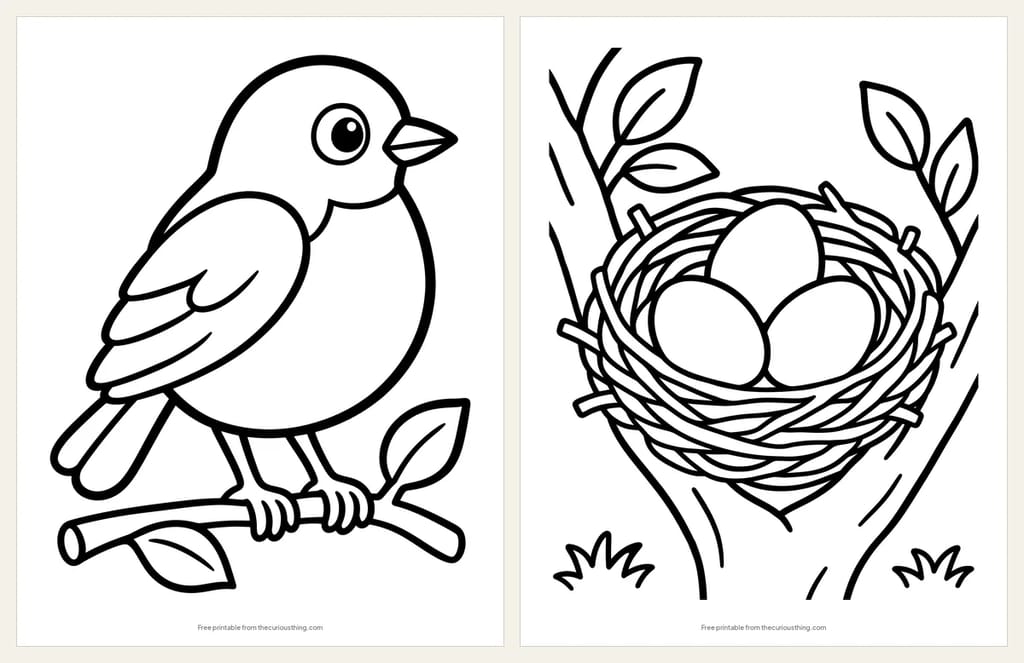
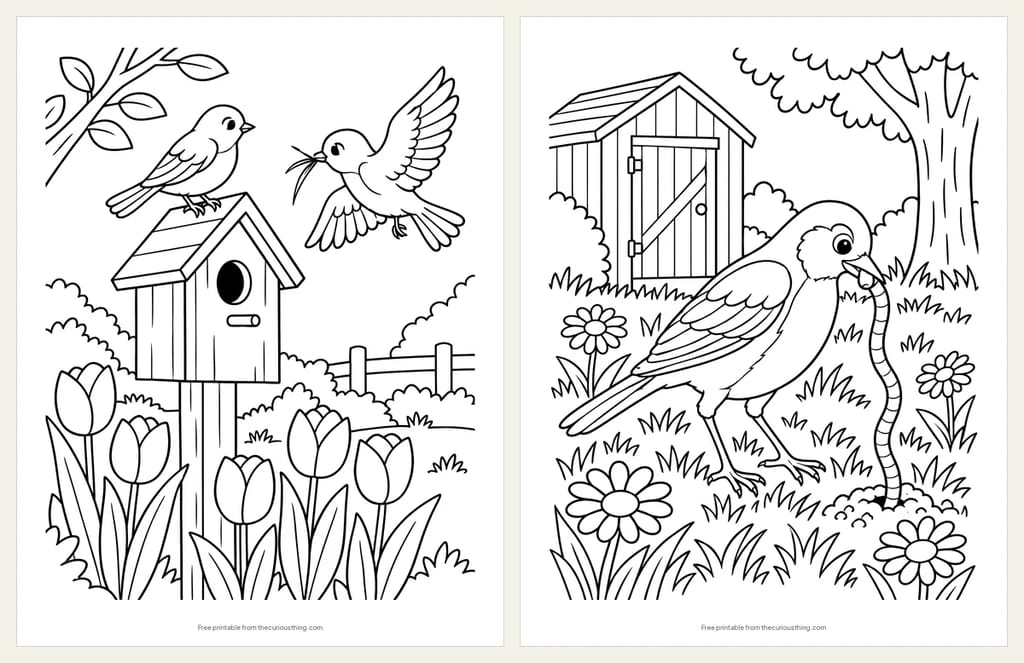
These six bird coloring pages run from a round robin and a nest of three eggs to bluebirds at a birdhouse, a robin pulling up a worm, robin chicks at feeding time and a hummingbird at a columbine. Color the nest eggs robin's-egg blue: that blue comes from a pigment called biliverdin, which goes onto the shell in the last few hours before the egg is laid, though nobody knows for sure why robins lay such bright eggs. When a robin tilts its head on the lawn, it may be listening. In aviary tests, robins found buried mealworms with no sight, smell or vibration to go on, and found fewer when white noise drowned out the sound.
The first robin isn't really the first sign of spring, though, since many spend the whole winter in their breeding range, eating fruit up in the trees. Hummingbirds are a truer sign. Many ruby-throats fly nonstop across the Gulf of Mexico, up to 500 miles in 18 to 22 hours, and most reach the Gulf Coast in March and early April, with arrivals peaking in the Northeast around mid-May.
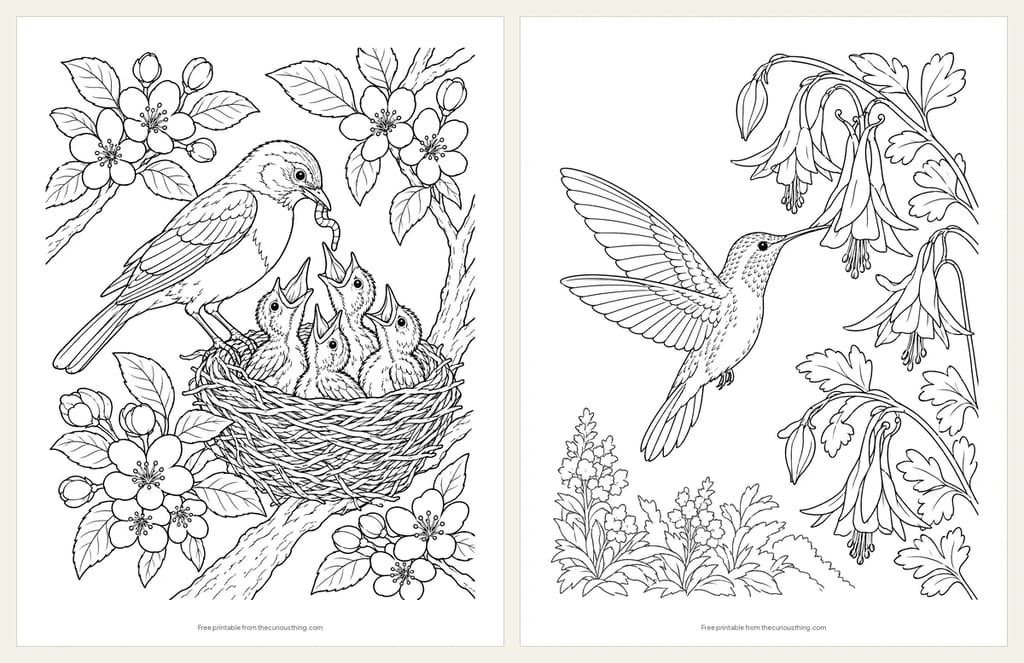
Will a mother bird reject a baby you touched?
No. Cornell's Lab of Ornithology says parent birds don't abandon young a person has touched. Most birds do have a good sense of smell, but they've put too much into raising their babies to give up on them over a scent. It's safe to put a fallen nestling back in its nest, or to move a fledgling out of danger into a nearby tree or shrub.
Ladybug, bee and frog coloring pages
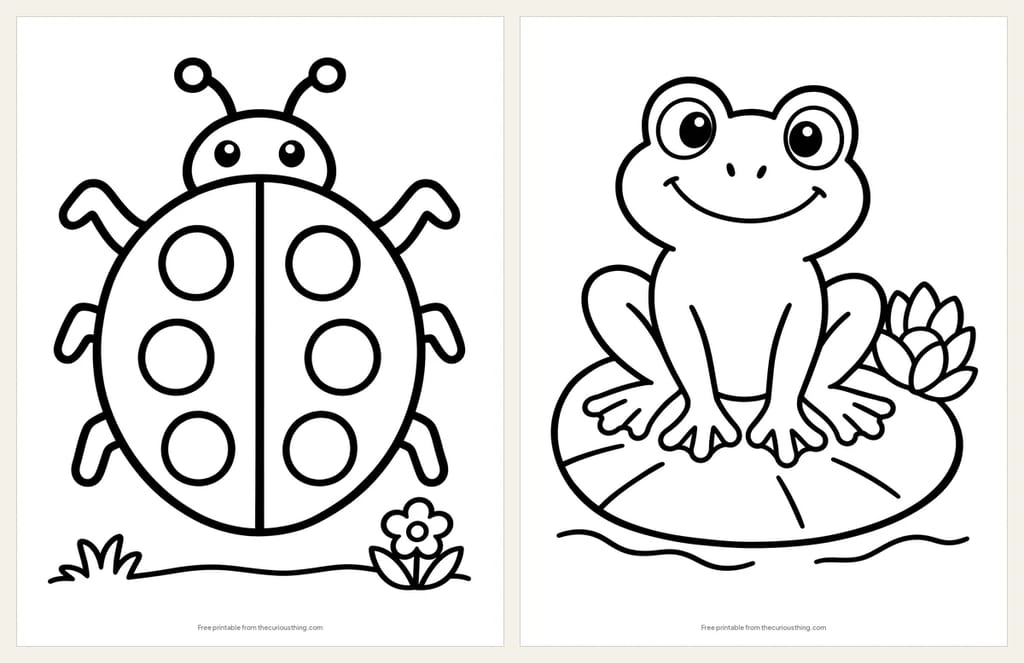
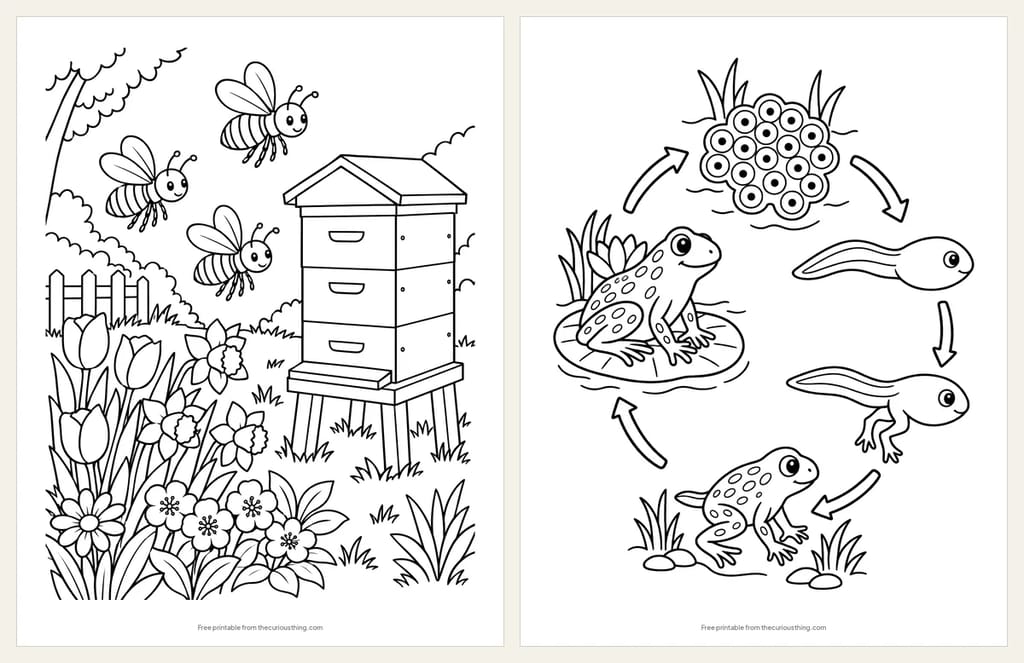
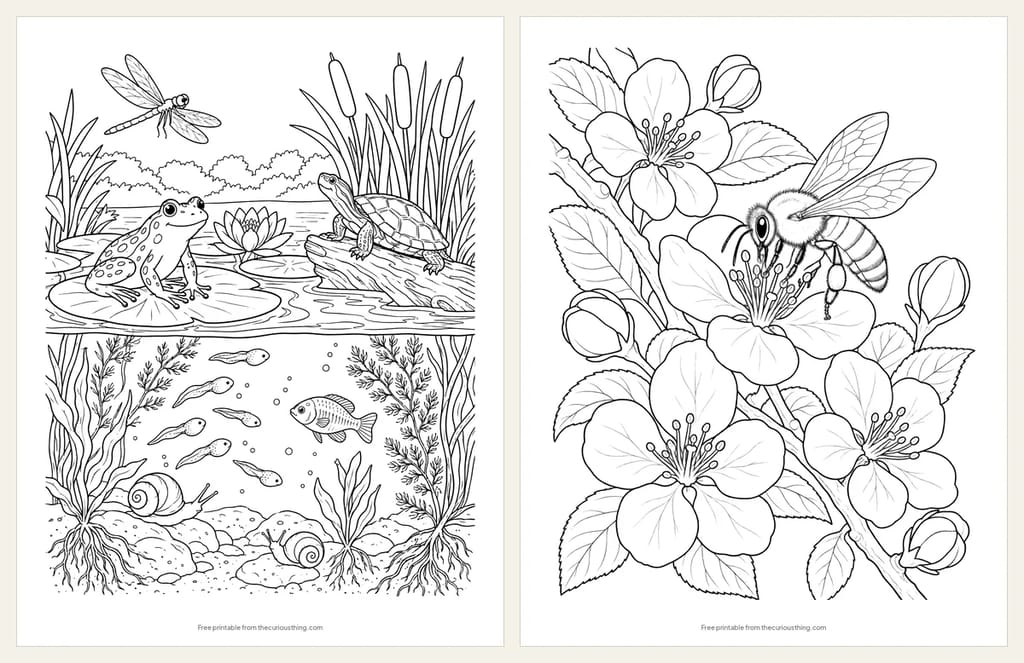
These six pages cover spring's small animals: a ladybug and a frog on a lily pad for toddlers, bees at a hive and the frog life cycle, then a cut-away pond and a honeybee on apple blossoms. You can't tell a ladybug's age from its spots. Adults don't molt, so the spots stay the same all their life, and the pattern is a clue to which kind of ladybug it is. There are almost 6,000 kinds worldwide and almost 500 in North America, some yellow or black and some with no spots at all. A frog starts as an egg, then becomes a tadpole that grows back legs, then front legs, and absorbs its tail; in between, a froglet has four legs and lungs but still a short tail.
How do bees tell each other where the flowers are?
They dance. Karl von Frisch, who shared the 1973 Nobel Prize in Physiology or Medicine, showed that a honeybee back from flowers more than about 50 meters away does a "waggle dance" on the comb, and its straight run shows the other bees which way to fly, measured against the sun. The three bees on the beehive page are heading home to do just that. If one stings, it's worth knowing that only honeybee workers die after stinging a person, because their barbed stinger catches in skin. Bumble bees can sting again, and male bees can't sting at all, since the stinger is a changed egg-laying tube.
Rain, rainbow and kite coloring pages
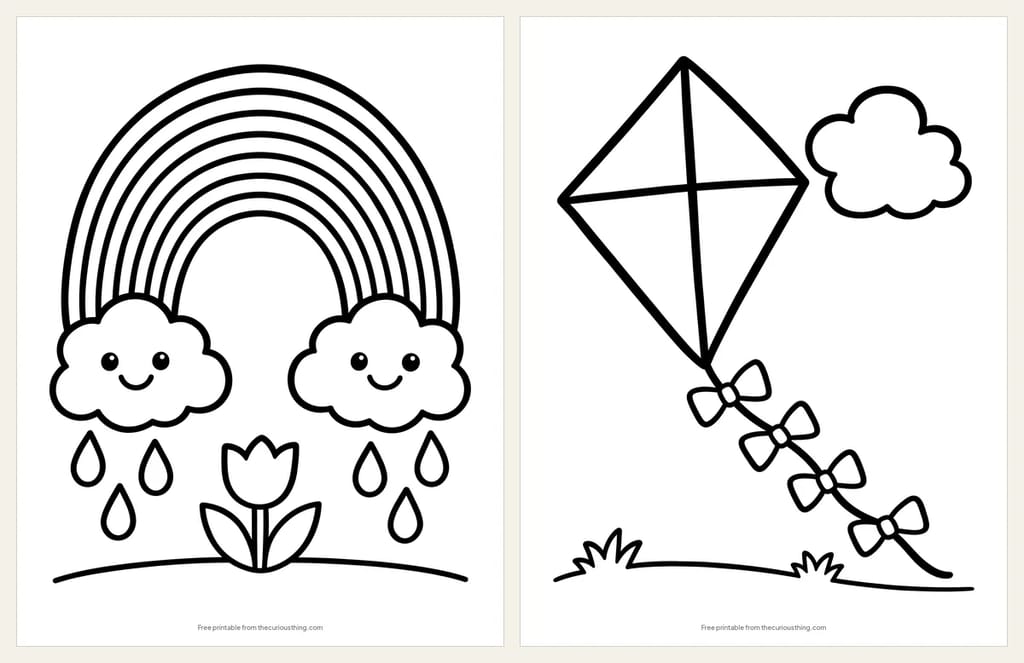
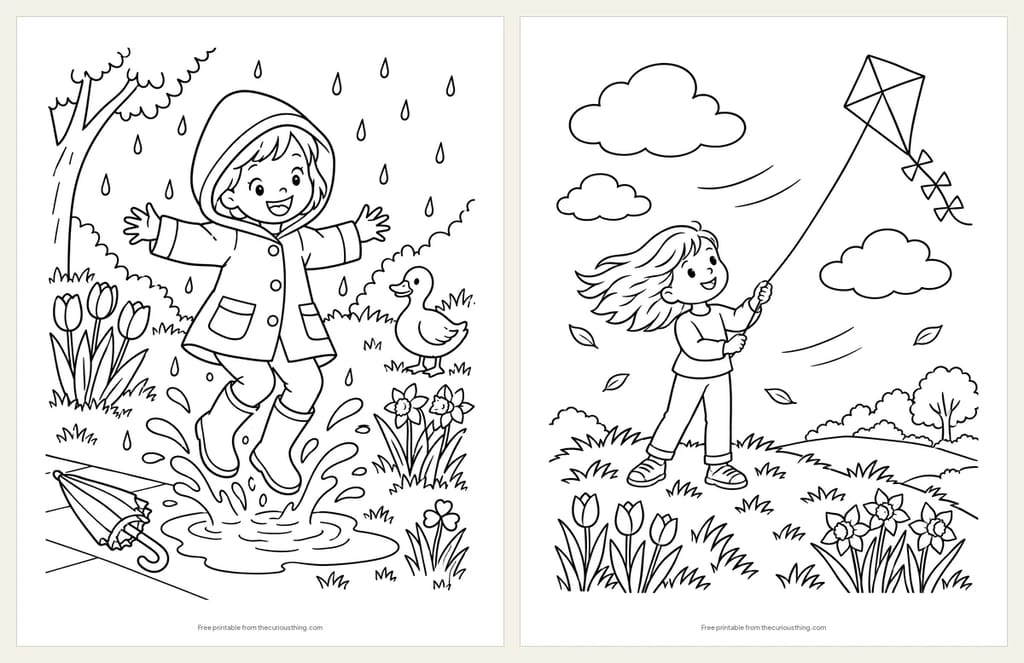
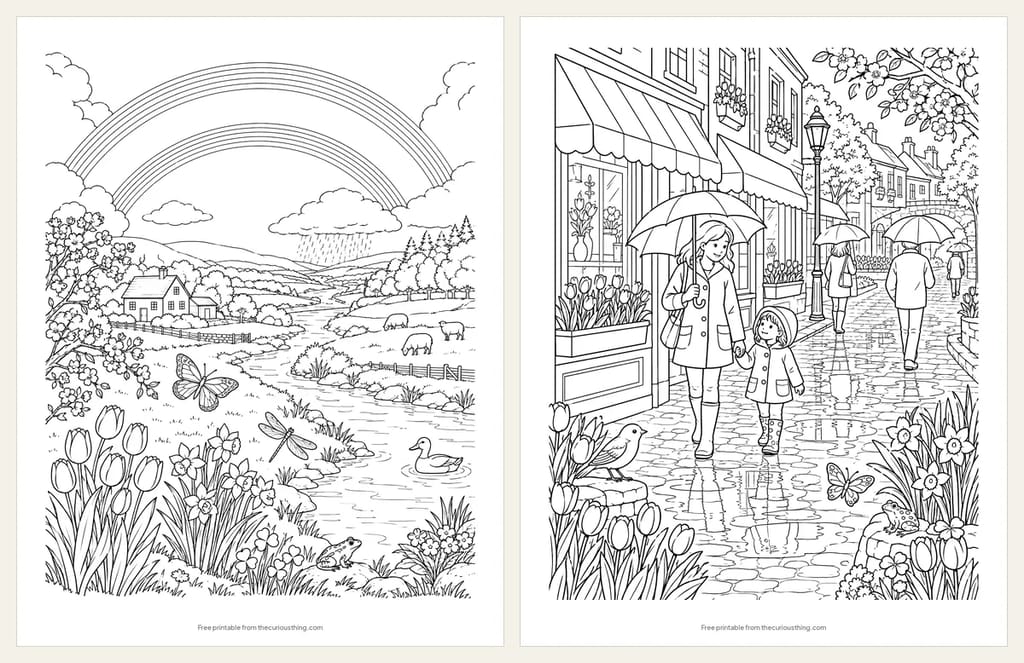
These six pages are for April weather: a rainbow between two rain clouds and a kite for toddlers, puddle jumping and a kite on a windy hill, then a double rainbow over a valley and a town street in a spring shower. To find a real rainbow, stand with the sun at your back. A rainbow always appears on the opposite side of the sky from the sun, and none shows from the ground when the sun is more than 42 degrees above the horizon, which is why rainbows turn up in the morning and late afternoon. On the double rainbow page, color the outer bow backwards: its colors run in reverse order, with red on the bottom, because the light bounced twice inside each raindrop. The sky between the two bows really is darker, a stripe called Alexander's band.
Kites have a spring story too. Before the Wright brothers built an airplane, Wilbur tested their steering idea on a kite with a 5-foot wingspan in 1899, watched only by a group of schoolboys.
Why does a rainbow have seven colors?
Because Isaac Newton chose seven. Medieval writers usually listed five colors in a rainbow, and Newton added orange and indigo so the colors would be divided like the notes of a musical scale. A real rainbow is a smooth blend of more shades than anyone can tell apart, and the UK's Met Office notes that modern descriptions often fold indigo into blue and violet. So a child who colors the rainbow page with five stripes, or with nine, isn't wrong.
Why does rain smell?
The smell of rain on dry ground has a name, petrichor, coined by Australian scientists Isabel "Joy" Bear and Richard Thomas in the journal Nature on March 7, 1964, from the Greek for stone and for the fluid in the veins of the gods. Much of the earthy note is geosmin, made by soil bacteria, and the human nose can catch it at about 100 parts per trillion. MIT engineers filming raindrops found that a drop landing on soil traps tiny air bubbles that burst out like the fizz in champagne, which may be how the smell gets into the air. As for "April showers bring May flowers": Chaucer praised April's sweet showers in the opening of the Canterbury Tales, but the earliest known version of the rhyme is Thomas Tusser's "Sweet April showers do spring May flowers", printed in 1557.
Garden and planting coloring pages
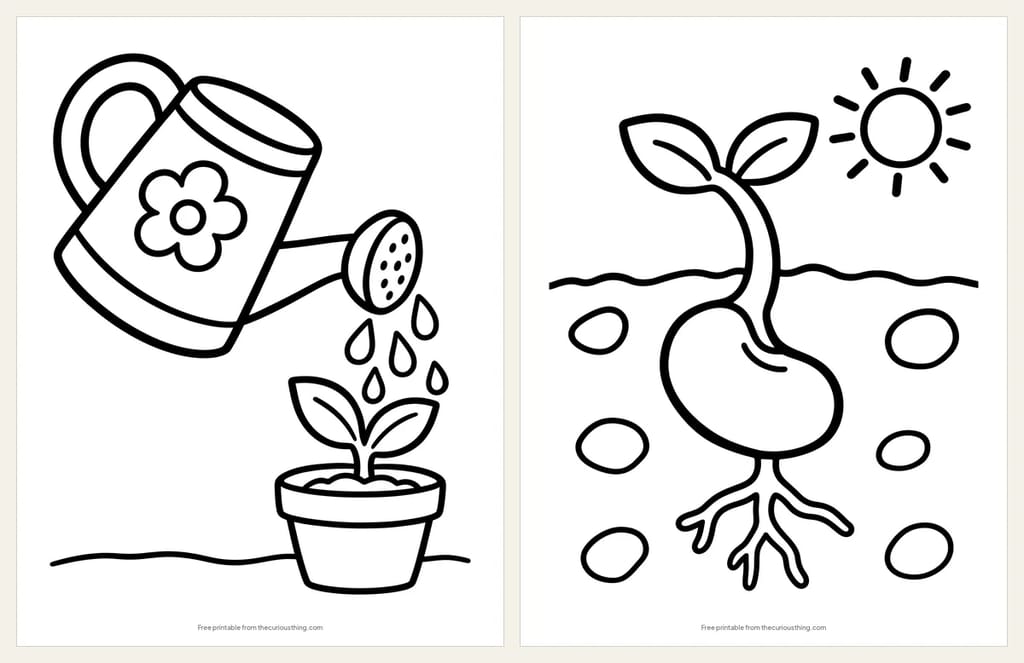
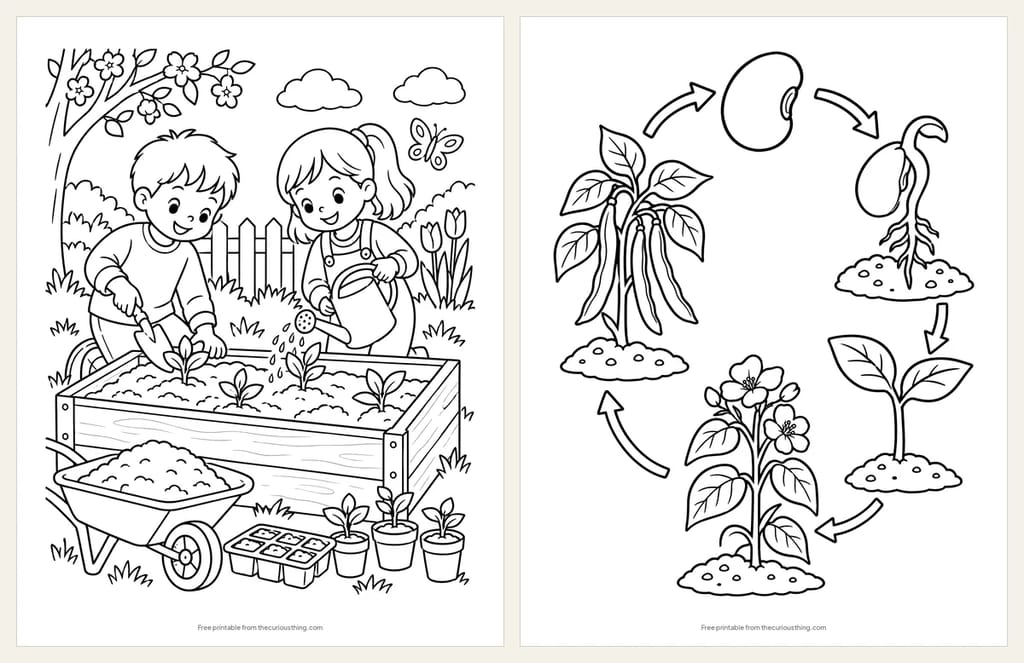
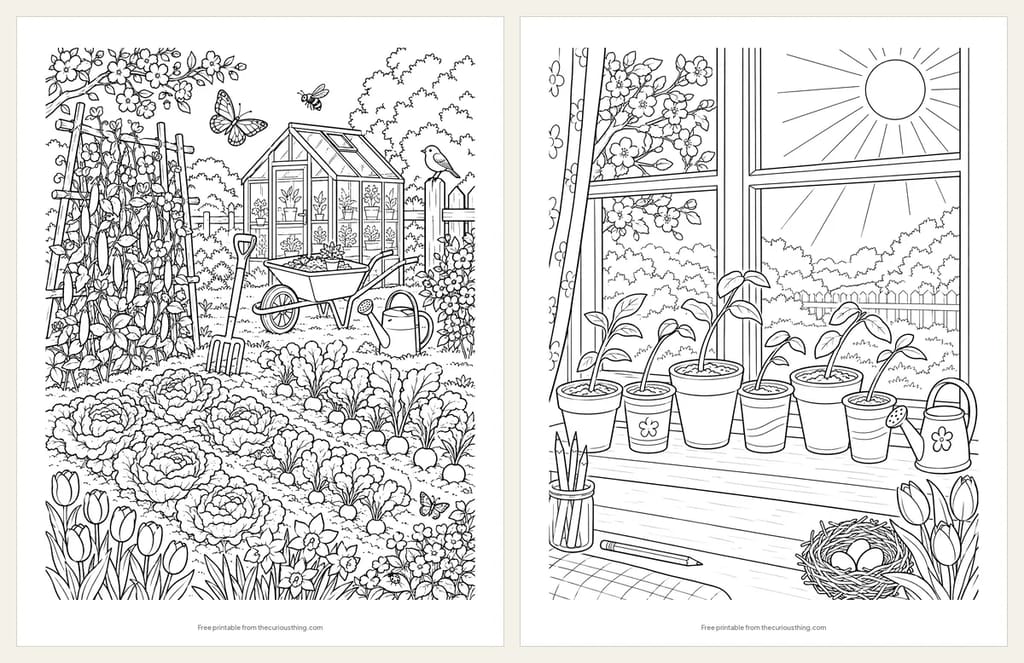
These six garden coloring pages follow a plant from seed to supper: a watering can over a sprout and a bean seed underground, two children planting a raised bed and a bean plant's life cycle, then a vegetable garden and seedlings on a windowsill. The windowsill page shows something you can try at home. Seedlings bend toward the light, and in 1880 Charles Darwin and his son Francis found that in some seedlings only the very tip senses it. They grew canary grass and oat seedlings in the dark and lit them from one side: the shoots bent toward the light, but when the tips were covered or cut off, they stayed straight. The tip, they decided, sends "some influence" down the stem.
For a fast first planting, beans are hard to beat. In warm soil, about 65 to 85°F, they usually come up in 7 to 10 days, and cold soil slows them down: snap beans take about 16 days at 59°F but about 8 at 77°F. Bury bean seeds, but press lettuce seeds onto the surface, since lettuce needs light to sprout.
Can you turn your child into a spring coloring page?
Yes, and it's free. Our photo-to-coloring-page tool redraws one photo of your child as a coloring page in a world they pick, such as a fairy among giant flowers and butterflies, an astronaut or a mermaid, with their face kept and everything around them in black outlines. It takes about 20 seconds, needs no account or email, and downloads as a US Letter PDF to print at 100%. The photo is sent once to draw the page and isn't stored, and nothing is used to train AI. It works for a pet or a whole family photo too.
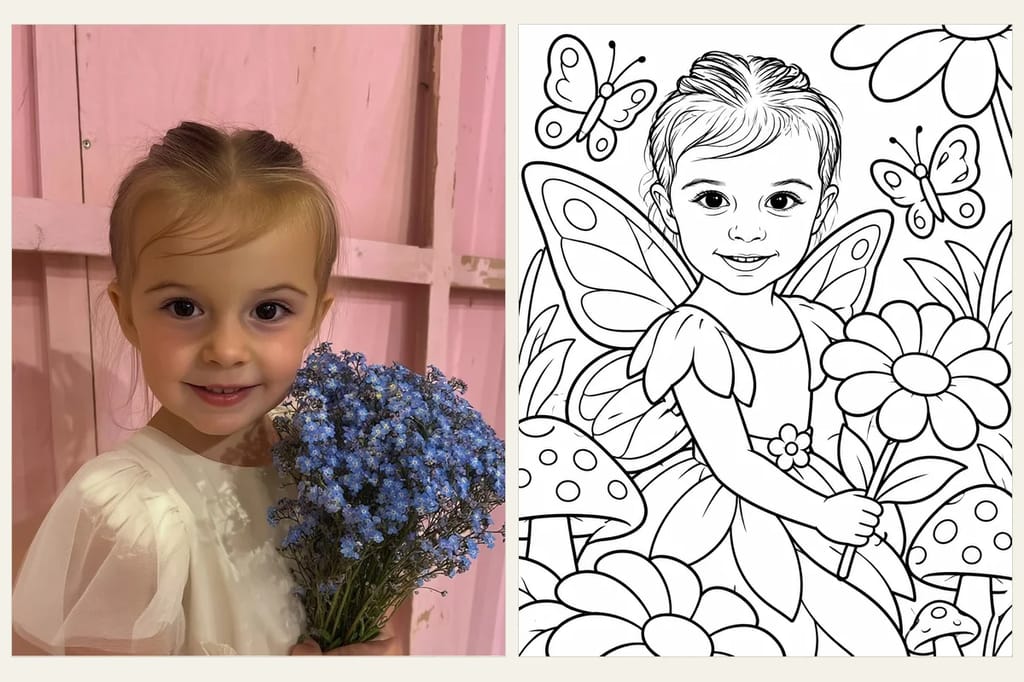
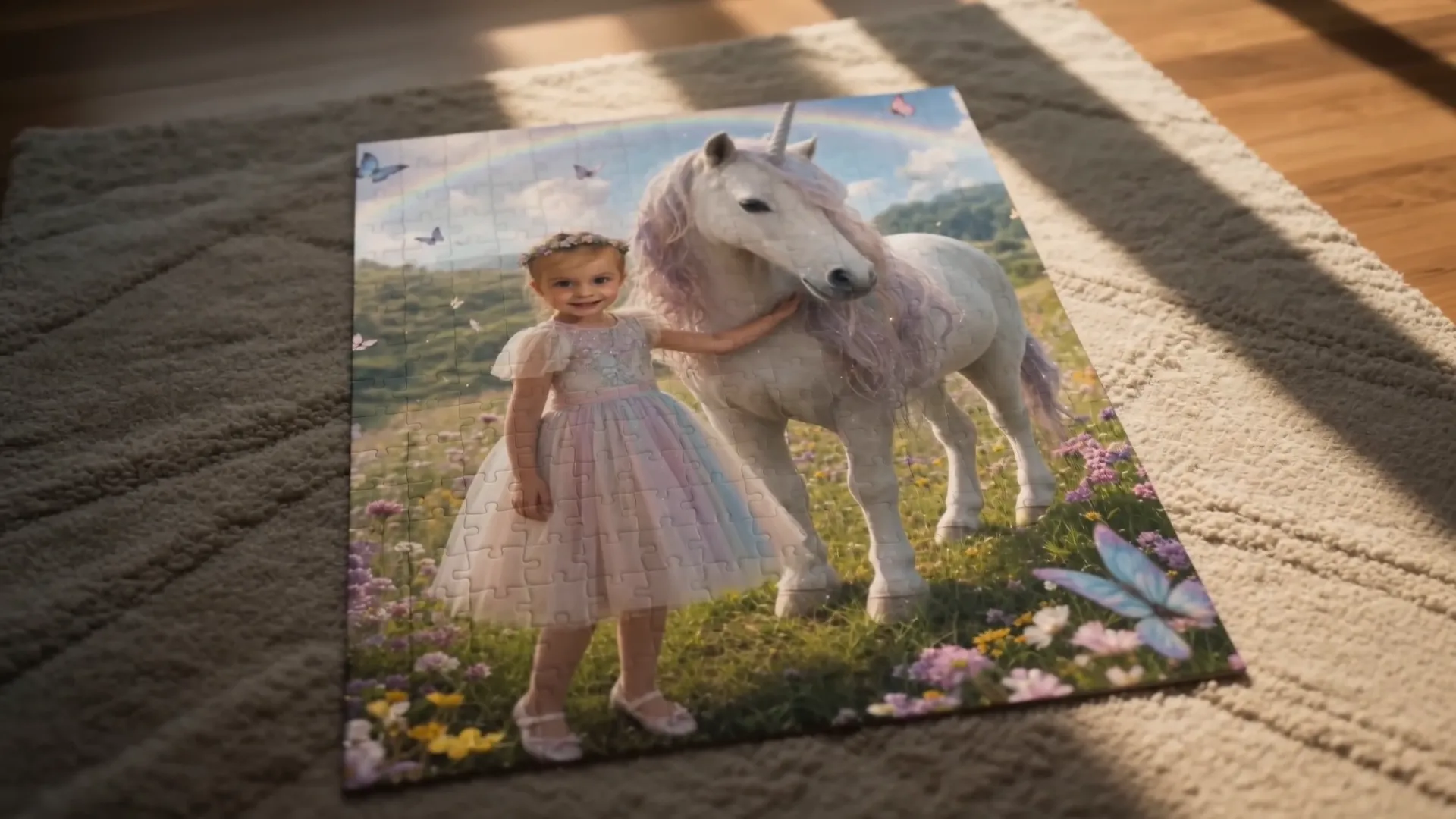
The same worlds come as full-color portraits too: Fairy Forest gives your child wings on a jigsaw puzzle, a canvas or a blanket, and you see a watermarked proof before anything prints. If she's going to be a fairy, she'll want a name, and our fairy names list says where each one comes from.
St. Patrick's Day, Holi and Earth Day coloring pages
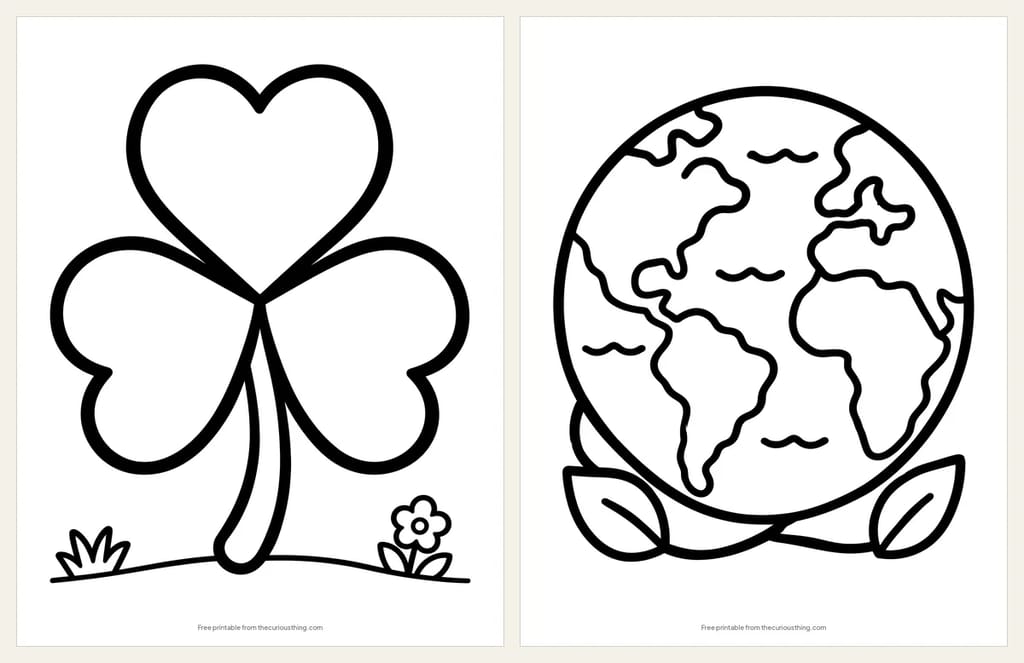
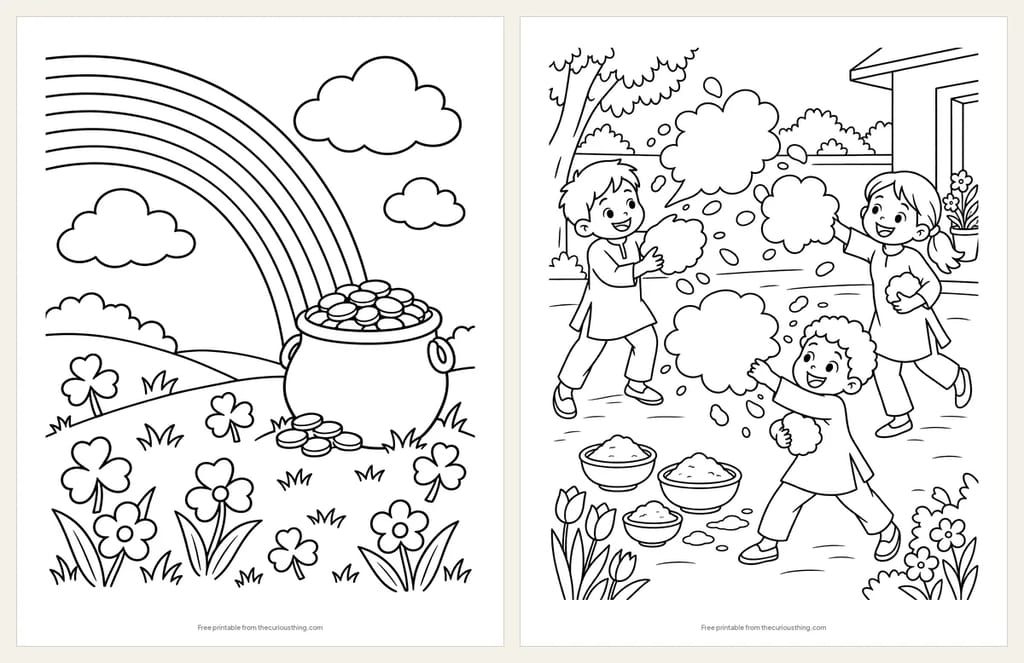
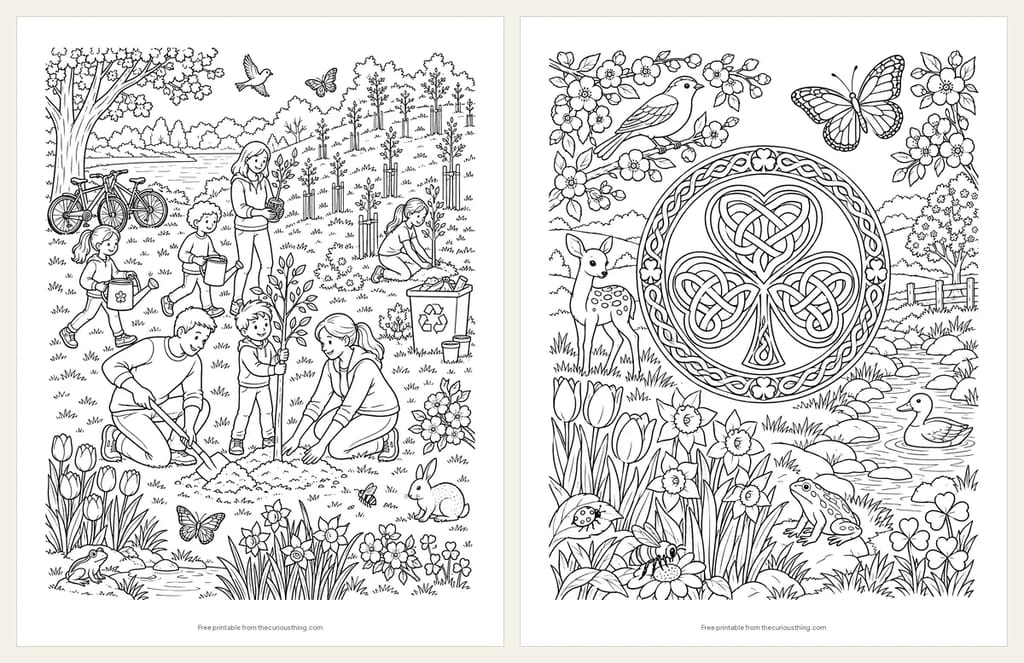
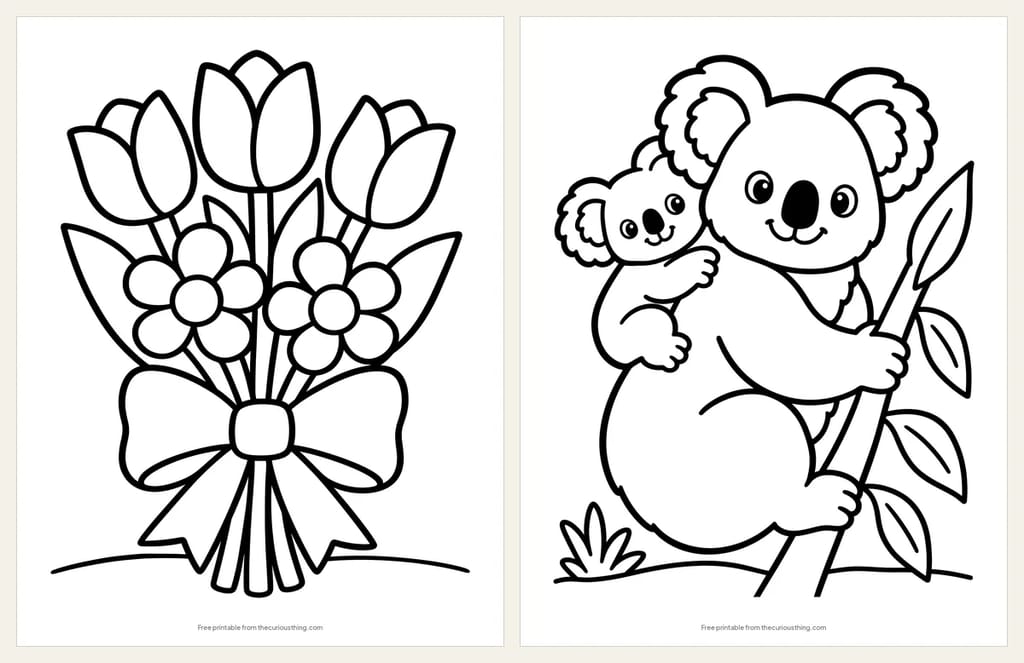
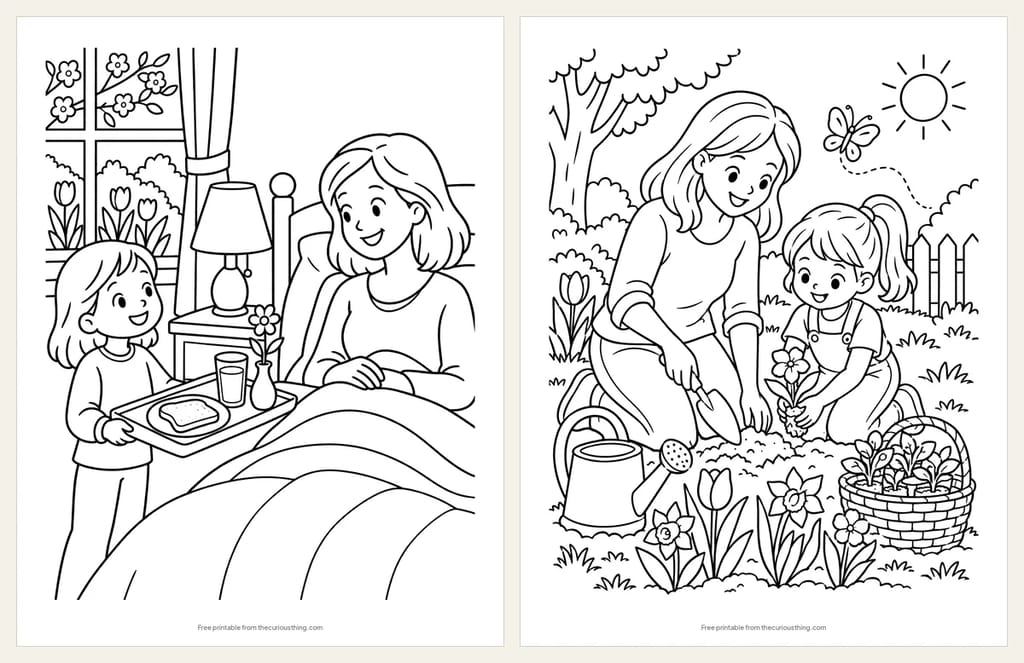
These six pages cover three spring holidays in a section of their own, so a teacher can grab one day's pages and skip the rest: a shamrock and planet Earth for toddlers, a rainbow ending in a pot of gold and children throwing colored powder at Holi, then families planting trees on Earth Day and a shamrock woven from Celtic knots. In 2027, St. Patrick's Day is Wednesday, March 17, Holi is Monday, March 22, and Earth Day is Thursday, April 22. There's no little man in a green hat on the rainbow page, just the pot of gold, and the shamrock has three leaves, as a real one should.
Why is the shamrock St. Patrick's plant?
Because of a legend, and a late one. The story that he used the three-leaf plant to explain the Holy Trinity first appears in print in 1726, in Caleb Threlkeld's book on the plants around Dublin, more than 1,200 years after Patrick lived. "Shamrock" comes from the Irish seamróg, little clover, and when people in Ireland sent in shamrocks for study, most turned out to be yellow or white clover. A four-leaf clover is a separate charm. Its odds are often quoted as 1 in 10,000, but a 2017 count by European clover hunters found about one for every 5,076 ordinary clovers. Green wasn't always Patrick's color: the earliest pictures show him in blue, and the Order of St. Patrick, founded in 1783, used a sky blue known as St. Patrick's blue.
What is Holi, and when is it in 2027?
Holi, the Hindu festival of colors, falls on Monday, March 22, 2027, at the full moon of the month of Phalguna, and marks the end of winter and the start of spring. The night before, families light a bonfire called Holika Dahan. It recalls young Prahlada, who came through a fire unharmed while his aunt Holika, who meant to hurt him, was burned, so it stands for good winning over evil. The colored powder recalls a playful story of the god Krishna smearing color on Radha's face. On the Holi page, the powder clouds are big outlined puffs, so every child picks their own colors.
How did Earth Day start?
Wisconsin Senator Gaylord Nelson came up with it, and on the first Earth Day, April 22, 1970, about 20 million Americans took part at some 2,000 colleges, 10,000 schools and hundreds of communities. His team picked a Wednesday because they figured more students would be on campus midweek. Planting trees for the occasion is older. Arbor Day began in nearly treeless Nebraska on April 10, 1872, when newspaper editor J. Sterling Morton got a day set aside for planting, and an estimated one million-plus trees went in that day. National Arbor Day 2027 is Friday, April 30, the last Friday in April.
Mother's Day coloring pages
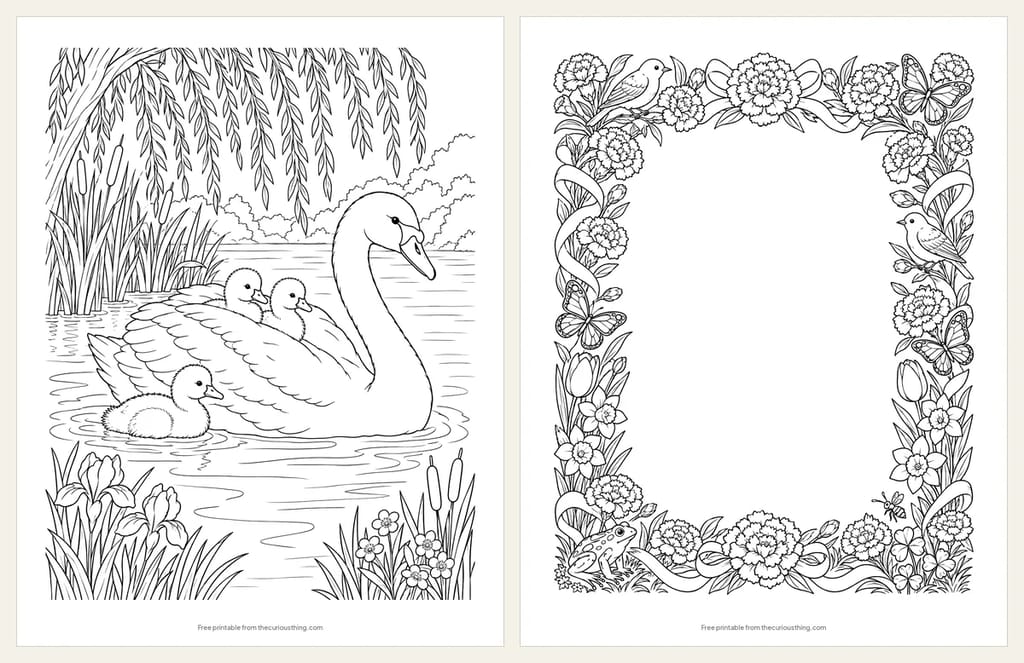
These six Mother's Day coloring pages run from a bouquet of tulips and a koala carrying her joey to breakfast in bed and gardening with Mom, then a swan with her cygnets and a card page with a border of carnations around a blank space. The carnations are there for a reason. Anna Jarvis organized the first official Mother's Day services on Sunday, May 10, 1908, in Grafton, West Virginia, and Philadelphia. She chose the white carnation because it was her mother Ann's favorite flower, and the second Sunday in May because it marked the anniversary of her mother's death.
President Woodrow Wilson signed a Mother's Day proclamation on May 9, 1914. Jarvis soon came to hate what the day became, railing against florists who raised carnation prices. She wanted people to write their mothers a heartfelt letter of thanks instead of sending a printed card, which is why the card page leaves its middle empty. In 2027, Mother's Day is Sunday, May 9.
Which animal moms carry their babies?
The two on these pages do. A koala joey is born about the size of a jelly bean, unable to see or hear, and crawls into its mother's pouch on its own. It stays there about six months, and once it's too big, it rides on her back, holding on with strong hands and feet. Mute swan cygnets, each about the size of a grapefruit at hatching, often climb aboard a parent's back, which keeps them warm and safe. A sea otter mother goes one better: she floats on her back with her pup on her chest, and when she dives to hunt, she may wrap it in kelp so it doesn't drift away.
Spring coloring pages for adults
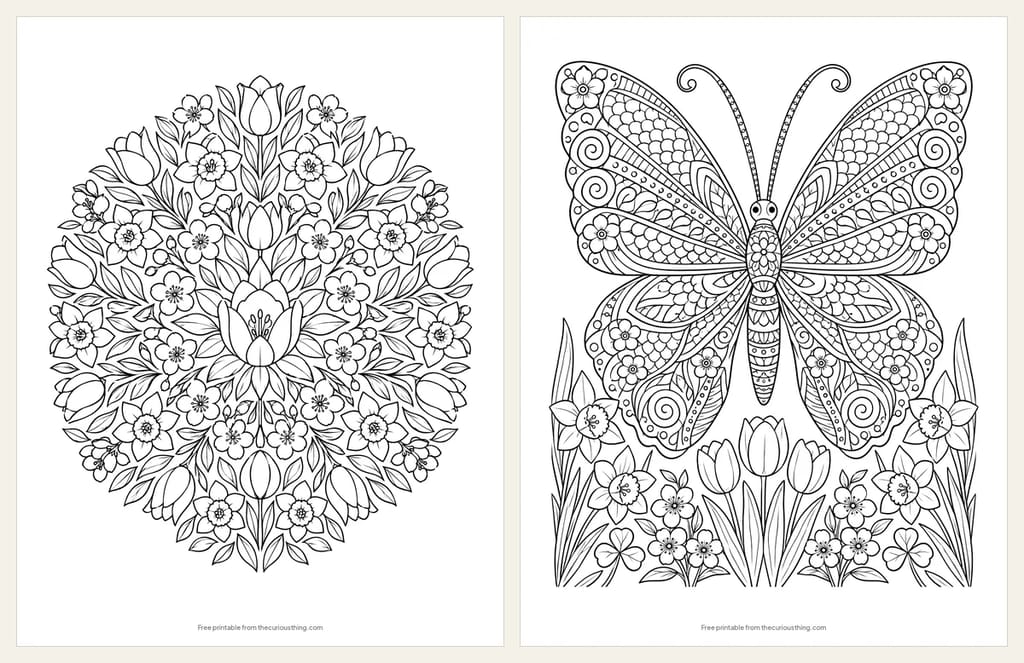
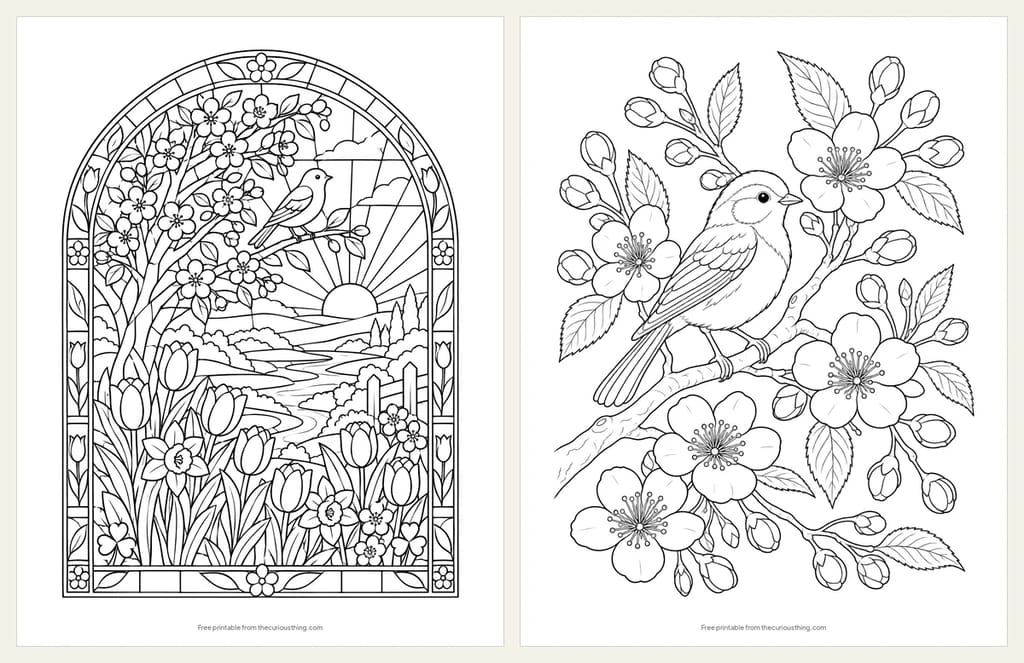
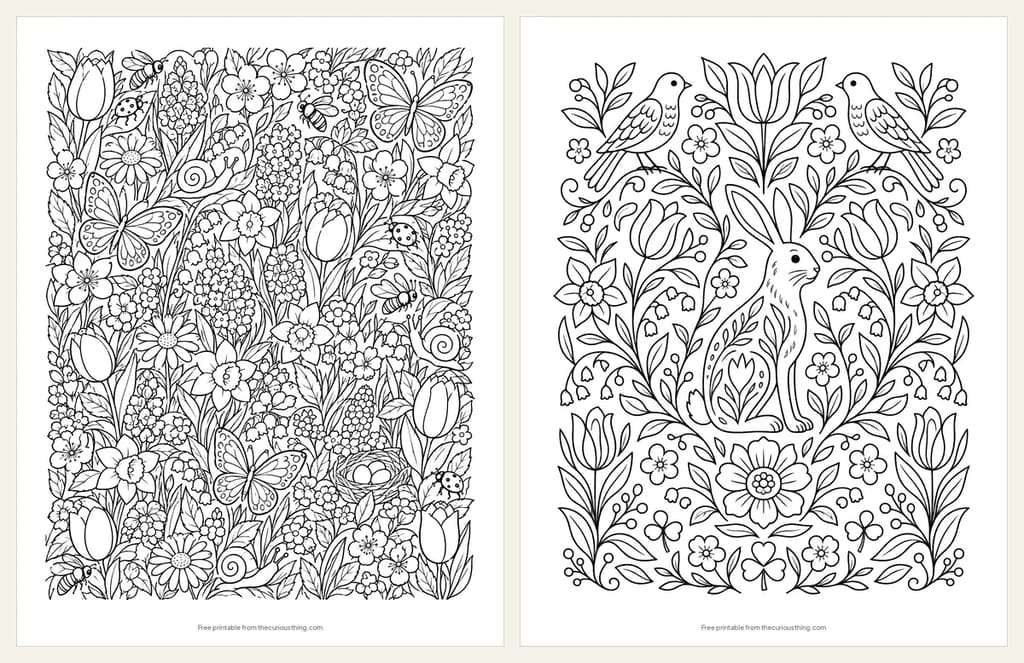
These six spring coloring pages for adults are full of small areas: a flower mandala, a butterfly full of zentangle patterns, a stained-glass garden, a botanical cherry blossom branch with a songbird, an all-over pattern of flowers and small creatures, and a folk-art hare. Coloring can calm adults, though mandalas aren't the magic part. In Curry and Kasser's 2005 study, 84 college students colored after a short task meant to make them anxious; anxiety fell about equally for those coloring a mandala or a complex plaid, and fell more than for those coloring on blank paper. Flett and colleagues had 104 female university students in New Zealand color or do logic puzzles for at least 10 minutes a day for a week; the colorers reported fewer depressive symptoms and less anxiety, and the puzzlers didn't. A 2022 review of 8 randomized trials with 578 adults found a mandala lowered anxiety no more than free drawing did. So pick the page you like best.
When does spring start, and which page goes with which day?
Astronomical spring starts at the March equinox, which in 2027 is Saturday, March 20, at 4:25 p.m. Eastern Daylight Time, according to the US Naval Observatory. Weather scientists count it differently: meteorological spring is March, April and May, so it starts on March 1 every year. Many people still think of March 21 as the first day of spring, but in mainland US time zones the equinox falls on March 19 or 20 every year this century.
| Date | What's on | Pages to print |
|---|---|---|
| Mon, March 1 | Meteorological spring begins | Tulip in a pot, big daisy, robin on a branch |
| Wed, March 17 | St. Patrick's Day | Shamrock, rainbow and pot of gold, Celtic knot shamrock |
| Sat, March 20 | The equinox, 4:25 p.m. EDT; Nowruz, the Persian New Year, on March 20 or 21 | Cherry blossom path, spring flower mandala |
| Mon, March 22 | Holi | Holi, rainbow and clouds |
| Sun, March 28 | Easter (Western churches); no Easter pages here | Fluffy bunny, chick and the shell, little lamb |
| Thu, April 22 | Earth Day | Planet Earth, Earth Day tree planting, life in the pond |
| Fri, April 30 | National Arbor Day | Planting day, bean sprouting, the vegetable garden |
| Sat, May 1 | May Day | Spring bouquet, tulip field and windmill |
| Sun, May 9 | Mother's Day | Carnation card page, breakfast in bed, swan and her cygnets |
On May Day, children in parts of the US used to leave a little basket of flowers on a friend's doorstep, knock and run. A colored spring bouquet does the job.
What do most spring coloring pages get wrong?
A few mistakes turn up again and again in spring pictures and in the stories told with them: the first robin of spring, the egg you can only balance on the equinox, the cocoon a butterfly comes out of. Some come from old stories rather than from what scientists have found. Our own easy rain pages draw raindrops as teardrops, because a teardrop is easier to color. Here's what the sources say.
| What the page or story says | What the evidence shows |
|---|---|
| Spring starts on March 21 | In the mainland US the equinox falls on March 19 or 20 every year this century |
| Day and night are exactly equal on the equinox | The day runs a few minutes long; the even day, the equilux, comes a few days earlier |
| You can only balance an egg on the equinox | You can stand a raw egg on end any day of the year with patience |
| A caterpillar spins a cocoon and becomes a butterfly | Butterflies form a chrysalis; cocoons are spun by moth caterpillars |
| A ladybug's spots show its age | Adults don't molt; the spots never change |
| Every bee dies after it stings | Only honeybee workers do; bumble bees can sting again |
| Bunnies live on carrots | Hay is a rabbit's main food; carrots are a sugary treat |
| Wild bunnies dig burrows | Cottontails nest in a shallow scrape; European rabbits dig warrens |
| The first robin means spring is here | Many robins stay all winter, up in the trees |
| Touching a toad gives you warts | Warts come from human papillomaviruses, not toads |
| Raindrops are shaped like teardrops | Falling drops are round or flat on the bottom like a hamburger bun |
| You can walk to the end of a rainbow | A rainbow moves when you move, so there's no end to reach |
| A four-leaf clover is a shamrock | A shamrock has three leaves; the four-leaf clover is a separate charm |
| Tulip mania ruined the Dutch economy | Goldgar found no drownings and no traceable bankruptcies |
| Card companies invented Mother's Day | Anna Jarvis did, and fought the card makers for years |
Frequently asked questions
Are these spring coloring pages free?
+
Yes. All 66 are free to print, with no email, account or sign-up. Tap a page's title to open the full-size file and print it at 100% or Actual size on US Letter paper. Print as many as you like for home or a classroom; please don't sell them.
What age are spring coloring pages for?
+
Every subject here comes at three levels. Easy pages, one big shape in thick lines, suit ages 2 to 4. Medium pages, the subject in a simple scene, suit ages 4 to 7. Detailed pages, realistic scenes with many small areas, suit ages 8 to adult, and the last section is drawn for teens and adults. Treat the ages as a starting point and let your child pick.
Are there spring coloring pages without Easter?
+
Yes, all of these. There are no Easter eggs, baskets or egg hunts on any of the 66 pages, and no bunny carries anything but a dandelion leaf, so they work from March 1 to Mother's Day and in classrooms that keep Easter out. The only eggs are plain ones in a bird's nest and the shell a chick just hatched from.
Can I print these for my classroom?
+
Yes. Print as many copies as your class, daycare or library needs. Each page opens directly as a picture file, with no cloud drive or sign-in, and the dates table shows which pages fit St. Patrick's Day, Holi, Earth Day, Arbor Day and Mother's Day in 2027. We only ask that you don't sell them.
Will these print on A4 paper?
+
Yes. The pages are sized for US Letter, 8.5 by 11 inches. On A4, which is a little narrower and a little longer, choose Fit or Fit to printable area in the print settings, and the page shrinks by a few percent with nothing cut off.
When is the first day of spring in 2027?
+
Astronomical spring starts at the March equinox, on Saturday, March 20, 2027, at 4:25 p.m. Eastern Daylight Time, according to the US Naval Observatory. Meteorologists start spring on March 1 every year, because they count it as the whole of March, April and May.
Do butterflies come out of cocoons?
+
No. A butterfly caterpillar turns into a chrysalis, which has no silk covering. Cocoons are the silk cases that many moth caterpillars spin. A monarch spends about 8 to 15 days in its chrysalis, and the butterfly life cycle page shows all four stages: egg, caterpillar, chrysalis and butterfly.
Can I make a spring coloring page of my child?
+
Yes. Our free photo-to-coloring-page tool turns one photo of your child, your pet or your whole family into a coloring page in a world you pick, such as Fairy Forest among giant flowers. The page is ready in about 20 seconds, it needs no email, and the photo isn't stored.