
In short
The best-known fairy names come from Shakespeare: Titania, queen of the fairies, and Oberon, their king, both from A Midsummer Night's Dream. Only a handful of names actually mean "fairy" or "elf": Faye (from the old word "fay"), Pari (Persian for fairy), Síofra (Irish for elf or sprite), Tünde (from Hungarian tündér) and Aubrey and Alfred, built on old Germanic and English words for elf. Every name below comes with its real origin and a link to where we checked it.
We read the fairy name lists that rank on Google before writing this one. Most give a name and a one-word meaning with no source, and the same errors travel from page to page. Tatiana shows up as a "fairy queen" (it comes from Tatius, a Roman family name). Elowen is said to mean "fairy" (it is Cornish for elm tree). Alden and Elwood get "elf friend" and "elf wood", when they mean "old friend" and "elder tree forest". Puck is listed as a fairy's first name, though Shakespeare's readers knew a puck as a kind of spirit.
So every meaning here was checked against Behind the Name, the original texts, or a folklore reference, and the folklore names link to the story they come from. Where we made names up ourselves, for the pixie names, fairy last names and the birthday name finder, we say so.
What is a pretty fairy name?
Here are twelve from across the list, picked for how they sound out loud and how well they hold up as a real name:
- Titania, Shakespeare's fairy queen
- Faye, which literally means fairy
- Áine (AW-nyuh), an Irish fairy queen
- Clover, the wildflower
- Aurelia, "golden" in Latin
- Juniper, the evergreen shrub
- Oberon, the fairy king
- Rowan, the tree
- Florian, from Latin flos, flower
- Peaseblossom, one of Titania's fairies (a big name for a small cat)
- Wren, the songbird
- Síofra, Irish for elf or sprite
Names that really mean fairy or elf
Fewer names carry fairy in their roots than most lists suggest. These fifteen do. Old English ælf, Old German alb and Old Norse alfr all meant elf,
- Faye. From the English word fay, a fairy, which came through Old French from Latin fata, the Fates. Behind the Name
- Fae. A variant spelling of Fay, with the same fairy root. Behind the Name
- Pari. Persian for "fairy, sprite, nymph." Behind the Name
- Peri. The Turkish form of Pari, and the English word for the winged spirits of Persian tales. Behind the Name
- Tünde. Made from Hungarian tündér, fairy, by the poet Mihály Vörösmarty in the 19th century. Behind the Name
- Síofra. Irish for "elf, sprite", first used as a given name in the 20th century. Behind the Name
- Aubrey. From Alberich, Old German alb (elf) plus rih (ruler): elf king. Behind the Name
- Alfred. Old English Ælfræd, elf counsel. Alfred the Great carried it in the 9th century. Behind the Name
- Alfie. The pet form of Alfred, so elf counsel again. Behind the Name
- Avery. An English surname that grew from the Norman French forms of Alberich or Alfred. Behind the Name
- Alvar. Old Norse Alfarr: alfr (elf) plus herr (warrior). Behind the Name
- Alfhild. Old Norse Alfhildr: elf plus battle. In Scandinavian legend she disguised herself as a warrior to avoid marrying a king. Behind the Name
- Elric. Possibly from Ælfric, elf ruler, though it can also come from Æðelric, noble ruler. Behind the Name
- Alvin. One of its three possible roots is Ælfwine, elf friend. The other two mean noble friend and old friend. Behind the Name
- Alvina. The feminine form of Alvin, with the same possible elf root. Behind the Name
Oberon belongs on this list too, since it also comes from Alberich, but he has his own entry with Shakespeare's fairies below.
Fairy names from folklore and old stories
Folk belief seldom gave fairies personal names. The Welsh called them the Tylwyth Teg, the fair family. Most of the famous fairy names come from poets and storytellers who wrote those beliefs down. Pronunciations are given only where a source we checked gives one.
What are the fairies called in A Midsummer Night's Dream?
Shakespeare's play, written around 1595, gave English its best-known fairy court. The full text is free on Project Gutenberg.
- Titania (tie-TAY-nee-uh). Queen of the fairies, who quarrels with Oberon over a changeling boy. Shakespeare probably took the name from Ovid, who used "Titania" as a Latin epithet for Diana and other goddesses descended from the Titans.
- Oberon. King of the fairies. He is older than Shakespeare: he appears centuries earlier in the 13th-century French romance Huon of Bordeaux, and his name goes back to Alberich, elf king.
- Robin Goodfellow, known as Puck. Oberon's mischief-maker, who leads travelers astray and spoils the milk. Britannica notes that a puck was a type of spirit, and the Folger edition calls him Robin throughout.
- Peaseblossom. One of the four fairies Titania sends to wait on Bottom. Pease meant pea, so the name means pea flower.
- Cobweb. Another of Titania's attendants. Bottom jokes that he'll use Cobweb to stop a cut finger bleeding.
- Moth (pronounced "mote"). One more of Titania's attendants. In Shakespeare's English moth and mote, a speck of dust, sounded the same, so the name probably means a tiny speck.
- Mustardseed. The last of the four, whom Bottom addresses as "Monsieur Mustardseed."
- Queen Mab. The tiny dream-bringer in Mercutio's speech in Romeo and Juliet, riding a hazelnut chariot over sleepers' noses. Shakespeare calls her "the fairies' midwife". Later poets made her their queen.
- Ariel. The spirit who serves Prospero in The Tempest. The cast list calls him "an airy Spirit" rather than a fairy, but he is close kin.
Irish, Scottish, Welsh and Cornish fairy names
The Celtic stories are where named fairy queens and kings actually live, often tied to a real hill.
- Áine (AW-nyuh). Fairy queen of Knockainy hill in County Limerick, honored with torch processions on St John's Eve.
- Aoibheall (EE-vul). Fairy queen of north Munster, and the judge in Brian Merriman's 1780 poem The Midnight Court.
- Clíodhna (said "Cleena"). Fairy queen of south Munster, whose rock, Carraig Chlíodhna, is near Mallow in County Cork. The folklorist Patricia Lysaght calls her queen of the Munster fairies.
- Fand. An otherworld woman of the síde, the fairy folk, who briefly loves the hero Cú Chulainn in The Sickbed of Cú Chulainn.
- Lí Ban. Fand's sister in the same tale, who comes to Cú Chulainn as a seabird. Her name glosses as "paragon of women."
- Niamh. Niamh of the Golden Head, who carries the poet Oisín away to the Country of the Young in Lady Gregory's retelling. Her name means "bright".
- Midir. Lord of the fairy mound of Brí Léith, who wins back his wife Étaín with a game of chess in The Wooing of Étaín.
- Finvarra. King of the fairies of the West of Ireland, holding court under Knockma hill near Tuam, in Lady Wilde's legends.
- Úna, spelled Onagh by Lady Wilde. Finvarra's queen, whose silver robe sparkles with dewdrops.
- Gwyn ap Nudd. The Welsh fairy king and lord of the otherworld, Annwn, whom Wirt Sikes called "the fairy-king". The name means Gwyn, son of Nudd; gwyn alone means white, fair or bright.
- Habetrot. A spinning fairy of the Scottish Borders who spins a lazy girl's yarn for her, recorded in Henderson's folklore of the northern counties.
- Skillywidden. A Cornish fairy child found asleep on a gorse-covered hillside and later carried home by his fairy parents, in Robert Hunt's collection.
Fairy queens and enchantresses of old romance
Medieval and Renaissance writers filled their stories with fairy royalty, and several of these names are still given to babies.
- Morgan le Fay. The fairy enchantress of Arthurian legend who carries the dying Arthur to Avalon. "Le Fay" is the fairy part. Morgana is her feminine form.
- Nimue (neem-OO-ay). Malory's chief Lady of the Lake, who traps Merlin. Lady of the Lake was a title several characters held.
- Viviane (VIV-ee-uhn). The Lady of the Lake of the French romances, who raised the infant Lancelot.
- Melusine (may-loo-ZEEN). A water fairy who turns half-serpent every Saturday, called the guardian fairy of the house of Lusignan.
- Pressine. Melusine's fairy mother, in the same 1393 romance.
- Melior. Melusine's fairy sister, sealed in a castle as a punishment.
- Gloriana. The Faerie Queene herself in Edmund Spenser's 1590 poem, who sends each knight on his quest.
- Tryamour. A fairy princess, daughter of the king of Fairyland, who rescues the knight Launfal in the Middle English Sir Launfal.
- Nymphidia. A lady of Queen Mab's court in Michael Drayton's 1627 poem Nymphidia.
- Pigwiggen. The fairy knight who courts Queen Mab in the same poem and fights a comic duel with Oberon.
- Tomalin. Oberon's kinsman and second in that duel.
- Peri-Banou. The fairy princess who marries Prince Ahmed in a tale added to the Arabian Nights.
Fairy names for girls
These are real given names that suit a fairy without coming from a fairy story. Each meaning is checked against Behind the Name.
Flower and woodland fairy names
- Fern. The plant, from Old English fearn.
- Ivy. The climbing plant.
- Hazel. The tree, and the light brown of its nuts.
- Clover. The wildflower.
- Marigold. The flower; the name joins Mary and gold.
- Posy. A small bunch of flowers, and a pet form of Josephine.
- Dahlia. The flower, named for the Swedish botanist Anders Dahl.
- Aster. The flower, from Greek aster, star.
- Juniper. The evergreen shrub.
- Linnea. The twinflower, named for the botanist Carl Linnaeus.
- Briar. The thorny wild rose bush.
- Calla. The calla lily.
- Wren. The small songbird.
- Lark. Another songbird.
- Meadow. The open field of grass and flowers.
Magical and whimsical fairy names
- Aurelia. From Latin aureus, golden.
- Liora. Hebrew, "my light".
- Seraphina. From the seraphim, the fiery six-winged angels of Isaiah.
- Sylvie. From Latin silva, wood or forest.
- Luna. Latin for the moon.
- Celeste. From Latin caelestis, heavenly.
- Eira. Welsh for snow.
- Nerys. Welsh, probably from nêr, lord, so roughly "lady".
- Aislinn. From Irish aisling, dream or vision.
- Oriana. Possibly from Latin aurum, gold; a princess in medieval romance.
- Morgana. The feminine of Morgan, and the name of Morgan le Fay.
- Ember. A glowing coal.
- Isolde. The heroine of the Tristan legend. Its origin is uncertain, whatever the lists say.
- Esme. Old French for "esteemed" or "loved". It does not mean emerald.
Fairy names for boys
Most lists pad their boys' section with James and Max. These have a woodland or storybook feel, and every meaning is checked. For the boy fairy kings, see Oberon, Midir, Finvarra and Gwyn ap Nudd above.
- Rowan. The rowan tree, or an Irish name meaning little red one.
- Alder. The tree. Despite the sound, not from elf.
- Linden. The linden tree.
- Florian. From Latin flos, flower.
- Silas. Probably short for Silvanus, from Latin silva, forest.
- Ash. The ash tree.
- Forrest. An old surname for someone who lived by a forest.
- Oren. Hebrew for pine tree.
- Sorrel. The sour-leaved meadow plant.
- Thorne. A surname for someone who lived by a thorn bush.
- Elio. Italian, traditionally linked to Greek helios, the sun.
- Jasper. The gemstone, and the name of one of the Magi.
- Orion. The hunter of Greek myth and his constellation. The meaning is uncertain.
- Emrys. The Welsh form of Ambrose, "immortal", and a name tied to Merlin.
- Evander. Greek for "good man"; a hero of Roman myth.
- Peregrine. Latin for traveler.
- Leif. Old Norse for heir, as in Leif Eriksson.
- Soren. Danish, from Latin Severinus.
- Kai. The boy in Hans Christian Andersen's The Snow Queen, and Hawaiian for sea.
- Cyprian. Latin, "from Cyprus".
Pixie and sprite names
Pixies are the small, mischievous fairies of Devon and Cornwall folklore, said to lead travelers astray. These are our own picks, small words for small folk, good for a pixie character, a doll or a garden gnome.
- Pip
- Thistle
- Nettle
- Sprig
- Tansy
- Bramble
- Acorn
- Button
- Fennel
- Moss
- Wisp
- Pepper
Dark fairy names
The old fairies were not all kind. In the Scottish ballad Tam Lin, the fairy queen holds a mortal knight captive until his true love wins him back on Halloween night. These names suit a darker fairy, a villain in a story, or a costume.
- Nicnevin (nik-NEE-vin). A Scottish witch-queen who, according to Walter Scott, was sometimes taken for the queen of the fairies, recorded in the Dictionary of the Scots Language.
- Nightshade
- Hemlock
- Belladonna
- Raven
- Rook
- Sable
- Umbra, Latin for shadow
- Vesper, Latin for evening
- Bracken
- Hollow
Fairy last names
No folklore gives fairies surnames, so these fifteen are ours: two-part nature names for a character, a story or a pretend family.
- Thistledown
- Dewdrop
- Moonwhistle
- Fernwhisper
- Brambleberry
- Mossbottom
- Starbright
- Hollyhock
- Willowmere
- Nettlebrook
- Puddlefoot
- Acornhollow
- Silverleaf
- Honeysuckle
- Glimmerwing
What's my fairy name?
Take your first name from your birthday month and your last name from the first letter of your first name. A February birthday and a name starting with M makes you Clover Starbright.
| Month | Fairy name | Month | Fairy name |
|---|---|---|---|
| January | Eira | July | Marigold |
| February | Clover | August | Aurelia |
| March | Wren | September | Hazel |
| April | Peaseblossom | October | Bramble |
| May | Meadow | November | Rowan |
| June | Titania | December | Juniper |
| Initial | Fairy last name | Initial | Fairy last name |
|---|---|---|---|
| A, B | Thistledown | O, P | Willowmere |
| C, D | Dewdrop | Q, R | Nettlebrook |
| E, F | Moonwhistle | S, T | Silverleaf |
| G, H | Fernwhisper | U, V | Honeysuckle |
| I, J | Brambleberry | W, X | Glimmerwing |
| K, L | Mossbottom | Y, Z | Acornhollow |
| M, N | Starbright |
It works well at a fairy birthday party: write each guest's fairy name on a place card or a paper wing, and read them out as the children arrive.
See her as the fairy she named
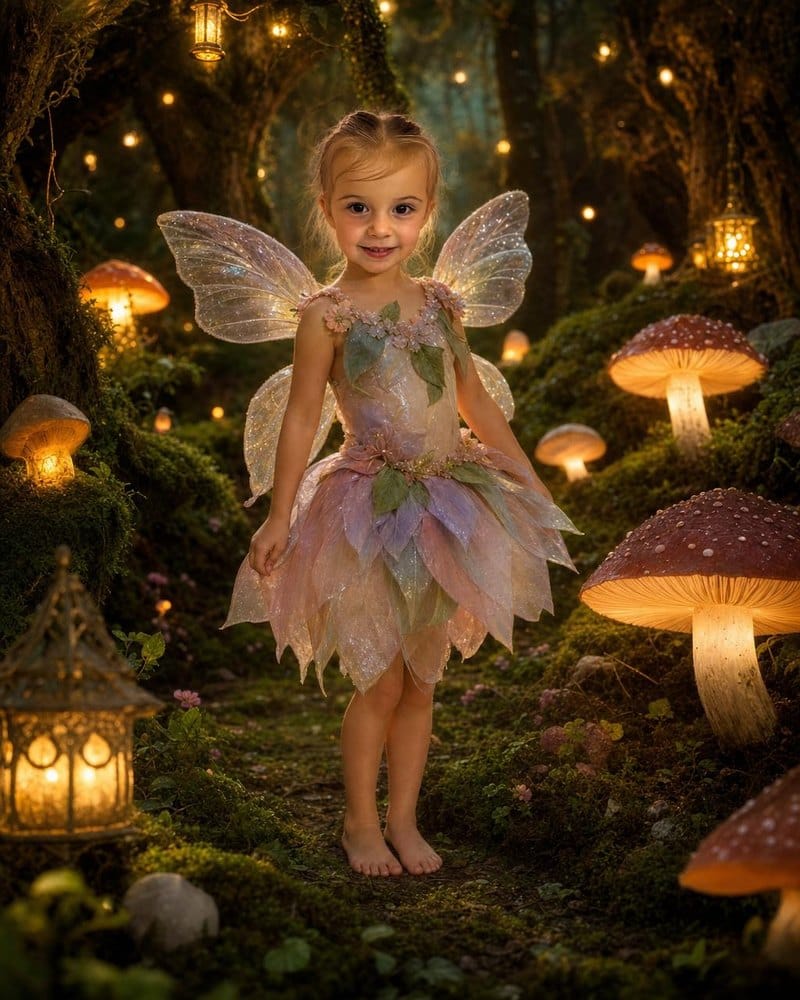
Once she has her fairy name, you can show her the fairy. Our Fairy Forest world turns one photo of your child into a woodland fairy with shimmering wings, standing among glowing toadstools and fireflies, and keeps her real face, hair and skin tone. It prints as a jigsaw puzzle from $55, a canvas or a fleece blanket, and the chunky 30-piece puzzle is sized for ages 3 to 5. You see a watermarked proof before anything prints. Her name, fairy or otherwise, never goes to the image model, so the only place it appears is where you choose to write it.
Fairy names for pets
Fairy names suit small, quick animals: a kitten that appears from nowhere, a dog that steals socks. Puck, Mab and Moth from Shakespeare work well too.
- Pixie
- Sprite
- Fizz
- Glimmer
- Twinkle
- Toadstool
- Flutter
- Bumble
- Snapdragon
- Buttercup
Fairy names that don't mean what the lists say
These are the corrections we made most often while checking other lists. Each one is linked to the entry that settles it.
| Name | What lists say | What it actually is |
|---|---|---|
| Tatiana | ✗ Russian fairy queen | From Tatius, a Roman family name. The fairy queen is Titania. |
| Elowen | ✗ Means fairy or elf | Cornish for elm tree, a recent coinage |
| Alden | ✗ Elf friend | Old English Ealdwine, old friend |
| Elwood | ✗ Elf wood | A place name meaning elder tree forest |
| Lorelei | ✗ A fairy of folklore | A rock on the Rhine; the singing maiden was invented by the poet Clemens Brentano in 1801 |
| Ondine | ✗ A fairy | A water spirit, a word coined by Paracelsus from Latin unda, wave |
| Delphine | ✗ Dolphin | "Of Delphi", the Greek city |
| Puck | ✗ A fairy's first name | A type of spirit; his name in the play is Robin Goodfellow |
| Queen Mab | ✗ Shakespeare's fairy queen | "The fairies' midwife"; later poets crowned her |
| Tam Lin | ✗ A fairy knight | A mortal knight held captive by the fairies |
| Peri | ✗ The root of the word "fairy" | From Avestan pairikā; fairy comes from Latin fata |
How do you make up a fairy name?
Pick a small thing from a garden or a wood (a seed, a flower, a bird, a kind of weather) and pair it with a sound word, the way Shakespeare did with Peaseblossom and Mustardseed. For a last name, join two nature words: dew and drop, moon and whistle, thistle and down. Say it out loud with the first name before you settle on it. For a real baby name, start with the fifteen names that actually mean fairy or elf, since each has centuries of use behind it.
For more to share with a fairy-mad child, our jokes for kids, sorted by age go down well at the same parties, and there's a unicorn world for the child who loves both.
Give her the wings to match the name
Upload one photo and we'll paint her as the fairy of Fairy Forest. You approve a free, watermarked proof before anything prints.
Frequently asked questions
What is a pretty fairy name?
+
Titania, the fairy queen of A Midsummer Night's Dream, is the classic. Faye, which comes from the old word fay, meaning fairy, works as an everyday name. Áine, an Irish fairy queen, Clover, Aurelia and Juniper are other favorites.
What name means fairy?
+
Faye and Fae come from fay, the old English word for a fairy. Pari is Persian for fairy, Síofra is Irish for elf or sprite, and Tünde was made from Hungarian tündér, fairy. Aubrey and Oberon mean elf king, from Old German Alberich, and Alfred means elf counsel.
What are some boy fairy names?
+
Oberon, the fairy king, is the best known, and Robin recalls Robin Goodfellow. Aubrey and Alfred have real elf roots. For a woodland feel, try Rowan, Linden, Florian, Silas or Forrest, and from Irish and Welsh stories, the fairy kings Finvarra, Midir and Gwyn ap Nudd.
What was the fairy queen's name?
+
In Shakespeare's A Midsummer Night's Dream she is Titania. Spenser's Faerie Queene is Gloriana, and Michael Drayton made Queen Mab the fairy queen in 1627. In Irish folklore the fairy queens include Áine, Aoibheall and Clíodhna. The Scottish ballads never name her: she is simply the Queen of Elfland.
What are some pixie names?
+
Short, small-sounding words work best: Pip, Thistle, Nettle, Sprig, Tansy, Bramble, Acorn, Button, Moss and Wisp. Pixies come from the folklore of Devon and Cornwall, where they were said to lead travelers astray.
How do I find my fairy name?
+
Use your birthday month for a first name and the first letter of your first name for a last name. January is Eira, February Clover, March Wren and so on; the initials run from Thistledown for A and B to Acornhollow for Y and Z. A February birthday and the initial M makes you Clover Starbright.