In short
Here are 60 free dinosaur coloring pages to print on US Letter paper, with no email or sign-up: T. rex, Triceratops, Stegosaurus, the long-necks, a feathered Velociraptor, Spinosaurus, Ankylosaurus and Parasaurolophus, babies and eggs, Pteranodon and Mosasaurus (which weren't dinosaurs), and a fossil dig. Each subject comes at three levels. Easy pages are one big animal in thick lines for ages 2 to 4, medium pages put it in a simple scene for ages 4 to 7, and detailed pages are realistic or patterned for ages 8 to adult. Tap a page's title to open the full-size file, then print it at 100% or Actual size.
Before drawing a single page, we read seven dinosaur coloring pages that rank on Google, from Crayola and ABCmouse to the National Park Service. Between them they offer more than 200 pages. Only ABCmouse sorts any of them by age, with a one-line reason about detail; none cites anything. All six commercial sets draw Velociraptor scaly and featherless, five of the seven file pterosaurs or sea reptiles under "dinosaurs", and three lean on licensed cartoon characters.
So every page here is new, drawn for this post with the image model behind our free photo-to-coloring-page tool, and drawn the way museums now reconstruct the animals: tails held off the ground, a Velociraptor the size of a turkey and covered in feathers, four-legged dinosaurs on four legs. We checked every page by hand and redrew the ones that came out wrong. Each section says how to say the name, when and where the animal lived, and one true story to tell while the crayons are out, linked to where it comes from. Print as many as you like for home or a classroom. Please don't sell them.
Which dinosaur coloring page suits which age?
Easy pages suit most children from two to four, medium pages four to seven, and detailed pages eight and up, adults included. The split tracks how coloring grows: toddlers scribble across the lines, preschoolers start to aim for the shapes, and older children fill small areas on purpose.
With a two-year-old, color one shape together rather than the whole page; the children's occupational therapists at Aneurin Bevan health board in Wales suggest coloring pictures together and keeping areas "small and achievable". A child who can name every dinosaur on the page but can't yet stay in the lines belongs on the easy and medium pages anyway; the realistic ones are for when the hand catches up with the head.
What can children do with a crayon at each age?
The CDC's milestone checklists list scribbling at 18 months, drawing a circle after being shown how at 3 years, and holding a crayon between fingers and thumb rather than in a fist at 4 years, each a skill at least three in four children have by that age. Huang and colleagues' 2024 study of 239 children aged 3 to 6, the one study we found that scored coloring itself, found most 3- and 4-year-olds coloring at a transitional level, with mature coloring typically coming after 5. Grip matures over the same years: in Schneck and Henderson's study of 320 children, 48% of children aged 3 to 3½ held a pencil in a mature grip, against 90% of children aged 6½ to 7.
| Level | Usually suits | What's on the page | What children that age usually do |
|---|---|---|---|
| Easy | 2 to 4 | One big animal, very thick lines, a fern or a rock at most | Scribble, often over the lines; many still hold the crayon in a fist before 4 |
| Medium | 4 to 7 | The animal in a simple scene (a river, a nest, a volcano), bold lines | Aim for the shapes, with neater coloring from about 5 |
| Detailed | 8 to adult | A realistic scene with scales and feathers, or a body full of patterns | Fill small areas carefully, with a mature grip |
The ages are starting points, not rules, and the line weights are our own choice: no study gives a line thickness for an age.
When did each dinosaur live?
Over more than 85 million years, from the oldest animal on these pages to the youngest, and most of them never met. The US Geological Survey puts it neatly: Stegosaurus had been extinct for about 80 million years before T. rex appeared, so more time separates those two than separates T. rex from you. The table runs from oldest to youngest, with each name the way the Natural History Museum in London or Merriam-Webster says it.
| Animal | Say it | Lived (million years ago) | Fossils found in | About how big |
|---|---|---|---|---|
| Stegosaurus | STEG-oh-SORE-us | 152 to 145 | Western US | Up to 30 ft long |
| Brachiosaurus | BRAK-ee-oh-SORE-us | 152 to 145 | Western US | 72 ft long, four stories tall |
| Diplodocus | dih-PLOD-uh-kus | 152 to 145 | Western US | 85 ft long |
| Spinosaurus | SPINE-oh-SORE-us | 99 to 94 | North Africa | 46 ft long |
| Pteranodon (not a dinosaur) | ter-AN-oh-don | about 85 | Kansas, then a sea | 20 ft wingspan |
| Maiasaura | my-ah-SORE-ah | 80 to 75 | Montana | Up to 30 ft long |
| Parasaurolophus | pa-ra-saw-ROL-off-us | 77 to 73 | US and Canada | 30 ft long |
| Velociraptor | vel-OSS-ee-rap-tor | 74 to 70 | Mongolia | 6 ft long, turkey weight |
| T. rex | tie-RAN-oh-SORE-us rex | 68 to 66 | Western US and Canada | 40 ft long |
| Triceratops | try-SER-uh-tops | 68 to 66 | Western US | 30 ft long |
| Ankylosaurus | an-KYE-low-SORE-us | 68 to 66 | US and Canada | 26 ft long |
| Mosasaurus (not a dinosaur) | Mosasaur: MOH-zuh-sore | about 66 | The Netherlands | 36 ft long or more |
Dates and sizes from the Natural History Museum's Dino Directory, except Brachiosaurus's height (Field Museum), Pteranodon (American Museum of Natural History) and Mosasaurus (the Natural History Museum's mosasaur page). Brontosaurus lived alongside Brachiosaurus and Diplodocus.
Which dinosaurs could have met?
T. rex, Triceratops and Ankylosaurus could have: all three lived 68 to 66 million years ago in what is now the western US and Canada, so a T. rex page and a Triceratops page belong side by side on the fridge. The Natural History Museum even describes a Triceratops horn bitten off by a T. rex that healed afterward. A T. rex chasing a Velociraptor, a favorite on other sites, never happened: Velociraptor lived in Mongolia and was gone before T. rex appeared.
How do you print these coloring pages?
Tap a page's title under any preview to open the full-size file, 2,550 by 3,300 pixels, which is 8.5 by 11 inches at 300 dpi, and print it at 100% or Actual size on US Letter paper. Adobe's print help explains the choice: Fit "reduces or enlarges each page to fit the printable area", while Actual size prints at full scale. On A4 paper (a little narrower than Letter) choose Fit, which shrinks the page by a few percent.
Plain 20 lb copy paper (75 g/m²) takes crayons and colored pencils. For markers or paint, use 65 lb cover cardstock if your printer's paper rating allows it, and slide a scrap sheet underneath: Strathmore notes that most papers eventually let markers bleed through, lighter ones sooner. Our Christmas coloring pages have more on crayons, grips and what a fat crayon does and doesn't help with.
T. rex coloring pages
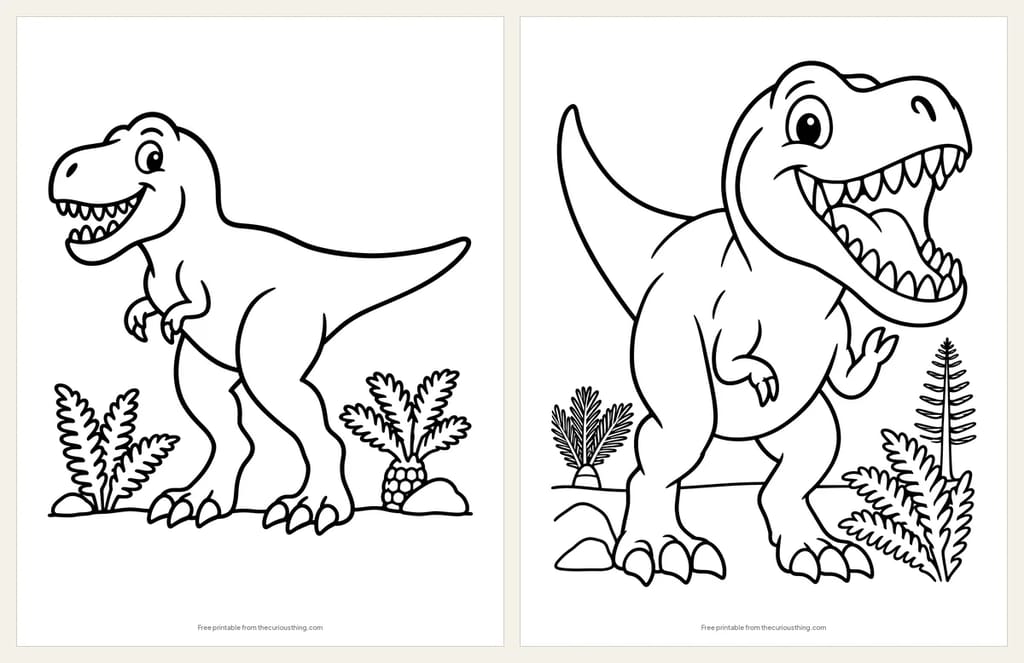
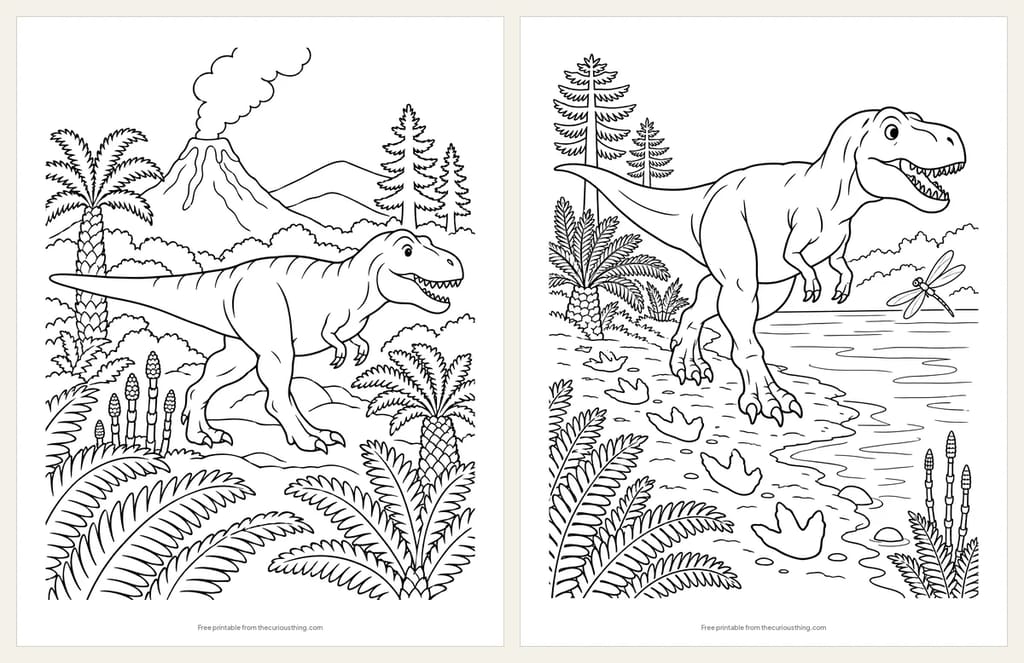
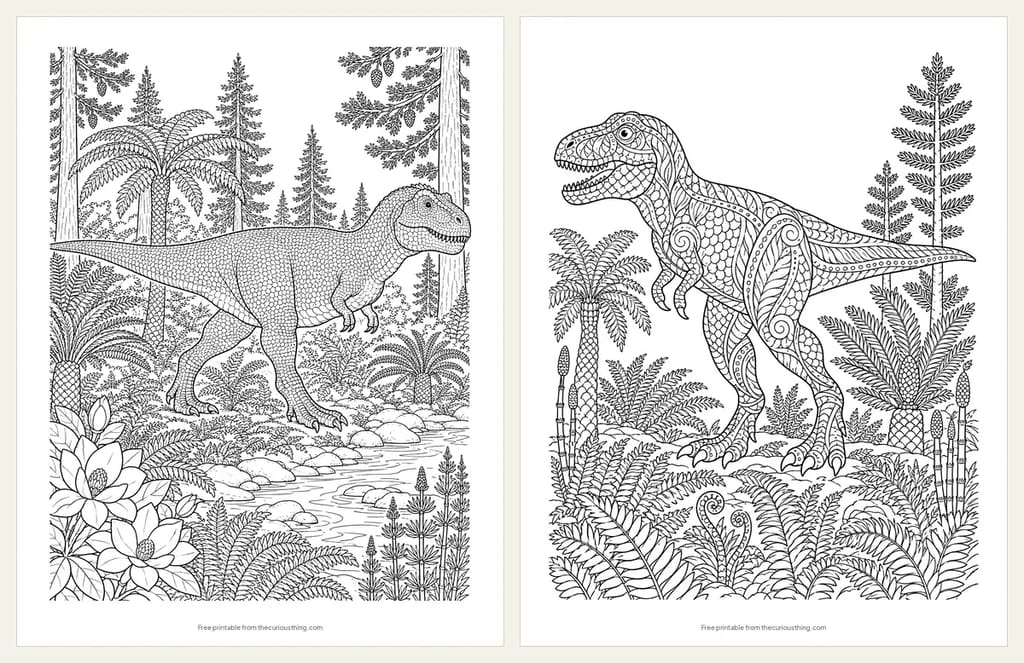
These six T. rex coloring pages run from a smiling cartoon with a silly roar for toddlers to a realistic T. rex striding through a forest, and every one holds its tail off the ground. Tyrannosaurus rex means "tyrant lizard king", Greek for tyrant lizard and Latin for king, according to the Smithsonian. It lived 68 to 66 million years ago and grew about 40 feet long, about the length of a school bus, with 60 teeth, some 8 inches long. The most famous one, SUE at Chicago's Field Museum, is named for Sue Hendrickson, who found it in South Dakota in 1990. Its growth rings show it reached full size at 19 and lived to about 28, and in its teenage growth spurt it gained as much as 4.5 pounds a day. Older pictures stand T. rex up like a kangaroo with its tail on the ground. In 1970 B. H. Newman of what is now London's Natural History Museum argued that its back was held horizontal, with the tail swung up off the ground as a counterweight, which is how every T. rex on these pages stands.
Triceratops coloring pages
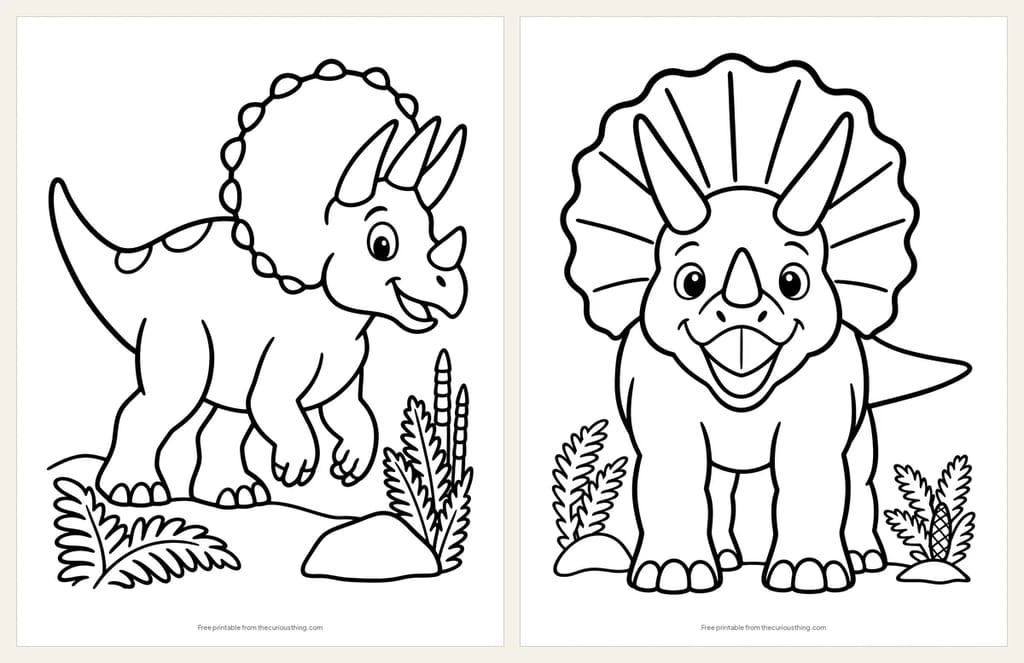
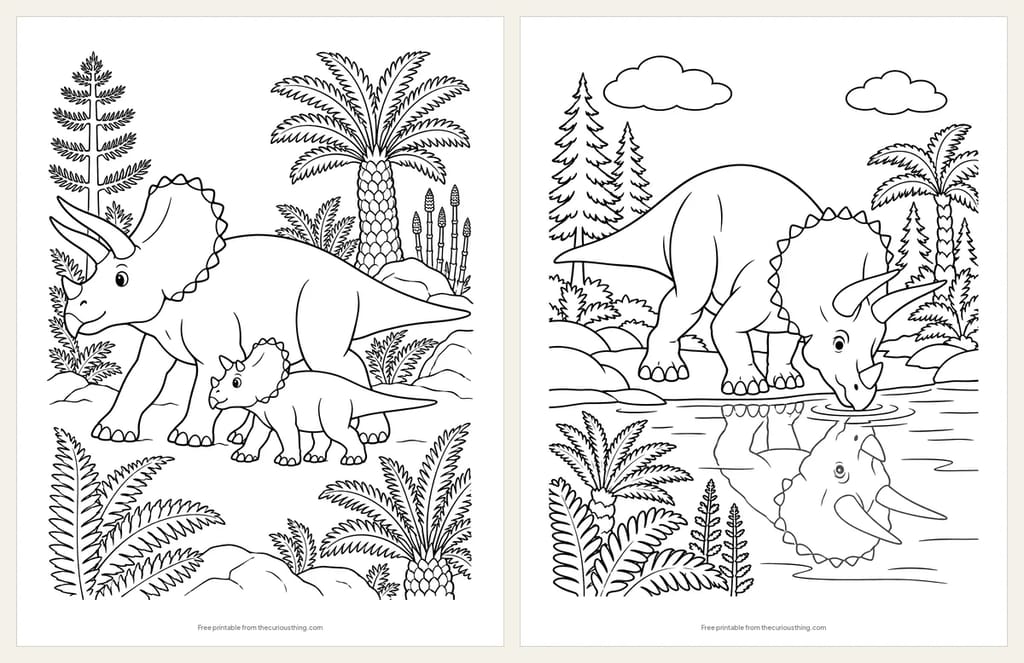
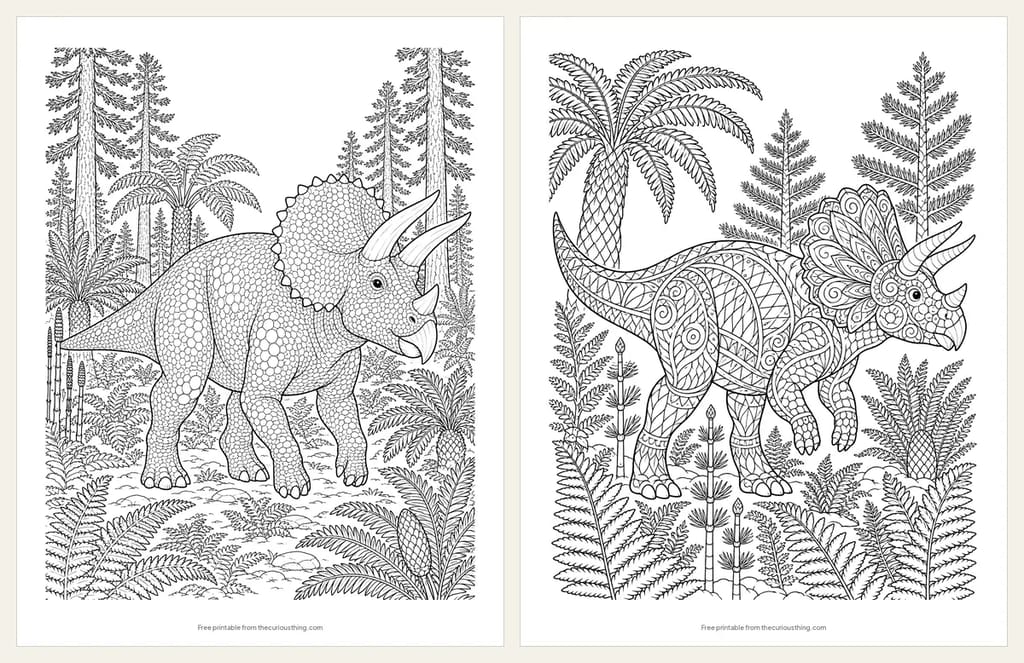
The Triceratops pages go from a big front-on face for little ones to a forest scene and a frill full of mandala patterns, each with exactly three horns. Triceratops (try-SER-uh-tops) means "three-horned face", for the two long horns over its eyes and the short one on its nose. Its first fossil was a pair of horns found near Denver in 1887 by a teacher and geologist, George Cannon, who sent them to the paleontologist O. C. Marsh. Marsh decided they came from a giant bison and named it Bison alticornis before realizing it was a dinosaur. Its horns changed as it grew up: a study of ten skulls from Montana found short straight stubs on babies, horns curving backward on youngsters, and horns curving forward on adults. The baby in that study had brow horns about an inch long, which is why the baby on the "Triceratops and her baby" page has stubs.
Stegosaurus coloring pages
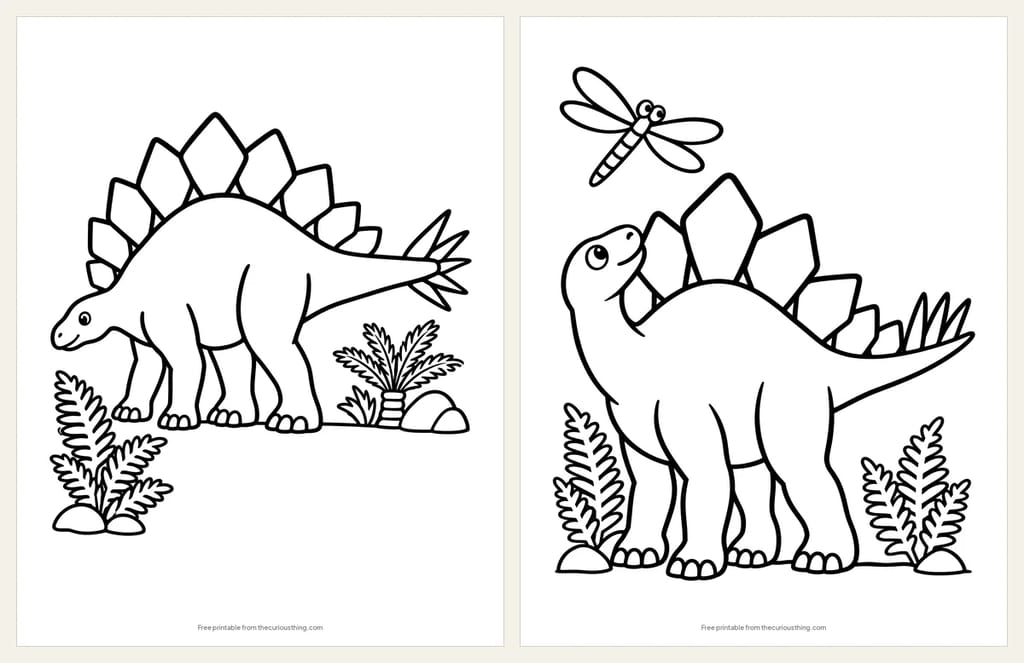
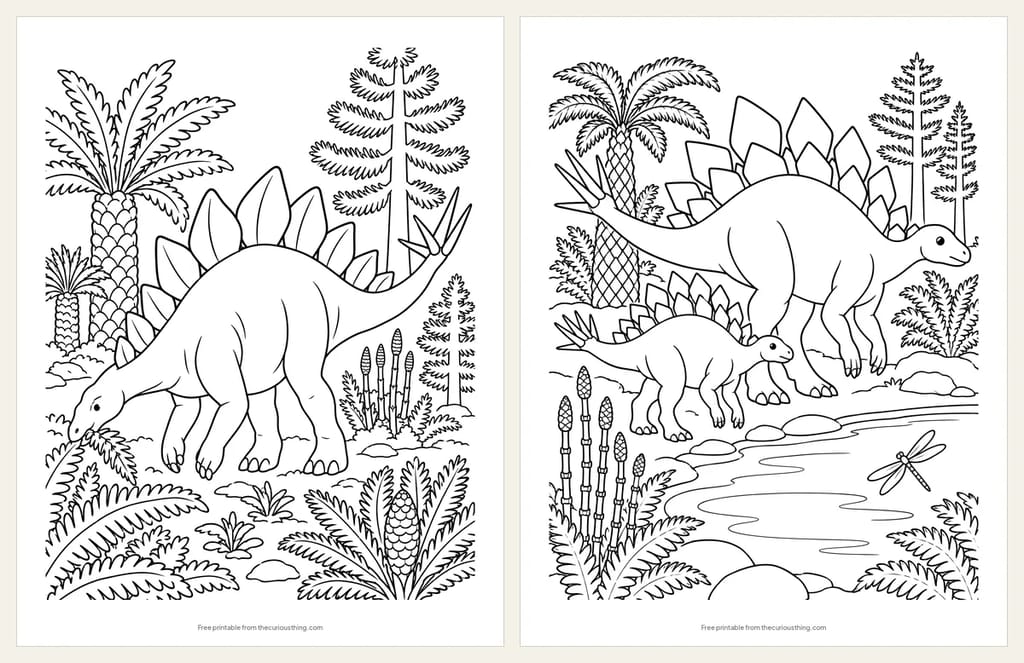
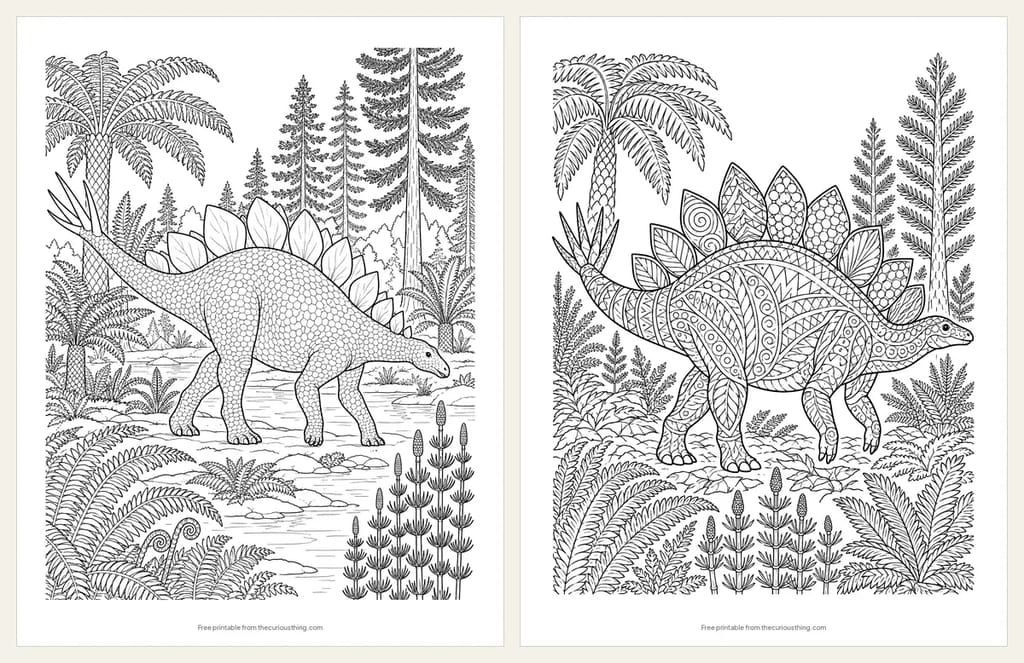
Six Stegosaurus pages, from a cartoon watching a dragonfly to a realistic Jurassic scene, all with the plates in staggered rows and four spikes on the tail. Stegosaurus means "roof lizard": Marsh, who named it in 1877, first thought its plates lay flat across its back like a shell, an idea that gave it the name. A fossil buried with its plates still in place showed they stood upright, in two staggered rows. Sophie, the most complete Stegosaurus ever found, now in London, has 19 plates and four tail spikes, so count before you color. The spiky tail is nicknamed the "thagomizer" after a 1982 Far Side cartoon, and it was a real weapon: an Allosaurus tail bone from Utah has a hole that a Stegosaurus spike fits, with healed bone around it, so the Allosaurus survived the hit. And no, it didn't have a second brain in its hips; it had one brain, about the size of a plum.
Long-necked dinosaur coloring pages
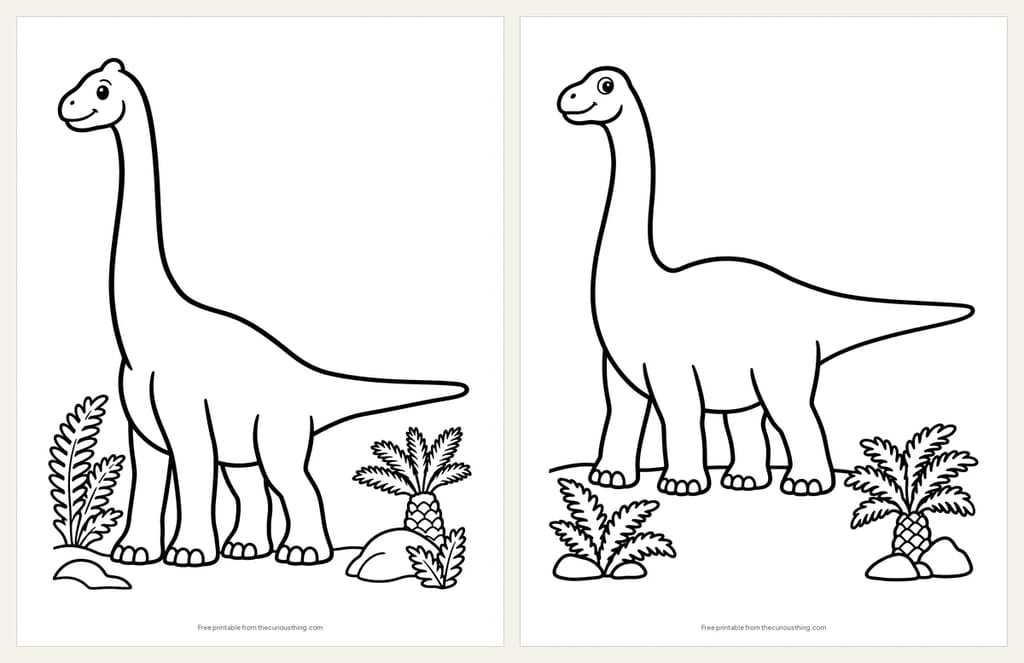
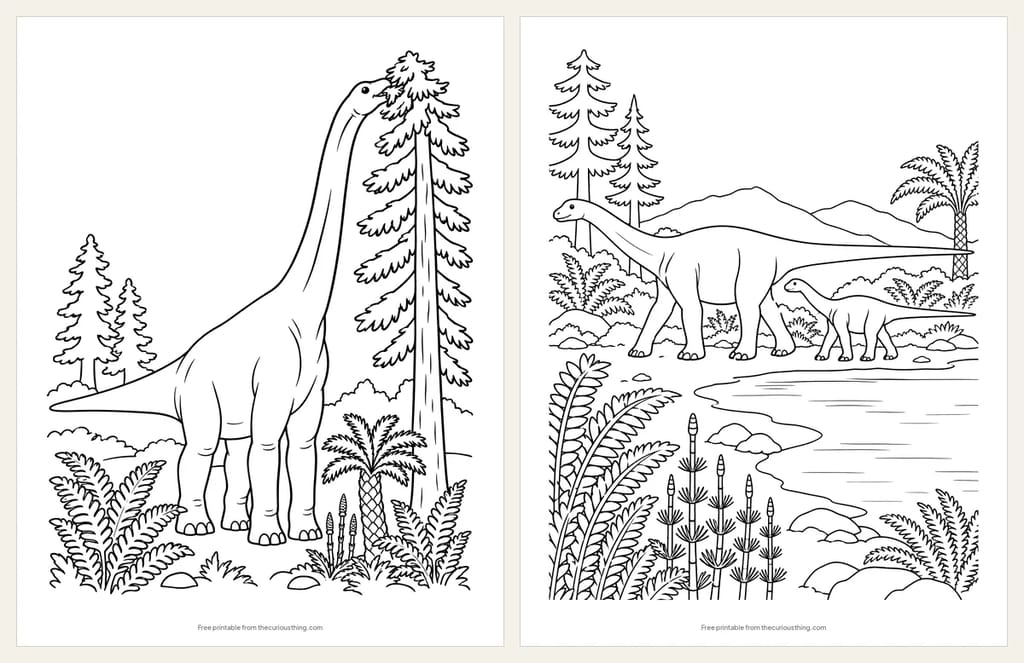
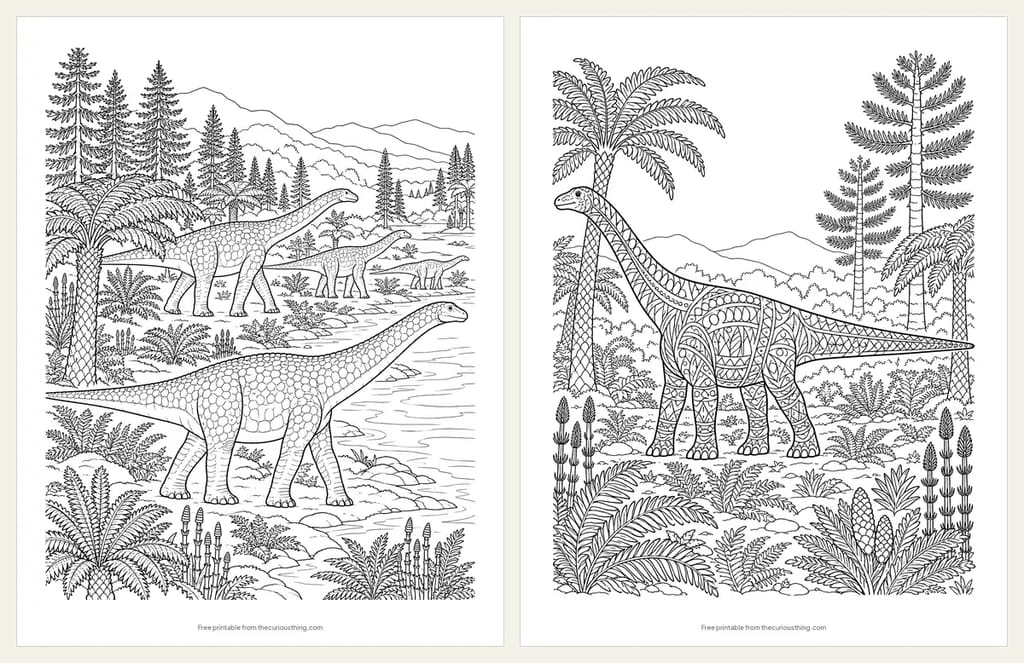
These pages cover the three best-known long-necks, Brachiosaurus, Brontosaurus and Diplodocus, from a toddler-sized cartoon to a whole herd walking beside a river. Brachiosaurus means "arm lizard", because its front legs were longer than its back legs, and Diplodocus means "double beam", for the paired bones under its tail (Natural History Museum). The first Brachiosaurus bone, dug up in Colorado on July 4, 1900, looked like a Brontosaurus thigh bone until Elmer Riggs of the Field Museum saw it was an upper arm bone 6.5 feet long, taller than most grown-ups. Brontosaurus, the "thunder lizard", spent more than a century folded into Apatosaurus until a 2015 study of 81 sauropod specimens found it different enough to be its own dinosaur again. Diplodocus replaced each of its teeth about once every 35 days. On every page here the tails are held up: London's famous Diplodocus cast, Dippy, had its tail lifted off the floor in 1993 once research showed that's how Diplodocus carried it.
Velociraptor coloring pages
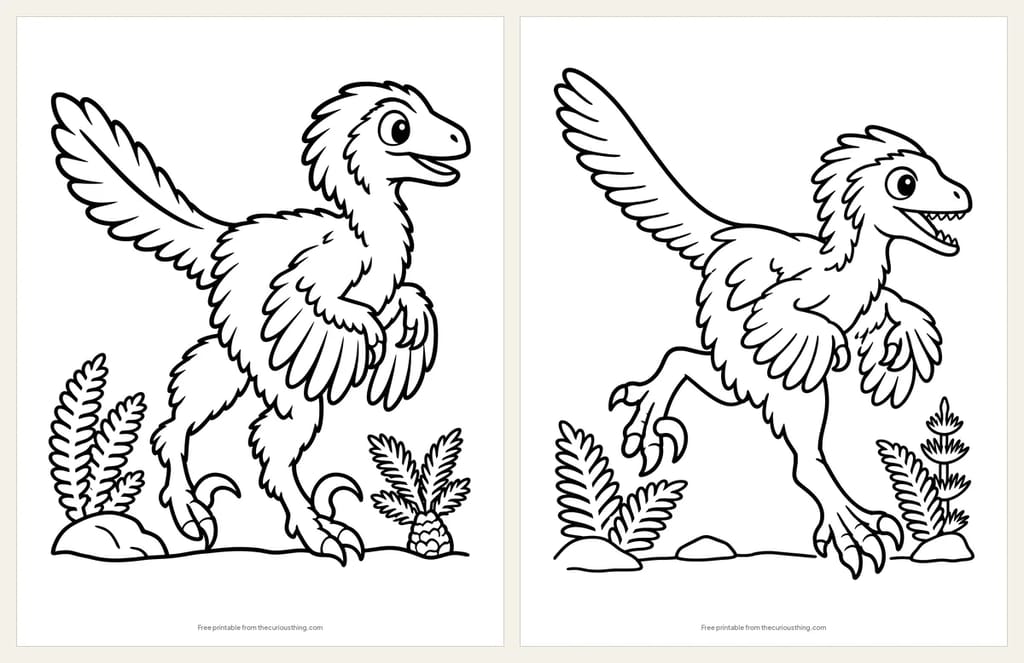
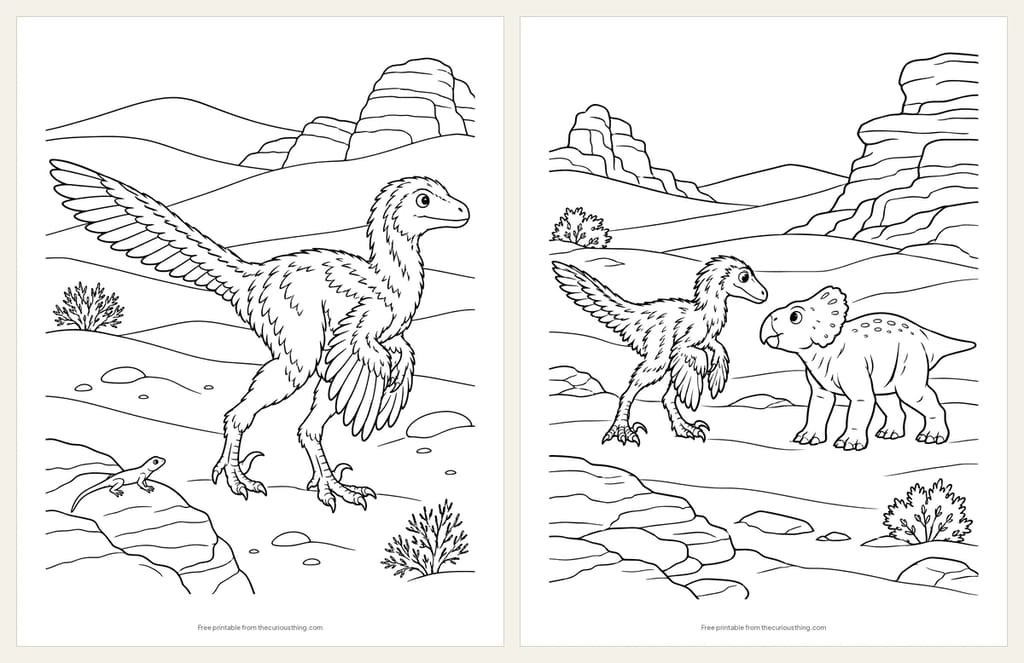
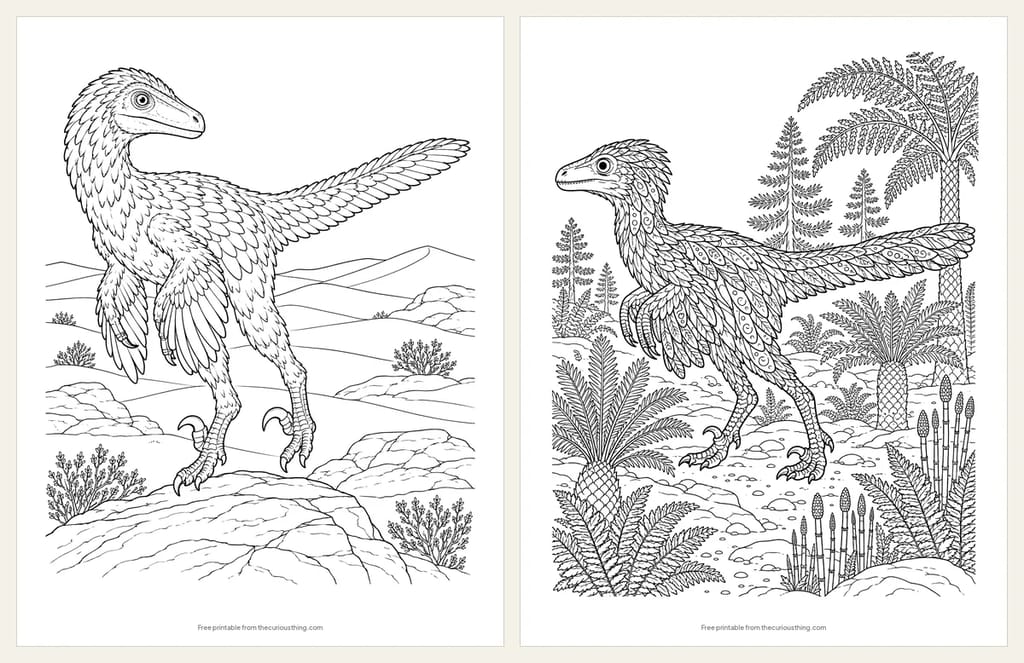
Every Velociraptor here is feathered and turkey-sized, the way the fossils show it, from a running cartoon for toddlers to a realistic close-up on a desert rock. Velociraptor (vel-OSS-ee-rap-tor) means "quick plunderer". The real one was about 6 feet long and about 15 pounds, around the weight of a big turkey, and about as tall as a preschooler. It had feathers: in 2007 American Museum of Natural History scientists found six quill knobs on a Velociraptor forearm, the bumps where big wing feathers anchor to bone in birds. "If animals like Velociraptor were alive today our first impression would be that they were just very unusual looking birds," said the museum's Mark Norell. The movie raptors, about twice the real animal's size, were modeled closely on a bigger cousin, Deinonychus. Velociraptor's fossils come from the Gobi Desert in Mongolia, which is why its pages are sand and rock instead of ferns. The "Velociraptor meets Protoceratops" page has a famous fossil behind it: two animals found locked together in 1971, the raptor's claw in the Protoceratops's neck and its own arm broken, both buried by an avalanche of sand. Our version keeps the peace.
Can you turn your child into a dinosaur coloring page?
Yes. Our free photo-to-coloring-page tool redraws one photo of your child as a coloring page in the Dino Expedition world: your child as a young explorer with a backpack, in a jungle full of friendly dinosaurs, with a long-necked one leaning down to say hello. It takes about 20 seconds, needs no account or email, and downloads as a US Letter PDF to print at 100%. The photo is sent once to draw the page and isn't stored, and nothing is used to train AI. It works for a pet or a whole family photo too.
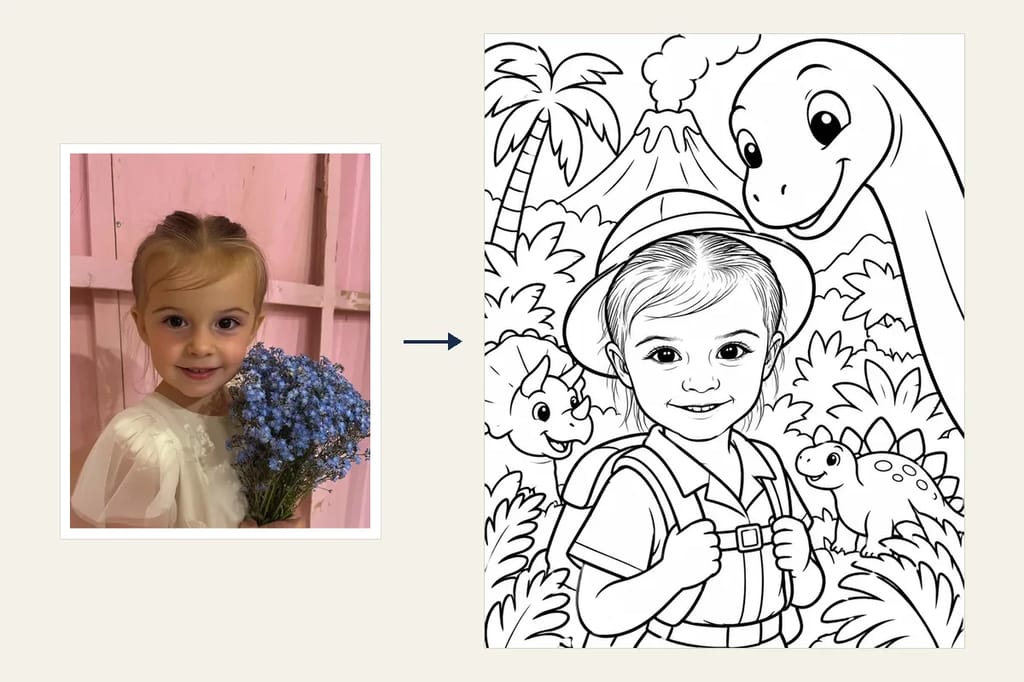
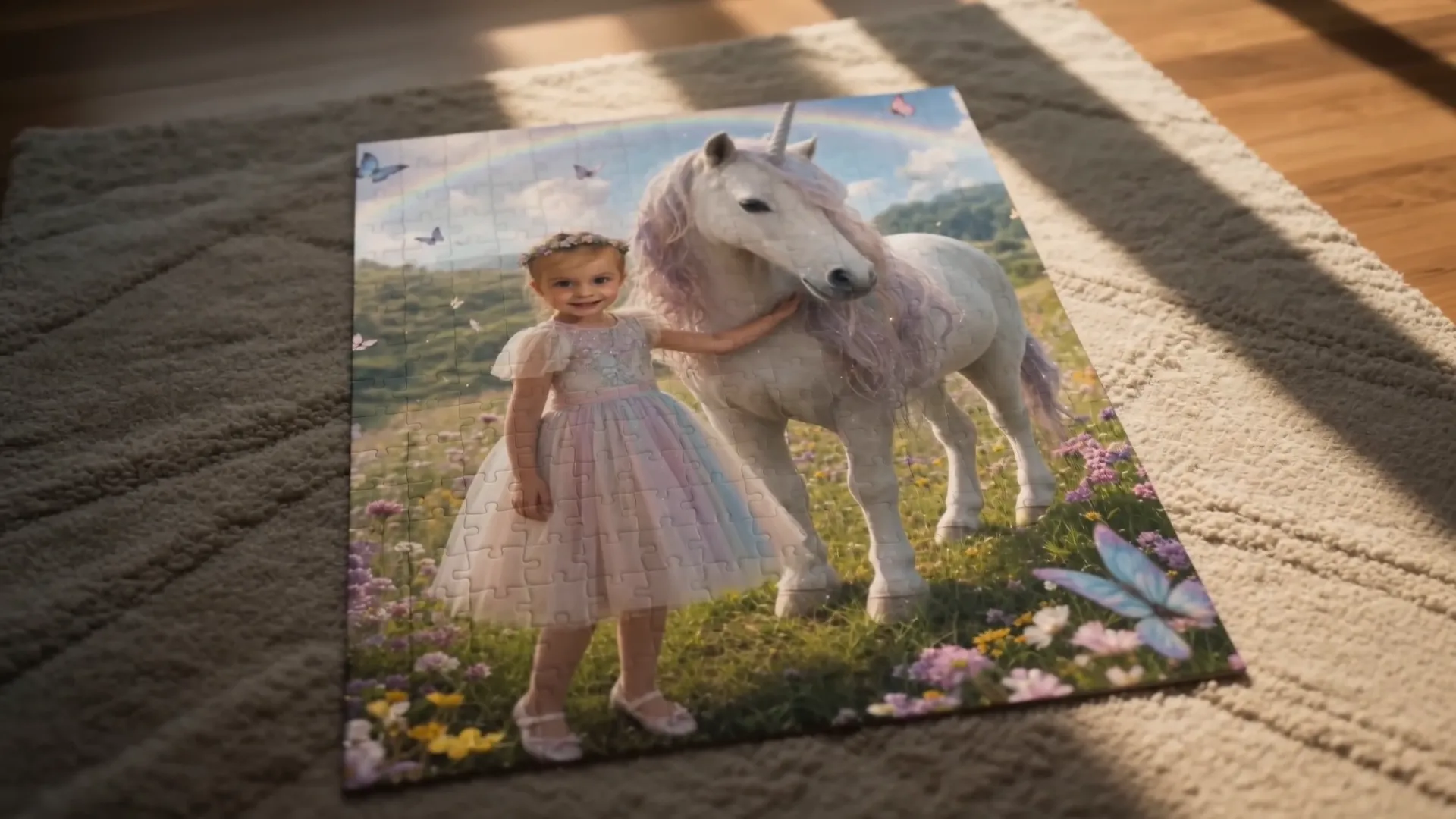
The same world comes as a full-color portrait too: Dino Expedition puts your child in the jungle on a jigsaw puzzle, a canvas or a blanket, and you see a watermarked proof before anything prints.
Spinosaurus coloring pages
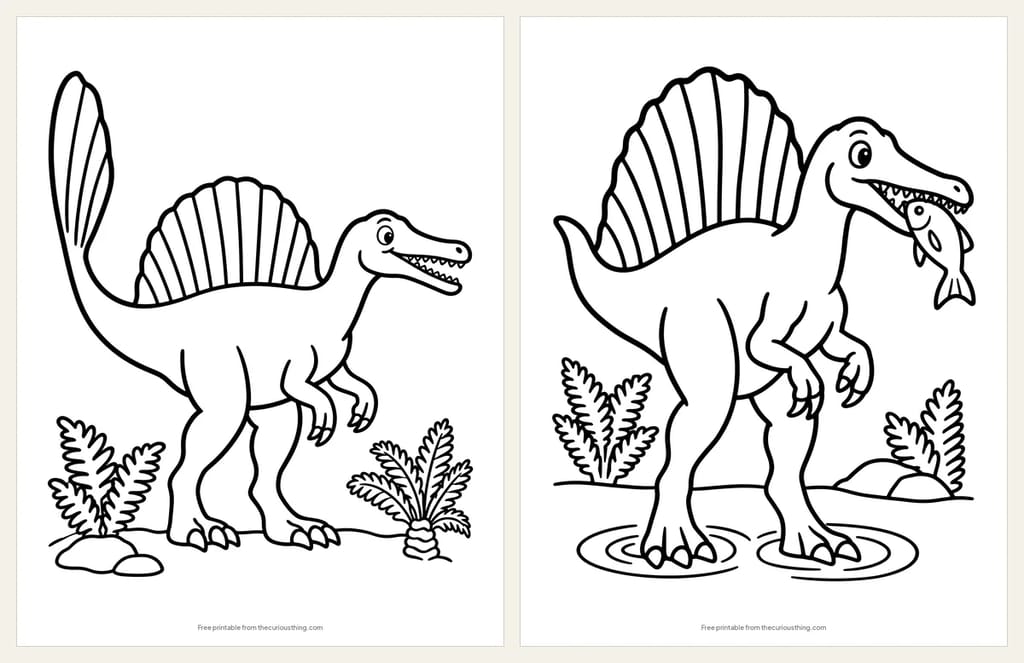
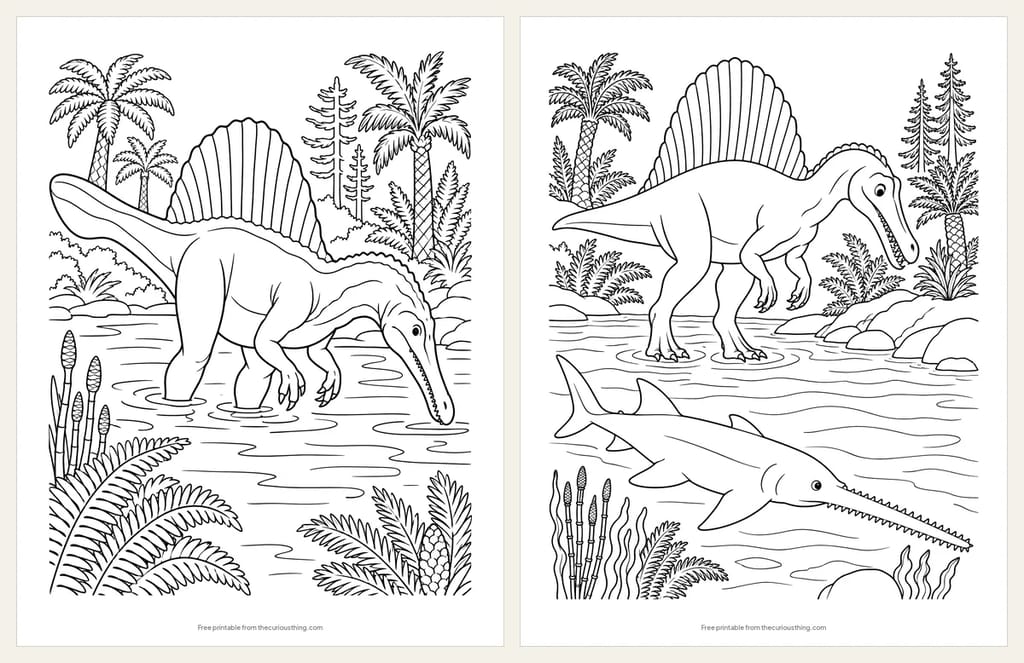
The Spinosaurus pages show it sail up and fishing, from a cartoon with a fish in its jaws to a sail like stained glass for older colorers. Spinosaurus means "spine lizard", for the tall spines that held up the sail on its back. Ernst Stromer named it in 1915 from bones found in Egypt, and those bones were destroyed in the bombing of Munich in 1944, leaving scientists with only very incomplete remains to study for decades. At about 46 feet long it's the longest meat-eating dinosaur known, though no complete skeleton has been found, so that length is an estimate. How it lived is still argued. In 2020 a team described a tail shaped like a paddle and argued that it swam with it; in 2022 another team built a flesh model and concluded it walked on two legs and was too buoyant to dive, ambushing fish along rivers and coasts instead. Our pages show it wading and fishing at the river's edge, and leave the swimming question for your child to decide.
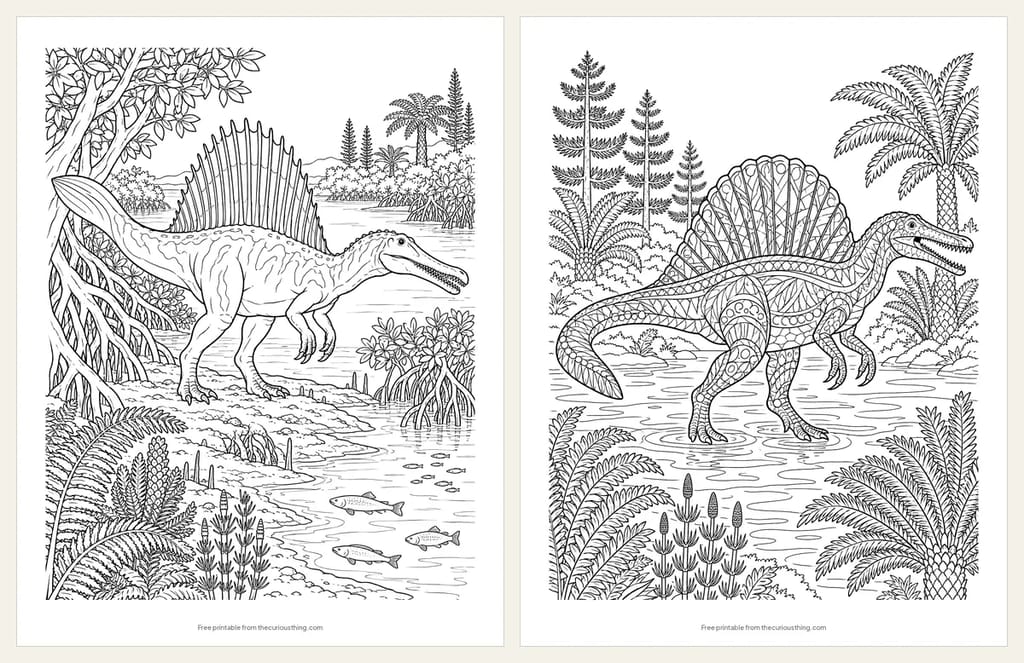
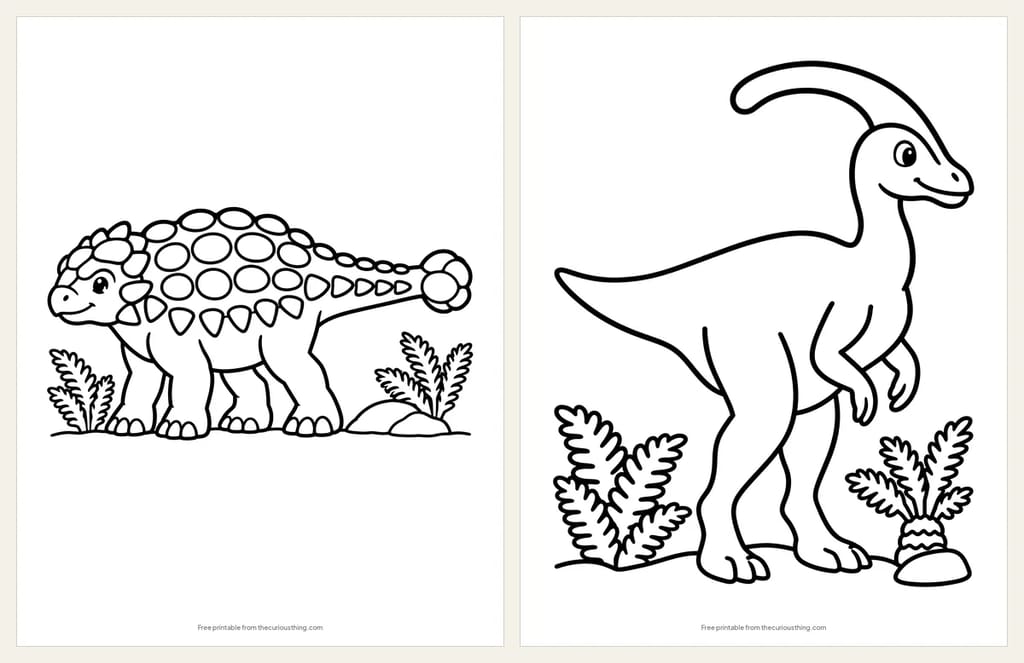
Ankylosaurus and Parasaurolophus coloring pages
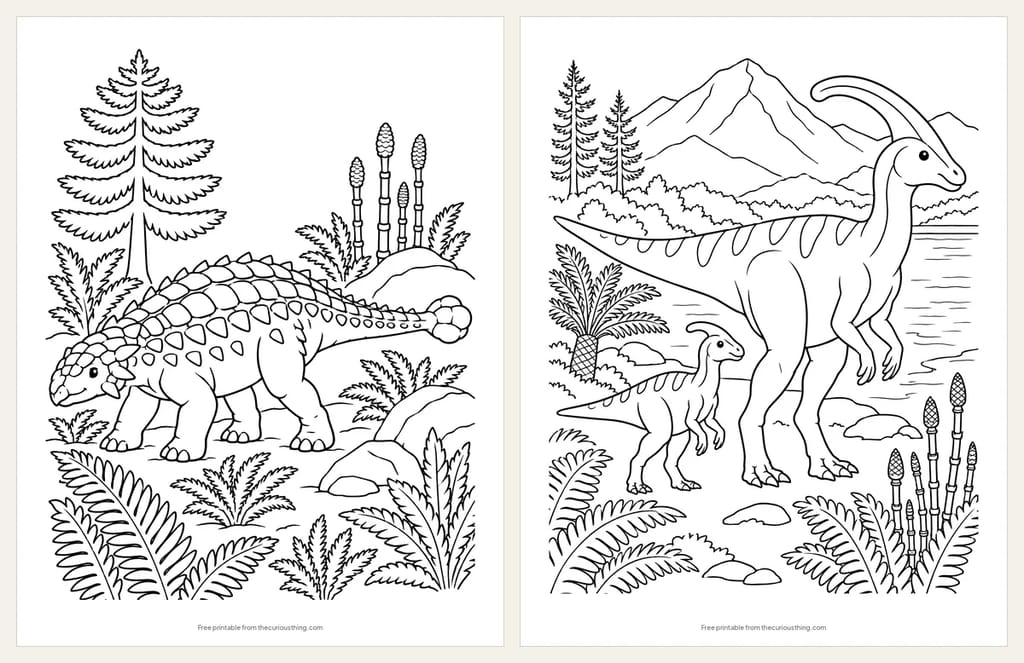
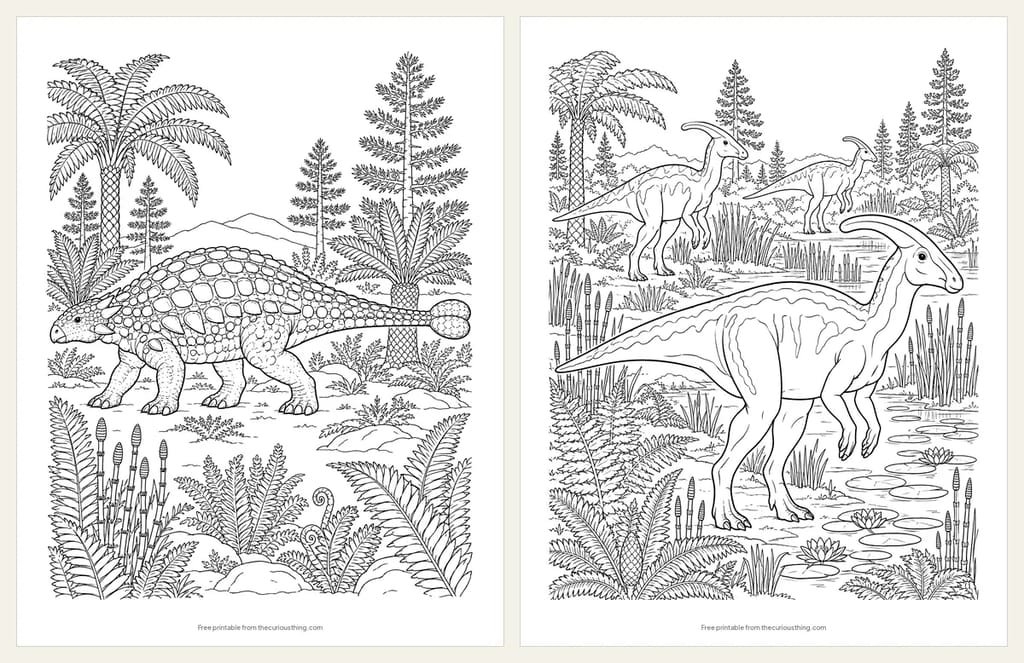
This section pairs two plant-eaters with built-in gear: Ankylosaurus with its armor and tail club, and Parasaurolophus with its tube-shaped crest. Ankylosaurus (an-KYE-low-SORE-us) means "fused lizard" and lived alongside T. rex and Triceratops. Its armor was real bone, probably covered in keratin, the stuff of fingernails, and the Natural History Museum estimates it needed about 130 pounds of plants a day, as much as an elephant. Barnum Brown's first drawing of it in 1908 had no tail club at all; the club turned up on a specimen found in 1910.
Parasaurolophus wore its crest like a trombone. A hollow tube ran from its nostrils up through the crest and back down, and in 1997 a paleontologist and a Sandia National Laboratories computer scientist used hospital CT scans of a skull to simulate a low, rumbling call that could change in pitch. A baby nicknamed Joe, found in Utah in 2009 by a high school student, may have been less than a year old and already had a small rounded bump of a crest.
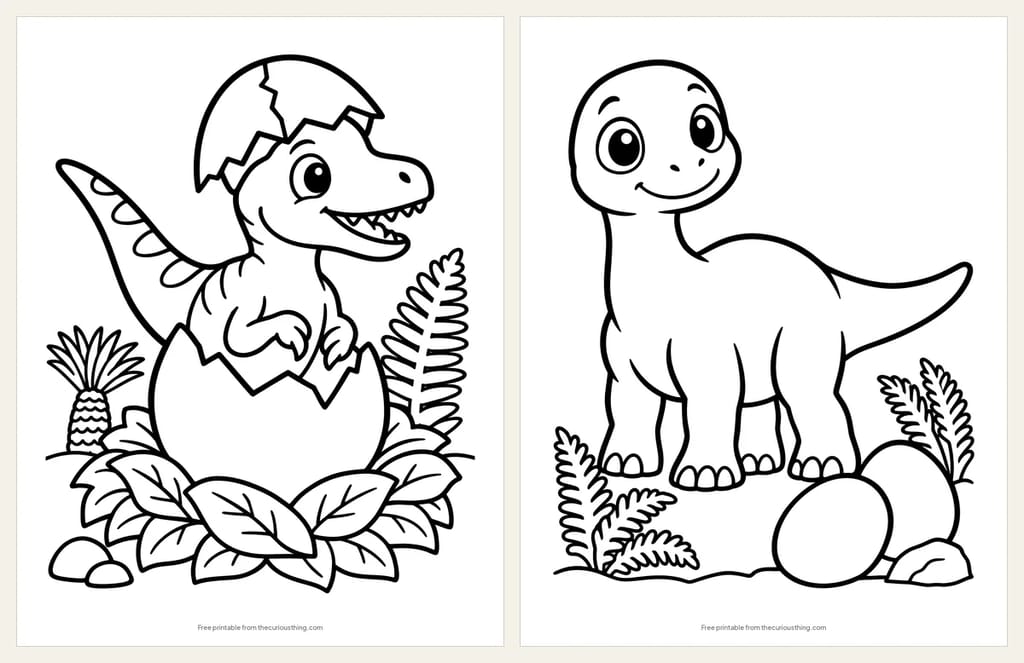
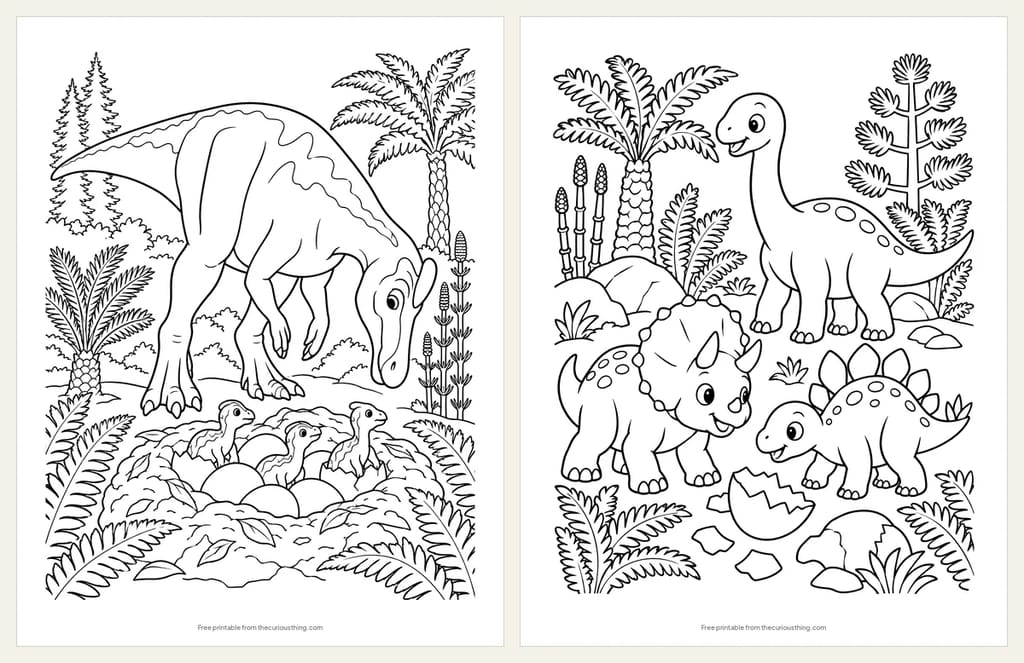
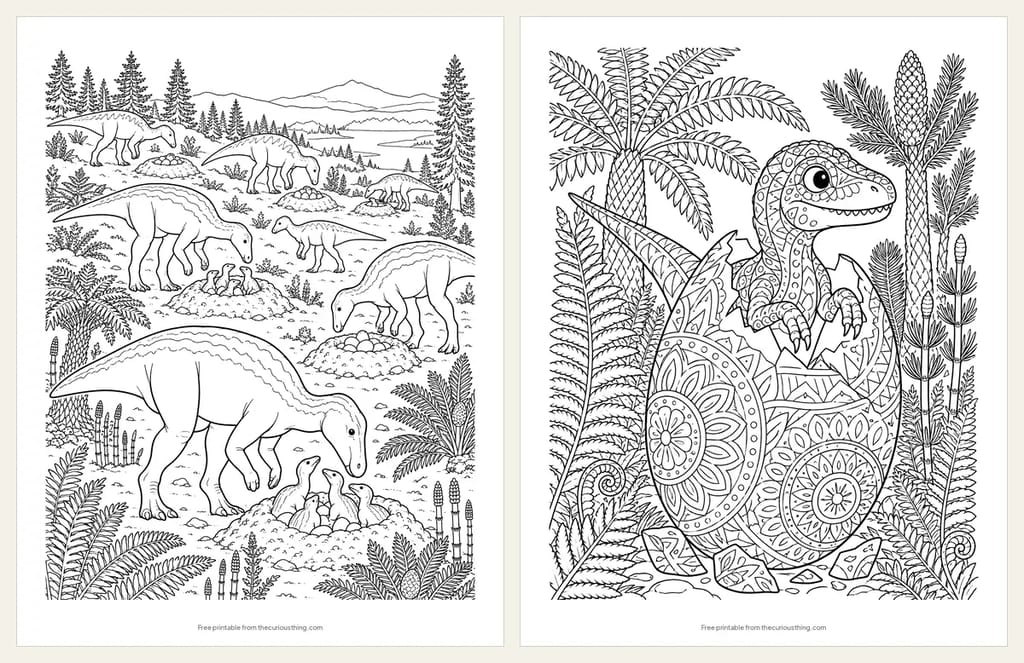
Baby dinosaur and egg coloring pages
These are the gentlest pages in the set: babies hatching, a mother over her nest, and a whole nesting colony on a hillside for older colorers. In 1979 Jack Horner and Robert Makela reported fifteen baby duck-billed dinosaurs, each about 3 feet long, found together in a nest near Choteau, Montana. They named the mother Maiasaura, "good mother lizard". The first babies were found by Marion Brandvold, who ran a rock shop in nearby Bynum; Horner's team went on to find 14 nests in one spot, now called Egg Mountain, the first strong evidence that dinosaurs cared for their young. A Maiasaura hatchling weighed under 2.2 pounds and grew to about 4,400 pounds in 8 to 10 years. Even the giants started small: the long-necked titanosaurs, the biggest land animals ever, laid eggs only about 6 inches across, in clutches of 30 or 40.
Pterodactyl and Mosasaurus coloring pages
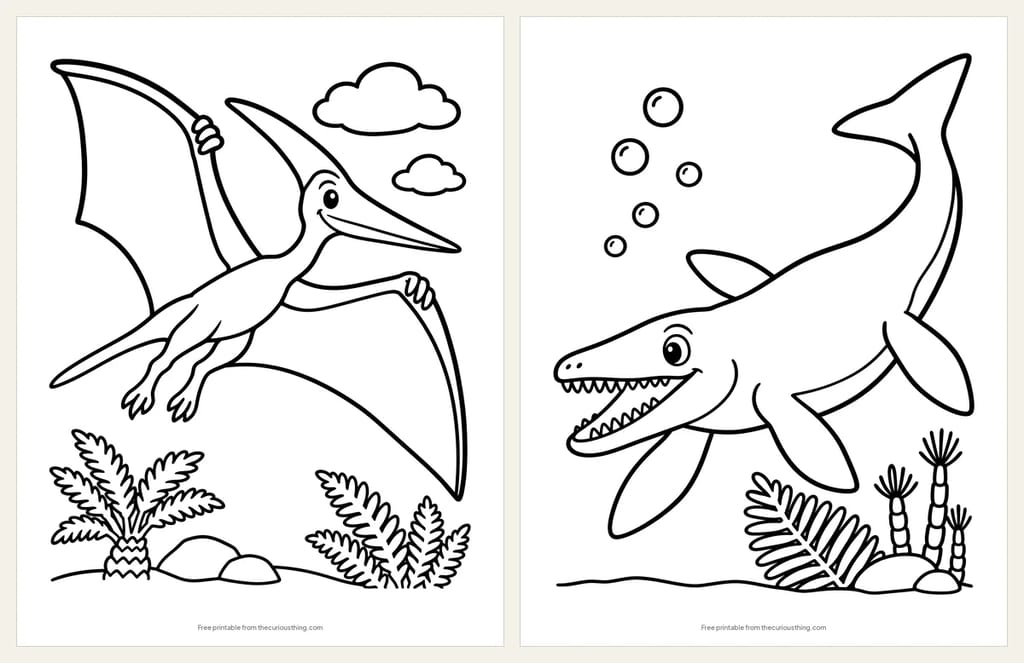
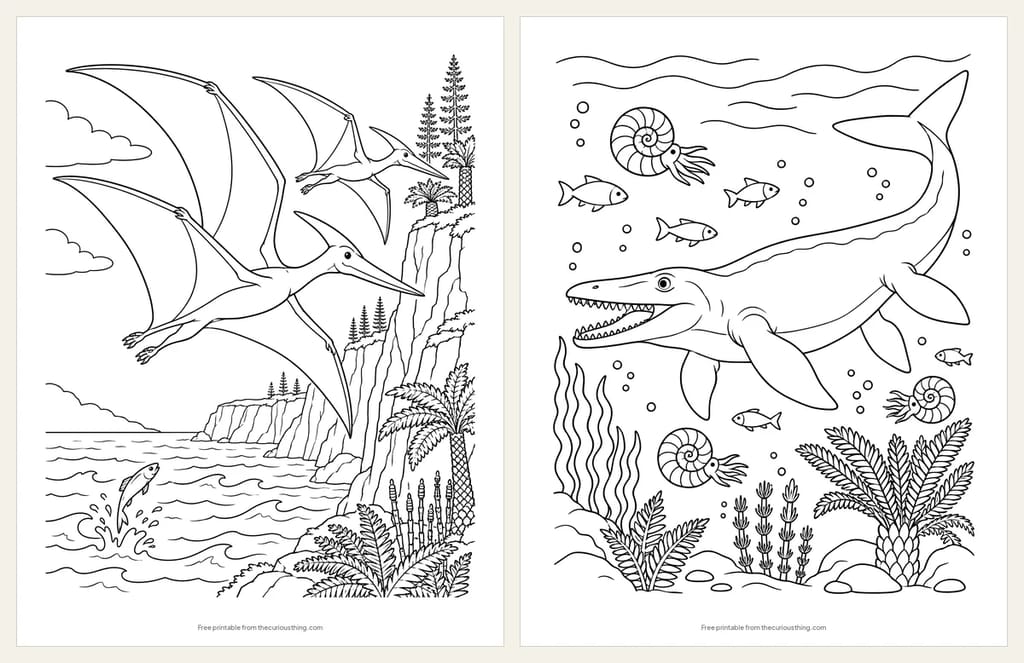
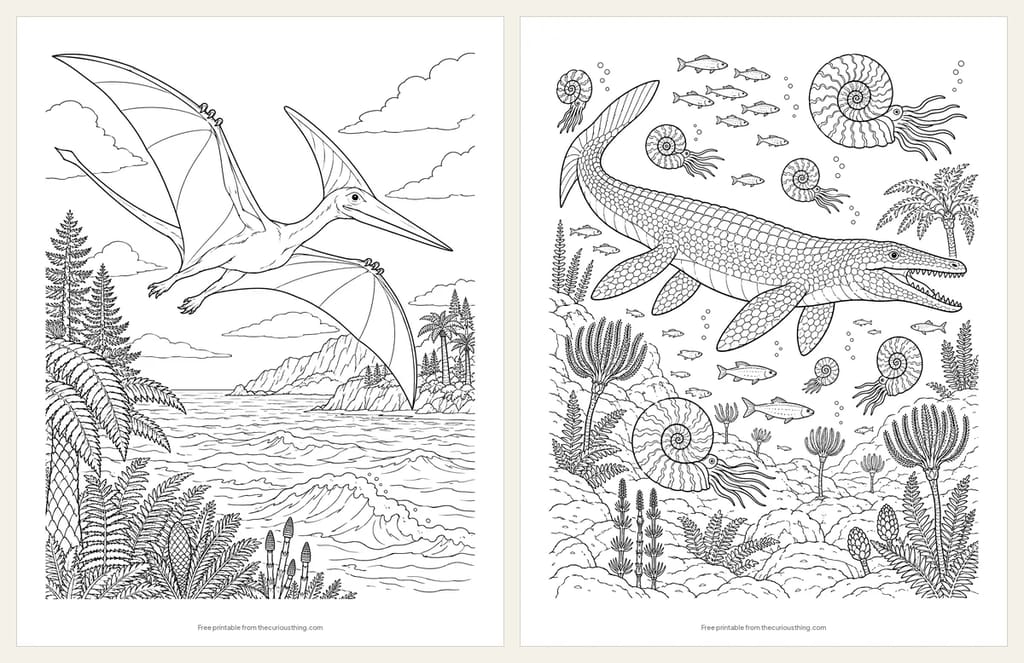
Neither one was a dinosaur, which makes this a good section to color and talk about at the same time. Pteranodon, the animal most people call a pterodactyl, was a pterosaur: a flying reptile, related to dinosaurs but not one of them, and pterosaurs were the first animals with backbones to fly, around 215 million years ago. The word "pterodactyl" comes from Pterodactylus, "wing finger", the first pterosaur ever found; the wing was a sheet of skin held up by one very long finger and reaching back to the ankles. Pteranodon's name means "winged and toothless", and its wings spanned up to 20 feet, about the size of a hang glider.
Mosasaurus was a giant sea reptile in the same group as lizards and snakes, named for the river Meuse at Maastricht in the Netherlands, where its first skulls came out of chalk quarries. When French troops took Maastricht in 1794, they carried the most famous skull off to Paris, where it is still on display.
Fossil and paleontologist coloring pages
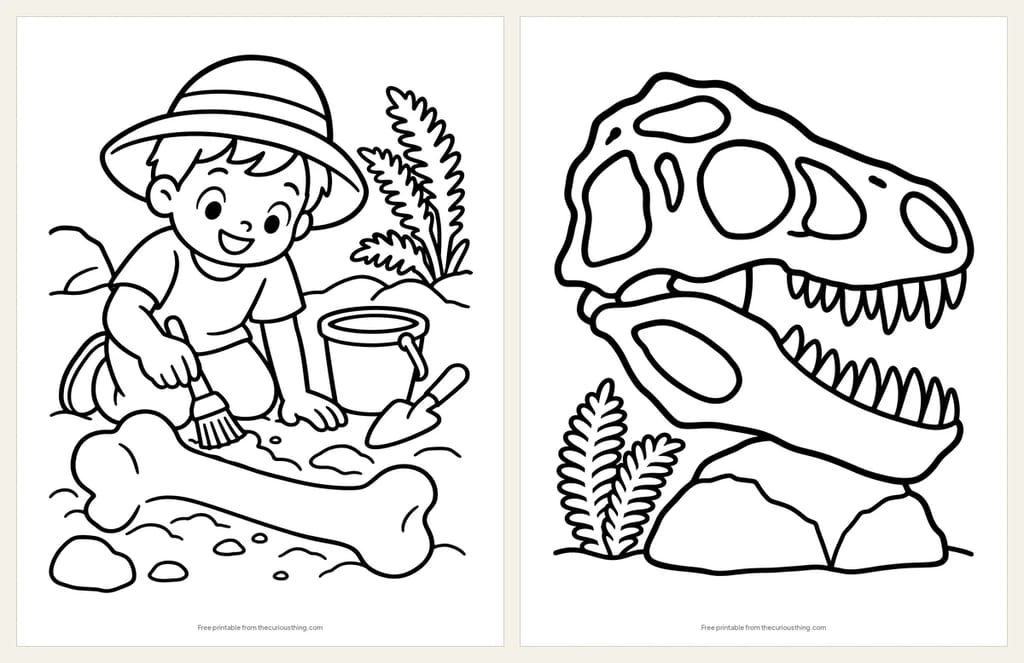
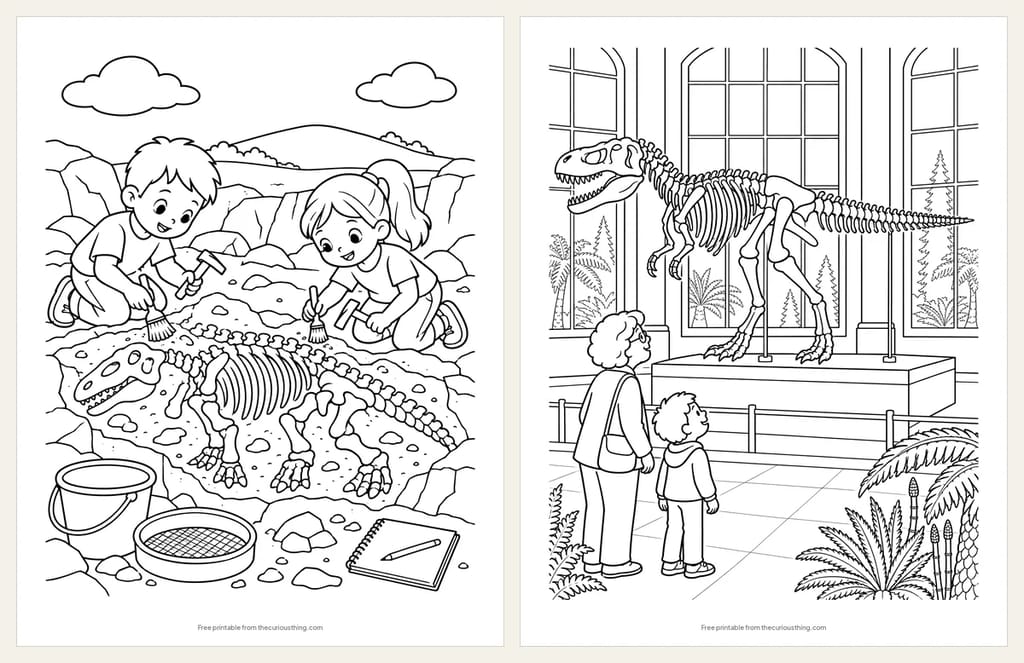
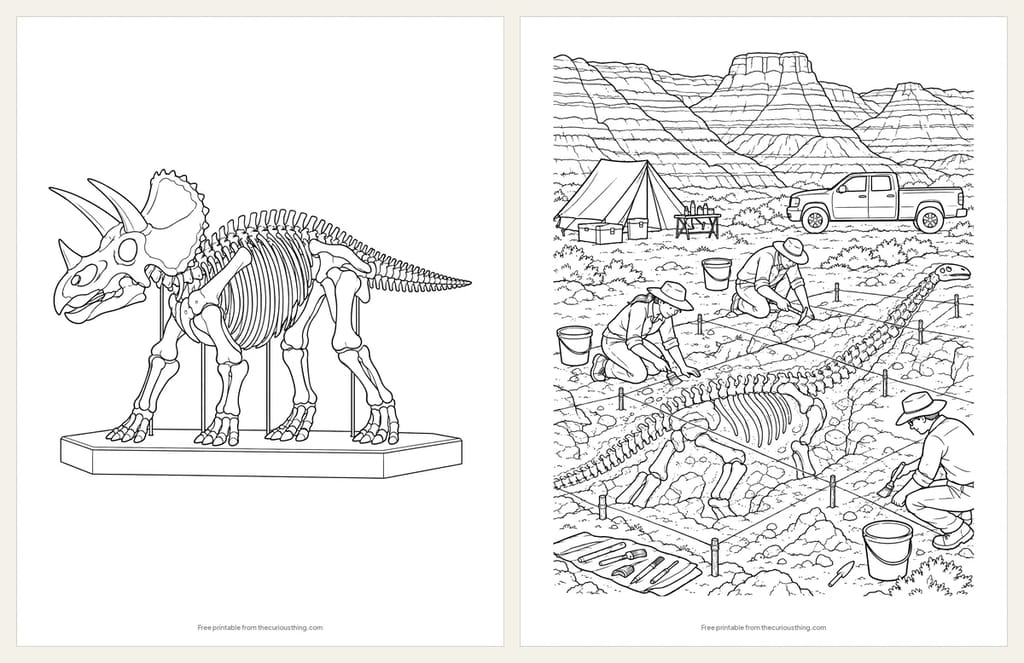
The fossil pages swap living dinosaurs for bones: a child brushing off a bone, a T. rex skull, a museum skeleton and a real dig in the badlands. Most dinosaur fossils formed when an animal was buried fast in mud or sand near a river or lake, and minerals in the water seeping through slowly turned its bones to stone. The first dinosaur ever given a name was Megalosaurus, "big lizard", in 1824, almost 20 years before anyone had coined the word "dinosaur". At Dinosaur National Monument in Utah, a rock wall holds about 1,500 dinosaur bones, including Stegosaurus and Diplodocus, and visitors can touch real fossils. Children aged 5 to 12 can also earn a free Junior Paleontologist badge from the National Park Service by finishing an activity booklet, from a ranger or downloaded at home.
What color were dinosaurs?
For most dinosaurs, nobody knows, so any color your child picks is a fair guess. The National Park Service says as much on its own dinosaur coloring pages: skin and feathers rarely fossilize, so a child coloring one is working as a paleoartist. For a few animals, though, scientists have found the answer in tiny pigment capsules called melanosomes, preserved in fossils.
In January 2010 a team including Bristol University scientists identified the colors of some dinosaur "feathers" for the first time: the small dinosaur Sinosauropteryx, covered in simple bristles, had orange and white rings down its tail. About a week later, Yale scientists mapped a whole animal, the chicken-sized Anchiornis, with a gray body, a reddish-brown crest and white wing feathers with black-spangled tips. And in 2017 an armored cousin of Ankylosaurus from Alberta, Borealopelta, turned out to be reddish-brown, darker on its back and lighter underneath, the camouflage called countershading. If your child wants a dinosaur that looks scientific, that's the trick: dark on top, pale on the belly. If they want a purple T. rex with green spots, nothing in the fossil record says no.
What do most dinosaur coloring pages get wrong?
Most dinosaur coloring pages repeat a handful of mistakes: pterosaurs and Mosasaurus filed as dinosaurs, a big scaly Velociraptor, and a T. rex standing upright on its tail. Several come from old museum mounts and films rather than from the fossils. Here's what the sources say instead.
| What the page shows | What the evidence shows |
|---|---|
| Pterodactyls and Mosasaurus filed as dinosaurs | Pterosaurs were flying reptiles and mosasaurs were sea reptiles; neither was a dinosaur |
| A big, scaly Velociraptor | About 6 feet long, turkey weight, with quill knobs for feathers |
| T. rex upright, dragging its tail | Back held horizontal, tail off the ground |
| T. rex fighting a Stegosaurus or a Velociraptor | Stegosaurus was gone about 80 million years before T. rex; Velociraptor lived in Mongolia, earlier |
| T. rex and Triceratops in a "Jurassic" scene | Both lived at the very end of the Cretaceous, 68 to 66 million years ago |
| Brontosaurus was never real | It was always a real animal; a 2015 study made it its own genus again |
| Dimetrodon, the sail-backed one, as a dinosaur | It was closer to mammals than to dinosaurs, and older than the first dinosaurs |
| Cave people beside dinosaurs | Nearly 65 million years apart |
| Every dinosaur a giant | Microraptor was about the size of a crow |
| Dinosaurs all extinct | Birds are living dinosaurs, descended from the same group as T. rex |
Why do so many young children love dinosaurs?
Nobody knows exactly why, but in one study of four-year-olds, dinosaurs topped the list. When a team followed 215 four-year-olds in Indiana, dinosaurs made up 43% of the knowledge-based interests that held for all four months, well ahead of cars and trucks. Intense interests start early, too: in a study of 177 children aged 11 months to 6, parents of nearly a third described an extremely intense interest in one topic, from trains and machines to dinosaurs, and 90% of those interests had started by age 2. These interests tend to fade: in the same group's two-year follow-up, they dropped off in the second year, the year most of the children started school.
While it lasts, it builds real knowledge. In a 1986 study of 7-year-old dinosaur experts and novices, the experts recognized an average of 15.6 of 20 dinosaurs against 3.6 for the novices, and reasoned their way to facts about dinosaurs they didn't know. And in a 2025 study at a children's museum Triceratops exhibit, children whose guardians rated them more curious about dinosaurs remembered more of the exhibit's main facts about 10 days later. All of these rely on parents' reports or small groups, and none shows that coloring a dinosaur teaches anything. It's a reason to tell the story in each section while they color, and to keep the dinosaur jokes handy for when the crayons go down.
Frequently asked questions
Are these dinosaur coloring pages free?
+
Yes. All 60 are free to print, with no email, account or sign-up. Tap a page's title to open the full-size file and print it at 100% or Actual size on US Letter paper. Print as many as you like for home or a classroom; please don't sell them.
What age are dinosaur coloring pages for?
+
Every dinosaur here comes at three levels. Easy pages, one big animal in thick lines, suit ages 2 to 4. Medium pages, the animal in a simple scene, suit ages 4 to 7. Detailed pages, realistic or full of patterns, suit ages 8 to adult. Treat the ages as a starting point and let your child pick.
Is a pterodactyl a dinosaur?
+
No. Pterodactyls and Pteranodon were pterosaurs, flying reptiles that were related to dinosaurs but not dinosaurs themselves. Mosasaurus and the plesiosaurs weren't dinosaurs either; they were sea reptiles. We include them here, labeled, because children ask for them.
Did T. rex have feathers?
+
Probably not much. Fossil skin from a T. rex's neck, hips and tail shows small scales, and a 2017 study concluded that if it had any feathers, they were limited to its back. Some of its earlier relatives were feathered. Velociraptor definitely had feathers, which is why ours does.
What color were dinosaurs?
+
For most, nobody knows, so any color is a fair guess. For a few, fossil pigment shows the answer: Sinosauropteryx had an orange and white ringed tail, Anchiornis was gray with a reddish-brown crest, and the armored Borealopelta was reddish-brown with a lighter belly.
Which dinosaurs lived at the same time as T. rex?
+
Triceratops and Ankylosaurus, both 68 to 66 million years ago in what is now the western US and Canada. Stegosaurus, Brachiosaurus and Diplodocus had died out about 80 million years earlier, and Velociraptor lived in Mongolia before T. rex appeared.
Can I make a dinosaur coloring page of my child?
+
Yes. Our free photo-to-coloring-page tool redraws one photo of your child, your pet or your whole family as a coloring page in the Dino Expedition world, with their face kept and friendly dinosaurs all around. It takes about 20 seconds, needs no email, and the photo isn't stored.
Make them a dinosaur coloring book
One photo of your child, your pet or the family, drawn into 24 worlds, with Dino Expedition on the cover if you like, and printed as an 8.5 by 11 inch softcover for $34. See the cover and two pages free first, swap any world you don't want, and approve every page before anything prints.