In short
Here are 60 free dog and puppy coloring pages to print on US Letter paper, with no email or sign-up. They're sorted by breed and by age: puppies, retrievers, herding dogs, huskies and St. Bernards, hounds, small dogs, Dalmatians, poodles and bulldogs, dogs with jobs, dogs at play, and six intricate pages for adults. Easy pages are one big dog in thick lines for ages 2 to 4, medium pages add a simple scene for ages 4 to 7, and detailed pages are realistic dogs for ages 8 to adult. Tap a page's title to open the full-size file, then print at 100% or Actual size. Every section has a true story about the dogs in it, linked to its source, and you can turn a photo of your own dog into a page for free.
Before drawing a single page, we read the dog and puppy coloring pages that rank on Google, about fourteen of them, from Crayola and ABCmouse to the big printable galleries. Between them they offer hundreds of dogs, and none links a single fact to a source. Only one gives an age with a reason, and none ties its ages to a source. Several lean on licensed cartoon dogs for traffic, one labels an ordinary hound with a famous cartoon dog's name, and no page offers to draw your own dog.
So every page here is new, drawn for this post with the image model behind our free photo-to-coloring-page tool and checked by hand. Eight came back with people nobody asked for, mostly an owner standing beside a dog's portrait, and were redrawn; the St. Bernard wears a plain collar and no barrel, for a reason you'll find below. Each section has one true story to tell while the crayons are out, linked to where it comes from, and a few favorite dog stories turn out to be wrong. Balto, for one, didn't run the hardest leg to Nome. Print as many as you like for home or a classroom. Please don't sell them.
Which dog coloring page suits which age?
Easy pages suit most children from two to four, medium pages four to seven, and detailed pages eight and up; the last section is drawn for teens and adults. The levels follow how coloring grows: toddlers scribble across a shape, preschoolers start aiming for it, and school-age children fill small areas on purpose.
The CDC lists scribbling as a milestone most children reach by 18 months, and by 4 years most hold a crayon between fingers and thumb instead of in a fist. When Huang and colleagues had 239 children aged 3 to 6 color a train, 66% of the 3- and 4-year-olds colored in a "transitional" way, between scribbling and staying inside the lines, while 89% of the 6-year-olds colored in a mature way. So a 3-year-old going over the lines on the puppy page is right on time. The children's occupational therapists at Aneurin Bevan health board in Wales suggest keeping the areas "small and achievable" and showing children that grown-ups go outside the lines too. Our dinosaur coloring pages go further into crayon grip at each age.
| Level | Usually suits | What's on the page | Good first picks |
|---|---|---|---|
| Easy | 2 to 4 | One big dog, very thick lines, almost no background | Puppy with a ball, Dalmatian, pug, dog with a bone |
| Medium | 4 to 7 | The dog in a simple scene, bold lines, a few details | Labrador in the lake, sled dog team, bulldog on a skateboard |
| Detailed | 8 to adult | A realistic dog or a busy scene, many small areas | Husky and the moon, St. Bernard in the Alps, the dog park |
| For adults | Teens and adults | Fine patterns from edge to edge, many tiny areas | Dog mandala, stained-glass dog, dog breeds pattern |
The ages are starting points, not rules. A child who loves huskies will happily color the detailed husky badly.
How do you print these dog coloring pages?
Tap a page's title under any preview to open the full-size file, 2,550 by 3,300 pixels, which is 8.5 by 11 inches at 300 dpi, and print it at 100% or Actual size on US Letter paper. Each title opens the picture itself, with no PDF bundle, email code or ad page in between. On A4 paper, which is about 6 mm narrower and 18 mm taller than Letter, choose Fit instead: in Adobe's print dialog, Fit scales each page to the paper, while Actual size crops whatever doesn't fit.
Ordinary 20 lb copy paper, about 75 g/m², is fine for crayons and colored pencils. For markers, slide a scrap sheet underneath: Strathmore says most papers will eventually let marker bleed through, and lighter ones sooner. If the family dog eats a crayon while you color, don't panic: the Pet Poison Helpline says children's crayons are generally non-toxic to dogs, and the risk is an upset stomach or, now and then, a blockage, so call your vet if the dog vomits, stops eating or seems sore.
Puppy coloring pages
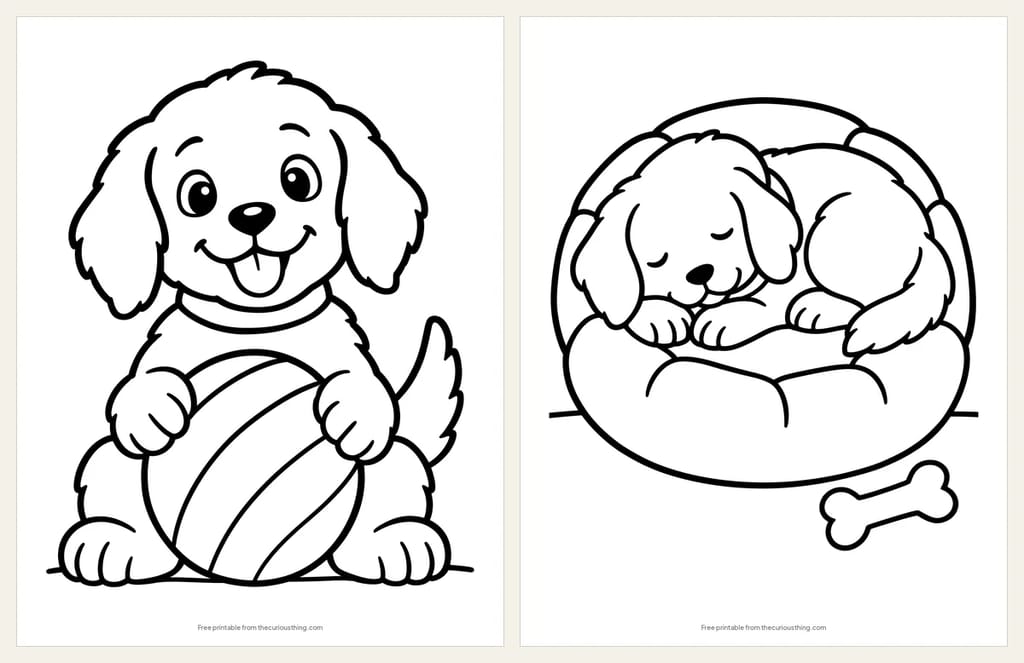
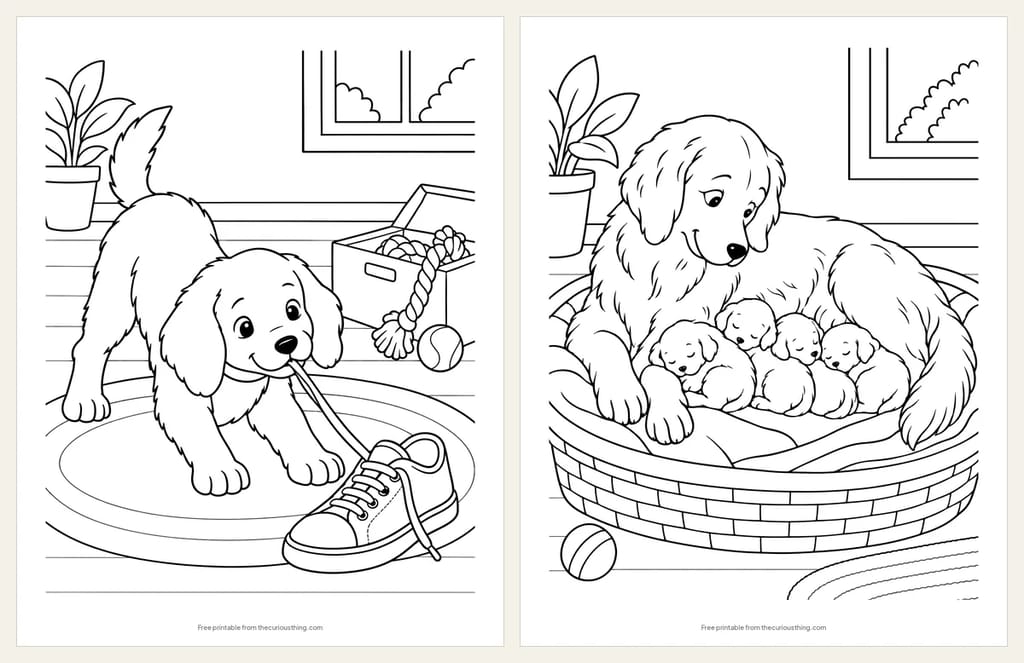
These six puppy coloring pages run from a fluffy puppy hugging a ball and a puppy asleep in its bed, for toddlers, to a puppy tugging a sneaker, a mother dog with her newborns, three puppies in a garden and a realistic Labrador puppy in a basket. The sleepy one is true to life. The American Kennel Club says puppies sleep 18 to 20 hours a day, and newborns about 90% of the time.
The newborns on the mother-dog page have their eyes shut, because puppies are born with their eyes and ears closed. Their eyes open at about two weeks, they can see well enough to use it at about three weeks, and their hearing switches on at around two and a half to three weeks. Puppies grow 28 baby teeth, and the Merck Veterinary Manual says the 42 adult teeth start coming in at around four to five months. You'll rarely find a lost puppy tooth, because puppies often swallow them while eating, which does them no harm.
Golden retriever and Labrador coloring pages
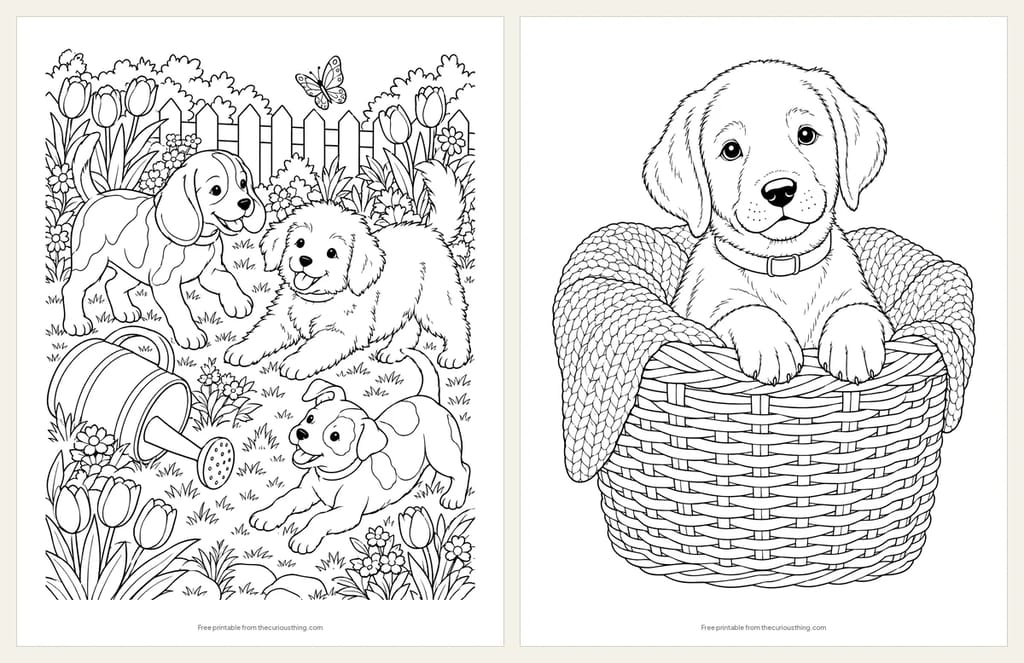
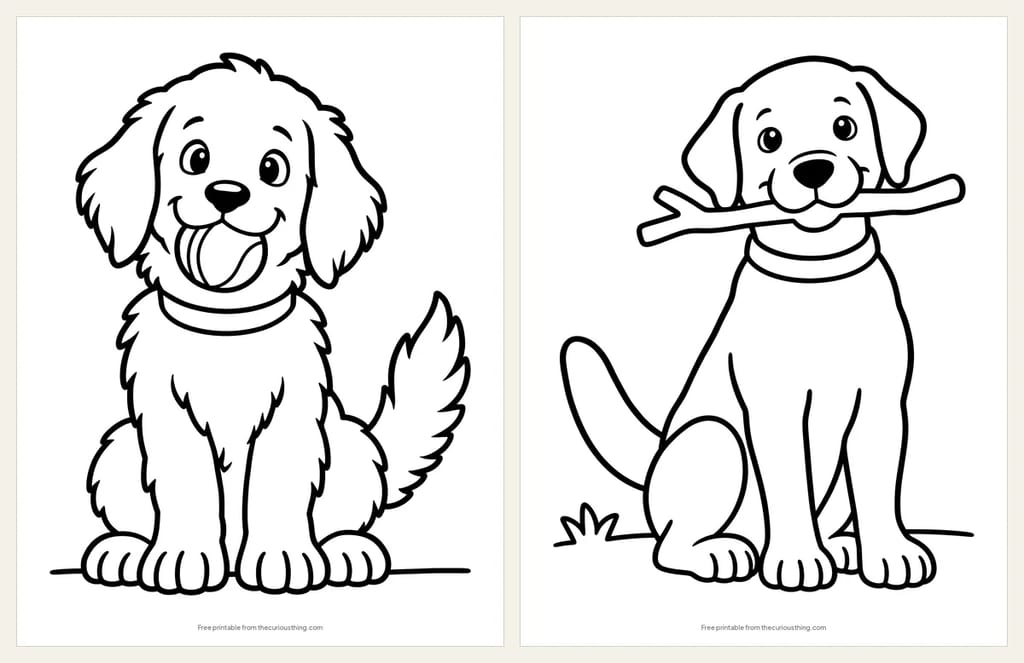
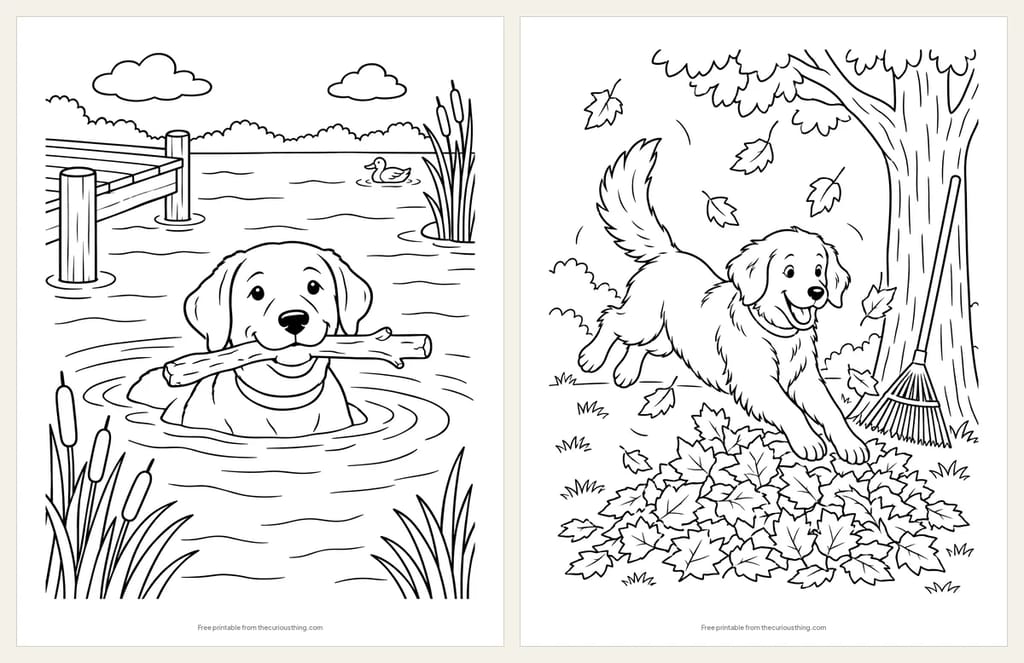
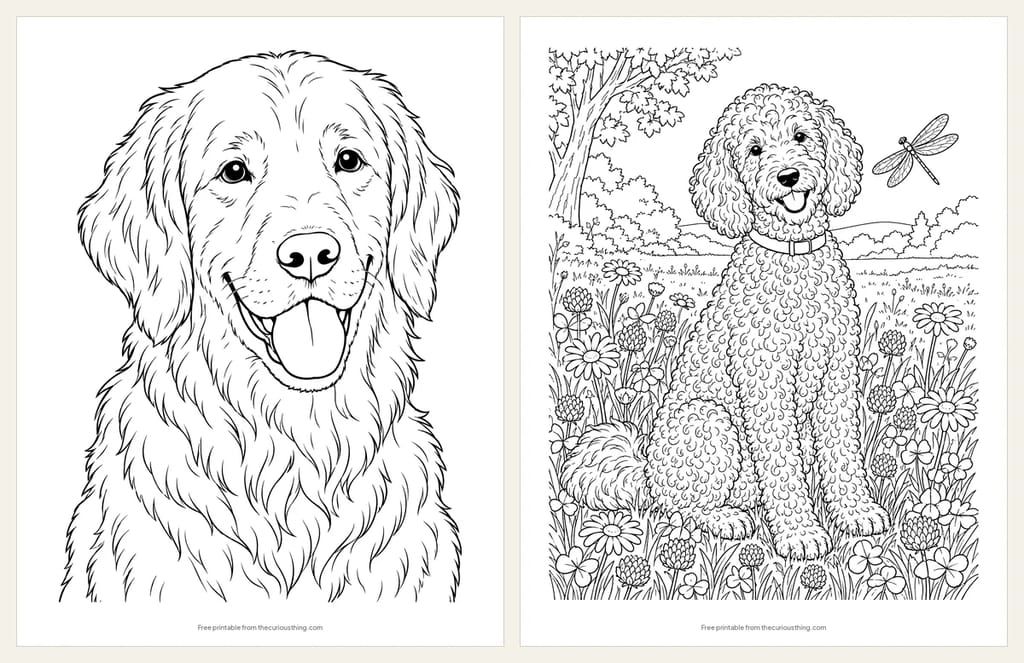
These six pages star America's two favorite retrievers: a golden retriever puppy with a tennis ball and a Labrador with a stick for the youngest, a Lab swimming with a stick and a golden leaping into leaves, then a realistic golden retriever portrait and a curly goldendoodle among the daisies. The Lab was the American Kennel Club's most popular breed for 31 years in a row, until the French bulldog took over in 2022; on the 2025 list the Lab, golden and German shepherd came second, third and fourth.
Labradors don't come from Labrador. Their ancestor was the St. John's water dog of Newfoundland, which hauled fishing nets and fetched cod that slipped off the hook; the last two are believed to have died in the early 1980s. The golden retriever began in 1868 on a Scottish estate called Guisachan, when Dudley Marjoribanks bred his yellow retriever Nous, bought from a Brighton shoemaker, to a Tweed Water Spaniel called Belle. The goldendoodle is a cross, and the AKC doesn't recognize any doodle as a breed.
Give them a coloring book that stars their dog
One photo of your dog, your child or the whole family, drawn into a different world on every page and printed as an 8.5 by 11 inch softcover for $34. See the cover and two pages free first, swap any world you don't want, and approve every page before anything prints.
German shepherd, corgi and herding dog coloring pages
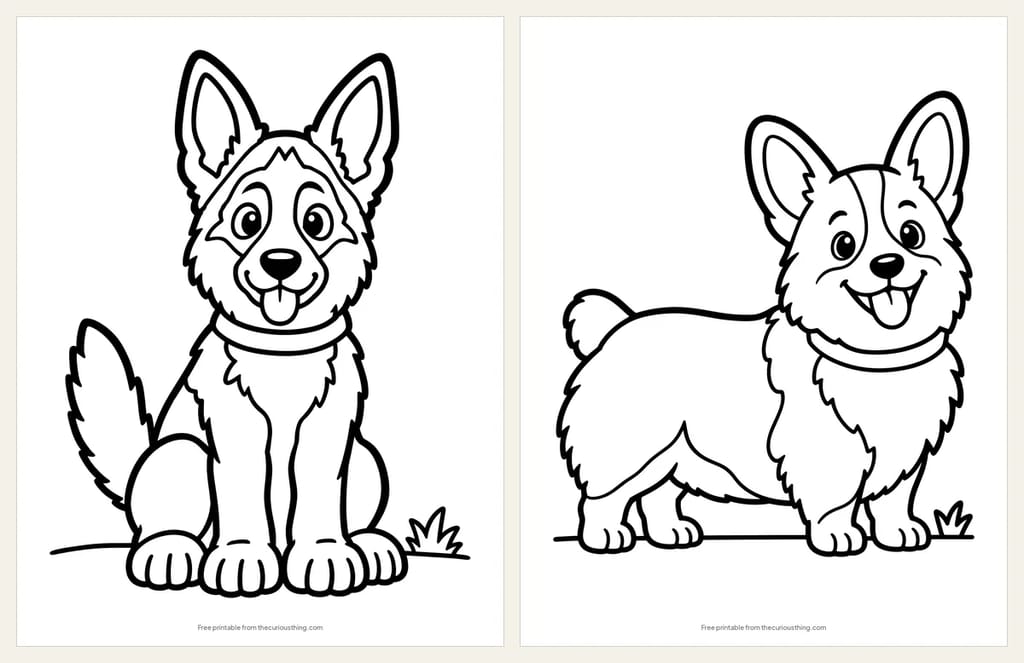
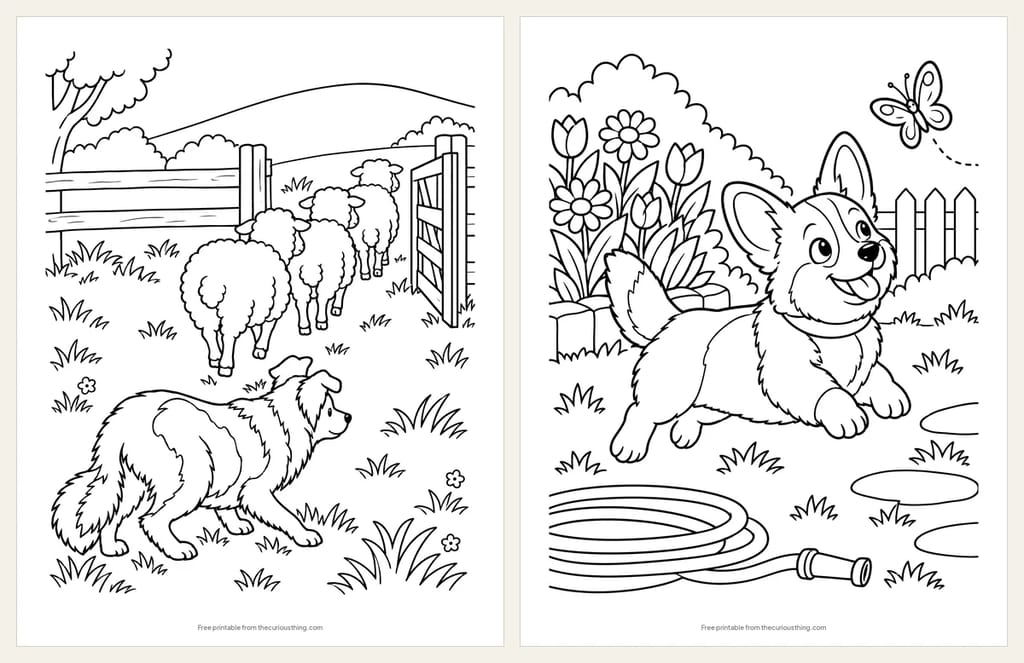
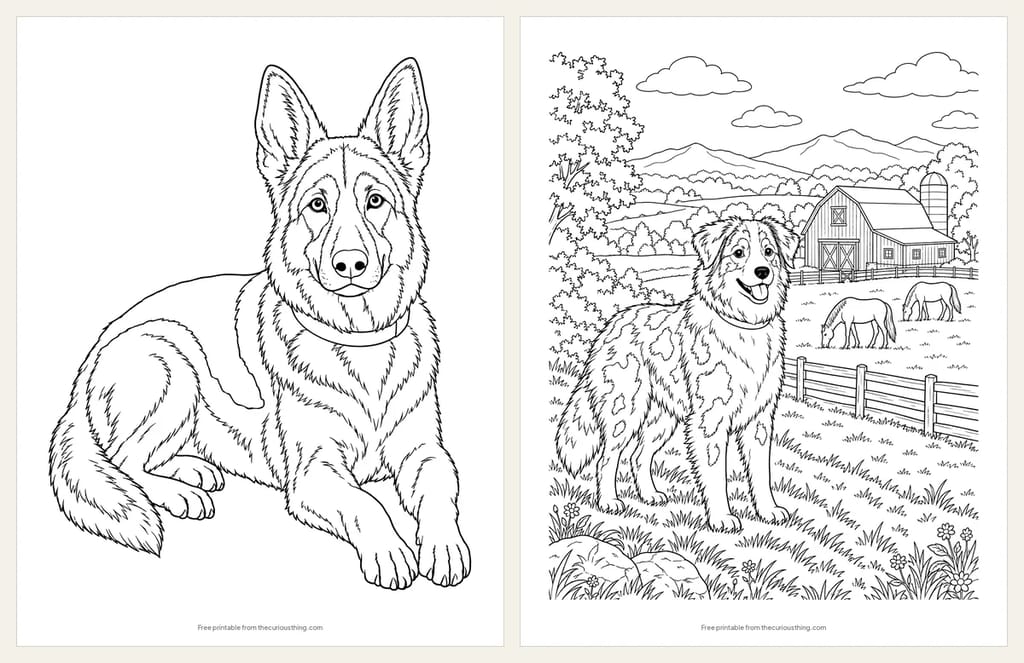
These six herding dog coloring pages have a German shepherd puppy and a smiling corgi for toddlers, a border collie eyeing a line of sheep and a corgi chasing a butterfly, then a realistic German shepherd and an Australian shepherd above a ranch. Herding is the youngest of the AKC's seven groups: until 1983 these breeds sat in the Working Group.
The very first German shepherd has a name. In 1899 a cavalry officer, Max von Stephanitz, saw a dog called Hektor at a show, bought him on the spot and renamed him Horand von Grafrath, and Horand became dog No. 1 in the new breed club's stud book. Corgis come in two breeds: the Cardigan has a long tail, and the Pembroke, the one on these pages, has a naturally short or docked one. In Welsh legend, fairies rode Pembrokes like ponies, and corgi fans point to a "fairy saddle" of fur over the shoulders. Queen Elizabeth II owned more than 30 corgis and corgi crosses, many of them descended from Susan, an 18th-birthday present who went on her honeymoon.
Husky, St. Bernard and sled dog coloring pages
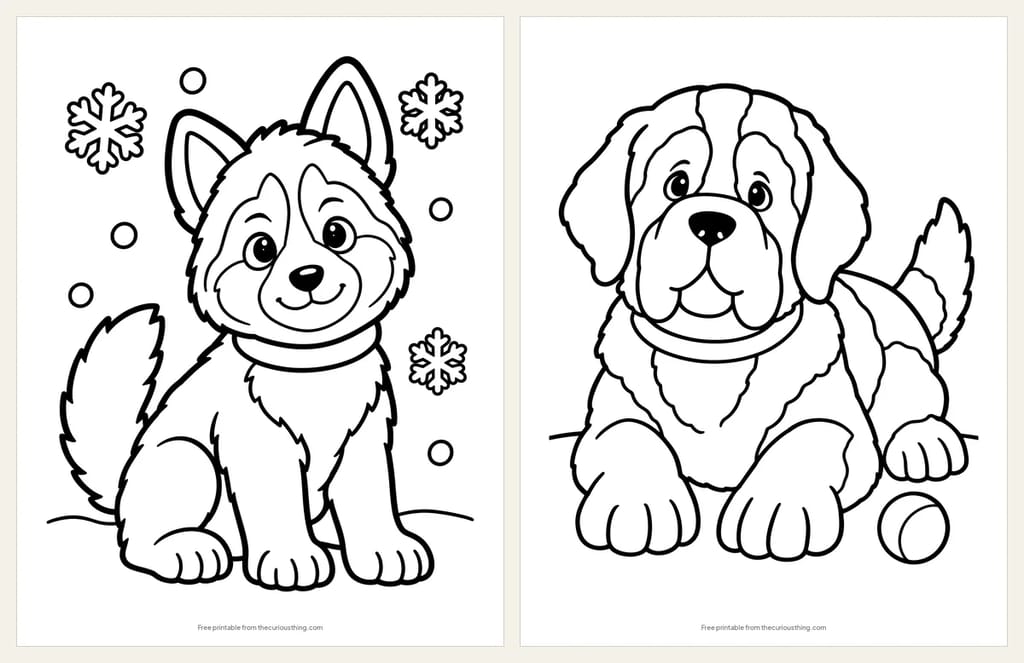
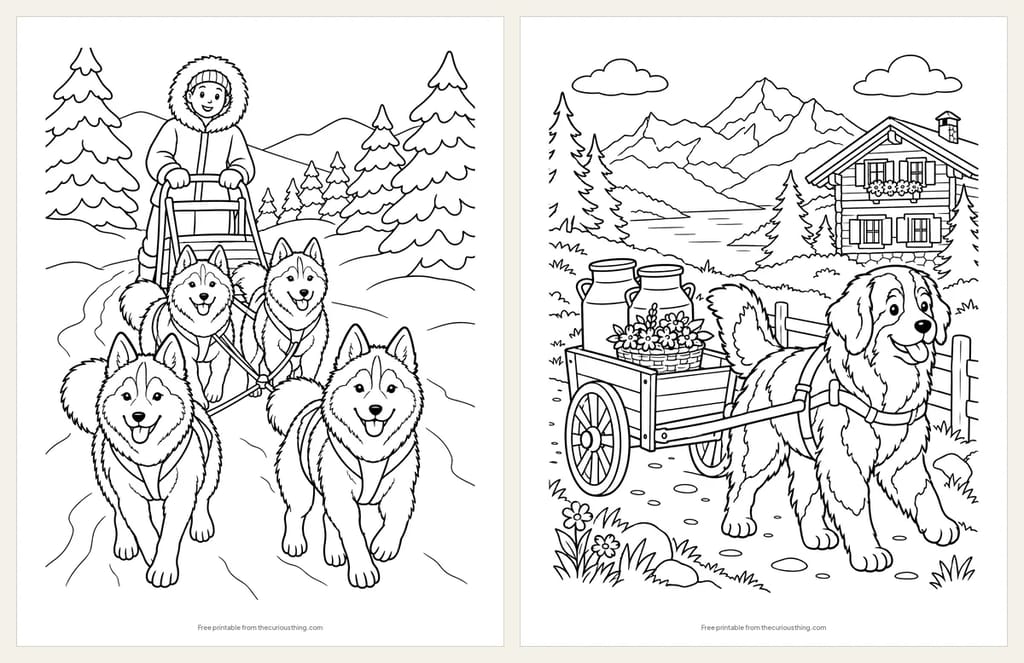
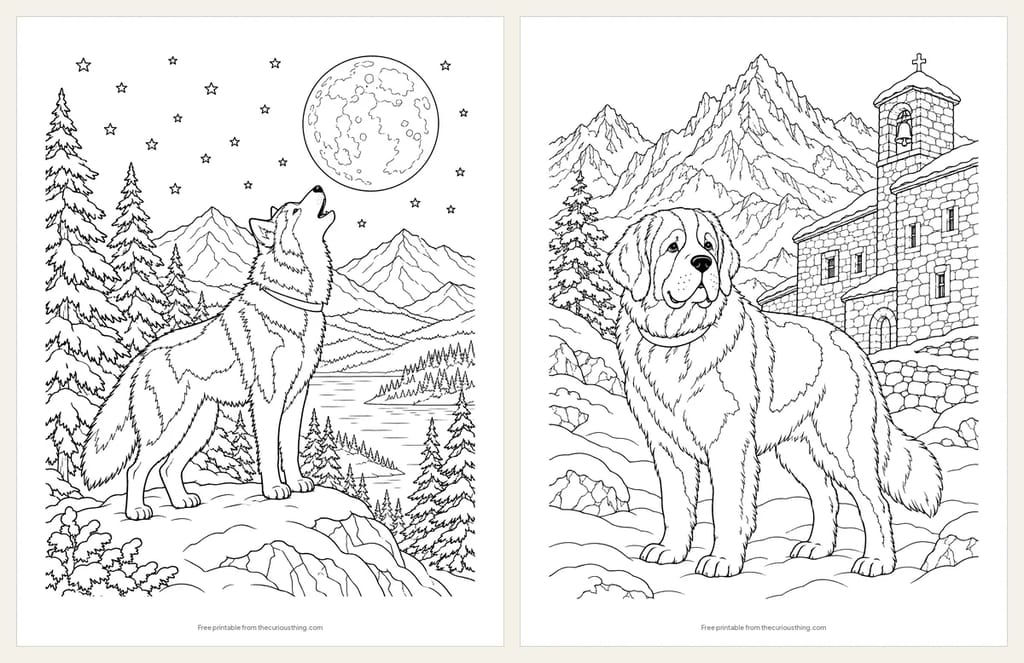
These six working dog coloring pages star dogs built for snow: a husky puppy and a St. Bernard puppy for the youngest, a sled team and a Bernese mountain dog pulling a cart, then a husky howling at the moon and a St. Bernard on a mountain pass. The Bernese cart is real farm history. Bernese mountain dogs guarded Swiss farms, drove cows to the mountain pastures and pulled carts of milk cans to the dairy.
The sled team belongs to the most famous dog relay ever run. In 1925, 20 mushers and more than 150 dogs carried diphtheria medicine 674 miles to Nome, Alaska, in about five and a half days. Balto got the statue in Central Park, but he ran the last 53 miles or so. The longest and most dangerous stretch belonged to Togo, Leonhard Seppala's veteran lead dog, whose team ran over 261 miles and crossed the sea ice of Norton Sound just hours before it broke up. A 2023 DNA study found Balto was only part Siberian husky, a mixed working sled dog. Color the husky's eyes as you like: the breed standard allows brown, blue, one of each, or both in one eye.
Did St. Bernards really carry brandy barrels?
No. The rescue dogs of the Great St. Bernard Pass never carried little barrels of brandy, and the picture is usually traced to a painting. Edwin Landseer was 18 when he painted Alpine Mastiffs Reanimating a Distressed Traveller in 1820, with a small cask on one dog, and advertising spread the idea from there. The Natural History Museum of Bern notes that a hospice chaplain said in 1956 the dogs never carried such barrels, and doctors warn never to give alcohol to someone dangerously cold. That's why our St. Bernards wear plain collars.
The real hero is Barry, born in 1800, who worked at the hospice, nearly 2,500 meters up, until 1812 and died in Bern in 1814; his preserved body is on show at the museum there. He's credited with saving more than 40 people, though no record of his single rescues survives, so nobody can check the number. The story that a soldier killed him is a legend too: he died of old age.
Beagle, dachshund and basset hound coloring pages
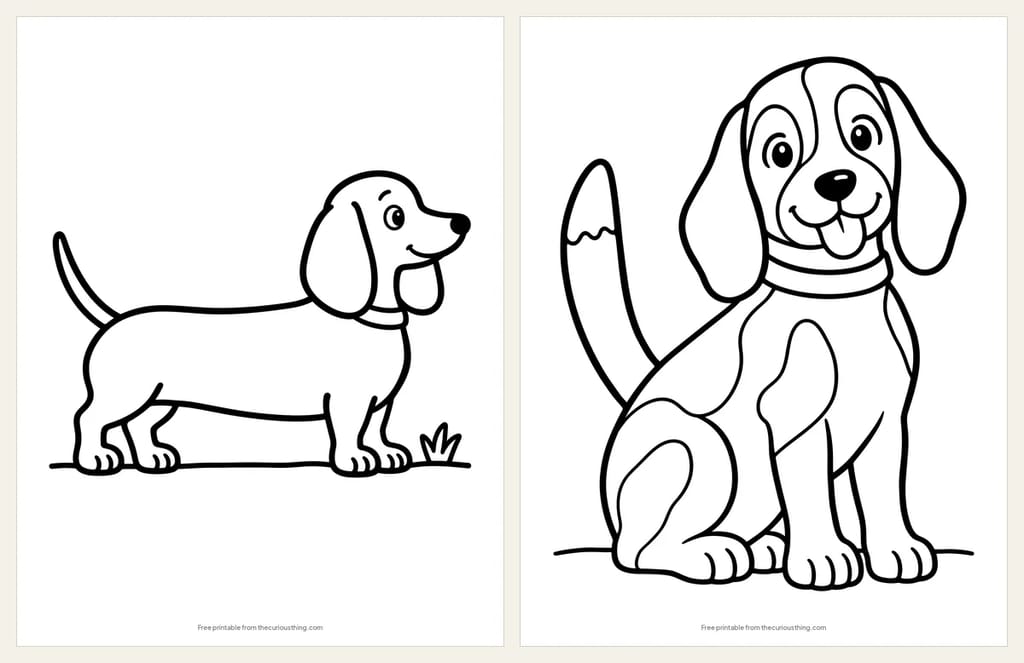
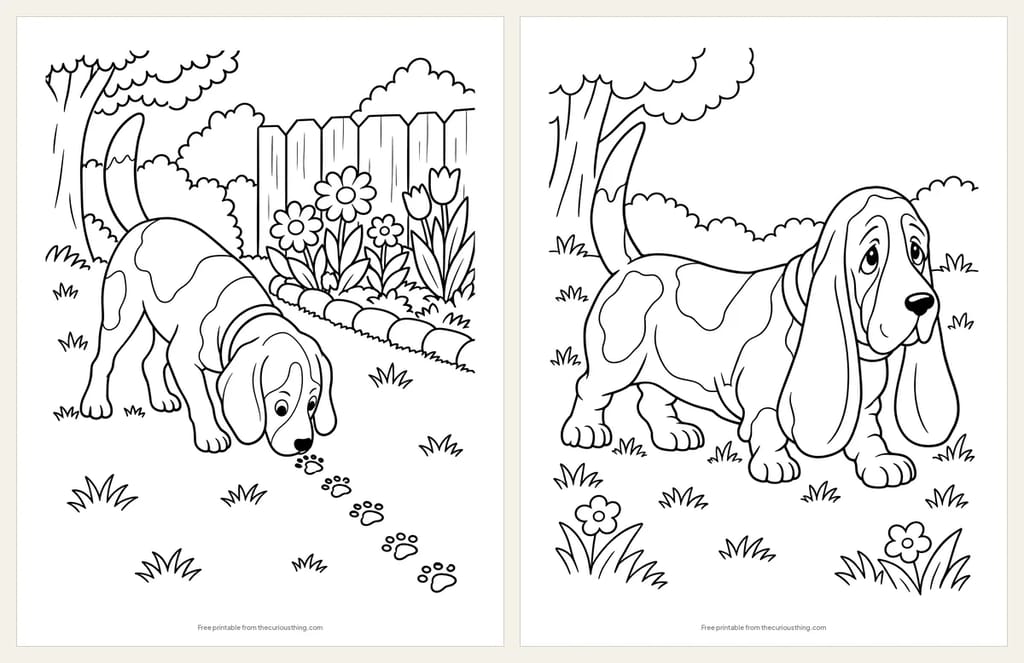
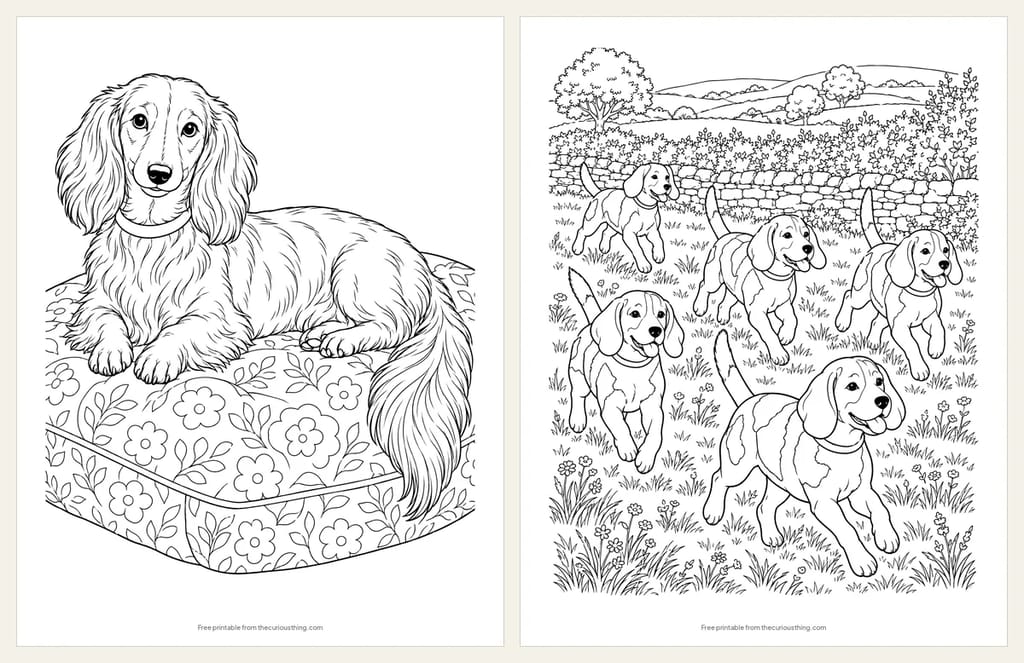
These six hound coloring pages have a long dachshund and a sitting beagle for toddlers, a beagle following a trail of paw prints and a basset hound with ears nearly touching the ground, then a long-haired dachshund on a cushion and a pack of beagles crossing a meadow. Every one of them hunted with its nose, and a dog's nose is extraordinary: dogs have roughly 125 to 300 million smell receptor cells, against about 5 million in people.
"Dachshund" is German for badger dog: the long, low body was bred to follow badgers into their dens. Beagles are English pack hounds bred to hunt rabbits, and breed histories say Queen Elizabeth I kept tiny "pocket" beagles about 9 inches tall. The basset's long ears have a job too. The Basset Hound Club of America says they help stir up scent when the nose is down, and the loose skin under the chin may help hold it, though that's the breed club's explanation rather than a tested finding. Ask your child to draw the trail the beagle is following, and where it ends.
Pug, chihuahua and small dog coloring pages
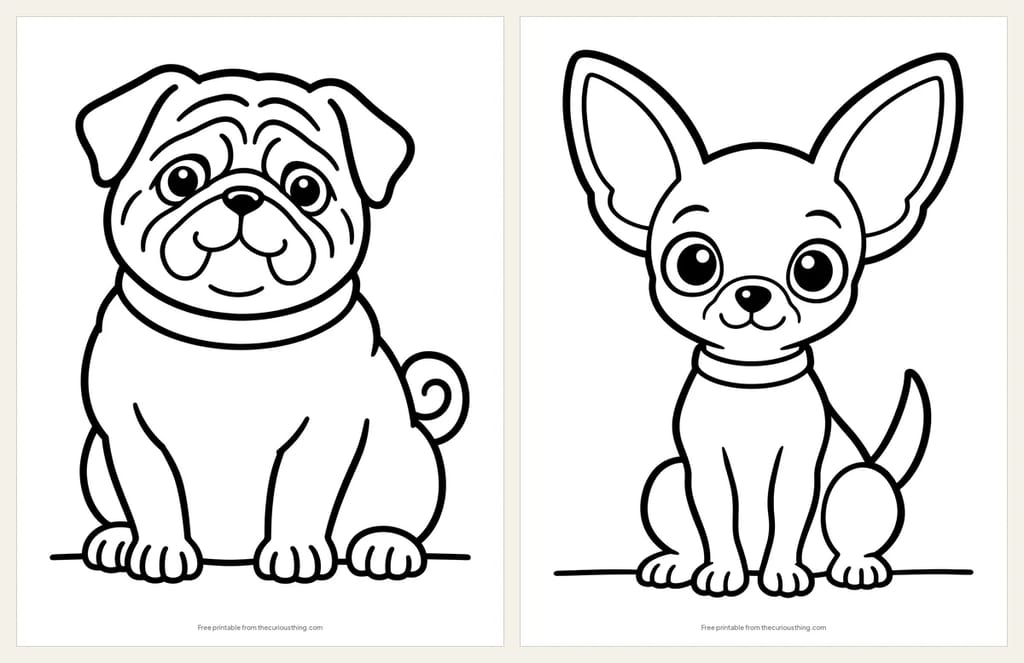
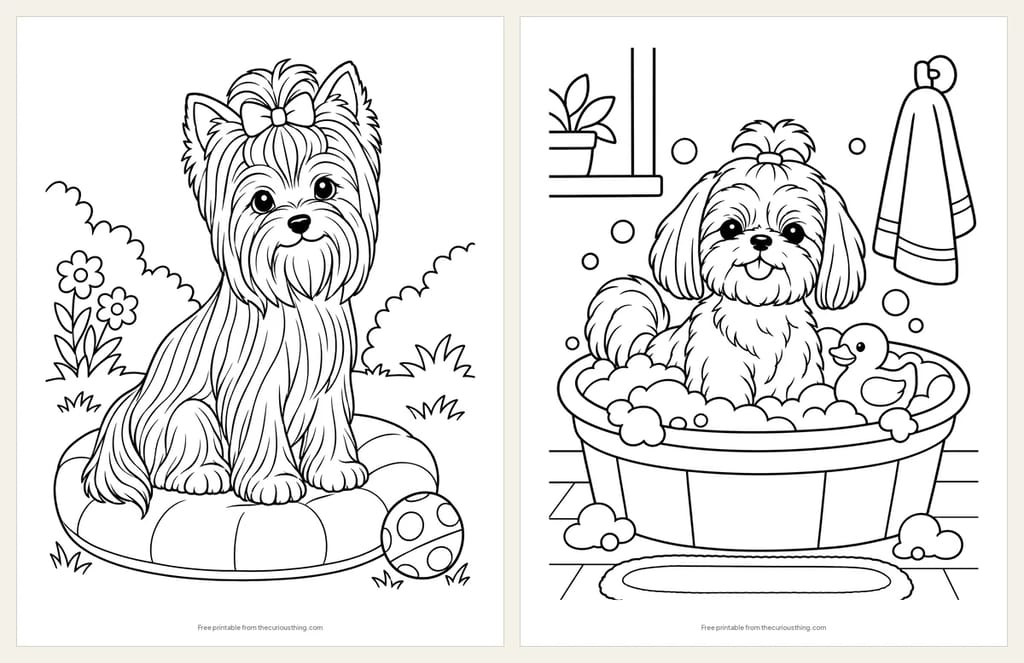
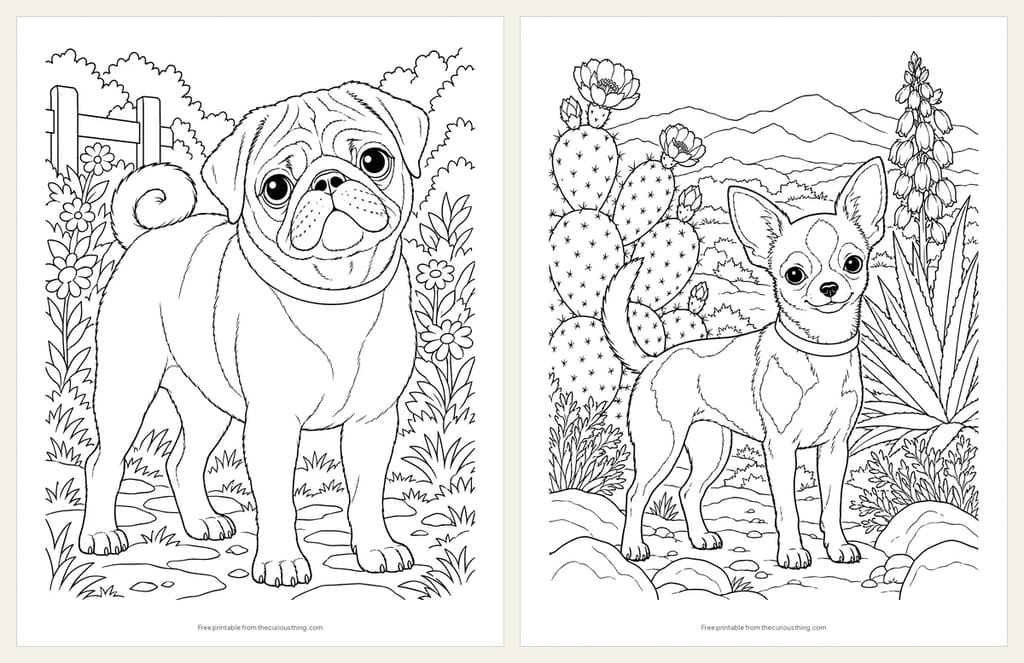
These six small dog coloring pages have a round pug and a big-eared chihuahua for toddlers, a Yorkshire terrier with a bow and a shih tzu in a bubble bath, then a pug by a garden gate and a chihuahua among the cactus flowers. The chihuahua is named after a place: the Mexican state of Chihuahua, where outsiders found the earliest examples of the breed in the 1800s. That's why its detailed page is set in a desert garden, with prickly pear and yucca.
Pugs come from China, where they were bred as companions, and the breed's motto is the Latin multum in parvo, "much in little." Pug books love a story about a pug named Pompey who saved William of Orange in 1572 by leaping onto his face when Spanish soldiers attacked his camp at night. A dog probably did wake him, but the earliest account, written by an English officer and published in 1618, describes "white little hounds, with crooked noses" and gives no name. The pug and the name Pompey came from later retellings.
Can you turn your own dog into a coloring page?
Yes, and it's free. Our photo-to-coloring-page tool redraws one photo of your dog as a coloring page in a world you pick, as an astronaut, a pirate, a firefighter and more, with its face, ears and markings kept and everything around it in black outlines. It takes about 20 seconds, needs no account or email, and downloads as a US Letter PDF to print at 100%. The photo is sent once to draw the page and isn't stored, and nothing is used to train AI. A photo taken at your dog's eye level, with the face in good light, works best, and it works just as well for a cat, a child or the whole family.
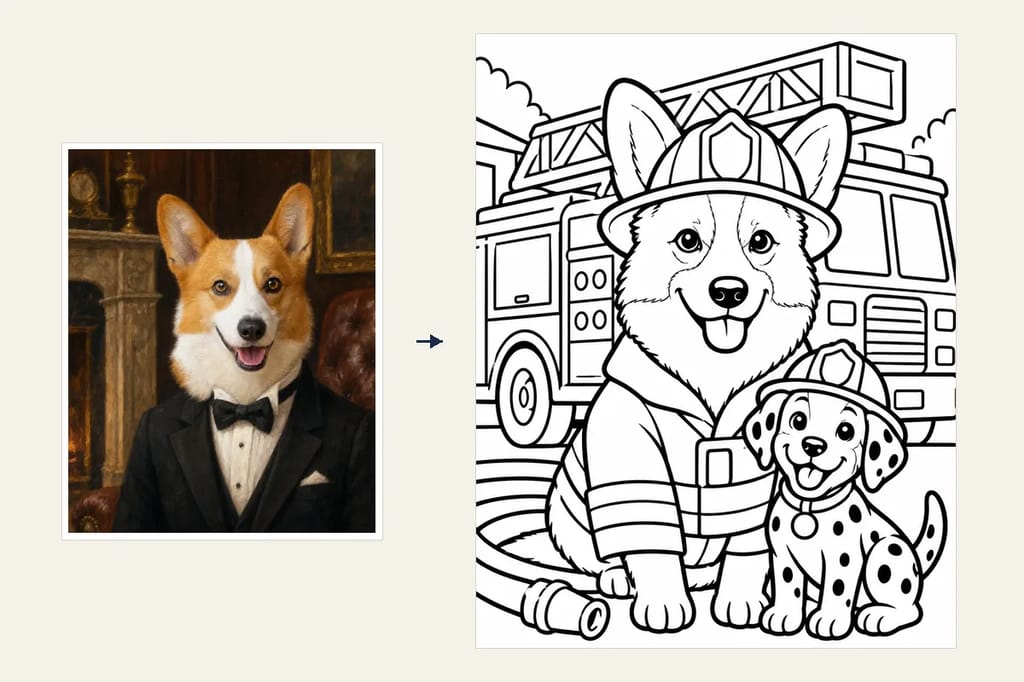
This matters most for the dogs no coloring site draws. The AVMA's 2026 survey estimates 88.9 million pet dogs in 58.9 million US homes, and no breed list covers all of them. The same photo can become a full-color painting too: our gentleman dog portrait dresses your dog in a tuxedo, printed as a canvas, a puzzle or a blanket, and you see a watermarked proof before anything prints.
Dalmatian, poodle and bulldog coloring pages
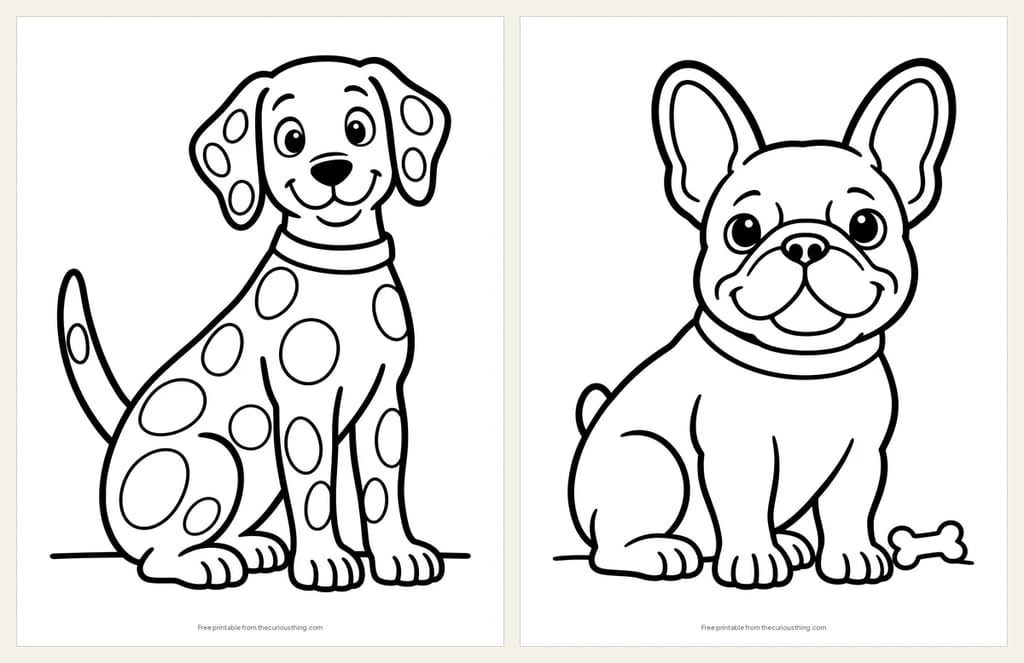
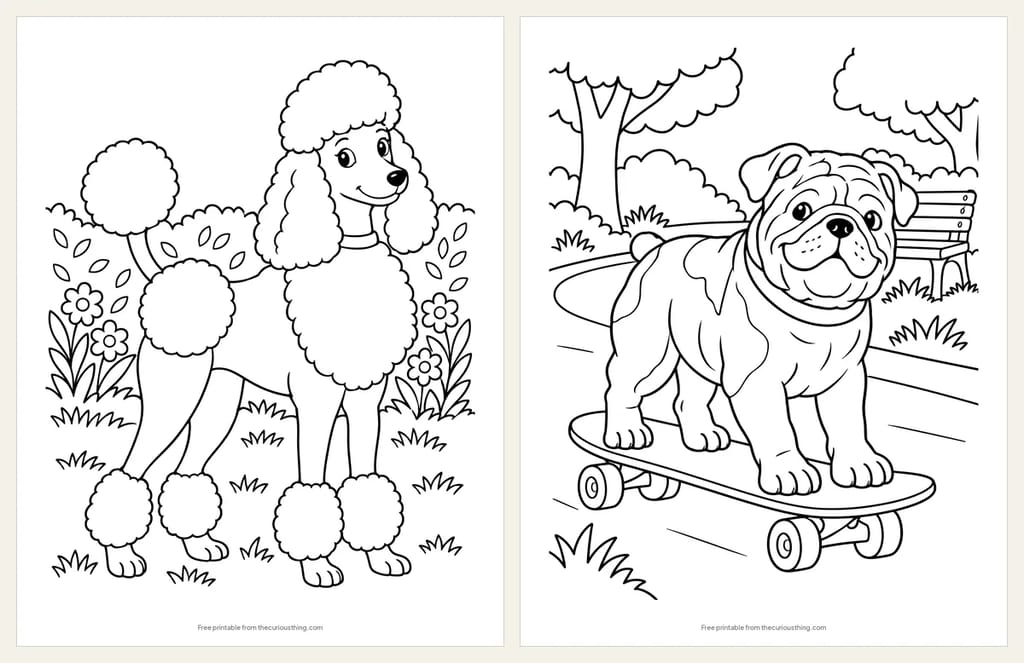
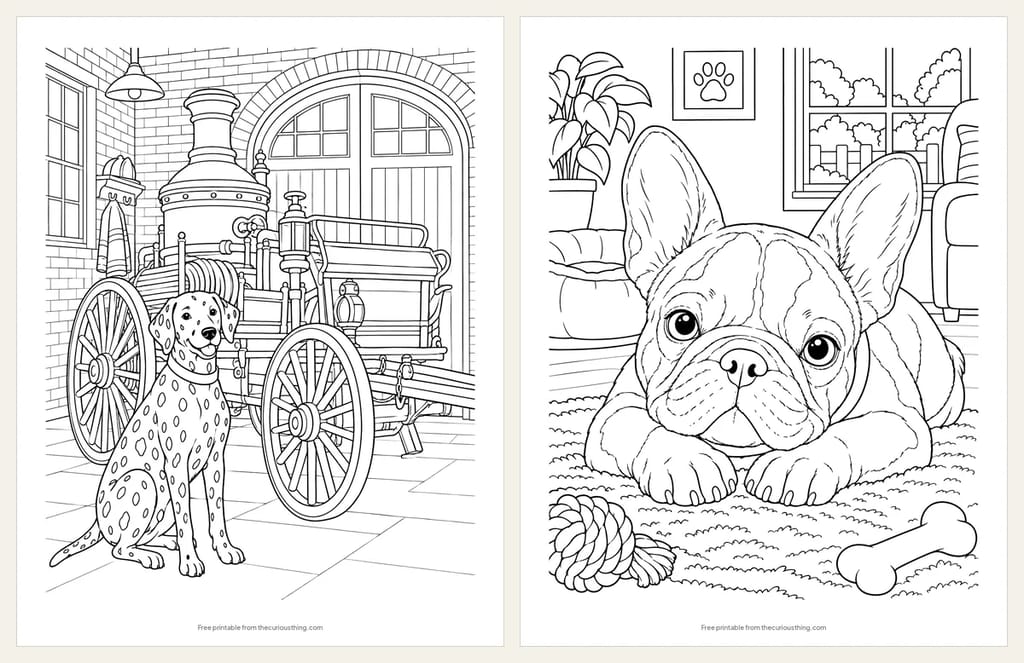
These six pages have an easy Dalmatian whose spots are empty circles and a French bulldog with bat ears, a poodle in a pom-pom clip and a bulldog on a skateboard, then a Dalmatian beside an old horse-drawn fire engine and a French bulldog resting its chin on its paws. Leave the Dalmatian's spots white if you're coloring a newborn: Dalmatian puppies are born completely white, and the spots start to show at about two weeks. The firehouse is real history. Dalmatians were coach dogs that ran beside carriages, and when fire engines were pulled by horses they ran ahead to clear the way and guarded the horses at the fire.
The poodle's fancy clip started as a working cut: hunters trimmed the heavy coat so the dog could swim after ducks, and "poodle" comes from the German Pudel, from a word for splashing. French bulldogs began with toy bulldogs that Nottingham lace makers took to France in the 1800s, and American fans fixed the tall bat ears. The bulldog's name comes from bull-baiting, a cruel sport Britain banned in the Cruelty to Animals Act of 1835.
What colors can dogs see?
Dogs see in color, just fewer colors than we do. A 1989 study at UC Santa Barbara trained three dogs to pick the odd color out of three lit panels and found two kinds of color-sensing cone in their eyes, so dogs see roughly the way a person with red-green color blindness does. The test dogs were two borrowed greyhounds and the researcher's own toy poodle, named Retina. The black-and-white idea had little research behind it.
Here's what your crayons probably look like to the dog in the picture, from a veterinary review of dog vision. It explains why a red ball is hard for a dog to spot on green grass, and why the lead author of a 2017 study suggested a blue one.
| Crayon | To a dog, probably |
|---|---|
| Red | Yellow |
| Orange | Yellow |
| Yellow | Yellow |
| Green | A yellowish shade, hard to tell from red |
| Blue-green | Gray or white |
| Blue | Blue |
| Violet | Blue |
From Miller and Murphy's review of dog vision. Try coloring one page twice, once your way and once "dog colors," with only blues, yellows and grays.
Coloring pages of dogs with jobs
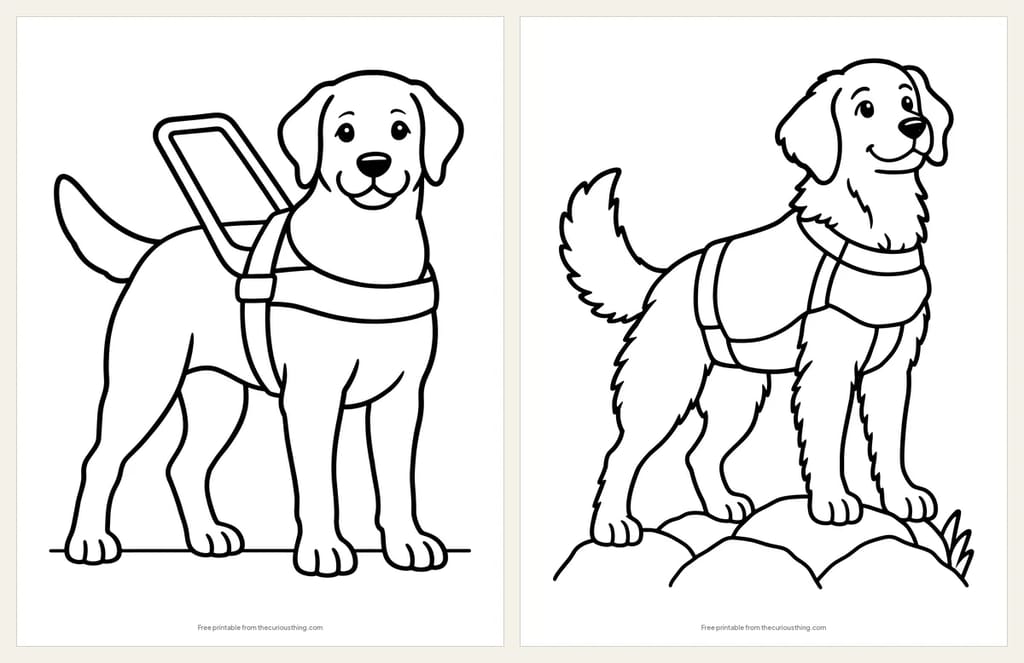
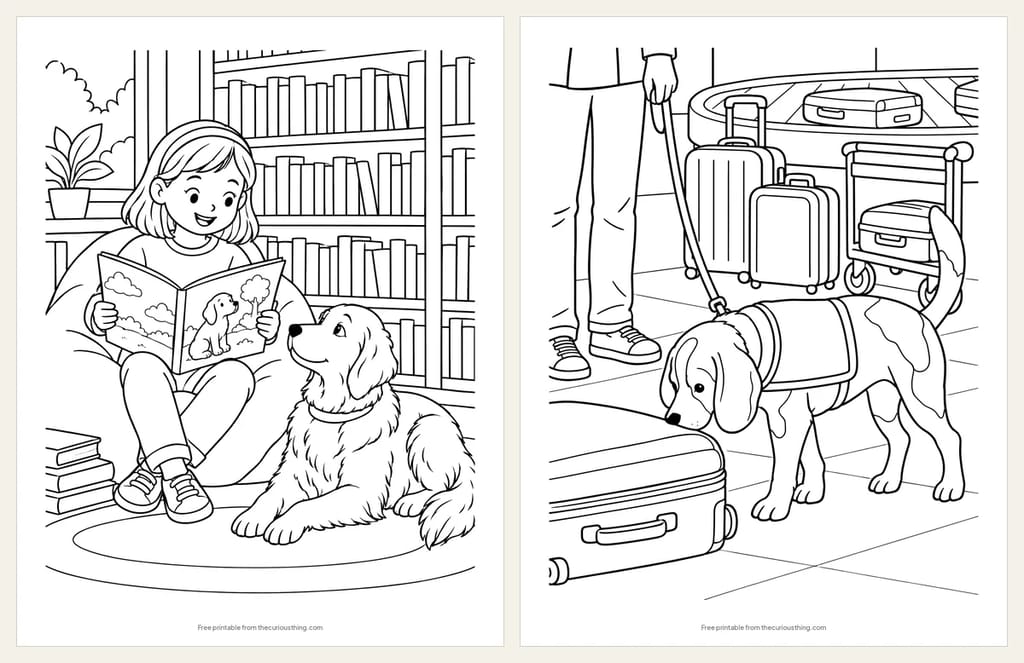
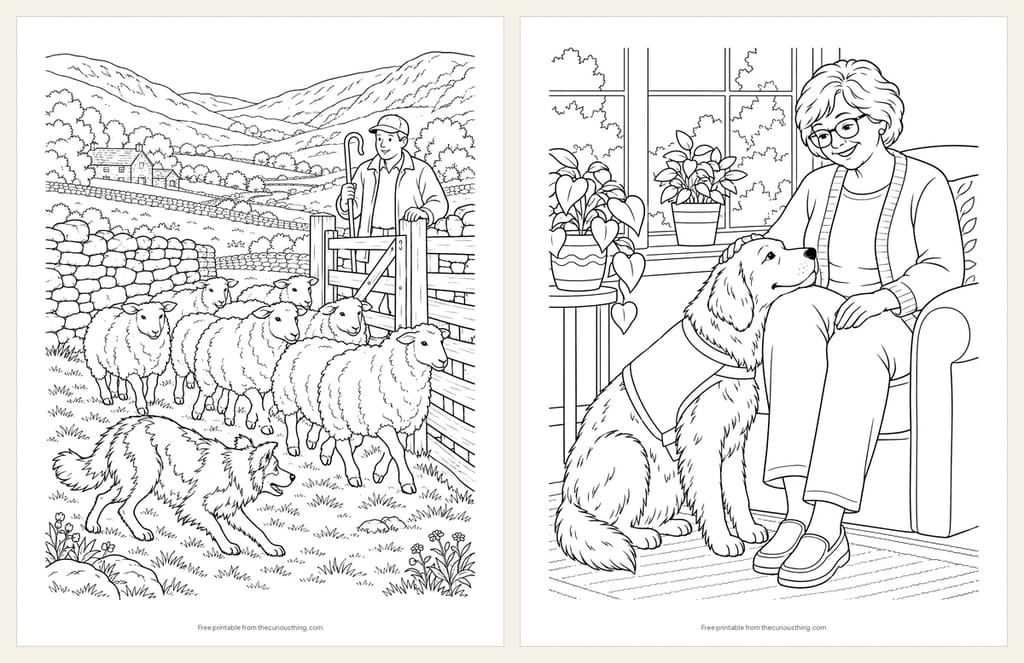
These six coloring pages show dogs at work: a Labrador guide dog in its harness and a rescue dog on the rocks for the youngest, a girl reading to a golden retriever in a library and a beagle checking suitcases at an airport, then a border collie herding sheep and a therapy dog visiting an older woman. The airport beagle is real. The USDA's "Beagle Brigade" began with one beagle at Los Angeles airport in 1984, and these dogs sniff luggage for forbidden fruit, plants and meat, not drugs. When one smells something, it sits down to tell its handler.
What do guide dogs and reading dogs actually do?
Guide dogs learn to say no. The first Seeing Eye dog was a female German shepherd named Buddy. In 1928 she led Morris Frank across busy West Street in New York in front of doubting reporters, and he sent a one-word telegram: "Success". Her successors learn "intelligent disobedience": they refuse to go forward if a car is coming. The R.E.A.D. program brought therapy dogs into a Salt Lake City library in 1999 so children could read aloud to them, and children often find it calming, but a review found the evidence that it improves reading still weak. The champion learner was Chaser, a border collie who knew the names of 1,022 toys.
Dogs at play coloring pages
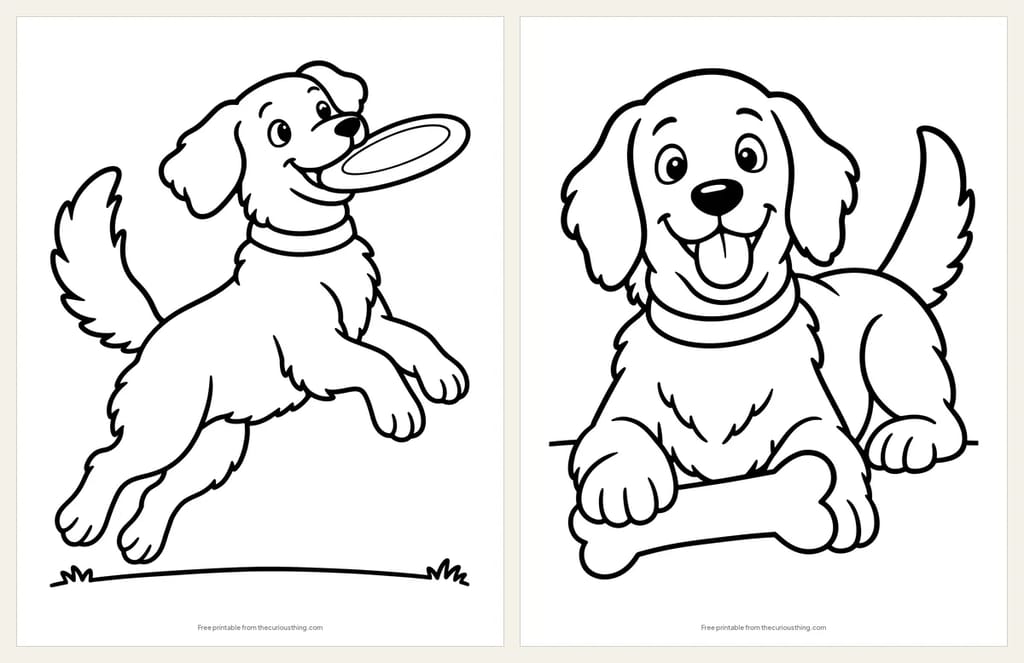
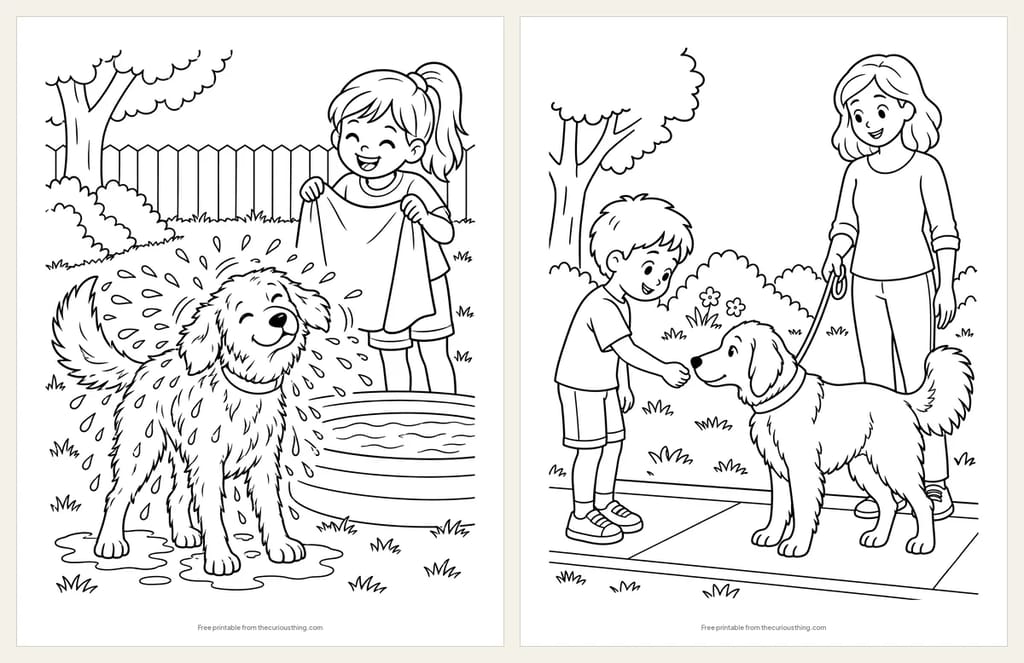
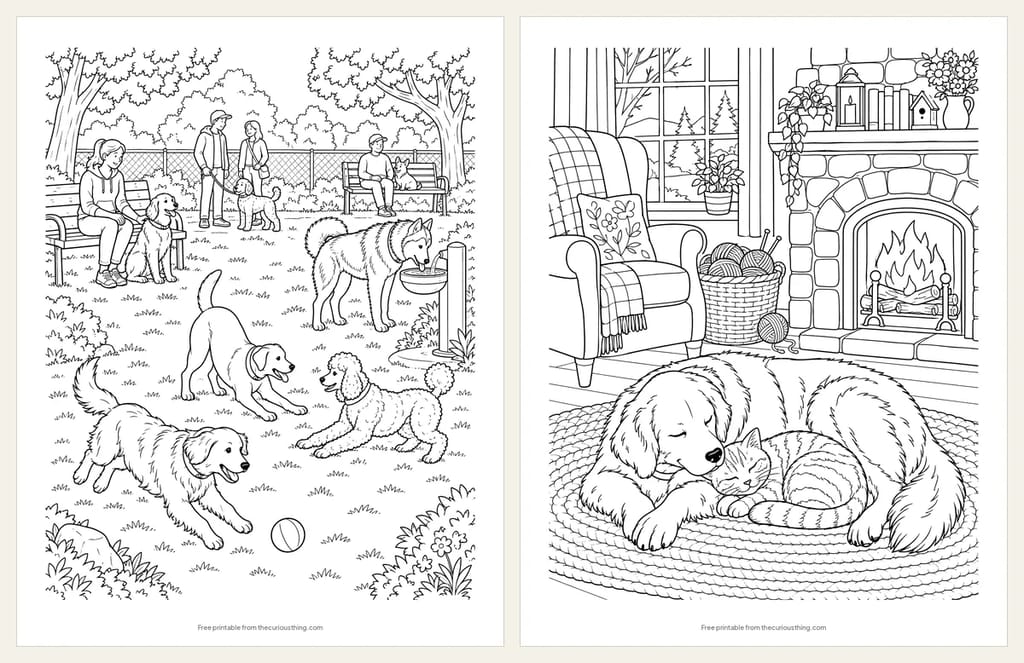
These six pages are pure fun: a dog leaping for a flying disc and a dog with a big bone for toddlers, a wet dog shaking off by the kiddie pool and a boy meeting a dog on a leash, then a busy dog park and a dog and a cat asleep by the fire. In the dog park, two dogs are bowing to each other, front legs down and tails up. That's the play bow, a dog's "let's play" signal, and the scientist Marc Bekoff found dogs also bow right after a rough move to say it's still a game.
The shake is a feat of physics. Filming wet animals in slow motion, a Georgia Tech team found a Labrador shakes about 4.5 times a second, and their lab tests suggest a good shake can fling off about 70% of the water in a dog's fur. As for the dog and cat by the fire, in a study of nearly 200 homes with both, about two-thirds reported a friendly relationship and only about 10% fighting, and things went best when the cat came first.
How should kids greet a dog they don't know?
Ask the owner first, then let the dog come to the child. The CDC's four steps are to ask first, let the dog approach, stay still, and pet only after it has sniffed you, and the AVMA adds that gentle petting on the back or shoulders is safest, away from the face, tail and ears. The "Ask before you pet" page shows that moment: the boy has asked, the owner is smiling, and the dog gets to sniff before any petting.
Two lessons are worth saying out loud while your child colors. A dog showing its teeth isn't smiling. In a University of Lincoln study, 69% of 4-year-olds read angry dog faces as happy. And a wagging tail doesn't always mean a happy dog: the AVMA says the same wag can mean anxiety in another dog, and it adds that breed doesn't predict whether a dog will bite. Most bites to young children come from familiar dogs during everyday activities, so these rules start with the family dog.
Dog coloring pages for adults
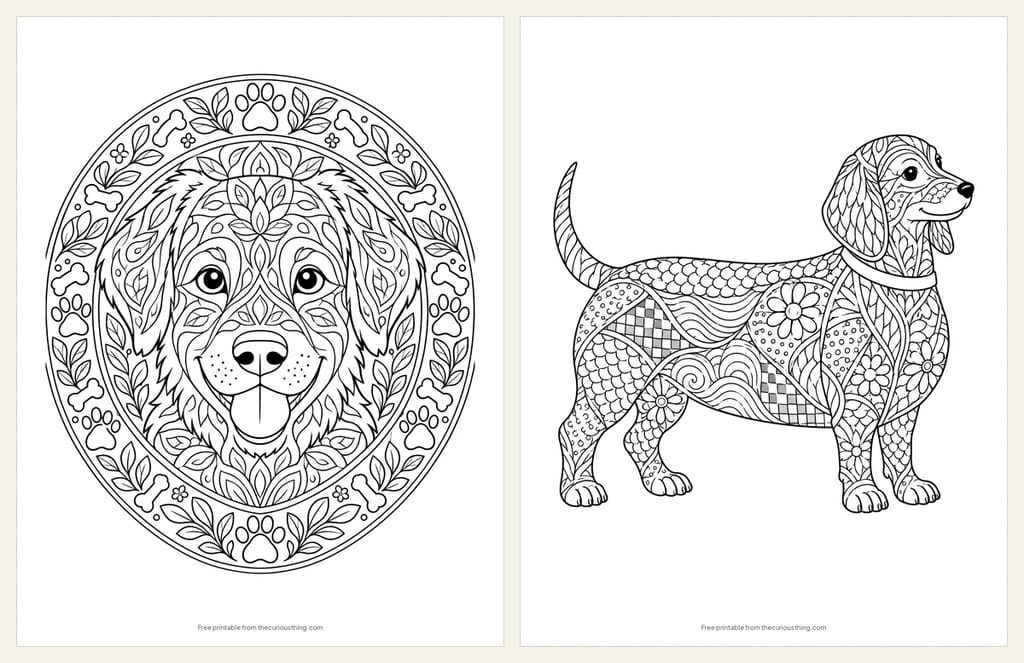
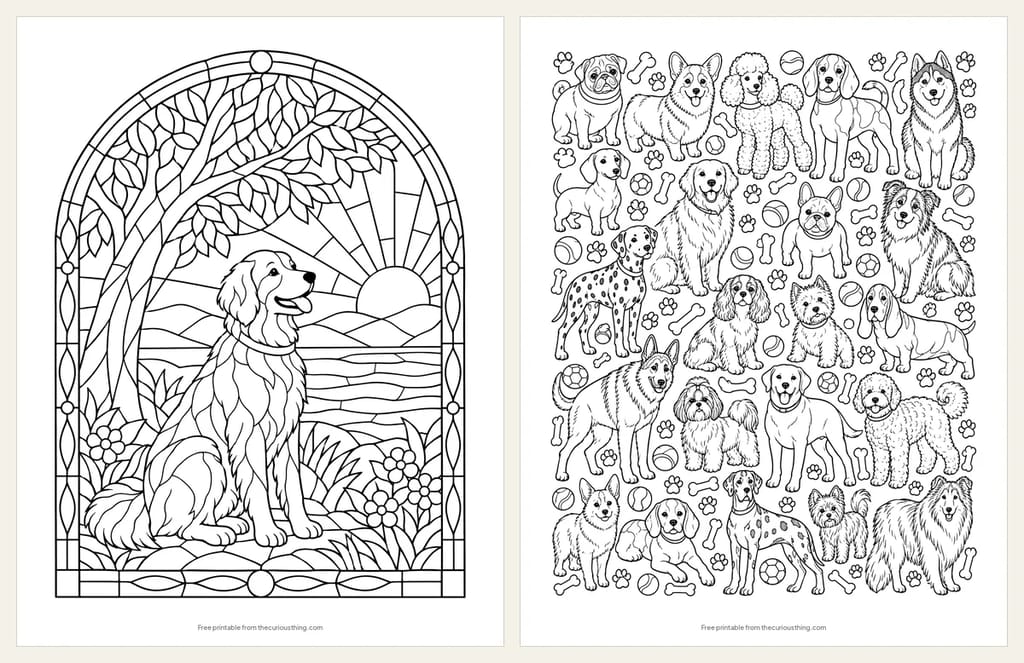
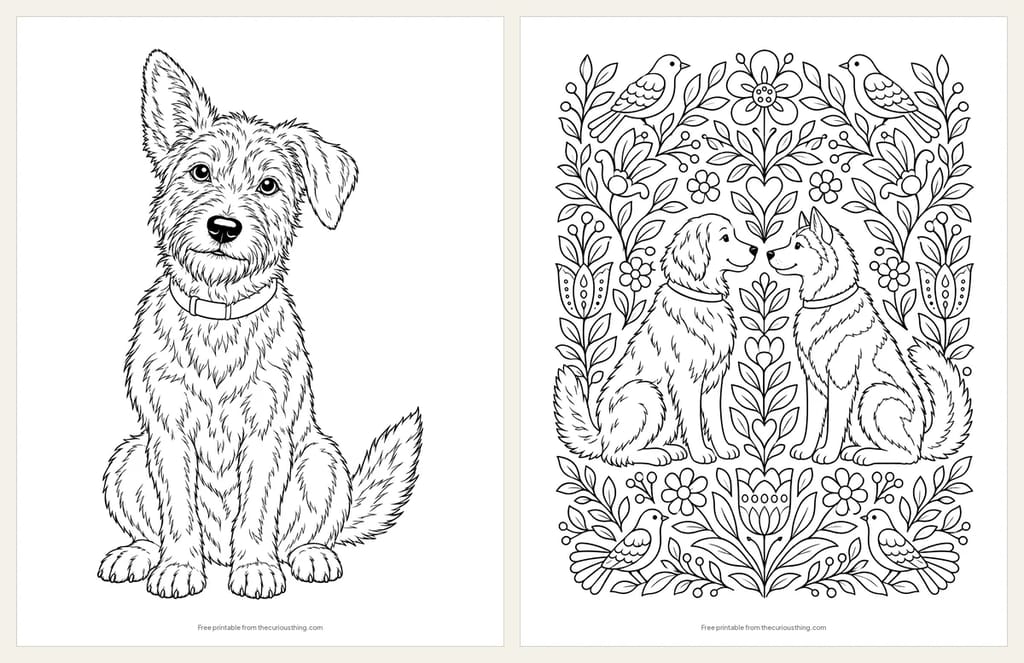
These six dog coloring pages for adults are full of small spaces: a dog's face filled with mandala patterns, a dachshund in zentangle sections, a stained-glass window with a dog under a tree, an all-over pattern of breeds, bones and balls, a realistic scruffy shelter dog with one ear up and one ear down, and two folk-art dogs among flowers and birds. Fine-tipped markers or sharpened colored pencils suit them better than crayons.
If you're coloring the shelter dog's nose, there's a reason to take care with it. The pattern of bumps and grooves on a dog's nose looks unique, like a fingerprint: in a 2021 study, a computer told 70 dogs of 19 breeds apart by nose photos alone with no mistakes, and an earlier study of sibling beagle puppies found the pattern fully formed by two months and unchanged through 11 months. That's encouraging, but it's 70 dogs, far from fingerprint-scale proof, and lost dogs are still found by microchip.
What do dog coloring pages get wrong?
Dog pages repeat dog stories, and some of the best-loved ones are wrong or stretched. A barrel on the St. Bernard turns up on coloring sites, one husky page leaves out brown eyes, and the rest of these come up whenever kids ask about dogs. Here's what the sources say.
| What the page or story says | What the evidence shows |
|---|---|
| St. Bernards carried brandy barrels | They never did; the barrel is traced to Landseer's 1820 painting |
| Dalmatians are born with their spots | Puppies are born completely white; spots start at about two weeks |
| Huskies have blue eyes | The standard allows brown, blue, one of each, or both in one eye |
| Dogs see in black and white | They see blues and yellows, much like red-green color blindness |
| Balto ran the hardest leg to Nome | Togo's team ran about 261 miles, including the riskiest stretch; Balto ran the last 53 or so |
| Labradors come from Labrador | They come from the St. John's water dog of Newfoundland |
| Golden retrievers came from Russian circus dogs | Kennel records show they began at Guisachan in 1868 |
| A pug named Pompey saved William of Orange | The first account names no dog and describes small white hounds |
| One dog year equals seven human years | For a medium dog, the first year is about 15 human years, about 24 by two, then about 5 a year |
| A wagging tail means a happy dog | The same wag can mean anxiety in another dog |
| Cats and dogs are natural enemies | About two-thirds of homes with both report a friendly relationship |
| Airport beagles sniff for drugs | They hunt for fruit, plants and meat |
| Crayons are poisonous to dogs | Children's crayons are generally non-toxic; watch for a blockage |
Frequently asked questions
Are these dog coloring pages free?
+
Yes. All 60 are free to print, with no email, account or sign-up. Tap a page's title to open the full-size file and print it at 100% or Actual size on US Letter paper. Print as many as you like for home or a classroom; please don't sell them.
What age are dog coloring pages for?
+
Easy pages, one big dog in thick lines, suit ages 2 to 4. Medium pages, a dog in a simple scene, suit ages 4 to 7. Detailed pages, realistic dogs and busy scenes, suit ages 8 to adult, and the last section is drawn for teens and adults. Treat the ages as a starting point and let your child pick the dog.
Which dog breeds are in these coloring pages?
+
Golden retrievers, Labradors, a goldendoodle, German shepherds, corgis, border collies, an Australian shepherd, huskies, St. Bernards, a Bernese mountain dog, dachshunds, beagles, a basset hound, pugs, chihuahuas, a Yorkshire terrier, a shih tzu, Dalmatians, a poodle, an English bulldog and French bulldogs, plus mixed breeds and a shelter dog. Each was drawn to look like its breed and checked by hand.
Can I make a coloring page of my own dog?
+
Yes. Our free photo-to-coloring-page tool turns one photo of your dog into a printable page in about 20 seconds, with its face, ears and markings kept, in a world you pick such as space or a pirate ship. It needs no email, and the photo isn't stored.
What color should I color a dog?
+
Any color your child likes, but if you want real coat colors: golden retrievers are light to dark gold, Labradors black, yellow or chocolate, Dalmatians white with black or liver spots, and huskies' eyes can be brown, blue or one of each. Our dog names by color list covers the common coat colors and the names that go with them.
Will these print on A4 paper?
+
Yes. The pages are sized for US Letter, 8.5 by 11 inches. A4 is a little narrower and a little taller, so choose Fit or Fit to printable area in the print settings, and the page shrinks slightly with nothing cut off.
Were these coloring pages made with AI?
+
Yes. We wrote a description of every page and drew it with an AI image model, the same one behind our free photo-to-coloring-page tool, then checked each page by hand. Pages with mistakes were redrawn: eight came back with people nobody asked for, mostly an owner standing beside a dog's portrait, and a pug portrait came back as a whole pug in a garden, so we renamed it.
Do dogs really see in black and white?
+
No. Dogs have two kinds of color-sensing cone where people have three, so they see blues and yellows, while reds, oranges and greens probably all look like shades of yellow. It's similar to red-green color blindness in people. A blue ball is easier for a dog to spot on grass than a red one.