

In short
These are the full lyrics to 31 classic lullabies, including Twinkle, Twinkle, Little Star (all five verses), Brahms' Lullaby, Rock-a-bye Baby, All Through the Night and All the Pretty Little Horses. Every one is in the US public domain, and each set of words links to an early printing you can open and check. We also correct the origin stories that get repeated from list to list, and name the famous "lullabies" we left out because they are still under copyright.
We read the lullaby lyric pages that rank on Google before writing this one, including BabyCenter, The Bump, Lovevery and Mommyhood101. None of them links a single lyric to the book it was printed in. Most mix in songs that are still under copyright, such as "You Are My Sunshine" and "Baby Mine". Several repeat stories that fall apart when you check them: that Rock-a-bye Baby describes mothers hanging cradles in trees while they worked the fields, that Brahms set the words of "Schlaf, Kindlein, schlaf," that Lavender's Blue is a Disney song.
So every lullaby here meets three rules. The words were printed in 1930 or earlier, which puts them in the US public domain as of 2026 (works from 1930 entered it on January 1). The lyrics match a printing we could open, linked under each song. The origin note is one we could source. Where the words people sing today differ from the old printing, we say so.
What are the best-known lullabies?
These six are the ones most parents half-remember at 2 a.m. Each has its full words, not just the first verse.
Twinkle, Twinkle, Little Star
Twinkle, twinkle, little star,
How I wonder what you are!
Up above the world so high,
Like a diamond in the sky.When the blazing sun is gone,
When he nothing shines upon,
Then you show your little light,
Twinkle, twinkle, all the night.Then the trav'ller in the dark,
Thanks you for your tiny spark:
He could not see which way to go,
If you did not twinkle so.In the dark blue sky you keep,
And often through my curtains peep,
For you never shut your eye
Till the sun is in the sky.As your bright and tiny spark
Lights the trav'ller in the dark,
Though I know not what you are,
Twinkle, twinkle, little star.
Words: Jane Taylor, "The Star," first published in 1806 in Rhymes for the Nursery, which she wrote with her sister Ann. Text from the 1831 edition on Project Gutenberg. Most people sing only the first verse, then repeat its first two lines after each of the others.
The tune: the French melody "Ah! vous dirai-je, maman," first published in 1761. Mozart did not write it. He wrote twelve piano variations on it around 1781-82, when the tune was already about twenty years old. Taylor's words weren't printed with that melody until 1838, according to the song's publication history.
Brahms' Lullaby (Lullaby and Good Night)
Lullaby and good night!
With roses bedight,
With lilies o'erspread,
Is baby's wee bed.
Lay thee down now and rest;
May thy slumber be blest!
Lay thee down now and rest;
May thy slumber be blest!Lullaby and good night!
Thy mother's delight!
Bright angels beside
My darling abide;
They will guard thee at rest,
Thou shalt wake on my breast.
They will guard thee at rest,
Thou shalt wake on my breast.
Words: this English singing version is printed in Songs of Harvard (copyright 1888), translator not named. Brahms set a German text: the first verse, "Guten Abend, gut' Nacht, mit Rosen bedacht," comes from the folk collection Des Knaben Wunderhorn (1808). The newer lines you may know ("Sleepyhead, close your eyes," "pink roses") don't appear in any printing we found from before 1931.
The story: Brahms never married and had no children. He wrote the song in 1868 for his friend Bertha Faber when her second son was born, and wove into it, as a hidden counter-melody, a love song she used to sing to him years earlier, according to the history of the Wiegenlied. He reused the melody in his Symphony No. 2.
Rock-a-bye Baby
Rock-a-bye, baby, on the tree top,
When the wind blows the cradle will rock,
When the bough breaks the cradle will fall,
And down will come baby, cradle and all.
Words: this exact wording is the refrain of Effie I. Canning's 1886 sheet music, "Rock-a-Bye Baby: Song and Lullaby." The rhyme itself is far older. It appears as "Hush a by Baby / On the Tree Top" in Mother Goose's Melody, a London book of about 1765 reprinted in Worcester, Massachusetts around 1785 (1889 facsimile). The Real Mother Goose (1916) still printed it as "Hush-a-bye, baby."
The story: the rhyme was in print a century before Canning, so she didn't write it. She wrote a tune and a parlor song around it. The earliest surviving London edition of Mother Goose's Melody, from 1791, adds a note under the rhyme: "This may serve as a warning to the proud and ambitious, who climb so high that they generally fall at last."
All Through the Night
Sleep, my child, and peace attend thee,
All through the night;
Guardian angels God will send thee,
All through the night.
Soft the drowsy hours are creeping,
Hill and vale in slumber steeping,
I my loving vigil keeping,
All through the night.While the moon her watch is keeping,
All through the night;
While the weary world is sleeping,
All through the night.
O'er thy spirit gently stealing,
Visions of delight revealing,
Breathes a pure and holy feeling,
All through the night.
Words: Sir Harold Boulton, 1884. Text from Gold Nuggets of Literature (1912). That printing has a third verse about a child's death, which we've left off.
The tune: the Welsh air "Ar Hyd y Nos," first written down by the harpist Edward Jones in 1784. Boulton's English is not a translation. The best-known Welsh words, by John Ceiriog Hughes, are a different poem about the stars and old age.
Sleep, Baby, Sleep
Sleep, baby, sleep!
Thy father watches his sheep;
Thy mother shakes the dreamland tree,
And down falls a little dream on thee.
Sleep, baby, sleep!Sleep, baby, sleep!
The large stars are the sheep;
The little stars are the lambs, I guess,
And the bright moon is the shepherdess.
Sleep, baby, sleep!
Words: an anonymous English version printed in Picture Studies from Great Artists (1917). An earlier translation from 1864 has "Thy father guards the sheep."
The story: it is the German "Schlaf, Kindlein, schlaf," which Des Knaben Wunderhorn printed in 1808 under the title "Morning song of the little sheep" (Bavarian State Library scan). The stars-as-sheep verse comes straight from the German second verse.
Skye Boat Song
Speed, bonnie boat, like a bird on the wing,
Onward, the sailors cry;
Carry the lad that's born to be king
Over the sea to Skye.Loud the winds howl, loud the waves roar,
Thunder-clouds rend the air;
Baffled, our foes stand by the shore;
Follow, they will not dare.Though the waves leap, soft shall ye sleep;
Ocean's a royal bed;
Rocked in the deep, Flora will keep
Watch by your weary head.
Sing the chorus ("Speed, bonnie boat...") again after each verse. The 1888 source says, "The chorus begins the song and comes in at the end of each verse."
Words: Sir Harold Boulton, published in Songs of the North in 1884. Text from The Music of the Waters (1888), p. 91.
The story: it sounds like a 1746 Jacobite song about Bonnie Prince Charlie escaping with Flora MacDonald, but it was written in the 1880s. Anne MacLeod heard boatmen on Skye singing a Gaelic rowing tune, and Boulton wrote English words for their 1884 book. It's often sung slowly as a lullaby, in a rocking 6/8.
What does a baby hear in a lullaby?
A baby hears the shape of the music long before the words mean anything. Researchers have measured this directly. In a 2009 study, sleeping newborns two or three days old showed a brain response when the downbeat of a drum rhythm was left out, which means they were already expecting the beat. In a 1984 study, infants aged 8 to 11 months treated a tune moved higher or lower as the same melody, but noticed when its up-and-down shape changed.
Lullabies also share a sound across cultures. In a 2018 study in Current Biology, 750 listeners in 60 countries heard 14-second clips of songs from societies they didn't know, and could tell which ones were meant to soothe a baby. Other listeners rated those lullabies slower and simpler than the rest. When 144 American babies heard unfamiliar lullabies from faraway cultures, their heart rates slowed and their pupils got smaller. The babies were 2 to 14 months old.
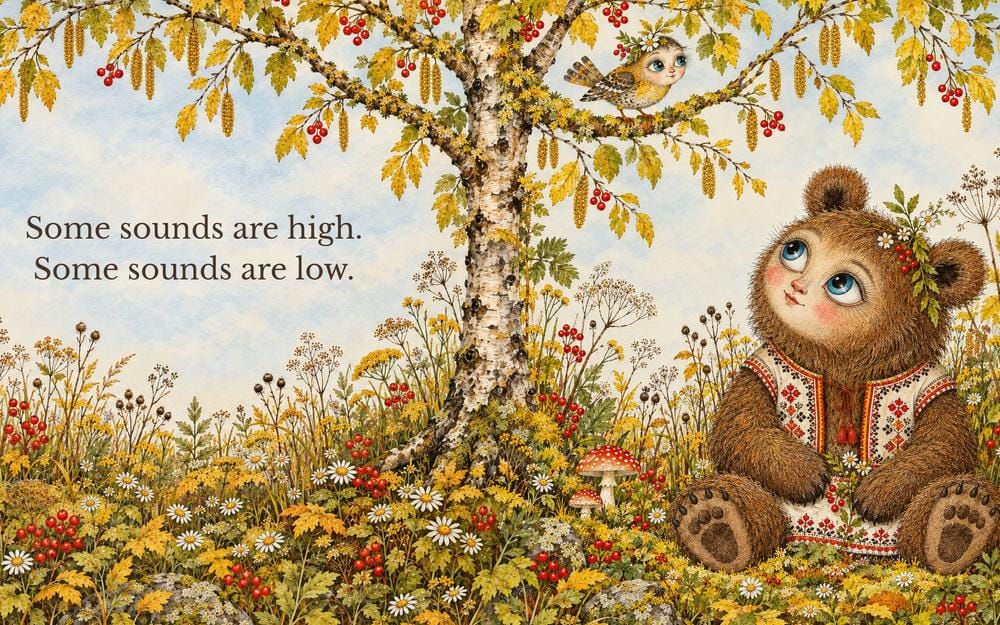
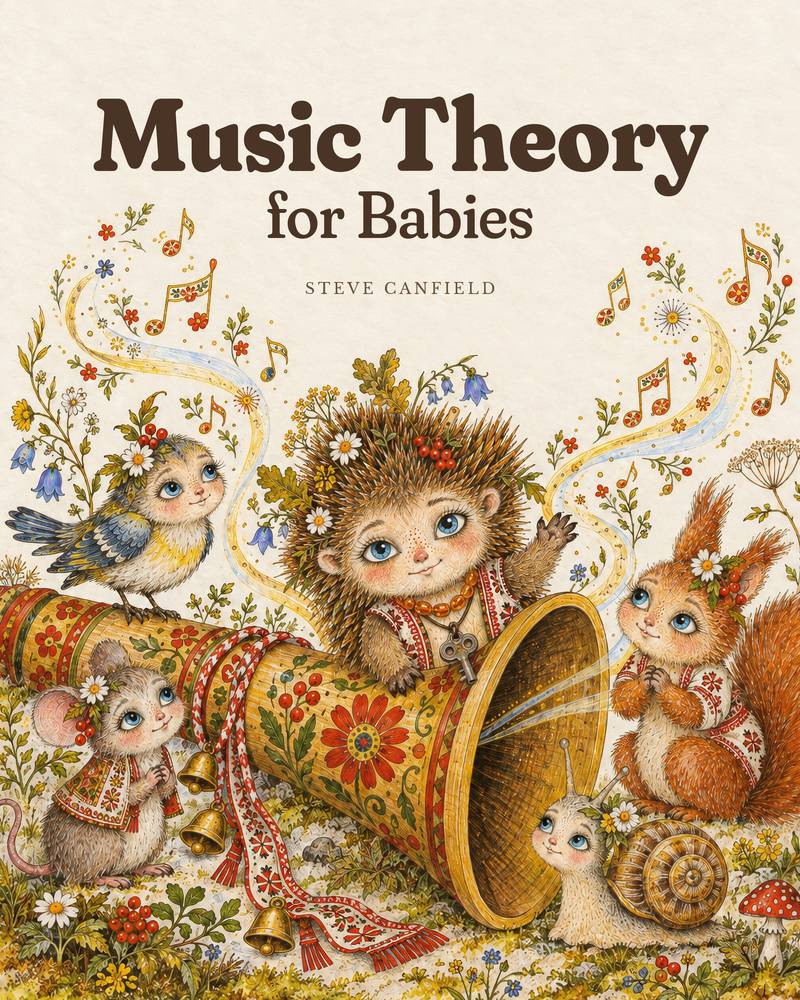
The ideas a baby is picking up on have names: high and low, loud and quiet, long and short, the beat, the melody. Our co-founder Steve Canfield wrote a picture book about exactly that. Music Theory for Babies gives each idea one line to read aloud: "Some sounds are high. Some sounds are low." Then it moves through rhythm, melody, the scale, the octave, harmony and chords, with a detailed folk-art picture on every spread for you and your baby to look at together. It's a 28-page paperback for babies to age 3, and it pairs well with any song on this page. After "Twinkle," you can point out that the tune jumps up high on the second "twinkle" and walks back down, step by step, by "what you are."
Which lullabies started as poems?
These four started as poems. Two have well-known musical settings, and all four work read aloud in a low voice.
Golden Slumbers
Golden slumbers kiss your eyes,
Smiles awake you when you rise.
Sleep, pretty wantons, do not cry,
And I will sing a lullaby.
Rock them, rock them, lullaby.Care is heavy, therefore sleep you;
You are care, and care must keep you.
Sleep, pretty wantons, do not cry,
And I will sing a lullaby:
Rock them, rock them, lullaby.
Words: Thomas Dekker, from the play Patient Grissil, first printed in 1603. Text from Walter de la Mare's anthology Come Hither (1923). "Wantons" here just means playful little ones.
The story: the Beatles' 1969 "Golden Slumbers" on Abbey Road is Paul McCartney's reworking of this poem. He saw the sheet music on the piano at his father's house, couldn't read it, and wrote his own tune. The album doesn't credit Dekker, according to the song's history. Only Dekker's words above are public domain.
Wynken, Blynken, and Nod
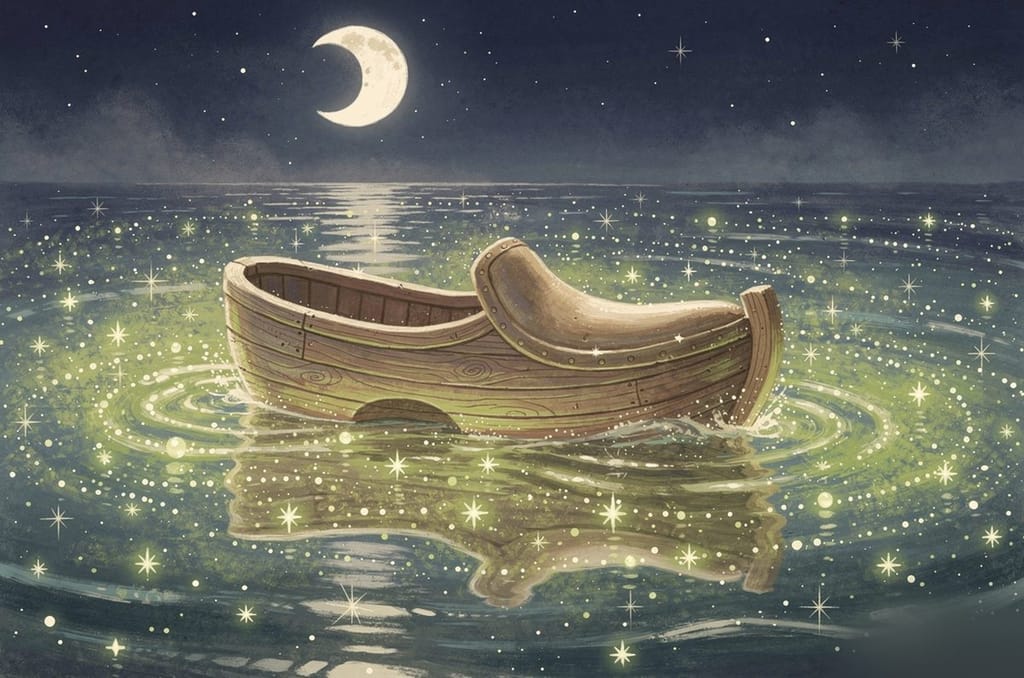
Wynken, Blynken, and Nod one night
Sailed off in a wooden shoe,
Sailed on a river of crystal light
Into a sea of dew.
"Where are you going, and what do you wish?"
The old moon asked the three.
"We have come to fish for the herring fish
That live in this beautiful sea;
Nets of silver and gold have we!"
Said Wynken,
Blynken,
And Nod.The old moon laughed and sang a song,
As they rocked in the wooden shoe;
And the wind that sped them all night long
Ruffled the waves of dew.
The little stars were the herring fish
That lived in that beautiful sea.
"Now cast your nets wherever you wish,
Never afeard are we!"
So cried the stars to the fishermen three,
Wynken,
Blynken,
And Nod.All night long their nets they threw
To the stars in the twinkling foam,
Then down from the skies came the wooden shoe,
Bringing the fishermen home;
'Twas all so pretty a sail it seemed
As if it could not be,
And some folks thought 'twas a dream they'd dreamed
Of sailing that beautiful sea;
But I shall name you the fishermen three:
Wynken,
Blynken,
And Nod.Wynken and Blynken are two little eyes,
And Nod is a little head,
And the wooden shoe that sailed the skies
Is a wee one's trundle-bed.
So shut your eyes while mother sings
Of wonderful sights that be,
And you shall see the beautiful things
As you rock in the misty sea,
Where the old shoe rocked the fishermen three:
Wynken,
Blynken,
And Nod.
Words: Eugene Field, from With Trumpet and Drum (1892).
The story: it was first printed as "A Dutch Lullaby," but nothing about it is Dutch. Field was a Chicago newspaper columnist, and the poem ran in the Chicago Daily News before the humor magazine Judge reprinted it in April 1889. The last verse gives the joke away: the three fishermen are a sleepy child's two blinking eyes and nodding head.
Sweet and Low
Sweet and low, sweet and low,
Wind of the western sea,
Low, low, breathe and blow,
Wind of the western sea!
Over the rolling waters go,
Come from the dying moon, and blow,
Blow him again to me;
While my little one, while my pretty one, sleeps.Sleep and rest, sleep and rest,
Father will come to thee soon;
Rest, rest, on mother's breast,
Father will come to thee soon;
Father will come to his babe in the nest,
Silver sails all out of the west
Under the silver moon:
Sleep, my little one, sleep, my pretty one, sleep.
Words: Alfred Tennyson, a song added to The Princess in its 1850 edition.
The music: the best-known setting is Joseph Barnby's part-song for four voices, first published in 1865.
The Seal Lullaby
Oh! hush thee, my baby, the night is behind us,
And black are the waters that sparkled so green.
The moon, o'er the combers, looks downward to find us
At rest in the hollows that rustle between.
Where billow meets billow, then soft be thy pillow,
Ah, weary wee flipperling, curl at thy ease!
The storm shall not wake thee, nor shark overtake thee,
Asleep in the arms of the slow-swinging seas!
Words: Rudyard Kipling, the verse that opens "The White Seal" in The Jungle Book (1894), sung by a mother seal to her pup.
The music: Eric Whitacre's choral setting premiered in 2008. He wrote it for a planned animated film of the story that the studio never made. His music is under copyright, but Kipling's words are not.
What are good short lullabies and bedtime rhymes?
Short enough to sing twice while the baby settles. Most are English nursery rhymes from the 1700s. One of them is American.
Bye, Baby Bunting
Bye, baby bunting,
Father's gone a-hunting,
Mother's gone a-milking,
Sister's gone a-silking,
And brother's gone to buy a skin
To wrap the baby bunting in.
Words: The Real Mother Goose (1916). An older short version from 1843 runs: "Bye baby bunting, / Father's gone a hunting, / To get a little rabbit-skin, / To lap his little baby in." A version was printed in England in 1731. "Bunting" is a pet name, one that may also mean plump, according to the rhyme's history.
Baa, Baa, Black Sheep
Baa, baa, black sheep, have you any wool?
Yes, sir, yes, sir, three bags full:
One for my master, one for my dame,
And one for the little boy that lives in our lane.
Words: Mother Goose's Nursery Rhymes (1877). The rhyme was first printed around 1744 with nearly the same words. It shares its tune with Twinkle, which is why both open with the same jump from low to high on the first four notes. The claim that it's about slavery has no historical support.
Lavender's Blue
Lavender's blue, dilly dilly, lavender's green,
When I am king, dilly dilly, you shall be queen:
Who told you so, dilly dilly, who told you so?
'Twas mine own heart, dilly dilly, that told me so.Call up your men, dilly dilly, set them to work,
Some with a rake, dilly dilly, some with a fork;
Some to make hay, dilly dilly, some to thresh corn,
Whilst you and I, dilly dilly, keep ourselves warm.
Words: James Orchard Halliwell, Popular Rhymes and Nursery Tales (1849). It isn't a Disney song. The folk song goes back to a 1670s broadside. Disney's "Lavender Blue (Dilly Dilly)" from 1948 is a new, copyrighted song that borrows the idea.
Wee Willie Winkie
Wee Willie Winkie runs through the town,
Upstairs and downstairs, in his nightgown;
Rapping at the window, crying through the lock,
"Are the children in their beds? Now it's eight o'clock."
Words: The Real Mother Goose (1916). The Glasgow poet William Miller published the original Scots poem in 1841, and in his version it's ten o'clock. Willie Winkie is sleep itself, a Scottish cousin of the Sandman.
I See the Moon
I see the moon, and the moon sees me,
God bless the moon, and God bless me!
Words: Gammer Gurton's Garland, first printed in 1784. Don't confuse it with "I See the Moon (Over the Mountain)," a separate song Meredith Willson wrote in 1953, which is still under copyright.
Star Light, Star Bright
Star light, star bright,
First star I see tonight;
I wish I may, I wish I might,
Have the wish I wish tonight.
Words: Horace Scudder, Verse and Prose for Beginners in Reading (1893). It gets filed with English nursery rhymes, but it's American, first recorded in 1866. An 1896 book of New England folklore records it as a wish to say on seeing the evening's first star.
Dance to Your Daddy
Dance to your daddy,
My little babby,
Dance to your daddy;
My little lamb.You shall have a fishy,
In a little dishy;
You shall have a fishy
When the boat comes in.
Words: Halliwell, The Nursery Rhymes of England (1886). The song comes from the fishing towns of north-east England and was printed in Songs of the Bards of the Tyne in 1849. The longer verses heard in a TV fish advert and on children's albums aren't in the old printings.
Which American folk songs work as lullabies?
Sung in American homes long before anyone wrote them down. The words below come from the collectors who first printed them.
All the Pretty Little Horses
Hush-a-by, don't you cry,
Go to sleepy, little baby.
When you wake, you shall have a cake,
And all the pretty little ponies.Coach and four little ponies,
A black and a bay, and a dapple and a gray.
Hush-a-by, don't you cry,
Go to sleep, little baby.
Words: every line is from one of two books: Dorothy Scarborough, On the Trail of Negro Folk-Songs (1925), and Carl Sandburg, The American Songbag (1927). Both print "ponies" in that line. The familiar "blacks and bays, dapples and grays" is in neither.
The story: Scarborough wrote that it was "one lullaby which is widely known through the South." It came from African American oral tradition, and she printed her sister's version, learned in childhood from Black singers in Grimes County, Texas. Elsewhere in the same chapter she prints a much darker Louisiana lullaby, about a "po' little lambie" alone in the meadow.
Go Tell Aunt Rhody
Go tell Aunt Tabbie,
Go tell Aunt Tabbie,
Go tell Aunt Tabbie,
The old grey goose is dead.The one she was a-savin',
The one she was a-savin',
The one she was a-savin'
To make a feather bed.
Words: Scarborough, On the Trail of Negro Folk-Songs (1925), p. 195. Singers today put "Rhody" in the name slot. The earliest printings name Aunt Nancy (1913) and Aunt Tabbie (1925), and Scarborough noted that "the goose remains constant." The tune is older than the words: it's a dance from Jean-Jacques Rousseau's 1752 opera Le Devin du village, according to the Traditional Ballad Index.
Down in the Valley
Down in the valley,
The valley so low,
Hang your head over,
Hear the wind blow.Hear the wind blow, dear,
Hear the wind blow,
Hang your head over,
Hear the wind blow.Roses love sunshine,
Violets love dew,
Angels in heaven
Know I love you.
Words: Sandburg, The American Songbag (1927), p. 148, which prints "Knows I love you." His version came from Frances Ries of Batavia, Ohio. It's written in 9/8 time and marked "Andante tranquillo," an unhurried walking pace, which makes it an easy rocking song.
Bye'm Bye
Bye'm bye, bye'm bye,
Stars shining,
Number, number one,
Number two, number three,
Good Lord, bye'm bye, bye'm bye,
Good Lord, bye'm bye.
Words: Sandburg, The American Songbag (1927), p. 453, which prints it in dialect spelling. Sandburg called it "a fragment of a spiritual heard in Texas in the early 1880's." It counts the stars as they come out, one by one, which makes it a good song for a window at dusk.
Shenandoah
O Shenandoah, I long to hear you,
Away, you rolling river,
Across that wide and rolling river.
Ah-ha, I'm bound away, 'cross the wide Missouri.O Shenandoah, I love your daughter,
Away, you rolling river,
I'll take her 'cross yon rolling water.
Ah-ha, I'm bound away, 'cross the wide Missouri.
Words: W. B. Whall, Sea Songs and Shanties (1910; this edition 1920). Most people now sing "Away, I'm bound away" where Whall has "Ah-ha." Whall wrote that it was "originally a song, not a shanty," probably from the voyageurs, the fur-trade canoe men, and that the Missouri is "nowhere near the sea." It isn't about the Shenandoah Valley or the Civil War. In the old verses, Shenandoah is a chief whose daughter a trader wants to marry.
Home on the Range
Oh, give me a home where the buffalo roam,
Where the deer and the antelope play,
Where seldom is heard a discouraging word
And the skies are not cloudy all day.Home, home on the range,
Where the deer and the antelope play;
Where seldom is heard a discouraging word
And the skies are not cloudy all day.How often at night when the heavens are bright
With the light from the glittering stars,
Have I stood here amazed and asked as I gazed
If their glory exceeds that of ours.
Words: John Lomax, Cowboy Songs and Other Frontier Ballads (1910). Lomax thought it was an anonymous cowboy song. It's a poem, "My Western Home," written by Dr. Brewster Higley, a Kansas homesteader, and printed in Kansas newspapers in 1873-74, according to the Kansas Historical Society. Lomax prints the tune in 6/8, and the second verse suits a night sky.
Too-Ra-Loo-Ra-Loo-Ral (That's an Irish Lullaby)
Over in Killarney, many years ago,
Me Mither sang a song to me in tones so sweet and low,
Just a simple little ditty, in her good ould Irish way,
And I'd give the world if she could sing that song to me this day.Too-ra-loo-ra-loo-ral, too-ra-loo-ra-li,
Too-ra-loo-ra-loo-ral, hush now, don't you cry!
Too-ra-loo-ra-loo-ral, too-ra-loo-ra-li,
Too-ra-loo-ra-loo-ral, that's an Irish lullaby.
Words and music: J. R. Shannon, published in New York in 1913 (Ball State University sheet music collection). It sounds like an old Irish folk song, but it is a Tin Pan Alley song, written for the singer Chauncey Olcott's musical Shameen Dhu. Its 1913 publication puts it in the public domain.
The Slumber Boat
Baby's boat's the silver moon,
Sailing in the sky,
Sailing o'er the sea of sleep,
While the clouds float by.Sail, baby, sail,
Out upon that sea,
Only don't forget to sail
Back again to me.Baby's fishing for a dream,
Fishing near and far,
His line a silver moonbeam is,
His bait a silver star.
Sing "Sail, baby, sail" again after the second verse.
Words and music: Alice C. D. Riley (words) and Jessie L. Gaynor (music), published in Chicago in 1898 (sheet music scan). Gaynor wrote it in 6/8 and marked it "Swinging rhythm." Some families sing "Her" for "His."
Which lullabies come from other languages?
Each of these comes with its original words and, where no good old translation exists, our own plain English version. Our translations are literal, not singable.
Frère Jacques (Are You Sleeping?)
Frère Jacques, frère Jacques,
Dormez-vous, dormez-vous?
Sonnez les matines, sonnez les matines,
Din, din, don,
Din, din, don.
Are you sleeping, are you sleeping?
Brother John, Brother John;
Morning bells are ringing, morning bells are ringing;
Ding, ding, dong, ding, ding, dong.
Words: French from Les enfantines du bon pays de France (1878); English from a 1919 Kansas school songbook, which files it under "Rounds," for four voices.
What it means: it's a wake-up song, not a lullaby. The French tells a friar who has overslept to get up and ring the bell for matins, the early prayers: "Brother Jacques, are you sleeping? Ring the bells for matins! Ding, ding, dong." The English changes it so the bells are already ringing. Its earliest known tune is in a French manuscript of about 1775-1785, according to the song's history.
Schlafe, mein Prinzchen (the "Mozart" Lullaby)
Schlafe, mein Prinzchen! es ruhn
Schäfchen und Vögelchen nun;
Garten und Wiese verstummt,
Auch nicht ein Bienchen mehr summt;
Luna mit silbernem Schein
Gucket zum Fenster herein.
Schlafe beym silbernen Schein,
Schlafe, mein Prinzchen, schlaf' ein!
Schlaf' ein! schlaf' ein!
Our translation: Sleep, my little prince! Now the lambs and little birds are resting; garden and meadow have gone quiet, not even a little bee is humming now; the Moon, with her silver light, peeps in at the window. Sleep in the silver light, sleep, my little prince, go to sleep!
Words: Friedrich Wilhelm Gotter, from his play Esther, printed in 1795 (Bavarian State Library scan).
The story: an 1828 Mozart biography printed it as his, and it was catalogued as Mozart's K. 350. Early copies credit the music to a composer named Flies, the Mozarteum's Köchel catalogue now marks the Mozart attribution as wrong, and a 2023 study traces who Flies was. In the play it's a comic scene: a character sings it on the guitar while a doctor falls asleep and snores between the verses.
Schubert's Lullaby (Wiegenlied)
Schlafe, schlafe, holder, süßer Knabe,
Leise wiegt dich deiner Mutter Hand;
Sanfte Ruhe, milde Labe
Bringt dir schwebend dieses Wiegenband.
Our translation: Sleep, sleep, lovely, sweet boy, your mother's hand rocks you softly; gentle rest and mild comfort this swaying cradle-band brings you.
Words and music: Franz Schubert set this anonymous poem in November 1816, at 19, and it was published in 1829, the year after he died (Schubert Lied archive). The first edition credited the poet Matthias Claudius, but the poem isn't in his works. We've printed the first verse only, since the second verse is about a grave.
Fais Dodo
Fais dodo, Colas, mon p'tit frère,
Fais dodo, t'auras du lolo.
Maman est en haut
Qui fait du gâteau;
Papa est en bas
Qui fait du chocolat:
Fais dodo, Colas, mon p'tit frère,
Fais dodo, t'auras du lolo.
Our translation: Go to sleep, Colas, my little brother, go to sleep, you'll get some milk. Mama is upstairs making cake; Papa is downstairs making chocolate. ("Lolo" is French baby talk for milk.)
Words: Charles-Marie Widor, Old Songs and Rounds for Children (New York, 1912). In this one the singer is the baby's big sister, bribing her little brother with cake and chocolate. The folklorist Eugène Rolland recorded versions from all over northern France in 1883.
Suo Gân
Huna blentyn ar fy mynwes,
Clyd a chynnes ydyw hon;
Breichiau mam sy'n dynn amdanat,
Cariad mam sy dan fy mron;
Ni chaiff dim amharu'th gyntun,
Ni wna undyn â thi gam;
Huna'n dawel, annwyl blentyn,
Huna'n fwyn ar fron dy fam.
Our translation: Sleep, child, on my bosom, it is snug and warm; a mother's arms are tight around you, a mother's love is in my breast; nothing shall disturb your slumber, no one will do you wrong; sleep quietly, dear child, sleep gently on your mother's breast.
Words: published in Sixteen Welsh Melodies (Boosey, 1907), with the Welsh words credited to Robert Bryan, who took the tune from an old manuscript book. "Suo gân" simply means lullaby. The tune reached a wide audience through Steven Spielberg's 1987 film Empire of the Sun.
Arrorró mi niño
Arrorró, mi niño,
arrorró, mi sol,
arrorró el encanto
de mi corazón.María lavaba,
San José tendía
los ricos pañales
que su hijo tenía.
Our translation: Hush-a-bye, my little boy, hush-a-bye, my sun, hush-a-bye, the delight of my heart. Mary was washing, Saint Joseph was hanging out the fine swaddling clothes that her son had.
Words: Ramón Laval, Contribución al folklore de Carahue (1916), p. 57, quoting an Argentine folklore journal of 1911. Many families now sing "arrorró, pedazo de mi corazón" ("piece of my heart"), a line also printed by 1909. It's sung in Spain, the Canary Islands and across Latin America, and Laval noted that the verses sung in Argentina were "almost the same" as those in Chile.
Which famous lullabies are still under copyright?
Several songs on other lullaby lists are modern, copyrighted songs, so we list them here without their lyrics. In the US, a song published in 1930 or earlier is in the public domain as of 2026. These were all published later.
| Song | First published | Why it's not here |
|---|---|---|
| You Are My Sunshine | 1940 | ✗ Copyrighted by Jimmie Davis and Charles Mitchell (Library of Congress) |
| Somewhere Over the Rainbow | 1939 | ✗ Written for The Wizard of Oz |
| When You Wish Upon a Star | 1940 | ✗ Written for Pinocchio |
| Baby Mine | 1941 | ✗ Written for Dumbo |
| Can't Help Falling in Love | 1961 | ✗ Only its tune borrows from an older French song |
| Hush, Little Baby (Mockingbird) | Traditional | ~ A real folk song, but we couldn't find today's verses in any printing from 1930 or earlier |
"Hush, Little Baby" is not known to be copyrighted. We left it out because we couldn't source its familiar words to an early printing.
Which lullaby stories are myths?
Each of these gets repeated on lullaby pages. The right column is what the printed record shows.
| The story | What the record shows |
|---|---|
| Mozart wrote the tune to Twinkle, Twinkle | The French tune was published in 1761. Mozart wrote variations on it around 1781-82. |
| Mozart wrote "Mozart's Lullaby" | The Mozarteum lists the attribution as wrong. Early copies credit a composer named Flies. |
| A Pilgrim wrote Rock-a-bye Baby after seeing Native American cradles in trees | No evidence. The rhyme was first printed in London around 1765. |
| Effie Crockett wrote Rock-a-bye Baby as a teenager | She wrote a tune and parlor song, published in 1886. The words were already a century old. |
| Brahms wrote "Lullaby and good night" for his own baby | He set German words for a friend's newborn son and had no children. The English words are a later translation. |
| The Beatles wrote "Golden Slumbers" | Thomas Dekker's words were printed in 1603. McCartney wrote a new tune and changed some lines. |
| Lavender's Blue is a Disney song | It goes back to a 1670s broadside. Disney's 1948 song is a different, newer song. |
| The Skye Boat Song dates from 1746 | Harold Boulton wrote the words, first published in 1884. |
| Too-Ra-Loo-Ra-Loo-Ral is an old Irish folk song | An American songwriter wrote it for a 1913 New York musical. |
| Frère Jacques is a lullaby | It's a wake-up song telling a friar to ring the morning prayer bell. |
How do you sing a lullaby if you can't sing?
Pick one song and repeat it. In a 2020 study at the University of Toronto, parents comforted upset 8- and 10-month-olds either by talking or by singing. Singing calmed the babies better than talking, and a song they already knew worked best. Singing the same few lullabies every night gives your baby exactly that.
Start low and slow. A song pitched where you'd hum it without thinking will sit comfortably in your voice for the fifth time through. The songs in 6/8 or 3/4 (Rock-a-bye, the Skye Boat Song, the Slumber Boat, Home on the Range) fall into the rhythm of rocking without any effort.
Humming counts, and so does reading. The poems in this list work spoken in a low voice, and so do the bedtime rhymes. If you've forgotten the second verse, sing the first one again.
Put your little one in a storybook scene
Upload one photo and we paint your child as the hero of a magical world, printed on a gallery canvas for the nursery wall. You approve a free, watermarked proof before anything prints.
A lullaby is usually the first song a child hears. If you're decorating the room where you'll sing it, our guide to personalized kids' wall art covers sizes and hanging heights, and baby's first Christmas gifts has keepsakes for a first year. You can see every storybook world, from outer space to a sold-out pop star concert, on the themes page.
Frequently asked questions
What are all the words to Twinkle, Twinkle, Little Star?
+
Jane Taylor's 1806 poem "The Star" has five verses. After the famous first verse come "When the blazing sun is gone," "Then the trav'ller in the dark," "In the dark blue sky you keep," and "As your bright and tiny spark," which ends back on "Twinkle, twinkle, little star." The full text is at the top of this page.
Why do lullabies help babies calm down?
+
Part of it is the sound itself. In a study published in Nature Human Behaviour, 144 American babies aged 2 to 14 months heard lullabies from cultures they didn't know, and their heart rates slowed and their pupils got smaller compared with other foreign songs. Lullabies around the world tend to be slow and simple, and a familiar song from a parent calms a baby better than talking.
Is "You Are My Sunshine" in the public domain?
+
No. It was first recorded in 1939 and copyrighted in 1940 by Jimmie Davis and Charles Mitchell, according to the Library of Congress. In the US, songs published in 1930 or earlier are in the public domain as of 2026, which is why every lullaby with lyrics on this page was printed in 1930 or earlier.
Why is Rock-a-bye Baby so dark?
+
Nobody knows who wrote it or what they meant. The earliest surviving London edition of Mother Goose's Melody, from 1791, prints it with a moral underneath: it "may serve as a warning to the proud and ambitious, who climb so high that they generally fall at last." The stories about Pilgrims and Native American cradles have no evidence behind them.
What does Frère Jacques mean in English?
+
Word for word it means "Brother Jacques, are you sleeping? Ring the bells for matins! Ding, ding, dong." It's a wake-up song telling a friar who has overslept to ring the bell for early prayers. The English "Are you sleeping, Brother John" changes it so the bells are already ringing.
Did Mozart write any of these lullabies?
+
No. The Twinkle tune was published in France in 1761, and Mozart later wrote piano variations on it. "Mozart's Lullaby" was credited to him for over a century, but the Mozarteum's catalogue now lists that attribution as wrong; early copies name a composer called Flies.
Does playing Mozart make babies smarter?
+
There's no good evidence that it does. The 1993 study behind the "Mozart effect" tested 36 college students, not babies, and found a small boost on a spatial task that lasted about 10 to 15 minutes. A 2010 meta-analysis of nearly 40 studies found no special effect from Mozart beyond what other music gave.
What is a good first music book for a baby?
+
Look for one short line per page and pictures worth talking about. Music Theory for Babies, written by our co-founder Steve Canfield, introduces high and low, loud and quiet, rhythm, melody and harmony in one read-aloud line each, for babies to age 3. It's available as a paperback on Amazon.