
In short
Personalized kids wall art is art made from your own child rather than a store print. The part almost every guide gets wrong is the height. The standard rule puts the center of a piece at 57 to 60 inches from the floor, which is adult eye level, and in a child's room that hangs it well above the only person who sleeps there. Hang to the child instead. Then match the width to the furniture below, pick a surface with no glass over a bed, and secure it top and bottom.
A child's bedroom is the one room in the house decorated entirely for someone who cannot reach the light switch, and it is usually hung as though that person were six feet tall. Most advice about kids room wall art stops at palette and theme, then repeats the same hanging numbers used for a living room sofa. Those numbers are correct, and in this room they produce art the child never really looks at. Below is what actually changes when the viewer is three feet tall, with the sizing math worked out for real beds and dressers.
What is personalized kids wall art?
Personalized kids wall art is a piece made from your own child instead of a stock illustration. The category splits in two. Name and birth-detail prints set a child's name in type, which is personal but static, and reads much the same in any nursery. Portrait pieces use the child's actual face, either as a plain photo enlargement or as art built from that photo. At The Curious Thing the input is one clear photo, and the output is a painted portrait: the real face preserved, the child cast as the hero of a world you pick, printed as a gallery canvas or a framed canvas. The distinction matters for a bedroom, because a photo enlargement reads as documentation and a portrait reads as art. One records that the child existed. The other is something they want on their wall.
There is a third input worth knowing about, and it involves no photo at all. A child's own drawing can be stitched in real thread onto a sweatshirt, hoodie or t-shirt, which is the wearable counterpart to hanging their portrait: the piece on the wall is about the child, and the one on the shirt is by them.
How high should you hang art in a child's room?
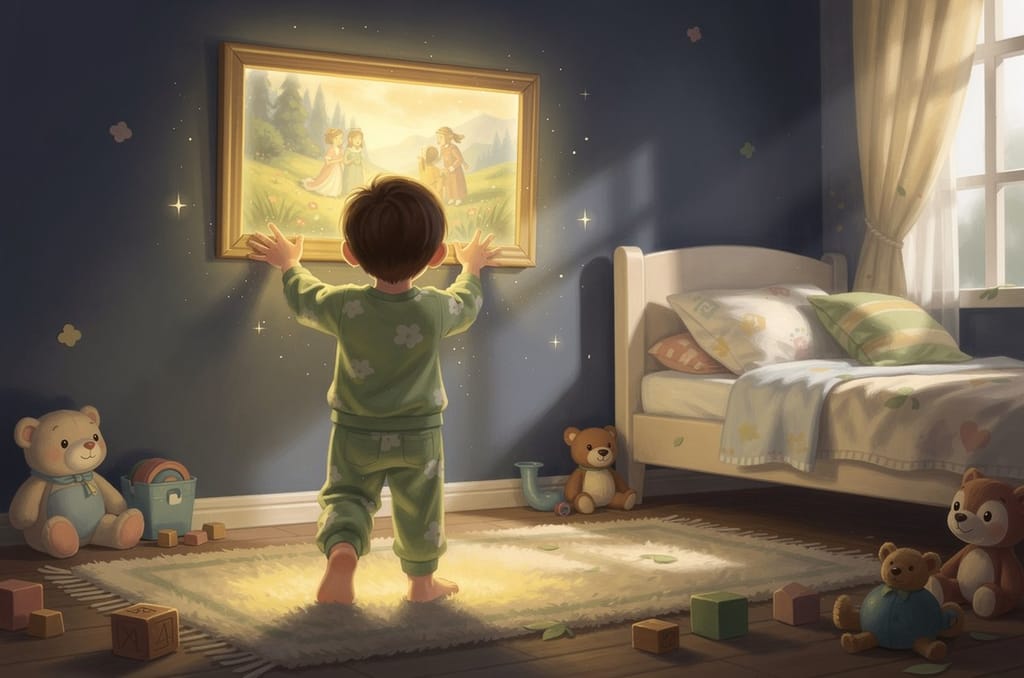
Lower than you think, and lower than every hanging guide says. The museum standard, used by galleries and professional installers alike, puts the center of a single piece 57 to 60 inches from the floor, because that is roughly average eye level for a standing adult. In a child's bedroom that reference point is wrong. On the CDC growth charts the median height at age five is 43.0 inches for boys and 42.5 inches for girls, so a five-year-old's sightline lands somewhere near 40 inches. Hang at the gallery standard and the art sits well over a foot above the head of the only person who lives in the room. Set the center between 40 and 48 inches instead. It will look low to you when you step back, which is the point: you are not the audience.
Where the adult rule still applies
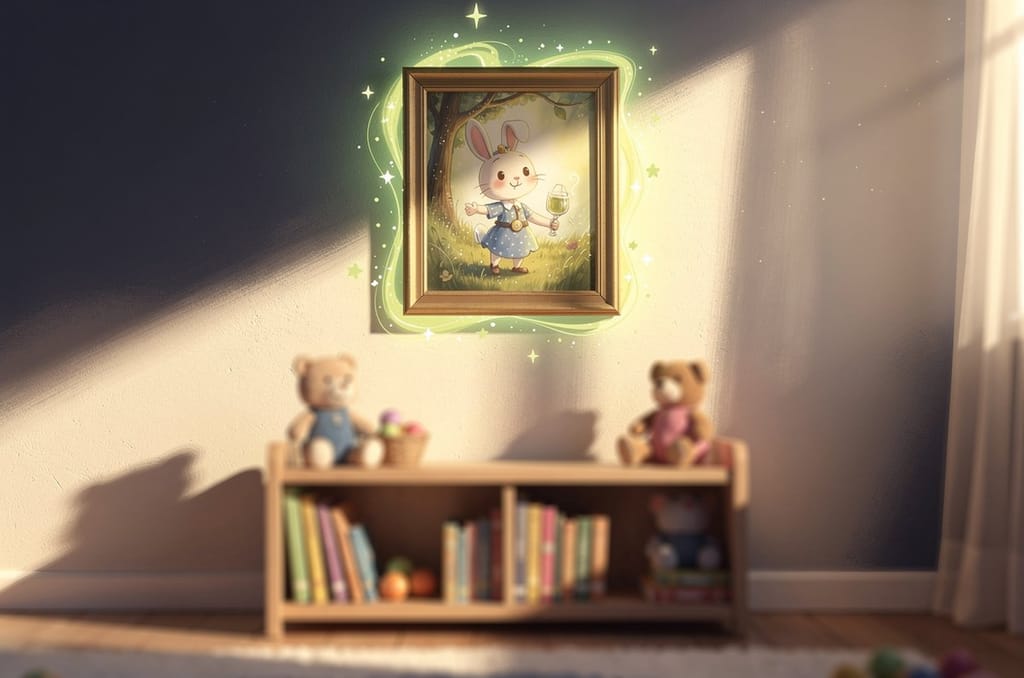
Two spots in the room keep the grown-up numbers. Art hung above a bed, a dresser, or a bookcase is governed by the furniture, not by anyone's eye level, so it goes 6 to 12 inches above the top of that piece and lands wherever that puts it. Above a bed, aim for the wider end of that gap, closer to 8 to 10 inches, so the frame clears pillows and a sitting-up child. The second exception is any wall an adult uses more than the child does, such as the changing area in a shared room. Everywhere else, especially a bare wall the child walks past or plays against, drop to their line of sight. A useful test costs nothing: crouch until your eyes are at the child's height and look at the wall.
What size should the art be?
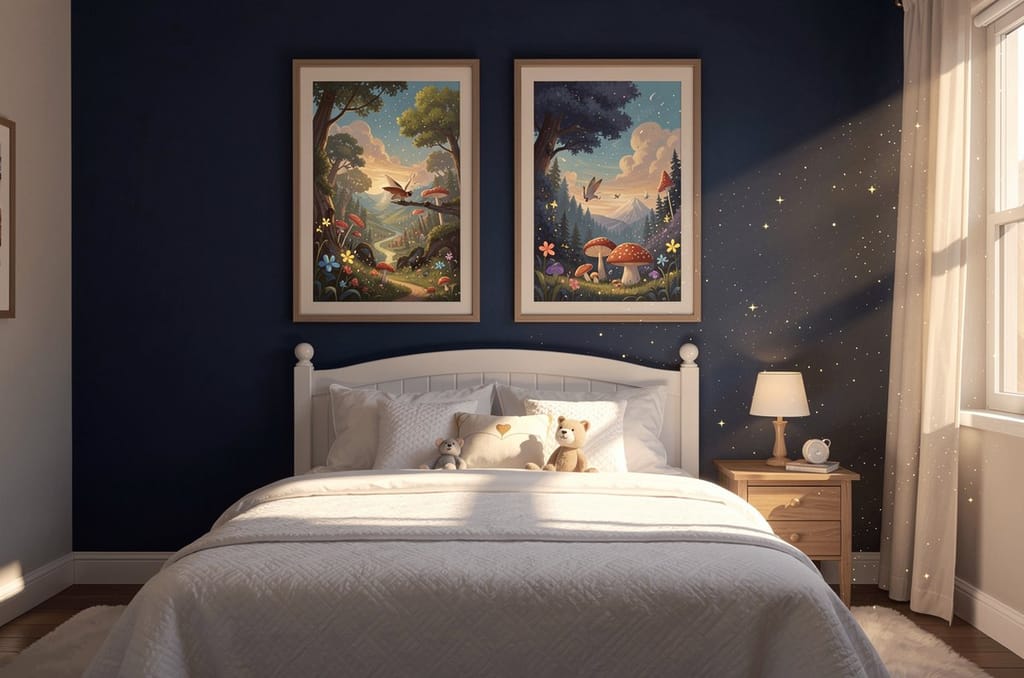
Match the width of the art to the width of the furniture underneath it, at two-thirds to three-quarters of that measurement. This is the rule that decides whether a wall looks composed or accidental, and it is where portrait-shaped pieces need honest math. A standard twin mattress is 38 inches wide, so the art above it should span about 25 to 29 inches. A full is 54 inches wide and wants roughly 36 to 40 inches. Our canvases are portrait orientation, so a single one is narrower than those targets: a 16 by 20 is only 16 inches across, which is under half a twin bed. Above a bed or a dresser, hang a pair or a trio and treat the group as one piece. A single canvas belongs over a nightstand or on a narrow stretch of wall.
| Spot | Furniture width | Target art width | What works |
|---|---|---|---|
| Nightstand | 18″ to 24″ | 12″ to 18″ | One 16 by 20, centered |
| Kids dresser | 30″ to 36″ | 20″ to 27″ | A pair of 11 by 14, set 3″ apart |
| Twin bed | 38″ | 25″ to 29″ | A pair of 11 by 14 at 3″, or a trio of 8 by 10 at 2″ |
| Full bed | 54″ | 36″ to 40″ | A pair of 16 by 20 at 4″, or a trio of 11 by 14 at 3″ |
Leave 2 to 4 inches between frames in a tight pair or trio, tightening the gap as the pieces get smaller. If you are hanging a group, measure the whole cluster as a single block and apply the two-thirds rule to that total, not to each piece.
Canvas or framed canvas for a kid's room?
Both work, and the deciding factor in a child's room is usually what is over the bed rather than what looks best on a screen. A gallery-wrapped canvas is the printed image stretched around a wooden frame, with no glass and no hard outer edge. A framed canvas is that same wrapped canvas set into a wood frame, available in black, espresso, white, or natural, which reads more finished and suits a room a child will grow into. Neither uses glass, and that is the relevant safety point: designers who specialize in children's rooms advise against glass-fronted art above a crib or bed, and against hanging a mirror there at all. If a piece you love only comes with glass, the usual fix is to swap the glazing for acrylic before it goes up.
Gallery canvas
Lighter, softer at the edges, no glass and no frame lip. The easy answer directly above a bed, and the cheaper way to hang a pair.
Framed canvas
The same canvas in a wood frame, in black, espresso, white, or natural. Reads more grown-up, so it survives the jump from little-kid room to big-kid room.
Portrait orientation
Every size prints tall rather than wide. Plan for pairs and trios above wide furniture, single pieces above narrow furniture.
Made to order
Printed after you approve the proof, so nothing is sitting in a warehouse waiting to be someone's generic nursery print.
Does a child's own face on the wall actually work?
It depends entirely on what kind of picture it is, and this is the question parents actually hesitate over. A blown-up photograph of a child, hung in that child's own bedroom, tends to read as documentation, closer to a school portrait than to art, and some families find it faintly strange. A portrait works differently. When the child is painted as the hero of a scene, an explorer on a far planet or a knight at a castle gate, the subject of the picture is the story, and the child is cast in it. Kids read that as being let into the world, not as being put on display. The practical test is simple: if the picture would still be interesting with a stranger in it, it is art. If it only makes sense because it is your child, it is a record, and a record belongs in an album.
Choosing a world it survives
Pick the world for the child's actual obsession rather than the room's color scheme, because the obsession lasts longer than you expect and the color scheme does not. A dinosaur-mad four-year-old is usually still dinosaur-adjacent at seven. Worlds built around a role the child imagines themselves in, like a space explorer, age better than worlds built around a single toy or show. It also helps to choose a scene with real background depth, because a piece with somewhere to look holds attention across years in a way a plain backdrop does not. The world and the format are separate decisions, so a scene chosen for an 8 by 10 above a nightstand still reads at 16 by 20 above a desk when the room is rearranged four years later. If you want the full picture of how the portrait is generated before you commit, our guide on how AI portrait gifts work walks through the process end to end.
How to hang it so it stays put
Hang it on hardware rated well beyond the weight of the piece, and then secure the bottom. In a child's room the failure mode is not gravity, it is a small person deciding to find out whether the picture comes off the wall. The method interior designers use around cribs and toddler beds is to carry the weight at the top with a stud-mounted screw, a French cleat, or D-rings, then fix the two bottom corners with removable hanging strips or putty so the piece cannot be swung, lifted, or pried loose. Adhesive strips alone are not enough above a bed. If you are hanging a pair or trio, lay the arrangement out on the floor first and mark the wall before a single hole goes in. The same care applies to any keepsake you plan on keeping, which is why we wrote a separate guide on how to frame a puzzle so it stays put.
What it costs and how it is made
A gallery canvas runs $59 for 8 by 10, $79 for 11 by 14, and $105 for 16 by 20. The framed canvas is the heirloom tier at $79, $109, and $149 for the same three sizes, in any of the frame colors, with US shipping free on all of them. The process is the same whichever you choose. You upload one clear photo, pick the world, and we repaint the child as its hero. Before anything prints you get a free watermarked proof to approve or re-roll, and nothing goes to the printer until you say so. The original photo is deleted within 24 hours of fulfillment, we never use customer photos to train AI models, and the child's name is never sent to the image model at all. Every order includes the digital file.
For a piece starring everyone rather than one child, the same process runs in family mode, and we covered the styling choices in custom family portrait ideas. Getting the source photo right matters more than any other input, so it is worth skimming how to pick the best photo before you upload.
Put them on their own wall
One photo becomes a painted portrait on gallery canvas or framed canvas, approved before it prints.
Frequently asked questions
How high should I hang wall art in a kid's room?
+
Center a single piece between 40 and 48 inches from the floor, not the usual 57 to 60 inches. The standard height matches adult eye level, and the CDC growth charts put the median height at age five at 43.0 inches for boys and 42.5 inches for girls, so the gallery rule hangs art above the child's sightline. Art above furniture is the exception: it sits 6 to 12 inches above the furniture regardless of eye level.
What size wall art goes above a twin bed?
+
A standard twin mattress is 38 inches wide, and art should span two-thirds to three-quarters of the furniture below it, so aim for 25 to 29 inches of total width. Because our canvases print in portrait orientation, a single piece is too narrow for that span. Hang a pair of 11 by 14 canvases about 3 inches apart, or a trio of 8 by 10, and treat the group as one piece when you measure.
Is it strange to hang a picture of your own child in their bedroom?
+
It depends on the kind of picture. An enlarged photograph of the child tends to read as documentation and can feel odd in their own room. A portrait that casts the child as a character in a scene reads as art instead, because the story is the subject and the child is playing a part in it. A useful test: if the image would still be interesting with someone else in it, it works as wall art.
Is canvas or framed art safer above a child's bed?
+
Either, as long as there is no glass. Designers who specialize in children's rooms advise against glass-fronted art above a crib or bed, and against hanging a mirror above one at all. Both our gallery canvas and our framed canvas are printed on stretched canvas with no glazing. Whichever you hang, carry the weight on stud-mounted hardware and fix the bottom corners so the piece cannot be pulled off the wall.
How long does personalized kids wall art take to arrive?
+
Your proof arrives first, usually within minutes of uploading, and nothing prints until you approve it. After approval the canvas is made to order and shipped free within the US. Because the piece is printed only after you sign off, the timeline depends on when you approve rather than on when you order, so allow extra room if it is meant for a birthday or a holiday.