
In short
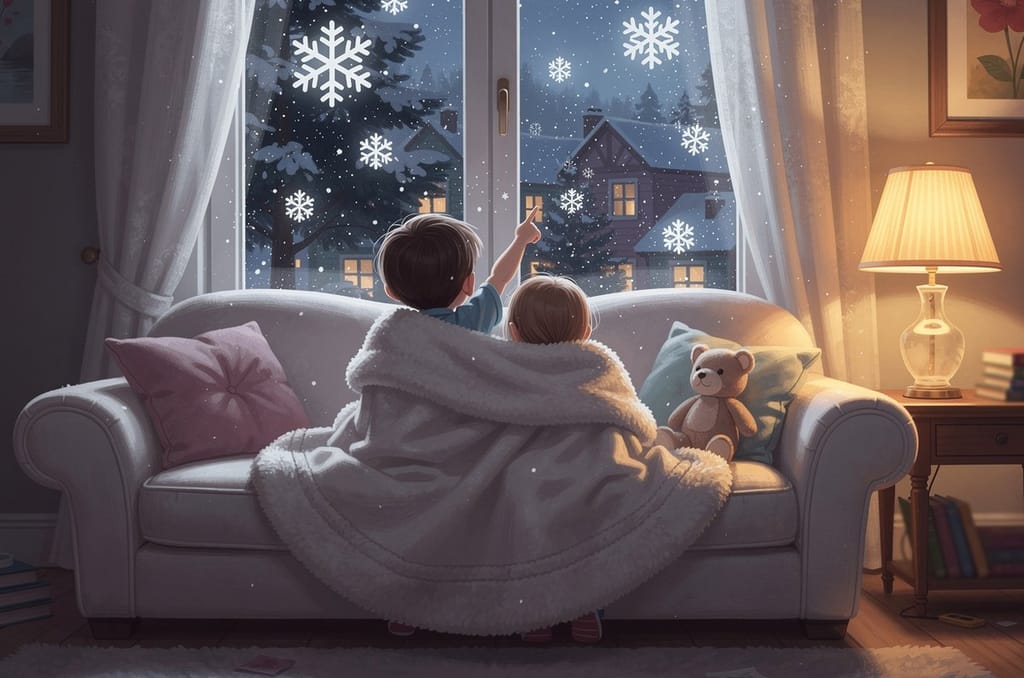
A standard throw blanket is 50 by 60 inches, or 127 by 152 centimeters. Throws are sold from about 40 by 50 inches up to 70 by 80, and the names are not standardized, so compare the inches rather than the label. A 50 by 60 throw covers one adult on a sofa, or two people sitting side by side, but it is shorter than the average adult is tall, so it won't fully cover someone lying down. For sleeping under, buy a blanket sized to the mattress. On a bed, a throw is a folded layer across the foot.
A throw is named for how it gets used, draped over a sofa or folded across the foot of a bed, and the name comes with no fixed size. Makers put it on blankets as small as a lap square and nearly as big as a twin blanket, which is why the same question gets different answers depending on whose chart you read. Below is every common size with its metric equivalent, plus the part most size charts leave out: what each one actually covers on a sofa, on each size of bed, and on a person.
How big is a throw blanket?
The standard throw blanket is 50 inches wide by 60 inches long, or 127 by 152 centimeters. That figure appears on nearly every size chart, including the Sleep Foundation's guide to blanket sizes, which notes that the dimensions vary by manufacturer. Makers stretch the label well past it: Casper's own chart runs from a 40 by 50 inch small throw to a 70 by 80 inch oversized one.
Read 50 by 60 against a body. The average American man is 68.9 inches tall and the average woman 63.5 inches, according to CDC measurements taken between 2021 and 2023. A 60-inch throw is about 9 inches shorter than the first and 3.5 inches shorter than the second. Sitting up, a person folds into far less than their height, so a throw covers them with room to tuck around the feet. Lying flat, the throw is shorter than the person, which is why the Sleep Foundation says throws generally don't fully cover an average-sized adult.
Throw blanket size chart
These are the sizes you'll see sold as throws and lap blankets, with the metric equivalent and what each one covers in use. Where makers disagree on a name, the chart gives the range rather than picking one.
| Size | Inches | Centimeters | What it covers |
|---|---|---|---|
| Lap blanket (lapghan) | 36 × 48 | 91 × 122 | One person seated in a chair or wheelchair |
| Small throw | 40 × 50 | 102 × 127 | One person in an armchair, or a child on a sofa |
| Standard throw | 50 × 60 | 127 × 152 | One adult on a sofa, or two sitting side by side |
| Afghan | 50 × 65 | 127 × 165 | A throw with a few more inches of length |
| Oversized throw | 50 × 70 to 70 × 80 | 127 × 178 to 178 × 203 | An adult lying down on a sofa, or two people with room to tuck |
Lap, standard and afghan sizes from the Sleep Foundation. Small and oversized ranges from the charts published by Casper and American Textile. Centimeters rounded to the nearest whole number.
The one row to look at twice is the oversized throw. Once a throw reaches 70 inches long, it is longer than the average American adult is tall, and that is the point at which it stops being a lap blanket and becomes something a person can actually lie under on a sofa.
What is the difference between a throw and a blanket?
Size and job. A bed blanket is cut to fit a mattress, with enough extra to hang over the sides, while a throw is cut to fit a person or a piece of furniture and moves around the house. Merriam-Webster's definitions work as shorthand: a throw is a light coverlet, or a loose covering for a sofa, and a coverlet is simply a bedspread.
The other names mostly describe how the thing is made. An afghan is a blanket or shawl knitted or crocheted in strips or squares, commonly around 50 by 65 inches, and a lapghan is the 36 by 48 inch version, often used, the Sleep Foundation notes, in hospitals and nursing homes. A quilt is two layers of cloth with padding held in place by stitching or ties. A comforter is a thick bed covering with a filling such as down, sized like a bed blanket rather than a throw. Whatever a listing calls it, compare the inches.
Blanket sizes from baby to king
Bed blankets are sized from the mattress outward, so each one covers the top of its bed and hangs over the sides. The chart pairs each blanket with the mattress it is made for, using the Sleep Foundation's mattress dimensions, and shows how much hangs over each side.
| Blanket | Blanket (in) | Mattress (in) | Overhang per side |
|---|---|---|---|
| Crib | 45 × 60 | 27¼ × 51⅝ (minimum) | About 9 in |
| Twin | 65–66 × 90 | 38 × 75 | 13½–14 in |
| Full / double | 80–85 × 90 | 54 × 75 | 13–15½ in |
| Queen | 90 × 90–100 | 60 × 80 | 15 in |
| King | 108 × 90–100 | 76 × 80 | 16 in |
| California king | 104 × 108 | 72 × 84 | 16 in |
Blanket sizes from the Sleep Foundation; crib mattress minimum from the federal crib mattress standard. Overhang is the blanket's width minus the mattress width, divided by two, before any tucking.
The overhang column is the one to check when a blanket looks skimpy. A twin blanket moved onto a full mattress hangs only about 6 inches over each side, less than half of what it was made to hang. Length works the same way: the twin through California king blankets run 10 to 24 inches longer than their mattresses, and that extra is what tucks in at the foot.
What size throw fits a sofa?
A 50 by 60 throw suits a standard sofa. The typical three-seat sofa is 84 inches wide, within a common range of 72 to 96, and a three-seater gives each person roughly 24 to 30 inches of seat. Opened out along its 60-inch side, a standard throw spans about two seats, so two people sitting side by side can share it, and one person can pull it up to the chin with the corners tucked under.
Size up in two situations. On a sectional, or for anyone who lies down on the sofa rather than sitting, choose an oversized throw: at 70 or 80 inches long, it is longer than the average adult is tall. And if the throw is mostly there to look good folded over the arm or the back, the drape of the fabric matters as much as the size. On a loveseat, which Dimensions.com puts at 48 to 72 inches wide, a standard 60-inch throw spans most or all of it.
Can you use a throw blanket on a bed?
Yes, as an extra layer, but not as the main covering. Against standard mattress sizes, a 50 by 60 throw is wider than a 38-inch twin, leaving 6 inches over each side, but it stops 15 inches short of the twin's 75-inch length. On a full, which is 54 inches wide, the throw is 4 inches narrower than the top of the mattress. Laid crosswise on a queen, its 60-inch side matches the 60-inch mattress exactly, with nothing left to hang over the edge. On a 76-inch king, it covers about four-fifths of the width.
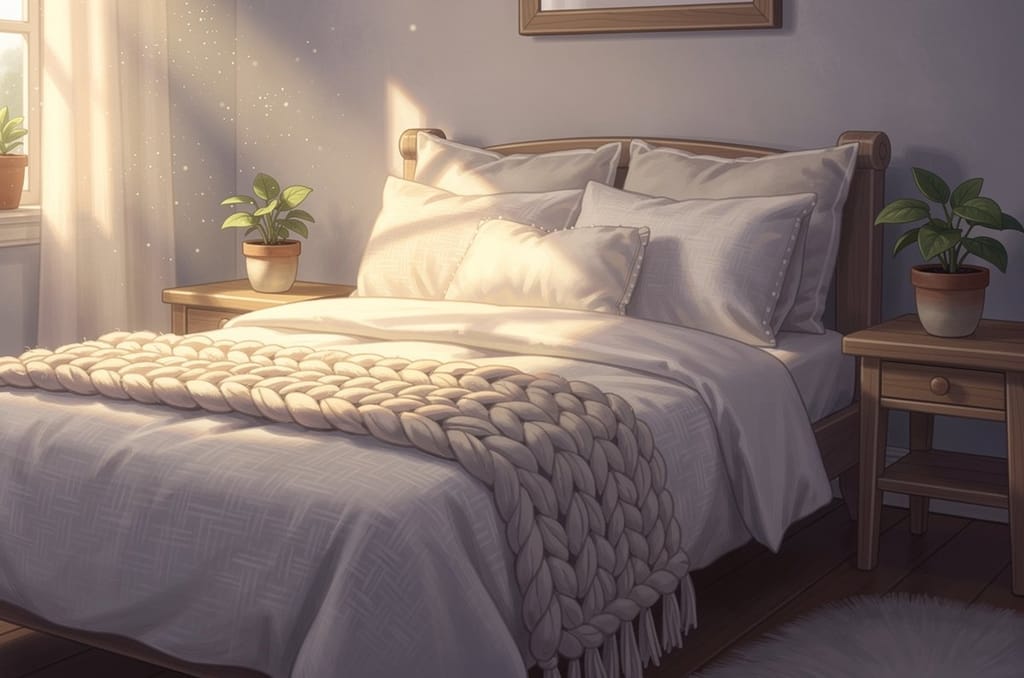
That is why a throw on a bed gets folded across the foot rather than spread over the top. There it adds warmth where feet get cold and a block of color on a made bed, without trying to do a bed blanket's job. For something to sleep under, use the blanket sized to the mattress from the chart above, and keep the throw for the extra layer on a cold night.
What size blanket for a baby or toddler?
Baby blankets have their own ladder of sizes, and one rule comes before all of them. For the first year, the American Academy of Pediatrics says to keep blankets and other soft bedding out of a baby's sleep area and to use a wearable blanket if the baby needs more warmth. The same guidance rules out weighted blankets on or near a baby.
| Blanket | Inches | Used for |
|---|---|---|
| Lovey | 12 × 12 | A small comfort object, kept out of the crib before age one |
| Baby (security) | 14 × 16 | Light comfort, and often a keepsake later |
| Cradle | 14 × 30 | A rocking cradle |
| Stroller | 22–30 × 30–36 | A stroller or car seat |
| Receiving | 40 × 40 | Swaddling, burping and changing |
| Crib | 45 × 60 | Sleep, from 12 months |
Sizes from the Sleep Foundation.
In a car seat, the AAP's advice is to buckle the child in first and then put the blanket over the harness straps, never underneath, keeping the face uncovered. For a toddler, the bed size is fixed by regulation: under the federal standard, a toddler bed is a bed for a full-size crib mattress of at least 27¼ by 51⅝ inches, meant for children 15 months and older. A 45 by 60 crib blanket covers that mattress with about 9 inches to spare on each side, and a 30 by 40 blanket covers its width and roughly three-quarters of its length.
Does the fabric change the size you should buy?
It can, because some fabrics change size in the wash. Cotton swells when it gets wet and contracts as it dries, and Cotton Incorporated's guide to shrinkage explains that tumble drying releases all of the shrinkage a cotton knit still has in it. The same guide notes that synthetic fibers can be heat-set to hold their dimensions and don't go through cotton's swell-and-shrink cycle. The University of Georgia's textile extension lists superior wash-wear performance among polyester's traits, along with a tendency to pill. So a cotton throw can come out of its first trips through the dryer smaller than it went in, while a polyester fleece throw holds its size far better.
Weighted blankets are sized differently again. The Sleep Foundation's rule of thumb is a blanket weighing about 10 percent of the user's body weight, so a weighted blanket is chosen for the person first and the furniture second.
How do you measure a blanket?
Lay it flat on the floor, smooth it without pulling, and measure the width and the length through the middle rather than along the edges, which can wave. If the blanket has fringe or tassels, measure the body and the fringe separately, because a listing might quote either figure. Measure a knit or a chunky weave relaxed rather than stretched, since knits give.
To check whether a size will work before you buy, measure the thing it is going on. For a sofa, measure from arm to arm. For a bed, measure the top of the mattress, then add the overhang you want: twice to the width, since it hangs over both sides, and once to the length, since the head of the bed sits against the pillows. For a person, use their height, because a throw longer than someone is tall is one they can lie under. A tape measure and two minutes answer the question more reliably than any size name on a label.
Which size makes the better gift?
For an adult, the standard 50 by 60 throw is the one that gets used, because it fits where a throw actually lives, which is a sofa. For a child, a 30 by 40 blanket is easier to carry around, is close to stroller-blanket size, so it works in a stroller or over a buckled car seat harness, and fits across a toddler bed once the child is old enough for one.
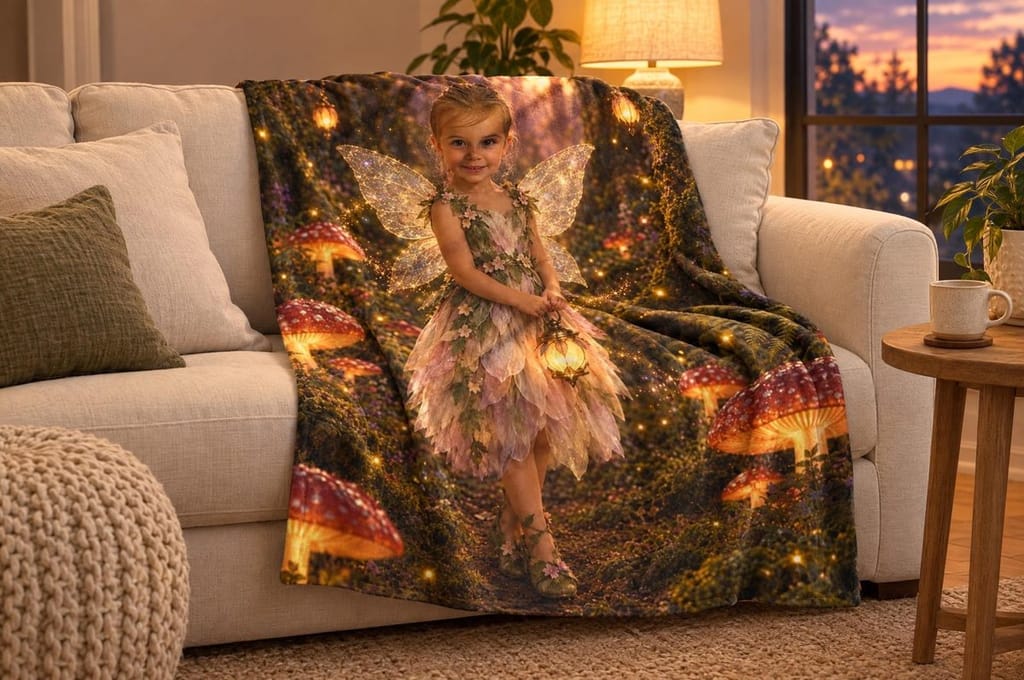
Those are the two sizes we make. A personalized photo blanket from The Curious Thing comes as a 30 by 40 inch blanket for $59 or a 50 by 60 inch standard throw for $89, in 315gsm polyester fleece with the portrait dyed into the fiber. The portrait can star a child as the hero of a magical world, the whole family painted in an art style, or a pet in a costumed or painted portrait. You approve a watermarked proof before anything prints, shipping is free in the US, and most orders arrive within 5 to 10 business days of approval. One honest trade-off: the larger size spreads the same portrait over two and a half times the fabric, so it prints a little softer.
Put a portrait on the throw
Upload one photo and see it on a 30 by 40 or 50 by 60 fleece blanket. Nothing prints until you approve the proof.
If you are weighing the blanket itself, what a personalized photo blanket is covers the portrait-versus-collage question, and are personalized photo blankets worth it covers the fleece, how sharp each size prints, and when a canvas is the better buy. To see what can go on the throw, browse the family portrait art styles or the pet portraits.
Frequently asked questions
What is the standard size of a throw blanket?
+
50 by 60 inches, or 127 by 152 centimeters. Throws are also sold from about 40 by 50 inches up to 70 by 80, and the size names are not standardized, so compare the inches rather than the label.
Is a 50x60 blanket a throw?
+
Yes. 50 by 60 inches is the standard throw size. It covers one adult sitting on a sofa, or two sitting side by side, and it is shorter than the average adult is tall, so it will not fully cover someone lying down.
How big is an oversized throw blanket?
+
Usually between 50 by 70 and 70 by 80 inches, depending on the maker. At 70 inches or more, the throw is longer than the average American adult is tall, so it covers someone lying down on a sofa.
Can a throw blanket cover a bed?
+
Not fully. A 50 by 60 throw covers the width of a 38-inch twin mattress but stops 15 inches short of its length, and it is narrower than a full, queen or king mattress. On a bed, a throw works as a folded layer across the foot. To sleep under, use a blanket sized to the mattress.
What size is a lap blanket?
+
About 36 by 48 inches. A lap blanket, or lapghan, is sized to cover the lap and legs of someone sitting in a chair or wheelchair, which makes it smaller than a 50 by 60 throw.
What size blanket is right for a toddler bed?
+
A 45 by 60 inch crib blanket. A toddler bed takes a full-size crib mattress of at least 27¼ by 51⅝ inches, so a crib blanket covers it with about 9 inches to spare on each side, and a 30 by 40 blanket covers its width. The AAP advises keeping all blankets out of a baby's sleep area for the first year.
What is the difference between a throw and a blanket?
+
A bed blanket is sized to a mattress, with extra to hang over the sides, while a throw is sized to a person or a sofa and gets used around the house. A twin bed blanket is about 66 by 90 inches; a standard throw is 50 by 60.
What size throw is best for a couch?
+
A 50 by 60 inch throw suits a standard three-seat sofa, which is typically about 84 inches wide. It spans roughly two seats, so two people can share it sitting down. For a sectional, or for lying down, choose an oversized throw.