
In short
Here are 220 Christmas trivia questions with answers, sorted into rounds you can play at the table: easy questions for kids, Santa and reindeer, Santa around the world, songs and carols, stories, Christmas around the world, history, food, trees and plants, science, words, hard questions for adults, a true-or-false round of famous myths, and tiebreakers. Every answer links to the source that backs it, such as the Library of Congress, NASA, a national tourism board or the original text. Each question in the main rounds is tagged Easy, Medium or Hard, worth 1, 2 or 3 points, so a seven-year-old and a grandparent can play on the same team.
We read ten of the most visible Christmas trivia pages before writing this one. Only one names its sources, and only for a handful of statistics and tree-care tips. The same wrong answers travel from page to page: Oliver Cromwell as the English monarch who banned Christmas (he was never king, and Parliament did it), Alabama as the first state to make Christmas a holiday in 1836 (its own state archives found no record of it), and O Holy Night as the first carol ever broadcast on radio (the story rests on one letter written decades later, which credits the tune to the wrong composer).
So every answer below links to the page where we checked it, and where a source hedges, the question hedges too. Before publishing we checked each question a second time against its source, and about a third were reworded in that pass, mostly to say exactly what the source says and no more.
How do you play Christmas trivia with kids and adults?
Mix the ages on every team and score by difficulty. Easy questions are worth 1 point, Medium 2 and Hard 3, so a child who answers three Easy questions scores as much as an adult who gets one Hard one. Every question in the main rounds carries its tag.
- Make teams of two to five, with a child and an adult on each where you can.
- Read each question twice, then allow about 30 seconds.
- Let the youngest player answer Easy questions first. Teammates help only if the child passes.
- Swap answer sheets to mark, and read out the answer and the fact after it.
- Score the true-or-false round at 1 point a statement.
- Settle a tie with the tiebreakers at the end. The closest number wins.
| Tag | Points | Who can usually answer | Questions here |
|---|---|---|---|
| Easy | 1 | Children from about 5 | 58 |
| Medium | 2 | Most adults | 72 |
| Hard | 3 | Trivia regulars, on a good night | 63 |
| True or false | 1 | Anyone willing to guess | 23 |
The tags are our own call, made while checking each answer. Move a question up or down to suit your table.
Easy Christmas trivia for kids
Read these aloud to children from about five. Most answers are one word, and several come from the 1823 poem A Visit from St. Nicholas, so it helps to read it to them first. For jokes and riddles between rounds, our Christmas jokes for kids are sorted by age.
- How many tiny reindeer pull the sleigh in the poem "A Visit from St. Nicholas"? Eight. The narrator sees "a miniature sleigh, and eight tiny reindeer," driven by "a little old driver, so lively and quick." Easy · Project Gutenberg
- The poem describes St. Nick as "chubby and plump, a right jolly old" what? Elf. The full line reads "He was chubby and plump, a right jolly old elf, / And I laughed when I saw him, in spite of myself." Easy · Project Gutenberg
- In the poem, St. Nick's little round belly shakes when he laughs, like a bowlful of what? Jelly. He has "a broad face and a little round belly, / That shook when he laughed, like a bowlful of jelly." Easy · Project Gutenberg
- In the poem, what does St. Nick fill before he rises back up the chimney? The stockings. "He spoke not a word, but went straight to his work, / And filled all the stockings; then turned with a jerk." Easy · Project Gutenberg
- In Thomas Nast's 1866 drawing "Santa Claus and His Works," a label reads "Santa Claussville, N.P." What does N.P. stand for? North Pole. HarpWeek notes the label sits on a curving border of the drawing and says Nast may have been the first illustrator to place Santa's home at the North Pole. Easy · The New York Times
- In Nast's 1866 "Santa Claus and His Works," what does Santa use to spot which children are being good? A telescope. The same drawing shows him recording children's behavior in an enormous account book and making toys by hand in his workshop. Easy · The New York Times
- What color is the horse that Sinterklaas rides? White. Sinterklaas travels with a milk-white horse, and by night the two are said to ride over the rooftops, dropping sweets and small presents down chimneys. Easy · Embassy of the Netherlands
- What vegetable do Dutch children tuck into their shoes for Sinterklaas's horse? A carrot. Children set their shoes by the fireplace with a carrot or some straw for the horse. The big night for gifts is the evening of December 5. Easy · Embassy of the Netherlands
- Before trusting the mail, where did many children put their letters to Santa, believing the smoke would carry their wishes to the North Pole? In the chimney (fireplace). Postal historians say the chimney was a popular early method, but by the 1890s many children were putting their faith in the Post Office instead. Easy · USPS Historian
- Besides a small gift or toy, what kind of hat is usually tucked inside a Christmas cracker? A paper hat. The cracker's inventor had a son, Walter, who added elaborate hats made of fancy paper to the family's crackers, and they have been part of the fun ever since. Easy · V&A Museum
- At Mexico's Posadas celebrations, what colorful decoration full of sweets do people take turns breaking? A piñata. Friars once used it as a teaching tool: its seven points stood for the seven deadly sins, and breaking it meant virtue winning out. The sweets or fruit inside were the reward. Easy · UNAM Global
- In Catalonia, children feed a smiling log called the Tió de Nadal for weeks. On Christmas Eve or Christmas Day, what do they hit it with to make it give presents? Sticks. Feeding starts on December 8, and the log is kept warm under a blanket. After the children sing and tap it, the blanket is lifted to reveal sweets and small gifts. Easy · Catalan News
- According to a Ukrainian legend, which little creatures decorated a poor family's bare Christmas tree with webs that turned to silver and gold? Spiders. As the legend goes, the sunrise turned the webs to silver and gold. Spider ornaments became a Ukrainian Christmas tradition in the late 1800s or early 1900s, says a folk art curator at New York's Ukrainian Museum. Easy · TODAY
- What does Lucia traditionally wear on her head in Sweden's Lucia processions? A crown of candles. Tradition says Lucia wears "light in her hair." Today the crown is usually a wreath of electric candles, and each of her attendants carries a candle too. Easy · Sweden.se
- In Australia, Christmas falls during which season? Summer. Christmas comes in early summer in Australia, so it also kicks off the summer holiday season, with beach trips and outdoor fun. In Melbourne, the Boxing Day cricket match is a long-standing tradition. Easy · Encyclopedia of Melbourne
- In December 1968, Apollo 8's three astronauts became the first people to circle around what? The Moon. Frank Borman, Jim Lovell and Bill Anders entered lunar orbit on Christmas Eve 1968 and circled the Moon 10 times before heading home. Easy · NASA
- In December 1965, the Gemini 6 astronauts surprised Mission Control by playing a holiday tune on a tiny harmonica and a handful of sleigh bells. Which song was it? Jingle Bells. Wally Schirra played the harmonica while Tom Stafford shook the bells; they had practiced before launch without telling anyone on the ground. The Smithsonian calls it the first musical interlude from space, and the astronauts gave both instruments to the National Air and Space Museum in 1967. Easy · Smithsonian Air and Space Museum
- In The Twelve Days of Christmas, what does the singer's true love send on the first day? A partridge in a pear tree. The partridge comes back in every single verse, so by the end of the song the singer has been sent twelve of them. Easy · Maths Careers
- In The Twelve Days of Christmas, what arrives on the fifth day? Five golden rings. Day five adds five golden rings to the four calling birds, three French hens, two turtle doves and the partridge in a pear tree. Easy · Maths Careers
- In We Wish You a Merry Christmas, what kind of pudding do the carolers ask for? Figgy pudding. The song is thought to come from England's West Country, where carolers sang at people's doors and were rewarded with treats. Its oldest known written score is a 1935 arrangement by Bristol choirmaster Arthur Warrell. Easy · Bristol Post
- Which member of the Cratchit family says "God bless us every one!"? Tiny Tim. After Bob Cratchit toasts the family at Christmas dinner, Tiny Tim, sitting on his little stool beside his father, adds the famous line last of all. Easy · Project Gutenberg
- The ghost of Scrooge's dead business partner warns him that he will be haunted by how many spirits? Three. They are the Ghost of Christmas Past, the Ghost of Christmas Present and the Ghost of Christmas Yet To Come. Easy · Project Gutenberg
- In The Nutcracker, whom do the Nutcracker and the toy soldiers battle? The Mouse King and his mice. Clara saves the Nutcracker's life, breaking the spell that had turned him from a boy into a toy. The ballet is based on E.T.A. Hoffmann's 1816 story The Nutcracker and the Mouse King. Easy · Royal Ballet and Opera
- Before they had red stripes, what color were candy canes? White. Candy canes were originally solid white, and stripes started to appear around the turn of the 20th century. Christmas cards from before the late 1800s show only plain white candy. Easy · The Conversation
- The French Christmas cake called a bûche de Noël is made to look like what? A log (a Yule log). The original Yule log was a real, heavy piece of wood burned over the Christmas season. Paris pastry chefs reimagined it in the late 1800s as a sponge cake piped with buttercream to look like bark. Easy · National Geographic
- The Christmas fern stays green at Christmastime. Its little leaflets are also shaped like what holiday item? A Christmas stocking. This evergreen fern grows across eastern North America. Both its winter greenery and its stocking-shaped leaflets suggest Christmas. Easy · NC State Extension
- How many sides or arms does a snowflake's basic pattern have? Six. Snow crystals share a six-fold symmetry. Scientists have been writing about where that six-sided pattern comes from since at least the 1600s. Easy · New York Academy of Sciences
- Every year on Christmas Island, millions of red crabs leave the forest and march where? To the ocean. They head to the sea to mate and spawn, swarming over roads, rocks and beaches. The march starts with the first rain of the wet season, usually in October or November. Easy · Parks Australia
- Christmas tree worms anchor themselves to what living thing on a tropical reef? Coral. Their two spiral, tree-shaped crowns help them breathe and catch food, and they duck into burrows in the coral when startled. They can live up to 30 years. Easy · UT Marine Science Institute
Santa and reindeer trivia
Three New York texts from 1809 to 1823 supply many of the answers in this round: Washington Irving's comic history of the city, an anonymous 1821 poem that first gave Santa a reindeer and sleigh, and the 1823 poem that gave him eight reindeer. The round ends with questions about the real animals. Santa's helpers have a list of their own in Christmas elf names, with the folklore behind them.
- St. Nicholas, the real man behind Santa Claus, was bishop of which ancient city? Myra. The Catholic Encyclopedia says almost nothing about him is historically certain except that he was Bishop of Myra, in the region of Lycia, in the fourth century. Hard · Catholic Encyclopedia
- The ancient city where St. Nicholas served as bishop and was buried lies in the southwest of which present-day country? Turkey (Türkiye). The Dutch embassy's Sinterklaas profile lists his burial spot as Myra, in the southwest of present-day Turkey. Medium · Embassy of the Netherlands
- In 1087, Italian merchants carried St. Nicholas's remains from his tomb to which city in Italy, where they are still kept? Bari. According to the Catholic Encyclopedia, merchants took his body from Myra in 1087, and his relics are still kept in the church of San Nicola in Bari. He is also known as Nicholas of Bari. Hard · Catholic Encyclopedia
- On what date does the church celebrate the feast of St. Nicholas? December 6. December 6 is his feast day, and in Germany, Switzerland and the Netherlands he became the secret bringer of gifts to children on that day. Medium · Catholic Encyclopedia
- According to one legend, how many bags of gold did St. Nicholas secretly drop down a poor family's chimney so the daughters would have dowries? Three. English Heritage retells a tale in which the saint, under cover of darkness, anonymously threw three bags of gold down a poor man's chimney to give his daughters dowries. It is a legend, not documented history. Medium · English Heritage
- In the legend of St. Nicholas secretly tossing gold into a poor man's house as dowries for his daughters, where did the gold land? In the daughters' stockings, drying by the fire. English Heritage says tales of his gold-giving helped give rise to the custom of leaving gifts for children on the night before December 6, St. Nicholas's Day. Medium · English Heritage
- In Washington Irving's 1809 comic history of New York, St. Nicholas rides over the treetops in what? A wagon. A Dutch settler dreams that "good St. Nicholas came riding over the tops of the trees, in that self-same wagon wherein he brings his yearly presents to children," and the saint tells the Dutch to settle on Manhattan. Medium · National Endowment for the Humanities
- Washington Irving's 1809 history of New York claims to be written by which made-up Dutch historian? Diedrich Knickerbocker. The book, published in December 1809, presents itself as the work of "Diedrich Knickerbocker, native of the city of New York." It also describes hanging a stocking in the chimney on St. Nicholas Eve. Hard · Project Gutenberg
- In the anonymous 1821 New York poem "Old Santeclaus with Much Delight," on which night does Santeclaus make his visit? Christmas Eve. English Heritage says the poem moved his arrival from St. Nicholas's Day to Christmas Eve, and it also introduced his reindeer and sleigh. Medium · English Heritage
- In which upstate New York newspaper did "A Visit from St. Nicholas" first appear, without a byline, on December 23, 1823? The Troy Sentinel. The poem ran anonymously and stayed unattributed for 14 years, until an 1837 anthology identified Clement Clarke Moore as the author. Hard · New York State Library
- Clement Clarke Moore is usually credited with the poem, but some scholars think which Poughkeepsie poet, who died in 1828, may have written it? Henry Livingston Jr. Moore published the poem as his own in 1844, but Livingston's descendants and some scholars, including Vassar professor Don Foster, have argued for Livingston. The New York State Library says the dispute has never been definitively settled. Hard · New York State Library
- In which magazine did cartoonist Thomas Nast publish his famous Santa Claus drawings from 1863 to 1886? Harper's Weekly. His "Santa Claus in Camp," on the January 3, 1863 cover, was the first of 33 depictions of Santa he drew for the magazine, by the Massachusetts Historical Society's count. Medium · Massachusetts Historical Society
- In Nast's first Santa drawing, made during the Civil War for a Union army camp scene, Santa's clothes are patterned after what? The American flag (Stars and Stripes). The jolly elf of the 1823 poem appears dressed in the Stars and Stripes, handing out gift boxes in a Union army camp. Medium · Massachusetts Historical Society
- Before Nast settled Santa's look, an 1858 Harper's Weekly sketch showed a beardless Santa whose sleigh was pulled by what bird? A turkey. HarpWeek points to this sketch as proof that, before Nast, different regions and artists pictured Santa in very different ways. Hard · The New York Times
- Which writer, best known for the words of "America the Beautiful," gave Mrs. Claus a voice of her own in the poem "Goody Santa Claus on a Sleigh Ride"? Katharine Lee Bates. Bates, a scholar and suffragist, wrote an outspoken Mrs. Claus who refuses to be left behind on Christmas Eve. The poem first appeared in the children's magazine Wide Awake. Hard · The Conversation
- In "Goody Santa Claus on a Sleigh Ride," Mrs. Claus says she tends flocks of "rainbow chickens" that lay what? Easter eggs. Goody lists her chores, from the Thanksgiving turkeys to the rainbow chickens, then begs to come along and hold the reindeer while Santa climbs down the chimneys. Easy · Wikisource
- What was the name of the Air Force colonel who answered a child's 1955 phone call asking "Is this Santa Claus?" and started the Santa-tracking tradition? Harry Shoup. The call reached Shoup's desk at the Continental Air Defense Command (CONAD) on November 30, 1955. CONAD began announcing Santa's progress, and NORAD carried the tradition on from 1958. Hard · Smithsonian Air and Space Museum
- What postal code does Canada's postal service use for Santa Claus at the North Pole? H0H 0H0. Santa's Canadian address is Santa Claus, North Pole, H0H 0H0, Canada, and letters to him mailed within Canada need no stamp. Medium · Canada Post
- Developers named a homestead near Fairbanks "North Pole," Alaska, hoping to attract what kind of manufacturer? A toy manufacturer. They hoped a toy maker would advertise products as made in North Pole. No toy makers came, but the city incorporated in 1953 and leans into Christmas with holiday street names and decorations. Medium · NOAA Fisheries
- When the poem was first printed in 1823, the two reindeer later known as Donder and Blitzen had different names. What were they? Dunder and Blixem. Dunder and Blixem are Dutch for thunder and lightning. The New York State Library notes the names later shifted to Donder and Blixen and finally to the German-sounding Donder and Blitzen. Hard · New York State Library
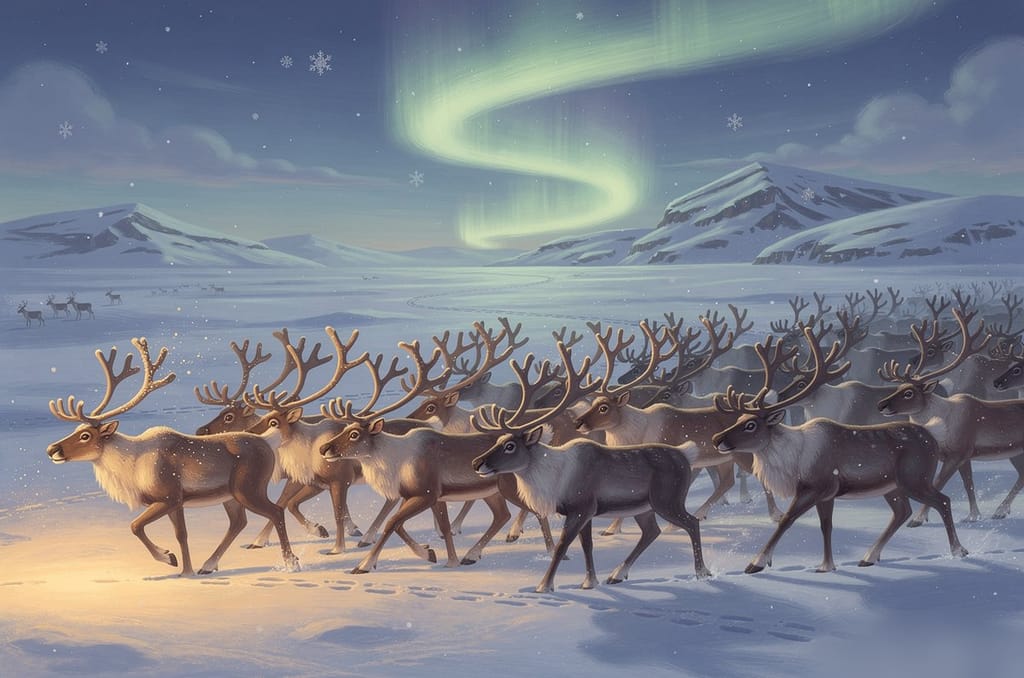
- Caribou are the only members of the deer family in which both males and females grow what? Antlers. Bulls grow large, massive antlers, while cows' antlers are much shorter and usually more slender. Easy · Alaska Dept. of Fish and Game
- What sound do caribou make as they walk? A clicking sound. The National Park Service says the click comes from tendons snapping past small sesamoid bones in the foot. Easy · National Park Service
- Caribou hooves are big and round enough to work like what kind of winter footwear? Snowshoes. Their very large hooves leave a nearly circular print and keep the animals from sinking into the snow. Easy · National Park Service
- The word "caribou" probably comes from a Mi'kmaq word meaning "the one who" does what? Paws. Hinterland Who's Who says the name likely comes from xalibu, "the one who paws," a nod to the way caribou paw through snow to reach lichens. Hard · Hinterland Who's Who
- In Sweden, reindeer herding is a livelihood reserved for which Indigenous people? The Sámi. Under Sweden's Reindeer Husbandry Act, the herding right rests on use since time immemorial, belongs only to the Sámi, and can be used only by Sámi who belong to a herding community called a sameby. Sweden has 51 of them, covering about a third of the country. Medium · OECD
Santa around the world trivia
Santa goes by other names elsewhere, and in some countries the presents come from someone else entirely, on a different night.
- In Finland, Santa's wife is called joulumuori. What does the name mean? Mother Christmas. Finland's official country site describes joulumuori as a wise, kind woman who helps Santa organize Christmas in Lapland. Medium · thisisFINLAND
- Finland's name for Santa, Joulupukki, literally means "Christmas" what animal? Goat. The name has roots in old customs such as the nuuttipukki, a horned figure in furs who visited homes after Christmas asking for leftover food and drink. Medium · thisisFINLAND
- In Finland, instead of sneaking down the chimney, how does Santa often arrive on Christmas Eve? He knocks on the door. Finnish Santa often knocks on Christmas Eve, asks whether there are any well-behaved children inside, sings with the family and hands out the presents in person. Easy · thisisFINLAND
- Russia's gift-bringer Ded Moroz has a name meaning "Grandfather" what? Frost. Ded Moroz began in Russian folktales as a winter force and became a gift-bringer in the 19th century. In the Soviet era he became the star of the secular New Year festival rather than Christmas. Medium · University of Graz
- What is the name of the Snow Maiden who accompanies Russia's Ded Moroz at New Year? Snegurochka. Snegurochka is Ded Moroz's granddaughter and helper. Since 1937 the pair have been the central duo of Russia's New Year tree celebration. Hard · University of Graz
- What is Santa Claus called in Italy? Babbo Natale. NPR reports that Italian children may leave Babbo Natale a clementine, plus some hay for his donkey. Medium · NPR
- In northern Germany the bearded Weihnachtsmann brings the gifts. Which golden-haired gift-bringer is more at home in the south? The Christ Child (Christkind). Germany's tourist board says the Weihnachtsmann is the newer figure and mostly works in the north, while the Christ Child with golden curly hair is more common in the south. Either way, presents come on December 24. Medium · German National Tourist Board
- In Chile, Santa Claus is known as El Viejo what? El Viejo Pascuero. In Chile, Christmas is called Pascua, so Santa Claus is El Viejo Pascuero, NPR reported. Hard · NPR
- When France's post office began answering children's letters to Père Noël in 1962, which famous child psychoanalyst wrote the reply card's text? Françoise Dolto. Dolto was the sister of the postal minister, Jacques Marette. The Père Noël secretariat later settled in Libourne, and in its first 50 years it sent more than 20 million replies. Hard · La Poste history committee
- What small festive pie do British children often leave out for Father Christmas on Christmas Eve? A mince pie. A British diplomat told NPR that children often leave a mince pie and a nip of sherry "to brace Father Christmas for the chill." Medium · NPR
- Swedish families may leave a bowl of what outside the front door for the Jultomte, who comes in by the door rather than the chimney? Rice porridge (risgrynsgröt). A Swedish embassy press officer told NPR the porridge is thickened with milk and flavored with cinnamon and a little salt. Medium · NPR
- Before St. Nicholas Day, what do German children polish and put outside the door to be filled with treats? Their shoes and boots. BBC Newsround says that by the morning of December 6 the boots hold sweets, nuts and small gifts for good children, while naughty ones may get twigs. Easy · BBC
Catch Santa in your own living room
Upload a photo of your room and we add Santa, caught on a home security camera on Christmas Eve, plus a Nice List certificate and a letter from Santa to print. You see watermarked previews before you pay, and no photo of your child is needed.
Christmas song and carol trivia
Silent Night was first sung in an Austrian village church in 1818, and Jingle Bells in a Boston hall in 1857. These questions ask who wrote the songs and where they began, so nobody has to sing.
- At its first known performance, in Boston in 1857, what was Jingle Bells called? The One Horse Open Sleigh. A playbill found by Boston University theater historian Kyna Hamill puts that performance at Ordway Hall on September 15, 1857. In 1859 the composer re-copyrighted the song as "Jingle Bells, or the One Horse Open Sleigh." Medium · Boston University
- Who wrote Jingle Bells? James Lord Pierpont. Pierpont (1822 to 1893) wrote about a dozen songs for a Boston troupe in the 1850s. Jingle Bells did not become a Christmas standard until decades after it was first sung. Hard · Boston University
- Silent Night was first sung on Christmas Eve 1818 in the village of Oberndorf, near which city? Salzburg. It premiered in the St. Nicholas church in Oberndorf near Salzburg. The priest Joseph Mohr had written the words as a poem in 1816, two years before they were set to music. Medium · Silent Night Society
- At its very first performance in 1818, Silent Night was accompanied by which instrument? A guitar. Schoolteacher and organist Franz Xaver Gruber wrote the melody for two voices, choir and guitar. That night Joseph Mohr sang tenor and played the guitar while Gruber sang bass. Medium · Silent Night Society
- In 2011, Silent Night was added to Austria's national inventory of what kind of heritage? Intangible cultural heritage. The Austrian Commission for UNESCO inscribed the carol in 2011. It notes the song has been translated into some 300 languages. Hard · Austrian Commission for UNESCO
- Which composer wrote the music for O Holy Night? Adolphe Adam. Placide Cappeau of France wrote the original French words in 1847. The English words found in most hymnals are by American music writer John Sullivan Dwight. Hard · Hymnary.org
- Which composer wrote the tune we sing to Hark! The Herald Angels Sing? Felix Mendelssohn. The melody comes from a chorus in Mendelssohn's Festgesang, first performed in 1840 at a festival in Leipzig celebrating Gutenberg's invention of the printing press. Medium · Hymnary.org
- Good King Wenceslas looked out on the Feast of Stephen. On what date is the Feast of Stephen? December 26. Saint Stephen's Day is the day after Christmas. In the carol, the duke and his page carry food and pine logs through the snow to a poor man's home that day. Medium · Encyclopedia.com
- The real Wenceslas never reigned as a king. In his lifetime he was a 10th-century duke of which land? Bohemia. Born around 907, he worked to spread Christianity among his people and was murdered by his brother in 929 or 935. He is now the patron saint of the Czech Republic. Hard · Encyclopedia.com
- The cheerful tune of Deck the Hall began as an old dance tune from which country? Wales. Carol historian Ian Bradley of the University of St Andrews traces it to the Welsh tune Nos Galan, meaning New Year's Eve, which merrymakers danced to in a ring around a harpist. Medium · WalesOnline
- The German carol O Tannenbaum is sung in English as O Christmas Tree. What kind of tree does "Tannenbaum" actually mean? A fir tree. The familiar words come from Ernst Anschutz's 1824 version, and the National Records of Scotland notes that versions of the song go back to at least the 16th century. Medium · National Records of Scotland
- Which songwriter wrote White Christmas, made famous by Bing Crosby's 1942 recording? Irving Berlin. The Library of Congress says Berlin wrote it in 1940 and that Crosby's record, about 50 million copies by most estimates, is the best-selling record in history. The 1942 recording joined the National Recording Registry in 2002. Medium · Library of Congress
Christmas story trivia
Every story in this round is old enough to be free to read, and we checked most of the answers against the original texts on Project Gutenberg.
- What is Scrooge's first name in A Christmas Carol? Ebenezer. The ghost of his old business partner calls him by his full name, "Ebenezer Scrooge," when he comes to warn him on Christmas Eve. Easy · Project Gutenberg
- When his nephew wishes him a merry Christmas, what two-word reply does Scrooge give? "Bah! Humbug!" His cheerful nephew bursts in with "A merry Christmas, uncle!" and Scrooge snaps back "Bah!" followed by "Humbug!" Easy · Project Gutenberg
- What was the name of Scrooge's business partner, who had died seven years before the story begins? Jacob Marley. Dickens opens the book with "Marley was dead: to begin with," and adds that he was "as dead as a door-nail." Medium · Project Gutenberg
- In A Christmas Carol, who was the kind old man Scrooge worked for as a young apprentice? Fezziwig. When the Ghost of Christmas Past takes him back to the old warehouse, Scrooge cries out in delight, "Why, it's old Fezziwig!" Hard · Project Gutenberg
- Dickens did not call the five sections of A Christmas Carol chapters. What did he call them? Staves. Each stave has its own title, and the last one, Stave V, is called "The End of It." Hard · Project Gutenberg
- In what year was A Christmas Carol first published? 1843. It came out on December 19, 1843, and the first edition sold out by Christmas Eve. Dickens wrote it in just six weeks. Medium · National Endowment for the Arts
- Who composed the music for The Nutcracker ballet? Pyotr Ilyich Tchaikovsky. The ballet was created in 1892, with choreography by Marius Petipa and Lev Ivanov. Medium · Royal Ballet and Opera
- In which city did The Nutcracker ballet first open in December 1892? St. Petersburg, Russia. It premiered at the Mariinsky Theatre and was not a hit at first; critics especially disliked the choreography for the Sugar Plum Fairy. Hard · Royal Ballet and Opera
- Which instrument plays the famous solo in the Dance of the Sugar Plum Fairy? The celesta. Petipa asked for music that sounded "as if drops of water were shooting out of fountains," and the composer answered with the twinkling celesta. Hard · Royal Ballet and Opera
- In O. Henry's The Gift of the Magi, what does Della sell to buy Jim's Christmas present? Her hair. She sells her long brown hair for twenty dollars and spends twenty-one dollars of it on Jim's present. Medium · Project Gutenberg
- In The Gift of the Magi, what does Jim sell to buy Della a set of combs? His gold watch. The watch had belonged to his father and grandfather. With the money he buys the tortoise shell combs Della had long admired in a Broadway window. Medium · Project Gutenberg
- How much money does Della have saved at the start of The Gift of the Magi? One dollar and eighty-seven cents ($1.87). The story's first line is "One dollar and eighty-seven cents," and sixty cents of it was in pennies. Hard · Project Gutenberg
- Little Women opens with which March sister grumbling, "Christmas won't be Christmas without any presents"? Jo. It is the first line of Louisa May Alcott's novel. On Christmas morning the sisters give their own breakfast to a poor neighboring family, the Hummels. Medium · Project Gutenberg
- On which night of the year is Hans Christian Andersen's The Little Match Girl set? New Year's Eve. As she lights her matches to keep warm, she sees a warm stove, a roast goose, a glowing Christmas tree and finally her beloved grandmother. Medium · Hans Christian Andersen Centre
- In Andersen's The Fir Tree, where do the servants put the tree the morning after its one glorious Christmas Eve? The attic (the garret). The butler and maid drag it upstairs to a dark corner of the garret, where little mice come to hear its stories about the forest and Christmas Eve. Hard · Hans Christian Andersen Centre
- How old was Virginia O'Hanlon when she wrote to The Sun asking whether Santa Claus was real? Eight. Her letter asked, "Please tell me the truth; is there a Santa Claus." The reply ran in the New York Sun on September 21, 1897. Medium · Library of Congress
- Who wrote the famous 1897 "Yes, Virginia" reply in the New York Sun? Francis Pharcellus Church. A veteran Sun writer, Church wrote it under deadline in fewer than 500 words and stayed anonymous as its author until his death in 1906. Its original title was "Is There a Santa Claus?" Hard · Library of Congress
- In Charles Dickens's A Christmas Carol, what bird do the Cratchits eat for Christmas dinner? A goose. Dickens writes "There never was such a goose," and the family marveled at its size and cheapness. Eked out with applesauce and mashed potatoes, it made a sufficient dinner for the whole family. Easy · Project Gutenberg
- On Christmas morning in A Christmas Carol, what does the changed Scrooge secretly send to the Cratchit family? The prize turkey. Scrooge asks a boy whether the big prize turkey at the poulterer's has been sold, then sends it to Bob Cratchit's home without saying who it is from. He jokes that it is twice the size of Tiny Tim. Easy · Project Gutenberg
Christmas around the world trivia
Customs from other countries, checked against each country's tourism board, embassy or national press wherever we could. Watch the dates: several of these fall well before or after December 25.

- In Japan, Christmas is less a family holiday and more a romantic date for whom? Couples. Couples plan restaurant dates and visit light displays, while Japanese families save their big get-together for the New Year holiday. Medium · Japan National Tourism Organization
- The Philippines is known for the world's longest Christmas season, which starts with the first of the "ber" months. Which month is that? September. "Christmas fever starts on Sept. 1 and ends the first week of January," a professor of Philippine studies at the University of the Philippines Diliman told CNBC. Medium · CNBC
- What do Filipinos call the nine Masses traditionally held at dawn from December 16 to 24? Simbang Gabi (also called Misa de Gallo). People traditionally rise before dawn for nine straight days so they can attend Mass before starting work, building up to Christmas. Hard · CBCP News
- In Iceland's "Christmas book flood" (Jolabokaflod), what do people give each other on Christmas Eve? Books. Presents are opened on the night of December 24 and people spend the evening reading. The season kicks off when a free catalog of new books arrives at every home. Easy · NPR
- Since 1947, Norway has given London a giant Christmas tree every year to thank Britain for its help in World War II. In which London square does it stand? Trafalgar Square. The Norwegian spruce, often 50 to 60 years old, comes from the forests around Oslo and is decorated Norwegian-style with vertical strings of lights. Medium · London City Hall
- Mexico's Las Posadas, which reenacts Mary and Joseph asking for a place to stay, lasts how many nights before Christmas? Nine. Posadas run from December 16 to 24, with guests singing a traditional request for shelter at the door before the party begins. Medium · UNAM Global
- In Italy, which old woman flies on a broomstick on the night of January 5 to fill children's stockings? La Befana. Her visit comes on the eve of Epiphany, January 6, which marks the end of Italy's Christmas holidays. Medium · Italia.it
- In Italy, what does La Befana leave in the stockings of children who have misbehaved? Coal. Well-behaved children find sweets, so whether you get candy or coal depends on how you behaved during the year. Easy · Italia.it
- In Austria, which horned, fur-covered figure goes with St. Nicholas and parades through the streets on December 5? Krampus. Krampus runs feature masks, bells and furs. In the Gastein Valley, the Krampus is seen as chasing away evil rather than being evil itself. Medium · Austria.info
- What is the name of the cheeky figure of a squatting peasant, pants down, hidden in Catalan nativity scenes? The caganer. The traditional caganer wears a red Catalan cap called a barretina and dates to around the late 17th or early 18th century. Catalans say leaving him out brings bad luck. Hard · BBC Travel
- In Venezuela, a Christmas tradition called "las patinatas" has families getting to dawn Christmas Masses how? On roller skates. People skate through the night in the days before Christmas, then roll on to the early-morning Mass. In Caracas, December falls in a warm season, so no winter coats are needed. Medium · America Magazine
- On what date does Sweden hold its candlelit Lucia processions? December 13. Choirs in long white gowns sing in schools, churches and workplaces, celebrating light in the middle of the dark Swedish winter. Medium · Sweden.se
- At a Polish Christmas Eve supper (Wigilia), why do many families leave one place at the table empty? For an unexpected guest or a stranger in need. The place is kept in case someone down on their luck asks for shelter, and tradition says such a guest must be welcomed and treated as family. Easy · Culture.pl
- Many Polish families wait for what to appear in the sky before sitting down to Christmas Eve supper? The first star. The custom remembers the Star of Bethlehem, which according to the New Testament guided the Wise Men. Easy · Culture.pl
- At Christmas, called Genna, Ethiopians play a traditional stick-and-ball game that is similar to which sport? Field hockey. The game, Ye Genna Chewata, is played with wooden sticks and a hard wooden ball, mostly in rural areas. Ethiopia follows its own calendar, so its Christmas does not fall on December 25. Medium · Ethiopian News Agency
- At Christmas, Ethiopian pilgrims flock to the famous rock-hewn churches of which town? Lalibela. Its 11 churches were carved from solid rock in the Middle Ages under King Lalibela, and they are a UNESCO World Heritage site. At Christmas, white-robed priests chant in circles at the top and bottom of the churches. Hard · Ethiopian News Agency
- Christmas Island in the Indian Ocean got its name because a sea captain spotted it on which day in 1643? Christmas Day. English sea captain William Mynors named the island after sighting it on December 25, 1643. Today it is an Australian territory. Easy · Parks Australia
Christmas history trivia
Where the customs came from and when they reached America. Several are younger than people guess.
- Many Orthodox churches, including those of Russia and Egypt, celebrate Christmas on what date? January 7. These churches still follow the older Julian calendar, which has drifted 13 days behind the Gregorian calendar most of the world uses, so their December 25 lands on our January 7. Medium · National Geographic
- Who sent what is generally recognized as the first Christmas card, in 1843? Henry Cole. Cole, later the first director of London's Victoria and Albert Museum, asked his artist friend John Callcott Horsley to design it and had 1,000 copies printed. Sold at a shilling each, the cards were judged a commercial flop. Hard · V&A Museum
- The Christmas tree as we know it is usually traced to which country? Germany. Its likeliest birthplace is the Alsace region, German territory in the 1500s and part of France today. Records show a Christmas tree was raised in Strasbourg Cathedral in 1539. Medium · National Geographic
- Which London baker and confectioner invented the Christmas cracker? Tom Smith. After seeing French bonbons (sugared almonds wrapped in paper) in Paris, he tucked love mottoes into wrapped sweets and later added the pop. The idea for the bang was supposedly sparked by the crackle of a log fire. Hard · V&A Museum
- Tinsel is said to have started in Nuremberg, Germany, around 1610. What precious metal were those first strands made of? Silver. The story goes that people in Nuremberg hung thin strands of real silver on their trees to reflect candlelight. Silver was costly and tarnished fast, so cheaper metals replaced it, and today tinsel is made of plastic. Medium · BBC
- During the 1914 Christmas truce, what sport did some British and German soldiers play in no man's land? Football (soccer). One rifleman's diary says men "exchanged souvenirs, played football, and not a shot fired all day or night." Easy · National Army Museum
- Boxing Day, celebrated in Britain and many Commonwealth countries, falls on what date? December 26. It is the day after Christmas, and it is thought to have grown out of traditions of charitable giving. Easy · National Geographic
- Saint Stephen, whose feast falls on Boxing Day, is considered Christianity's first what? Martyr. He was known for serving the poor, which fits the day's traditions of giving alms and gifts. Medium · National Geographic
- Which British king gave the first royal Christmas broadcast, by radio, in 1932? George V. He spoke live on the radio from the Sandringham Estate in Norfolk, reading words written by Rudyard Kipling. The first televised Christmas broadcast came in 1957, from Queen Elizabeth II. Hard · BBC
- On Christmas Eve 1968, the Apollo 8 astronauts took turns reading from which book of the Bible during a live broadcast from lunar orbit? Genesis. They read the opening verses of Genesis and closed with a wish for everyone "on the good Earth." The same mission produced the famous Earthrise photo. Medium · NASA
- Which American colony made celebrating Christmas a crime from 1659 to 1681? Massachusetts Bay Colony. The Puritans saw the holiday as a time of excess with no basis in the Bible. The ban was repealed under pressure from London, and Christmas did not become a Massachusetts state holiday until 1856. Medium · Mass Humanities
- On Christmas night 1776, George Washington led about 2,400 soldiers across which icy river for a surprise attack? The Delaware River. The next morning, December 26, they defeated Hessian troops at Trenton, New Jersey, capturing close to 900 of them and lifting the struggling patriot cause. Medium · National Museum of the US Army
- Which president lit the first National Christmas Tree in Washington, D.C., on Christmas Eve 1923? Calvin Coolidge. He pushed a button to light a balsam fir on the Ellipse as about 3,000 people watched. The tree came from his home state of Vermont, a gift of Middlebury College. Hard · National Park Service
- In 1931, who lined up for their pay beside the very first Christmas tree on the Rockefeller Center site, a humble 20-foot balsam fir? Construction workers. During the Great Depression, the men building the center collected their wages in front of the little tree on a rubble-strewn lot. The first official tree followed in 1933. Easy · The New York Times
Christmas food trivia
Questions about Christmas food and where it comes from, including a few famous stories that turn out to be legends.
- Which English queen is said to have served her guests tiny gingerbread versions of themselves? Queen Elizabeth I. The Tudors loved gingerbread at feasts and state events. According to English Heritage, Elizabeth I once impressed her guests by serving them miniature gingerbread figures of themselves. Medium · English Heritage
- A small blue spruce decorated in 1847 is often cited as the first documented use of candy canes on an American Christmas tree. In which Ohio town did it stand? Wooster. A young immigrant named August Imgard decorated the tree. Researchers at Toronto Metropolitan University call it the first documented case of candy canes. Hard · The Conversation
- Which chemical in peppermint makes a candy cane feel cool in your mouth? Menthol. Menthol switches on the same nerve sensor (called TRPM8) that normally detects cold. Your brain gets the message that something cold is in your mouth, even though nothing has changed temperature. Medium · The Conversation
- The "sugar-plums" that danced in children's heads in the 1823 poem A Visit from St. Nicholas were not sugared plums. According to candy historians, what kind of candy was a sugar plum? A comfit (a seed, nut or bit of spice coated in hard sugar). Candy historians and the Oxford English Dictionary define a sugar plum as a comfit, built up from layers of hard sugar around a seed, nut or bit of spice. Making them by hand took hours or days, so they were pricey treats first made for aristocrats. Medium · National Geographic
- The "nog" in eggnog is usually traced to an old English dialect word for what drink? Strong ale (a strong beer). Eggnog turns up in America in the late 1700s. The Oxford English Dictionary links "nog" to a strong beer brewed in Norfolk, England, though some think it comes from "noggin," a small mug, and its ultimate origin is still a mystery. Hard · Wordorigins.org
- Stir-up Sunday, when British families traditionally mix the Christmas pudding, gets its name from the opening words of what? A prayer (the collect) in the Book of Common Prayer. The prayer for the Sunday before Advent begins "Stir up, we beseech thee, O Lord." Over time people linked that Sunday with stirring up the year's Christmas pudding, which is made ahead and reheated on Christmas Day. Hard · Anglican Life
- Medieval and Tudor mince pies were filled with something that modern mince pies leave out. What was it? Meat. A 1591 English recipe fills the pie with minced mutton or beef along with dried fruit and spices. By the 20th century the only trace of meat left was suet. Easy · English Heritage
- Panettone, the tall Christmas bread dotted with raisins and candied fruit, comes from which country? Italy. Italy's official tourism site says it almost certainly began in Milan. The popular story that it is named after a kitchen boy called Toni is described as romantic but not necessarily true. Easy · Italia.it
- Pandoro, a Christmas cake from Verona, Italy, is shaped like what? An eight-pointed star. Pandoro was first patented in Verona in 1884 as a soft, eight-pointed star-shaped Christmas dessert. The star design came from a Veronese painter. Medium · Italia.it
- A papal letter nicknamed the "Butter Letter" finally let the stollen bakers of which German city bake with butter during Advent? Dresden. The Church had banned baking with butter during Advent, so early stollen was a bland fasting bread of flour, yeast and water. Pope Innocent VIII's "Butterbrief" exempted Dresden's stollen bakers from that ban. Hard · European Commission
- On which night do many Italian American families hold the Feast of the Seven Fishes? Christmas Eve. The seafood feast is an Italian American tradition that grew after the big wave of Italian immigration around 1900. In Italy the Christmas Eve meal is simply called "la vigilia," meaning "the eve." Easy · National Geographic
Christmas tree and plant trivia
Answers in this round come mostly from university extension services and the National Christmas Tree Association.
- The wild ancestor of the poinsettia grows as a lanky shrub mainly in which country? Mexico. In the wild the poinsettia is a tall, lanky shrub of Mexico's coastal forests and hot, dry interior. Its botanical name, Euphorbia pulcherrima, means it is the most beautiful member of the spurge family. Easy · Penn State Extension
- The poinsettia is named after Joel Roberts Poinsett. What post was he appointed to in 1825? First US Minister to Mexico. President John Quincy Adams appointed Poinsett, a South Carolina congressman, as the first US Minister to Mexico. An amateur botanist, he sent the plant home, and it was later named in his honor. Medium · US House of Representatives
- National Poinsettia Day falls on which date? December 12. The US House of Representatives passed a resolution in 2002 designating December 12 as National Poinsettia Day. By then poinsettias were bringing in hundreds of millions of dollars a year in sales. Hard · US House of Representatives
- In Spanish the poinsettia is called "flor de Nochebuena." What does that mean in English? Christmas Eve flower. The plant became tied to Christmas in Mexico after Spanish friars began using it in Nativity processions in the 1600s. The Aztecs, who grew it long before, called it cuetlaxochitl. Medium · UC Agriculture and Natural Resources
- Holly trees come as separate male and female plants. Which ones grow the red berries? The female plants. Hollies are dioecious, meaning each plant is either male or female. Only females make berries, and they need a male holly nearby to pollinate them. Medium · UF/IFAS
- Holiday mistletoe makes some of its own food with green leaves but takes water and nutrients from its host tree. What do botanists call this kind of partial parasite? A hemiparasite. Hemiparasites contain chlorophyll, so they get only part of their nourishment from the tree they live on. Dwarf mistletoes, by contrast, are full parasites. Hard · UW Extension
- In 1820, Washington Irving wrote that young men who kissed under the mistletoe would pluck something from it each time. What? A berry. When all the berries were gone, the kissing privilege ended. Kissing under the mistletoe began to be mentioned regularly in literature during the 1700s. Medium · UConn Extension
- The Christmas cactus comes from the coastal mountains of which country? Brazil. Unlike desert cacti, it is a rain forest plant that grows on trees or rocks in southeastern Brazil. Its flat green stems do the work of leaves. Medium · NC State Extension
- Which US state produces the majority of Fraser fir Christmas trees? North Carolina. The Fraser fir is native to the southern Appalachian Mountains and is named for John Fraser, a Scottish botanist. Medium · National Christmas Tree Association
- Which tree species has been used most often for the giant Christmas tree at New York's Rockefeller Center? Norway spruce. The New York Times reported in 2008 that a Norway spruce had been used every year since 1982, though white spruces and balsams have also been chosen. The very first tree, in 1931, was a humble 20-foot balsam at the construction site. Medium · The New York Times
- According to the National Christmas Tree Association, about how many years on average does it take to grow a 6 to 7 foot Christmas tree? About 7 years. It can take as few as 4 years or as many as 15, depending on the tree. For every real tree harvested, growers plant 1 to 3 seedlings the following spring. Medium · National Christmas Tree Association
- In 2022, which two states together harvested more than half of the 14.5 million cut Christmas trees in the US? Oregon and North Carolina. Christmas tree farming is concentrated in states with the right elevation, soil, rain and winter temperatures. Michigan, Washington, Pennsylvania, Wisconsin and Virginia followed. Hard · American Farm Bureau
Christmas science and nature trivia
The winter sky, snow, birds and the people born on Christmas Day.

- The December solstice, the Northern Hemisphere's shortest day, usually falls on December 21 or which other date? December 22. The December solstice brings the shortest day and longest night of the year to places north of the equator, like the US. It marks the start of astronomical winter there. Medium · NASA
- In 1885, after much trial and error, Vermont farmer Wilson Bentley used a camera attached to a microscope to photograph what? A single snow crystal (a snowflake). The man later known as "Snowflake" Bentley got his first snow crystal photo on January 15, 1885. Over the next 46 years he took more than 5,000 snow crystal photos. Easy · New York Academy of Sciences
- NOAA's white Christmas map counts a Christmas as white when at least how much snow is on the ground on December 25? At least 1 inch. The map uses 1991 to 2020 weather records from thousands of stations. The best historical odds are in places like Minnesota, Maine, Idaho, upstate New York and the Rockies. Medium · NOAA Climate.gov
- In 1900, ornithologist Frank Chapman proposed replacing the holiday "side hunt" with a new tradition. Instead of shooting birds at Christmas, people would do what with them? Count them. His "Christmas Bird Census" became the Christmas Bird Count. On Christmas Day 1900, 27 birders held 25 counts and tallied around 90 species. Easy · National Audubon Society
- In December 2020, which two planets came so close together in the night sky that people nicknamed them the "Christmas Star"? Jupiter and Saturn. Their "great conjunction" peaked on December 21, 2020. NASA said it had been nearly 400 years since the two planets passed this close. Medium · NASA
- The idea that the Star of Bethlehem was a comet goes back to which early Christian writer, around AD 248? Origen. One appeal of the comet theory is that comets move across the sky, which some argued fits a star that "moved" as it guided the Magi. Royal Museums Greenwich lists it as just one of several possible explanations. Hard · Royal Museums Greenwich
- Which meteor shower peaks in mid-December every year? The Geminids. NASA calls it one of the best and most reliable meteor showers of the year. Under perfect conditions up to 120 meteors an hour can be seen at its peak. Medium · NASA
- Which famous scientist was born on Christmas Day 1642, by the calendar England used at the time? Isaac Newton. England still used the old Julian calendar, which was ten days behind the Gregorian one. On today's calendar his birthday is January 4, 1643. Medium · The Newton Project
- Which Civil War nurse, who went on to found the American Red Cross, was born on Christmas Day 1821? Clara Barton. She was born in North Oxford, Massachusetts, and became the American Red Cross's first president. She led the organization for 23 years. Medium · National Park Service
Christmas word trivia
Where the Christmas words come from, checked against the Online Etymology Dictionary, plus Merry Christmas in five languages.
- The word Christmas comes from the Old English "Cristes maesse." What does that mean? Christ's Mass. It joins Christ and mass, the church service. Etymonline notes it was being written as one word by the mid-1300s. Medium · Etymonline
- The word Noel comes from the Latin "natalis." What does natalis refer to? A birth (birthday). Latin natalis dies meant "birth day" and was used in Church Latin for the birthday of Christ. It reached English through Old French noel in the late 1300s. Medium · Etymonline
- Which old word for the Christmas season comes from the Old English "geol" and is related to the Old Norse "jol"? Yule. Jol was the name of a pagan feast later absorbed into Christianity. By the 1000s Christmas had replaced yule in most of England, except in areas of Danish settlement. Medium · Etymonline
- Wassail comes from the Old Norse greeting "ves heill." What does it mean? Be healthy (be in good health). It began as a toast, and by about 1300 also meant the spiced ale drunk on Christmas Eve. Going house to house caroling, called wassailing, is recorded from 1742. Hard · Etymonline
- Advent, the season before Christmas, comes from the Latin "adventus." What does adventus mean? A coming (an arrival). In Church Latin the word referred to the coming of the Savior, which is why the weeks of waiting before Christmas are called Advent. Medium · Etymonline
- Epiphany, the feast on January 6, comes from a Greek word meaning what? Manifestation (a striking appearance). Greek epiphaneia meant a manifestation or striking appearance. The feast marks the manifestation of Christ to the gentiles, and the wider sense of any manifestation or revelation is recorded by 1840. Hard · Etymonline
- Mistletoe comes from the Old English "mistiltan." What did the ending "tan" mean? Twig. Mistel was the name of the plant, so the word is roughly "mistletoe twig." Etymonline notes that Washington Irving mentions the custom of hanging it at Christmas and kissing under it. Hard · Etymonline
- If someone wishes you "Feliz Navidad," which language are they speaking? Spanish. BBC Languages pairs it with "Feliz Año Nuevo" for Happy New Year. Easy · BBC
- If someone wishes you "Joyeux Noël," which language are they speaking? French. BBC Languages pairs it with "Bonne Année" for Happy New Year. Noël is the same word English borrowed as Noel. Easy · BBC
- If someone wishes you "Frohe Weihnachten," which language are they speaking? German. BBC Languages pairs it with "Frohes Neues Jahr" for Happy New Year. Easy · BBC
- If someone wishes you "Buon Natale," which language are they speaking? Italian. BBC Languages pairs it with "Felice Anno Nuovo" for Happy New Year. Easy · BBC
- "Mele Kalikimaka" means Merry Christmas in which language? Hawaiian. The Pukui-Elbert Hawaiian Dictionary, hosted by the University of Hawaii at Hilo, defines Mele Kalikimaka simply as "Merry Christmas." Easy · University of Hawaii at Hilo
Hard Christmas trivia for adults
Every question in this round is worth 3 points. Save it for the end of the night, when the grown-ups' table needs settling.
- The earliest known record of December 25 as a church festival reflects Roman practice in which year? 336. It appears in a Roman calendar copied in 354, called the Philocalian Calendar, which records how the church in Rome kept the day in 336. No one knows the actual date of Jesus' birth. Hard · Schaff-Herzog Encyclopedia
- When England's Parliament abolished Christmas and other holy days in 1647, what regular day off did servants and apprentices get instead? The second Tuesday of every month. The ordinance of June 8, 1647, replaced the old holy days with monthly time for "recreation and relaxation," with a justice of the peace settling any disputes. Hard · British History Online
- What was the fine for celebrating Christmas under the Massachusetts Bay Colony's 1659 law? Five shillings. The law fined anyone caught "observing any such day as Christmas or the like, either by forbearing of labor, feasting, or any other way." Hard · Mass Humanities
- In what year did Congress first make Christmas Day a federal holiday? 1870. The first federal holiday law gave federal workers in Washington, D.C., time off for Christmas, New Year's Day, Independence Day and Thanksgiving. Hard · Congressional Research Service
- What password did Washington choose for his army's Christmas night crossing of the Delaware in 1776? "Victory or Death" Officers stressed absolute silence and order, and every soldier carried three days of rations and 40 rounds of ammunition. Hard · National Museum of the US Army
- Which president had the first known Christmas tree inside the White House, in 1889? Benjamin Harrison. On Christmas morning his grandchildren led the family into the second-floor Oval Room to see the candlelit tree, with stockings hung from the mantel. Hard · White House archive
- In a 15th-century English carol, the earliest known personified Christmas introduces himself as "Sir" who? Sir Christemas (Sir Christmas). English Heritage says Father Christmas began as a symbol of the season, not a gift-giver. In the carol, Sir Christemas shares the news of Christ's birth and tells listeners to "make good cheer and be right merry." Hard · English Heritage
- Charles Wesley's 1739 Christmas hymn originally began "Hark, how all the welkin rings." What does "welkin" mean? The heavens (the sky). Preacher George Whitefield changed the opening to "Hark! The herald angels sing" when he published the hymn in 1753, and that version stuck. Hard · Hymnary.org
- Isaac Watts wrote Joy to the World in 1719 as a paraphrase of which Psalm? Psalm 98. Watts published it in his Psalms of David Imitated under the heading "The Messiah's Coming and Kingdom." Hymnary notes it suits Christmas Day but can be sung any time of year. Hard · Hymnary.org
- The Twelve Days of Christmas first appeared in print in England in 1780, in a children's book with what title? Mirth Without Mischief. It was printed as part of a Twelfth Night game of forfeits: anyone who could not repeat the growing list of gifts correctly had to give up a forfeit, such as a kiss or a treat. Hard · National Catholic Register
- The word "humbug" is first recorded in 1751 as slang among students at which two universities? Oxford and Cambridge. It meant a trick, jest or hoax. Its true origin was already a mystery by the time the word became fashionable. Hard · Etymonline
- The word carol comes from the Old French "carole." What kind of activity did carole describe? A ring dance (a round dance with singers). The English sense "Christmas hymn of joy" is recorded from about 1500. Using carol as a verb for going around in a group singing Christmas carols is recorded from 1879. Hard · Etymonline
- At Christmas, a 14-year-old future Queen Victoria gave two bits of gingerbread to her beloved King Charles Spaniel. What was the dog's name? Dash. Victoria gave Dash the gingerbread surrounded with branches of holly and candles. Later her husband, Prince Albert, handed out gingerbread and apples to their well-behaved children. Hard · English Heritage
- In medieval England, pie crusts went by a name that sounds spooky today. What were they called? Coffins. Medieval pie crusts were a simple flour and water dough used to hold and cook the filling. They were often thrown away once the filling had been eaten. Hard · English Heritage
- The American mistletoe's genus name, Phoradendron, means what in Greek? Thief of the tree. American mistletoe pushes root-like structures called haustoria under a tree's bark to draw out water and nutrients. Those structures can live inside the tree for years even after the visible plant is cut off. Hard · The Conversation
- Mistletoe is the state floral emblem of which US state? Oklahoma. An Oklahoma State University horticulturist writes that it was chosen apparently because it was the only greenery available to put on graves during the harsh winter of 1889. Hard · The Conversation
- The Douglas-fir is not a true fir. Its genus name, Pseudotsuga, means what? False hemlock. Only trees in the genus Abies are true firs, which is why "Douglas-fir" is written with a hyphen. Its cones hang down and fall off whole, while true fir cones stand upright and fall apart. Hard · Oregon State University Extension
- At the Northern Hemisphere's winter solstice, the Sun is directly overhead at which line of latitude? The Tropic of Capricorn. The Tropic of Capricorn lies 23.5 degrees south of the equator and runs through Australia, Chile, southern Brazil and northern South Africa. Hard · National Weather Service
- Christmas Island's red crabs always spawn before dawn during which phase of the moon? The last quarter. The crabs release their eggs into the sea on a receding high tide during the moon's last quarter. If the rains come late, they have to hurry to make this lunar date. Hard · Parks Australia
- Which 17th-century astronomer is associated with the idea that the Star of Bethlehem may have been a close meeting of two bright planets in the sky? Johannes Kepler. The planets were Jupiter and Saturn. This is only one of several proposed explanations, and none is proven. Royal Museums Greenwich notes the planets were never close enough to look like a single object. Hard · Royal Museums Greenwich
- Most meteor showers come from comets. What kind of object does the big mid-December meteor shower come from instead? An asteroid (3200 Phaethon). Phaethon looks like a rocky asteroid, though it might be a "dead comet" or "rock comet," and scientists are not certain how to classify it. It circles the Sun every 1.4 years. Hard · NASA
True or false Christmas trivia
Each false statement here is a story that gets repeated as fact, and several turn up as answers on popular trivia lists. Read the statement, take a vote, then read the correction. Every statement scores 1 point.
- "Xmas" was invented to take Christ out of Christmas. False. The X stands for Christ. It comes from chi, the first letter of the Greek Khristos, and English writers were spelling Christmas "X'temmas" by 1551. Etymonline
- Sinterklaas arrives in the Netherlands each November by steamboat from Spain. True. In the Dutch tradition he lives in Spain, sets sail in early November and arrives in mid-November to welcoming parades. Embassy of the Netherlands
- Prince Albert brought the Christmas tree to Britain. False. Queen Charlotte introduced decorated trees to the British upper classes in the 1700s. An 1848 picture of Victoria and Albert's family around their tree at Windsor Castle spread the fashion to the rest of society. Newcastle University
- Oliver Cromwell banned Christmas when he ruled England as Lord Protector. False. Parliament had already abolished Christmas in June 1647, more than six years before Cromwell became Lord Protector in December 1653. As Lord Protector he supported enforcing the ban. National Army Museum
- Reindeer eyes change color in winter. True. A mirror-like layer behind the retina of Arctic reindeer shifts from gold in summer to deep blue in the dark winter. The team that found it thinks this makes their eyes more sensitive to light, though other vision scientists are not convinced. National Geographic
- The 1914 Christmas truce was one official ceasefire along the whole Western Front. False. It was a series of unofficial truces along parts of the front. Senior officers disapproved, much fighting went on, and only some soldiers played football. National Army Museum
- Boxing Day is named after the sport of boxing. False. Historians disagree on the origin, but it is thought to come from charitable giving on St. Stephen's Day, such as opening church alms boxes for the poor or handing out Christmas "boxes," or tips, to workers. National Geographic
- Santa's red suit was invented for a soft-drink advertisement in the 1930s. False. English Heritage traces his red coat to the 1821 poem "Old Santeclaus with Much Delight" and calls the idea that a soft-drink company invented Santa a myth. The company only began using him in its ads in the 1930s. English Heritage
- Reindeer and caribou are the same species. True. They are considered one species, Rangifer tarandus. In Europe the animals are all called reindeer, while in Alaska and Canada only the semi-domesticated form gets that name. Alaska Dept. of Fish and Game
- Silent Night was written because mice had chewed through the church organ. False. The Silent Night Museum in Oberndorf says the mouse legend is clearly not true. Documents from the time mention only that the old organ's sound could not fill the church. Silent Night Museum
- O Holy Night was the first music ever broadcast on radio. False. The story rests on one letter Reginald Fessenden wrote at the end of his life, and it has been disputed. In the version passed down, a wax cylinder recording of Handel's Largo was heard before his violin solo, and his letter credits the piece to Gounod, who did not write O Holy Night. NPR
- The red "petals" of a poinsettia are not petals at all. True. They are bracts, leaf-like structures. The real flowers sit inside the small yellow-green globes in the center. Penn State Extension
- The Twelve Days of Christmas was a secret code for persecuted English Catholics. False. There is no historical evidence for it. The song was first printed in a 1780 children's book as a memory game of forfeits, the code story dates only from the 20th century, and most of the beliefs it supposedly hides were shared by Catholics and Anglicans anyway. National Catholic Register
- Martin Luther wrote Away in a Manger for his children. False. Luther is only an attribution. The first two verses are anonymous and were first published in 1885 in a Lutheran children's book printed in Philadelphia. Hymnary.org
- Jingle Bells was written in 1850 in a tavern in Medford, Massachusetts. False. In 1850 its writer was in California trying to cash in on the Gold Rush. Historian Kyna Hamill found that the Medford story first appeared in a 1946 Boston Globe article. Boston University
- By Christmas, adult female reindeer are more likely to have antlers than adult males. True. Adult males shed their antlers after the autumn rut, while females can keep theirs all winter. National Park Service
- A poinsettia can kill a child who eats it. False. Poinsettias can irritate the mouth and stomach, and the sap can cause a rash, but researchers could not find a poisonous dose even at about 500 to 600 leaves. Poison Control
- Candy canes were invented in 1670 by a choirmaster at Cologne Cathedral to keep children quiet. False. Researchers at Toronto Metropolitan University call this story a folktale with little evidence behind it. There are no exact records of who invented the candy cane. The Conversation
- In the Brothers Grimm tale, the witch's house in Hansel and Gretel is made of gingerbread. False. The original tale describes a house made of bread, with a cake roof and sugar windows. Later retellings upgraded the bread to gingerbread. English Heritage
- December is cold in the US because Earth is farthest from the Sun. False. Earth is about 1.6 million miles closer to the Sun than average in the first week of January. Winter comes from Earth's 23.5 degree tilt, which points the Northern Hemisphere away from the Sun. National Weather Service
- Thomas Edison lit the first electric Christmas tree. False. Edward H. Johnson, an executive in Edison's electric lighting business, lit 80 hand-wired bulbs on a Christmas tree in his New York City home in 1882. IEEE Spectrum
- Most snowflakes are perfectly symmetrical six-pointed stars. False. Caltech physicist Kenneth Libbrecht says irregular, lopsided crystals are by far the most common kind. The perfect ones in photos are rare finds picked out from thousands. SnowCrystals.com (Caltech)
- Alabama was the first US state to make Christmas a legal holiday, in 1836. False. The Alabama Department of Archives and History searched for years and found no evidence for it, and a former assistant director there calls it "totally false." The legislature made Christmas a bank holiday in 1848, and the only link to 1836 the archives found is that the 1848 law later appeared as section 1836 of the state code. Snopes
Christmas tiebreaker questions
If two teams tie, ask one of these. The closest number wins.
- If you count every repeated gift in The Twelve Days of Christmas, how many gifts does the singer receive in total? 364. Each day repeats all the earlier gifts, so the twelfth day alone brings 78, and the total comes to one for every day of the year except Christmas Day. Maths Careers
- How many hand-wired bulbs lit Edward H. Johnson's electric Christmas tree in 1882? 80. They were red, white and blue, on a tree that turned on a revolving box. IEEE Spectrum
- How tall, in feet, was the first National Christmas Tree, lit by Calvin Coolidge in 1923? 48 feet. It was a balsam fir from Vermont, lit on the Ellipse as about 3,000 people watched. National Park Service
- According to the National Christmas Tree Association's consumer survey, how many real Christmas trees did Americans buy in 2023? About 21.6 million. About 14% of the people surveyed bought one, paying a median price of $75. National Christmas Tree Association
Put the whole family in one portrait
Upload a photo of up to six people, pick an art style, and we repaint everyone as one portrait on a gallery canvas from $59 or a framed canvas from $79. You approve a free, watermarked proof before anything prints.
Frequently asked questions
What are some good Christmas trivia questions?
+
Good ones have a single short answer and a fact worth hearing afterward. Try: What did Della sell to buy a present in The Gift of the Magi? (Her hair.) Which instrument plays the Dance of the Sugar Plum Fairy? (The celesta.) What did the Gemini 6 astronauts play on a harmonica and bells in December 1965? (Jingle Bells.) Which president had the first known Christmas tree inside the White House, in 1889? (Benjamin Harrison.)
What are easy Christmas trivia questions for kids?
+
Questions with one-word answers they can shout out: How many tiny reindeer pull the sleigh in the poem A Visit from St. Nicholas? (Eight.) What color were candy canes before they had stripes? (White.) How many sides does a snowflake's basic pattern have? (Six.) What does La Befana leave in the stockings of naughty children in Italy? (Coal.)
What are some hard Christmas trivia questions?
+
What was the fine for celebrating Christmas under the Massachusetts Bay Colony's 1659 law? (Five shillings.) What regular day off did English servants get after Parliament abolished Christmas in 1647? (The second Tuesday of every month.) In the hymn line "Hark, how all the welkin rings," what does welkin mean? (The heavens.) Most meteor showers come from comets, so what does the mid-December one come from? (An asteroid, 3200 Phaethon.)
How many reindeer does Santa have?
+
Eight, in the 1823 poem A Visit from St. Nicholas: Dasher, Dancer, Prancer, Vixen, Comet, Cupid, and two first printed as Dunder and Blixem, Dutch for thunder and lightning. Those two names later shifted to Donder and Blitzen.
How do you keep score when kids and adults play Christmas trivia together?
+
Score by difficulty: 1 point for an Easy question, 2 for Medium and 3 for Hard, and put children and adults on the same teams. Let the youngest player answer Easy questions first, with teammates helping only if they pass, and break ties with a closest-number question.
How long does a Christmas trivia game take?
+
Allow about 30 seconds a question plus time to read it twice, which comes to roughly 15 minutes for a 20-question round. Three or four rounds and a tiebreaker fill an hour.
When did Christmas become a federal holiday in the US?
+
In 1870, when Congress passed the first federal holiday law, giving federal workers in Washington, D.C., time off for Christmas, New Year's Day, Independence Day and Thanksgiving. The often-repeated answer for the first state, Alabama in 1836, has no record behind it, according to Alabama's own state archives.