In short
The best joke for a kid is the one their brain is ready for. Under about five, a joke lands because something is absurd, so nonsense works and puns do not. Around six or seven, children start holding two meanings of one word in mind at once, which is the exact machinery a pun needs, and the classic question-and-answer joke suddenly works. By nine, misdirection and long setups land too. The jokes below are grouped by subject, and every group says which ages it suits. No holiday filler, no jokes about characters somebody else owns, and the count is real.
There is a specific kind of failure every parent has lived through. You read a four-year-old a joke about a math book having too many problems, and you get a long, patient stare. Then the same child tells you that a banana went to the store wearing a hat, laughs until she cannot breathe, and asks you why you are not laughing.
Nothing went wrong. Those are two different pieces of cognitive equipment, and only one of them has arrived. Almost every joke list online ignores this. Of the seven pages currently ranking for this search, exactly one carries a single age label anywhere on it, and the largest hands over 260 jokes sorted into categories an adult picked, nearly half of them tied to four holidays. So a parent gets a pile and finds out by trial which half of it works.
This list is sorted. Every group tells you the age it suits, the groups are subjects children actually ask for rather than the categories an adult would pick, and the section after the jokes explains the developmental step that decides whether any of it lands.
What age do kids start understanding jokes?
Far earlier than the first knock-knock, and in a fixed order: appreciating humor comes before producing it. The Bristol-led Early Humour Survey, built on parent reports about 671 children aged 1 to 47 months, predicted half of children appreciating humor by two months old but not producing any of their own until eleven months.
What changes is not whether a joke works but why. A preschooler laughs at something being wrong: a cow on roller skates, a shoe on a head, a word in a silly voice. Paul McGhee's stage model puts that humor, slapstick and physical incongruity, at its peak between roughly two and seven, and it holds up in testing. In a 2024 study of 61 Swiss kindergarteners, children picked the bewildered-face version of a mishap over the painful or angry version on about 67% of trials. The pun is a later and much harder trick, and the section below is the one worth reading before you pick anything off this page.
Why can't my four-year-old understand a pun?
Because a pun asks for something a four-year-old brain has not built yet. To get "nacho cheese", a child has to notice that one sound carries two meanings, hold both at once, and work out which makes the sentence funny. Linguists call this a metalinguistic act, and a 2022 study in the Journal of Child Language Acquisition and Development describes it that way: the child must spot the ambiguity, then shuttle between both meanings until each fits. That paper puts the machinery's arrival at around seven.
The numbers are stark. In a 2020 study of 74 British children aged 4 to 11, four- and five-year-olds could explain a riddle on only about 4% of occasions. Tested on riddles with a genuinely ambiguous punchline, 60 British schoolchildren picked the right one 49% of the time at six and seven, 80% at eight and nine and 88% at ten and eleven. The biggest leap sits between six and nine.
Does laughing mean they understood the joke?
No, and this is the thing that misleads every parent, including me. In that same study of 74 children, the four- and five-year-olds smiled or laughed at about a third of the riddles they heard, and they smiled at the non-joke control items nearly as often, 30% against 33%. They rated the non-jokes almost as funny as the real ones. They were laughing at something, but it was not the wordplay.
Smiling only tracked genuine comprehension in the six-to-nine-year-old band, and not in the oldest children tested, who had worked out that you can find a joke unfunny and still understand it perfectly. So a laugh is not a receipt. If you want to know whether a joke landed, ask them to explain it, which is also the most reliable way to find out whether you have a five-year-old who is ready for puns or one who is being polite.
Which jokes work at which age?
Match the joke to the equipment, not to the child's reading level. Below about five, a joke works by breaking a rule the child already knows, so nonsense and absurdity land and wordplay does not. Between five and about six or seven sits a stage researchers call the pre-riddle period, when children tell things shaped like jokes that contain no actual wordplay, which is why "why did the chicken cross the road? Because bananas!" is a completely normal thing to hear at that age. From six or seven, the double-meaning joke arrives properly. Knock-knock and doctor-doctor routines, linguist David Crystal notes, become fashionable after seven.
One rule follows from all of this. If a joke needs the child to notice a word has two meanings, it needs a six- or seven-year-old, and giving it to a four-year-old produces the patient stare. If the joke is funny because something is simply wrong, it works at three. Every group below is labelled on that basis.
| Age | What is funny | Works | Skip |
|---|---|---|---|
| 2-4 | Something being obviously wrong | Nonsense, silly voices, animals doing human jobs | Puns, riddles, anything with a double meaning |
| 5-6 | The shape of a joke, plus absurdity | Simple sound-alike puns, joke-shaped nonsense they invent | Long setups, misdirection, sarcasm |
| 6-8 | Two meanings of one word | Question-and-answer puns, knock-knocks, riddles | Shaggy-dog stories, irony that depends on tone |
| 9-11 | Being led one way and sent another | Misdirection, longer setups, groan-worthy wordplay | Not much, and they will tell you so |
Age bands describe typical development and overlap heavily. A five-year-old with an older sibling often runs a year ahead on jokes.
Knock-knock jokes
The form every kid asks for by name, and worth saving until about seven. A knock-knock is a small piece of theatre with a script the child has to run correctly and a pun buried in the last line, which is two hard things at once. Younger children love performing them and will happily deliver one with no punchline at all.
- Knock knock. Who's there? Lettuce. Lettuce who? Lettuce in, it's freezing out here.
- Knock knock. Who's there? Boo. Boo who? Don't cry, it's only a joke.
- Knock knock. Who's there? Interrupting cow. Interrupting c... MOO.
- Knock knock. Who's there? Cows go. Cows go who? No they don't, they go moo.
- Knock knock. Who's there? Tank. Tank who? You're welcome.
- Knock knock. Who's there? Atch. Atch who? Bless you.
- Knock knock. Who's there? Hoo. Hoo who? Is there an owl in the house?
- Knock knock. Who's there? Spell. Spell who? W. H. O.
- Knock knock. Who's there? Figs. Figs who? Figs the doorbell, I've been out here for an hour.
- Knock knock. Who's there? A little old lady. A little old lady who? I had no idea you could yodel.
- Knock knock. Who's there? Wooden shoe. Wooden shoe who? Wooden shoe like to know.
- Knock knock. Who's there? Olive. Olive who? Olive right next door to you.
- Knock knock. Who's there? Nobel. Nobel who? No bell, that's why I knocked.
- Knock knock. Who's there? Ice cream. Ice cream who? Ice cream if you don't let me in.
- Knock knock. Who's there? Needle. Needle who? Needle little help getting through this door.
- Knock knock. Who's there? Doughnut. Doughnut who? Doughnut ask, it's a long story.
- Knock knock. Who's there? Broken pencil. Broken pencil who? Never mind, it's pointless.
- Knock knock. Who's there? Alpaca. Alpaca who? Alpaca the suitcase, you get the snacks.
- Knock knock. Who's there? Mustache. Mustache who? I mustache you a question, but I'll shave it for later.
- Knock knock. Who's there? Banana. Banana who? Knock knock. Who's there? Banana. Banana who? Knock knock. Who's there? Orange. Orange who? Orange you glad I stopped saying banana.
- Knock knock. Who's there? Cash. Cash who? I knew you were a little nuts.
- Knock knock. Who's there? Water. Water who? Water you doing in my house.
- Knock knock. Who's there? Snow. Snow who? Snow use, I've forgotten my own joke.
- Knock knock. Who's there? Déjà. Déjà who? Knock knock.
Dinosaur jokes
The first obsession for a lot of four-year-olds, and the group where the wordplay can stay simple because the subject is doing the heavy lifting. Most of these work from five up, and the sillier ones land younger. If yours is deep in a dinosaur phase, the Dino Expedition world is where that phase goes on a wall.
- What do you call a dinosaur that never gives up? A try-try-try-ceratops.
- Why can't you hear a pterodactyl in the bathroom? Because the P is silent.
- What do you call a dinosaur who is fast asleep? A dino-snore.
- What do you call a dinosaur with an enormous vocabulary? A thesaurus.
- How do you invite a T. rex to lunch? You say, "Tea, rex?"
- Why did the dinosaur cross the road? Chickens hadn't been invented yet.
- What does a triceratops sit on? Its tricera-bottom.
- Why was the stegosaurus so bad at hide and seek? She was always spotted.
- What do you get if a dinosaur tramples a strawberry patch? Strawberry jam.
- What do you call a dinosaur in a cowboy hat and boots? Tyrannosaurus Tex.
- Why do museums keep such old dinosaur bones? They can't afford new ones.
- What's the best thing about a dinosaur band? The drumsticks are enormous.
- Why did the dinosaur bring string to dinner? He wanted a bow-tie-saurus.
- What do you call a dinosaur who crashes his car? Tyrannosaurus wrecks.
- Why don't dinosaurs ever forget? Nobody ever tells them anything.
- What did the dinosaur say after the car accident? "I'm so saur."
- How do you know if there's a dinosaur under your bed? Your nose is touching the ceiling.
- What's a dinosaur's least favorite reindeer? Comet.
Space and alien jokes
The single best group for a six- or seven-year-old, because space words are already double-jointed: space, star, planet and meteor all mean two things without any effort from the child. Pair them with the Space Explorer world and you have a birthday party theme.
- How does the man in the moon cut his hair? Eclipse it.
- Why did the sun go to school? To get a little brighter.
- What's an astronaut's favorite part of a keyboard? The space bar.
- How do you throw a party on another planet? You planet.
- Why did the astronaut break up with the moon? She needed space.
- What do you call a tick that lives on the moon? A luna-tick.
- Where do astronauts leave their spaceships? At a parking meteor.
- Why couldn't the astronaut book a room on the moon? It was full.
- What did the astronaut cook for dinner? An unidentified frying object.
- How do you get a baby astronaut to sleep? You rocket.
- Why don't aliens visit our solar system? They read the reviews. One star.
- What's an astronaut's favorite dessert? Anything with a Milky Way in it.
- Why did the alien bring a ladder to the party? He heard the drinks were on the house.
- What kind of music do planets listen to? Nep-tunes.
- How do you organize a space party? You comet.
- What's an alien's favorite sport? Spaceball.
- Why was the astronaut hungry at 12:30? He missed launch.
- What do you say to an alien with three heads? "Hello, hello, hello."
Pirate jokes
Historically the best-performing group with six- to nine-year-olds, because pirates come with a sound effect built in and half the jokes let a kid do a voice. Almost all of these turn on a pun, so they need the six-and-up equipment. Deep in a pirate phase already? That is the Pirate Cove world.
- Why couldn't the pirate play cards? He was sitting on the deck.
- How much did the pirate pay for his earrings? A buccaneer. A buck an ear.
- Why do pirates take so long to learn the alphabet? They spend years at C.
- What does a pirate use to cut the grass? A lawn-arrrr-mower.
- How do pirates know who they are? They think, therefore they arrr.
- What did the pirate say on his eightieth birthday? "Aye, matey."
- What's a pirate's least favorite vegetable? Leeks. Terrible news on a ship.
- What do you call a pirate with two eyes, two arms and two legs? A rookie.
- What's a pirate's favorite exercise? The plank.
- Why was the pirate's map no use? It was all Xs and no Ys.
- How do two pirates settle an argument? Aye to aye.
- What's a pirate's favorite letter? You'd think it's R, but his heart belongs to the C.
- Why did the pirate go to the doctor? He had a bad case of the arrrrthritis.
- What do you call a pirate who skips class? Captain Hooky.
- How does a pirate keep in touch? He drops you a line.
- Why don't pirates shower before walking the plank? They just wash up on shore.
- What's a pirate's favorite kind of sock? Arrrrgyle.
- What did the ocean say to the pirate ship? Nothing. It just waved.
Dog jokes
Not one of the seven pages ranking for this search has a dog group, which is strange given how many households have one. These run from about five up, and the ones about food work younger. The same dog can become the star of a portrait if the joke phase gets out of hand.
- What kind of dog does a magician have? A labracadabrador.
- Why did the dog sit in the shade? He didn't want to be a hot dog.
- What do you get if you cross a dog with a telephone? A golden receiver.
- What's a dog's favorite kind of pizza? Pupperoni.
- Why do dogs run in circles? Because it's very hard to run in squares.
- Why was the dog such a good detective? He always followed his nose.
- What do you call a dog in winter? A chili dog.
- What kind of market should you never take a dog to? A flea market.
- Why did the dog go to the bank? To make a de-paws-it.
- What do you call a dog that can tell the time? A watchdog.
- Why was the dog such a good singer? He had perfect pitch, and also a very loud bark.
- What's a dog's favorite instrument? The trom-bone.
- What do you call a dog who loves bubble baths? A shampoodle.
- What do you call a frozen dog? A pupsicle.
- Why did the dog cross the playground? To get to the other slide.
- What did the dog say when he sat on the sandpaper? "Rough."
- Why did the dog pack a suitcase? He was going on a paw-cation.
- Why don't dogs make good dancers? They have two left feet, and then two more.
Cat jokes
The highest-volume animal group parents search for, and the one with the most usable puns per cat, because purr, meow, hiss and paws all sit inside ordinary words. Six and up for most of them.
- What's a cat's favorite color? Purr-ple.
- Why was the cat sitting on the computer? To keep an eye on the mouse.
- What do you call a pile of kittens? A meow-ntain.
- How do cats end an argument? They hiss and make up.
- What's a cat's favorite dessert? Mice cream.
- Why don't cats play cards in the jungle? Too many cheetahs.
- What do you call a cat who joins the first-aid team? A first-aid kit.
- What does a cat say when something shocks it? "You have got to be kitten me."
- Why did the cat run away from the tree? It was afraid of the bark.
- What's a cat's favorite song? Three Blind Mice.
- How does a cat decide where to sleep? Wherever you just put the clean laundry.
- What do you call a cat that lives in an igloo? An eskimew.
- What's a cat's favorite subject at school? Hiss-tory.
- Why are cats such bad storytellers? They only have one tail.
- What do you get if you cross a cat with a lemon? A sourpuss.
- Where does a cat go when it loses its tail? The retail store.
- What do cats eat for breakfast? Mice Krispies.
- Why was the cat so small? It only drank condensed milk.
Animal jokes
The group that works across the widest age range, because an animal doing a human job is funny to a three-year-old on absurdity alone, while the pun underneath rewards a seven-year-old. If you only memorize one group, memorize this one.
- What do you call an alligator in a vest? An investigator.
- Why do giraffes have such long necks? Because their feet smell.
- What's a monkey's favorite cookie? A chocolate chimp.
- Why don't leopards play hide and seek? They're always spotted.
- What do you call a bear with no teeth? A gummy bear.
- Where do cows go on a night out? The moo-vies.
- What do you call a sleeping bull? A bulldozer.
- Why are fish so clever? They swim in schools.
- What do you call a fish with no eyes? Fsh.
- What's a rabbit's favorite kind of music? Hip hop.
- Why did the chicken join a band? It had the drumsticks.
- What do you call a pig that does karate? A pork chop.
- How do you know a duck is telling a joke? It quacks up.
- What do you get from a pampered cow? Spoiled milk.
- Why did the bee get married? Because he found his honey.
- What do you call a snake that works for the government? A civil serpent.
- What's an owl's favorite subject? Owl-gebra.
- Why did the horse feel unwell? He was a little hoarse.
- What do frogs order at lunch? French flies and a diet croak.
- What do you call a deer with no eyes? No idea.
- What's a sheep's favorite kind of story? One with a happy en-ding.
- Why don't elephants use computers? They're afraid of the mouse.
- What do you call a penguin in the desert? Lost.
- Why was the crab arrested? He kept pinching things.
Jungle and safari jokes
Nobody ranking for this search has a jungle group at all, which is a gap given how reliably a five-year-old will pick a lion over a math joke. Most of these run from five up. They belong with the Jungle Safari world.
- What do you call a lion who tells bad jokes? A roaring failure.
- How does an elephant hide in the jungle? It paints its toenails red. Have you ever seen an elephant in the jungle? See, it works.
- Why did the elephant bring a suitcase to the jungle? For his trunk.
- What do you call a crocodile that sings? A rap-tile.
- Why are frogs always so happy? They eat whatever bugs them.
- How do you know a snake is good at math? It's an adder.
- What do you call a monkey at the very top of a tree? A branch manager.
- Why don't tigers ever eat clowns? They taste funny.
- What time is it when an elephant sits on your fence? Time to get a new fence.
- What do you call a gorilla with a banana in each ear? Anything you like, he can't hear you.
- Why did the leopard wear a spotted coat? He didn't want to be spotted.
- How do monkeys get down the stairs? They slide down the banana-ster.
- What do you call a hippo in a phone booth? Stuck.
- Why did the zebra get the job? She was the best in her field.
Dragon and knight jokes
Not one dragon or knight joke appears on any page currently ranking for this search, which is a shame, because a seven-year-old in a dragon phase is a captive audience. These need the six-and-up equipment. The Dragon Kingdom world is the other place that phase can go.
- What do you call a dragon who tells terrible jokes? A real flame-thrower.
- Why was the little dragon sent to his room? He kept roasting his brother.
- What's a dragon's favorite snack? Firecrackers.
- Why don't dragons eat knights? They can't get past the tin foil.
- What do you call a knight who is afraid to fight? Sir Render.
- How do knights keep in touch? By chain mail.
- What do you call a dragon with a cold? A fire-sniffer.
- Why did the knight bring a pencil to the castle? To draw his sword.
- How does a dragon eat soup? Very carefully, and the bowl is never the same again.
- What did the dragon say to the knight in armor? "Nice can. Mind if I open it?"
- Why was the knight so tired? He'd been on a knight shift.
- What's a dragon's favorite day of the week? Fry-day.
- Where does a knight park his horse? In the knight-time parking lot.
- What do you call a dragon who works in a bakery? A bready-breather.
Unicorn and fairy jokes
Exactly one unicorn joke exists across every page currently ranking for this search. Most of these work from five up, because the absurdity carries them even when the pun does not land. The Unicorn Meadow and Fairy Forest worlds cover the same obsession.
- What do you call a unicorn with no horn? A horse. A very disappointed horse.
- Why did the unicorn get sent to the principal? She kept horning in.
- What's a unicorn's favorite subject? Mythmatics.
- How do unicorns get around on a rainy day? They ride the rainbow.
- What do you call a sad unicorn? A blue-nicorn.
- Why are fairies so good at gymnastics? They have wings, which is frankly cheating.
- What does a fairy use to dry off after a bath? A dandelion.
- Why did the fairy sit on the mushroom? There was no room on the toadstool.
- How does a fairy answer the phone? "Hello? Speak up, I'm extremely small."
- Why don't unicorns ever get lost? They always follow their horn.
- What do you get if you cross a unicorn with a sheep? A sweater nobody believes in.
- What's a fairy's favorite kind of weather? Light showers.
- Why was the unicorn late to school? She was having a bad mane day.
- How do you know a fairy has been in your garden? The flowers are suspiciously tidy.
Mermaid and ocean jokes
Another empty group across the whole first page of results. Ocean words pun themselves, which makes this an easy first pun group at six. It pairs with the Mermaid Lagoon world.
- Where do mermaids go to see films? The dive-in.
- How do you make an octopus laugh? With ten tickles.
- What does a mermaid sleep on? A water bed.
- Which fish is the most famous? The starfish.
- Why did the whale blush? It saw the bottom of the ocean.
- What do you call a singing mermaid? A tuna-ful one.
- Where do fish keep their money? In a river bank.
- What do you call a mermaid who won't share? Shellfish.
- Why don't oysters give to charity? Because they're shellfish too.
- How does a mermaid get to school? By octobus.
- What's a mermaid's favorite instrument? The clam-bourine.
- Why was the sea so grumpy? It had been crossed too many times.
- What do you call a fish who wears a crown? A kingfish.
- What do you call a mermaid's favorite bedtime story? A tide-tale.
Superhero jokes
Exactly one non-trademarked superhero joke appears anywhere on the first page of results for this search, which is a real gap for anyone whose child is currently wearing a cape indoors. Six and up. The Superhero City world is where the cape goes permanent.
- Why did the superhero flush the toilet? It was his duty.
- What's a superhero's favorite part of a joke? The punch line.
- Where does a superhero buy groceries? At the supermarket.
- Why was the young superhero so good at hiding? She had real cape-ability.
- What do you call a superhero's dog? A super-collie.
- Why don't superheroes need glasses? They already have super vision.
- What's the hardest part of being a superhero? The laundry. Capes are dry-clean only.
- How does a superhero like her eggs? Scrambled, at extremely high speed.
- What do you call a superhero who is scared of heights? Grounded.
- Why did the superhero take the bus? The invisible jet was in the shop.
- What does a superhero put in her drink? Just ice.
- Why was the superhero standing on the roof? She heard the drinks were on the house.
Princess and castle jokes
Zero generic princess jokes exist across the whole first page of results, which leaves an entire obsession unserved. These work from five up. The Princess Kingdom world is the same obsession, framed.
- Why did the princess bring a ladder to the ball? She heard the party was upstairs.
- What's a princess's favorite kind of tree? A royal palm.
- Why couldn't the princess find her crown? It had slipped her mind.
- What do you call a princess who tells the future? A crystal-ball gown.
- Why did the castle go to the doctor? It had a moat in its eye.
- What's the tallest building in the kingdom? The library. It has the most stories.
- Why was the king only twelve inches tall? He was a ruler.
- How does a princess like her toast? With a lot of jam-boree.
- Why did the knight refuse to dance with the princess? He had two left gauntlets.
- Why did the dragon get invited to the royal ball? He was excellent at breaking the ice.
Cowboy jokes
A small group with almost no competition and a lot of pun surface, since horse, ranch, herd and range all mean two things. Six and up. Pair with the Wild West Cowboy world.
- Why did the cowboy get a dachshund? Somebody told him to get a long little doggie.
- What do you call a cowboy who works with cattle? A steer-ing wheel.
- Why couldn't the cowboy hear the joke? He'd already herd it.
- What's a cowboy's favorite kind of math? Rounding up.
- Why did the cowboy ride his horse to town? Because the horse was far too heavy to carry.
- What's a cowboy's favorite kind of story? A tall tale.
- Why was the young cowboy always in trouble? He kept horsing around.
- What kind of songs do cowboys sing at bedtime? Lulla-bull-bies.
- Why did the cowboy bring rope to dinner? He wanted to lasso the last roll.
- What do you call a cowboy with no horse? A walking disappointment.
- Why don't cowboys ever get lost? They always follow the range.
- Why was the young cowboy sent to bed early? He would not stop lassoing the cat.
Food and candy jokes
The most reliable group for a five- or six-year-old, because the child already knows every word in it, so the double meaning has the shortest possible distance to travel. The Candy Kingdom world exists for exactly this obsession.
- Why did the cookie go to the doctor? It felt crummy.
- What do you call a sad strawberry? A blueberry.
- Why did the banana go to the nurse? It wasn't peeling well.
- Why did the tomato turn red? It saw the salad dressing.
- What do you call cheese that isn't yours? Nacho cheese.
- How do you make a lemon drop? You let go of it.
- Why was the cucumber upset? It was in a pickle.
- What did the grape say when it got stepped on? Nothing. It let out a small wine.
- Why did the gingerbread man go to bed early? He was feeling crumby.
- What kind of candy is always late? Choco-late.
- What do you call fake spaghetti? An impasta.
- Why did the orange stop halfway up the hill? It ran out of juice.
- What do you call a peanut in a spacesuit? An astro-nut.
- Why don't eggs tell jokes? They'd crack each other up.
- What's a scarecrow's favorite fruit? Straw-berries.
- Why did the muffin go to therapy? It was feeling a bit crumbly.
- What do you call a pizza that plays music? A little bit cheesy.
- Why was the bread so tired? It had been loafing all day.
- What do you call a bear who loves sweets? A gummy grizzly.
- Why did the ice cream truck break down? It had a rocky road.
School and teacher jokes
The group with the longest legs, because a child can use these at school and get an actual audience. Most work from six up, and the ruler joke works younger. If yours is heading back in September, the Back to School world is the version they can hold.
- Why did the math book look so sad? It had too many problems.
- What's the king of all school supplies? The ruler.
- Why did the student eat his homework? The teacher said it was a piece of cake.
- What did the pencil say to the paper? "You've got a point."
- Why was the teacher wearing sunglasses? Her students were so bright.
- What's a teacher's favorite nation? Expla-nation.
- Why can't you trust the stairs at school? They're always up to something.
- Which building has the most stories? The library.
- Why did the kid bring a ladder to school? She wanted to go to high school.
- What do you call a teacher with no ruler? Unruly.
- Why did the clock in the cafeteria get in trouble? It kept going back four seconds.
- What's the worst thing you'll find in the school cafeteria? The food. Ask any nine-year-old.
- Why did the kid throw the clock out of the window? To see time fly.
- What did one pencil say to the other on exam day? "You're looking sharp."
- Why was the geometry book so upset? Its problems were never right.
- Where's the best place to do your homework? On a multiplication table.
- Why did the student take a ruler to bed? To see how long he slept.
- What do you call a student who never stops asking questions? A future scientist, and also very tiring.
Jokes for 3 and 4 year olds
A separate group because almost nothing above will work here, and handing a three-year-old a pun is how you end up with the patient stare. At this age the joke is the absurdity itself. These are meant to be performed loudly, and they survive being repeated for the fortieth time, which they will be.
- What sound does a cow make when it's upside down? Ooooooom.
- Why did the banana wear a hat? Because it was a fancy banana.
- What do you call a dog with no legs? It doesn't matter, he won't come anyway.
- Where does a sheep get a haircut? At the baa-baa shop.
- What does a cat wear to bed? Paw-jamas.
- Why did the elephant wear pink socks? Because his blue ones were in the wash.
- What's brown and sticky? A stick.
- Why did the chicken sit on the tractor? It wanted to hatch a plan.
- What goes "oom oom"? A cow walking backwards.
- Why can't you give a balloon to a porcupine? Guess. Just guess.
- What do you call a bear in the rain? A drizzly bear.
- Where do fish sleep? On a sea bed.
- What did the daddy tomato say to the baby tomato? "Ketchup."
- Why did the teddy bear say no to dessert? He was already stuffed.
- What's a duck's favorite snack? Quackers.
- Why did the cow go to space? To see the moooon.
Which riddles can a kid actually solve?
Riddles do more work than jokes, and the payoff is measurable. In a study of 100 sixth and seventh graders, riddle-solving explained unique variance in reading comprehension even after vocabulary was controlled for. These start working around six and get much better at eight. For 175 more, sorted by age and with the classics traced to their sources, see our riddles for kids.
- What gets wetter the more it dries? A towel.
- What has hands but cannot clap? A clock.
- What has a neck but no head? A bottle.
- What is full of holes but still holds water? A sponge.
- What goes up but never comes down? Your age.
- What has many teeth but cannot bite? A comb.
- What has one eye but cannot see? A needle.
- What has a head and a tail but no body? A coin.
- What month has 28 days? All of them.
- What can you catch but never throw? A cold.
- What gets bigger the more you take away? A hole.
- What has keys but opens no doors? A piano.
- Where does today come before yesterday? In the dictionary.
- What has legs but cannot walk? A table.
- What can travel around the world while staying in one corner? A stamp.
- I have branches but no fruit, trunk or leaves. What am I? A bank.
Jokes for 9 to 11 year olds
By nine, the double meaning alone is not enough. What lands now is misdirection, the setup that walks you somewhere and leaves you somewhere else, and jokes that are deliberately, proudly terrible. Expect groaning. The groan is the point.
- I told my friend ten jokes to make him laugh. Sadly, no pun in ten did.
- What's the difference between a hippo and a Zippo? One is really heavy and the other is a little lighter.
- Why don't skeletons fight each other? They don't have the guts.
- I used to be addicted to the hokey pokey, but I turned myself around.
- What do you call a factory that makes okay products? A satisfactory.
- My friend claims he can build a car out of spaghetti. You should have seen his face when I drove pasta.
- Why did the scarecrow get a promotion? He was outstanding in his field.
- I only know 25 letters of the alphabet. I don't know why.
- What did the janitor say when he jumped out of the closet? "Supplies."
- Why is it hard to explain puns to kleptomaniacs? They always take things literally.
- I'd tell you a construction joke, but I'm still working on it.
- What's the best thing about Switzerland? I don't know, but the flag is a big plus.
- Why can't you hear a psychiatrist using the bathroom? Because the P is silent. Ask a pterodactyl.
- I invented a new word: plagiarism.
Put them in the world they can't stop talking about
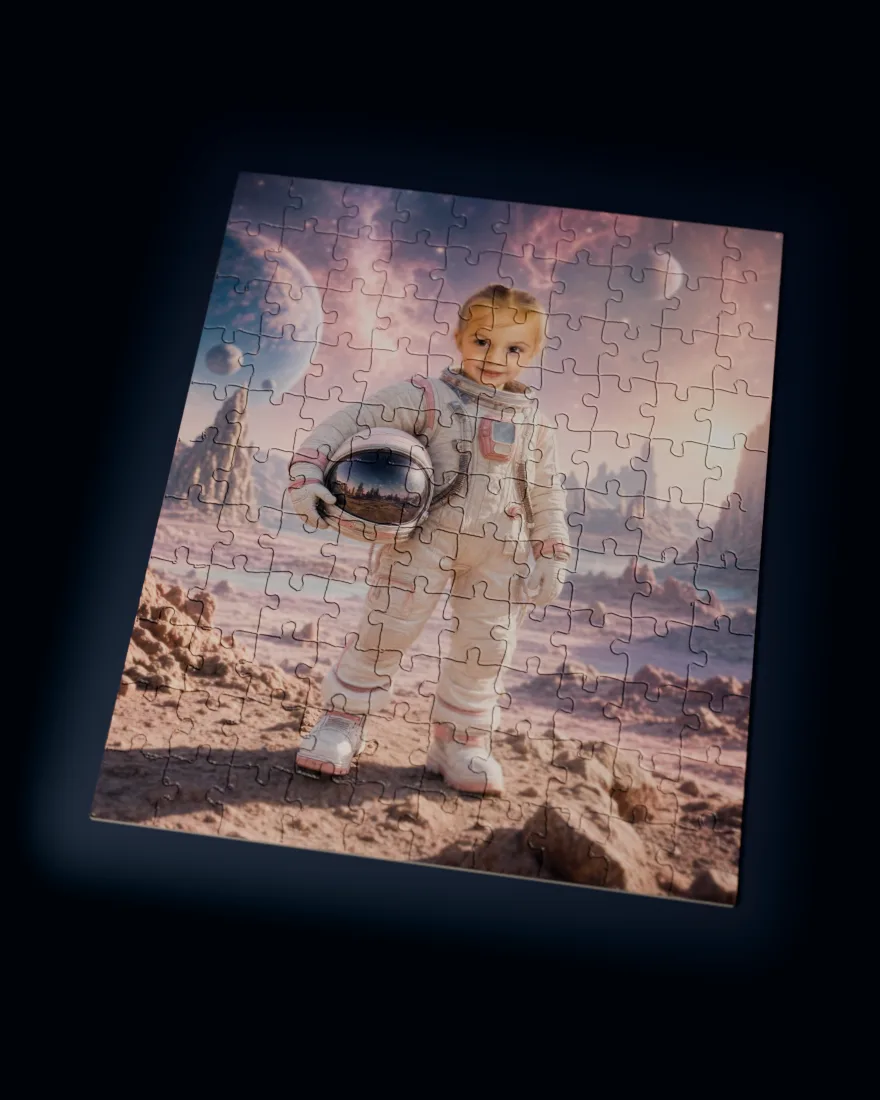
Whichever group made your kid laugh hardest is usually the phase they are in. Upload one photo and see them painted into that world as a jigsaw puzzle, canvas or blanket. You approve a free watermarked proof before anything prints.
How do you help a kid tell a joke well?
Teach the pause, not the joke. The single most common way a child kills a joke is racing the setup and the punchline together into one breath, and the fix is one beat of silence before the answer. Ask the question, count to two in your head, then answer. Everything else follows from that.
Three more things help. Let them practice on a soft audience first, because a grandparent on a video call will laugh at anything and that is exactly what a nervous seven-year-old needs. When they blow it, and they will blow it by shouting the punchline first, laugh at the wreck rather than correcting the mechanics, since a child who gets corrected mid-joke stops volunteering. And keep the list short: five jokes they know cold beat forty they half-remember. If you want the shortlist, take the first three from the animal group and the first two knock-knocks.
How can a kid write their own jokes?
Give them a formula rather than an example. Almost every joke on this page is one of three shapes, and a seven-year-old who spots the shape can generate their own for hours. The first is "What do you call a ___ that ___?", where the answer is a squashed-together word. The second is "Why did the ___ ___?", where the answer takes a word from the question and uses its other meaning. The third is "What do you get when you cross a ___ with a ___?"
This is worth doing for reasons beyond the noise. In a randomized experiment with 46 third graders, teaching children to spot double meanings using homonyms and riddles improved their reading comprehension on a paragraph-completion test. Writing a pun is the same skill as noticing that a sentence you are reading could mean two things, which is a large part of what comprehension actually is.
Why does my kid tell the same joke forty times?
Because the pleasure is not in the joke, it is in knowing the punchline while you wait. Once a child works out that they are holding something you have to wait for, the waiting is the game, and they will run it again. The repetition is the skill being drilled, not a failure to notice your face.
It passes faster if you give the joke somewhere to go. Ask for it in a different voice, ask them to tell somebody who has not heard it, or ask them to change one word and see whether it still works, which turns retelling into writing. Around six, children switch from improvising their own nonsense to retelling ready-made jokes. Martha Wolfenstein, who collected jokes from children aged 4 to 17 for a 1954 study, quoted one six-year-old on the change: "We didn't know any of these jokes last year." Relentless repetition is often the sound of a child switching from making things up to getting things right.
Frequently asked questions
What age do kids start understanding jokes?
+
Appreciation comes first and comes early. In the Early Humour Survey's age analysis of 671 children aged 1 to 47 months, half were predicted to appreciate humor by two months old and to produce their own by eleven months. Understanding a joke that turns on wordplay is much later: the cognitive machinery for a pun is typically in place around seven.
What jokes are good for a 5 year old?
+
Sound-alike puns with words a five-year-old already owns, plus straight absurdity. "What do you call cheese that isn't yours? Nacho cheese" works because the child knows both words. Five is also the start of the pre-riddle period, when children tell joke-shaped sentences with no actual wordplay in them, so expect a lot of homemade nonsense and laugh at it.
What are good jokes for kids aged 8 and 9?
+
Anything built on a double meaning, because this is the age when it reliably lands. Tested on riddles with a genuinely ambiguous punchline, six- and seven-year-olds picked the right answer 49% of the time and eight- and nine-year-olds picked it 80% of the time. Riddles, knock-knocks and question-and-answer puns all work here. Save misdirection and long setups for nine and up.
What are the best knock knock jokes for kids?
+
"Interrupting cow" and "Lettuce in, it's freezing out here" are the two most reliable, because one needs no wordplay at all and the other uses a word a young child knows. Knock-knock routines become fashionable after about age seven, since the form asks a child to run a four-line script correctly and land a pun at the end.
Do jokes and riddles help with reading?
+
The evidence points that way for riddles specifically. In 100 sixth and seventh graders, riddle-solving explained unique variance in reading comprehension even after vocabulary was statistically controlled. A separate randomized experiment with 46 third graders found that teaching double meanings through homonyms and riddles improved comprehension on a paragraph-completion test, though not on a multiple-choice recall test.
Why does my 4 year old tell jokes that make no sense?
+
Because they have learned the shape of a joke before the wordplay that goes inside it. Four- and five-year-olds could explain a riddle on only 3.5% of occasions in one study, so a joke-shaped sentence with a random punchline is the expected output at this age, not a mistake. The right response is to laugh at the performance.
The best joke on this page is whichever one your kid is currently repeating at you. The Christmas ones have their own list, sorted the same way. If it happens to be about dinosaurs, or pirates, or a very specific dog, that obsession is worth something you can keep. We also wrote about what puzzles actually do for a developing brain and how many pieces a three-year-old can handle, which is the same matching problem as this one in a different costume.