

In short
Here are 175 riddles for kids with answers, sorted by the age they actually work for. Start four- to six-year-olds on plain "What am I?" riddles built from things they can see and touch, because riddles that turn on a word with two meanings mostly go over their heads: in one study, four- and five-year-olds could explain that kind of riddle about 4% of the time. Double meanings start landing around seven and are the main event from eight to ten. After the age groups come science riddles whose answers are checked against NASA, NOAA and natural history museums, plus math, logic and treasure hunt riddles, and classic riddles from history, each one traced to the old text it comes from.
We read the riddle lists that come up when you search for this, from small blogs to big parenting and teaching sites, before writing this one. Most share the same core: of the answers on six of the largest lists, more than two dozen show up on at least five of them. Two of the lists we read give the same riddle two different answers. One riddle, about a breath nobody can hold for five minutes, appears on three of them and is wrong: people have held their breath underwater for more than 11 minutes. Not one list traces a classic riddle to where it came from, and the ones sorted by age cite no research for the sorting.
So we checked every riddle on this page for three things before it went in: that only one answer fits, that no clue gives the answer away, and that any fact in it is true. Riddles that fail the first test have their own section, because a riddle with two good answers is worth arguing about at dinner.
What age can kids solve riddles?
A plain description riddle ("I have four legs and bark") needs no wordplay, which makes it the natural place to start at four or five. Riddles that hinge on a word with two meanings take much longer. In a 2020 study of 74 British children, kids explained simple double-meaning riddles on about 4% of occasions at ages four and five, 18% at six and seven, 38% at eight and nine, and 51% at ten and eleven. Given three possible punchlines to choose from, 60 British schoolchildren picked the right one 49% of the time at six and seven, 80% at eight and nine and 88% at ten and eleven.
The type of riddle matters as much as the age. An older study that collected riddles from 575 children and tested 208 found riddles built on a conceptual trick were understood first, riddles built on a double meaning came next, and riddles built on pure absurdity were understood only by the oldest groups it tested, tenth graders and college students. In the 60-child study, eight- and nine-year-olds got one-word puns right 92% of the time but puns that depend on how a whole sentence is built only 63% of the time.
| Age | Explained a pun riddle | Picked the right punchline | Riddles to try |
|---|---|---|---|
| 4-5 | About 4% | Not tested | "What am I?" riddles with two or three clues they can see or hear |
| 6-7 | 18% | 49% | One word with two everyday meanings, like a tree's bark |
| 8-9 | 38% | 80% | Sound-alike words, metaphor riddles, short logic stumpers |
| 10-11 | 51% | 88% | Sentence-level wordplay, math tricks, multi-step logic |
Explaining comes from the 74-child study, picking a punchline from three choices from the 60-child study, where guessing alone would score 33%. Treat the ages as soft edges, not cut-offs.
Laughter is a poor guide. In the 74-child study, smiling tracked understanding only between six and nine, and the youngest children rated nonsense control items almost as funny as the real riddles. Our jokes for kids post goes deeper into how a sense of humor develops by age.
How do you play riddles with kids?
Read the riddle twice, slowly, and give three guesses before offering a hint. If a child is stuck, repeat the most useful clue rather than adding a new one. Then try these, each of which has research behind it.
- Tell a sister riddle first. Trick riddles of the "how can that be?" kind are rarely solved cold. In a 2025 study of 172 children aged three to seven, only about 8% gave the intended answer to the first one they heard, but within a set of three similar riddles, intended answers rose from 10.5% on the first to 25.5% on the third. Hearing one answer teaches the trick.
- Ask them to explain both meanings. In a study of 48 children aged seven to nine, pairs who talked through the double meanings in joking riddles gained more in reading comprehension than children who did not, and the gains went with explaining both meanings at once.
- Don't put the answer in the picture. In kindergarten experiments from the 1960s, riddle pictures that showed the answer leaned on children's memory and did little for their thinking, while pictures that showed only parts of the answer got children reasoning.
- Let them stump you. Kids hold on to riddles: in the 208-student study, memory for riddle answers was good at every grade and nearly perfect by sixth grade. Being the one who knows the answer is half the fun.
Easy what am I riddles for ages 4 to 6
These are description riddles: every clue is something a young child can see, hear or touch, and none depends on a word with two meanings. Read all the clues before taking guesses. If a child shouts out "dog!" after the first clue, that is a good guess, not a wrong one.
- I have four legs and a wagging tail, and I bark when someone knocks at the door. What am I? A dog.
- I am yellow and curved, and you peel me before you eat me. What am I? A banana.
- I open up when the rain comes down, and you hold me over your head. What am I? An umbrella.
- I shine in the sky all day and keep you warm, but you must never look straight at me. What am I? The sun.
- You pull us onto your feet before your shoes, and we come in pairs. What are we? Socks.
- I am cold and white, I fall from the sky in winter, and you can pack me into a ball and throw me. What am I? Snow.
- I have a long trunk and big flappy ears. What am I? An elephant.
- I say "moo," and I give you milk. What am I? A cow.
- I have lots of pages and a story inside, and you read me at bedtime. What am I? A book.
- I fill up with warm water and bubbles, and you splash in me before bed. What am I? A bathtub.
- I look like a horse wearing black and white stripes. What am I? A zebra.
- I am orange and crunchy, I grow under the ground, and rabbits love me. What am I? A carrot.
- You brush us twice a day, and we help you chew. What are we? Your teeth.
- I have two wheels and two pedals, and you wear a helmet when you ride me. What am I? A bike.
- I am made of twigs, I sit high up in a tree, and baby birds hatch inside me. What am I? A nest.
- I am sweet and cold, I sit on top of a cone, and I melt in the sun. What am I? Ice cream.
- I carry my house on my back and leave a shiny trail behind me. What am I? A snail.
- I have black and white feathers, I cannot fly, and I am a very fast swimmer. What am I? A penguin.
- I hop on two big back feet, my baby rides in a pocket on my tummy, and I am the biggest animal that hops. What am I? A kangaroo.
- I have a big red nose and huge floppy shoes, and I make people laugh at the circus. What am I? A clown.
Riddles for kids ages 7 to 9
This is the age when double meanings click, so most of these hinge on one word doing two jobs. The short note after each answer explains the trick. Read it out, because explaining the trick is the part that builds the skill.
- What has a bed but never sleeps, and a mouth but never eats? A river. A river has a bed and a mouth, just not the kind you sleep in or eat with.
- What has a spine but no bones, and a jacket but no arms? A book. The spine is the edge that holds the pages together, and a jacket is the paper cover some books wear.
- What has a thumb and four fingers but isn't a hand? A glove.
- What kind of band never plays music, but can hold a stack of cards together? A rubber band.
- What kind of coat is always wet when you put it on? A coat of paint. A coat is a jacket, and also a layer of paint.
- What has wheels and flies but never leaves the ground? A garbage truck. The flies are the buzzing kind.
- What has ears but cannot hear, and grows taller than a grown-up in a field? Corn. Corn grows in ears.
- What has a bark but no bite? A tree. Bark is a tree's skin and a dog's noise.
- What kind of room has no doors or windows, and can go on a pizza? A mushroom.
- What goes up and down inside your house but never moves? The stairs.
- What has lots of eyes but cannot see, and grows under the ground? A potato. The little buds on a potato are called eyes.
- What belongs to you, but other people use it more than you do? Your name.
- What starts with T, ends with T, and has T in it? A teapot. The T inside is tea.
- What has a tongue and a sole but cannot talk? A shoe. The flap under the laces is the tongue, and the bottom is the sole.
- What has a head, a foot and four legs, and gets made every morning? A bed. You make a bed by tidying it, not by building it.
- What kind of tree is always in your hand? A palm tree. Your hand has a palm.
- What is black and white and read all over, and lands on the doorstep in the morning? A newspaper. "Read" sounds like "red."
- What has to be broken before you can use it? An egg.
- If a red house is made of red bricks and a blue house is made of blue bricks, what is a greenhouse made of? Glass. A greenhouse is named for the plants inside.
- You are running a race and you pass the person in second place. What place are you in now? Second. You took their place, not first place.
Hard riddles for kids 10 and up
These work for ten-, eleven- and twelve-year-olds and hold up for teenagers too. Several hinge on spelling, and some on idioms or how a whole sentence is built, the kind of wordplay that research finds lands later than a single word with two meanings.
- What starts with P, ends with E, and has thousands of letters? The post office. The letters are the kind you mail.
- The more you take, the more you leave behind. What are they? Footsteps.
- What has 13 hearts but no other organs? A deck of cards.
- What word is spelled wrong in every dictionary? "Wrong."
- What disappears the moment you say its name? Silence.
- What has cities but no houses, forests but no trees, and rivers but no water? A map.
- Forward I am heavy, but backward I am not. What am I? The word "ton." Backward it spells "not."
- What five-letter word gets shorter when you add two letters to it? "Short." Add "er" and you get "shorter."
- What is always coming but never arrives? Tomorrow.
- What runs all the way around the yard without moving? A fence.
- If you have me, you want to share me. If you share me, you no longer have me. What am I? A secret.
- What begins with E, ends with E, and usually contains one letter? An envelope.
- I shave every day, but my beard stays the same. Who am I? A barber.
- What comes once in a minute, twice in a moment, and never in a thousand years? The letter M.
- Feed me and I grow. Give me a drink and I die. What am I? Fire.
- The more of me there is, the less you can see, and I vanish the moment you flip a switch. What am I? Darkness.
- Which is faster, hot or cold? Hot, because anyone can catch a cold.
- What invention lets you look right through a wall? A window.
- I'm black when you buy me, red when you use me, and gray when you throw me away. What am I? Charcoal.
- Drop me and I'll crack, but smile at me and I'll smile right back. What am I? A mirror.
Space riddles
Every space riddle here, and in the science rounds that follow, rests on a fact checked against an expert source, linked after each answer. Read the fact aloud after the reveal. If the Mars riddle gets the biggest cheer, the space explorer world is where they belong.
- I'm a huge, glowing ball of hot gas. Earth and seven other planets travel around me. Without my light and heat, life on Earth couldn't exist. What am I? The Sun. It's the only star in our solar system. Ages 4-6 · NASA
- I'm rocky and full of craters, and I travel around Earth. There's no air on me you could breathe. I'm the only world beyond Earth that people have visited. What am I? The Moon. It is Earth's only natural satellite. Ages 7-9 · NASA
- Rusty dust makes me look red. The biggest volcano in the solar system stands on me, and two small, potato-shaped moons circle me. What am I? Mars. The red comes from iron minerals in the rocks and dust rusting, and the volcano is Olympus Mons. Ages 7-9 · NASA
- I'm the biggest planet of all. A storm bigger than Earth has swirled on me for hundreds of years, and I spin so fast my day is under 10 hours. What am I? Jupiter. Its day lasts about 9.9 hours, the shortest in the solar system, and the storm is the Great Red Spot. Ages 7-9 · NASA
- Other planets have rings, but mine are the showiest, made of billions of chunks of ice and rock. I'm so light for my size that I could float in a big enough bathtub. What am I? Saturn. It's the only planet whose average density is less than water. Ages 7-9 · NASA
- I'm a dirty snowball left over from when the solar system formed. When I swing close to the Sun my ice turns to gas, and I can grow two long tails. What am I? A comet. One tail is dust and the other is gas. Ages 10-12 · NASA
Dinosaur riddles
Dinosaur facts change as fossils turn up, so every clue here comes from a museum's own dinosaur pages. For a child who already knows the answers, the dino expedition world puts them on the dig.
- I had three horns on my face and a beak like a parrot's, and a big bony frill spread out behind my head. What am I? Triceratops. A Triceratops horn has been found with healed T. rex bite marks. Ages 4-6 · Natural History Museum
- I had about 60 saw-edged teeth, some about 8 inches long, and the strongest bite of any known land animal. But my arms were surprisingly small! What am I? Tyrannosaurus rex. Its teeth were up to 20 centimeters long, and nobody is sure what it used its small arms for. Ages 7-9 · Natural History Museum
- Tall bony plates stood up in a zigzag along my back, I swung a spiky tail at hunters, and my brain was about the size of a plum. What am I? Stegosaurus. It would have used the spiked tail against predators such as Allosaurus. Ages 7-9 · Natural History Museum
- Bony plates covered my body like armor, and I swung a heavy club on the end of my tail. I ate plants in North America at the very end of the dinosaur age. What am I? Ankylosaurus. It lived 68 to 66 million years ago. Ages 7-9 · Natural History Museum
- My front legs were longer than my back legs, so I stood tilted up. I ate leaves from tall trees and swallowed them without chewing, and my first bones were found in Colorado. What am I? Brachiosaurus. Those first bones were found in 1900. Ages 7-9 · Natural History Museum
- I had a big curved claw on each foot and more than 60 jagged teeth, but I was only about six feet long from nose to tail. My first fossil was dug up in Mongolia's Gobi Desert in the 1920s. What am I? Velociraptor. Ages 10-12 · American Museum of Natural History
Put your riddle solver in the picture
A riddle is a puzzle made of words. Here is one they can hold: upload a photo and see them painted into the world they keep guessing about, as a space explorer, a dinosaur hunter or a pirate captain, printed as a jigsaw puzzle. You approve a free watermarked proof before anything prints.
Ocean riddles
Sea creatures make great riddle answers because the true facts sound made up.
- In my family, the dad carries the eggs in a pouch and gives birth to as many as 1,000 babies at once. I cling to underwater grasses and change color to hide. What am I? A seahorse. Ages 4-6 · NOAA
- I have three hearts and blue blood. I have eight arms but not the two long grabbing tentacles my squid cousins have, and with no shell inside me I can squeeze through tiny gaps. What am I? An octopus. Its blood is blue because it carries oxygen with copper instead of iron. Ages 7-9 · Smithsonian Ocean
- I'm the largest animal on Earth, but my food is tiny and shrimp-like. I strain it from seawater through plates in my mouth. What am I? A blue whale. The food is krill, and the plates are called baleen. Ages 7-9 · NOAA Fisheries
- I live only in salt water, but I have no gills, scales or fins. I creep along on lots of tiny tube feet, and if I lose an arm I can grow it back. What am I? A sea star. It isn't a fish at all, and some kinds have as many as 40 arms. Ages 7-9 · NOAA
- I have no brain, no heart and no blood, and my body is about 95 percent water. Watch out, my tentacles can sting! What am I? A jellyfish. Most stings cause people only minor discomfort. Ages 7-9 · NOAA
- I look like a rock or a plant, but I'm really an animal. Tiny algae live inside me, and together we build the biggest structures made by living things on Earth. What am I? Coral. Those structures are coral reefs. Ages 10-12 · NOAA
Animal riddles
These cover pets and wild animals, and each one carries a clue that rules out the obvious wrong guess.
- Long, long ago, my wild family were gray wolves. I was the very first animal people ever tamed, long before anyone grew crops on farms. What am I? A dog. Exactly when it happened is still being worked out. Ages 4-6 · Natural History Museum
- My tongue tastes salty, sour and bitter just fine, but I probably can't taste sugar at all, and neither can my big wild cousins, tigers and cheetahs. What am I? A house cat. All three carry a broken copy of a sweet-taste gene. Ages 7-9 · PLOS Genetics
- I have long ears and strong back legs built for jumping. My front teeth never stop growing, so I keep gnawing, and I'm busiest at dawn and dusk. Lots of families keep me as a pet. What am I? A rabbit. Ages 7-9 · Merck Veterinary Manual
- I'm the tallest animal on land. My neck has seven bones, just like yours, but each one can be over 10 inches long. What am I? A giraffe. Ages 7-9 · San Diego Zoo
- I have fur and feed my babies milk, but I'm the only mammal that can truly fly. I'm not blind, and many of my kind find bugs using echoes. What am I? A bat. That echo trick is called echolocation, and whales and dolphins use it too. Ages 7-9 · National Park Service
- I go from 0 to 45 miles per hour in 2.5 seconds, the fastest of any land mammal. A black tear-like line runs from each eye to my mouth, and I can't roar, but I purr and chirp. What am I? A cheetah. Ages 7-9 · Smithsonian's National Zoo
Bug and plant riddles
- I have eight legs and no wings or feelers on my head, so I'm not an insect. Every one of my kind can make silk, and my babies can float away on the wind on a silky thread. What am I? A spider. Ages 4-6 · University of Minnesota Extension
- In spring I'm a bright yellow flower. Then I turn into a round, fluffy ball of seeds, and each seed rides the wind on its own tiny parachute. What am I? A dandelion. Ages 4-6 · University of Wisconsin-Madison Extension
- When I find good flowers, I fly home and dance on the wax comb. The angle of my wiggle and how long it lasts tell the other workers which way to go and how far. What am I? A honey bee. It's called the waggle dance. Ages 7-9 · NC State Extension
- I have wings, but I'm really a beetle. Special parts on the underside of my belly make light, and most of my kind come out at night. What am I? A firefly. Ages 7-9 · Britannica
- Each fall, some of us fly as far as 3,000 miles to the mountain forests of Mexico. The trip back north in spring takes three or four generations. What are we? Monarch butterflies. The ones that fly south have never been to Mexico before, yet they find the way. Ages 7-9 · USDA Forest Service
- I'm a plant that eats insects. When a bug touches two of the six tiny hairs on my leaf, the halves snap shut, and I'm native only to the Carolinas. What am I? A Venus flytrap. Ages 7-9 · NC State Extension
Weather and nature riddles
- To see me, the Sun must be behind you and water drops in front of you. Light bends inside each drop and spreads into colors, and from an airplane you might see me as a whole circle. What am I? A rainbow. Ages 7-9 · NOAA
- I'm a giant spark of electricity from a storm cloud. I can heat the air to about five times hotter than the surface of the Sun, and you see me before you hear my boom. What am I? Lightning. The boom is thunder. Ages 7-9 · National Weather Service
- I'm a narrow column of air, spinning hard, that reaches from a thunderstorm all the way down to the ground. I've been reported in all 50 states. What am I? A tornado. Ages 7-9 · NOAA Severe Storms Laboratory
- I'm not a frozen raindrop. I grow slowly in a cloud as water vapor turns to ice on a tiny speck, and my pattern repeats six times around my middle. What am I? A snowflake. Ages 7-9 · NOAA
- Deep below me, rock is so hot it has melted. Underground it's called magma, and when it pours out of me it's called lava. What am I? A volcano. Ages 7-9 · USGS
- The giant plates of rock under your feet are always moving slowly. When their stuck edges suddenly slip, I send waves through the ground that make it shake. What am I? An earthquake. Ages 10-12 · USGS
Human body riddles
- I'm about the size of your fist, and I pump blood all through your body. Little doors called valves keep the blood going the right way. What am I? Your heart. Ages 4-6 · National Heart, Lung, and Blood Institute
- There are two of us, one on each side of your heart, and the left one is a little smaller to make room for it. We bring oxygen in and let carbon dioxide out. What are we? Your lungs. Ages 7-9 · National Heart, Lung, and Blood Institute
- I'm the biggest organ of your body, and I cover all of you. I keep germs out, give you your sense of touch, and make sweat to cool you down. What am I? Your skin. Ages 7-9 · NIAMS
- I'm the hardest stuff in your whole body, the shiny outer coat on the parts of your mouth that bite and chew. Acid can wear me away, and that's how cavities start. What am I? Tooth enamel. It's harder than bone. Ages 7-9 · National Institutes of Health
- I'm the longest and strongest bone in your body. My round top fits into your hip like a ball in a socket, and my bottom end helps make your knee. What am I? Your femur, or thigh bone. Ages 10-12 · StatPearls
- I'm the smallest bone in your body, the last of three tiny bones in your middle ear, and I pass sound on to your inner ear. What am I? The stapes, or stirrup bone. Ages 10-12 · StatPearls
Pirate and treasure riddles
Pirate riddles suit any age from five up. For a crew that wants the full costume, the pirate cove world puts your child on deck.
- I'm buried in the sand on a desert island, and a big X marks the spot. What am I? Treasure.
- I'm thrown over the side when the ship wants to stay, and hauled back up when it's time to sail away. What am I? An anchor.
- I have a deck but no cards, and a crow's nest but no crows. What am I? A ship.
- I make faraway ships look close, and a pirate holds me up to one eye. What am I? A spyglass, a small telescope.
- I fly at the top of the mast with a skull and crossbones on me. What am I? A pirate flag.
- I'm a narrow board that sticks out over the water, and in pirate stories, nobody wants to walk me. What am I? The plank.
Castle, knight and dragon riddles
These are easy enough for five-year-olds. For the child who always plays the dragon, the dragon kingdom world gives them a dragon of their own.
- I have towers, thick walls and a moat all around, and a king and queen live inside me. What am I? A castle.
- I wear a metal suit that clanks when I walk, and I carry a sword and a shield. Who am I? A knight.
- I have scales but I'm not a fish, and wings but I'm not a bird, and smoke comes out when I sneeze. What am I? A dragon.
- I'm made of gold and covered in jewels, and only a king or a queen wears me on their head. What am I? A crown.
- I look like a white horse, but one long spiral horn grows from my forehead. What am I? A unicorn.
- I'm tiny and I have wings, and I fly in at night to leave a coin under your pillow. Who am I? The tooth fairy.
Math riddles for kids
These need nothing beyond the arithmetic a child already knows, so pick them by grade rather than age. The working is in the answer.
- I am an odd number. Take away one letter and I become even. What number am I? Seven. Take away the S and you have "even."
- A farmer has 17 sheep. All but 9 run away. How many are left? Nine.
- There are 3 apples and you take away 2. How many apples do you have? Two, the ones you took.
- How many times can you subtract 5 from 25? Once. After that you're subtracting from 20. Five is fair too, if you keep taking 5 from what's left.
- Which three positive whole numbers give the same answer whether you add them or multiply them? 1, 2 and 3. 1 + 2 + 3 = 6 and 1 × 2 × 3 = 6.
- A brick weighs one pound plus half a brick. How much does a whole brick weigh? Two pounds. The one pound must be the other half of the brick, so half a brick weighs one pound and the whole brick weighs two.
- I am a three-digit number. My tens digit is five more than my ones digit, and my hundreds digit is eight less than my tens digit. What number am I? 194. The tens digit is eight more than the hundreds digit, and the hundreds digit can't be zero, so the tens digit must be 9. That makes the ones digit 4 and the hundreds digit 1.
- Tom is 6 and his sister is half his age. When Tom is 40, how old will his sister be? 37. She is 3 now, three years younger than Tom, and the gap never changes.
- Using only addition, how can you put eight 8s together to make 1,000? 888 + 88 + 8 + 8 + 8.
- What do you get if you multiply together every number on a phone keypad? Zero. One of the keys is 0.
- Which is heavier, a pound of feathers or a pound of bricks? Neither. They both weigh a pound.
- If two's company and three's a crowd, what are four and five? Nine.
- A bat and a ball cost $1.10 together. The bat costs $1.00 more than the ball. How much does the ball cost? 5 cents. The bat is $1.05. The answer that jumps out, 10 cents, would make the bat only 90 cents more. This one comes from decision researcher Shane Frederick's 2005 test of careful thinking, built to catch the fast wrong answer.
Logic riddles and brain teasers
These are stumpers: the answer is simple once you see it, and most people miss it the first time. Use the sister-riddle trick from above. After the rooster riddle, try the electric train, which works the same way, and follow the cowboy riddle with Mary's father.
- A cowboy rode into town on Friday, stayed three days, and rode out on Friday. How? His horse was named Friday.
- Two mothers and two daughters went fishing. They caught three fish, and each of them took one home. How? There were only three people: a grandmother, her daughter and her granddaughter.
- There are six eggs in a basket. Six people each take one egg, but one egg is still in the basket. How? The last person took the basket with the egg still in it.
- A rooster lays an egg on the very top of a barn roof. Which way does the egg roll? It doesn't. Roosters don't lay eggs.
- A man walked in the rain for an hour with nothing on his head and nothing over it. His clothes got soaked, but not one hair on his head got wet. How? He was bald.
- A girl fell off a 20-foot ladder onto hard ground and wasn't hurt at all. How? She fell off the bottom step.
- An electric train is heading north and the wind is blowing west. Which way does the smoke go? There is no smoke. It's an electric train.
- What can go up a chimney down, but can't go down a chimney up? An umbrella. Closed, it fits. Open, it doesn't.
- Mary's father has five daughters: Nana, Nene, Nini and Nono. What is the fifth daughter's name? Mary.
- You walk into a dark room with one match. There's a candle, a wood stove and an oil lamp. What do you light first? The match.
Which riddles have more than one right answer?
A good riddle has exactly one answer that fits every clue. These popular ones have two or more, though most lists print only one. Accept any answer that fits, then ask your child to add a clue that rules the others out. That is how riddles get written.
- What has keys but can't open locks? A piano, a computer keyboard or a calculator. All three fit. Add "and when you press my keys, little hammers inside me hit strings" and only the piano is left.
- What has legs but can't walk? A table, a chair, a bed or a pair of pants. Any furniture with legs works, and so do pants. Add "and you eat at me" for the table.
- What has teeth but can't eat? A comb, a zipper, a saw, a rake or a gear. Add "and you pull me through your hair" for the comb.
- What has a ring but no finger? A phone, a bell, a tree or Saturn. A phone and a bell ring, a tree trunk has rings inside, and Saturn has rings around it. Add "and you answer me" for the phone.
- What can fill a room but takes up no space? Light, sound, silence or darkness. Add "and you can see by me" for light. Air is a common wrong guess: air does take up space.
- I'm light as a feather and I go in and out of you all day, but the strongest person can't hold me for long. What am I? Your breath. We changed the ending and added a clue, since a soap bubble is light and can't be held for long either. The common version says nobody can hold it "for five minutes," but the Guinness record for holding your breath underwater without breathing pure oxygen first is 11 minutes 54 seconds.
Classic riddles from history
People have traded riddles for thousands of years, and some of the best ones for kids are among the oldest. The English word goes back to the Old English rædels, which Etymonline connects to "read" through an old meaning of that word: to interpret. Every riddle below links to the old text it comes from, and every quotation is from a public-domain text or translation.
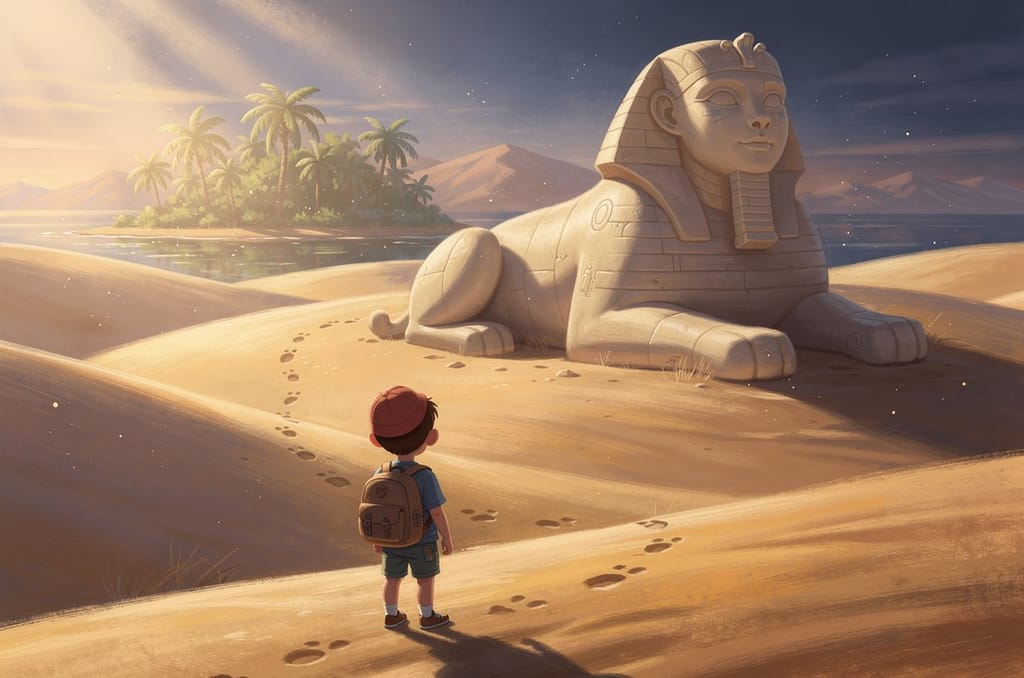
What is the riddle of the Sphinx?
- "What is that which has one voice and yet becomes four-footed and two-footed and three-footed?" A person. A baby crawls on four limbs, an adult walks on two feet, and an old person adds a walking stick. In the myth, Oedipus solves it and the Sphinx is defeated. This wording is from Apollodorus. The oldest full version is a verse that the writer Asclepiades recorded in the 300s BC, kept only because a later author quoted it. A Greek cup painted around 470 BC already has part of it, "and three-footed," written beside the Sphinx. Sophocles' famous play mentions the riddle but never states it. Apollodorus, Library 3.5.8
- "Out of the eater came forth meat, and out of the strong came forth sweetness." Honey in a lion. This is Samson's riddle. Nobody could have guessed it, because only Samson knew that bees had made honey in the body of a lion he had killed, and the guests got the answer by pressuring his wife. Good for a talk about what makes a riddle fair. Judges 14, King James Version
- "One sire there is, he has twelve sons, and each of these has twice thirty daughters different in feature; some of the daughters are white, the others again are black; they are immortal, and yet they all die." The year. Twelve months, each with about thirty days and thirty nights. It was credited to Cleobulus, one of ancient Greece's Seven Sages. Diogenes Laertius, Lives 1.91
- Fishing boys tell the poet Homer: "All that we caught, we left behind, and carry away all that we did not catch." Lice. They had been picking lice from their clothes. The ones they caught they left; the ones they missed came home with them. A legend, but kids love it. The Contest of Homer and Hesiod
Riddles from Rome and the Middle Ages
- "A house there is which rings throughout the land with song, / The house itself doth sing, the guests in silence throng, / Yet both the house and guests together move along." A river and its fish. From the Latin poet Symphosius, whose 100 three-line riddles probably date from around AD 400. Symphosius, Riddle 12
- "A modest maid am I, yet not, perhaps, too meek; / No impudence I own, nor indiscretion seek, / Naught of myself I say, but answer those that speak." An echo. Try it in a stairwell. Symphosius, Riddle 98
- "A moth ate words... Though he swallowed the word the thieving stranger was no whit the wiser." A bookworm, or book moth. From the Exeter Book, a collection of Old English poems copied in the late 900s. The manuscript gives no answers, so every answer is a scholar's solution. Pose it as "Who is the thief who eats words but learns nothing?" because the first three words give it away. Exeter Book Riddle 47
- "I war oft against wave and fight against wind... I am strong in the strife if I stay at rest... I withstand them then if my tail endures and the stones hold me fast. Ask what my name is." An anchor. It wins its fight by staying still on the seabed. Exeter Book Riddle 16
- "Silent is my garment when I tread the earth... Then my adornments resound in song and sing aloud with clear melody..." A swan. Its feathers are silent on the ground but sing in flight. Exeter Book Riddle 7
- "Dearest of women is indeed my mother; she is my daughter grown big and strong." An iceberg. Water makes ice, and ice makes water. Exeter Book Riddle 33
- "What was the drink that I had yesterday? It was neither wine nor water, mead nor ale, nor any kind of food; and yet I went away with my thirst quenched." Dew. From a riddle contest in a 13th-century Icelandic saga, where a stranger who turns out to be the god Odin tests a king. Hervarar saga, tr. Kershaw
- "What is the sister of the sun, though made for the night? The fire causes her tears to fall, and when she is near dying they cut off her head." A candle. Credited to Moses ibn Ezra, a Hebrew poet of medieval Spain. The tears are dripping wax. Jewish Encyclopedia, "Riddle"
- "Or what is louder than the horn, / Or what is sharper than a thorn? / Or what is greener than the grass..." Thunder, hunger and poison. From the first ballad in the collection of English and Scottish ballads that Francis Child began publishing in 1882. Ask your kids to beat the ballad's answers. Child Ballad 1
Nursery rhyme riddles
Several famous nursery rhymes started life as riddles. All of these come from James Orchard Halliwell's Nursery Rhymes of England, which printed the answers to all of them except St. Ives.
- "Humpty dumpty sate on a wall, / Humpty dumpty had a great fall; / Three score men and three score more / Cannot place Humpty Dumpty as he was before." An egg. The rhyme never says he is an egg. That's the riddle. Halliwell
- "Little Nancy Etticoat, / In a white petticoat, / And a red nose; / The longer she stands, / The shorter she grows." A candle. Halliwell
- "Thirty white horses upon a red hill, / Now they tramp, now they champ, now they stand still." Teeth and gums. Halliwell
- "In marble walls as white as milk, / Lined with a skin as soft as silk; / Within a fountain crystal clear, / A golden apple doth appear. / No doors there are to this strong-hold. / Yet things break in and steal the gold." An egg. The walls are the shell, the fountain is the white, and the golden apple is the yolk. Halliwell
- "Lives in winter, / Dies in summer, / And grows with its root upwards!" An icicle. The best first riddle for a four-year-old in this whole section. Halliwell
- "Two legs sat upon three legs, / With one leg in his lap; / In comes four legs, / And runs away with one leg. / Up jumps two legs, / Catches up three legs, / Throws it after four legs, / And makes him bring back one leg." A man on a stool with a leg of meat, and a dog. Two legs is the man, three legs the stool, four legs the dog and one leg a joint of meat. Act it out. Halliwell
- "As I was going to St. Ives, / I met a man with seven wives, / Every wife had seven sacks, / Every sack had seven cats, / Every cat had seven kits: / Kits, cats, sacks, and wives, / How many were there going to St. Ives?" One. Only the speaker is going to St. Ives; everyone else was met coming the other way. Halliwell prints no answer, though, and if they were all headed there, the total is 2,802. The oldest known version is in a manuscript from about 1730. Halliwell
Riddles from around the world
- "The lady with a crown has eyes everywhere." A pineapple. The crown is the leafy top and the eyes are the bumps on the skin. A Filipino riddle, called a bugtong in Tagalog, published in 1909. Frederick Starr, A Little Book of Filipino Riddles
- "The house of my mother has no door." An egg. Printed in 1914 by a missionary working in what is now Malawi. Put it next to the Humpty Dumpty and marble walls riddles from England, and kids get three egg riddles from two continents. Donald Fraser, Winning a Primitive People
Why is a raven like a writing desk?
- "Why is a raven like a writing-desk?" There was no answer, at first. The Mad Hatter asks it in Lewis Carroll's Alice's Adventures in Wonderland (1865) and then admits, "I haven't the slightest idea." Readers kept asking, so in a preface dated Christmas 1896 Carroll offered one: "Because it can produce a few notes, though they are very flat; and it is nevar put with the wrong end in front!" "Nevar" is "raven" spelled backward, though the printed preface said "never" by mistake. He added that the riddle "as originally invented, had no answer at all." Ask your kids for a better answer. Carroll's 1896 preface
Which riddle facts are myths?
Some stories about famous riddles get repeated from list to list. Here is what the sources actually say.
| The myth | What the sources say |
|---|---|
| The Sphinx's riddle is in Sophocles' play Oedipus Rex | ✗ The play mentions "the riddling Sphinx" but never gives the words. Those survive in other ancient writers. Sophocles, full text |
| The Sphinx asked about legs in the morning, at noon and in the evening | ✗ The ancient Greek versions say only four-footed, two-footed and three-footed. Times of day are not in them. Apollodorus |
| Humpty Dumpty was a cannon on the walls of Colchester | ✗ No evidence has ever been produced for the cannon story, and the earliest mention of it the Library of Congress could find is from the 1980s. Writers called the rhyme a riddle from 1813 on, and by 1835 it was printed with the answer: an egg. Library of Congress |
| Lewis Carroll had a secret answer to the raven riddle | ✗ He wrote that it "had no answer at all" and offered one only as an afterthought, decades later. Carroll, 1896 |
| The teeth riddle and the egg riddle were invented for The Hobbit | ✗ Both rework older riddles. Halliwell printed "Thirty white horses" and a longer egg riddle, "In marble walls," in the 1800s. Halliwell |
| Nobody can hold their breath for five minutes | ✗ Without breathing pure oxygen first, the Guinness record for holding your breath underwater is 11 minutes 54 seconds. Guinness World Records |
| A riddle and "riddled with holes" are the same word | ✗ Two unrelated words. The holes one comes from an Old English word for a sieve. Etymonline |
| Solving riddles raises a child's IQ | ✗ We found no study that shows it. The research links riddles to reading, through talking about double meanings, not to IQ. Reading Research Quarterly |
Each link goes to the source we checked the row against.
What riddle games can you play?
Riddles work best as a game with turns. These four need nothing but a pencil, and the last one fills a birthday party.
- Twenty Questions. One player thinks of an object, and everyone else gets twenty yes-or-no questions to find it. It's a riddle built backward. The best first question is about the category: "Is it alive?"
- Riddle relay. One player gives a single clue about a secret object. Each guesser who misses adds a clue of their own once they have worked it out, until someone gets it.
- Riddle of the day. Write one riddle on a lunchbox note and put the answer in the next day's note. Kids carry it to school and test it on friends.
- Treasure hunt. Write a riddle whose answer is a place in your home, and hide the next clue there. Six to eight clues fill a party, and the last one leads to the prize.
Treasure hunt riddles for around the house
- I'm cold inside even in summer, and I keep the milk fresh. Where's the next clue? The fridge.
- Clothes go into me dirty, spin around, and come out clean. The washing machine.
- Brush, rinse and spit: you visit me twice a day. The bathroom sink.
- Letters go inside me, but I never read them. The mailbox.
- I hold bread inside until it's brown, and then I pop it up. The toaster.
- I have soft cushions, and you sit on me to watch a movie. The couch.
- I'm dark and full of coats and shoes. The closet.
- You wipe your feet on me before you come in. The doormat.
- I'm full of dirt, and something green grows out of me. The plant pot.
How can kids write their own riddles?
Kids can write good riddles once they know the recipe. Literacy researcher Marcy Zipke, who uses riddles to teach reading, defines a riddle for children as "a question that turns into a joke" because the same words carry two meanings. Here's the recipe.
- Pick an everyday thing, like a sock, a clock or the moon.
- List what it has and does. A clock has a face and hands and ticks.
- Look for a word with two meanings. A face and hands are things a person has too.
- Speak as the thing. "I have a face and two hands, but no arms or legs. What am I?"
- Test it on someone. If they guess it straight away, a clue gives it away. If two answers fit, add one clue that rules out the other.
Run the recipe on a sock and you might get: "I come in pairs, I live in a drawer, and the washing machine eats one of me." Accept the joke answers too. A four-year-old's riddle with a random answer is still a riddle at that age.
The riddle-solver as the hero
Whichever round they solved fastest usually tells you what they're into right now. Upload one photo and see them painted into that world, as a space explorer, a dino hunter or a dragon tamer, on a jigsaw puzzle, canvas or blanket. You approve a free watermarked proof before anything prints, the photo is deleted within 24 hours of fulfillment, and it's never used to train AI.
Frequently asked questions
What are some good riddles for kids?
+
The best riddle is one that matches the child's age. For four- to six-year-olds, try "I carry my house on my back and leave a shiny trail behind me" (a snail). For seven- to nine-year-olds, try "What has a bark but no bite?" (a tree). For ten and up, try "What five-letter word gets shorter when you add two letters to it?" (short).
At what age can kids understand riddles?
+
Most four- and five-year-olds can solve a plain "What am I?" riddle with clues they can see, but riddles that hinge on a word with two meanings come later. In one study of 74 children, four- and five-year-olds explained that kind of riddle about 4% of the time, eight- and nine-year-olds 38% and ten- and eleven-year-olds 51%.
Do riddles make kids smarter?
+
We found no study showing that riddles raise IQ. The best evidence is about reading: in two small studies of seven- to nine-year-olds, children who practiced working out the two meanings in riddles and other wordplay gained more on a reading comprehension test than children who did not. Telling riddles casually has not been tested the same way.
What is the hardest riddle for kids?
+
The hardest are logic stumpers, where the answer is simple but almost nobody sees it the first time, such as "Six people each take one egg from a basket of six, but one egg is still in the basket. How?" (the last person took the basket). In a 2025 study of three- to seven-year-olds, only about 8% gave the intended answer to the first stumper they heard.
What has keys but can't open locks?
+
The usual answer is a piano, but a computer keyboard or a calculator fits every clue too, so all three are right. To make the riddle fair, add a clue such as "and when you press my keys, little hammers inside me hit strings," which leaves only the piano.
Why is a raven like a writing desk?
+
The riddle from Alice's Adventures in Wonderland had no answer when Lewis Carroll wrote it in 1865. In 1896 he offered one as an afterthought: "Because it can produce a few notes, though they are very flat; and it is nevar put with the wrong end in front!" Nevar is raven spelled backward.
What is the riddle of the Sphinx?
+
It asks what has one voice yet becomes four-footed, two-footed and three-footed. The answer is a person, who crawls as a baby, walks on two feet as an adult and uses a walking stick in old age. The oldest surviving version dates from the 300s BC.
What is the difference between a riddle and a joke?
+
A riddle is a question the listener is invited to solve, and a joke is told to be laughed at. Many children's riddles are both: a question whose answer turns on a word with two meanings, so solving it and getting the joke happen at the same moment.