
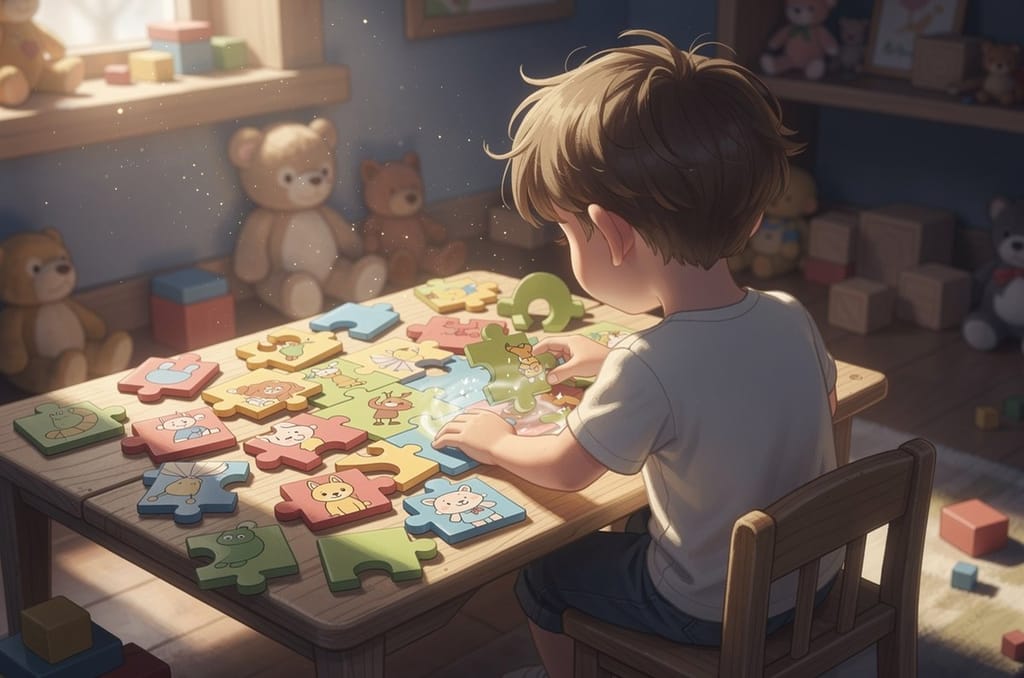
Your three-year-old is right in the sweet spot for puzzles, the age when little fingers get nimble enough to place a piece on purpose and a brain starts reading a picture for clues. The hard part is choosing one that fits: too few pieces and they are bored, too many and they melt down. This guide covers the piece count that suits a three-year-old, the type of puzzle to pick, what is genuinely safe, and how to land on one they will come back to and grow into.
The short answer
Most three-year-olds do best with interlocking puzzles of about 12 to 24 large pieces, having graduated from chunky knob and peg puzzles. A child new to jigsaws can start nearer 12, while a confident three- or four-year-old can stretch to around 30 pieces with a grown-up alongside. Pick large, thick pieces (a true jigsaw is graded for ages 3 and up, not younger), a picture your child loves, and sit down to build it together.
How many puzzle pieces should a 3-year-old have?
For most three-year-olds, the comfortable range is about 12 to 24 interlocking pieces, with a brand-new solver starting nearer 12 and a practiced one working up toward 24 and beyond. That range comes from pediatric occupational therapists: one widely used OT readiness chart places 12-piece interlocking puzzles at ages 3 to 4 and 24-piece puzzles at ages 3 to 5.5. A study in the journal Child Development found that most three-year-olds can already complete simple interlocking jigsaws, largely by trial and error, with the ability to read the picture as a guide maturing around age four. There is no single correct number, because children build visual-spatial skill at different rates. The honest rule: match the count to the child in front of you, not the birthday, and step up gradually rather than doubling it (go 12 to 16 to 24, not 12 straight to 48).
| Stage | Pieces | Puzzle type | What it builds |
|---|---|---|---|
| Around age 2 | 2-6 | Chunky knob and peg, inset boards | Pincer grip, shape matching |
| Just turned 3, new to jigsaws | 4-12 | First interlocking jigsaw, large pieces | Orienting and flipping pieces, confidence |
| Age 3 to 4, typical | 12-24 | Large-piece interlocking jigsaw | Spatial reasoning, reading the picture |
| Confident 3 to 4, with help | ~30 chunky | Step-up jigsaw, built together | Planning, persistence |
| Age 4 to 5 | 24-48 | Jigsaws | Edge strategy, sustained focus |
Ranges follow pediatric occupational-therapy guidance; they overlap because children develop at their own pace. Follow your child's confidence, not the number.
What kind of puzzle is best for a 3-year-old?
The best puzzle for a three-year-old is a large-piece interlocking jigsaw or a simple floor puzzle, the next step up once a child has mastered chunky knob and peg boards. By three, most children are ready to leave behind the wooden inset puzzles of toddlerhood, where each piece drops into its own matching hole, and start fitting pieces to one another. Look for big, thick pieces a small hand can grip and a clear, uncluttered picture. Chunky cardboard or wooden jigsaws of 12 to 24 pieces are the everyday workhorse, while large floor puzzles add a whole-body element and pull a sibling or parent in to help. A personalized portrait puzzle fits right here: our 30-piece chunky kids puzzle uses oversized, rounded-corner pieces at 11 by 14 inches, sized for little hands and built around a picture your child already loves.
Is a 30-piece puzzle too many for a 3-year-old?
Not for a confident three- or four-year-old building it with a grown-up, though it is a stretch for a child brand new to jigsaws. Thirty pieces sits just above the 12-to-24 range most three-year-olds settle into, so whether it lands depends on the child and the pieces. Two things make 30 work at this age: large, thick, chunky pieces, which lower the difficulty at any given count because they are easier to see, grip, and place, and a parent sitting alongside. That is exactly how our smallest tier is built, a 30-piece chunky kids puzzle at 11 by 14 inches for $59, designed as a do-it-together keepsake rather than a solo task. If your three-year-old is just starting out, begin nearer 12 to 24 pieces and treat 30 as the next rung. A puzzle that is a little hard, but finishable with help, is the one that builds skill.
Are puzzles safe for a 3-year-old?
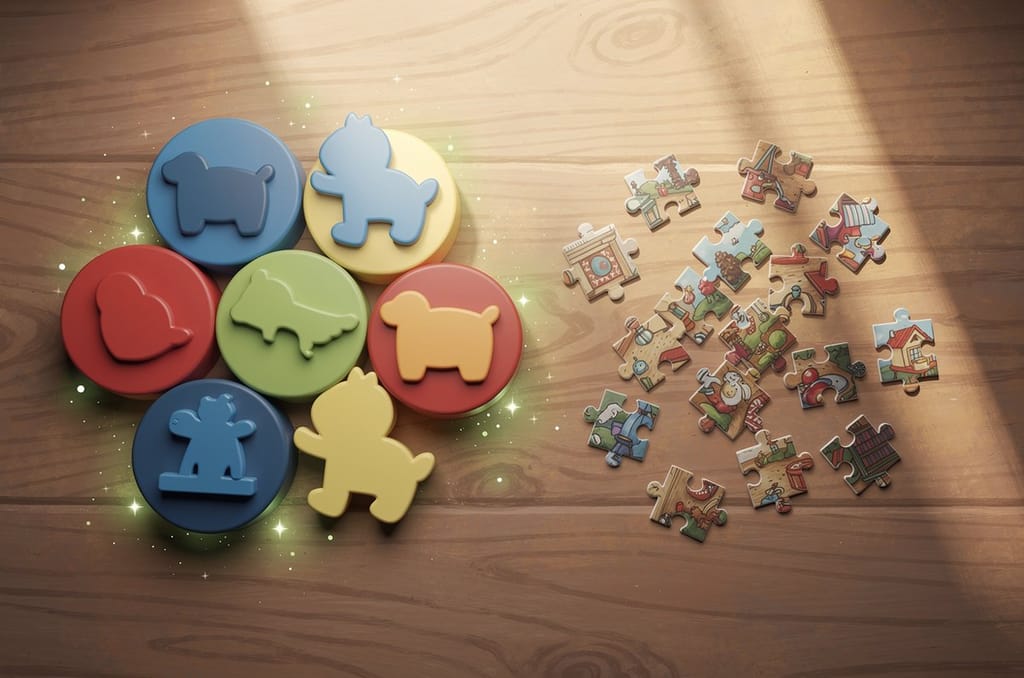
Yes, and age three is exactly when standard jigsaw puzzles become appropriate, with the right pieces and a little supervision. Here is the part most guides skip. U.S. federal law (the small-parts rule at 16 CFR Part 1501, enforced by the Consumer Product Safety Commission, and the mandatory ASTM F963 toy-safety standard) restricts small parts in toys and puzzles intended for children under three, because of the choking risk. A "small part" is anything that fits inside a test cylinder about 1.25 inches wide and 2.25 inches long, roughly the throat of a child under three. A puzzle graded for ages 3 and up is allowed smaller pieces and carries a choking-hazard warning, which is why a true jigsaw is not meant for a younger sibling who still mouths things. The American Academy of Pediatrics advice is simple: think large, keep every piece bigger than the child's mouth, and supervise. Our 30-piece tier uses oversized chunky pieces, rated ages 3 to 5, for exactly that reason.
A 10-second safety check
If a puzzle piece, or anything that could snap off one, fits through the cardboard tube from a roll of toilet paper, treat it as a choking risk for any child under three. For a just-turned-three who still puts things in their mouth, size the pieces up and stay close while they play.
What do puzzles teach a 3-year-old?
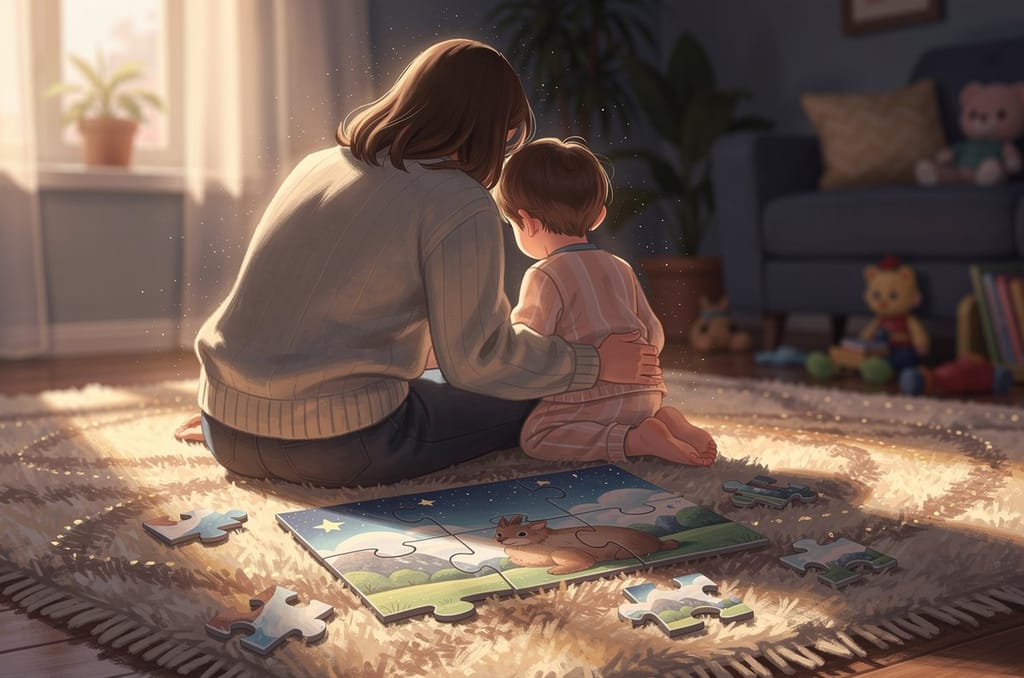
Quite a lot, for something so quiet. Fitting pieces builds the pincer grip, the thumb-and-forefinger hold a child will later use for a pencil, along with hand-eye coordination and using both hands together. Puzzles also feed spatial reasoning: a University of Chicago study published in Developmental Psychology followed children from ages 2 to 4 and found that those who played with puzzles later scored higher on a shape-rotation task, an early skill linked to math. It is an association rather than a guarantee, so think of a puzzle as genuine enrichment, not a shortcut. The biggest multiplier is you. Children hear far more spatial words, edge, corner, flip, under, when a grown-up plays along, and that "puzzle talk" is part of what makes the activity so valuable. For the full picture of the research, see our deeper guide to the benefits of puzzles for kids.
How do I know if a puzzle is too easy or too hard?
Watch how your child works, not how old they are. A puzzle is pitched right when they can finish it with a little effort in roughly 5 to 10 minutes, with maybe one nudge from you. Too easy looks like boredom and wandering off; too hard looks like flinging pieces and quitting. When frustration hits, do not put the whole thing away. Take all but two or three pieces off the board and let them finish from there, so the session still ends on the satisfying click of success. Confidence on an easier puzzle beats a struggle on a hard one every time, and a child who feels like a finisher is the one who asks to do it again.
They complete their current puzzle quickly and want to rebuild it right away. That is the clearest sign to add pieces.
They turn and flip a piece to line it up before placing it, instead of forcing it in. That is real spatial thinking.
They look for the right color or edge rather than trying every piece everywhere. Strategy is replacing trial and error.
Can a puzzle be a keepsake, too?
Yes, and that is where a three-year-old's puzzle can punch above its weight. Two things decide how hard a puzzle feels: the piece count and the picture. A busy, low-contrast image is harder to solve than a clear one with distinct sections, which is why a recognizable subject helps so much, and nothing is more recognizable to a child than their own face. A personalized portrait, your child as the hero of one of our magical worlds, is both easier to read and far more motivating, so they stay at the table longer. It grows with them, too: start at the chunky 30-piece size and move up through the larger tiers (five sizes run from $55 to $115, up to 1,014 pieces) as their skills do, while the picture stays a keepsake the family keeps. You approve a watermarked proof before anything prints, and the uploaded photo is deleted within 24 hours and never used to train AI.
Make their first puzzle one they will keep
Turn a photo into your child as the hero of a magical world, then build it together on a chunky 30-piece puzzle made for little hands. You approve a free, watermarked proof before we print a single piece.
Frequently asked questions
How many puzzle pieces should a 3-year-old have?
+
Most three-year-olds do best with about 12 to 24 interlocking pieces, starting nearer 12 if they are new to jigsaws and working toward 24 and beyond with practice. Pediatric occupational-therapy charts place 12-piece puzzles at ages 3 to 4 and 24-piece puzzles at ages 3 to 5.5. Large, chunky pieces make any count easier, and a confident child can stretch to around 30 with a grown-up alongside.
What type of puzzle is best for a 3-year-old?
+
Large-piece interlocking jigsaws and simple floor puzzles, the step up from the chunky knob and peg boards of toddlerhood. By three, most children can fit pieces to one another rather than dropping them into inset holes. Choose big, thick pieces and a clear picture your child loves, since a recognizable image is easier to solve.
Is a 30-piece puzzle too hard for a 3-year-old?
+
Not for a confident three- or four-year-old building it with a parent, though it is a stretch for a child brand new to jigsaws. Thirty pieces sits just above the usual 12-to-24 range, so large chunky pieces and a grown-up alongside make it work. If your child is just starting out, begin nearer 12 to 24 and treat 30 as the next step.
Are puzzles a choking hazard for 3-year-olds?
+
A puzzle graded for ages 3 and up is designed for children past the stage of mouthing pieces, but supervision still matters. U.S. rules (16 CFR Part 1501, enforced by the Consumer Product Safety Commission) ban small parts in toys for children under three: anything that fits in a cylinder about 1.25 inches wide is too small. Keep pieces larger than the child's mouth, and keep true jigsaws away from younger siblings.
When is a 3-year-old ready for interlocking jigsaw puzzles?
+
Age three is a typical entry point. Most children move from knob and peg puzzles to their first interlocking jigsaws between about two and three, then to 12-to-24-piece jigsaws through ages 3 to 4. A study in the journal Child Development found that most three-year-olds can complete simple interlocking jigsaws by trial and error, with the ability to use the picture maturing around age four. Readiness shows in behavior: they orient pieces and scan for matches rather than forcing them.
Are puzzles good for a 3-year-old's development?
+
Yes. Pediatric occupational therapists use puzzles to build fine motor skills (the pincer grip behind handwriting), hand-eye coordination, and problem-solving, and a University of Chicago study in Developmental Psychology linked early puzzle play with stronger spatial reasoning, a skill connected to later math. The benefit grows when an adult plays along and narrates with spatial words like edge, corner, and flip.
For more on choosing a custom puzzle that lasts, see our guide to what makes a good custom photo puzzle and how we keep your child's photo safe.
This article is for general information and is not medical or developmental advice. If you have questions about your child's development, talk with your pediatrician.