
In short
A family symbol is an image that stands for a household, a lineage or the bond between relatives. There is no single universal one. The most used is the family tree, which goes back to medieval kinship charts and Jesse trees (the English phrase "family tree" dates from 1752). Among the oldest documented family meanings are the household hearth of Greece and Rome and the Chinese character 家 (home, family); Japanese kamon and Northwest Coast crests are family emblems still in use. Many "ancient Celtic family knots" are modern: the motherhood knot was in circulation by about 2015 and a popular tattoo by 2017, and the sisters and family knots are jewelers' own designs.
We read the pages that rank on Google for "symbols of family" before writing this one. Between them they list dozens of symbols, and none of them links a single origin to a museum, a dictionary or a scholar. Several present modern designs, such as the Dara knot and Serch Bythol, as authentic Celtic symbols, and a few pass off souvenir-chart meanings as tribal teaching.
So we checked each symbol against the people who would know: the National Museum of Ireland, the V&A, the Met, the College of Arms, the Court of the Lord Lyon, Gotlands Museum, the Royal BC Museum, published scholarship on runes, adinkra and heraldry, and the old dictionaries. Every symbol below says where it comes from and whether its family meaning is old or new. A modern meaning is not a worse meaning. A design you choose because it fits your family is a fine reason to wear it. You should just know which kind you are wearing.
Family symbols at a glance
The most searched symbols, with where each comes from and how long it has meant family. The sections below cover these and many more.
| Symbol | Where it comes from | Family meaning |
|---|---|---|
| Family tree | Medieval kinship charts and Jesse trees (1086 on) | ✓ Old: leafy lineage trees by the 1300s |
| Hearth | Ancient Greece and Rome | ✓ Ancient: Latin focus meant hearth and household |
| 家 (jia) | Shang dynasty China | ✓ Ancient: home and family in classical texts |
| Kamon | Japan, Heian period | ✓ Old: the emblem of a house |
| Northwest Coast crests | Haida, Tlingit, Kwakwaka'wakw and others | ✓ Old and living: inherited lineage property |
| Akoko Nan | Akan, Ghana | ✓ Parenting, recorded by 1927 |
| Abusua Pa | Akan, Ghana | ✓ "Good family", recorded by 1999 |
| Claddagh ring | Galway and Kinsale, c. 1700 | ✓ Heirloom passed mother to daughter, recorded 1840s |
| Coat of arms | Western Europe, 1100s | ~ Passes to one person's descendants, never to a surname |
| Triquetra | Christian England, 7th century | ✗ Modern: sisters (1990s TV), three generations |
| Triskele | Newgrange, c. 3200 BC | ✗ Modern |
| Celtic motherhood knot | Tattoo design | ✗ Modern, by about 2015 |
| Celtic tree of life | Artwork drawn in 1989 | ~ The early Irish sacred tree is real; the knotwork design is modern |
| Elephants | Elephant biology | ~ Modern emblem, real female-led families |
| Wolf pack | Wolf biology | ~ Modern emblem; a wild pack is a breeding pair and their young |
| Infinity | John Wallis, 1655 | ✗ Modern jewelry design |
| Anchor | Roman catacombs, 2nd to 3rd century | ✗ Modern: it first meant Christian hope |
| Mother's ring | US birthstone list, 1912 | ✗ Modern: established by 1967 |
✓ the family meaning belongs to the symbol's own tradition. ~ partly, or the family reading rests on something real but is applied in a new way. ✗ the family meaning was added recently, by jewelers, tattoo artists or TV. Sources for every row are in the sections below.
What is the most common symbol for family?
The tree. It appears on nine of the ten pages that rank for this search, and it has a long documented history as a picture of a family, though that history is shorter and odder than "ancient" suggests.
- The family tree (medieval Europe). Two medieval drawings lie behind it. One is the arbor consanguinitatis, a lawyer's chart for counting degrees of kinship so a court could rule on who might marry whom. It first appears in manuscripts of Isidore of Seville's Etymologies (c. 600 to 625), and the Walters Art Museum holds a late 12th-century English copy. The other is the Tree of Jesse, which shows Christ's ancestors growing from Jesse, after Isaiah 11:1. The earliest firmly dated one is in the Vysehrad Codex of 1086. Historian Simon Teuscher shows that only late commentators began reading kinship charts as one actual family, and that from the 15th century on these charts were the model for family trees. The English phrase "family tree" is first recorded in 1752, according to the OED. Even then, the Folger Shakespeare Library notes, most pedigrees were grids or lines, not leafy trees.
- Roots (Hebrew Bible; 1970s America). Isaiah's "root of Jesse" is an early, famous use of a root for an ancestor. "Roots" as an everyday word for ancestry got a huge boost from Alex Haley's Roots: after the 1977 TV series, Time reported that genealogy letters to the National Archives averaged 2,344 a week, against 758 the week before.
- The oak and the acorn (English proverb). "Great oaks from little acorns grow" sounds Celtic, but the idea first turns up in Chaucer around 1385 and the exact wording in a Philadelphia newspaper in 1833. The Woodland Trust calls the oak a national symbol of strength in England, and notes that the famous druid oak lore comes from Roman writers such as Pliny, since no druid records survive. Parent oak, child acorn is a modern family reading.
- The bird nest (English). "Nest" has long meant a snug home as well as a bird's nest. The family sense came later: the OED's first "empty nest" is from 1886 (OED) and "empty nester" from 1958 (Merriam-Webster).
Which Celtic symbols for family are really old?
Fewer than the jewelry ads suggest. A senior curator at National Museums Scotland told the Herald that knotwork only arrives in the 7th century AD, as Christian art, and that the older Iron Age style used spirals and curves, not knots. No early Irish or British source assigns a meaning to a particular knot. IrishCentral, writing for the Irish diaspora, says plainly that there is no exact Celtic symbol for family. Here is what each popular one actually is.
- Triquetra or trinity knot (England and Ireland, 7th century). Three interlaced loops. Archaeologist Alexandra Pesch found no triquetras in classical antiquity, pre-Roman Celtic art or early Germanic gold; the earliest are in 7th-century English Christian objects, and it appears in the Book of Kells around 800. Its family readings are recent. The best known is from the TV series Charmed (1998 to 2006), where it stood for three sisters, and by 2017 a US Celtic jeweler described it as sometimes read as three generations of women.
- Triskele or triple spiral (Newgrange, c. 3200 BC). The famous three-spiral stone at Newgrange was carved by Neolithic tomb builders, roughly 2,500 years before Celtic culture reached Ireland, and its meaning is unresolved. The National Museum of Ireland notes that some archaeologists read the spirals as a doorway to the otherworld. Three-limbed triskeles also appear in Iron Age metalwork such as the Llyn Cerrig Bach plaque in Wales (200 BC to AD 50). No early source links any version to family.
- Dara knot (modern). Said to come from doire, "oak". In the standard Irish dictionary doire means an oak wood or grove; the word for oak is dair. We found no early example of a design by this name, and the family-roots meaning has no historical basis.
- Celtic motherhood knot (modern, by about 2015). A triquetra or heart with a mother-and-child form inside. In 2017 a New York Celtic jeweler wrote that it was a popular tattoo design they did not originate, first requested by a customer a year or two earlier.
- Celtic sisters knot (by 2015). The Irish Jewelry Company of New York says the design is the original, copyrighted creation of its owner, and a modern one.
- Celtic family knot (modern). A circle of loops, one per family member, sold in sizes for two to seven people. The same company calls it an original design exclusive to them.
- Serch Bythol (modern). The name is ordinary Welsh, not Gaelic: serch is love and bythol is everlasting. Popular sites cannot agree whether it is two triquetras or two triskeles, and no historical example is known.
- Celtic tree of life and the bile (old idea, modern image). The circular knotwork tree whose branches mirror its roots was drawn by Welsh artist Jen Delyth in 1989, who says no Celtic tree images survive from antiquity. What is real is the bile, a venerated tree at royal inauguration sites; the annals record enemies uprooting the bile of Magh Adhair in 982. The Dictionary of the Irish Language records bile used for a scion or hero, and once for a family tree, so this one has a genuine, if thin, family thread.
- Claddagh ring (Ireland, c. 1700). Two hands holding a crowned heart, a crowned form of the older clasped-hands ring. The earliest surviving rings date to about 1700, and the name "Claddagh ring" only to the 1840s, per Galway City Museum. Its family link is real and documented: writers in the early 1840s recorded the ring as an heirloom passed by a mother to her first daughter to marry. The National Museum of Ireland says the heart-in, heart-out wearing rules are of uncertain origin.
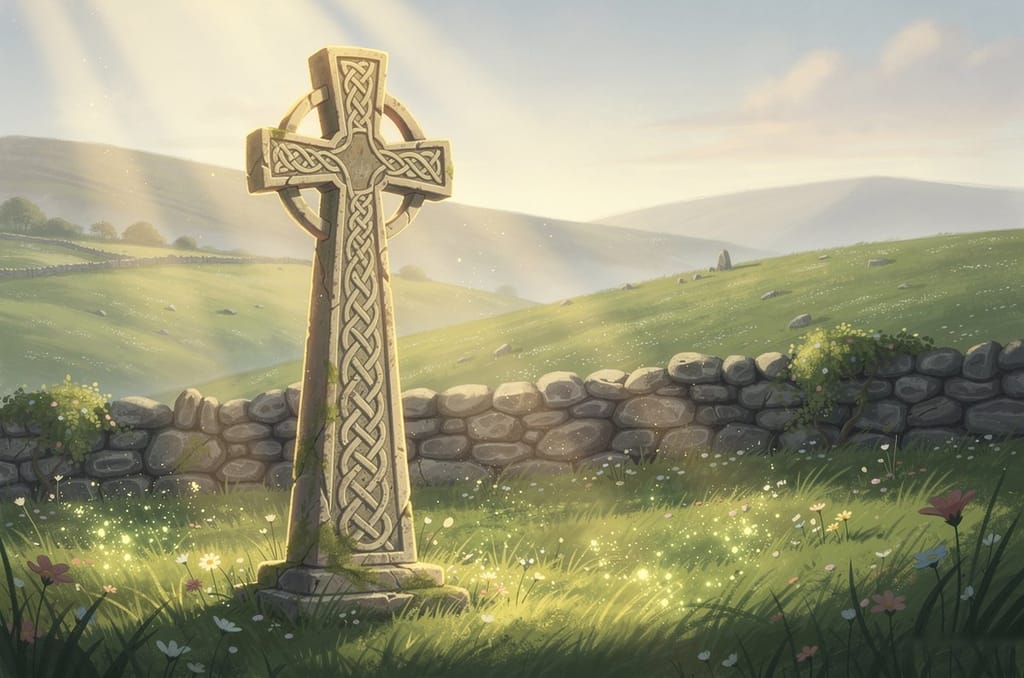
- Celtic cross (Ireland and Britain, c. 800 to 1150). The ringed high crosses taught Bible stories and marked land and power, and were never meant to mark burials. Family graves took them up in the Celtic Revival, from the 1860s. One caution: the ADL lists a short, equal-armed cross in a circle as a white supremacist symbol, so choose the tall Christian form.
- Ailm (ogham). Sold as the "Celtic symbol of strength". It is the name of the ogham letter A, and the University of Glasgow's ogham project says its original meaning is unknown. The strength and family meanings are modern.
- Luckenbooth brooch (Scotland, 18th century). A silver heart, often crowned. A love token with a family use the listicles miss: the V&A records that these brooches were pinned in children's clothing against the evil eye, and worn by nursing mothers.
- Welsh lovespoon (Wales, from 1667). Carved courting spoons; the oldest dated one is 1667. Caged wooden balls are often read as the number of children hoped for, but Museum Wales says such meanings can only be guessed at.
Are there Viking symbols for family?
Not really. The Norse symbols that turn up on family lists have documented meanings of land, cosmology or death, and two of them now carry hate-group baggage.
- Yggdrasil (Old Norse, written down c. 1220 to 1270). The world tree of the Eddas, where the gods hold judgement and the Norns water the tree. It has no role in kinship or lineage. Reading it as a family tree is a modern borrowing from the general tree of life idea.
- Othala (runic, from about the 2nd century AD). A rune whose Old English name meant an estate or homeland, and whose Old Norse cousin odal meant family land handed down father to son. So "inheritance" is fair. But Nazi Germany used it, including on Waffen-SS insignia, and the ADL lists it as a hate symbol. We would not put it on a family keepsake.
- Valknut (Gotland, c. 700 to 1000). Three interlocking triangles, carved on picture stones beside scenes read as arrival among the dead. It is not a family symbol, the word "valknut" is not recorded before the 18th century, and racist groups have adopted it.
African symbols of family: the adinkra
Adinkra are stamped symbols of the Akan peoples of Ghana and Côte d'Ivoire. They are older than most lists claim in one way and younger in another. Stamped adinkra cloth was collected in Kumase in 1817 and has been in the British Museum since 1818, but the first systematic record of the symbols is R. S. Rattray's list of 53 designs from 1927, and several "family" adinkra are not on it. Adinkra began as a royal and above all a mourning cloth, and Ghana's copyright law treats the designs as national folklore, so use them with care.
- Abusua Pa, "good family". Family unity and support among relatives, tied to a saying that love and unity live in a good family. Abusua is the Akan matrilineal clan, so the symbol means the extended clan, not only parents and children. Its meaning is documented in G. F. Kojo Arthur's Cloth as Metaphor (1999), as summarized here; we found no earlier record.
- Akoko Nan, "the hen's foot". From the proverb that a hen steps on her chicks but does not kill them: parenting that corrects without crushing. It is one of the most directly family-linked adinkra and one of the oldest recorded, closing Rattray's 1927 list. Professor Kwesi Yankah explains it for Ashesi University.
- Nkonsonkonson, "chain links". Rattray recorded only the name. An Akan proverb compares the clan to a chain whose members stay joined in life and in death, as Kofi Agyekum sets out in a 2024 study of Akan family proverbs.
- Funtunfunefu Denkyemfunefu, the joined crocodiles. Two crocodiles that share one stomach yet fight over food. The Smithsonian reads its 18th to 19th century brass weight as unity in diversity, like in a family, and the Penn Museum says the proverb is said of a relative who turns greedy. It is as much a warning about family quarrels as a celebration of togetherness.
- Boa Me Na Me Mmoa Wo, "help me and let me help you". Cooperation and mutual help in general (University of Michigan). Lists call it a family symbol; that is an extension.
- Akoma Ntoso, "linked hearts". Agreement and understanding between people or parties. The Ghana Stock Exchange uses it as a logo (adinkrasymbols.org). Using it for a couple or a family is a modern extension.
Asian symbols of family
Several East and South Asian family symbols have a far longer written record than anything on the Celtic list, and some of the best are missing from every ranking page.
- 家 (jia), the character for home and family (China, Shang dynasty). A roof over a pig. It appears in oracle-bone inscriptions over 3,000 years old, and the Shuowen Jiezi of about 100 CE defines it as a dwelling. Why a pig is under the roof is still argued: a Qing scholar thought the character first meant a pigsty, while others read the pig as a sound marker (Wang Li, 2024).
- Mandarin ducks (China). A couple symbol first, not a whole-family one. A Han-era commentary already glosses them as birds that rest and fly in pairs, and the Met has a Ming dish of ducks with lotus as marital fidelity on wedding gifts. The real birds keep strong seasonal pair bonds and do change partners.
- Pomegranate with boys (China, from the 10th century). The character 子 means both seed and son, so a pomegranate full of seeds voices a wish for many descendants. The Met's 10th-century silk shows boys inside pomegranates, and an 18th-century agate carving reads the seeds as many sons to continue the family line. It was a wish for sons specifically.
- Kamon (Japan, Heian period on). The emblem of a house. Heian nobles marked their ox-carts, samurai put crests on banners from the Kamakura period (1185 to 1333), and townspeople took them up in the Edo period, often in place of surnames they could not use (Government of Japan). Many families settled their crest only after the 1875 surname decree. Avoid the 16-petal chrysanthemum (the imperial crest) and the paulownia (a government emblem).
- Koinobori, carp streamers (Japan). Flown for Children's Day on May 5. The carp-family meaning is modern and well dated: early streamers were one black carp, a red one was added around 1900 as the son, the 1931 school song has no mother, and three-carp family sets became common only in the 1970s.
- Hamsa (North Africa and the Middle East). A hand-shaped amulet against the evil eye, used by Muslims and Jews. Its documented family roles are protecting homes and children, as an 1882 account of hands painted over Sephardi doorways records (Sabar, 2010), and in Shi'i Islam the five fingers stand for the five members of the Prophet's household. It is a religious and protective object, not a generic family logo.
- Purna-kalasha, the full vase (Hindu, Jain and Buddhist). A full vessel of water standing for abundance, fertility and good fortune. It is worshipped at childbirth, weddings, housewarmings and naming ceremonies, so it marks blessings on the household at family milestones.
- Bodhi tree (Buddhist). Sometimes sold as a family-growth symbol. It is the tree of the Buddha's awakening at Bodh Gaya and stood for the Buddha himself in early art (Smarthistory). It has no family meaning.
- Tree of life in Turkish and Persian weaving. In Turkish textile studies the motif reads as life and eternity, not family. The real family tree in that tradition is a separate thing: the word for tree, şecere, also names a drawn genealogy.
What do Indigenous American family symbols really mean?
This is where the ranking pages go most wrong. The "Native American family symbol" of a man, a woman and children inside a circle has no source in any museum, ethnography or tribal record we could find. It belongs to the genre of souvenir "Indian symbols and their meanings" charts; a 1941 postcard of one is even titled "as interpreted by modern Indian craftsmen". Cards like it gave crossed arrows "friendship" and the thunderbird "happiness unlimited". Marketing a design in a way that falsely suggests it is Indian-made is illegal under the Indian Arts and Crafts Act of 1990.

The real family symbols are kinship systems, and they belong to the families and nations that hold them.
- Northwest Coast crests and crest poles (Haida, Tlingit, Tsimshian, Kwakwaka'wakw and others). Crests are inherited family property recording a lineage's ancestry, rights and histories. The Haida Gwaii Museum's curator, writing for the Pitt Rivers Museum, says they work much like a coat of arms, passed down the mother's line; the Star House pole was raised to mark a chief adopting a girl. The museum says "crest pole" is the preferred term over "totem pole".
- Thunderbird (many nations). A thunder being, and on the Northwest Coast a crest owned by particular families: the Royal BC Museum identifies the Thunderbird atop Mungo Martin's 1953 pole as the crest of a family whose first ancestor was a Thunderbird who became a man.
- Doodem (Anishinaabe, Great Lakes). The source of the English word "totem", first recorded in English in 1760 (Etymonline). It was a clan mark, not a personal spirit animal: Theresa Schenck traces the earliest form to a 1661 dictionary glossed "village", so "my village" meant "my family", and traces the spirit-guide sense to a trader's travel book of 1791.
- Haudenosaunee clans (Six Nations). Turtle, Wolf, Bear and other clans are extended families traced through the mother, each led by a clan mother. The Oneida Nation notes that marrying within your clan is forbidden, because all clan members are family.
- Diné (Navajo) clans. There is no Navajo pictorial "family symbol". A person is born of the mother's clan and "born for" the father's (Navajo Tribe Museum, 1972), and introduces themselves by four clans.
- Hopi clan symbols. Clans are traced through the mother, and men on the salt pilgrimage carved their clan emblem at the Tutuveni shrine, which holds about 5,000 petroglyphs, mostly clan symbols. It is a sacred site, now fenced after vandalism.
- Bear paw (Santa Clara Pueblo). On water jars it recalls a bear that led the people to water; the Cleveland Museum of Art says the design first appeared in the late 1800s. Its family tie is the craft itself, handed mother to daughter in potter families like the Tafoyas, and each potter's paw served as a signature.
- Dreamcatcher (Ojibwe). It began as a spider-web charm hung on an infant's cradleboard, recorded by Frances Densmore in the early 1900s. The decorative dreamcatcher is a reinvention dating no earlier than the 1960s.
- Zia sun (Zia Pueblo). The Zia read the sun as father and the earth as mother. The symbol was copied from a Zia pot for New Mexico's flag in 1925 without consent, and the Pueblo has objected to its commercial use. Leave it off products and tattoos.
Family symbols from Greece, Rome and Egypt
The hearth may be the oldest family symbol with a clear written meaning, and the one that comes closest to "home" in the everyday sense.
- The hearth: Hestia and Vesta. In Greek homes, offerings went into the hearth fire at meals, and newborns, brides and new members of the household, enslaved people included, were brought into the family by rites at the hearth. In the Athenian Amphidromia, a few days after birth, the baby was carried around the hearth and named. In Latin, focus meant both hearth and household: Horace's farm of "five hearths" meant five families. Vesta, the Roman hearth goddess, was worshipped in every household.
- The Lares and the household shrine (Rome). The Lares protected the whole household, and were honored daily at a small shrine. The poet Persius recalls hanging up his own childhood amulet as a gift to them when he came of age (Satire 5). At Pompeii and Herculaneum, small Lar statuettes found in the streets seem to have been carried by people fleeing Vesuvius.
- The bulla (Etruscan and Roman). A protective locket hung on a freeborn child. Johns Hopkins' archaeology museum says a boy received his on his naming day, eight days after birth, marking his acceptance into the family. Think of it as an ancient baby locket.
- Ancestor masks (Rome). Elite families kept masks of distinguished ancestors in a wooden shrine in the house, and at a family funeral men of similar build wore them, as Polybius describes in the 2nd century BC.
- The ankh (Egypt). Often listed as man, woman and child united. It is the hieroglyph for "life", and the Griffith Institute says it depicts some kind of loop; the man-woman-child reading grew from 19th-century writers such as Thomas Inman, who read it as male and female united, not from Egyptian texts.
- Seneb and his family (Egypt, 24th to 23rd century BC). The oldest family image we found with a clear family meaning is not a knot or a rune. It is a portrait: a statue group of the official Seneb, his wife Senetites with her arm around him, and their son and daughter, made for his tomb at Giza and now in the Egyptian Museum in Cairo (Global Egyptian Museum record).
The word "family" itself has moved. Latin familia meant everyone under the head of a house, enslaved people included. In English "family" first meant a household's servants, and the sense of parents with their children only appears in the 1660s (Etymonline).
The oldest family image we found is a portrait
Upload one photo of up to six people, pick a style such as stained glass or a woven tapestry, and approve a free, watermarked proof before anything prints on a canvas, framed canvas or puzzle.
Does every family have a coat of arms?
No. This is the most common heraldry myth, and the official bodies are blunt about it. The College of Arms in London says there is no such thing as a coat of arms for a surname: arms are granted to one person and pass to that person's legitimate descendants. Scotland's Court of the Lord Lyon says there is no "family" or "clan" coat of arms, only one person bears a given coat at a time, and arms bought online are souvenirs.
- Coat of arms (western Europe, 12th century). Shield emblems became personal around 1100 to 1140 and hereditary by about 1180; the earliest exactly dated armorial seal is from 1146 (heraldica.org summary of Pastoureau). Heraldry is not Roman or Viking.
- "Family crest". The crest is only the device above the helmet, and the Heraldry Society says no such thing as a family crest has ever existed.
- Clan crest badge (Scotland). The one heraldic object a whole kin group may wear: the chief's crest inside a belt-and-buckle ring, which the Lord Lyon says marks the chief's relatives and the extended clan family. The crest still belongs to the chief.
- Motto. In England a motto is optional and can be changed at will, and many unrelated families use the same one; in Scotland it is part of the grant (Society of Genealogists).
- Cadency marks and joined arms. Small marks that tell brothers apart (a crescent for a second son, a mullet, or star, for a third), and the practice of placing husband's and wife's arms side by side on one shield, both set out by the College of Arms. These are heraldry's real family symbols, and they record birth order and marriage.
Which animals symbolize family?

The elephant and the wolf top every list, and both hold up, though not quite the way the lists describe. Here is what the biology says.
- Elephants. Female African elephants live in family groups of related females and their young, led by an old female, the matriarch. Females stay for life; males leave at about 12 to 14 years. A 2001 study in Science found that groups led by older matriarchs were better at telling friend from stranger. So a mother, grandmother and calf design is accurate. A mother, father and calf design is not.
- Wolves. The "alpha wolf" came mostly from studies of unrelated wolves in captivity. In 1999 wolf biologist L. David Mech set out what field work shows: a wild pack is usually a breeding pair and their offspring of the past one to three years, with the parents leading. The wolf pack is a family, and a good symbol of one.
- Swans. A real two-parent family, with less perfect fidelity than the necklaces suggest. In a 1960s study 85% of breeding mute swans kept the same mate if it survived, and DNA testing found about 15% of black swan cygnets fathered outside the pair.
- Canada geese. Pairs stay together year-round, both parents guard the goslings, and the young often stay with their parents through the first year. A widowed goose usually pairs again.
- The pelican in her piety. A mother pelican feeding her young with blood from her own breast. It is a fable from the late antique Physiologus, used in medieval Europe for Christ's sacrifice, and Elizabeth I wore it as mother of her nation. Real pelicans do no such thing.
Modern family symbols and where they started
Most of the shapes people choose for family jewelry and tattoos today got their family meaning in the last century. That is no reason to avoid them, and here is where each one came from.
- Infinity. The mathematician John Wallis introduced the sign in 1655. Infinity loops with family names in them are a recent jewelry design. The white figure eight on the Métis flag, recorded in 1815 and 1816, is a national symbol of the Métis Nation and not a design to borrow.
- Interlocking rings and hearts. Gimmel rings of two or three linked hoops are mentioned from the early 13th century; a betrothed couple could each keep a hoop and join them at the wedding (British Museum). They marked a marriage, the founding of a household. Multi-heart family pendants extend the idea.
- Anchor. Early Christians carved anchors on Roman catacomb epitaphs as a sign of hope and salvation, and it later became a sailor's tattoo. "My family is my anchor" is a modern reading.
- Compass and nautical star. The US Navy's tradition is that a sailor wore one to find the way back to port. The "find your way home to family" meaning grew from that 20th-century lore.
- Birthstones and the mother's ring. The US birthstone list was adopted by a jewelers' association in Kansas City in 1912, as gem scholar George Kunz recorded the next year in The Curious Lore of Precious Stones. A mother's ring with one stone per child was already an established idea when a US patent filed in 1967 described it.
- Birth flowers. A bouquet of each family member's birth-month flower is a recent twist on Victorian flower books, such as Hulme's The Garland of the Year (1873). Our guide to birth month flowers and what they mean traces each month's flower back to its 19th-century source.
- Coordinates. A tattoo of the latitude and longitude of a birthplace or family home. It was in the news by 2008, when an actor added her twins' birthplace below the coordinates for her other children. Use a town, not your street.
- Stick-figure family. The car-window decal. Its origin is disputed, with claims for an Australian couple in 2005, an Idaho maker in 2006 and an early start in Mexico. The best version is the one a child draws. That drawing can be stitched in thread onto a shirt or hoodie and kept long after the decal fades.
Family symbol myths, checked
The claims below appear on the pages that rank for this search. Each is checked against the source in the right-hand column.
| The claim | What the record shows |
|---|---|
| Celtic knots are ancient druid designs | Knotwork arrives in the 7th century AD as Christian art (National Museums Scotland curator) |
| The Newgrange spiral is a Celtic family symbol | Carved c. 3200 BC, about 2,500 years before the Celts reached Ireland (Knowth.com) |
| The Celtic motherhood knot is ancient | In circulation by about 2015, a popular tattoo by 2017 (Walker Metalsmiths, 2017) |
| The Celtic tree of life is a druid emblem | The knotwork tree was drawn in 1989 (Jen Delyth) |
| Othala is the Viking rune of family | It is absent from the Viking-Age rune row (Medievalist Toolkit) and is now a listed hate symbol (ADL) |
| Every surname has a family coat of arms | Arms belong to one person and their descendants (College of Arms) |
| A totem is a personal spirit animal | The Ojibwe doodem is a clan mark; calling a personal spirit guide a "totem" goes back to a 1791 travel book (Schenck) |
| There is a Native American family symbol of figures in a circle | No museum or tribal source; it comes from souvenir symbol charts (1941 postcard) |
| The ankh means man, woman and child | It is the hieroglyph for "life" (Griffith Institute) |
| Wolf packs are ruled by an alpha | A wild pack is a breeding pair and their young (Mech, 1999) |
| Koinobori carp have always been father, mother and child | The mother carp became standard only in the 1970s (Nippon.com) |
| The family tree is ancient | The English phrase dates from 1752 (OED) |
How do you choose a family symbol?
Start with what you want the symbol to say about your family, then check that it really means that. The checks below are what we would run before inking, engraving or framing anything.
- Match the count to your family. A triquetra has three parts, a gimmel ring two or three, the jeweler's family knot one loop per person. A tree, a bouquet of birth flowers or a row of birthstones grows with the family, which suits a design you may need to add a child to later.
- Decide on old or new. If the history matters to you, pick from the symbols marked old above: a hearth, a Claddagh, Akoko Nan, a family tree. If the meaning is personal, a modern design is just as honest. Just don't call it ancient.
- Skip the borrowed and the hijacked. Leave out clan crests and Northwest Coast crests that belong to other families, sacred designs like the Zia sun, the Othala and valknut runes, the short sun cross, and copyrighted retail designs like the sisters knot or the 1989 tree of life.
- Keep it private. A town instead of your home's coordinates, and no children's names on a public car decal.
- Consider a picture of the family itself. It is the oldest family image in this post, and nobody else has the same one. Our family portrait in a stained glass style paints your own photo with bold leadlines and jewel colors. Our family photo ideas cover getting a photo it can be painted from.
Family tattoo ideas built on real symbols
These family tattoo ideas are drawn from the symbols above, each with the meaning it can honestly carry. Ask your artist how small a design can go and still read clearly in your chosen spot.
- A matching trio of triquetras for three sisters, or for a grandmother, mother and daughter. The meaning is modern, and you can say so.
- A Claddagh passed down the women of a family, which is the tradition writers recorded in the 1840s.
- Akoko Nan for a parent: firm and kind at once.
- An elephant matriarch with calves, one calf per child. Leave out the bull.
- A wolf pair and pups, the actual shape of a wild pack.
- A family tree with roots, one branch per person and room to add more.
- A hearth or a small flame, the classical sign for home.
- Birth flowers in a wreath, one bloom per family member.
- Gimmel rings, two linked hoops for a couple's anniversary.
- Coordinates of a hometown, set in a simple typeface.
- A child's own drawing, traced line for line. It is the stick-figure family nobody else has.
- Birth-order hearts, a matching set for siblings with one heart filled in per person.
Wear it instead of inking it
A portrait, a birth-flower wreath or your child's own drawing, laser engraved on a pendant cut to the shape of the art, in stainless steel, gold plate or sterling silver.
Frequently asked questions
What is the symbol for family?
+
The family tree is the most widely used. It grew from medieval kinship charts and Jesse trees, and the English phrase "family tree" dates from 1752. Other symbols with a long, documented family meaning include the household hearth of Greece and Rome, Japanese kamon, the crests of Northwest Coast nations and the Akan adinkra Akoko Nan (parenting). Abusua Pa ("good family") is another adinkra, recorded more recently.
Is there a universal symbol for family?
+
No. Every culture has its own, and most popular ones mean family only in some places. The tree comes closest to universal, but even its family meaning was built up gradually in medieval Europe.
What is the Celtic symbol for family?
+
There is no single historical one. The triquetra, triskele and Celtic knots had no recorded family meaning in early Ireland or Britain, and the motherhood, sisters and family knots are modern designs. The Claddagh ring has the strongest documented family tie: in the 1840s it was recorded as an heirloom passed from mother to daughter.
Is the Celtic motherhood knot ancient?
+
No. It is a modern variant of the triquetra. A New York Celtic jeweler wrote in 2017 that it was already a popular tattoo design they did not originate, so it was in circulation by about 2015.
What animal symbolizes family?
+
The elephant and the wolf, and the biology supports both. Elephant families are related females and their young led by an old matriarch, and a wild wolf pack is usually a breeding pair and their offspring. Canada geese, which raise their young as a pair and keep them close through the first year, are a good third.
What flower symbolizes family?
+
No flower carries one fixed family meaning. The usual choice is a bouquet or wreath made of each family member's birth-month flower, a modern twist on Victorian month-flower books such as Hulme's The Garland of the Year (1873).
Which family symbols should you avoid?
+
Avoid the Othala rune, the valknut and the short equal-armed sun cross, which hate groups have adopted. Leave out sacred or owned symbols, such as the Zia sun, a chief's clan crest or another family's Northwest Coast crest. Also avoid "Native American family symbols" from symbol charts, which have no tribal source.
Does my surname have a family crest?
+
No. The College of Arms says there is no coat of arms for a surname: arms are granted to one person and pass to that person's descendants. The crest is only the part above the helmet, and the Heraldry Society says a "family crest" has never existed.