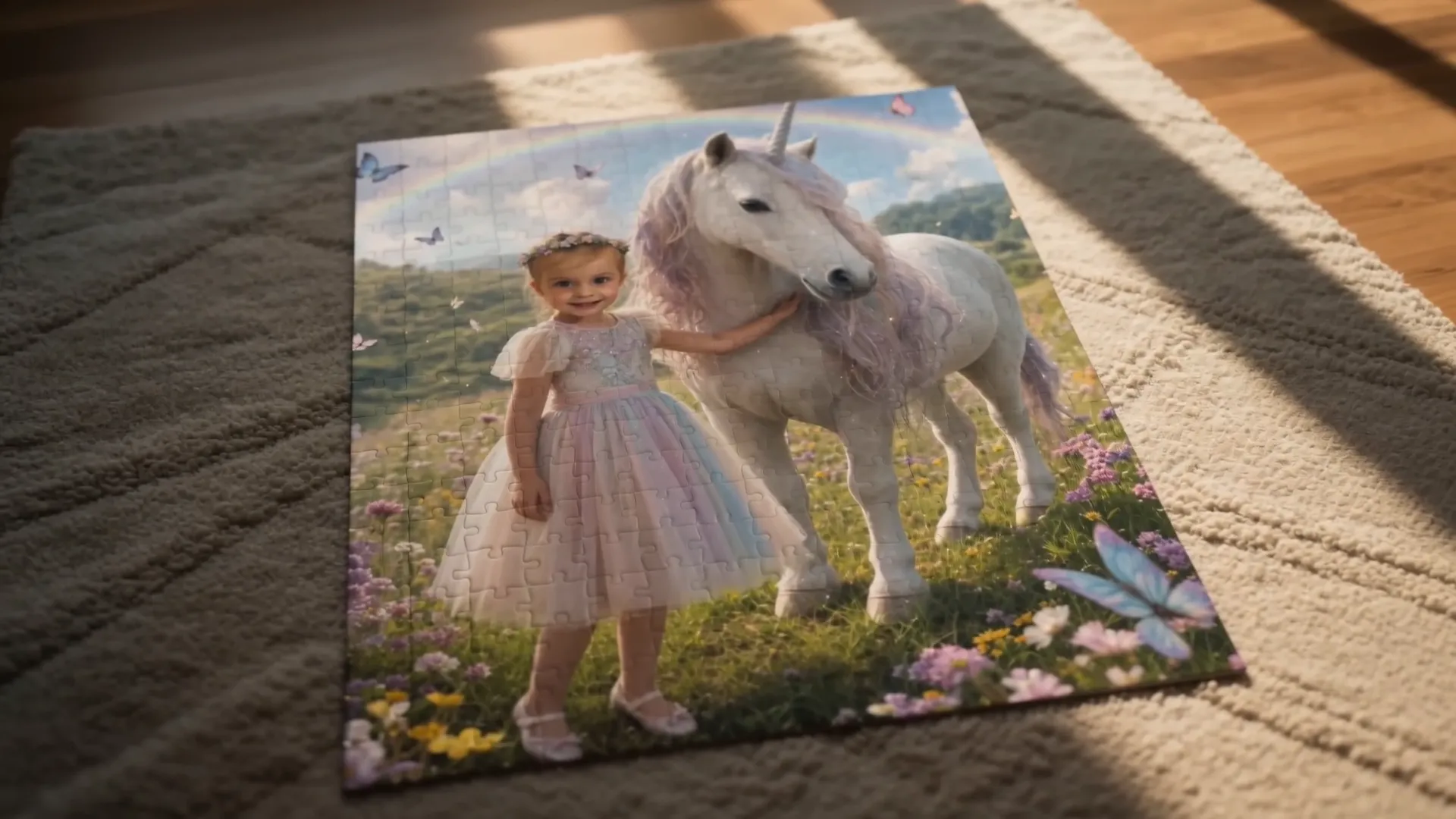
Seven is the year the thinking changes. A five-year-old plays a game; a seven-year-old works out how to win it, remembers the rules next Saturday, and argues about them. This is the age developmental psychologists mark as the start of concrete operational thought, when a child can hold a system in their head and reason through it (OpenStax, Lifespan Development). Gift guides for this age tend to be long lists of whatever is trending. This one does two things those lists skip: it matches the gift to what a seven-year-old can now actually do, and it answers the question every puzzle aisle raises and no other list touches, which is how many pieces is right.
The short answer
The best gifts for a 7-year-old suit a child who can plan, follow rules, and stick with something: strategy board games, building and STEM kits, a real bike or scooter, chapter books and graphic novels, craft kits with a finished result, and one keepsake they keep. For a jigsaw, occupational therapists put 48 pieces up to about 260 within expected range for ages 5 to 8, so a 110-piece or 252-piece puzzle fits a seven-year-old well. Buy for the child's actual obsession, not the age on the box.
| If you want | Give | Good to know |
|---|---|---|
| One keepsake that lasts | A personalized hero puzzle | From $59, and it frames as wall art after |
| The best all-rounder | A strategy board or card game | Seven is when rules finally stick |
| For a builder | A LEGO or STEM kit with a real result | Fine motor skill jumps between 6 and 8 |
| For an active kid | A pedal bike, scooter, or sports gear | They need an hour of activity a day |
| For a new reader | A graphic novel or chapter series | They can read age-appropriate books now |
| Under $25 | A brainteaser or a craft kit | Small, and it survives past January |

What is a 7-year-old actually like right now?
Capable, opinionated, and suddenly able to concentrate. A six-year-old should be able to focus on a task for at least fifteen minutes, and by nine that stretches to about an hour, so seven sits on a steep part of that curve (MedlinePlus). Most six- and seven-year-olds can tell time, copy a complex shape like a diamond, follow an instruction with three separate steps, read age-appropriate books, ride a bike, and tie their own shoelaces (CHOC). Socially they are pulling away from you and toward friends, and they care a great deal about being good at things and being seen to be good at them. That last part matters more than any product category. The gift that lands at seven is usually the one that lets a child get visibly better at something and then show you the evidence.
Why seven is the year logic arrives
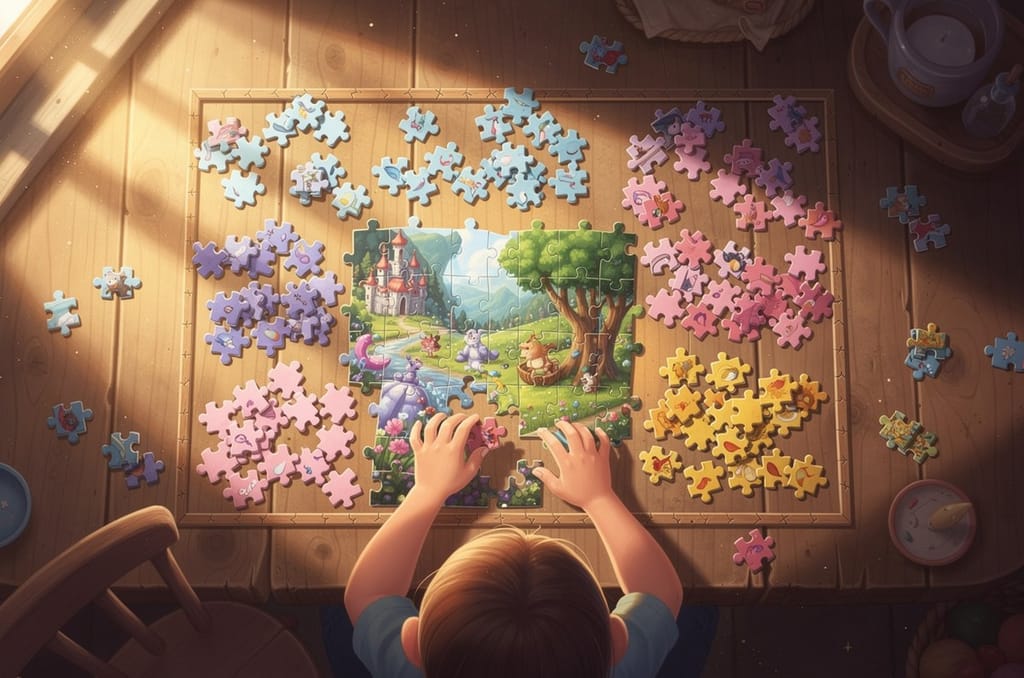
Around age seven children enter what Piaget called the concrete operational stage, which runs to roughly eleven. They start using real logic on things they can see and touch: sorting objects along more than one dimension at once, arranging a set in order, and understanding that a quantity holds steady even when its shape changes (OpenStax). Memory changes too. Children can use strategies like grouping and rehearsal from about five, but they start using them efficiently around seven. This is why a jigsaw suddenly gets easier at this age. Sorting the edges out from the middles, then grouping the middles by color, is exactly the kind of two-level classification that arrives now. The child is not just trying shapes against a hole any more. They have a method, and watching them run it is the tell that this year is different.
What makes a good gift for a 7-year-old?
Four traits separate the gifts still in use by Easter from the ones under the bed by February.
Rules, a strategy, a technique. Seven-year-olds want to get good at something and show you.
A built model, a completed puzzle, a soap they made. A visible result is the payoff at this age.
Space, horses, football, dinosaurs. Buy the interest they already have, not the one on the box.
Still good at nine, or it becomes something else, like a puzzle that ends up framed.
A note on quantity. A University of Toledo study gave toddlers four toys in one session and sixteen in another, and found that an abundance of toys reduced the quality of play, while fewer at once helped them focus better and play more creatively (Dauch et al., 2018). Those were much younger children, so treat it as a direction rather than a rule. It still helps on a morning when the pile is already large: one good thing beats five filler ones.
How many puzzle pieces is right for a 7-year-old?
Roughly 48 up to about 260. Occupational therapists place interlocking jigsaws from 48 pieces up to 260 within the expected range for independent completion at ages 5 to 8, with 500 pieces and beyond starting at about eight (KidSense Therapy Group). A widely used retail age chart lands in the same place from the other direction, putting 50 to 100 pieces at ages 6 to 7 and 100 to 200 at ages 7 to 8 (RGS puzzle age guide). So a seven-year-old who does puzzles now and then is well served by something near 110 pieces, and one who already likes them can take 252 and treat it as a two-day project on the dining table. Buy the level, not the birthday. A child who has never finished a jigsaw will enjoy 110 far more than a 500 they abandon halfway.
Do puzzles actually build anything?
There is decent evidence that puzzle play and spatial skill travel together, though the strongest study is about younger children. Researchers at the University of Chicago observed children at home every four months between two and four years old, then tested them at four and a half on a task requiring mental transformations of shapes. Those who had been seen playing with puzzles did better, and among the puzzlers, how often they played predicted how well they scored, after controlling for parent education and income (Levine et al., 2012). That was preschoolers, not second graders, so it is not a promise about seven. But spatial reasoning is still developing through middle childhood, and a jigsaw remains one of the few gifts that exercises it while a child believes they are only playing.
What are the best gift categories at seven?
Three carry most of the weight: something with rules, something to build, and something to ride.
To stretch their thinking. A strategy board or card game is the strongest single category, because this is the first year rules genuinely stick. Board games are a listed favorite of six- and seven-year-olds, who by now cooperate, share, and take turns properly (CHOC), so the evening no longer ends in a flipped board.
To build something. LEGO, magnetic tiles, model and STEM kits with a working result. Between ages six and eight there is a brain growth spurt bringing significant gains in fine motor skill and eye-hand coordination, so builds that ended in tears at five now satisfy.
To burn energy. A bike, a scooter, roller skates, a ball and a goal. School-age children need at least an hour of activity a day (MedlinePlus), and most seven-year-olds ride a bike confidently.
What about books, art, and making things?
Both work at seven, and both benefit from aiming slightly high rather than slightly safe.
To read. Graphic novels and early chapter series. Most seven-year-olds can read age-appropriate books on their own now, so one that looks a little too old is usually the right call, and a series beats a standalone because the next book is already the next gift.
To make things. Craft kits, real art supplies, a kid-safe camera. Anything with a finished object at the end outperforms an open-ended pack of materials at this age, because the payoff is visible. A child who draws constantly can also have one of their own drawings stitched in real thread onto a sweatshirt, which is the rare gift they made themselves. For one deep in a particular world, our guide to gifts by a kid's obsession pairs the common ones up.
One keepsake, if you only buy one thing
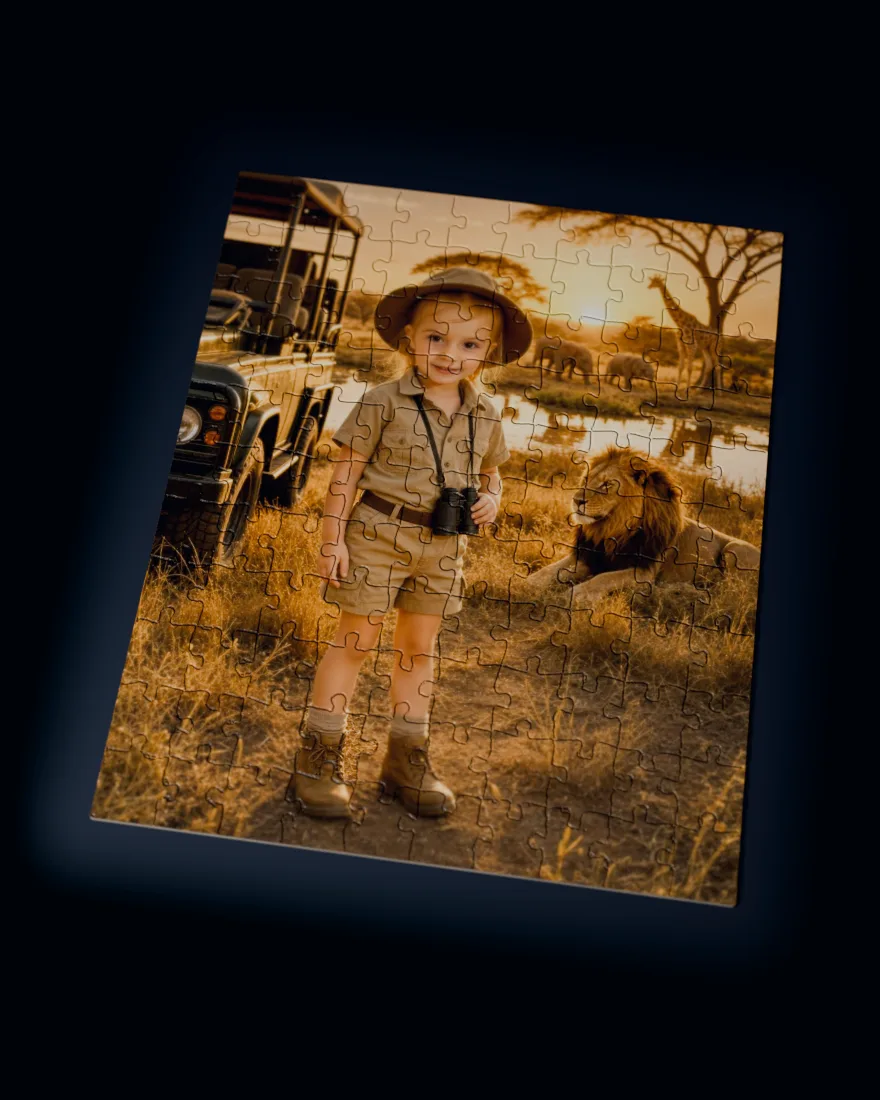
Seven-year-olds get a lot of stuff. The gift that survives the cull is usually the one that could not have been bought for any other child. That is what a personalized portrait does: you upload one photo, choose a world, and your child is repainted as its hero.
As a jigsaw it fits the age exactly. The 110-piece version at 8″ × 10″ is $65 and sits in the band the charts above put at ages 5 to 7. The 252-piece at 10.6″ × 13.5″ is $69 and suits a child who already finishes puzzles, and the 520-piece at $89 is the one to grow into. Because the picture is of them, most stay with it longer than they would a stock castle. Afterwards it need not go back in the box, since plenty of families glue and frame it. Our post on why puzzles earn their shelf space covers what that play is doing.
Or put it on the wall instead
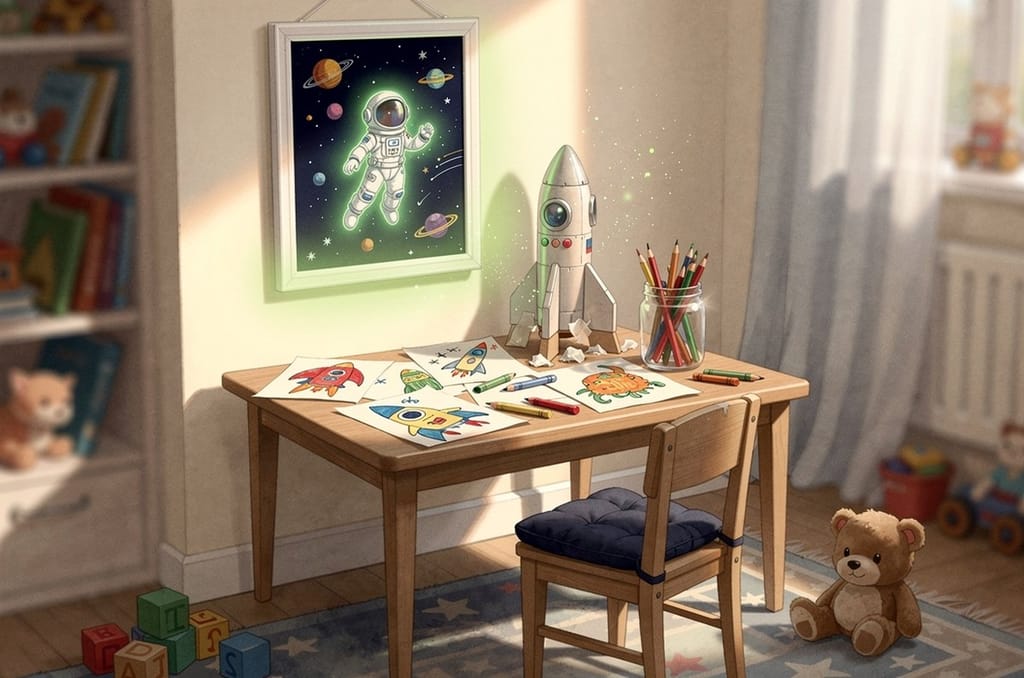
If a puzzle is not the thing, the same portrait prints as wall art, which suits a bedroom starting to have opinions about decoration. A gallery-wrapped canvas at 8″ × 10″ is $59, a framed canvas that arrives ready to hang is $79, and a fleece blanket at 30″ × 40″ is $59. The worlds run from space and dinosaurs through to football and ballet, so browse the space explorer world and pick whichever they are already obsessed with. Every physical order includes the high-resolution file, and nothing prints until you approve a watermarked proof. Shopping for a younger sibling too? Our gift guide for five-year-olds covers that age and its different piece count.
Make them the hero of their own world
Upload one photo, pick a world, and approve a free, watermarked proof before we print a single piece.
What should you skip?
Three categories reliably disappoint at seven. Anything labeled for ages three and up, because a seven-year-old reads the box and knows it is beneath them, and the play pattern is genuinely too simple now. Anything with one fixed outcome, like a single-scene playset or a build-it-once kit with no second use, since the interest curve at this age is steep and short. And a jigsaw far above their level: 500 pieces is an eight-plus proposition on the therapy charts, and handing one to a child who has not finished a 250-piece usually produces an abandoned table rather than a triumph. Trend-driven collectibles are a softer no. They are fine as the small extra, and at seven a child genuinely wants the thing their friends have, but they rarely survive to the next birthday, so avoid building the main gift around one.
How much should you spend?
There is no correct number, and the research pushes toward fewer and better rather than more. A workable shape for seven is one main gift in the $40 to $80 range that has a method to learn or something to build, one book, and one small thing under $15. That covers the categories that actually get used without producing the pile the toy study points at. If you want a single gift to do the work, spend it on the thing they will still own in five years rather than the thing that is popular this December. A keepsake and a good board game both clear that bar, because one gets kept and the other gets played. A trending plastic figure usually does not, however much it is wanted in the shop.
Frequently asked questions
What are the best gifts for a 7-year-old?
+
The best gifts for a 7-year-old suit a child who can now plan, follow rules, and stay with a task: strategy board and card games, LEGO and STEM kits with a finished result, a pedal bike or scooter, graphic novels and chapter books, craft kits, and one keepsake such as a personalized portrait puzzle where they are the hero. Buy for the specific obsession the child already has rather than the age printed on the box.
How many puzzle pieces is right for a 7-year-old?
+
Roughly 48 to 260 pieces. Occupational therapists list interlocking jigsaws from 48 up to about 260 pieces as within expected range for independent completion at ages 5 to 8, and put 500 pieces and up at eight and older. A 110-piece puzzle suits a seven-year-old who does jigsaws occasionally, and 252 pieces suits one who already enjoys them. Match the child's actual experience rather than their birthday.
How long can a 7-year-old focus on one activity?
+
A six-year-old should be able to focus on a task for at least fifteen minutes, and by age nine that extends to about an hour, so a seven-year-old typically falls somewhere between. Attention spans in middle childhood vary widely by task and by child. In practice this means a gift at seven can reasonably ask for a sitting of twenty minutes or more, which is why board games, builds and jigsaws start working properly at this age.
What should you not buy a 7-year-old?
+
Skip toys labeled for ages three and up, which a seven-year-old will read as babyish and outgrow immediately. Skip single-outcome toys with no second use. Skip jigsaws far above their level, since 500 pieces is generally an eight-plus challenge and an abandoned puzzle is worse than none. Trend-driven collectibles make fine small extras but rarely last as a main gift.
Is a personalized puzzle a good gift for a 7-year-old?
+
Yes, and the piece count is why. A personalized puzzle at 110 or 252 pieces sits in the band therapists consider age-appropriate for 5 to 8, and because the picture is of the child rather than a stock scene, most stay with it longer. It also outlives the play: families often glue and frame the finished puzzle. At The Curious Thing you approve a free watermarked proof before anything prints.