In short
Here are 54 free winter coloring pages to print on US Letter paper, with no email or sign-up, and not one of them is a Christmas page, so they work from the first snow through February. There are snowmen, snowflakes, penguins, polar bears and Arctic animals, woodland animals, sledding and skating, hot cocoa and mittens, New Year's, Groundhog Day and Lunar New Year. Each subject comes at three levels: easy pages are one big shape in thick lines for ages 2 to 4, medium pages add a simple scene for ages 4 to 7, and detailed pages are realistic or patterned for ages 8 to adult. Tap a page's title to open the full-size file, then print at 100% or Actual size.
Before drawing a single page, we read the winter coloring pages that rank on Google, from teacher blogs to big printable galleries. Most drift into Christmas, with reindeer and gingerbread houses filed under winter, and one of the largest collections is mostly Christmas pages. None sorts its pages by age with a reason, none links a single fact to a source, and a few put a penguin in the same scene as a bear or a bunny. Groundhog Day barely appears, and we found no Lunar New Year pages at all.
So every page here is new, drawn for this post with the image model behind our free photo-to-coloring-page tool and checked by hand: every snowflake has six arms, the penguins stay south, the polar bears stay north, and nobody wears a Santa hat. If you do want Santa, he's in our Christmas coloring pages. Each section here has one true story to tell while the crayons are out, linked to where it comes from. Print as many as you like for home or a classroom. Please don't sell them.
Which winter coloring page suits which age?
Easy pages suit most children from two to four, medium pages four to seven, and detailed pages eight and up, adults included. The levels follow how coloring develops: toddlers scribble across a shape, preschoolers begin to aim for it, and school-age children fill small areas on purpose.
The CDC's milestone checklists list scribbling at 18 months and copying a circle after being shown how at 3 years, and Huang and colleagues' 2024 study of 239 children aged 3 to 6 found most 3- and 4-year-olds coloring at a transitional level, with mature coloring usually after 5. For a two-year-old, color together and keep the area small, one shape rather than the whole page. The children's occupational therapists at Aneurin Bevan health board in Wales suggest coloring pictures together and keeping the areas to color "small and achievable". Our dinosaur coloring pages go further into grip and crayon skills by age.
| Level | Usually suits | What's on the page | Good first picks |
|---|---|---|---|
| Easy | 2 to 4 | One big shape, very thick lines, almost no background | Snowman in earmuffs, one big snowflake, mug of hot cocoa |
| Medium | 4 to 7 | The subject in a simple scene, bold lines, a few details | Snowball fight, penguin huddle, building a snow fort |
| Detailed | 8 to adult | A realistic scene or a page full of patterns, many small areas | Snowflake mandala, moose by a frozen stream, dragon dance |
The ages are starting points, not rules. Let a child who loves penguins color the detailed penguins badly and happily.
How do you print these coloring pages?
Tap a page's title under any preview to open the full-size file, 2,550 by 3,300 pixels, which is 8.5 by 11 inches at 300 dpi, and print it at 100% or Actual size on US Letter paper. Each title opens the picture itself, with no PDF bundle, cloud drive or sign-in in the way. Adobe's print help explains the setting: Fit "reduces or enlarges each page to fit the printable area", while Actual size prints at full scale. On A4 paper (a little narrower than Letter), choose Fit.
Plain 20 lb copy paper (75 g/m²) is fine for crayons and colored pencils. For markers, slide a scrap sheet underneath: Strathmore notes that most papers eventually let markers bleed through, and lighter ones sooner. Printing for a class? Put one level on each table, and keep the detailed pages for older kids at indoor recess.
Snowman coloring pages
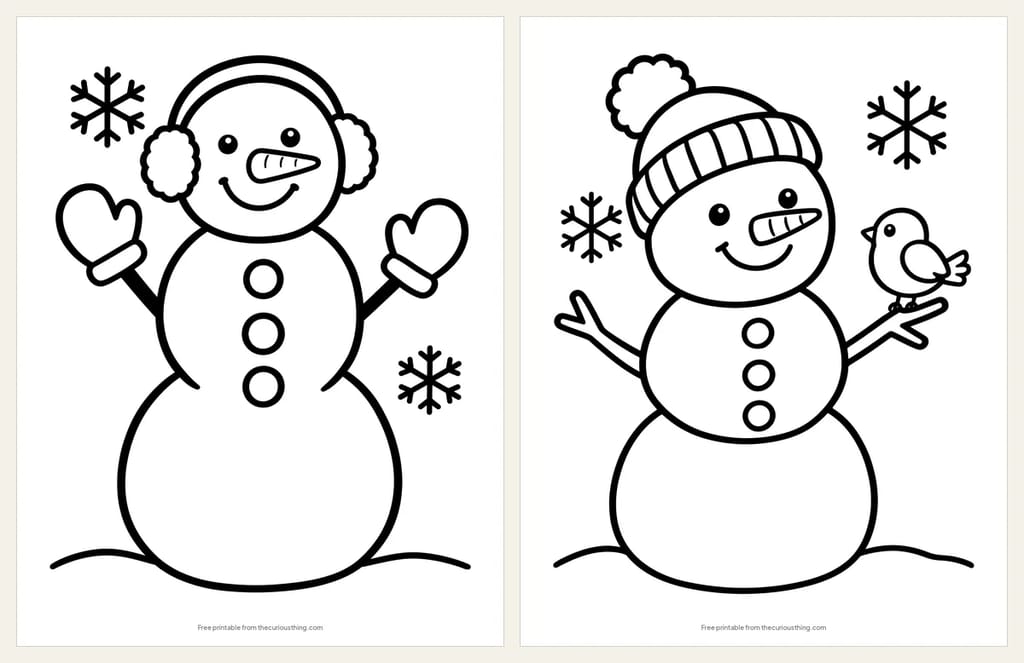
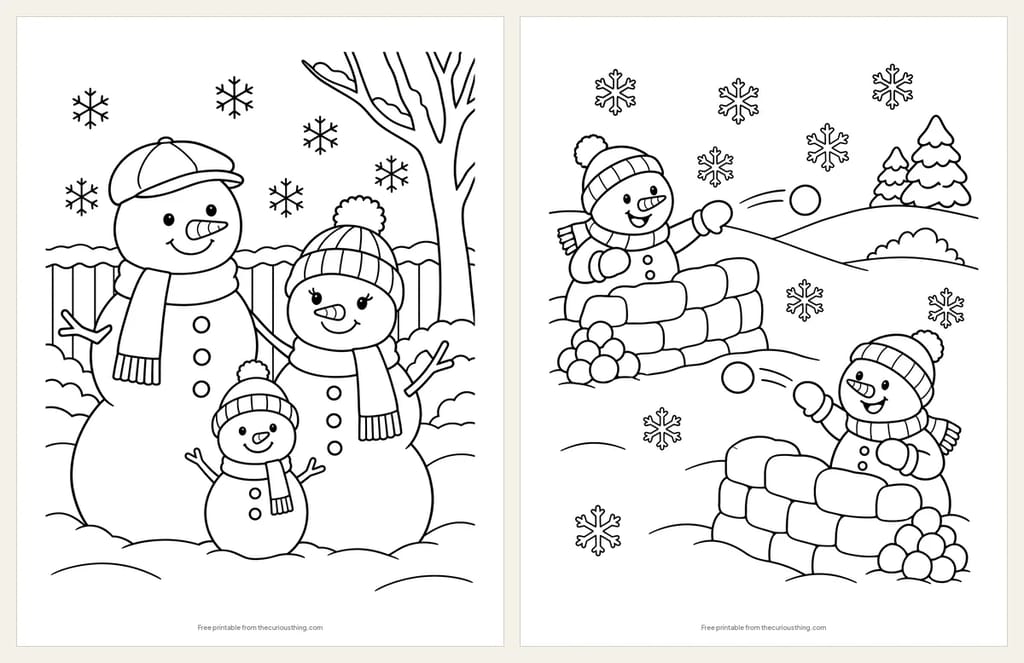
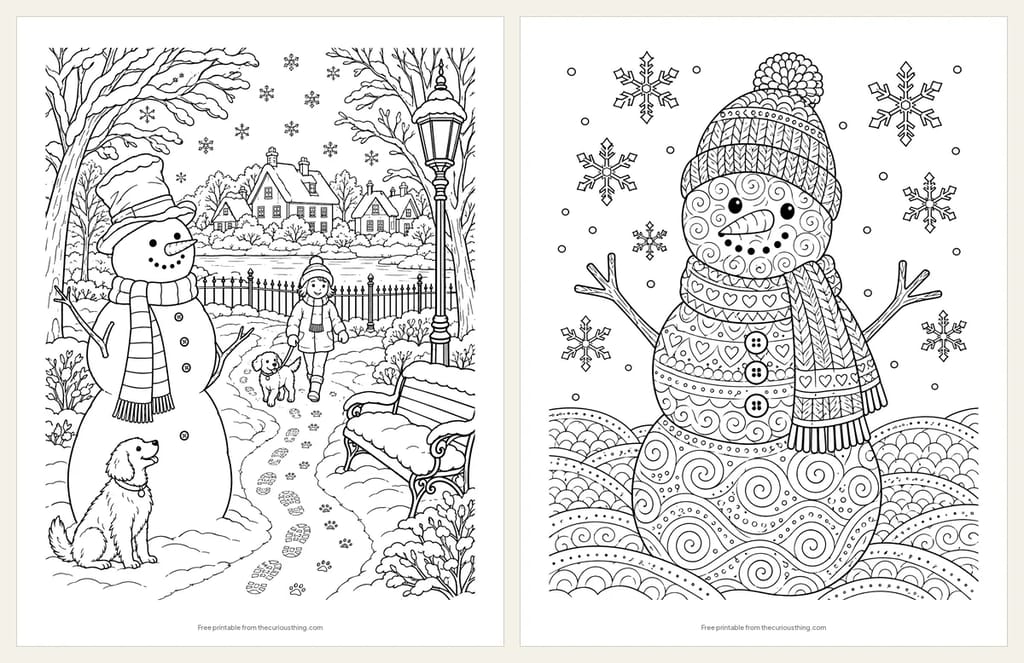
These six snowman coloring pages run from a snowman in earmuffs for toddlers to a snowman family, a snowball fight and a snowman in a town park, and not one of them wears a Santa hat. The tallest snowperson on record is Olympia, finished by the people of Bethel, Maine, on February 26, 2008, at 122 feet 1 inch. Her eyelashes were alpine skis, her arms were 25-foot spruce trees, her mouth was made of car tires, and she took until July 30 to melt, according to Bethel's chamber of commerce. If your snow won't roll, it's too dry. NOAA's snow scientists grade snow by its liquid water: dry snow has none and "little tendency for snow grains to stick together", while moist snow, which only happens right at 32°F, has "a distinct tendency to stick together". A snow scientist at Montana State calls that free water "the glue". The carrot nose goes back a long way too: a snowman in a 1944 picture book already had coal eyes and a carrot nose, PBS's American Experience found.
Snowflake coloring pages
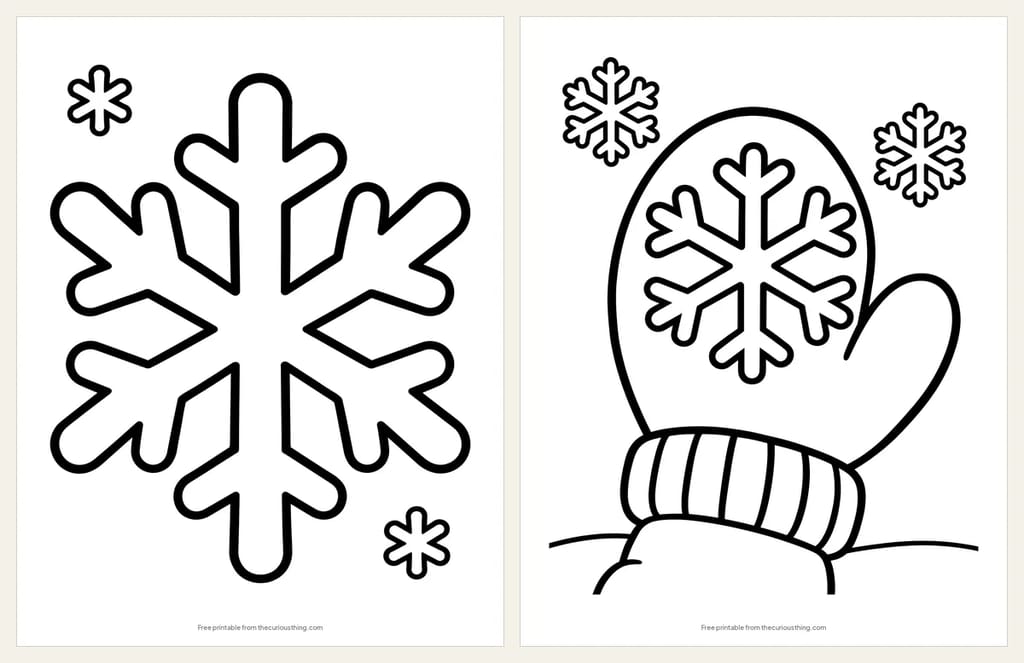
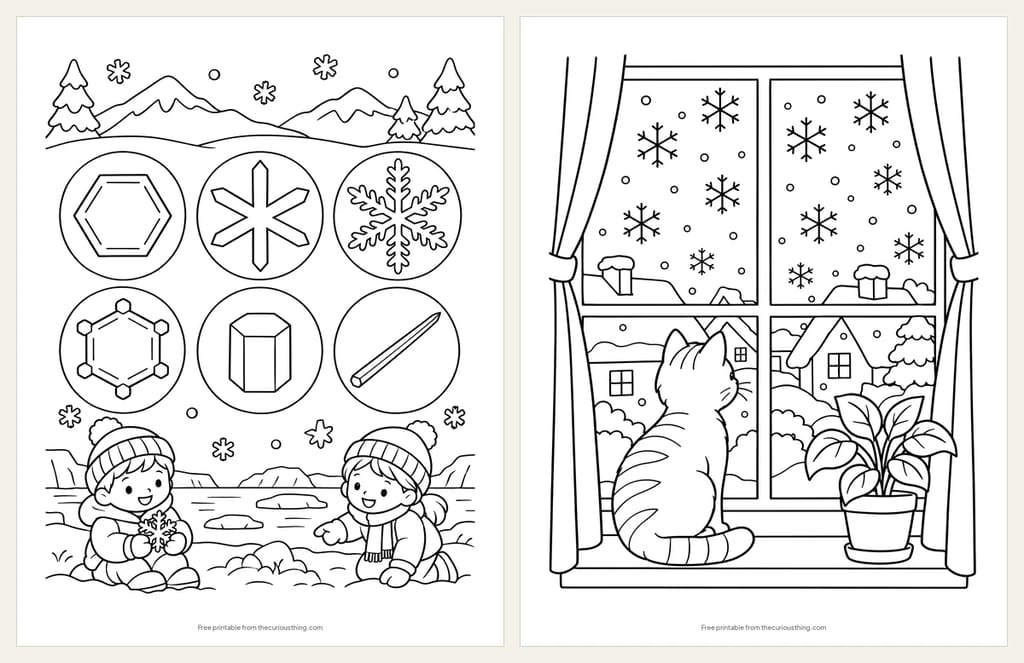
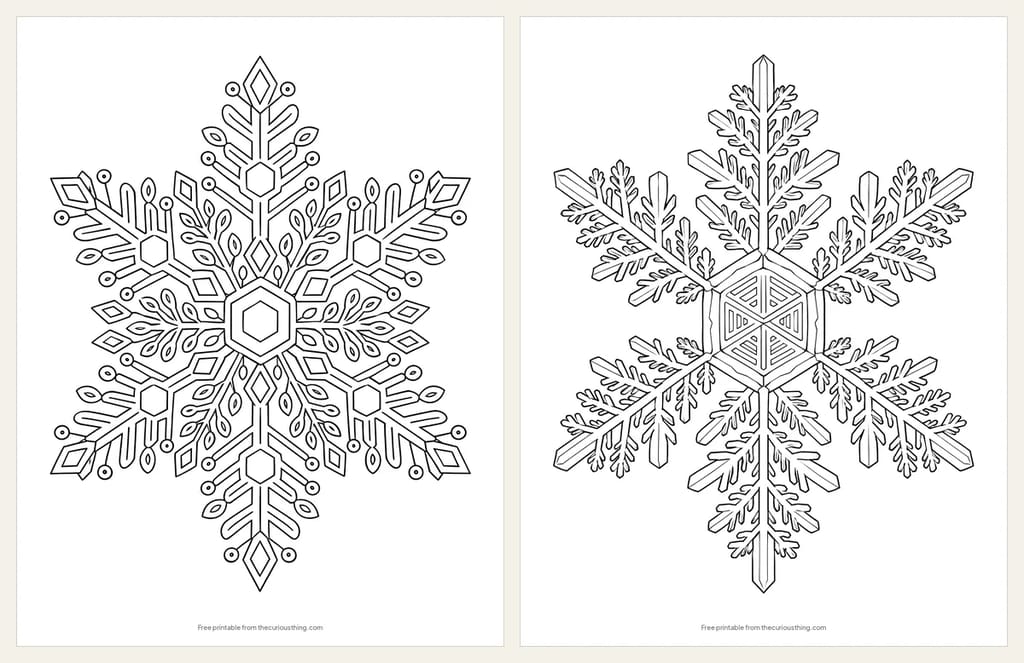
These six snowflake coloring pages go from one huge snowflake for toddlers to a page of snow crystal shapes and a cat at the window, then a snowflake mandala and a real crystal as it looks under a microscope. Every one has six arms, because real snowflakes do: the shape comes from the way water molecules lock together into six-sided ice, and real ones are never eight-sided. On January 15, 1885, Wilson Bentley, a 19-year-old farmer in Jericho, Vermont, took the first photograph of a single snow crystal, and he went on to photograph well over 5,000. In March 1936, Ukichiro Nakaya grew the first snow crystal in a lab in Japan, on a single rabbit hair. The temperature decides the shape: needles grow at about 23°F and flat plates at about 5°F, which is why the "Kinds of snowflakes" page has both.
Are any two snowflakes alike?
The big, branching ones almost certainly never are, says Caltech physicist Kenneth Libbrecht: with about 100 features that can vary, the possible arrangements number nearly a 1 followed by 158 zeros. The tiniest plain crystals, simple six-sided prisms, can look like twins. The star-shaped crystals on greeting cards are typically 2 to 4 millimeters across, about an eighth of an inch, and the fernlike ones can reach 5 millimeters or more. Most falling snowflakes look nothing like that. They are lumpy clumps of many crystals stuck together, says NC State atmospheric scientist Sandra Yuter, and the largest clumps she has photographed falling were about 1.5 inches across. The famous 15-inch snowflake reported in Montana in 1887 has no photograph behind it.
Penguin coloring pages
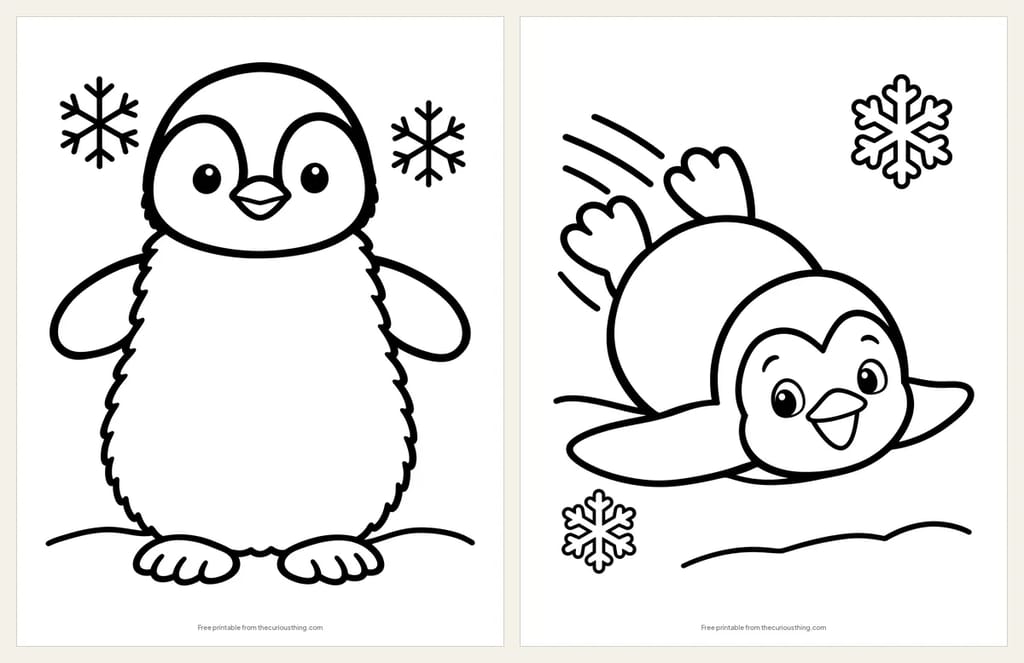
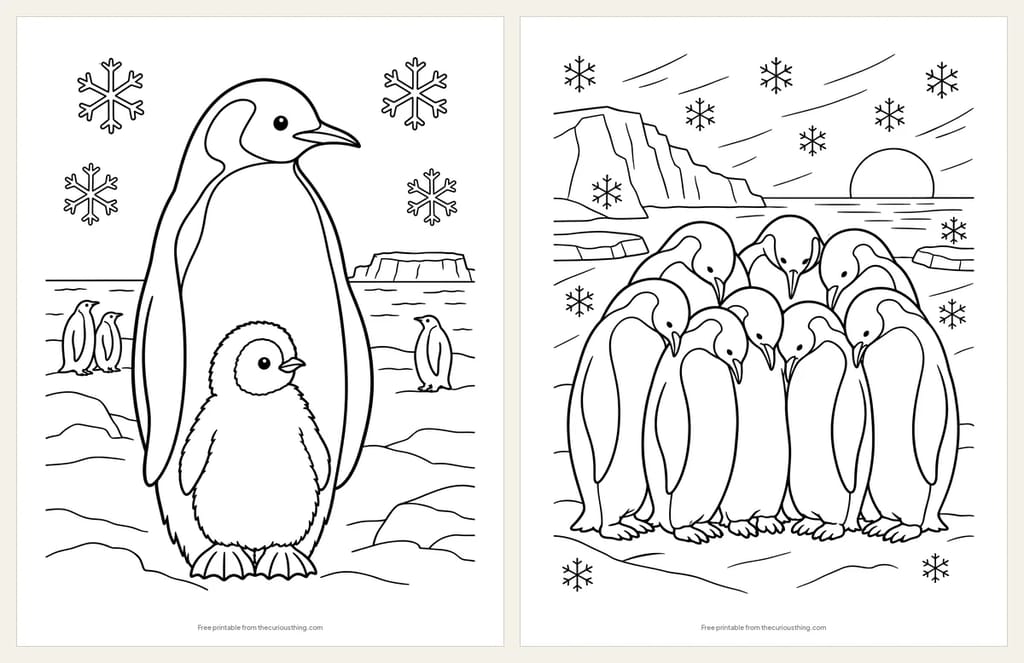
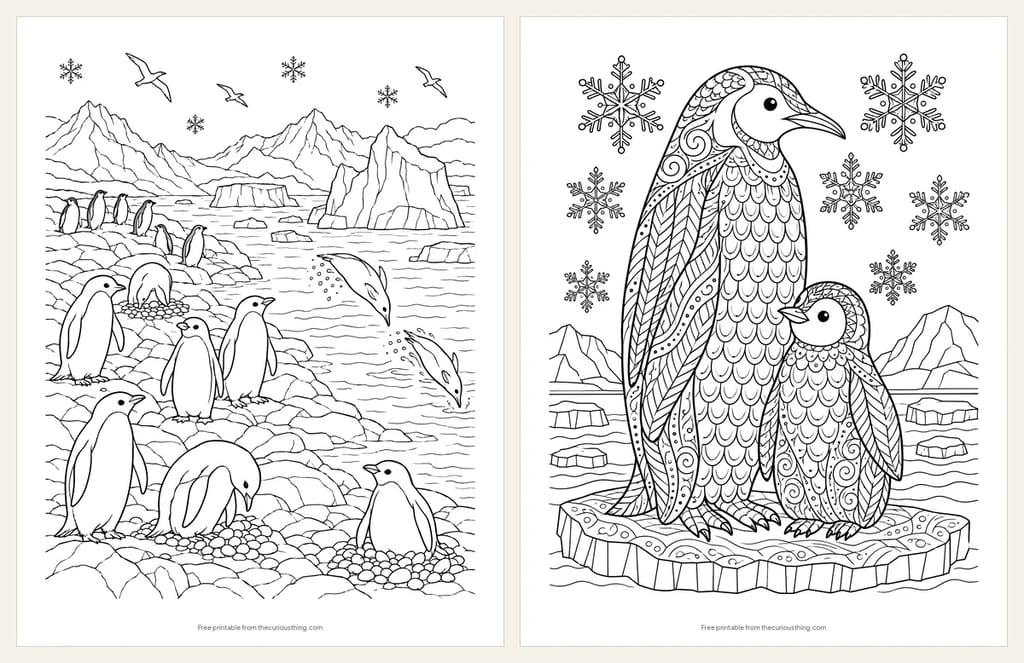
The penguin pages run from a fluffy chick and a belly-sliding penguin for toddlers to an emperor parent with its chick and a huddle, then Adélie penguins on a rocky shore and a patterned pair. Emperor penguins are the only animals that breed through the Antarctic winter. The father holds the egg on his feet under a fold of belly skin for 65 to 75 days, eating nothing, and keeps it at about 100°F while the air outside can drop well below −31°F. The fathers huddle to get through it, taking turns at the windy edge, and the middle of a huddle can reach 75°F. Sliding on the belly is real too: penguins push with their feet and steer with their flippers, which saves energy on long trips across the ice. There are 18 penguin species, by BirdLife International's count, and all of them are native to the Southern Hemisphere; the Galápagos penguin is the only one also found north of the equator. Only the emperor and the Adélie live on Antarctica and nowhere else.
Polar bear and Arctic animal coloring pages
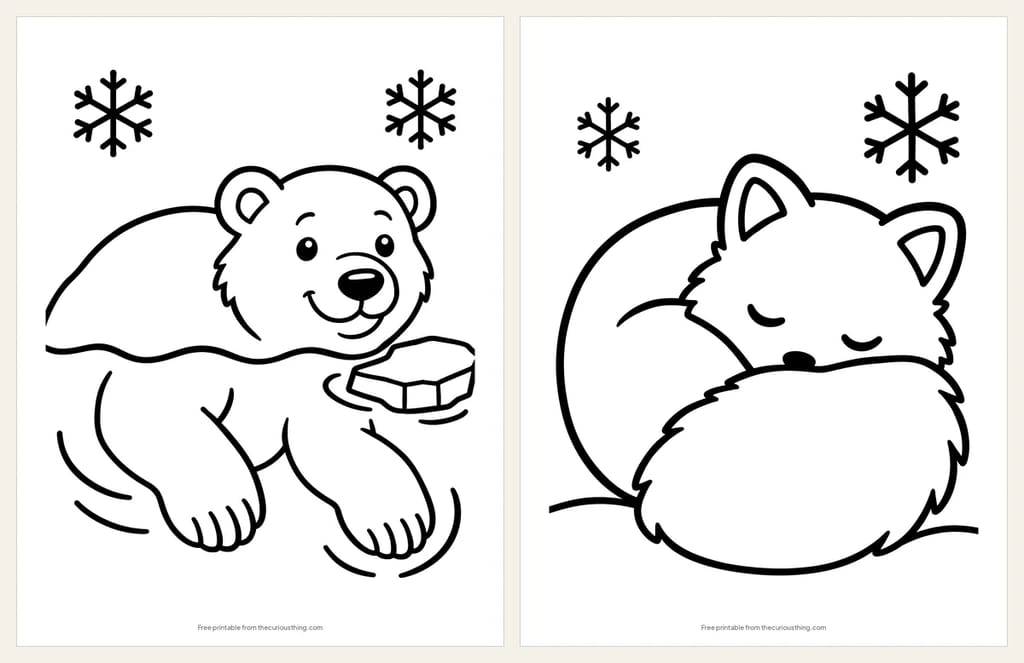
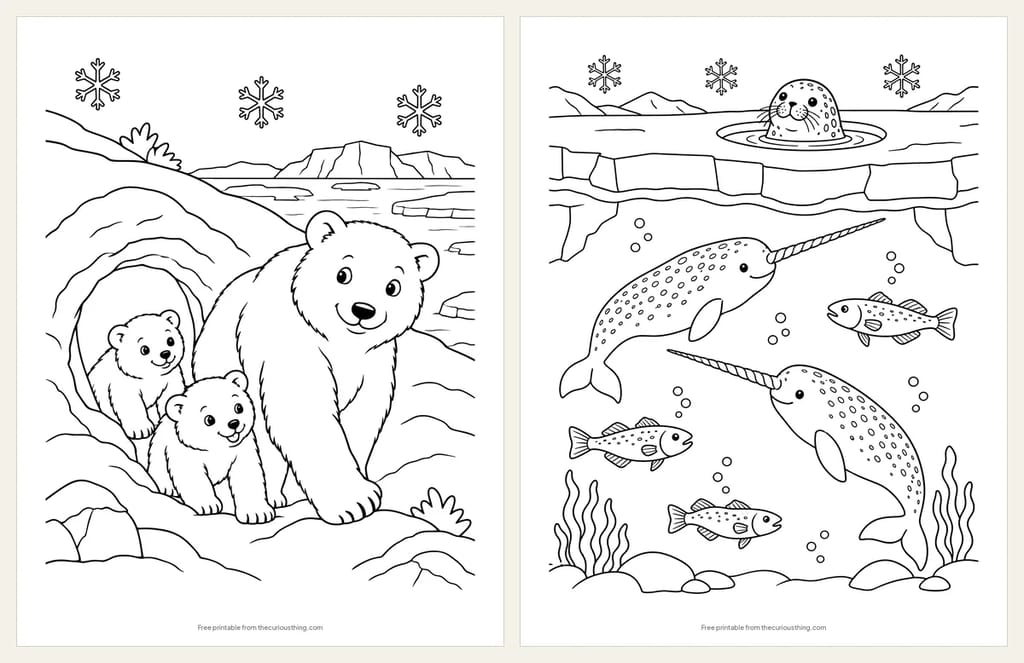
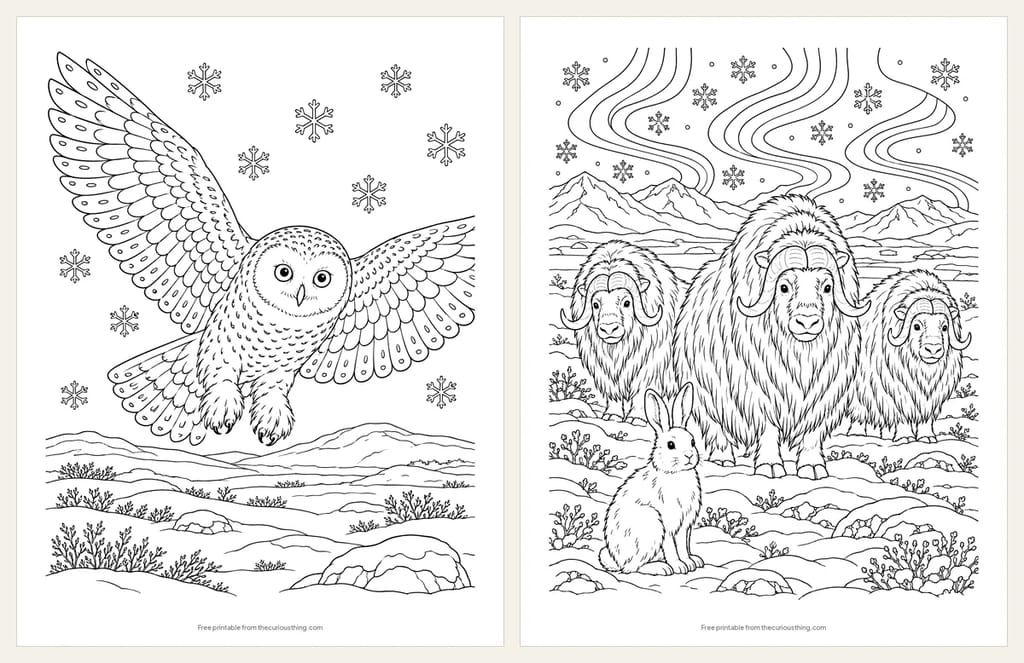
The Arctic pages are a swimming polar bear and a sleeping Arctic fox for toddlers, a polar bear family and narwhals under the ice for ages 4 to 7, and a snowy owl and musk oxen under the northern lights for older colorers. Here's one to tell while coloring the bear: its fur isn't white. Each hair is clear, with a hollow core that scatters light, and the skin underneath is black. Only pregnant females spend the winter in a den, and the cubs, usually twins, are born there in December or January weighing a little more than a pound. They come out in late March or early April at about 20 to 25 pounds, which is the moment on the den page. A white Arctic fox has its full white coat by November and is mostly brown by late June, says Alaska's Department of Fish and Game, while blue-phase foxes stay dark all year. A narwhal's tusk is a tooth, up to 9.8 feet long, and a musk ox's underwool is eight times warmer than sheep's wool.
Winter woodland animal coloring pages
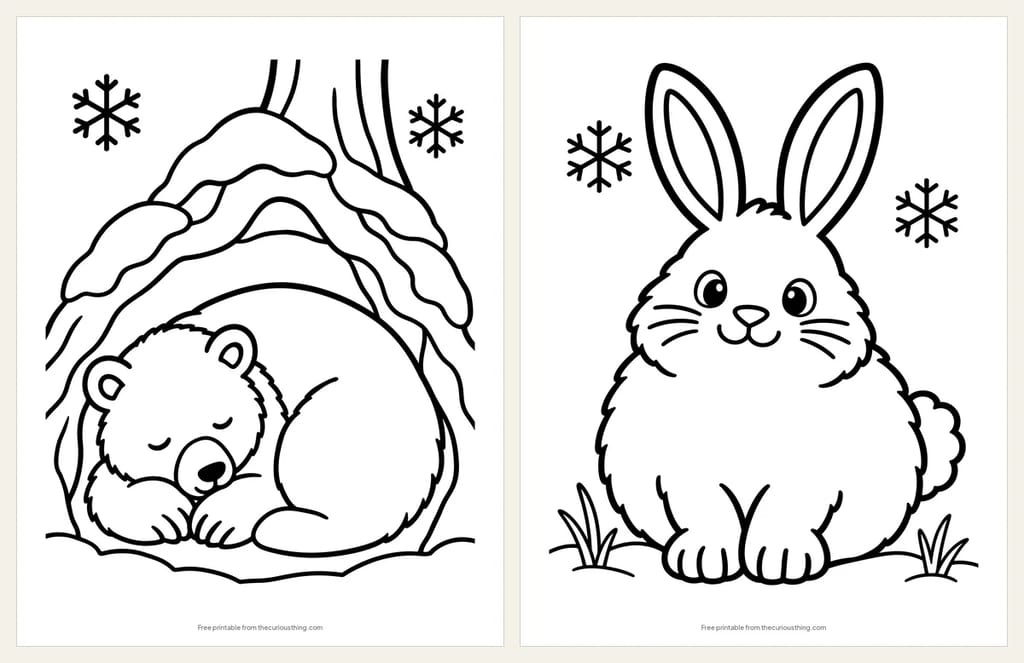
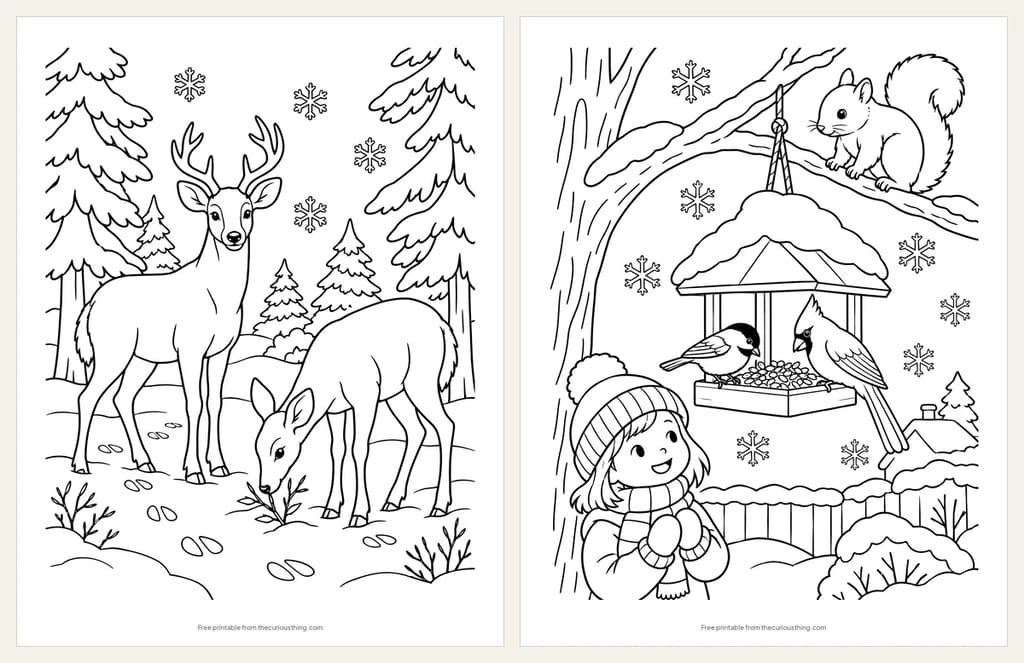
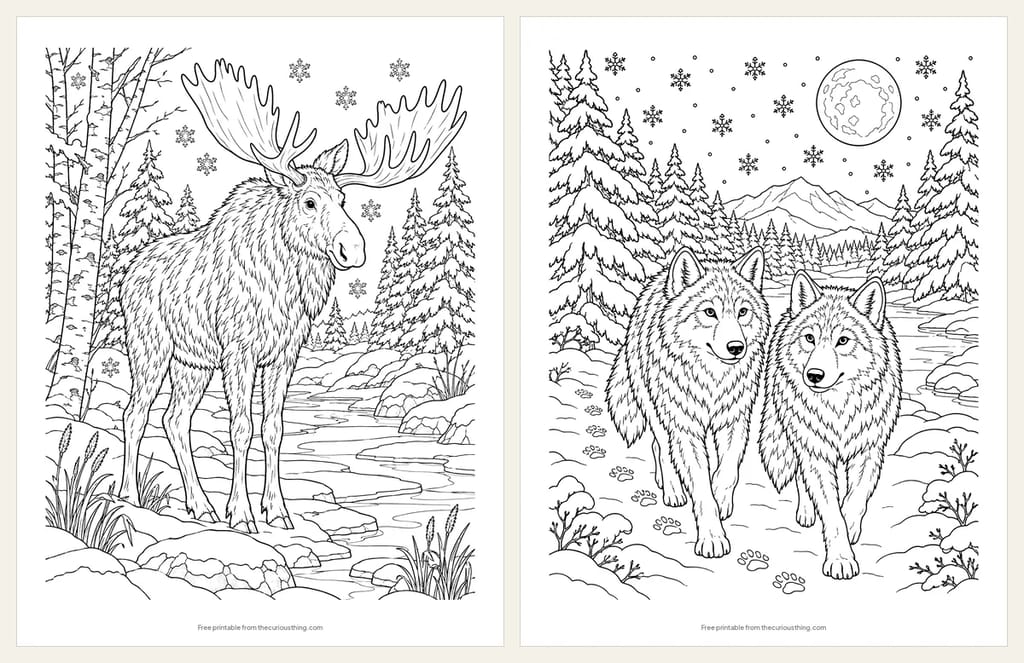
The woodland pages go from a bear asleep in its den and a bunny in the snow to deer in a clearing and a backyard bird feeder, then a moose by a frozen stream and two wolves under the moon. Black bears really do hibernate, just not the way people picture it. A 2011 study in Science found their metabolism drops to a quarter of normal while the body stays fairly warm, 86 to 97°F, and the heart slows from 55 beats a minute to as few as 9. Their cubs are born in the den in midwinter, weighing under half a pound. White-tailed deer drop their antlers in winter, from mid-December to late January in Connecticut and mostly in February and March in Missouri, and moose from November to January, so the moose on these pages still has his and it's probably early winter. Fawns are born in late May and June, which is why there's no spotted fawn in the snow here. Chickadees survive the long nights by letting their body temperature fall 18 to 22°F below their daytime level, and cardinals stay all winter instead of migrating.
Can you turn your child into a coloring page?
Yes, for the snow day when the stack runs out. Our free photo-to-coloring-page tool redraws one photo of your child as a coloring page in a world they pick (a dragon rider, an astronaut, a mermaid and more), with their face kept and everything around them in black outlines. It takes about 20 seconds, needs no account or email, and downloads as a US Letter PDF to print at 100%. The photo is sent once to draw the page and isn't stored, and nothing is used to train AI. It works for a pet or a whole family photo too.
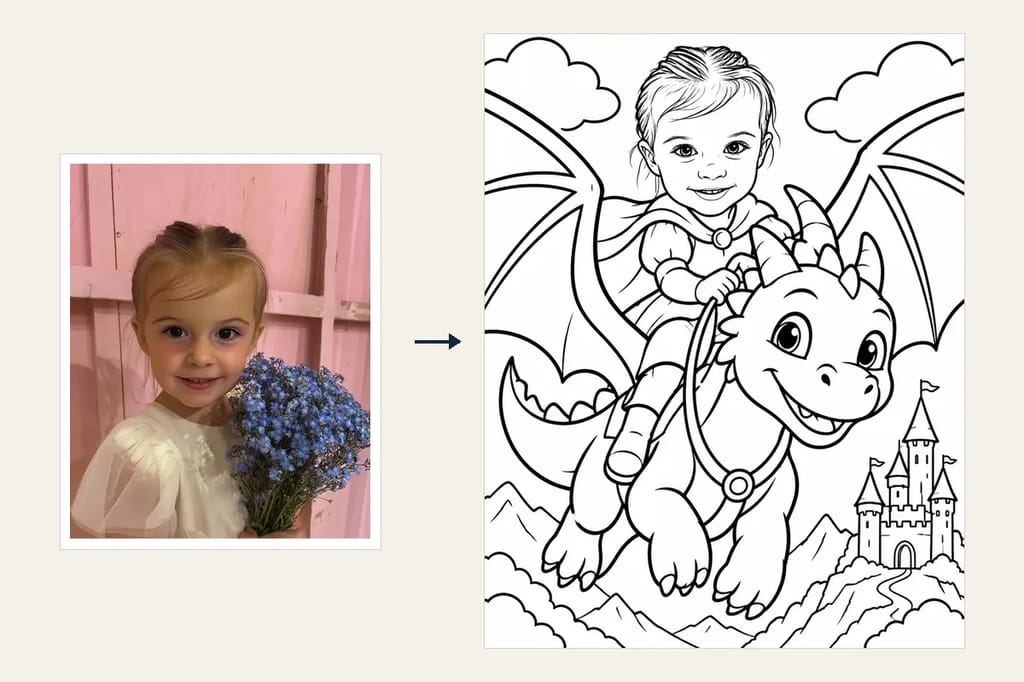
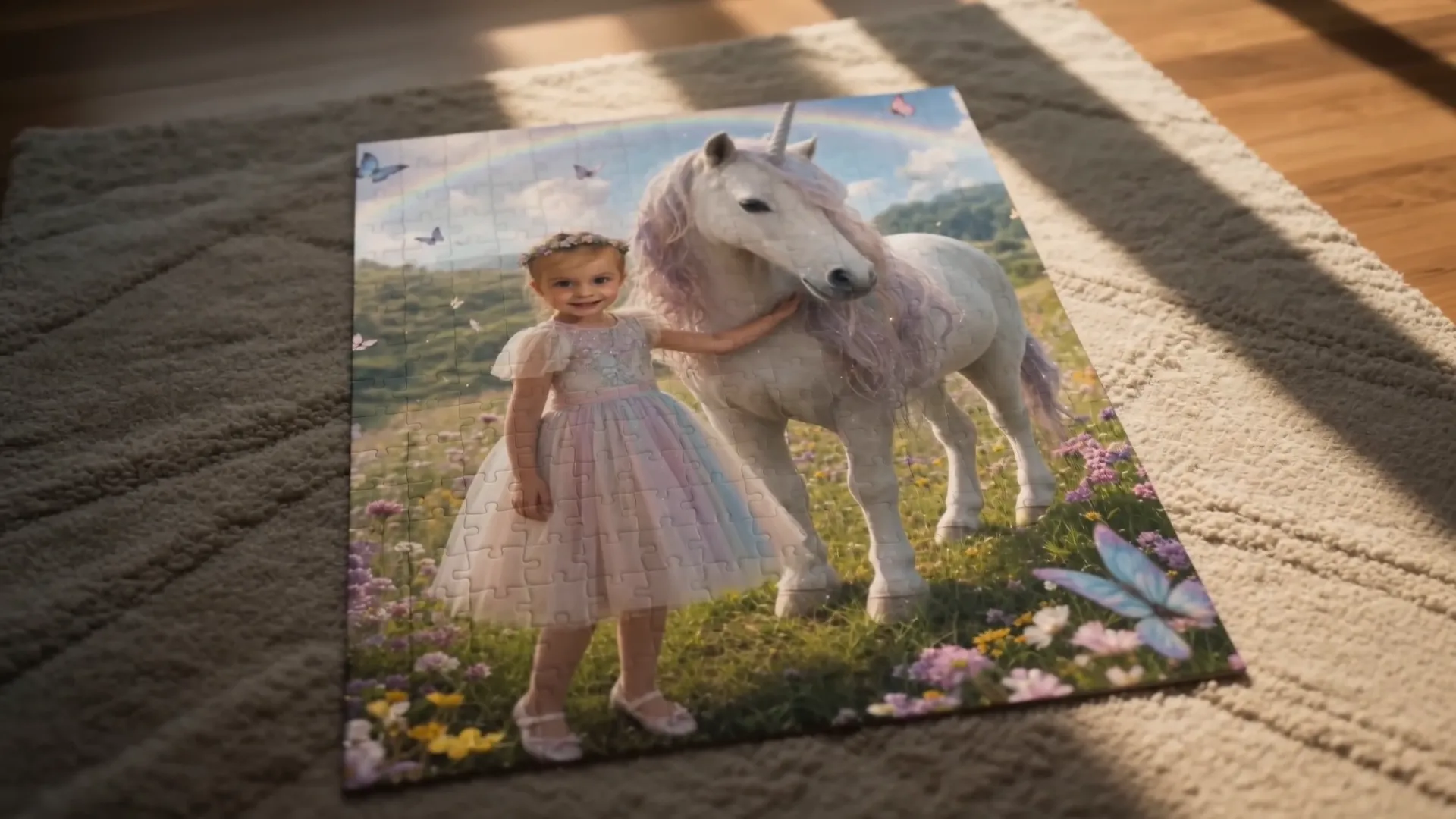
The same worlds come as full-color portraits too: Dragon Kingdom puts your child in the saddle on a jigsaw puzzle, a canvas or a blanket, and you see a watermarked proof before anything prints.
Sledding, skating and snow day coloring pages
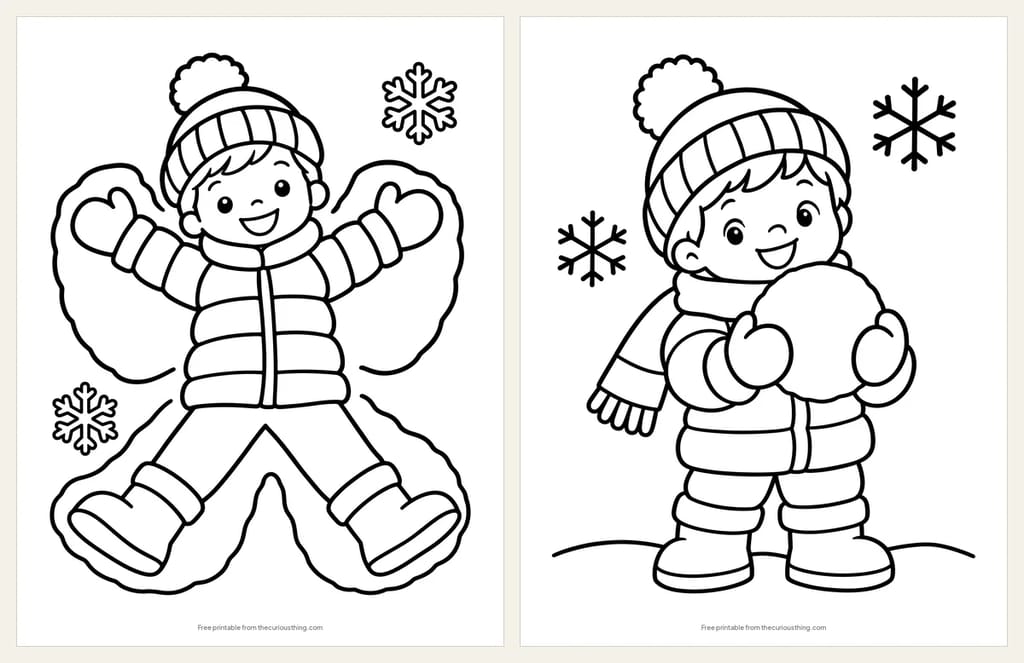
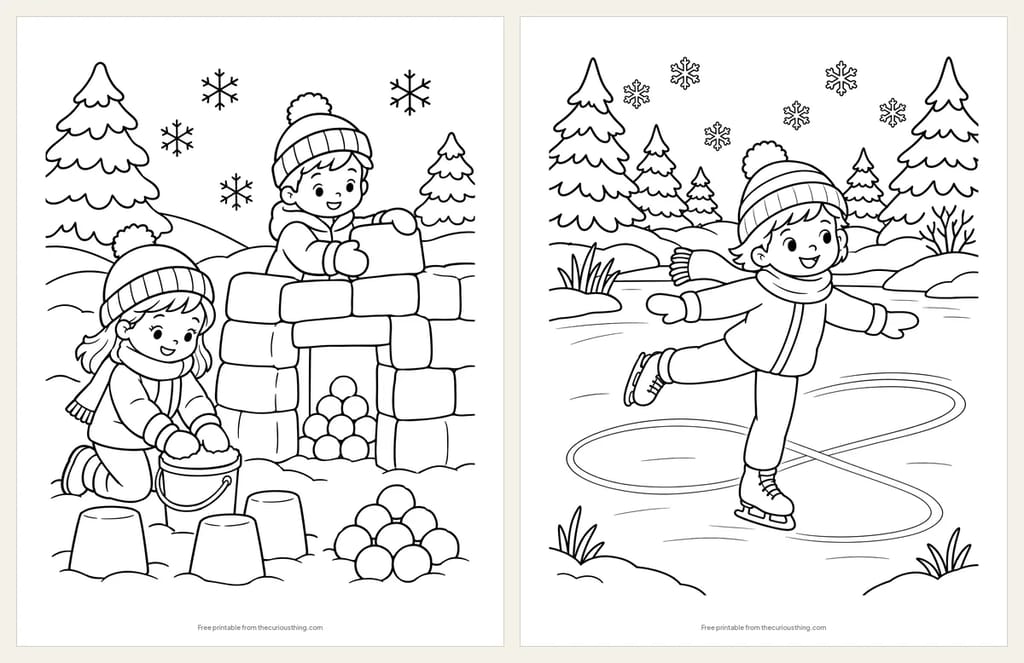
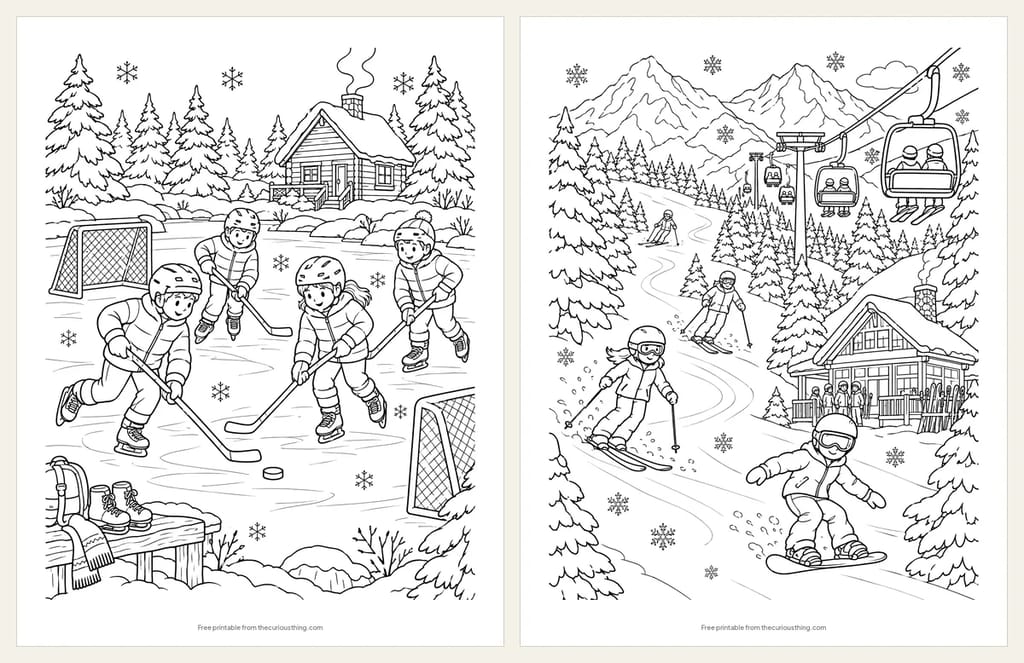
These six snow day pages go from a snow angel and a snowball for toddlers to a snow fort and a skater, then pond hockey and a ski slope for older colorers. People have skated for thousands of years: when researchers tested a bone skate design dated to about 1800 BC against modern skates, modern skating took a quarter of the energy and went four times as fast for the same effort. In the 1170s, a London writer, William Fitz Stephen, described young people tying animal shinbones to their feet and pushing off with iron-tipped sticks, "as swift as a bird in flight". Skates don't glide because their weight melts the ice, either: the pressure lowers the melting point only a few degrees. A thin, liquid-like layer on the ice's surface and the heat from friction do the work. The game the International Ice Hockey Federation recognizes as the first organized ice hockey game was played at Montreal's Victoria Skating Rink on March 3, 1875, with "a flat circular piece of wood" in place of a ball. And "toboggan" most likely comes from the Mi'kmaq or Maliseet language.
Is sledding safe for young children?
Mostly, with a few rules. The American Academy of Pediatrics says riding feet first or sitting up, instead of lying down head first, may prevent head injuries, and that children under 12 should always be supervised. It suggests considering a helmet, choosing steerable sleds over snow disks and inner tubes, and picking slopes of less than 30 degrees that end in a flat runoff. Nemours KidsHealth is firmer on the position: sit facing forward with your feet downhill, and never go down face first.
Hot cocoa, mitten and cozy winter coloring pages
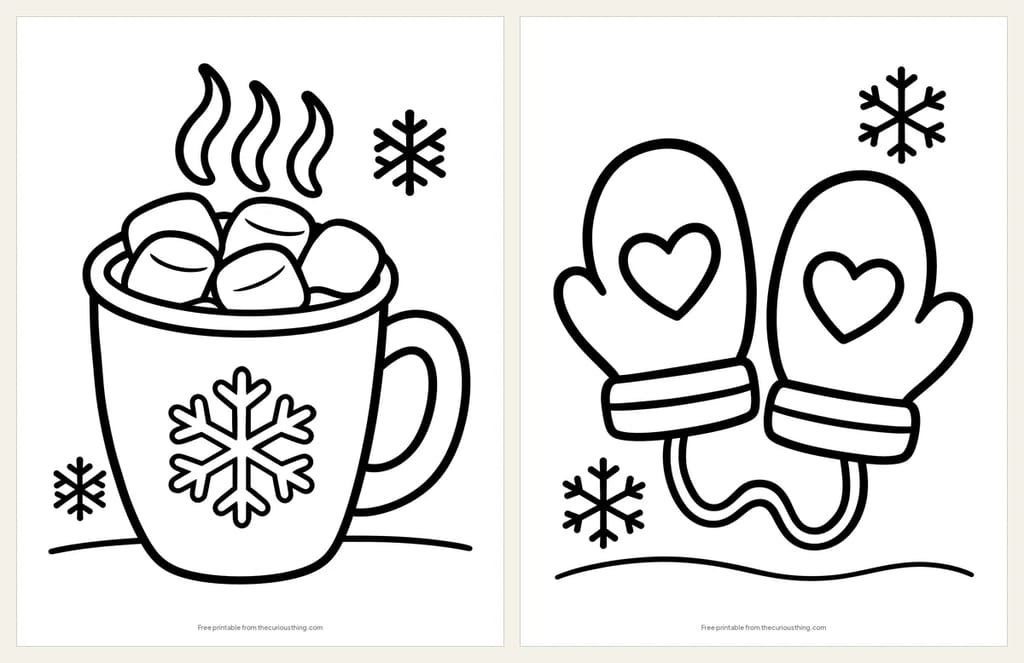
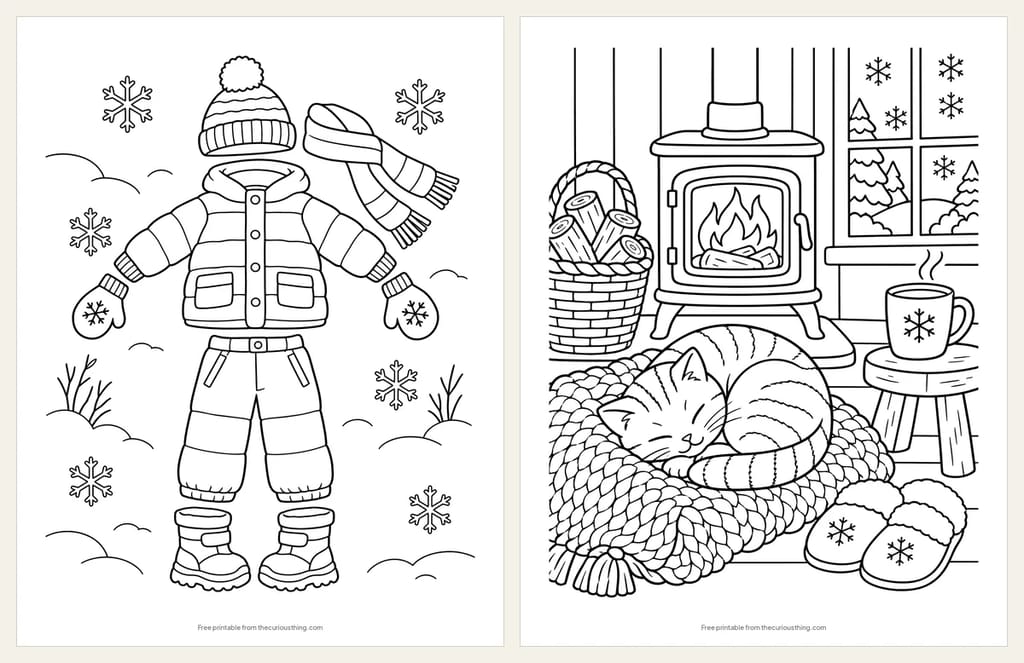
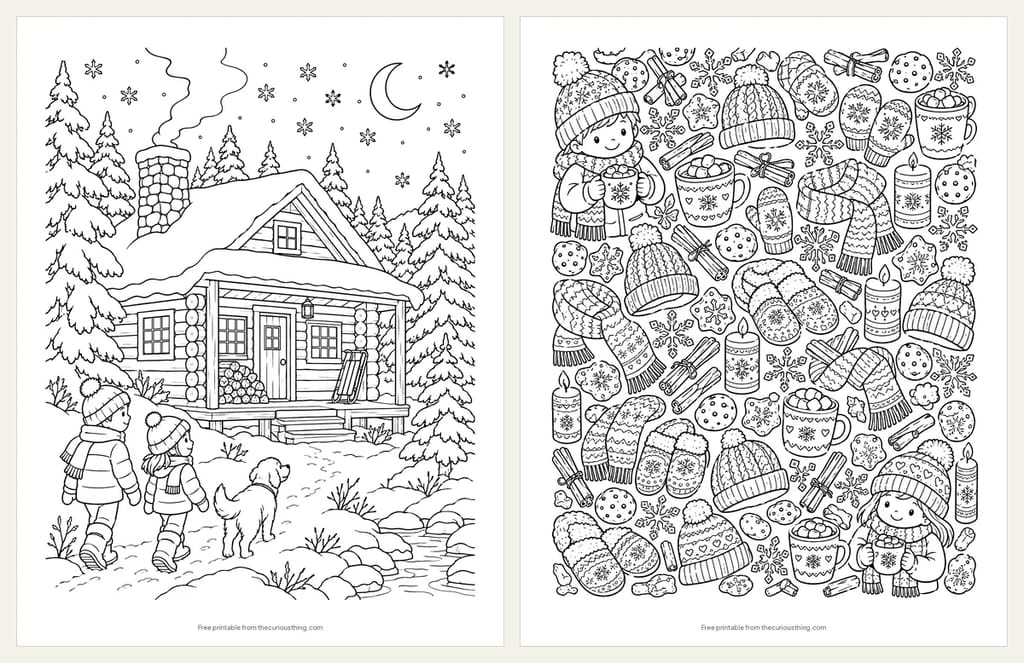
The cozy pages are a mug of cocoa and a pair of mittens for toddlers, a child's snow clothes and a cat by the stove for ages 4 to 7, and a cabin in the woods and a pattern page of cozy things for older colorers. The earliest evidence of people using cacao comes from Ecuador's upper Amazon, about 5,300 years ago. The Maya painted the word kakaw on their cups, and pictures on those cups show the drink topped with foam. The foam came from pouring it from one vessel to another, and unlike today's cocoa it was "somewhat bitter": the Penn Museum lists chili, corn, honey, flowers and vanilla among the flavorings. Marshmallows are named for a plant, the marsh mallow, whose root was used for sore throats; the candy is a 19th-century French invention, later made with gelatin. And the mittens are the right call. The National Weather Service says mittens, snug at the wrist, are better than gloves. Fingers kept together in one space, with less surface to lose warmth from, lose less heat.
New Year's coloring pages
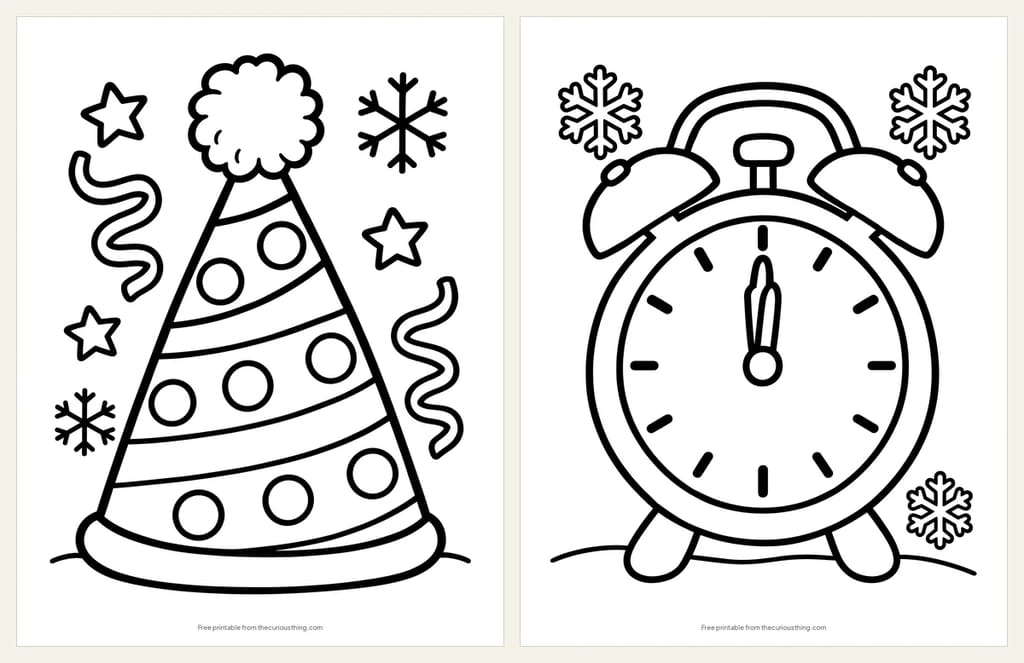
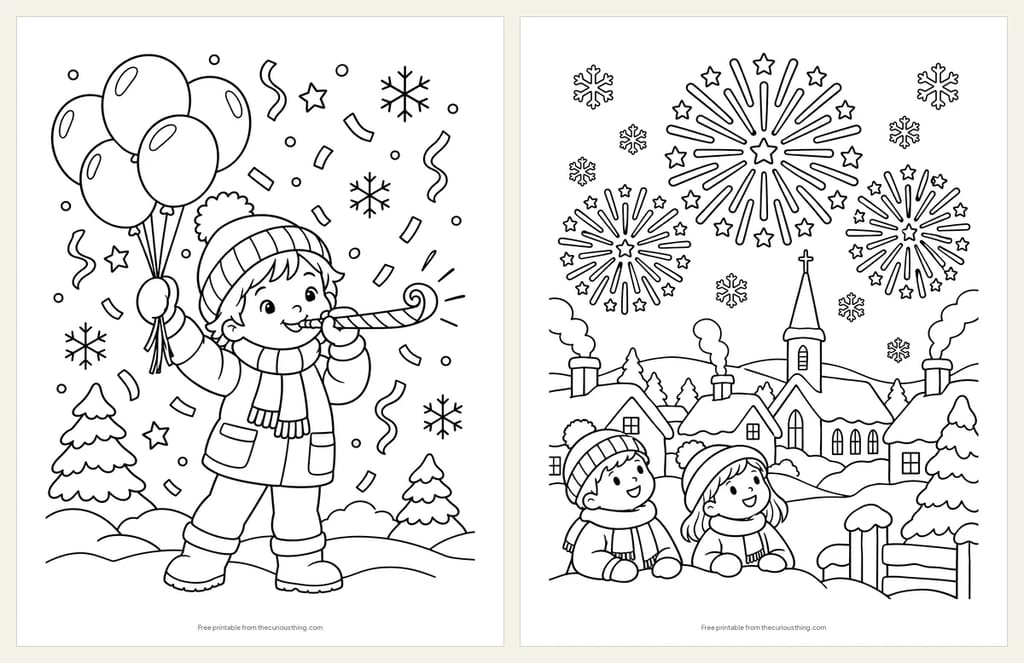
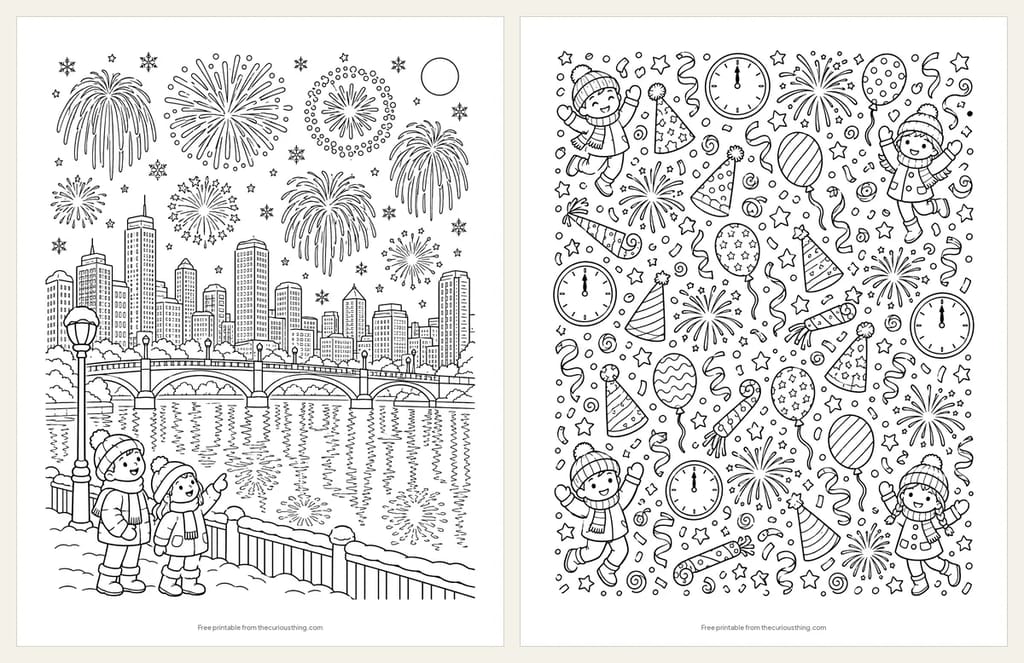
The New Year's pages are a party hat and a clock at midnight for toddlers, a party horn and fireworks over a snowy town for ages 4 to 7, and a city's fireworks and a celebration pattern for older colorers. None has a year written on it, so they work every January. The first ball came down in Times Square on New Year's Eve 1907: it was iron and wood, 5 feet across, weighed 700 pounds and carried one hundred 25-watt bulbs, says the Times Square Alliance. Dropping a ball to mark the time is older still: the time ball at Greenwich was first used in 1833, and on a normal day it still drops at exactly 1 p.m., a time signal for ships on the Thames. In Spain, people eat one grape for each of the 12 strokes of the midnight clock in Madrid. In Japan, temple bells ring 108 times, and at Chion-in in Kyoto it takes a team of seventeen monks to strike the bell. "Auld lang syne", from the Robert Burns song, means roughly "old long since", so the chorus is a toast to old times.
Groundhog Day and Lunar New Year coloring pages
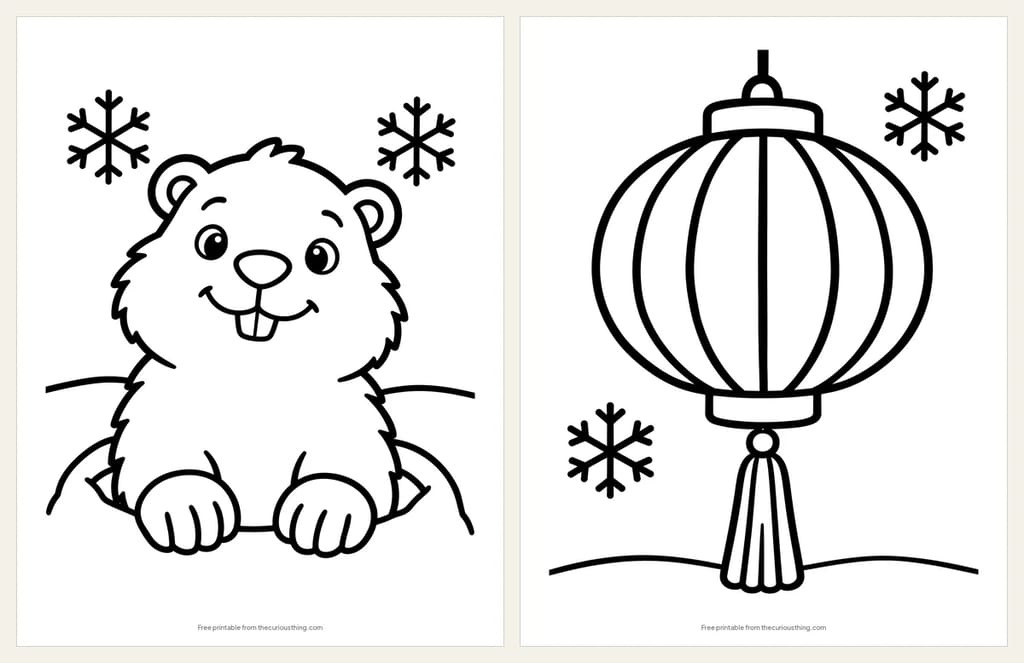
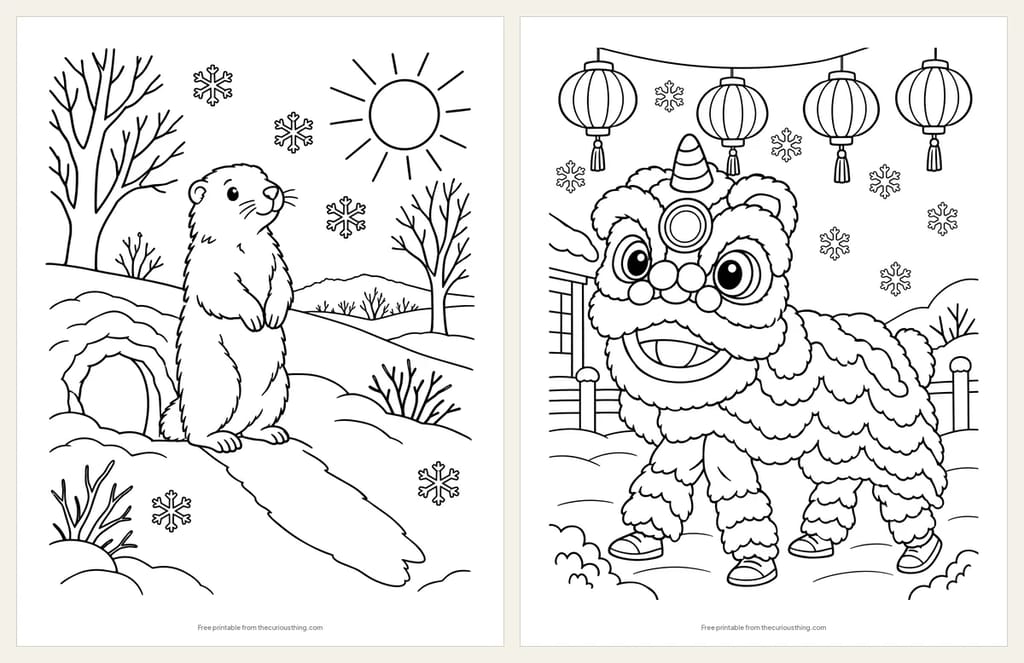
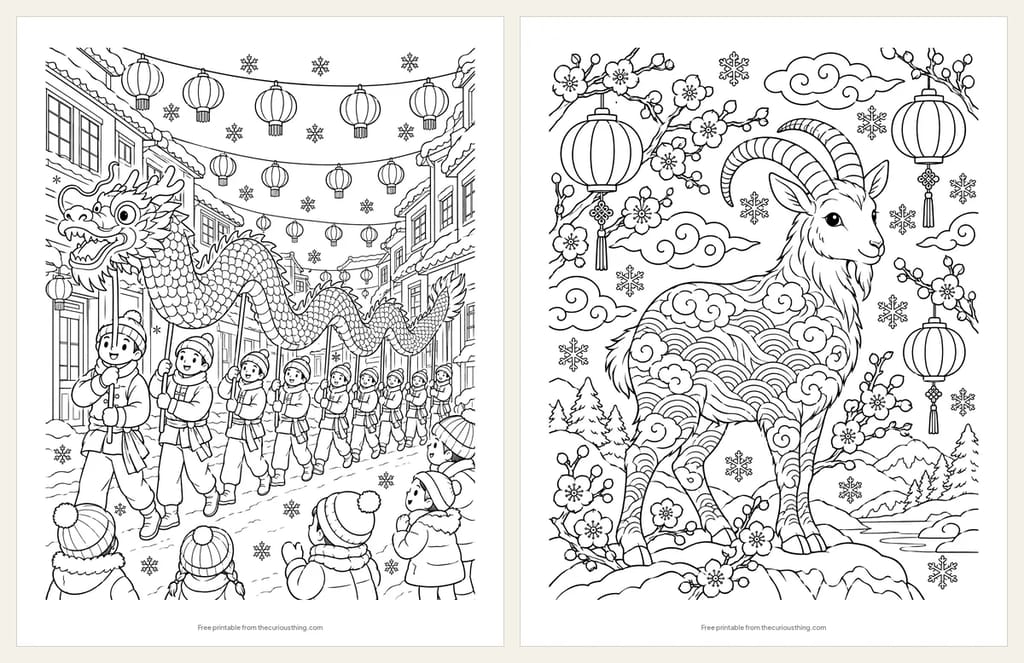
This last section covers the two big February days: a groundhog and a lantern for toddlers, a groundhog with its shadow and a lion dance for ages 4 to 7, and a dragon dance and a Year of the Goat page for older colorers. Groundhog Day is February 2. The Punxsutawney celebration traces to 1887, and its roots are older: in German-speaking Europe the weather animal was a badger, and German settlers in Pennsylvania swapped in the groundhog. NOAA keeps score, and found that Phil was right 30% of the time over the past ten years. Lunar New Year 2027 falls on Saturday, February 6, and begins the Year of the Goat. The zodiac's character covers both goats and sheep, so you'll see it drawn as either. The lion and the dragon on these pages are different dances: a lion takes two dancers, one at the head and one at the back legs, while a dragon is carried on poles by a dozen or more. On the 15th day, February 20, the Lantern Festival ends the celebration.
When does winter start, and which page goes with which day?
By the astronomers' calendar, winter starts at the December solstice, which in 2026 falls on Monday, December 21, at 3:50 p.m. Eastern, and ends at the March equinox on March 20, 2027, by the US Naval Observatory's 2026 and 2027 tables. Weather forecasters count it differently: for them, winter is simply December, January and February, the three coldest months. Winter isn't cold because Earth is far from the sun, either. Earth is actually closest to the sun in early January, about 91.4 million miles away; the cold comes from the Northern Hemisphere tilting away from it, so the sun's rays reach it less directly. For a class or a fridge door, here's when each section fits.
| Date | What happens | Pages to print |
|---|---|---|
| Dec 21, 2026 | Winter solstice, the shortest day | Snowflakes, snowmen, snow day |
| Dec 31 to Jan 1 | New Year's Eve and New Year's Day | New Year's |
| Jan 2 to 3, 2027 | Earth at its closest to the sun (evening of Jan 2, Eastern time) | Penguins, polar bears, cocoa and mittens |
| Feb 2, 2027 | Groundhog Day | Groundhog pages |
| Feb 6, 2027 | Lunar New Year, the Year of the Goat | Lantern, lion dance, dragon dance, goat |
| Feb 20, 2027 | Lantern Festival | Lantern |
| Mar 20, 2027 | Spring equinox, the end of winter | Woodland animals, the last snowman |
Solstice, perihelion and equinox times from the US Naval Observatory; Lunar New Year and Lantern Festival dates from the Hong Kong Observatory. For Valentine's Day, our Valentine jokes for kids go in the lunchbox.
What do most winter coloring pages get wrong?
A few mistakes turn up again and again in winter pictures and in the stories told with them: penguins beside polar bears, snowflakes with eight points, a spotted fawn in the snow. Some come from old stories rather than from what scientists have found. Here's what the sources say instead.
| What the page or story says | What the evidence shows |
|---|---|
| A penguin and a polar bear on the same ice | Polar bears live in the Arctic and penguins in the south; the two never meet outside a zoo |
| Snowflakes with eight (or five) points | Snow crystals are six-sided and never eight-sided |
| Penguins all live in Antarctica | Most species never set foot there; some live on warm coasts |
| Polar bears are white all the way through | Their hairs are clear and their skin is black |
| Bears don't really hibernate | Black bears do: metabolism falls to a quarter of normal while the body stays fairly warm |
| A spotted fawn in the snow | Fawns are born in late May and June and lose their spots by about the end of August |
| Skates glide because their pressure melts the ice | Pressure lowers the melting point only a few degrees; a liquid-like surface layer and friction do the work |
| Winter is cold because Earth is far from the sun | Earth is closest to the sun in January; the tilt of its axis makes winter |
| The groundhog knows | NOAA found Phil right 30% of the time over ten years |
| Spain's twelve grapes began with a grape surplus in 1909 | A Madrid paper mentions the custom in 1893 |
Frequently asked questions
Are these winter coloring pages free?
+
Yes. All 54 are free to print, with no email, account or sign-up. Tap a page's title to open the full-size file and print it at 100% or Actual size on US Letter paper. Print as many as you like for home or a classroom; please don't sell them.
What age are winter coloring pages for?
+
Every subject here comes at three levels. Easy pages, one big shape in thick lines, suit ages 2 to 4. Medium pages, the subject in a simple scene, suit ages 4 to 7. Detailed pages, realistic or full of patterns, suit ages 8 to adult. Treat the ages as a starting point and let your child pick.
Are there winter coloring pages that aren't Christmas?
+
Yes, all of these. There's no Santa, no reindeer, no decorated tree and no stocking on any of the 54 pages, so they work through January and February and in classrooms that keep holidays out. If you do want Christmas, our Christmas coloring pages have Santa, elves and the Nativity.
Can I print these for my classroom?
+
Yes. Print as many copies as your class, daycare or library needs. Each page opens directly as a picture file, with no cloud drive or sign-in, and the dates table shows which pages fit Groundhog Day, Lunar New Year and New Year's. We only ask that you don't sell them.
Will these print on A4 paper?
+
Yes. The pages are sized for US Letter, 8.5 by 11 inches. On A4, which is a little narrower and a little longer, choose Fit or Fit to printable area in the print settings, and the page shrinks by a few percent with nothing cut off.
How many points does a snowflake have?
+
Six. Water molecules freeze into six-sided ice, so a snow crystal grows six arms or six sides, and real ones are never eight-sided. Some twinned crystals show twelve. Every snowflake on these pages has six, so your child can count them.
Do penguins and polar bears live together?
+
No. Polar bears live around the Arctic, at the top of the world, and penguins live in the Southern Hemisphere, from Antarctica to the coasts of South America, Africa, Australia and New Zealand; only the Galápagos penguin is also found north of the equator. Outside a zoo they never meet, which is why they have separate sections here.
Can I make a winter coloring page of my child?
+
You can make a coloring page of your child, your pet or your whole family with our free photo-to-coloring-page tool. Upload one photo, pick a world such as Dragon Kingdom or Space, and the page is ready in about 20 seconds. It needs no email, and the photo isn't stored.
Make them a coloring book for the snow days
One photo of your child, your pet or the family, drawn into 24 worlds and printed as an 8.5 by 11 inch softcover for $34. See the cover and two pages free first, swap any world you don't want, and approve every page before anything prints.