In short
The most common canvas sizes in the US are 8 by 10, 11 by 14, 16 by 20, 18 by 24, 24 by 36 and 30 by 40 inches, plus squares from 12 by 12 up. Most of them fall into four shapes: 4:5 (8 by 10, 16 by 20, 24 by 30), 3:4 (12 by 16, 18 by 24, 30 by 40), 2:3 (12 by 18, 20 by 30, 24 by 36) and square. Pick the shape that matches your photo so nothing gets cropped, then pick the size from the wall: over a sofa or bed, the art should span about two-thirds of the furniture's width, with its center about 57 inches from the floor on an open wall.
Canvas size charts usually stop at a list of dimensions. That list is the easy part. The two questions that decide whether a canvas looks right are whether your photo's shape matches the canvas's shape, and whether the canvas is big enough for the wall it's going on. This guide covers both: every common size in inches and centimeters, sorted by shape, the pixels each size needs, and the measurements for a sofa, a bed, a hallway or a desk.
What are the standard canvas sizes?
Standard canvas sizes run from 5 by 5 inch minis up to 36 by 48 inches and beyond, and they fall into four rough bands. The table below uses the bands most US print shops use, including Tribeca Printworks' guide to common print dimensions, with the metric size and the shape of each.
| Band | Inches | Centimeters | Shape | Typical spot |
|---|---|---|---|---|
| Mini | 5 × 5, 6 × 6 | 12.7 × 12.7, 15.2 × 15.2 | Square | A shelf or windowsill |
| Small | 8 × 10 | 20.3 × 25.4 | 4:5 | A desk, a nightstand, a grouping |
| Small | 11 × 14 | 27.9 × 35.6 | 11:14 | A narrow wall, a hallway |
| Small | 12 × 12 | 30.5 × 30.5 | Square | Pairs and grids |
| Medium | 16 × 20 | 40.6 × 50.8 | 4:5 | A console, a bedroom wall |
| Medium | 18 × 24 | 45.7 × 61.0 | 3:4 | A console, a hallway end wall |
| Medium | 20 × 24 | 50.8 × 61.0 | 5:6 | A dresser |
| Large | 24 × 30 | 61.0 × 76.2 | 4:5 | A loveseat, a sideboard |
| Large | 24 × 36 | 61.0 × 91.4 | 2:3 | A loveseat or a bed, landscape |
| Large | 30 × 40 | 76.2 × 101.6 | 3:4 | A queen bed or a loveseat, landscape |
| Oversized | 36 × 48 | 91.4 × 121.9 | 3:4 | A 72-inch sofa or a king bed, landscape |
Size bands after Tribeca Printworks; ratio groupings after Austin Gallery. Centimeters rounded to one decimal place. The "typical spot" column applies the furniture rule further down.
Sizes are written short side first, and a vertical (portrait) canvas and a horizontal (landscape) one are the same size turned 90 degrees. So a 24 by 36 is the same canvas whether it hangs tall beside a door or long over a sofa.
Canvas sizes by aspect ratio
The shape of a canvas matters more than its size, because the shape decides whether your photo fits it without cropping. To find a canvas's ratio, divide both sides by their largest common factor: 16 by 20 divides by 4 to give 4:5, 18 by 24 divides by 6 to give 3:4, and 24 by 36 divides by 12 to give 2:3. Two canvases with the same ratio are the same shape at different sizes, so a picture that fits an 8 by 10 also fits a 16 by 20 or a 24 by 30 exactly, but not an 18 by 24.
| Ratio | Short side ÷ long side | Sizes in this family | Matches |
|---|---|---|---|
| Square (1:1) | 1.00 | 8 × 8, 10 × 10, 12 × 12, 16 × 16, 20 × 20, 24 × 24, 30 × 30, 36 × 36 | A square crop |
| 4:5 | 0.80 | 8 × 10, 16 × 20, 24 × 30, 32 × 40 | 8 × 10 photo prints, Instagram portrait posts |
| 3:4 | 0.75 | 9 × 12, 12 × 16, 18 × 24, 30 × 40, 36 × 48 | Phone photos at the default setting |
| 2:3 | 0.67 | 4 × 6, 12 × 18, 20 × 30, 24 × 36 | DSLR and mirrorless camera photos |
| 11:14 | 0.79 | 11 × 14 | Close to 4:5; a slight crop either way |
Families after Austin Gallery's ratio chart. Camera ratios from Adobe and Photography Life.
11 by 14 is the odd one out. It's a standard frame and canvas size with no common factor at all, sitting between 4:5 and 3:4, so most photos lose a sliver on one side or the other.
What canvas size fits a phone photo?
A 3:4 canvas: 12 by 16, 18 by 24 or 30 by 40. Smartphones shoot in a 4:3 ratio, Adobe's aspect ratio guide notes, and Photography Life confirms most phone cameras are 4:3 natively, even though the screens are much taller. Held upright, that's a 3:4 portrait, which fills those canvases with no crop at all. Photos from a full-frame or APS-C camera are 3:2, so they fit the 2:3 family (12 by 18, 20 by 30, 24 by 36) instead.
On a canvas of a different shape, the printer trims the photo to fit. A 3:4 phone photo on a 4:5 canvas such as a 16 by 20 loses about 6 percent of its height, which is a little sky or floor. A 2:3 camera photo on the same 16 by 20 loses about 17 percent, enough to clip the top of a head in a tight portrait. On an 11 by 14, the phone photo loses about 5 percent. A photo shot with space around everyone survives any of these trims; one framed edge to edge doesn't. More on that in how to pick the best photo.
How many pixels does each canvas size need?
About 150 pixels per inch for a canvas seen from across a room, and 300 for one seen up close. 365Canvas gives 150 as enough for larger canvases viewed from a distance and 300 for small ones viewed close, and Saxon Print says canvas texture lets some images print well down toward 180. Distance is the reason: the Picto print lab's viewing-distance chart halves the needed resolution each time viewing distance doubles, from 300 at 25 centimeters to 150 at 50.
| Canvas (in) | At 150 ppi (across a room) | At 300 ppi (up close) |
|---|---|---|
| 8 × 10 | 1,200 × 1,500 | 2,400 × 3,000 |
| 11 × 14 | 1,650 × 2,100 | 3,300 × 4,200 |
| 16 × 20 | 2,400 × 3,000 | 4,800 × 6,000 |
| 18 × 24 | 2,700 × 3,600 | 5,400 × 7,200 |
| 24 × 30 | 3,600 × 4,500 | 7,200 × 9,000 |
| 24 × 36 | 3,600 × 5,400 | 7,200 × 10,800 |
| 30 × 40 | 4,500 × 6,000 | 9,000 × 12,000 |
Pixels = inches × pixels per inch. These figures cover the face of the canvas; a wrapped edge needs extra image on every side, which the print shop's template adds.
A 12-megapixel phone photo is 4,032 by 3,024 pixels. At 150 pixels per inch that covers about 20 by 27 inches, so it handles an 18 by 24 canvas on a living room wall. At 300 it covers about 10 by 13, the right size for a desk. Upscaling adds pixels, not detail, so start from the original file rather than a screenshot.
What size canvas goes above a sofa?
Art over a sofa should span about two-thirds of the sofa's width. That's the two-thirds rule Apartment Therapy credits to designer Emily Henderson, and Better Homes & Gardens gives the same figure; some designers stretch it to three-quarters. The typical three-seat sofa is about 84 inches wide, so it wants art about 56 inches across, which is wider than any single standard canvas in a portrait orientation.
| Sofa width | Art width (2/3 to 3/4) | One canvas that fits | Or a group |
|---|---|---|---|
| 60 in (loveseat) | 40–45 in | 30 × 40 landscape | Two 18 × 24 portraits |
| 72 in | 48–54 in | 36 × 48 landscape | Two 24 × 30 portraits |
| 84 in (three-seat) | 56–63 in | 40 × 60 landscape | Three 18 × 24 portraits |
| 96 in | 64–72 in | An oversized custom size | Three 20 × 24 portraits |
Group widths include 3-inch gaps between canvases: two 18 × 24 portraits come to 39 inches, two 24 × 30 to 51, three 18 × 24 to 60 and three 20 × 24 to 66. The 2/3 to 3/4 range is a guide, not a cutoff; a group an inch or two under it still reads as balanced.
Hang the bottom edge 8 to 10 inches above the sofa back, which is where Better Homes & Gardens puts it. For a group, measure the whole arrangement edge to edge and treat it as one piece. Keep the gaps between canvases small and even, 2 to 3 inches for a tight row, so the group reads as one shape.
What size canvas goes above a bed?
The same two-thirds rule, measured against the bed. Use the headboard's width if it's wider than the mattress, and the mattress if there's no headboard. Against standard mattress widths, that works out to roughly 25 inches over a 38-inch twin, 36 over a 54-inch full, 40 over a 60-inch queen and 51 over a 76-inch king.
For a child's twin bed, a single 18 by 24 canvas hung landscape or a 24 by 30 hung upright is about right. For a queen, a 30 by 40 landscape or a pair of 18 by 24 portraits with a 3-inch gap (39 inches across) fits the span. For a king, go to 36 by 48 landscape or three 16 by 20 portraits in a row (54 inches). Above a bed, hang the canvas so its bottom edge clears the headboard, and fix it securely, since it hangs over someone's head.
How high should you hang a canvas?
Put the center of the canvas 57 inches from the floor. That's the height Framebridge recommends and the standard Apartment Therapy describes as the average human eye height used by galleries and museums. Some galleries use up to 60; the Alberta University of the Arts hanging guide works from 58. A group is centered the same way.
The math is short. Halve the canvas's height and add it to 57 to find the top edge. A 16 by 20 hung upright has its top edge at 67 inches and its bottom at 47. Then measure from the top of the canvas down to the hanging wire or bracket and set the hook that far below the top-edge mark.
Two exceptions. In a hallway, where people walk past close up, Framebridge suggests 60 to 66 inches. Over furniture, the gap to the furniture wins: 8 to 10 inches above a sofa back, even if that puts the center higher or lower than 57. A preparator at the McMaster Museum of Art goes further for homes and suggests hanging art for people who are sitting in a room full of chairs.
Gallery wrap, standard wrap or framed canvas?
The difference is depth and edge. A standard wrap sits on stretcher bars about 0.75 inches deep and a gallery wrap on bars about 1.5 inches deep, according to Printseekers and Nations Photo Lab, which offers both. On a gallery wrap the image continues around the sides, so it hangs without a frame. A thin standard wrap is often meant to go inside one.
The edge also changes the image. Wrapping the picture around the sides uses some of it, so a print shop needs extra image beyond the face: Nations Photo Lab asks for an extra inch on each side at 0.75 inches deep and 1.75 inches at 1.5 inches deep. Faces or text near the border can end up on the side of the canvas. A framed canvas, usually in a floating frame that leaves a small gap around the canvas edge, finishes the edge for you, and the frame adds its own width to the overall size, which is worth counting when the canvas has to fit a tight wall.
What canvas size works for a hallway, a desk or a dresser?
Size a canvas by what sits under it, or by how close people stand to it. On a desk or shelf, people look from an arm's length, so a small 8 by 10 or 11 by 14 reads well and needs the sharpest file. In a hallway, people pass close and can't step back, so a mid-size canvas hung slightly higher works better than a large one. Over a console or dresser, the two-thirds rule from the sofa section applies: a 36-inch console takes art about 24 inches wide. A wall with no furniture below it has nothing to measure against, so it can carry the largest size the room allows.
| Spot | Size that usually fits | Why |
|---|---|---|
| Desk, shelf or nightstand | 8 × 10 or 11 × 14 | Seen from an arm's length, so it needs the sharpest file |
| Hallway | 11 × 14 or 16 × 20, upright | People pass close; hang a little higher, 60 to 66 inches on center |
| Over a 36-inch console or dresser | 24 × 30 upright, or 16 × 20 | Two-thirds of 36 inches is 24 |
| Feature wall | 30 × 40 and up | Nothing below it to measure against, so go large |
For a wall that grows as the kids do, a row of same-size canvases is easier to extend than one big piece. Our guide to personalized kids wall art covers hanging art in a child's room at their height.
Which canvas sizes do we print?
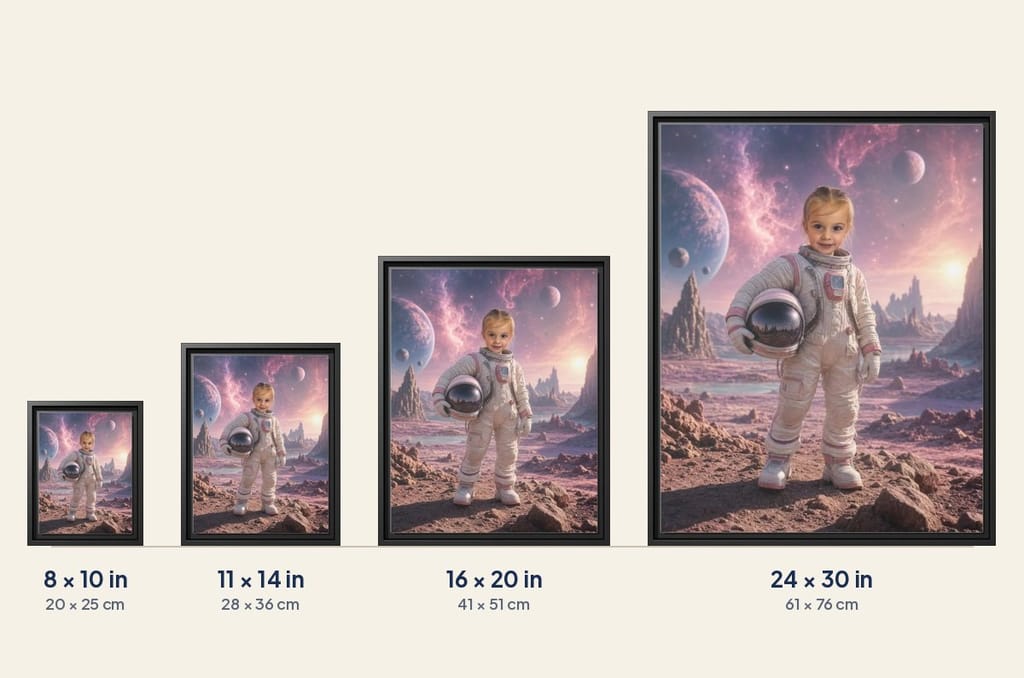
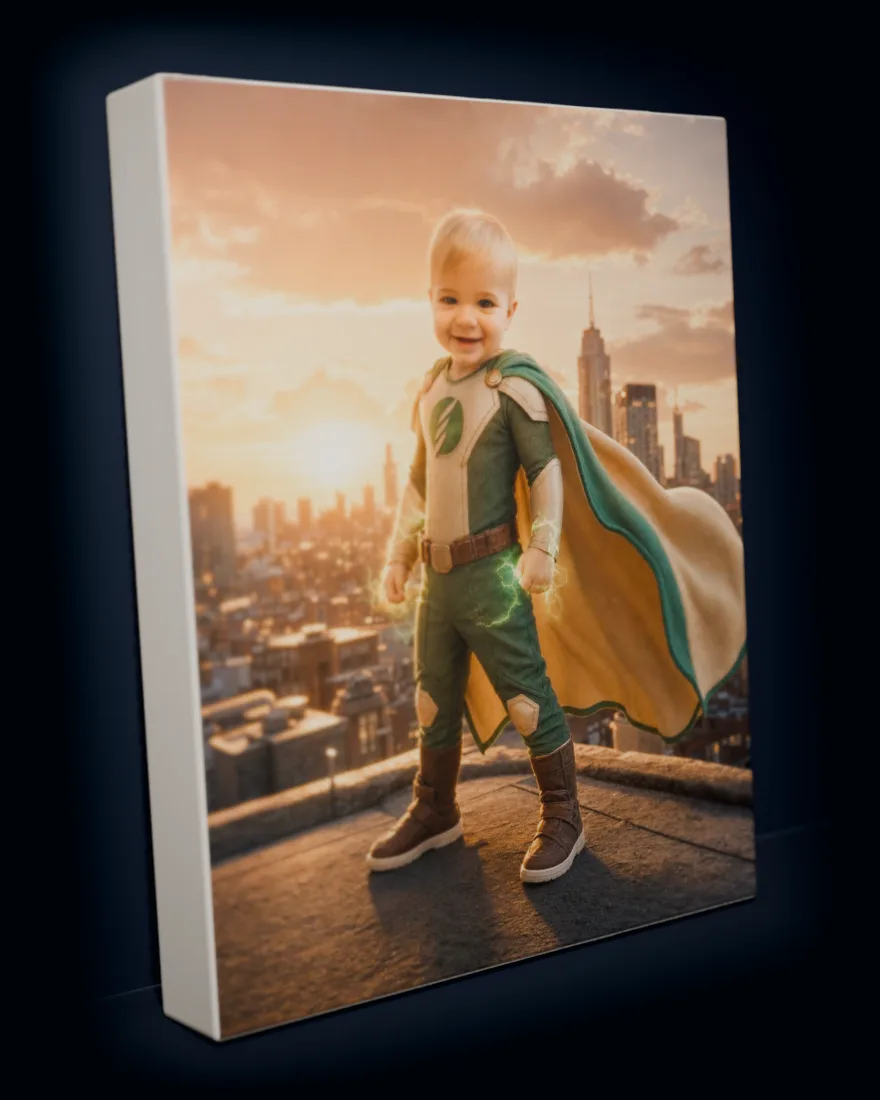
The Curious Thing prints portraits on canvas in the 4:5 family and close to it: an 8 by 10 for $59, an 11 by 14 for $79 and a 16 by 20 for $105, on a matte canvas wrapped around a 1.25-inch-deep wooden stretcher and printed edge to edge, so it hangs without a frame. The framed canvas puts the same canvas in a floating frame in black, espresso, white or natural, at 8 by 10 for $79, 11 by 14 for $109, 16 by 20 for $149 and 24 by 30 for $229. Each one starts from a single photo: a child painted as the hero of a magical world, the whole family in an art style, or a pet. The portrait is made in the same 4:5 shape as the canvas, so nothing important lands on the trim.
You approve a watermarked proof before anything prints, shipping is free in the US, and most orders arrive within 5 to 10 business days of approval. By the furniture rule, a 16 by 20 suits a hallway, a bedroom wall or a narrow dresser; the 24 by 30 framed canvas fits over a 36-inch console; and over a king bed, a row of three 16 by 20s gives you the span.
See your photo on a canvas
Upload one photo and see it as a painted portrait on an 8 by 10, 11 by 14 or 16 by 20 canvas, framed or unframed. Nothing prints until you approve the proof.
To see the canvas and framed canvas side by side, start at turning a photo into a painting. For the art styles a family portrait can take, see custom family portraits, and for taking a photo that prints well at any of these sizes, see family photo ideas that actually work.
Frequently asked questions
What are the standard canvas sizes?
+
The most common are 8 by 10, 11 by 14, 16 by 20, 18 by 24, 24 by 30, 24 by 36 and 30 by 40 inches, plus squares such as 12 by 12 and 24 by 24. Minis start at 5 by 5 and oversized canvases run to 36 by 48 and beyond.
What is the most popular canvas size?
+
16 by 20 inches is one of the most popular medium sizes, according to Austin Gallery's size chart. It is large enough to read from across a room, small enough for a console, dresser or bedroom wall, and it shares a 4:5 shape with 8 by 10 photo prints.
What size canvas should I get for a phone photo?
+
A 3:4 canvas, such as 12 by 16, 18 by 24 or 30 by 40. Phones shoot in 4:3 by default, which fills those sizes with no crop. A 4:5 canvas like 16 by 20 trims about 6 percent of the photo's height.
What size canvas goes over a couch?
+
About two-thirds of the couch's width. A standard 84-inch sofa takes art about 56 to 63 inches wide, such as a 40 by 60 landscape canvas or three 18 by 24 canvases with 3-inch gaps. Hang the bottom edge 8 to 10 inches above the sofa back.
How high should a canvas be hung?
+
With its center 57 inches from the floor, the eye-level standard galleries use. To find the top edge, add half the canvas's height to 57. Over furniture, keep the bottom edge 8 to 10 inches above it instead.
What resolution does a canvas print need?
+
About 150 pixels per inch for a canvas seen from across a room, and 300 for one seen up close. A 16 by 20 needs 2,400 by 3,000 pixels at 150 and 4,800 by 6,000 at 300.
What is the difference between gallery wrap and standard wrap?
+
Depth. A standard wrap sits on stretcher bars about 0.75 inches deep and is often framed; a gallery wrap uses bars about 1.5 inches deep with the image continuing around the sides, so it hangs without a frame.
Is 11 by 14 the same shape as 8 by 10?
+
Close, but not quite. 8 by 10 is 4:5 (0.80), while 11 by 14 is 11:14 (about 0.79), so a photo sized for one loses a sliver when printed on the other.