In short
The best Valentine joke for a child depends on their age more than on the joke. Three- and four-year-olds laugh at things that are wrong or silly, like a hippo footprint in the cake, so puns go over their heads. Around six or seven, children discover that one word can mean two things, and Valentine's Day is packed with words that do: owl and I'll, bee and be, lettuce and let us. By nine, they want riddles and corny groaners. Every group below says which ages it suits, the harder puns come with a one-line explanation, and no joke uses a character or a brand that belongs to somebody else.
Before writing this list we read the Valentine joke pages that rank on Google, from the national magazines to parenting sites and a few store blogs. Space-movie characters turn up on six of them, and candy and soda brands on most. Not one sorts a single joke by age. Several "for kids" lists put breakup jokes and innuendo a line away from preschool puns, and the same few dozen jokes travel from page to page, sometimes twice on the same page.
This list is sorted. Each group says which ages it suits and opens with one true story to tell while the cards are being signed, linked to where it comes from. Nothing appears twice, the riddles are real riddles with one answer each, and there is a clean section for grown-ups and grandparents at the end.
What makes a Valentine joke funny to a kid?
It depends on how old the kid is. A preschooler laughs because something is backwards or wrong. Paul McGhee, who spent his career studying how children's humor develops, describes preschoolers delighting in things done "backwards or wrong" and the familiar world turned upside down. Puns come later. By six or seven, he writes, children discover that the same word can have two meanings, and only then do they really understand the riddles they have been telling for a year.
Laughing isn't the same as getting it. In a 2020 study of 74 British children aged 4 to 11, four- and five-year-olds could explain a riddle on only 3.5% of occasions, yet they smiled or laughed at about a third of them, and almost as often at "jokes" with no joke in them at all.
That matters on Valentine's Day more than most days, because nearly every Valentine joke is a pun. It is why most groups below start at six, why three- and four-year-olds get a group of their own, and why our jokes for kids list sorts year-round jokes the same way.
Which Valentine jokes work at which age?
Match the joke to what the child can hear. If the laugh depends on noticing that a word means two things, it needs a six- or seven-year-old. If it's funny because something is silly, it works at three.
| Age | What's funny | Valentine jokes that work | Skip |
|---|---|---|---|
| 3-4 | Something obviously wrong | A hippo footprint in the cake, a cat sitting on its valentine, a bear hug with a growl | Puns, riddles, knock-knocks |
| 5-6 | Copying the shape of a joke | Interrupting Cupid, Cupid who can't walk yet, the octopus who holds eight hands | Grammar jokes, idioms |
| 6-8 | Two meanings of one word | Owl always love you, bee mine, most knock-knocks, the easier riddles | Idioms, jokes about dating |
| 9-11 | Idioms, misdirection and groaners | Significant otter, a-maize-ing, the mothers-and-daughters riddle, corny jokes | Very little, and they'll tell you |
| Grown-ups | Long marriages and bad puns | The clean jokes for adults, the corny group | Anything from the 3-4 group, unless a toddler is telling it |
Age bands describe typical development and overlap heavily, so treat them as a starting point rather than a rule.
The research backs the six-to-nine jump. In a 2022 study of 60 British schoolchildren by Giulia Baker and the Cardiff University linguist Michelle Aldridge, picking the right punchline from three choices rose from 49% at ages 6 to 7 to 80% at 8 to 9 and 88% at 10 to 11. Puns built on one word with two meanings, or on one swapped sound, were understood more readily than jokes that hinge on grammar or idioms, which is why "significant otter" sits in the nine-and-up band.
Valentine jokes for 3 and 4 year olds
These have no puns at all. Children this age make up their own jokes the same way: in a study of 2- and 3-year-olds, parents reported children inventing new jokes from age two, and their jokes included things like putting underwear on their heads or announcing that a pig says moo. A Valentine joke for a four-year-old works on the same principle. Something is in the wrong place, the wrong size or making the wrong noise.
- How do you know a hippo came to the Valentine's party? There's a big footprint in the cake.
- Why did the dog eat the valentine? He wanted to know what love tastes like.
- What's red, shaped like a heart and says "moo"? A cow holding a valentine.
- Why was the snail late for the Valentine's party? He's still on his way.
- What did the porcupine say after a Valentine's hug? "Ouch!"
- How does a mouse give a giraffe a valentine? With a very tall ladder.
- What did the fish write in her valentine? Nothing. Her pen got wet.
- What happens when you give a valentine to a cat? It sits on it.
- Why did the elephant paint her toenails red? So she could hide in the box of valentines.
- Who gives the biggest Valentine's hugs? Bears. Grrr!
Cupid jokes
Cupid was the Roman god of love, the counterpart of the Greek Eros, and in myth he was the son of Venus, often shown as a winged baby with a bow and a quiver of arrows that made people fall in love. He wasn't always a baby. Early Greek art showed Eros as a handsome winged young man, and artists made him younger and younger until, by the Hellenistic period that began in 323 BC, he was an infant. Most of these jokes need six and up. The first one works at four.
- Why is Cupid always flying? He can't walk yet.
- What card game does Cupid play? Hearts.
- Why did Cupid get an A in art class? He's been drawing since he was a baby. (Archers draw a bow when they pull back the string.)
- Why did Cupid shoot an arrow at the clock? He wanted to see time fly.
- What's Cupid's favorite dessert? Cupid-cakes.
- Why does Cupid never get lost? He just follows the arrows.
- Why did Cupid get kicked off the archery team? Everyone he aimed at fell. (In love.)
- What exercise does Cupid do? Arrow-bics.
- Where does Cupid go on vacation? To visit his mom on Venus. (In the myths his mother is Venus, the goddess the planet is named after.)
- Why does everyone trust Cupid? He's a straight arrow. (A straight arrow is someone honest.)
- Why does Cupid make a good teacher? He always gets to the point.
- What did Cupid say when he missed? "Well, I gave it my best shot."
Heart jokes
The heart shape we draw on valentines took a long time to settle. One of the oldest known pictures of a heart as a sign of love was painted in a Paris workshop in about 1255, in a French love story called the Romance of the Pear, and that heart looks like a pine cone held upside down, point at the top. (Some scholars think the object might be the pear.) Most of these work from six. The last few lean on idioms, so they suit nine and up.
- What did the heart say when it won the race? "Beat you!"
- Why did the heart get in trouble at school? It kept skipping.
- What does a heart grow in its garden? Pump-kins. (Your heart pumps blood all day long.)
- What did the red heart say to the pink heart? "Are you blushing?"
- What did the heart say to the doctor's stethoscope? "I knew you'd listen."
- What did the heart say to the arrow? "Ow. I mean, aww."
- What did the heart-shaped balloon say to the cactus? "Please don't break my heart."
- What did the heart doodle say to the pencil? "You really drew me in."
- Why do hearts never take a day off? They're muscles, and they work out all day and all night.
- What did one heart say to the other on February 15? "Same time next year?"
- How did the heart learn its spelling words? By heart.
- Why does the heart always win arguments with the brain? The brain is still thinking it over.
Valentine animal puns
Lovebirds earned their name. They are small African parrots whose scientific name, Agapornis, comes from the Greek for love and bird, and pairs pass food to each other beak to beak, which looks a lot like kissing. Animal puns suit six- to eight-year-olds best, because the swapped words (owl and I'll, ewe and you) are easy to hear. The otter needs nine and up.
- What did the owl say to his valentine? "Owl always love you."
- What do bees write on their valentines? "Bee mine."
- What did the whale say to his valentine? "Whale you be mine?"
- What did the octopus say to his valentine? "Can I hold your hand, hand, hand, hand, hand, hand, hand, hand?"
- What did the cat say to her valentine? "You're purr-fect."
- What did the frog say to his valentine? "You're toad-ally wonderful."
- What did the snake ask for on Valentine's Day? "Give me a hiss."
- What did the rabbit write on his valentine? "Some bunny loves you."
- What did the sheep say to her valentine? "I love ewe." (A ewe is a female sheep.)
- What do you call two birds in love? Tweethearts.
- What did the bear say to his valentine? "I can't bear to be without you."
- What did the elephant say to her valentine? "I'll never forget you."
- What did the penguin give his valentine? A pebble. (Adélie penguins line their nests with stones, and the ornithologist David Ainley says a parent leaving for its turn at sea first brings its mate a couple dozen pebbles.)
- What did the otter say to his valentine? "You're my significant otter." (A significant other is the person you love.)
Valentine food puns
The sayings printed on candy hearts go back to a Boston candy maker. Oliver Chase invented a machine that cut out lozenges in 1847, and in 1866 his brother Daniel invented one that printed words straight onto the candy. The heart shape came later, in 1902. Food puns span the ages: the banana and the melon work at six, while the pickle, the corn, the cupcake and the toast need nine and up.
- What did the banana say to the other banana? "I find you very a-peel-ing."
- What do peas write on their valentines? "Peas be mine."
- What did the grape say to her valentine? "I like you a bunch."
- What did the melon say to his valentine? "You're one in a melon."
- What did the bread say to its valentine? "I loaf you."
- What did the egg say to its valentine? "You're egg-cellent."
- What did the strawberry say to her valentine? "You're berry special."
- What did the pear say to the other pear? "We make the perfect pair."
- What did the donut say to the coffee? "I donut know what I'd do without you."
- What did the tea bag say to the mug? "You're tea-rrific."
- What did the cheese write in his valentine? "I'm so grate-ful for you."
- What did the pickle say to his valentine? "You mean a great dill to me." (A great deal.)
- What did the corn say to his valentine? "You're a-maize-ing." (Maize is another word for corn.)
- What did the cupcake say to the frosting? "I'd be muffin without you." (A cupcake without frosting is just a muffin, and "muffin" sounds like "nothing.")
- What did the toast say to the butter? "You're my butter half." (Your better half is your partner.)
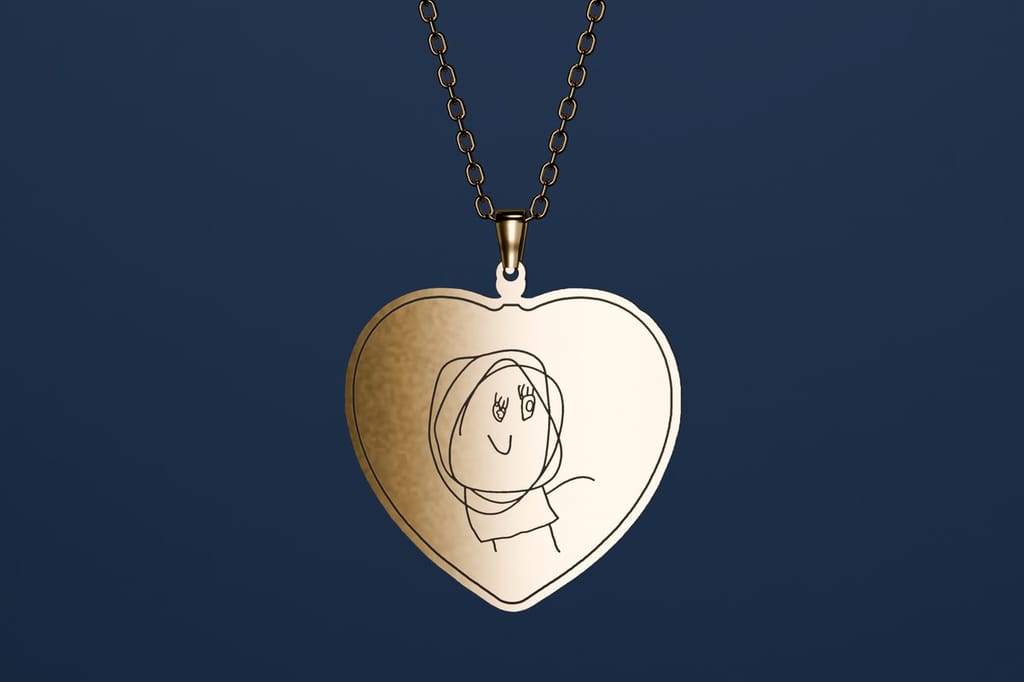
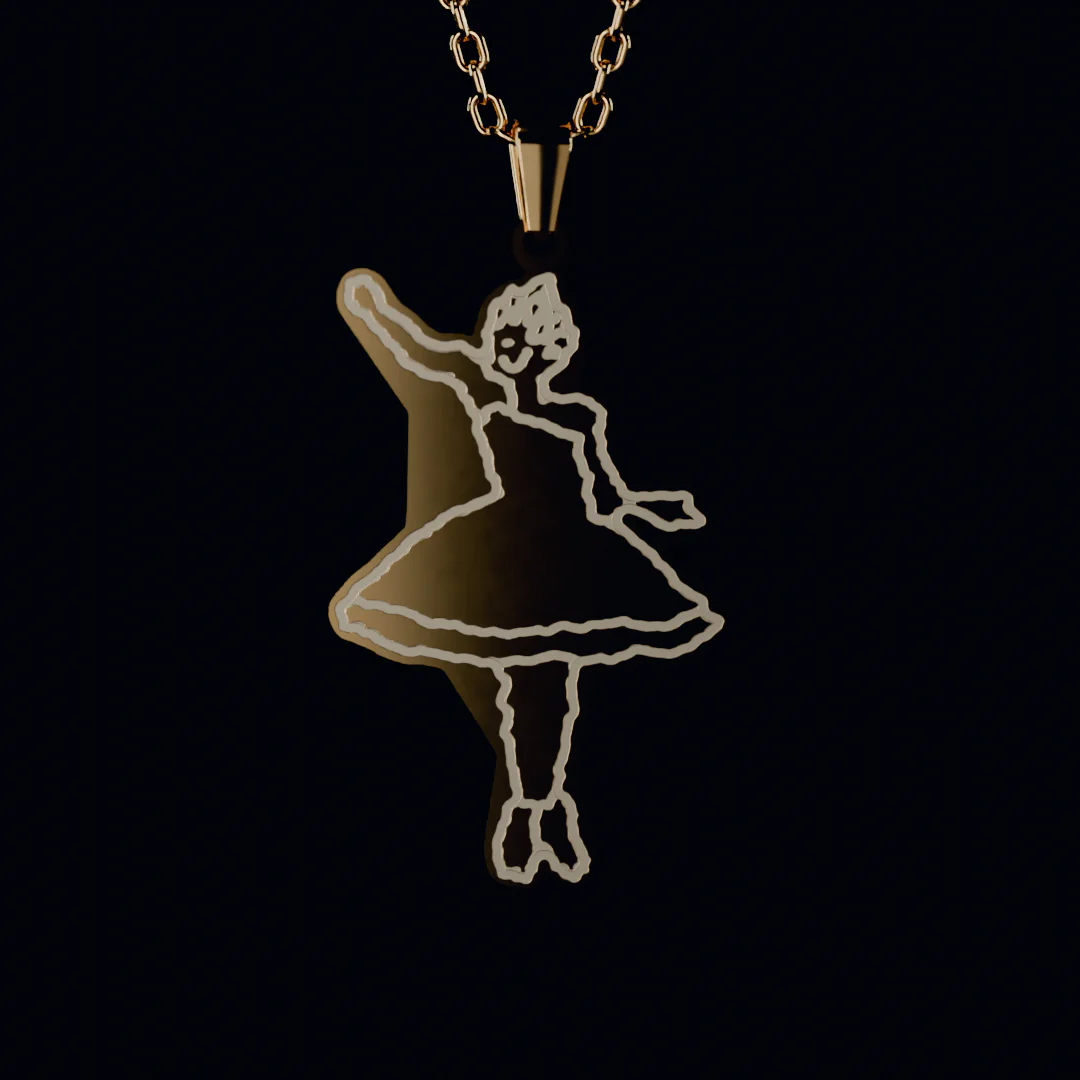
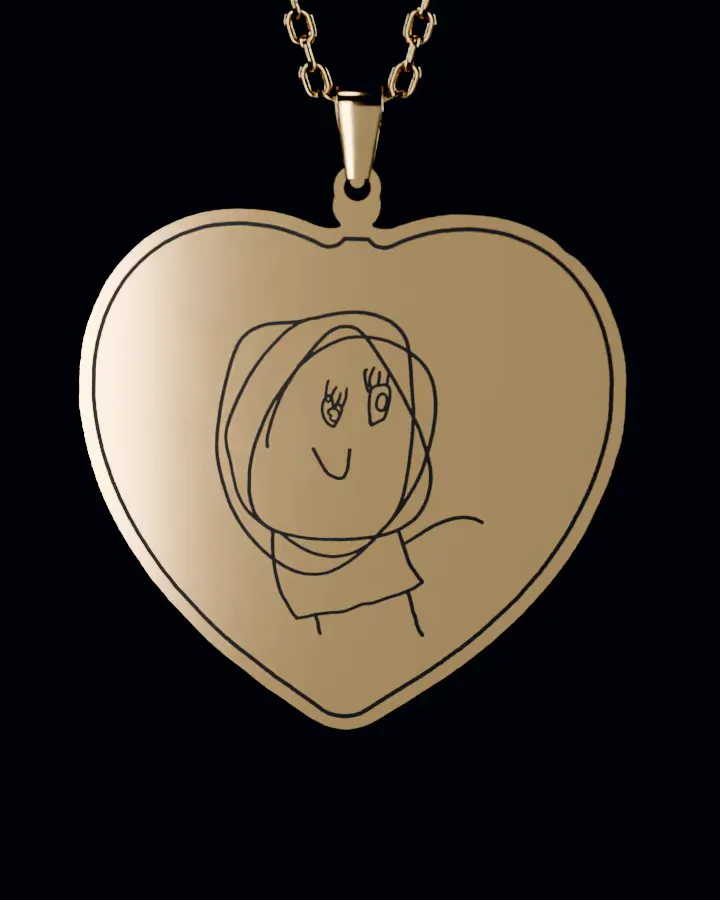
The jokes go in the cards for classmates. The card a child makes for a parent or a grandparent usually comes with a drawing, and that is the one worth keeping. Our drawing necklace puts a child's own drawing onto a pendant, engraved or in crisp black line, and one of the shapes is a heart: stainless steel $59, gold plated $69, sterling silver $89. You see the pendant with their drawing on it before anything is made. If the drawing belongs on a sweatshirt instead, we stitch that too.
Valentine knock-knock jokes
The words "Knock, knock!" "Who's there?" turn up as a joke in a Ben Jonson play from about 1597, eight or nine years before Shakespeare's Macbeth, which usually gets the credit. The modern name-pun routine was a nationwide craze in 1936, with radio stations telling them and knock-knock clubs forming in Illinois, Iowa and Kansas. Kindergartners copy the shape before they get the pun: McGhee's example of a five-year-old's knock-knock is "Who's there? Nobody's home!" That is why Interrupting Cupid, which needs no wordplay, works at five. The rest suit six and up.
- Knock, knock. Who's there? Interrupting Cupid. Interrupting Cu... "Twang! Got you."
- Knock, knock. Who's there? Olive. Olive who? Olive you!
- Knock, knock. Who's there? Will. Will who? Will you be my valentine?
- Knock, knock. Who's there? Abby. Abby who? Abby Valentine's Day!
- Knock, knock. Who's there? Lettuce. Lettuce who? Lettuce celebrate Valentine's Day!
- Knock, knock. Who's there? Hugo. Hugo who? Hugo first. I'm shy.
- Knock, knock. Who's there? Ima. Ima who? Ima big fan of yours!
- Knock, knock. Who's there? Justin. Justin who? Justin time for Valentine's Day!
- Knock, knock. Who's there? Howard. Howard who? Howard you like to be my valentine?
- Knock, knock. Who's there? Juicy. Juicy who? Juicy the card I made you?
- Knock, knock. Who's there? Wooden shoe. Wooden shoe who? Wooden shoe like to open the door and find out?
- Knock, knock. Who's there? Sherwood. Sherwood who? Sherwood like a hug.
Valentine riddles for kids
Two hundred years ago, some valentines were riddles in themselves. A "puzzle purse" valentine was a sheet of paper folded into a little packet, with drawings or verses on each square, numbered so the person opening it could read the message in the right order; the Met has one dated February 14, 1826. These are true riddles, each with one answer, and they run from easy to tricky. The first four work from about six, and the last two suit nine and up.
- I have a point but I'm not a pencil, feathers but I'm not a bird, and Cupid can't work without me. What am I? An arrow.
- I'm red, I live inside you, and I keep a beat all day and all night, but I'm not a drum. What am I? A heart.
- I'm red, I smell sweet, I'll prick you if you grab my stem, and people give me by the dozen on Valentine's Day. What am I? A rose.
- I come in a box, I melt if you hold me too long, and I'm a favorite Valentine's present. What am I? Chocolate.
- I have wings but I'm not a bird, a bow but I'm not a violin, and arrows but I'm not a road sign. Who am I? Cupid.
- What travels all around the world but stays in one corner? A stamp.
- What has 13 hearts but no other organs? A deck of cards.
- What flower grows between your nose and your chin? Tulips. (Two lips.)
- What starts with E, ends with E, needs a stamp and has only one letter in it? An envelope.
- Valentine's Day is in February, which usually has 28 days. How many months have a 28th day? All of them.
- Two mothers and two daughters each sent one valentine, but only three valentines were sent. How? They were a grandmother, her daughter and her granddaughter.
For more in the same style, our riddles for kids list sorts 175 year-round riddles by age.
Funny roses are red poems for kids
The rhyme's roots go back more than 400 years. Edmund Spenser's long poem The Faerie Queene, first published in 1590, has the line "She bath'd with roses red, and violets blew", and a Valentine verse very close to today's was printed in a nursery rhyme collection called Gammer Gurton's Garland, first published around 1784: "The rose is red, the violet's blue, / The honey's sweet, and so are you." The funny versions keep the first two lines and swerve on the last two. All of these work read aloud from about five, and kids of seven and up can write their own with the template underneath.
- Roses are red, / violets are blue, / I made you this card / with glitter and glue.
- Roses are red, / violets are blue, / I'd share my last cookie / with no one but you.
- Roses are red, / my dog's name is Lou, / he licked this card first, / so it's from him too.
- Roses are red, / violets are blue, / I can't count to ten / but I can count on you.
- Roses are red, / violets are blue, / I asked for a puppy / but I'll settle for you.
- Roses are red, / peas are green, / you're the best big sister / I've ever seen.
- Roses are red, / my socks don't match, / you're the best friend / in the whole batch.
- Roses are red, / snow is white, / I love you more / than staying up all night.
- Roses are red, / stars shine so bright, / thanks for checking my closet / every single night.
- Roses are red, / violets are blue, / you're the best teacher / in room twenty-two.
- Roses are red, / mud puddles are brown, / you're the best grandpa / in the whole town.
- Roses are red, / the oven is hot, / I like your cookies, Grandma, / but I love you a lot.
Write your own: keep "Roses are red," then name something with a color ("bananas are yellow"), then write one true thing about the person, and end on a word that rhymes with the color word. Read it aloud before writing it in the card. If the rhyme is a stretch, that's part of the joke.
Valentine puns for non-candy class valentines
About 5.8% of American children have a diagnosed food allergy, an average of two students in every classroom, according to Food Allergy Research & Education. Its Valentine's toolkit suggests non-food treats instead, including stickers, pencils, bookmarks and jigsaw puzzles. Each line below is short enough for a child to copy onto a class card and comes with the small thing it goes with. They suit six and up, and a younger child can sign their name while a grown-up writes the pun.
- A pencil: "You're one sharp valentine."
- An eraser: "I'd never erase you."
- A bottle of bubbles: "Valentine, you blow me away."
- A glow stick: "You make me glow."
- A sheet of stickers: "Friends stick together."
- A box of crayons: "I'd be blue without you."
- A bouncy ball: "I'm having a ball being your friend."
- A bookmark: "You're one for the books."
- A packet of seeds: "I'm rooting for you."
- A ruler: "You rule."
- A mini notebook: "You're note-worthy."
- A puzzle piece: "You're the missing piece."
- A rubber duck: "You quack me up."
- A toy dinosaur: "Have a roar-some Valentine's Day."
- A toy car: "I wheel-y like you."
School and teacher Valentine jokes
Punny school valentines are older than most grandparents. In February 1947 a Minnesota newspaper described the cheap "two-for-a-penny" cards headed for the heart-covered valentine boxes in two local grade schools, including a knitting lady asking, "Wool you be my Valentine? I needle lot of romance." Most of these suit six and up. The scissors, geometry, triangle and library jokes need nine.
- What did the backpack say to the student? "I've got your back."
- Why was the math book sad on Valentine's Day? It had too many problems.
- Which two letters of the alphabet are the most romantic? U and I.
- What did the globe say to the map? "You flatter me."
- What did the scissors say to the paper heart? "You're a cut above the rest." (A cut above means better than the others.)
- What did the stapler say to the paper? "We're attached now."
- What's the best thing to put in a Valentine's cupcake? Your teeth.
- Why did the teacher wear sunglasses to the Valentine's party? Her class was so bright.
- Why does the music teacher love Valentine's Day? All the love notes.
- What did the geometry teacher write on her valentine? "You're acute one." (An acute angle is a small, sharp one.)
- What did the triangle say to the circle? "You're pointless, and I love that about you."
- What did the library book say to its valentine? "I'm overdue to tell you how I feel."
Valentine jokes about friends and siblings
For children, Valentine's Day is mostly about friends. In the National Retail Federation's 2026 survey, 27% of people celebrating planned to buy something for their children's classmates and teachers, a projected $2.2 billion. These are the jokes for the friend, the brother or the sister who is getting a card whether they like it or not. They suit seven and up.
- What did one best friend say to the other on Valentine's Day? "We'll always be friends. You know too much."
- What did the top bunk say to the bottom bunk? "I'll always look out for you."
- What did the sister say when her brother gave her a valentine? "Did Mom make you do this?"
- Why did the twins send each other the same valentine? Great minds think alike.
- Why are best friends like bookends? They hold each other up.
- What did one friend say to the other on the swings? "I'll always push for you."
- Why did the two pencils become best friends? They were always on the same page.
- What did the little brother give his sister for Valentine's Day? Half his cookie. The smaller half.
Cheesy Valentine lines for friends and family
These are kid-safe pick-up lines: silly compliments for a friend, a parent or a grandparent, with no flirting in them. Grown-ups have been writing mush into love letters for a long time. The X for a kiss caught on in British letters in the 1800s, and by 1898 a court heard about a man who had sent 1,030 letters containing 15,000 kisses drawn as crosses. During the Second World War, military censors briefly banned the crosses in case they hid secret codes. Most of these suit seven and up; the chemistry and math ones need ten.
- Are you a camera? Every time I look at you, I smile.
- Are you a dot-to-dot? Because I'm feeling a connection.
- Are you a nightlight? Because everything's less scary with you around.
- Are you a trampoline? Because you always lift me up.
- Are you a good book? Because I can't put you down.
- Are you a sandwich? Because you're the best thing since sliced bread.
- Are you a snowman? Because you make me melt.
- Are you a battery? Because you charge me up.
- Are you a dictionary? Because you add meaning to my life.
- Are you a bank? Because you're so interest-ing.
- Are you a 90-degree angle? Because you're looking right.
- Are you made of copper and tellurium? Because you're Cu-Te. (Cu and Te are the chemical symbols for those two elements.)
Corny Valentine jokes
Valentine humor used to be mean. In the early 1900s it began to shift away from insulting cards and toward bad puns, like a 1907 postcard that reads "Your Unkindness Makes Me Melon-choly," with a melon standing in for part of the word. These are the groaners, the dad jokes of the holiday. McGhee notes that riddles are funniest in first and second grade and get less funny after that because they are too easy, which, he adds, is also why adults groan at some puns. They suit nine and up, and grown-ups who enjoy groaning.
- Why do valentines have hearts on them? Because brains would look weird.
- What's a calendar's favorite Valentine's treat? Dates.
- What do farmers give their sweethearts on Valentine's Day? Hogs and kisses.
- What did the paper clip say to the magnet? "I find you very attractive."
- Why do skunks love Valentine's Day? They're very scent-imental.
- Why did the goalie get the most valentines? Everyone said she was a keeper.
- What did the volcano say to its valentine? "You're magma-nificent."
- What do you call a very small valentine? A valen-tiny.
- What did one rowboat say to the other? "How about a little row-mance?"
- What did the light bulb say to its valentine? "I love you watts and watts."
- What did the ghost write on his valentine? "You're boo-tiful."
- What did the left shoe say to the right shoe? "We're sole mates."
Clean Valentine jokes for adults and grandparents
Grown-ups have been sending each other joke valentines for more than 200 years. The Metropolitan Museum of Art holds a British "comic valentine" from 1820, and in the 1840s and 1850s anonymous cards that teased or insulted the person who got them sold about as well as sentimental ones in Britain and the US. These are the opposite: no innuendo, no breakups, and safe to read aloud to a table that includes a seven-year-old.
- I bought my wife a new fridge for Valentine's Day. Her face lit up when she opened it.
- After forty years, my husband still gives me butterflies. Mostly when he's driving.
- My wife said, "Nothing would make me happier than a diamond necklace." So I got her nothing.
- How did the telephone propose? He gave her a ring.
- Our Valentine's dinner reservation is at 4:30. We're the late crowd.
- My wife wanted to go somewhere expensive for Valentine's Day, so I took her to the gas station.
- The secret to fifty years of marriage? Two bathrooms.
- After twenty years, our love language is "I already started the dishwasher."
- My grandkids made me a valentine with glitter. I'll be finding it until next February.
- At our age, the candles at Valentine's dinner are for reading the menu.
- My husband says I'm the only one for him. I checked. He's right.
- After all these years, we still hold hands on our Valentine's walk. It keeps us both upright on the ice.
Where do Valentine jokes work best?
On the class valentine, mostly. About 145 million Valentine's cards are exchanged in the US in a typical year not counting classroom valentines, the Greeting Card Association estimates, which makes it the second-biggest card holiday after Christmas, and the classroom swap comes on top of that. What a child can write depends on the grade. Kindergartners are expected to print many upper- and lowercase letters and spell simple words by sound, so a short pun and their own name is plenty, with a grown-up writing the rest if they want. By the end of first grade, children are expected to spell common words and capitalize names, which covers a classmate's name and a pun from the non-candy list.
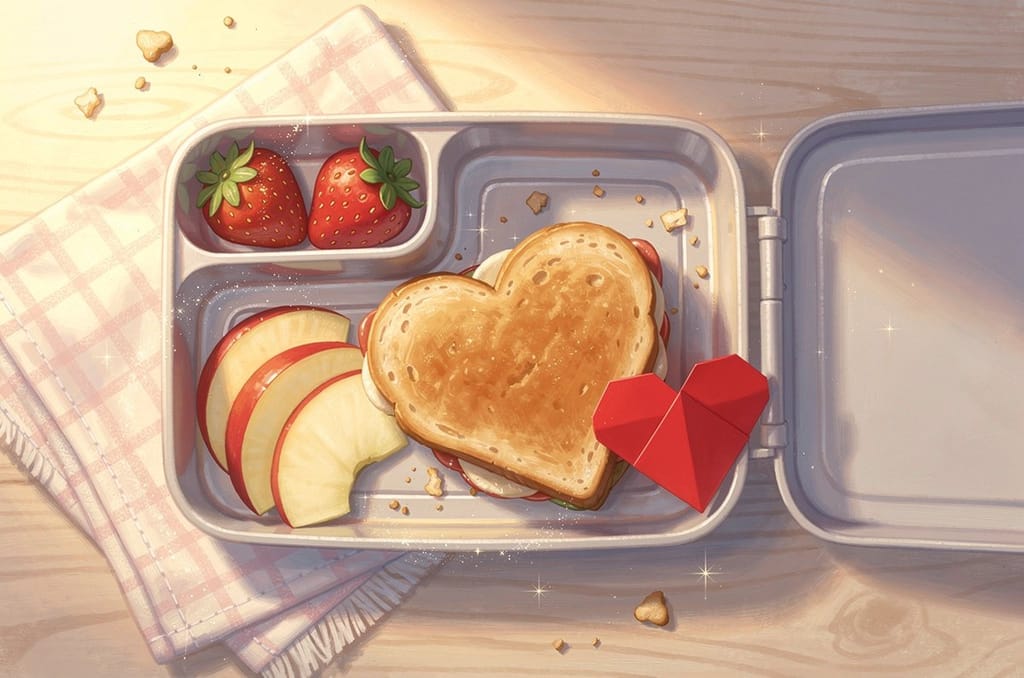
The lunchbox note is the other good spot. Write the question on the outside of a folded paper heart and the answer inside, so the joke gets its pause. At home, a dinner-table joke round works for mixed ages: the youngest tells one from the three-and-four group first, and everyone has to laugh.
How should a kid tell a Valentine joke?
Three things make the difference. Say the question, then wait a beat before the answer, because the pause is when the listener tries to guess. Say the punchline once, clearly, without explaining it. And don't laugh first. If it gets a blank look, the one-line explanations above are there for the moment someone asks why everyone groaned.
How can kids write their own Valentine jokes?
Give them the word list instead of more examples. Nearly every pun on this page swaps a Valentine word for one that sounds like it, and once a seven-year-old spots the swap, they can build new ones. In McGhee's 1974 study of first, second, fourth and sixth graders, the ability to make up joking answers increased significantly with age, so expect a six-year-old's first attempts to be gloriously random, and accept them anyway. Pick a word from the left column, find what it sounds like, then write a question whose answer uses the other meaning.
| Word | Sounds like | The joke it makes |
|---|---|---|
| Owl | I'll | "Owl always love you." |
| Bee | be | "Bee mine." |
| Whale | will | "Whale you be mine?" |
| Ewe | you | "I love ewe." |
| Olive | I love | Olive who? Olive you! |
| Lettuce | let us | Lettuce celebrate Valentine's Day. |
| Berry | very | "You're berry special." |
| Pear | pair | "We make the perfect pair." |
| Loaf | love | "I loaf you." |
| Hogs | hugs | "Hogs and kisses." |
| Hiss | kiss | "Give me a hiss." |
| Sole | soul | "We're sole mates." |
Say the word out loud before deciding what it sounds like. Most puns only work spoken.
Spotting the swap is a reading skill as well as a party trick. When researchers recorded 20 kindergartners in class for an hour each, more than 23% of what they said was sound play or word play, and the children who played with words more were better at explaining riddles, a skill that went with higher early-reading scores.
Which Valentine's Day facts are actually myths?
Most of the Valentine's Day "facts" passed around each February don't hold up. No card company invented the day, the famous 1415 "oldest valentine" was written decades later, and the story of St. Valentine marrying couples in secret has no medieval evidence behind it. Here is each one, checked against the sources.
| The story | What the sources say |
|---|---|
| A card company invented Valentine's Day | No. Valentines were already a craze in the 1840s: on February 14, 1846, more than 30,000 of them went through the New York City post office in a single day. Esther Howland of Worcester, Massachusetts, who assembled valentines in her family home, placed her first newspaper ad for them in February 1850. |
| The oldest valentine was sent from the Tower of London in 1415 | No. The British Library says Charles, Duke of Orléans wrote the poem in about 1443-60, after he had gone home to France, and it is really an anti-valentine, excusing himself from a Valentine's Day partner draw. |
| St. Valentine secretly married couples so the husbands wouldn't go to war | A legend with little behind it. The best-known medieval life of the saint says nothing about love or weddings, and a Durham University medievalist says the story "seems unsupported by medieval data". |
| Valentine's Day is the Roman festival of Lupercalia in disguise | Disputed. Pope Gelasius supposedly condemned the festival in 496, but there is no evidence he swapped it for St. Valentine's feast. |
| The Church stopped counting St. Valentine as a saint in 1969 | No. His feast was taken off the Church's universal calendar in 1969 because so little is reliably known about him, but he is still a saint, and the patron saint of lovers, people with epilepsy and beekeepers. |
| The day has always been about love | Not as far as anyone can tell. The earliest known link between St. Valentine's Day and romance is a 14th-century poem by Geoffrey Chaucer, the Parliament of Fowls, in which birds gather on the day to choose their mates. |
| Sea otters hold hands when they sleep | Sometimes, but not very often. Large groups of resting otters mostly stay together by watching and listening for each other. |
Keep the valentine they draw you
The class gets the jokes. The drawing they make for you can be kept: we put a child's own drawing onto a pendant cut in the shape of a heart, a pebble or their own outline, in stainless steel, gold plated or sterling silver. You see their drawing on the pendant before anything is made.
Frequently asked questions
What are the best Valentine jokes for kids?
+
For six and up, start with the animal puns that turn up on most lists for a reason: "What did the owl say to his valentine? Owl always love you," and "What do bees write on their valentines? Bee mine." For three- and four-year-olds, skip puns and go silly: "How do you know a hippo came to the Valentine's party? There's a big footprint in the cake." The groups above are labeled by age, so pick by the child rather than by the joke.
What are good Valentine jokes for 5 year olds?
+
Silly jokes plus the easiest sound-alikes. "Why is Cupid always flying? He can't walk yet" works at five, and so does Interrupting Cupid, because neither needs wordplay. Five sits at the edge of understanding puns, so if "Bee mine" gets a blank look, switch to the three-and-four group and try the pun again in six months.
At what age do kids understand Valentine puns?
+
Around six or seven, when children discover that one word can carry two meanings. In one study, four- and five-year-olds could explain a riddle only 3.5% of the time, and children's ability to pick the right punchline jumped between ages six to seven and eight to nine. Puns that depend on an idiom, like "significant otter," usually land closer to nine.
What are some funny roses are red poems for kids?
+
"Roses are red, violets are blue, I can't count to ten but I can count on you" works for a parent, and "Roses are red, my dog's name is Lou, he licked this card first, so it's from him too" works for anyone. The trick is to keep the first two lines and swerve on the last two. The list above has twelve, plus a template for writing your own.
What are good Valentine puns for class valentines?
+
Short lines paired with a small non-food item, so every classmate can enjoy them: a pencil with "You're one sharp valentine," stickers with "Friends stick together," a bookmark with "You're one for the books," or a puzzle piece with "You're the missing piece." Food Allergy Research & Education estimates an average of two students per American classroom have a food allergy, which is why non-candy valentines are worth considering.
What are some clean Valentine jokes for adults?
+
Long-marriage jokes travel best: "The secret to fifty years of marriage? Two bathrooms," and "After forty years, my husband still gives me butterflies. Mostly when he's driving." The corny group works too, since adults are the ones who groan loudest at "Hogs and kisses." None of the jokes on this page relies on innuendo.
Where does "roses are red" come from?
+
It is usually traced to a line in Edmund Spenser's The Faerie Queene, published in 1590: "She bath'd with roses red, and violets blew." A Valentine verse close to the modern one, "The rose is red, the violet's blue, / The honey's sweet, and so are you," appeared in the nursery rhyme collection Gammer Gurton's Garland around 1784.
Why is February 14 called Valentine's Day?
+
It is the feast day of St. Valentine, an early Christian martyr about whom very little is reliably known. The earliest known link between the day and love is a 14th-century poem by Geoffrey Chaucer, in which birds choose their mates on St. Valentine's Day. By the 1840s, sending valentines was a craze in the United States.