In short
The best Valentine poem for a card is four lines or fewer and names one true thing about the person: the coffee they make, the jacket they lend, the joke they always tell. Below are 85 short poems we wrote, sorted by who they are for, and 49 public-domain classics, from Sappho's single line to Dorothy Parker's "One Perfect Rose" (1926), each dated and linked to its text so you can copy it with confidence. Famous modern poems that are still under copyright are named and linked instead of reprinted.
Before writing this list we read twelve of the Valentine poem pages that rank on Google, from national magazines to poetry nonprofits and card shops. Almost none gives a year for any poem, and most don't say where a poem comes from. Several reprint whole poems that are still under copyright, by poets including Langston Hughes, Maya Angelou and Carol Ann Duffy. One credits Tennyson with a garden verse whose earliest known printing is a 1985 newspaper ad. None puts dated classics and new poems for every kind of recipient on one page.
This page does. The new poems are grouped by recipient, from a partner of forty years to the dog. Every classic says when it was published and links to where you can read it. The lines that travel under the wrong name have their own table near the end.
How long should a Valentine poem be?
Four lines is right for most cards, two for a gift tag or a text, and a full classic only when it will be read aloud. Short isn't lazy. Four handwritten lines fit inside most cards with room to sign, and a four-line poem can hold one image, one turn and one rhyme. Shakespeare's Sonnet 116, the wedding favorite, runs 14 lines. Leigh Hunt's "Jenny Kiss'd Me" runs eight. Your four lines also have company: the Greeting Card Association estimates that about 145 million Valentine's cards are exchanged in the US in a typical year, not counting the ones children swap at school, and a printed verse reads the same in every copy of a card. A short poem in your own handwriting is the part nobody else could have sent.
| Where it's going | Length | Try |
|---|---|---|
| Gift tag, text, sticky note | 1-2 lines | The short poems, or Sappho's single line |
| Valentine card | 4 lines | Any of the new poems below |
| Letter or the back of a photo | 8-16 lines | "Jenny Kiss'd Me," "A Red, Red Rose" |
| Read aloud at dinner, a vow renewal or a wedding | 14 lines | Sonnet 116, "How do I love thee?" |
Line counts are the poems as printed below. A long classic can be cut to its best stanza, as several are here.
Short Valentine poems for a card
These fit inside any card with room left to sign. Each names something small and real, which is what makes a short poem land. Swap in your own detail where one of ours doesn't fit: their tea for our coffee, their boots for our coat.
- I don't need roses, wine or rings,
or anything a florist brings.
I need the you who makes me tea
and saves the warmest seat for me. - You laugh at things I haven't said,
you know the song stuck in my head.
Of all the luck I've had so far,
the best of it is where you are. - Some days are long, some days go wrong,
some days are plain and gray.
I've yet to have a single one
you couldn't make okay. - Two coffee cups, the kitchen light,
your boots beside the door:
the plainest things I've ever loved,
and I keep finding more. - If love were measured out in days,
I'd ask for all of yours. - We've moved four times.
I've only ever lived
in one place: next to you. - You're the first one I want to tell
when something good comes true,
and the first one I want to call
when it's the other kind, too. - I keep a note on my phone
of small things you do.
It's longer than the grocery list. - There are a thousand cards in town
with hearts and gold and lace.
I picked the one that says it plain:
I love your face. - Roses fade by Friday.
I don't plan to.
The shortest love poem on this page is about 2,600 years old. Sappho wrote two lines that survive only because the grammarian Hephaestion quoted them in a handbook on meter. Henry Thornton Wharton's 1885 prose translation gives them as one line:
Now Love masters my limbs and shakes me, fatal creature, bitter-sweet.
Valentine poems for her
The best Valentine poems for her are specific: the tune she hums, the plants she keeps alive, the laugh you fell for first. Eight new ones come first, then Burns and Byron. Burns didn't claim to have invented his red, red rose. In a 1794 letter he called the song "a simple old Scots song which I had pickt up in this country", which he reworked. The new poems come first.
- You hum when you cook,
you hum when you read,
you hum when you're nervous
and don't know you've hummed.
I'd know you anywhere
by that one little tune. - You make the morning easier,
the evening, too, by far.
I've loved a lot of things in life,
but none the way you are. - Your hand in mine in aisle nine
still feels like our first date.
Ten years of lists and parking lots,
and I still can hardly wait. - You keep the plants alive, the dates,
the birthdays and the bills,
and best of all, you've kept me,
and I hope you always will. - I fell for your laugh
before I knew your name.
I've learned a lot of you since then.
The laugh is still the same. - If I could give you anything
I'd give you back the hours
you've spent on everyone but you,
tied up with all the flowers. - You're lovely in the morning
with your hair up in a knot,
and lovely at midnight,
and every hour I've got. - Some people light up a room.
You light up a Tuesday,
which is harder.
"A Red, Red Rose," Robert Burns, 1794
O my Luve is like a red, red rose
That's newly sprung in June;
O my Luve is like the melody
That's sweetly played in tune.So fair art thou, my bonnie lass,
So deep in luve am I;
And I will luve thee still, my dear,
Till a' the seas gang dry.Till a' the seas gang dry, my dear,
And the rocks melt wi' the sun;
I will love thee still, my dear,
While the sands o' life shall run.And fare thee weel, my only luve!
And fare thee weel awhile!
And I will come again, my luve,
Though it were ten thousand mile.
First printed in 1794 in Pietro Urbani's A Selection of Scots Songs. Gang dry is "go dry," and weel is "well." Text at the Poetry Foundation.
"She Walks in Beauty," Lord Byron, 1815 (first stanza)
She walks in beauty, like the night
Of cloudless climes and starry skies;
And all that's best of dark and bright
Meet in her aspect and her eyes;
Thus mellowed to that tender light
Which heaven to gaudy day denies.
Know the story before you send it. Byron first saw his cousin's wife, Mrs. Wilmot, at a party in June 1814, "in mourning with numerous spangles in her dress," and wrote the poem the next day, according to an account by James Wedderburn Webster printed with his collected works. It was published in Hebrew Melodies in 1815.
One line you'll see credited to Shakespeare for her, "When I saw you I fell in love, and you smiled because you knew," isn't his. It comes from Arrigo Boito's Italian libretto for Verdi's opera Falstaff (1893).
Valentine poems for him
A Valentine poem for him can be short and still land, as long as it names something he actually does, like warming up the car. Eight new ones come first, then three classics. Shakespeare's Sonnet 18 belongs here as much as anywhere: it sits in the run of sonnets traditionally read as addressed to a young man, though the poem itself never says who it is for.
- You warm the car before I'm up,
you find the keys I lose,
and if I had the world to pick,
it's still you I would choose. - You're not a man for poetry,
so I'll keep this one brief:
I love you. That's the poem.
I know. It's a relief. - Your jacket on my shoulders
when the evening turned cold:
I'd like a hundred more of those
until we're very old. - I like your snoring (some nights),
your terrible jokes (most days),
your hand on my back in a crowded room
(always). - You make me laugh at breakfast
and laugh again at ten.
I can't believe I get to wake
and do it all again. - You'd never ask for flowers,
so here's a poem instead.
It's short, because I know you'd rather
I just made the bed. - Thank you for the coffee,
the patience and the plan,
and for loving me on days
when I'm hard to understand. - If love were something you could build,
you'd build it from the ground:
the steady kind, the level kind,
the kind that sticks around.
"To My Dear and Loving Husband," Anne Bradstreet, 1678
If ever two were one, then surely we.
If ever man were loved by wife, then thee.
If ever wife was happy in a man,
Compare with me, ye women, if you can.
I prize thy love more than whole mines of gold,
Or all the riches that the East doth hold.
My love is such that rivers cannot quench,
Nor ought but love from thee give recompense.
Thy love is such I can no way repay;
The heavens reward thee manifold, I pray.
Then while we live, in love let's so persever,
That when we live no more, we may live ever.
Written to her husband, Simon Bradstreet, whom she married in England in 1628 before they sailed to Massachusetts. It was printed in Boston in 1678, six years after her death.
"I Would Live in Your Love," Sara Teasdale, 1911
I would live in your love as the sea-grasses live in the sea,
Borne up by each wave as it passes, drawn down by each wave that recedes;
I would empty my soul of the dreams that have gathered in me,
I would beat with your heart as it beats, I would follow your soul as it leads.
Teasdale reprinted it in Love Songs (1917), which won a special 1918 Pulitzer award for poetry. Text on Project Gutenberg.
Sonnet 18, William Shakespeare, 1609
Shall I compare thee to a summer's day?
Thou art more lovely and more temperate:
Rough winds do shake the darling buds of May,
And summer's lease hath all too short a date;
Sometime too hot the eye of heaven shines,
And often is his gold complexion dimm'd;
And every fair from fair sometime declines,
By chance or nature's changing course untrimm'd;
But thy eternal summer shall not fade,
Nor lose possession of that fair thou ow'st;
Nor shall death brag thou wander'st in his shade,
When in eternal lines to time thou grow'st:
So long as men can breathe or eyes can see,
So long lives this, and this gives life to thee.
Text at the Poetry Foundation. The last two lines are the boast: the poem, not the summer, keeps the beloved alive.
Valentine poems for someone new
Early Valentine's Days call for light poems: interested, not yet devoted. Marlowe's "Come live with me and be my love" is the classic invitation, and it started a fashion for answers. The most famous, Sir Walter Ralegh's "The Nymph's Reply to the Shepherd," turns the shepherd down point by point.
- It's early days, I know, I know,
I shouldn't say too much,
but I've been grinning at my phone
since you said, "Keep in touch." - I don't know your middle name
or how you like your tea,
but I've got time to find it out,
if you'll spend it with me. - Our first Valentine's Day.
No pressure.
(I bought the card three weeks ago.) - Here's to the start of something,
whatever it turns out to be.
So far it's the best thing that's happened
to Tuesdays, and to me. - Be my valentine?
I practiced asking
in the car.
Eleven times. - Not sure what we are yet.
Sure that I like it.
"The Passionate Shepherd to His Love," Christopher Marlowe, 1599 (first two stanzas)
Come live with me and be my love,
And we will all the pleasures prove,
That Valleys, groves, hills, and fields,
Woods, or steepy mountain yields.And we will sit upon the Rocks,
Seeing the Shepherds feed their flocks,
By shallow Rivers to whose falls
Melodious birds sing Madrigals.
Printed without a name in The Passionate Pilgrim (1599) and signed "Chr. Marlow" in England's Helicon (1600). Text at the Poetry Foundation.
"Love's Philosophy," Percy Bysshe Shelley, 1819
The fountains mingle with the river
And the rivers with the ocean,
The winds of heaven mix for ever
With a sweet emotion;
Nothing in the world is single;
All things by a law divine
In one spirit meet and mingle.
Why not I with thine?See the mountains kiss high heaven
And the waves clasp one another;
No sister-flower would be forgiven
If it disdained its brother;
And the sunlight clasps the earth
And the moonbeams kiss the sea:
What is all this sweet work worth
If thou kiss not me?
A playful argument for a kiss. Shelley sent it from Italy to his friend Leigh Hunt, who wrote back "What a delicious love song is that you enclosed!" and printed it in his weekly The Indicator in December 1819. Text from the 1914 Oxford edition; the 1819 printing differs in four lines.
"A Birthday," Christina Rossetti, 1861
My heart is like a singing bird
Whose nest is in a water'd shoot;
My heart is like an apple-tree
Whose boughs are bent with thickset fruit;
My heart is like a rainbow shell
That paddles in a halcyon sea;
My heart is gladder than all these
Because my love is come to me.Raise me a dais of silk and down;
Hang it with vair and purple dyes;
Carve it in doves and pomegranates,
And peacocks with a hundred eyes;
Work it in gold and silver grapes,
In leaves and silver fleurs-de-lys;
Because the birthday of my life
Is come, my love is come to me.
The birthday isn't a date on the calendar but "the birthday of my life," the day love arrives. First printed in Macmillan's Magazine, April 1861. Text at RPO.
"He Wishes for the Cloths of Heaven," W. B. Yeats, 1899
Had I the heavens' embroidered cloths,
Enwrought with golden and silver light,
The blue and the dim and the dark cloths
Of night and light and the half light,
I would spread the cloths under your feet:
But I, being poor, have only my dreams;
I have spread my dreams under your feet;
Tread softly because you tread on my dreams.
In the 1899 first edition the speaker had a name: the poem was titled "Aedh wishes for the Cloths of Heaven."
"First Love," John Clare, 1920 (first stanza)
I ne'er was struck before that hour
With love so sudden and so sweet.
Her face it bloomed like a sweet flower
And stole my heart away complete.
My face turned pale as deadly pale,
My legs refused to walk away,
And when she looked "what could I ail?"
My life and all seemed turned to clay.
Love at first sight, though the poem ends without her loving him back. Clare left it in manuscript, and it was first printed in 1920, 56 years after his death.
Valentine poems for a long marriage
After twenty or forty years, the funny and specific lines often say more than the grand ones. The classics here are mostly about growing old together.
- We've had the years that knocked us flat
and years that flew right by.
I'd take them all again with you
and never wonder why. - Thirty Februaries in,
I still save you the crust,
and you still give me the window seat.
That's love, or else it's trust. - Your hair has gone the way of mine,
our knees have both gone too;
the only thing that hasn't moved
is how I feel for you. - We don't need candles anymore,
or dinners out at eight.
Give me the crossword, you, and tea,
and the evening's just as great. - I knew you when we had no couch,
no savings and no car.
We've got a couch now, and three kids,
and look how rich we are. - Fifty years of "Where are my glasses?"
"On your head, dear."
Every time.
I wouldn't change a line. - The house is quiet, the kids are grown,
the dog is fast asleep.
It's you and me again, my love,
and you're the one I'd keep.
"John Anderson, my Jo," Robert Burns, 1790
John Anderson, my jo, John,
When we were first acquent;
Your locks were like the raven,
Your bonie brow was brent;
But now your brow is beld, John,
Your locks are like the snaw;
But blessings on your frosty pow,
John Anderson, my jo.John Anderson, my jo, John,
We clamb the hill thegither;
And mony a cantie day, John,
We've had wi' ane anither:
Now we maun totter down, John,
And hand in hand we'll go,
And sleep thegither at the foot,
John Anderson, my jo.
An old wife to her husband. Jo is sweetheart, brent smooth, beld bald, pow head, cantie cheerful and maun must. Burns made it a polite rewrite of a much older and much bawdier song that shares only its first line. Text at robertburns.org.
"Believe Me, if All Those Endearing Young Charms," Thomas Moore, 1808
Believe me, if all those endearing young charms,
Which I gaze on so fondly to-day,
Were to change by to-morrow, and fleet in my arms,
Like fairy-gifts fading away,
Thou wouldst still be ador'd, as this moment thou art,
Let thy loveliness fade as it will,
And around the dear ruin each wish of my heart
Would entwine itself verdantly still.
A promise to love someone just as much once youth fades, written as new words to an old tune for Moore's Irish Melodies. The popular story that he wrote it for a wife scarred by smallpox doesn't fit the dates: the song appeared about 1808, three years before he married Bessy Dyke in 1811.
"My Wife," Robert Louis Stevenson, 1896
Trusty, dusky, vivid, true,
With eyes of gold and bramble-dew,
Steel-true and blade-straight,
The great artificer
Made my mate.Honour, anger, valour, fire;
A love that life could never tire,
Death quench or evil stir,
The mighty master
Gave to her.Teacher, tender, comrade, wife,
A fellow-farer true through life,
Heart-whole and soul-free
The august father
Gave to me.
A portrait of his wife, Fanny, published two years after his death in Songs of Travel. Text on Project Gutenberg.
"Jenny Kiss'd Me," Leigh Hunt, 1838
Jenny kissed me when we met,
Jumping from the chair she sat in;
Time, you thief, who love to get
Sweets into your list, put that in:
Say I'm weary, say I'm sad,
Say that health and wealth have missed me,
Say I'm growing old, but add,
Jenny kissed me.
It first appeared in 1838 as "Rondeau" and began "Nelly kiss'd me"; Hunt changed the name for his 1844 Poetical Works. By tradition Jenny was his friend Jane Welsh Carlyle, so it is a greeting kiss rather than a romance, but it reads perfectly for a long marriage. Text at the Poetry Foundation.
"Rabbi Ben Ezra," Robert Browning, 1864 (opening lines)
Grow old along with me!
The best is yet to be,
The last of life, for which the first was made:
A favorite anniversary line, though the 32-stanza poem it opens is a monologue on age and faith, spoken by a 12th-century scholar, not a love letter. The opening still says exactly what an anniversary card needs.
"On Marriage," Kahlil Gibran, 1923 (from The Prophet)
But let there be spaces in your togetherness,
And let the winds of the heavens dance between you.Love one another, but make not a bond of love:
Let it rather be a moving sea between the shores of your souls.
Fill each other's cup but drink not from one cup.
Give one another of your bread but eat not from the same loaf.
The Prophet entered the US public domain on January 1, 2019, the day Project Gutenberg released it. Gibran wrote it in English, so there is no translation to clear.
Funny Valentine poems for grown-ups
A funny poem is the safest choice for a partner who squirms at mush, and the classics prove it isn't a modern habit. For roses-are-red rhymes a child can write, see our Valentine jokes for kids, which sorts them by age.
- I'd give you my last fry,
the good side of the bed,
the remote (on weekdays).
That's love. Enough said. - Roses are red.
The last ones died in a day.
So this year you get a poem.
It's cheaper, and it'll stay. - You steal the covers,
you hog the bed,
you finish my sentences
with things I never said.
I love you anyway. - I set two alarms for work.
For you
I'd get up on the first one. - You've seen me sick.
You've seen me cry at an ad for dog food.
You've watched me try to fold a fitted sheet.
And you stayed. - Our love is like the houseplant
that's somehow still alive:
we never read the instructions,
and still, we thrive. - Plans for tonight:
takeout.
Your freezing feet on my shins.
Perfect. - Roses are red,
my white shirts are pink.
I love you. You're banned
from the laundry, I think. - Love is patient, love is kind,
love gives you the window seat
and doesn't mind.
"One Perfect Rose," Dorothy Parker, 1926
A single flow'r he sent me, since we met.
All tenderly his messenger he chose;
Deep-hearted, pure, with scented dew still wet,
One perfect rose.I knew the language of the floweret;
"My fragile leaves," it said, "his heart enclose."
Love long has taken for his amulet
One perfect rose.Why is it no one ever sent me yet
One perfect limousine, do you suppose?
Ah no, it's always just my luck to get
One perfect rose.
From Enough Rope (1926), now in the US public domain. It works best with an actual rose attached.
Emily Dickinson's comic valentine, 1852 (first stanza)
"Sic transit gloria mundi,"
"How doth the busy bee,"
"Dum vivimus vivamus,"
I stay mine enemy!
Oh "veni, vidi, vici!"
Oh caput cap-a-pie!
And oh "memento mori"
When I am far from thee!
A nonsense medley of Latin tags and schoolbook lines, sent as a valentine and printed anonymously in the Springfield Daily Republican on February 20, 1852, under the title "A Valentine." The Emily Dickinson Museum's list of her lifetime publications puts only one item ahead of it: a prose valentine printed in 1850. A later stanza has the best flirting line: "Put down the apple, Adam, / And come away with me."
Valentine poems for friends and Galentine's Day
A Valentine poem for a friend should sound like the friendship: an old joke, a 2 a.m. phone call, the bus you both rode. Galentine's Day, February 13, began as a joke on the sitcom Parks and Recreation, in an episode that first aired on February 11, 2010, and it stuck. Valentines for friends are much older: Lewis Carroll's "A Valentine" was written to a friend, and so was Emily Dickinson's first.
- Friends since the lunch line,
friends since the bus.
Nobody gets a valentine
quite like the two of us. - You're the friend who answers
at two in the morning,
no questions asked,
just "I'm up. Go." - Some people get flowers,
some people get rings.
I got a friend who remembers
the dumbest things. - We've had the same jokes
for twenty-two years,
and they still get us laughing
right down to the tears. - Three time zones apart,
and you still pick up first.
That's a friend.
"The Arrow and the Song," Henry Wadsworth Longfellow, 1845
I shot an arrow into the air,
It fell to earth, I knew not where;
For, so swiftly it flew, the sight
Could not follow it in its flight.I breathed a song into the air,
It fell to earth, I knew not where;
For who has sight so keen and strong,
That it can follow the flight of song?Long, long afterward, in an oak
I found the arrow, still unbroke;
And the song, from beginning to end,
I found again in the heart of a friend.
Longfellow's journal for October 16, 1845, says he wrote it before church, standing with his back to the fire: "Literally an improvisation." The arrow makes it a natural valentine.
"Love and Friendship," Emily Brontë, 1850
Love is like the wild rose-briar,
Friendship like the holly-tree.
The holly is dark when the rose-briar blooms
But which will bloom most constantly?The wild rose-briar is sweet in spring,
Its summer blossoms scent the air;
Yet wait till winter comes again
And who will call the wild-briar fair?Then scorn the silly rose-wreath now
And deck thee with the holly's sheen,
That when December blights thy brow
He still may leave thy garland green.
Her sister Charlotte printed it in 1850, two years after Emily's death. Text at the Poetry Foundation. The friend wins.
"Unfortunate Coincidence," Dorothy Parker, 1926
By the time you swear you're his,
Shivering and sighing,
And he vows his passion is
Infinite, undying,
Lady, make a note of this:
One of you is lying.
The Galentine's card for a friend who has heard every line. From Enough Rope (1926).
"A Valentine," Lewis Carroll, 1860 (a later stanza)
And if the verse flow free and fast,
Till even the poet is aghast,
A touching Valentine at last
The post shall carry,
When thirteen days are gone and past
Of February.
Despite the title it is a comic reply to a male friend at Radley College, who had complained that Carroll was "glad enough to see him when he came, but did not seem to miss him if he stayed away." It is dated February 13, 1860, and was first printed in Phantasmagoria (1869); this stanza follows Carroll's revised text on Project Gutenberg.
Emily Dickinson's matchmaking valentine, 1850 (opening lines)
Awake, ye muses nine, sing me a strain divine,
Unwind the solemn twine, and tie my Valentine.Oh the earth was made for lovers, for damsel, and hopeless swain,
For sighing, and gentle whispering, and unity made of twain.
All things do go a courting, in earth or sea, or air,
God hath made nothing single but thee in His world so fair!
Harvard University Press calls it her first surviving original verse valentine. She sent it unsigned to Elbridge Bowdoin, a law student in her father's office who, as her 1894 editor noted, "was considered by the young girls at that time 'a confirmed bachelor,'" and it ends by naming local girls he ought to court. It is the valentine for a single friend.
From "Goblin Market," Christina Rossetti, 1862 (for a sister)
"For there is no friend like a sister
In calm or stormy weather;
To cheer one on the tedious way,
To fetch one if one goes astray,
To lift one if one totters down,
To strengthen whilst one stands."
The closing lines of a long and strange fairy tale in which one sister saves the other. Rossetti first titled it "A Peep at the Goblins" and inscribed it to her own sister, Maria.
Valentine poems for mom
The Valentine poems moms keep are the ones that remember something specific, from scraped knees to a folded paper heart. Christina Rossetti gave her mother a valentine every February from 1876 to 1886, eleven in all. She left a pencilled note explaining why: "These Valentines had their origin from my dearest mother's remarking that she had never received one. I, her C. G. R., ever after supplied one on the day; and (so far as I recollect) it was a surprise every time, she having forgotten all about it in the interim." Her mother was nearly 76 when the first one arrived.
- You showed me how to fold the paper
so the heart comes out whole.
Thirty years later I still fold it
the way you showed me.
This one's for you. - You kissed the scraped knees,
you checked under the bed,
you said I could be anything,
and I believed what you said. - Happy Valentine's Day, Mom.
I'm wearing a coat.
Just thought you should know. - (From a small child) Mommy, I love you
as big as the sky,
as big as a dinosaur,
and that is SO high. - You're the one I call
when the cake won't rise,
when the car won't start,
and when the news is good. - Mom, you were my first valentine,
and every year since then.
The rest have come and gone, but you're
my valentine again.
Christina Rossetti's valentine to her mother, 1879
Mother mine,
Whom every year
Doth endear,
Before sweet Spring
(That sweetest thing
Brimfull of bliss)
Sets all the throng
Of birds a-wooing,
Billing and cooing,
Your Valentine
Sings you a song,
Gives you a kiss.
All eleven were first published in 1896, after both women had died. Several mourn family deaths; this one and the 1880 one are the lightest. The 1885 valentine ends "And still you reign my Queen of Hearts / And I'm your Valentine."
"Sonnets are full of love," Christina Rossetti, 1881
Sonnets are full of love, and this my tome
Has many sonnets: so here now shall be
One sonnet more, a love sonnet, from me
To her whose heart is my heart's quiet home,
To my first Love, my Mother, on whose knee
I learnt love-lore that is not troublesome;
Whose service is my special dignity,
And she my loadstar while I go and come.
And so because you love me, and because
I love you, Mother, I have woven a wreath
Of rhymes wherewith to crown your honoured name:
In you not fourscore years can dim the flame
Of love, whose blessed glow transcends the laws
Of time and change and mortal life and death.
The dedication that opens her 1881 book A Pageant and Other Poems. Text at poets.org.
"To My Mother," Robert Louis Stevenson, 1885
You too, my mother, read my rhymes
For love of unforgotten times,
And you may chance to hear once more
The little feet along the floor.
One of the short envoys that close A Child's Garden of Verses. Text on Project Gutenberg.
"My Mother," Ann Taylor, 1804 (first two stanzas)
Who fed me from her gentle breast,
And hush'd me in her arms to rest,
And on my cheek sweet kisses prest?
My Mother.When sleep forsook my open eye,
Who was it sung sweet hushaby,
And rock'd me that I should not cry?
My Mother.
From Original Poems, for Infant Minds (1804), which Ann wrote with her sister Jane. Copy the early stanzas: the original last one threatened a disrespectful child with God's vengeance, a line Ann later rewrote.
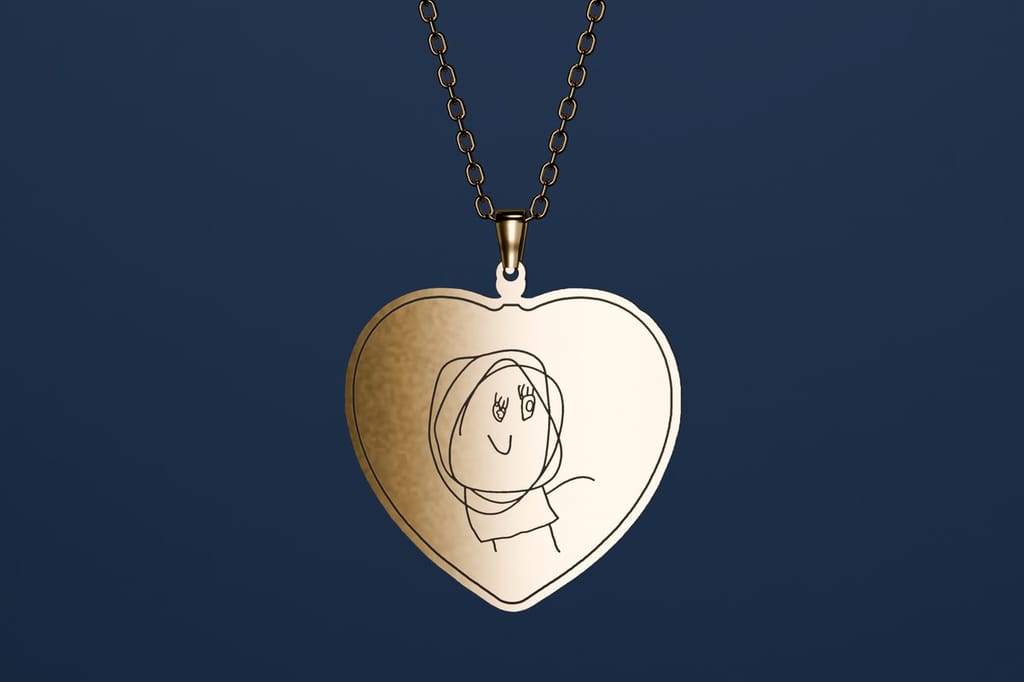
The poem a child makes for a parent or a grandparent usually comes with a drawing, and the drawing is the part people keep. Our drawing necklace puts that drawing on a pendant about an inch across, and one of the shapes is a heart: stainless steel $59, gold plated $69, sterling silver $89, on an 18-inch chain in a gift box. You see their drawing on the pendant before anything is made, and each one leaves the workshop in 2 to 5 days.
Valentine poems for dad
Dad poems work best when they're specific about what he did rather than how he felt about it. Edgar Guest's newspaper verse is the old-fashioned version, from a 1916 book he dedicated to his two children, "Marjorie and Buddy."
- Dad, you taught me how to ride,
to swim, to throw a ball;
you taught me how to get back up,
which mattered most of all. - You laughed at every joke I told,
even the ones that were bad.
I get my sense of humor
straight from you, Dad. - (From a small child) Daddy, you're the best
at piggyback rides and pancakes
and finding the monster
that wasn't there. - You never said much about it.
You just showed up:
every game, every recital,
every time. - Happy Valentine's Day, Dad.
Here is a card.
It is not a tie.
"Only a Dad," Edgar Guest, 1916 (last stanza)
Only a dad but he gives his all,
To smooth the way for his children small,
Doing with courage stern and grim
The deeds that his father did for him.
This is the line that for him I pen:
Only a dad, but the best of men.
Valentine poems for grandparents
A grandparent's valentine is usually signed in crayon, and that's the point. The first five are for a child to copy or dictate; the last three go the other way, from a grandparent to a grandchild. If you want the card to start a conversation, tuck in one of our questions to ask your grandparents.
- Grandma, your kitchen smells like cinnamon
and your hugs smell like you.
If I could bottle both of them,
I'd keep them all year through. - Grandpa, you know every bird
and every fishing knot.
You've taught me more out on that porch
than any school has taught. - Nana, you always have time,
a story and a snack.
Each time I leave your house I'm counting
the days till I come back. - Happy Valentine's Day, Grandpa.
You taught me checkers and patience.
I still lose at checkers. - We're miles apart on a map,
but close in every call.
I'm sending you this valentine
and a hug, the biggest of all. - (From a grandparent) I've had a lot of valentines
in all my years, it's true,
but the best ones came in crayon,
and all of them from you. - (From a grandparent) Every heart you've drawn for me
is taped up on my door.
Keep drawing them, my darling.
I've got room for plenty more. - (From a grandparent) You're nearly up to my shoulder now,
you're reading on your own.
I loved you when you fit in my arms,
and I'll love you fully grown.
Valentine poems for kids
These are for a parent to tuck into a lunchbox or write in a card, plus one for a child to give a teacher. Edward Lear wrote "The Owl and the Pussy-Cat" in December 1867 as a "picture poem" for the small daughter of a friend, who was ill at the time. For jokes and riddles to put in class valentines, see Valentine jokes for kids.
- I love you when you're muddy,
I love you when you're clean,
I love you when you're sleepy
and everywhere between. - (For the lunchbox) You are brave,
you are kind,
and all day long
you're on my mind. - If I could pick from every kid
in every town I knew,
I'd look at every single one
and still pick you. - You were my valentine
before you could walk,
before you could laugh,
before you could talk. - Here's a heart
for your lunchbox.
(Eat the sandwich first.) - When you're grown and far away
and find this note one day,
know I loved you from the start
with every bit of my heart. - (For a teacher) Thank you for the stories,
the stickers and the stars,
and for knowing all our names
and who we really are.
"The Owl and the Pussy-Cat," Edward Lear, 1870 (first stanza)
The Owl and the Pussy-Cat went to sea
In a beautiful pea-green boat:
They took some honey, and plenty of money
Wrapped up in a five-pound note.
The Owl looked up to the stars above,
And sang to a small guitar,
"O lovely Pussy, O Pussy, my love,
What a beautiful Pussy you are,
You are,
You are!
What a beautiful Pussy you are!"
First printed in February 1870 in Our Young Folks, a Boston children's magazine, then in Lear's Nonsense Songs (1871). Text on Project Gutenberg.
"Love me, I love you," Christina Rossetti, 1872 (from Sing-Song)
Love me, I love you,
Love me, my baby;
Sing it high, sing it low,
Sing it as may be.Mother's arms under you,
Her eyes above you;
Sing it high, sing it low,
Love me, I love you.
Sing-Song is a nursery rhyme book, "dedicated without permission to the baby who suggested them."
"Happy Thought," Robert Louis Stevenson, 1885
The world is so full of a number of things,
I'm sure we should all be as happy as kings.
The whole poem, from A Child's Garden of Verses. It fits on the smallest valentine there is.
Valentine poems for the dog (and from the cat)
Pets get valentines too, and they can sign them. Elizabeth Barrett Browning wrote a whole poem to her spaniel, Flush, who was a gift from her friend the writer Mary Russell Mitford, as her own footnote explains.
- (From the dog) I've loved you since the day you came
and filled my bowl and called my name.
I chewed your shoe. I'm sorry. Mostly.
Love, the dog. - (From the cat) I let you sit on my couch.
I let you pay for my food.
This is how I show love.
Don't make it weird. - (To the pet) You don't know it's February.
You don't know it's anything.
You only know I'm home,
and that's your favorite thing.
"To Flush, My Dog," Elizabeth Barrett Browning, 1844 (first stanza)
Loving friend, the gift of one,
Who, her own true faith, hath run,
Through thy lower nature;
Be my benediction said
With my hand upon thy head,
Gentle fellow-creature!
If the dog is the real valentine in your house, we also paint pet portraits from one photo.
Which poems were written for Valentine's Day itself?
Most "Valentine poems" are simply love poems. These five were written for the day, and they show how old the habit of sending verse on February 14 is. The oldest dates from 1477; the most ingenious hides a woman's name inside its letters.
Margery Brews to John Paston, February 1477
And yf ye commande me to kepe me true wherever I go,
I wyse I will do all my myght yowe to love and never no mo.
In modern spelling: "And if you command me to keep me true wherever I go, / Indeed I will do all my might you to love and never no more." The British Library calls her letter, addressed "unto my right well-beloved Valentine," the oldest surviving Valentine's Day letter in the English language. It was mostly about a dowry dispute, and the couple married later that year. Full text.
Ophelia's song, Hamlet, 1603
Tomorrow is Saint Valentine's day,
All in the morning betime,
And I a maid at your window,
To be your Valentine.
It rests on an old custom: the first man a woman saw on Valentine's morning would be her valentine, which is why she is at his window early. Ophelia sings it in her madness, and the lines that follow are bawdy, so copy only these four. Text at the Folger.
"An Epithalamion... on St. Valentine's Day," John Donne, 1613 (opening lines)
Haile Bishop Valentine, whose day this is,
All the Aire is thy Diocis,
And all the chirping Choristers
And other birds are thy Parishioners,
Written for a royal wedding: Princess Elizabeth, daughter of James I, married Frederick V of the Palatinate on February 14, 1613, when both were 16. Royal Museums Greenwich notes that Donne's was one of dozens of marriage poems published for the day. In modern spelling it begins "Hail Bishop Valentine, whose day this is, / All the air is thy diocese." Full text on Project Gutenberg.
"The Baker to his sweetheart," The New English Valentine Writer, about 1787
My heart just like my Oven glows,
And lost alas! is my repose,
You never pity me, tho' sick,
And are as crusty as a Brick.
Whene'er I'm kneading of my Dough,
It's whiteness I compare to you;
The finest Flour that e'er was ground,
So fine as you was never found.
Ah! be to me a loaf of bread,
The staff of life, or I am dead;
To my fond wishes now incline,
And be my faithful Valentine.
Valentine Writers were cheap booklets of ready-made verses to copy into a valentine; this London one cost sixpence and promised "A Complete Set of Valentines, Proper for almost every Trade in Town or Country." The baker's is the funniest. Scan of the book; its date comes from the English Short Title Catalogue.
"A Valentine," Edgar Allan Poe, 1846 (first four lines, as printed in 1849)
For her this rhyme is penned, whose luminous eyes,
Brightly expressive as the twins of Lœda,
Shall find her own sweet name, that, nestling lies
Upon the page, enwrapped from every reader.
The poem is a puzzle. Take the first letter of line one, the second letter of line two, the third of line three and so on, and the 20 lines spell the name of the poet Frances Sargent Osgood. The four lines above already give F, r, a, n. Poe sent it to a Valentine's party in New York in February 1846. (Lœda is the magazine's spelling of Leda.)
Which classic love poems are free to copy?
Any poem first published before 1931 is in the US public domain, so you can copy it into a card, print it on a gift or read it at a wedding without asking anyone. Works from 1930 entered the public domain on January 1, 2026, according to Duke University's Center for the Study of the Public Domain. A translation counts separately: Sappho is ancient, but most English versions of her are modern and copyrighted. Every classic on this page qualifies, and each text follows the edition we link, except that we've set the poets' long dashes as commas or periods. These eight are the best-known love poems not already placed above.
"How Do I Love Thee?" (Sonnet 43), Elizabeth Barrett Browning, 1850
How do I love thee? Let me count the ways.
I love thee to the depth and breadth and height
My soul can reach, when feeling out of sight
For the ends of being and ideal grace.
I love thee to the level of every day's
Most quiet need, by sun and candle-light.
I love thee freely, as men strive for right.
I love thee purely, as they turn from praise.
I love thee with the passion put to use
In my old griefs, and with my childhood's faith.
I love thee with a love I seemed to lose
With my lost saints. I love thee with the breath,
Smiles, tears, of all my life; and, if God choose,
I shall but love thee better after death.
She wrote the sequence while Robert Browning was courting her and published it as if it were a translation; the title Sonnets from the Portuguese is thought to come from his pet name for her, "my little Portuguese." Text at poets.org.
Sonnet 116, William Shakespeare, 1609
Let me not to the marriage of true minds
Admit impediments; love is not love
Which alters when it alteration finds,
Or bends with the remover to remove.
O no, it is an ever-fixèd mark
That looks on tempests and is never shaken;
It is the star to every wand'ring bark
Whose worth's unknown, although his height be taken.
Love's not time's fool, though rosy lips and cheeks
Within his bending sickle's compass come.
Love alters not with his brief hours and weeks,
But bears it out even to the edge of doom:
If this be error and upon me proved,
I never writ, nor no man ever loved.
The Folger Shakespeare Library calls it "a fixture of wedding ceremonies today." Text at the Poetry Foundation.
"Song: To Celia," Ben Jonson, 1616
Drink to me only with thine eyes,
And I will pledge with mine;
Or leave a kiss but in the cup,
And I'll not look for wine.
The thirst that from the soul doth rise
Doth ask a drink divine;
But might I of Jove's nectar sup,
I would not change for thine.I sent thee late a rosy wreath,
Not so much honouring thee
As giving it a hope, that there
It could not withered be.
But thou thereon didst only breathe,
And sent'st it back to me;
Since when it grows, and smells, I swear,
Not of itself, but thee.
Much of it is borrowed from the love letters of the Greek writer Philostratus, as the RPO notes explain. It is often sung "love's nectar sip," but the 1616 text reads "Jove's nectar sup."
"The Good-Morrow," John Donne, 1633 (opening of the second stanza)
And now good-morrow to our waking souls,
Which watch not one another out of fear;
For love, all love of other sights controls,
And makes one little room an everywhere.
First printed in 1633, two years after Donne's death. "One little room an everywhere" is the line for a couple who would rather stay in. Full text at RPO.
"Wild nights! Wild nights!" Emily Dickinson, 1891
Wild nights! Wild nights!
Were I with thee,
Wild nights should be
Our luxury!Futile the winds
To a heart in port,
Done with the compass,
Done with the chart.Rowing in Eden!
Ah! the sea!
Might I but moor
To-night in thee!
One of her first editors, Thomas Wentworth Higginson, wrote that it was "one poem only I dread a little to print," then added, "Yet what a loss to omit it!" Copy this 1891 text: the later editions that keep her dashes are still under copyright. Text on Wikisource.
"Out of the Rolling Ocean the Crowd," Walt Whitman, 1865 (from the second stanza)
Now we have met, we have look'd, we are safe,
Return in peace to the ocean my love,
I too am part of that ocean, my love, we are not so much separated,
The poem for a long-distance valentine. It first appeared in Drum-Taps, Whitman's Civil War book, and he later moved it into "Children of Adam," his group of love poems. Text at the Poetry Foundation.
"Invitation to Love," Paul Laurence Dunbar, 1895 (first stanza)
Come when the nights are bright with stars
Or when the moon is mellow;
Come when the sun his golden bars
Drops on the hay-field yellow.
Come in the twilight soft and gray,
Come in the night or come in the day,
Come, O love, whene'er you may,
And you are welcome, welcome.
First published in Majors and Minors (1895) and soon set to music for voice and piano, in 1901 and again in 1923. Text at poets.org.
"The Gardener, 30," Rabindranath Tagore, 1913
You are the evening cloud floating in the sky of my dreams.
I paint you and fashion you ever with my love longings.
You are my own, my own, Dweller in my endless dreams!
Tagore translated The Gardener into English himself, which is why it is free to copy, and dedicated the book to Yeats. His preface says these "lyrics of love and life" are translations "not always literal."
Bible verses for a Valentine card
The King James Version (1611) is in the public domain. Most modern translations are not, though their publishers usually allow a verse or two with credit.
Song of Solomon 8:6-7 (KJV)
Set me as a seal upon thine heart, as a seal upon thine arm: for love is strong as death; jealousy is cruel as the grave: the coals thereof are coals of fire, which hath a most vehement flame. Many waters cannot quench love, neither can the floods drown it: if a man would give all the substance of his house for love, it would utterly be contemned.
Contemned means scorned. Text at Bible Gateway.
1 Corinthians 13:4-7 (KJV)
Charity suffereth long, and is kind; charity envieth not; charity vaunteth not itself, is not puffed up, doth not behave itself unseemly, seeketh not her own, is not easily provoked, thinketh no evil; rejoiceth not in iniquity, but rejoiceth in the truth; beareth all things, believeth all things, hopeth all things, endureth all things.
Charity here means love: it translates the Greek agape, and the Revised Version of 1881 changed the word to "love." The familiar "Love is patient, love is kind" is the NIV's wording. Paul wrote it to a quarrelling church rather than to a couple, and a University of Manchester study guide by the New Testament scholar Peter Oakes and Benedict Kent notes that he "was not referring to romantic love between two people." It is read at weddings anyway, and it fits. Text at Bible Gateway.
Which famous love lines are misattributed?
These lines travel every February under the wrong name or with the wrong meaning. Eight are credited to people who never wrote or said them, among them Tennyson, Winnie the Pooh, Shakespeare, Dr. Seuss and Marilyn Monroe. Others are real but mean something different in context: Hamlet's famous love verse is read aloud by Polonius as proof that Hamlet has gone mad. Before you copy a famous line into a card, look it up with the person's name on Quote Investigator or Wikiquote. If neither can point to a book, a letter or a date, sign it "anonymous" or leave it out. The real sources below are linked, so you can check each one. For more sourced lines and their real authors, see our family quotes, which checks the same way.
| The line, roughly | Usually credited to | What the sources say |
|---|---|---|
| A flower for every time I thought of you | Tennyson | Not in his work. The earliest known instance is an unsigned Valentine's Day classified ad from 1985, later credited to the greeting-card poet Claudia Adrienne Grandi, per Quote Investigator. |
| Live to be a hundred minus one day | Winnie the Pooh | Not in A. A. Milne. The idea goes back to a 1917 verse by Tom Phillips in The Rotarian, and the exact line was first credited to Pooh in 1999, per Quote Investigator. |
| I love you not only for what you are, but for what I am with you | Elizabeth Barrett Browning, or "Roy Croft" | Not Browning. It became famous in the 1936 anthology Best Loved Poems of the American People, signed "Roy Croft," and it ends by calling this what being a friend means. |
| When I saw you I fell in love, and you smiled because you knew | Shakespeare | Arrigo Boito's libretto for Verdi's opera Falstaff (1893), per Quote Investigator. The Folger lists it among fake Shakespeare quotes. |
| To the world you may be one person, but to one person you may be the world | Dr. Seuss | Anonymous. The earliest instance found is an unattributed 1998 Usenet post, per Barry Popik. |
| You know you're in love when you can't fall asleep | Dr. Seuss | Not in any Seuss book. Wikiquote lists it as misattributed; its origin is unknown. |
| If you can't handle me at my worst | Marilyn Monroe | No evidence she said or wrote it, per Snopes. |
| Being deeply loved by someone gives you strength | Lao Tzu | Not in the Tao Te Ching. Its earliest known print is Dean Koontz's 1988 novel Lightning, per Stefan Stenudd, who keeps a list of fake Lao Tzu quotes. |
| Love is a single soul inhabiting two bodies | Aristotle, on love | About friends, not lovers. Diogenes Laertius reports that when asked "What is a friend?" Aristotle answered "A single soul dwelling in two bodies." |
| Doubt thou the stars are fire... but never doubt I love | Shakespeare, as a love poem | Real, but in Hamlet Polonius reads it aloud to the King and Queen as proof that Hamlet is mad for love, and Hamlet later tells Ophelia "I did love you once" and "I loved you not." Folger text. |
| Whatever our souls are made of, his and mine are the same | Emily Brontë, as a vow | Real, from Wuthering Heights (1847), but Catherine says it while explaining why she has agreed to marry someone else. Chapter 9. |
Which modern love poems can't you copy into a card?
Several modern favorites on other Valentine lists are still under copyright, and so are most English translations of older poems. In the US, a poem published from 1931 to 1963 is protected for 95 years after publication if its copyright was renewed, and one published since 1978 for the poet's life plus 70 years, according to Cornell University Library's copyright chart. That keeps Cummings's 1952 poem under copyright until the end of 2047. Write the title and poet in the card and let them look it up, or quote a single line with the poet's name. Reprinting the whole poem on a website, a product or anything you sell is the rights holder's decision. Here is where to read each one.
| Poem | Poet and year | Read it |
|---|---|---|
| "i carry your heart with me(i carry it in my heart)" | E. E. Cummings, 1952 | Poetry Foundation |
| Sonnet XVII, from One Hundred Love Sonnets | Pablo Neruda, 1959; English translations from 1986 and 2004 | poets.org |
| "Valentine" | Carol Ann Duffy, 1993 | Scottish Poetry Library |
| "Unending Love" | Rabindranath Tagore, 1890; the English is William Radice's 1985 translation | Penguin |
| The Rumi lines on lovers who were "in each other all along" | English versions by Coleman Barks, 1984, from Rumi's 13th-century Persian | The New Yorker on Barks's versions |
How do you write your own Valentine poem?
Start with one true, small thing about them, and build four lines around it. "You warm the car before I'm up" beats "you are my everything" because only one person does it. Say it plainly in the first two lines, turn it in the third, and end on a word that rhymes or on a short line that surprises. Read it aloud before you copy it into the card; a rhyme that only works on paper will trip you up. Three old forms make it easier, and each has a template below.
An acrostic. Write their name down the left margin and start each line with its letter. Poe hid a name the hard way, one letter deeper on every line; the easy way works fine.
Makes the best pancakes,
Often sings off-key,
Most of all, loves me.
A haiku. Three lines of five, seven and five syllables, usually about one moment.
Red paper hearts dry
on the kitchen table, glue
on all of our hands
A cinquain. Five lines of two, four, six, eight and two syllables, a form the poet Adelaide Crapsey invented while ill in 1913-14. It suits a child who likes counting on fingers.
Grandpa,
slow, patient, warm,
knows every bird by name.
We sat on the porch all morning,
my friend.
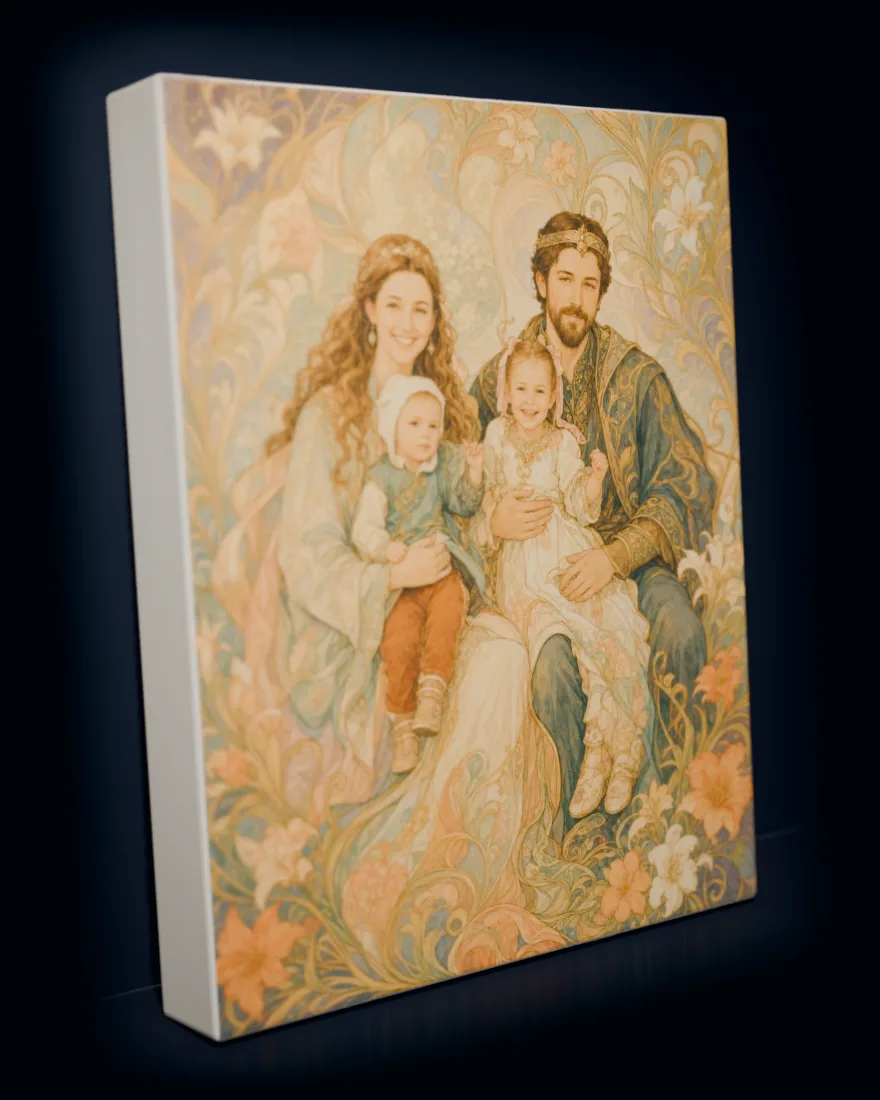
Paint the two of you
The poem goes in the card. For the wall, upload one photo of the two of you and we repaint it in the art style you choose, from an Art Nouveau panel to a felted-wool scene, as a canvas, a framed canvas or a fleece blanket. You approve a free, watermarked proof before anything prints.
Frequently asked questions
What is the best Valentine poem?
+
For a partner, two classics are hard to beat and free to copy: Robert Burns's "A Red, Red Rose" (1794) and Elizabeth Barrett Browning's "How do I love thee?" (1850). For a card, the best poem is usually a short one you write yourself around one true detail, like "You warm the car before I'm up, / you find the keys I lose."
What is a good short Valentine poem for a card?
+
Four lines is the right length for a card. One example: "Two coffee cups, the kitchen light, / your boots beside the door: / the plainest things I've ever loved, / and I keep finding more." For a gift tag, try two lines: "If love were measured out in days, / I'd ask for all of yours."
What are the most famous love poems?
+
Among the best known in English are Shakespeare's Sonnets 18 and 116 (1609), Elizabeth Barrett Browning's Sonnet 43, "How do I love thee?" (1850), Robert Burns's "A Red, Red Rose" (1794) and Lord Byron's "She Walks in Beauty" (1815). All are in the US public domain. Popular modern ones, such as E. E. Cummings's "i carry your heart with me" (1952), are still under copyright.
What should I write in a Valentine card?
+
Name one specific thing the person does that you love, say it plainly, and sign it. Four lines is plenty. If you'd rather borrow, copy a public-domain classic and add one line of your own underneath, so the card still sounds like you.
What is Carol Ann Duffy's "Valentine" about?
+
It is a 1993 poem in which the speaker turns down the usual red rose and satin heart and gives an onion instead, because an onion is truthful: it brings tears, its taste lingers, and its rings could stand in for a wedding ring. It is still under copyright, so read it at the Scottish Poetry Library rather than copying it out.
Can I copy a love poem into a Valentine card?
+
Any poem first published before 1931 is in the US public domain, so you can copy it into a card, print it on a gift or read it aloud freely. For a modern poem, write the title and the poet's name, or quote one line with credit. Reprinting a whole copyrighted poem on a website or a product is the rights holder's decision.
Did Tennyson write "If I had a flower for every time I thought of you"?
+
No. Quote Investigator found nothing like it in Tennyson's work. The earliest known instance is an unsigned Valentine's Day classified ad from 1985, and it was later credited to the greeting-card poet Claudia Adrienne Grandi.
Where does "roses are red" come from?
+
It is usually traced to a line in Edmund Spenser's The Faerie Queene (1590), "She bath'd with roses red, and violets blew." A Valentine verse close to the modern one, "The rose is red, the violet's blue, / The honey's sweet, and so are you," appeared in the nursery rhyme collection Gammer Gurton's Garland around 1784.