
In short
A handprint ornament is a child's (or a pet's) print pressed into dough or clay, or painted onto an ornament, then dried and sealed. Salt dough is the classic: 1 cup flour, 1/2 cup salt and 1/2 cup water, rolled 1/4 inch thick and baked at 250°F for 2 to 3 hours, the recipe Michigan State University Extension uses. Properly dried and sealed, it can last decades. Air-dry clay needs no oven, polymer clay stays soft until it's baked so a wriggly baby's print can be redone, and cinnamon dough smells like the holidays. Two safety rules matter more than the method: salt dough is poisonous to dogs and cats, even years-old ornaments, and a hand should never be cast directly in plaster of Paris, which heats up to about 140°F as it sets.
We read about twenty of the pages that rank for handprint ornaments before writing this one. Each covers a single material. Their oven settings run from 200°F to 300°F with no reason given for any of them. Four mention in one line that salt dough is bad for dogs, and none links a vet or a poison center. None mentions that a plaster handprint kit can burn a child.
So this page puts six methods side by side, takes its numbers from extension services, museums, children's hospitals and the clay makers' own instructions, and takes its safety advice from the ASPCA, the FDA, the CPSC and the American Academy of Pediatrics. Everything is linked, so you can check it.
Which handprint ornament method is best?
For most families, salt dough: it costs pennies and can last for decades if it is dried all the way through and sealed. Pick something else in three cases. With a pet in the house, use air-dry or polymer clay, because salt dough can poison a dog or cat. With a baby, polymer clay is easiest, since it stays soft until baked and you can redo the print as many times as you need. With no oven, use air-dry clay or cinnamon dough.
| Method | Oven? | Drying | Best for | Watch out for |
|---|---|---|---|---|
| Salt dough | 250°F, 2-3 hours | Or air dry 3-5 days | Kids 3 and up, classrooms | Raw flour; salt is poisonous to pets |
| Air-dry clay | No | 24 hours to touch, 72 to dry | Homes with pets, no oven | Can crack if thinner than 1/4 inch |
| Polymer clay | 275°F, about 30 min | Hard once cool | Babies; redo the print until it's right | Adult bakes; never hotter than the label |
| Cinnamon dough | No | 48 hours | Scent, quick crafts | Fragile; dusty to mix |
| Paint on an ornament | No | 4 to 21 days to cure | Older kids | Paint on skin; glass near toddlers |
| Plaster, from a mold | No | About 7 days | A heavy keepsake, not the tree | Never cast a hand directly |
Times and temperatures come from the sources linked in each section below.
How do you make a salt dough handprint ornament?
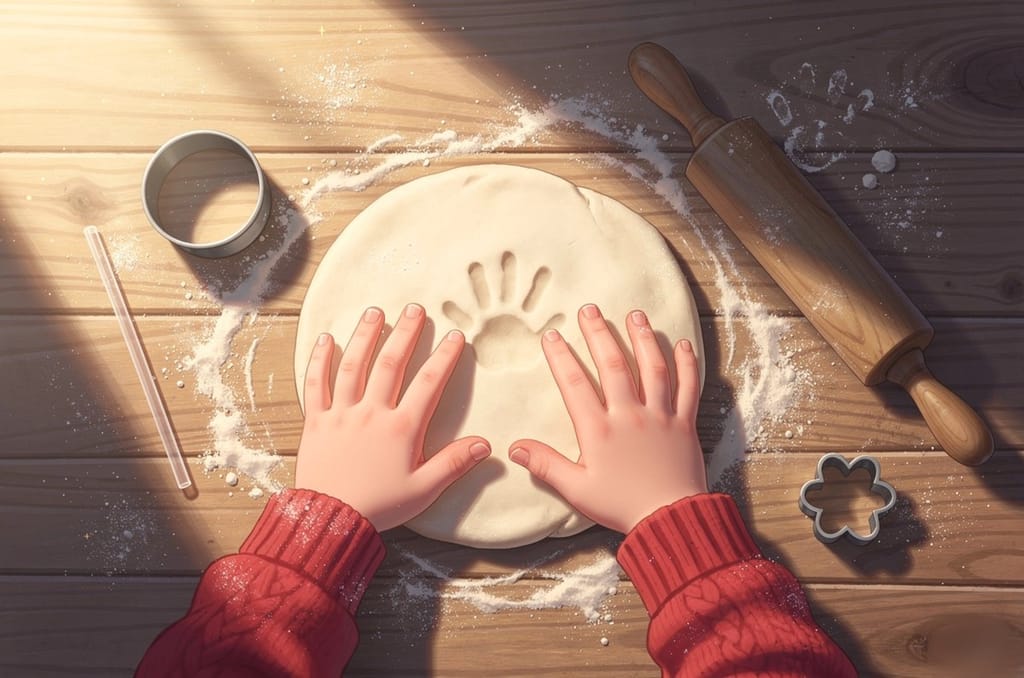
Mix 1 cup flour with 1/2 cup salt, add 1/2 cup water and knead until soft, adding flour if it sticks. Roll it 1/4 inch thick straight onto a sheet of parchment, so you never have to lift the soft print, press the hand in, cut a circle around it and poke a hanging hole with a straw about 1/2 inch in from the top edge. Slide the parchment onto a baking sheet. Bake at 250°F for 2 to 3 hours, or until completely dry, then cool it fully before you paint. That is the Michigan State University Extension recipe, and museum versions use the same 2:1:1 ratio: the Brandywine Museum of Art bakes it at 200°F for 1.5 to 2 hours.
How long do you bake salt dough ornaments?
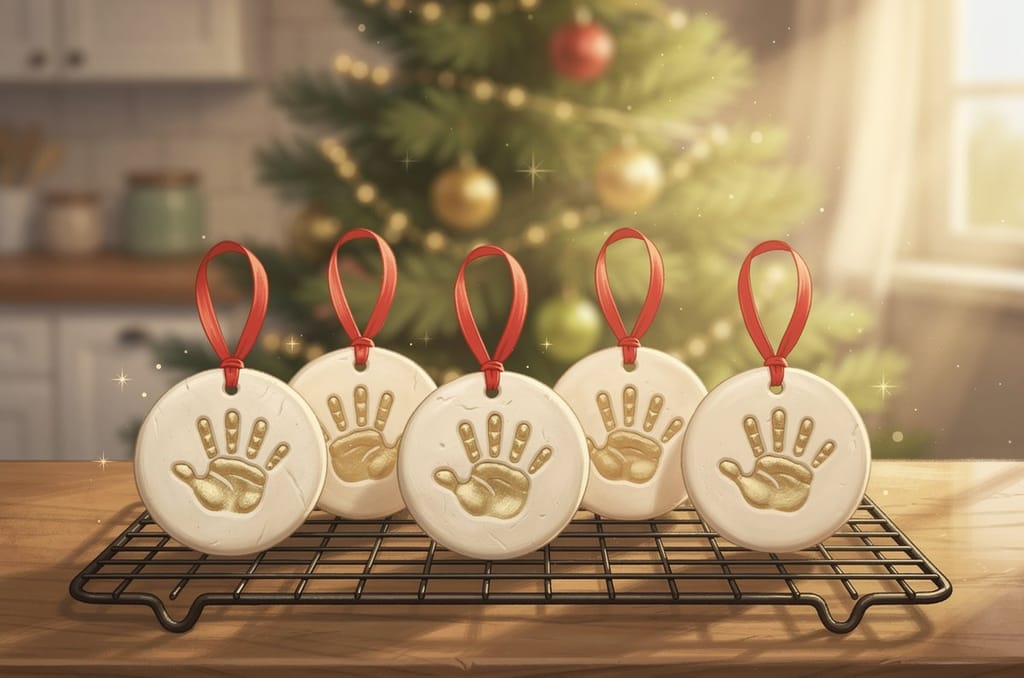
Low and slow, and longer for thick pieces. The temperatures in reputable recipes run from 200°F to 250°F, and the time depends on thickness: the Asheville Art Museum says thin ornaments take about an hour at 200°F, while a handprint rolled 1/4 inch thick needs the 2 to 3 hours MSU gives at 250°F. The North Dakota Forest Service flips its ornaments halfway through, which dries the back as well as the front.
Two checks tell you it's done. The American Chemical Society says dry salt dough looks less shiny, and Kidspace Children's Museum says to keep baking any piece that still feels sticky or has some give, then leave it to keep drying overnight. Kidspace also notes that larger, heavier pieces can crack as they harden.
Can you air dry salt dough instead?
Yes. The North Dakota Forest Service air dries its salt dough ornaments for about 3 to 5 days, up to a week for big or thick ones. Air drying is also the better choice if you scent the dough: the same guide adds 5 to 15 drops of essential oil and says air-dried ornaments keep the scent longer.
Is raw salt dough safe for kids?
Not to eat, and the government advice is stricter than most craft pages. The CDC says raw flour can carry E. coli and Salmonella and names dough for crafts and holiday ornaments among the raw doughs children shouldn't eat or play with. The FDA adds that children who don't eat the dough may still put their hands in their mouths afterward. Baking kills the bacteria, so the risk is in the raw stage.
If you make salt dough with a young child, keep the raw part to one quick press, wash the hand and the counter with soap and water straight after, and keep the dough away from mouths. For a toddler who mouths everything, air-dry or polymer clay avoids the flour entirely.
How do you make an air-dry clay handprint ornament?
Roll the clay at least 1/4 inch thick, press the print, cut the shape and poke the hole, then leave it to dry with no heat at all. One maker says its air-dry clay takes about 24 hours to dry to the touch and 72 hours to dry completely. The 1/4-inch minimum matters: thinner pieces can crack, and so can pieces made with too much water, according to the same maker, which suggests trying a few drops of water or a little wet clay smoothed in with a finger to repair a crack.
Flat pieces warp because the edges dry faster than the middle. The fix is to turn them regularly and dry them on a rack so air reaches the underside. Don't speed it up with a hair dryer: another clay maker says slow drying at cooler temperatures gives greater resistance to cracking and that a hair dryer can deform or crack the piece. Seal it once it's fully dry, but know that sealing air-dry clay won't make it waterproof, so it stays an indoor ornament.
How do you make a polymer clay handprint ornament?
Roll the clay about 1/2 inch thick, press the hand or foot in firmly, poke a hanging hole, and bake at the temperature on the package. One polymer clay maker's keepsake instructions bake a baby print for about 30 minutes at 275°F, and its general rule for most of its clays is 15 minutes per 1/4 inch of thickness. The big advantage with a wriggly baby is that the clay stays soft until it's baked, so you can smooth it over and press again as many times as it takes.
How do you bake polymer clay safely?
Follow the package and never go hotter: overheated clay starts to break down and gives off fumes that irritate the eyes, nose and mouth. The maker suggests checking your oven with a separate thermometer, since home ovens often run hotter than the dial, and keeping the kitchen ventilated. An adult should do the baking. Put parchment or foil between the clay and any pan you also cook on, and keep clay tools separate from kitchen tools. If you keep birds, bake with them well away from the kitchen: the ASPCA notes that fumes from baking these clays may be dangerous to birds.
How do you make cinnamon handprint ornaments?
Mix equal parts ground cinnamon and applesauce, adding cinnamon if it's wet or applesauce if it's dry. About 1/2 cup of each makes 4 to 6 small cutter-sized ornaments; a handprint disc takes far more, so double it for more than two or three. Roll it 1/4 inch thick between sheets of wax paper, press the print, poke the hole with a straw and let it air dry for 48 hours before handling. That is the Perkins School for the Blind version, which notes the finished ornaments "can be somewhat fragile."
The Chicago Botanic Garden says to roll it about 1/4 inch thick, because thinner dough can make brittle ornaments, and to mix it somewhere ventilated with an adult nearby, since pouring cinnamon makes a fine dust. The dough isn't edible. For pets, the ASPCA says a similar dough of applesauce, cinnamon and glue is not typically a big problem but can cause vomiting, so hang these high too.
Can you paint a handprint on a glass or plastic ornament?
Yes, and it is the one method that puts the print on a ready-made ornament instead of making one. Clean the surface first: one glass-paint maker says to wash glass in warm soapy water, then wipe it with rubbing alcohol or white vinegar to remove the film that stops paint from sticking. For the print itself, brush a washable finger paint whose label says it's safe on skin onto the palm and fingers. On a flat disc ornament, press the hand flat and hold each finger down so every line prints; on a ball, have your child cup it so the palm and fingers wrap around. Wash the hand straight away, and once the print is dry, seal it with a clear sealer so it doesn't rub off the slick surface. Save glass paint for details you add afterward with a brush, and give it time to cure: another maker's directions give 4 days, and the first maker's enamels need 21 days of air drying.
Is craft paint safe on a child's skin?
Only briefly, and only the right kind. The CPSC says not to use standard paint for skin painting, and Poison Control says to use products on skin only when the label says that's safe; water-based tempera and poster paints are at most mildly irritating. For children's art supplies in general, the American Academy of Pediatrics recommends water-based products labeled "conforms to ASTM D4236" with the AP (Approved Product) seal, and washing with soap and water afterward. With a toddler at home, choose a shatterproof ornament over glass: a Boston pediatric emergency department found the median age of children hurt by holiday ornaments was 2, and almost all the swallowed ornaments were glass.
Is plaster of Paris safe for a handprint?
Not directly on the skin, ever. Plaster of Paris gives off heat as it sets and can reach about 140°F (60°C); the UK's National Society for Education in Art and Design says skin can be damaged at much lower temperatures, perhaps as low as 113°F (45°C), with prolonged contact, and that holding a hand in setting plaster can cause burns severe enough to need surgery or amputation. That has happened. In 2007 a 16-year-old student in Lincolnshire, England, put her hands into plaster of Paris to make a cast and, the BBC reported, was left after 12 operations with no fingers on one hand and two on the other. The CPSC's art safety guide and the plaster makers' own safety sheets carry the same warning.
What is the safe way to make a plaster hand cast?
Make a mold first, the way one children's hospital does. The Royal Children's Hospital in Melbourne holds the hand in alginate, a soft molding material that sets in a minute or two; the hand slides out, and the mold is filled with casting stone away from the child. The cast is dry to the touch in 1 to 2 hours and fully dry in 7 days. It is a lovely keepsake, but a heavy one, so it belongs on a shelf rather than a branch.
How do you get a good handprint from a baby?
Expect a fist. Stroking a baby's palm makes the fingers close in a grasp, Stanford Medicine Children's Health explains, and the reflex usually disappears by about 6 months. The foot has a similar reflex, where pressure on the sole just below the toes curls them. So avoid stroking the palm or the ball of the foot while you position them.
Use two people. A hospital child life coordinator at Texas Children's describes uncurling each finger as she rolls the brush from palm to fingertip, then gently holding each finger down on the board so every line prints. With polymer clay, one maker's keepsake tips suggest holding the baby above the clay and pressing down on the fingers or toes, then redoing it until you like it. Whatever clay you use, roll it at least 1/4 inch thick and let the print dry flat; the Royal Children's Hospital in Melbourne keeps its clay prints flat for about a week while they dry. For a baby's first Christmas, our baby's first Christmas gifts guide has more keepsakes for that year.
How do you make a paw print ornament safely?
Use air-dry or polymer clay, not salt dough, and get two people. Veterinary Wisdom, which supplies paw-print kits to vet clinics, suggests trimming the hair around the pads and washing the paw, having one person gently hold the pet while the other brings the clay to the paw, pressing the center pad and then each toe without letting go, then lifting the paw away in one smooth motion.
Why is salt dough dangerous for pets?
Because of the salt. The FDA's veterinary center says a 10-pound pet can get sick from just 1/2 teaspoon of table salt, and 1 1/2 teaspoons can be fatal; the 1/2 cup of salt in the recipe above is 24 teaspoons. Pet Poison Helpline says as few as 1 or 2 salt dough ornaments could make a dog very sick, and baked pieces can also cause a blockage. In a peer-reviewed study of 14 dogs that ate homemade play dough, 12 showed signs, most often vomiting. The ASPCA says to keep any salt dough out of reach, even ornaments that are years old, and to call your vet or the ASPCA Animal Poison Control Center at (888) 426-4435 if a pet eats some. Modeling and polymer clays, by contrast, pose minor threats, usually an upset stomach.
If the paw won't cooperate, or the pet is gone, a photo is enough for an ornament with your dog or cat painted on it.
How do you seal a handprint ornament?
Let it dry completely first, then seal every side. MSU Extension uses clear acrylic varnish to protect salt dough against moisture, and Kidspace Children's Museum says salt dough needs sealing after decorating, with a decoupage sealer or spray shellac. Coat the back, the edges and the inside of the hanging hole too, so no bare dough is left to take in moisture.
Write the name and year before the last coat, with a permanent paint pen, so the sealer covers the writing too. Do any spraying outdoors, away from children, pets and open flames, and bring the ornaments in once the smell has gone. Indoors, brush the sealer on instead.
How long do salt dough ornaments last?
They can last decades as long as they are dried all the way through, according to a West Virginia University Extension 4-H agent. Moisture is what ruins them, which is why MSU's sealing step exists.
Store them the way you'd store anything that dislikes damp: wrapped in tissue in a closed box, indoors, rather than in a basement or a garage. Check them each year when the box comes out, and re-seal any chipped spot. And keep that box somewhere a dog can't reach, since the salt is still there decades later.
| Problem | Likely cause | Fix |
|---|---|---|
| Salt dough still soft or sticky | Not dry in the middle | Bake longer and let it dry overnight (Kidspace) |
| Salt dough cracked | A large, heavy piece | Keep it to 1/4 inch, no thicker, and keep shapes compact (Kidspace) |
| Air-dry clay cracked | Too thin or too wet | Keep it 1/4 inch or thicker; try filling with wet clay (maker FAQ) |
| Air-dry clay curled | Edges dried first | Turn it often and dry it on a rack (maker FAQ) |
| Polymer clay darkened | Oven running hot | Check with an oven thermometer; bake a test disc (maker FAQ) |
| Cinnamon dough has hairline cracks | Too dry | Work in more applesauce (Chicago Botanic Garden) |
| Scent faded | Baked instead of air dried | Air dry scented dough (North Dakota Forest Service) |
What are easy Christmas handprint crafts?
The easiest are a handprint tree, a handprint Santa and a footprint reindeer: each needs one or two colors of washable paint, a sheet of card and a few minutes, and the twelve below build on them. Painted handprints on card are the quickest version of all; use blue, green or red card for anything printed in white so it shows. The single-print ideas (Santa, the snowman, the penguin, the gingerbread figure) also fit on a dried salt dough or clay disc cut a little bigger than the hand or foot, and the fingerprint ones fit on any ornament. Use a washable finger paint labeled safe for skin, keep each print to one quick press, and wash hands right after.
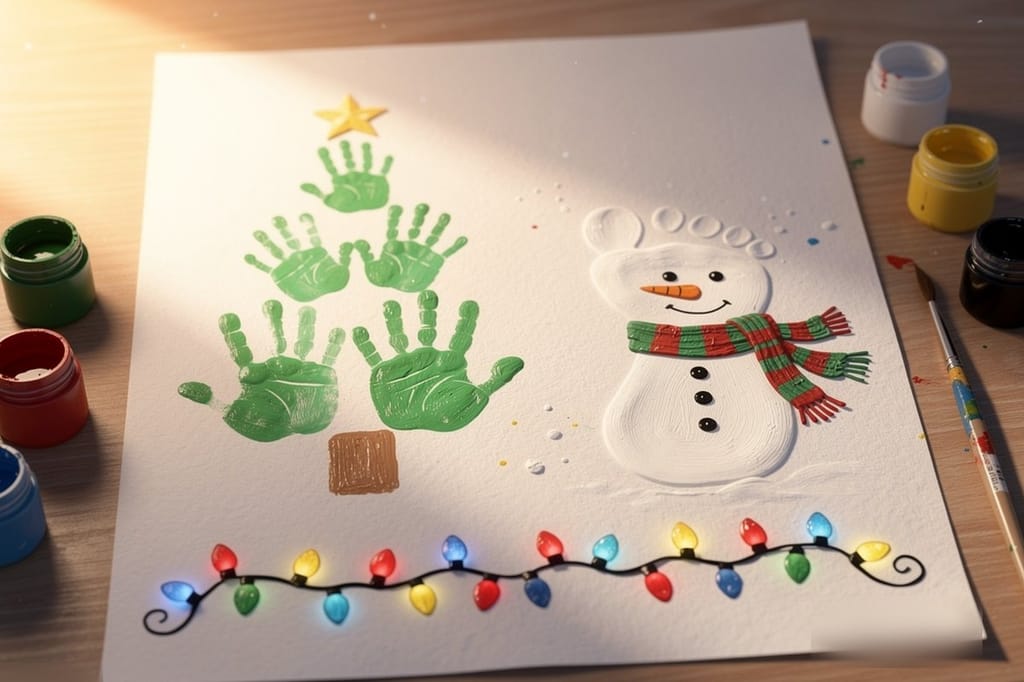
- Christmas tree. Green handprints with the fingers pointing down, in overlapping rows: three along the bottom, then two, then one at the top, each row printed once the one below is dry. Add a brown thumbprint trunk and fingerprint ornaments all over.
- Santa. Paint the palm a skin tone and the four fingers white, leave the thumb bare, and press with the fingers pointing down: the palm is the face and the fingers are the beard. Paint a red hat with white trim above the palm, then add eyes.
- Reindeer. A brown footprint with the heel at the bottom is the face: the heel is the muzzle and the toes are the top of the head. Two brown handprints with the fingers spread, angled up and out from either side of the toes, are the antlers. Add two eyes and a black thumbprint nose on the heel.
- Snowman. On blue or dark card, a white footprint with the heel at the top: the heel is the head and the ball of the foot is the body. Paint a scarf across the narrow middle, then add eyes, an orange nose and three button dots.
- Angel. On colored card, two white handprints with the fingers pointing up and out make the wings. Once they dry, press a footprint between them, heel at the top for the head and toes at the bottom as the hem of the gown, then paint a yellow halo above the heel.
- Wreath. A ring of green handprints, fingers pointing out, with a painted bow at the bottom.
- Penguin. A black footprint with the heel at the top for the head. Once it dries, paint a white belly over the wide part, two eyes, an orange beak on the heel and orange feet at the toes.
- String of lights. Draw a wavy wire across the card and add a fingerprint bulb in a different color every inch.
- Candy cane. Alternate red and white fingerprints along a hook shape.
- Holly. Two green handprints, fingers together, with the heels of the hands touching and the fingers angled apart in a V, as two leaves. Add three red thumbprint berries where the heels meet.
- Star. Five yellow handprints, fingers together, pointing out from a shared center with the palms overlapping in the middle: each hand is one point of the star.
- Gingerbread figure. A brown handprint with the fingers pointing up, the middle three pressed together for the head and the thumb and little finger stretched out to the sides for the arms; the palm is the body. Add two brown thumbprint feet under the palm, a face on the fingers, then icing lines and buttons in white paint.
And when one of your child's drawings is too good to keep in a box, it can be stitched in thread onto a sweatshirt.
Why make a handprint ornament every year?
Because the change is the point, and it's bigger than it looks. In a University of Michigan survey of American children, average hand length (wrist crease to middle fingertip) was about 2.7 inches at 0 to 3 months and 3.5 inches at age 1. It adds about 0.4 inch in the second year, then roughly 1/4 to 1/3 inch a year from age 2 to 7. Make the circle the same size every year and the hand fills more of it each time.
| Age | Hand length | Age | Hand length |
|---|---|---|---|
| 0-3 months | 2.7 in (6.8 cm) | 7 | 5.2 in (13.1 cm) |
| 1 | 3.5 in (8.8 cm) | 8 | 5.4 in (13.7 cm) |
| 2 | 3.9 in (9.8 cm) | 9 | 5.6 in (14.2 cm) |
| 3 | 4.2 in (10.6 cm) | 10 | 5.7 in (14.6 cm) |
| 4 | 4.4 in (11.2 cm) | 11 | 6.1 in (15.4 cm) |
| 5 | 4.7 in (11.9 cm) | 12 | 6.2 in (15.8 cm) |
| 6 | 4.9 in (12.5 cm) | 13 | 6.5 in (16.5 cm) |
Means from the 1975 University of Michigan anthropometric survey of US children (Snyder et al.), via NIST. Use them to pick a cutter: an average five-year-old's hand is 4.7 inches long, so a 5-inch circle only just holds it. Go up to about 6 inches to leave room for the hanging hole above the fingertips.
People have been leaving handprints for a long time. A hand stencil on the wall of a cave on Muna Island, Indonesia, is at least 67,800 years old, according to a 2026 study in Nature, the oldest dated cave art yet attributed to our species.

Hang this year's portrait next to the handprint
A handprint shows how big they were. A portrait ornament shows who they were that year: upload one photo and we paint your child as the hero of a world they'd choose, on a ceramic ornament about three inches across with a gold cord. You see the finished design before you pay, and nothing prints until you approve it.
Extra ornaments in the same order are $19 each, so it's easy to add one for every grandparent. See every world and style on the personalized Christmas ornament page.
Frequently asked questions
How long do you bake salt dough handprint ornaments?
+
About 2 to 3 hours at 250°F for a handprint rolled 1/4 inch thick, or until completely dry, per Michigan State University Extension. Thinner pieces can be done in about an hour at 200°F. Keep baking any piece that still feels sticky or gives when pressed.
Are salt dough ornaments safe for dogs?
+
No. The salt can cause vomiting, extreme thirst, seizures and death. The FDA says a 10-pound pet can get sick from 1/2 teaspoon of salt, and the ASPCA says to keep salt dough out of reach even when the ornaments are years old. If a pet eats some, call your vet or the ASPCA Animal Poison Control Center at (888) 426-4435.
What paint is safe for a baby's handprint?
+
Use a washable finger paint whose label says it's safe on skin, and keep contact brief: Poison Control says to put art products on skin only when the label says that's safe, and that water-based tempera and poster paints are at most mildly irritating. The American Academy of Pediatrics recommends water-based supplies labeled "conforms to ASTM D4236" with the AP seal. Wash the hand with soap and water right after. A clay print needs no paint at all.
Can you use plaster of Paris for a handprint?
+
Not directly. Setting plaster can reach about 140°F and has caused severe burns and amputations when hands were held in it. Make a mold first with alginate, slide the hand out, then fill the mold with plaster or casting stone, the method the Royal Children's Hospital in Melbourne uses.
How long do salt dough ornaments last?
+
They can last decades if they are dried all the way through and sealed against moisture. A West Virginia University Extension 4-H agent says properly dried salt dough ornaments can last decades. Store them wrapped in a closed box indoors, away from damp basements and garages.
What do you seal a salt dough ornament with?
+
Clear acrylic varnish or decoupage sealer brushed on, or spray shellac used outdoors, once it's completely dry. Michigan State University Extension uses clear acrylic varnish to protect against moisture. Coat the back, the edges and the inside of the hanging hole as well as the front.
Can you make a handprint ornament without an oven?
+
Yes. Air-dry clay takes about 72 hours to dry completely, cinnamon and applesauce dough about 48 hours, and salt dough can air dry in 3 to 5 days. You can also paint a handprint straight onto a shatterproof ornament.