In short
A valentine box is the decorated box with a slot that a child brings to the class Valentine's party so classmates can drop their cards in. Here are 48 ideas sorted from 15-minute boxes a 3-year-old can decorate to two-hour machines for 10-year-olds, each with an age, a build time and the steps. Cut the slot about 5 inches long and half an inch to an inch wide, wrap the lid separately so it still lifts off, and let a grown-up do the cutting and any hot glue.
Before planning a single box, we read the valentine box lists that rank on Google, from the big magazine galleries to the craft blogs and Hallmark's own tutorials. None of them gives an age or a build time for each idea. Only one tutorial gives a measurement for the slot. The most popular list builds 17 of its 59 boxes around a licensed character, and several list a craft knife and a hot glue gun among the supplies for a kids' project without saying who should hold them.
Every box here is generic, so your child can make it their own, and each one comes with who it suits, how long it takes, what it starts from and how to build it. The pictures are AI renders of each finished build, made for this post to show the shape. Below the boxes you'll find what teachers actually ask for, sourced from real school letters, and the safety details that matter when a 6-year-old and a glue gun share a table.
Which valentine box suits which age?
Most 3- to 5-year-olds can decorate a box while a grown-up does the cutting. From about 5, children can cut out simple shapes for themselves, so save the machines with windows and moving parts for 8 and up. Pick the box by the hands that will build it, not by the picture.
The ages follow how scissor skills develop. A developmental sequence published by the American Occupational Therapy Association's children and youth section, citing Hilton and Kramer (2020), has children cutting along a 6-inch line at 3 to 3½, cutting out a circle at 3½ to 4, a square at 4½ to 5, and a range of shapes at 6 to 7. The CDC lists "writes some letters in her name" and paying attention for 5 to 10 minutes during arts and crafts among the milestones most children reach by 5, which is why the youngest boxes here take about 15 minutes.
| Age | What their hands can do | Who cuts the slot | Good first picks |
|---|---|---|---|
| 3 to 5 | Stickers, glue sticks, paint, snipping fringe with blunt-tip scissors | A grown-up | Heart sticker box, tissue-box monster, paper bag owl |
| 5 to 7 | Cutting out circles and squares, gluing small parts, writing their name | A grown-up | Owl, hedgehog, unicorn, rocket, donut |
| 7 to 9 | Cutting curves and many shapes, building a second shape onto the box | A grown-up | Dragon, castle, pirate ship, airplane |
| 9 to 12 | Planning a build with windows, moving parts and clear plastic | A grown-up, or the child with a grown-up beside them | Gumball machine, vending machine, claw machine |
The ages are starting points. A 5-year-old who loves dragons can build the dragon with more help.
How big should the slot in a valentine box be?
Cut the slot about 5 inches long and half an inch wide for flat cards, or an inch wide if your class tapes on pencils, lollipops or erasers. That takes every boxed classroom valentine we found listed, short edge first, and most homemade cards in an envelope.
Boxed classroom valentines are small. Hallmark lists its kids' sets with cards about 2.5 by 3.6 inches, and its mini cards are listed at 2.25 by 3.5 inches. Homemade cards are bigger: the common A2 envelope is 4⅜ by 5¾ inches, so it needs about 4¾ inches of slot on its short side, and the University of Michigan's print shop suggests a quarter inch of room on each dimension so a card slides in easily. Hallmark's own koala box tutorial uses a slot about 3½ by 1¼ inches, which an A2 envelope can't fit through.
| Valentine | Size | Slot length it needs |
|---|---|---|
| Mini boxed valentine | 2¼ × 3½ in | 2½ in |
| Kids' boxed classroom valentine | 2½ × 3⅝ in | 2¾ in |
| Valentine with a small toy taped on | 3½ × 4½ in (one maker's eraser card) | 3¾ in, about 1 in wide |
| Homemade card in an A2 envelope | 4⅜ × 5¾ in | 4¾ in |
| Large exchange card | 4¼ × 6 in (one maker's big card) | 4½ in |
| Oversized novelty card | 6 × 8 in (sunglasses card) | 6¼ in, or a side door |
Slot length = the card's short side plus about a quarter inch. A 5-inch slot covers every row but the last.
What box should you start with?
A shoebox is the classic base because the lid lifts off, so the cards come out without tearing anything. Any clean box works, though, and a few common ones change what you can build.
A child's shoebox from packaging supplier Uline measures 9 by 7 by 4 inches, a women's 12 by 7 by 4 and a men's 14 by 8 by 5, and even the smallest holds a class's cards. The average US self-contained elementary class had 19.1 students in 2020-21, though one Ohio school's 2024 letter asked for 28 signed valentines. Most shoe boxes and cereal boxes are thin paperboard, which the EPA counts separately from corrugated cardboard: easy to cut with scissors, but floppy under heavy parts.
| Base | Typical size | Good for | Watch out for |
|---|---|---|---|
| Shoebox | 9 × 7 × 4 to 14 × 8 × 5 in | Almost anything; the lid lifts off | Printed logos show through thin paper |
| Cube tissue box | 4½ × 4⅜ × 5 in | Monsters and faces; the hole is already cut | Small; test the hole with a real card |
| Round oatmeal canister | About 5 in across, 10 in tall | Rockets, penguins, drums | Curved sides are hard to cut neatly |
| Family-size cereal box | About 8 × 4 × 13 in | Tall machines, robots, vending machines | No lid, so add a flap to empty it |
| Paper lunch bag | 6⅛ × 4 × 12⅜ in (#8) | Quick owls and animals, when bags are allowed | Tears if it gets wet |
| Paper plates | 8½ or 10 in | Donuts, saucers, wheels, rings | Shallow; flat cards only |
How do you make a valentine box?
Plan the slot first, cover the box and the lid separately, build the shape, then decorate. That order keeps the lid working and stops anyone cutting through finished decorations.
- Mark the slot and have a grown-up cut it with a craft knife on a cutting mat, blade moving away from the body, as Canada's workplace safety agency advises for any utility knife. Cut it before decorating.
- Cover the box and the lid separately in paper, folding the edges inside, so the lid still lifts off to empty the box at the party.
- Add the big shapes: heads, necks, wings, towers. Score any fold first by pressing a dry ballpoint pen along a ruler, the trick bookbinders use with a bone folder, so card bends where you want it.
- Decorate. This is the child's part: eyes, hearts, scales, stickers.
- Put their name on the outside where the teacher can read it, then push a real valentine through the slot to test it.
Start at least a week ahead. White glue needs time: Aleene's says to let white glue set at least overnight, and 48 hours if a part bears weight, and Crayola's own shoebox craft allows 1 to 2 hours per coat of washable paint, with two coats.
Which glue works on what?
Use a glue stick for paper, white school glue for card and craft sticks, tacky glue for felt, foam and pom-poms, and a low-temperature glue gun, held by a grown-up, for heavy parts like heads, necks and towers.
| Glue | Use it for | Drying time |
|---|---|---|
| Glue stick | Paper onto paper or the box; the best glue for small children | Fast; bonds paper and cardboard |
| White school glue | Paper, card, craft sticks | Overnight; 48 h if it bears weight |
| Tacky glue | Felt, foam, pom-poms, googly eyes | About 37-47 minutes for a thin coat |
| Low-temperature glue gun | Heavy parts: heads, necks, towers | Seconds; a grown-up uses it |
| Clear tape | Holding parts while glue dries; inside joins | None |
Glue both surfaces, wait about five minutes for white glue to get tacky, then press and hold with tape or clothespins, as Aleene's suggests.
15-minute valentine boxes for ages 3 to 5
These six take about as long as a preschooler's attention span. A grown-up does any cutting, and the child does the sticking, painting and choosing. Each one starts from something you probably have at home: a shoebox, a tissue box or a paper bag.
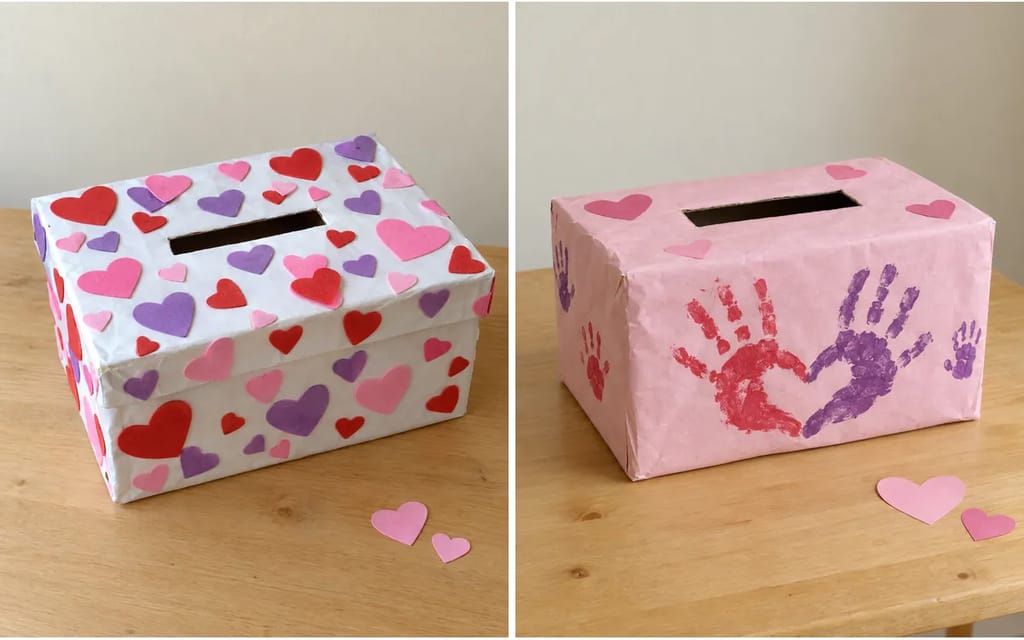
1. Heart sticker box. Ages 3-5 · 15 minutes · shoebox Wrap the box and the lid separately in plain white paper, so the lid still lifts off when it's time to read the cards, then hand over a sheet or two of foam heart stickers. There's no glue to dry and no wrong answer. A grown-up cuts the slot in the lid at the end, once the stickers are down.
2. Handprint heart box. Ages 3-5 · 20 minutes, plus drying · shoebox Cover the box in pink paper first, because paint soaks into bare cardboard and any printing on the box shows through. Brush your child's palm with a washable paint labeled safe for skin (see the safety section), press two hands side by side with the thumbs touching, and the prints make a heart. Let it dry overnight before anyone cuts the slot.
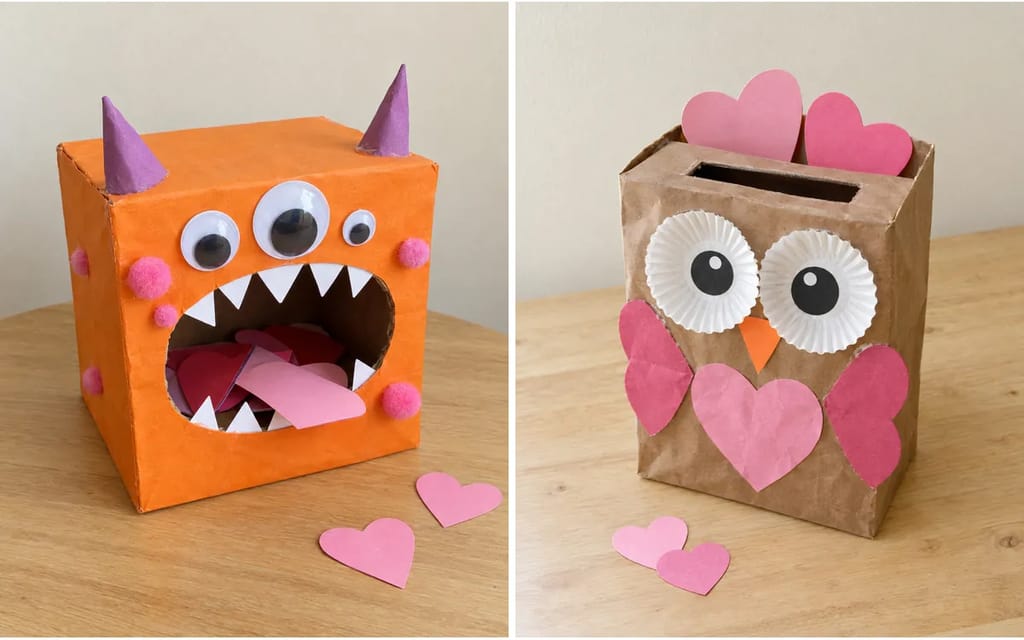
3. Tissue-box monster. Ages 3-5 · 15 minutes · cube tissue box The quickest box on the list, because a tissue box comes with its hole already cut. Pull out the last tissues and the plastic film, cover the box in bright paper, trim the paper around the opening, then add googly eyes, paper horns and a ring of paper teeth. The cards go straight into the mouth. Push a real valentine through before the party in case the opening is narrower than your class's cards.
4. Paper bag owl. Ages 3-5 · 15 minutes · paper lunch bag If the teacher's note allows bags, a lunch bag is the cheapest box there is. Glue on two cupcake liners for eyes, an orange paper beak and paper hearts for wings, then fold the top over twice, staple it shut, and cut the slot through the fold. Paper heart ear tufts glued behind the fold finish the owl. It goes to school folded flat in a backpack, which a box can't.
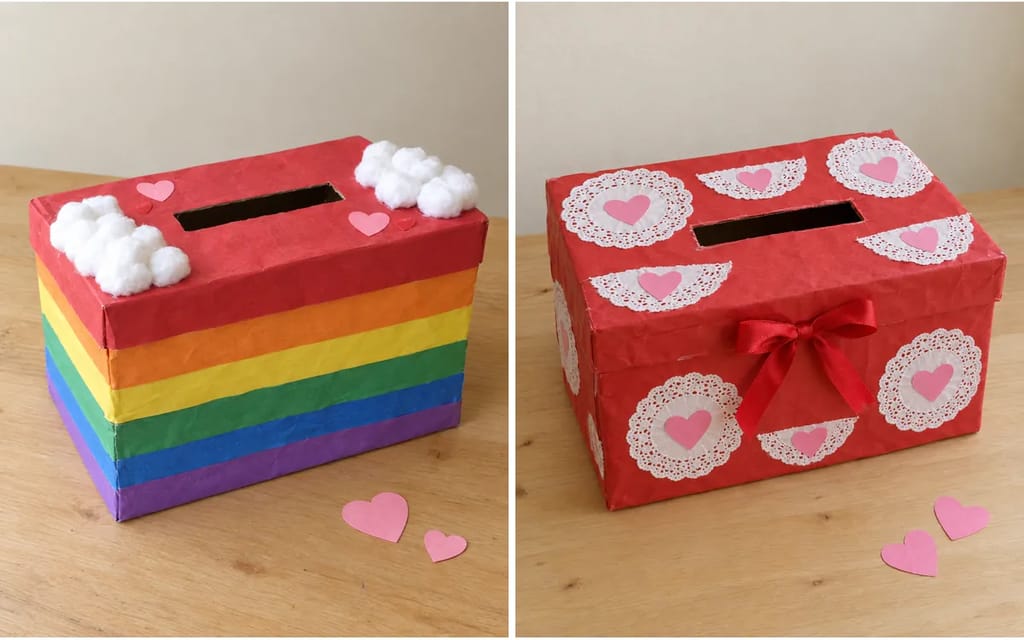
5. Rainbow box. Ages 3-5 · 20 minutes · shoebox Cut strips of construction paper in red, orange, yellow, green, blue and purple ahead of time, and your child glue-sticks them across the box in rainbow order. Cotton balls pressed onto each end of the lid become clouds. Wobbly stripes look better than straight ones here.
6. Paper lace box. Ages 3-5 · 20 minutes · shoebox Paper doilies are sold with baking and party supplies, and a pack covers a shoebox twice. Wrap the box in red paper, glue on whole and half doilies with a glue stick, put a pink paper heart in the middle of each, and finish with a ribbon bow on the front. It looks like the lace-paper valentines of the 1800s (more on those below).
Animal valentine boxes
An animal is the easiest shape to read from across a classroom, because a face does most of the work. Most of these stand a shoebox on its end so the box becomes a tall body with a face at the top and the slot as a mouth or a belly.
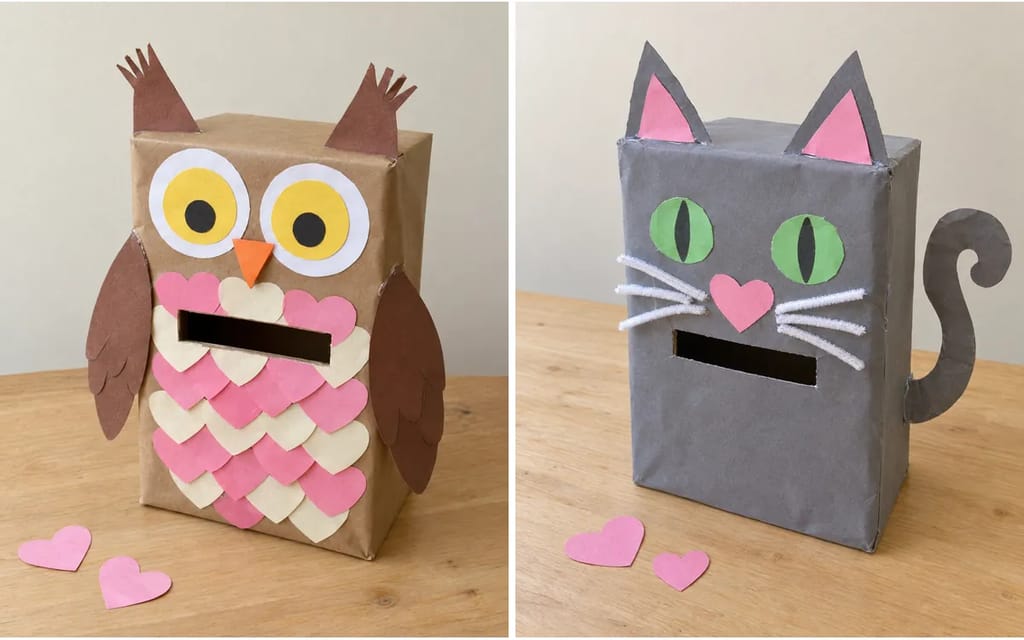
7. Owl. Ages 4-7 · 45 minutes · shoebox, standing on its end Tape the lid shut and stand the box on one short end so it's tall like an owl. Cover it in brown paper, cut the slot across the middle (the belly), then glue rows of paper heart "feathers" from the bottom up so each row overlaps the one below and frames the slot. Big paper-circle eyes, a beak and two ear tufts finish it.
8. Cat. Ages 4-7 · 40 minutes · shoebox, standing on its end Stand the box up and cover it in gray paper. Cut two triangle ears from card stock with a tab folded at the bottom, glue the tabs inside the top, and add green eyes and a pink heart nose. A grown-up pokes three small holes on each side of the nose for pipe-cleaner whiskers. The slot is the smile.
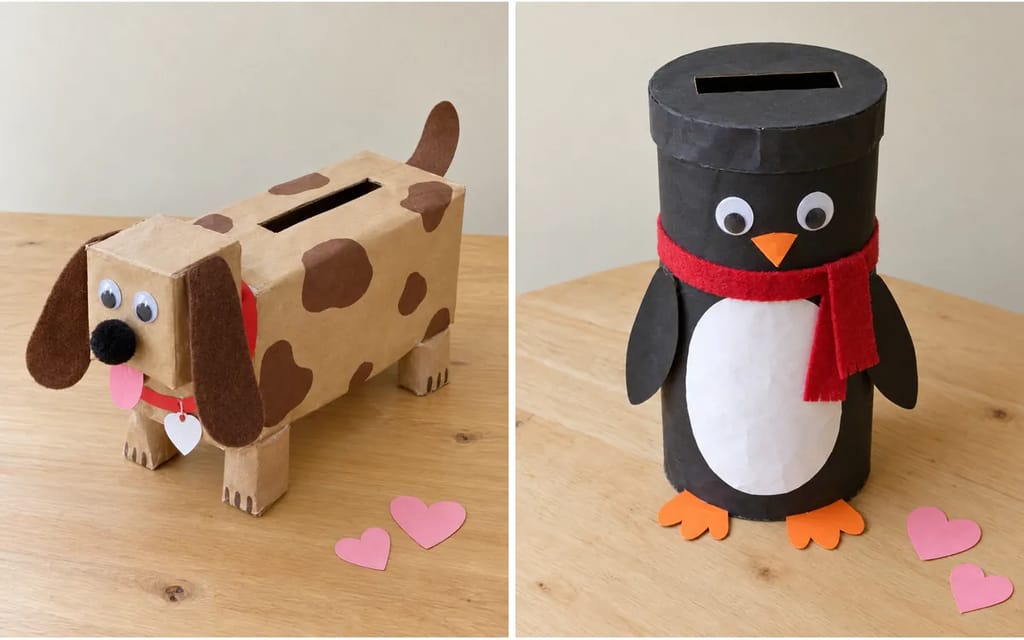
9. Puppy. Ages 4-7 · 40 minutes · shoebox plus a small box Lay the shoebox flat for the body and glue a small box (a tea or gift box) on one end for the head. Long felt ears, a black pom-pom nose and a pink paper tongue make the face, and a red paper collar holds a blank heart tag for your child's name. Copy the colors and spots of your own dog if you have one. The slot runs along the back.
10. Penguin. Ages 4-7 · 35 minutes · round oatmeal canister A round canister makes a penguin without any shaping. Cover it in black paper, glue a white oval for the belly, add an orange beak, flippers and two orange feet sticking out at the bottom, and tie a strip of felt around the "neck" as a scarf. The slot goes in the plastic lid, so the cards come out the top.
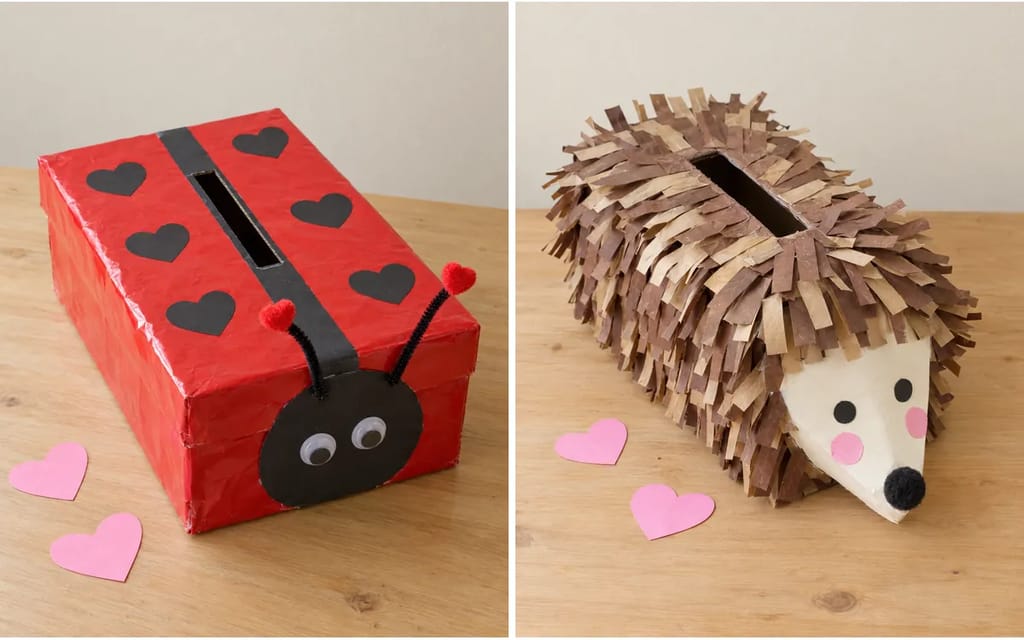
11. Ladybug. Ages 4-7 · 35 minutes · shoebox Cover the box in red paper, run a black paper line down the middle of the lid, and dot it with black hearts instead of round spots. A black paper head goes on the front with googly eyes and pipe-cleaner antennae. Cut the slot along the black line so it looks like the place where a ladybug's wing cases open.
12. Hedgehog. Ages 5-8 · 1 hour · shoebox This one is mostly scissor practice. Cut strips of brown and tan paper about two inches wide, snip one long edge into fringe, and glue the strips in rows from the back of the box to the front, each row overlapping the last, so the fringe stands up like spikes. A cream paper face with a pom-pom nose goes on the front, and the slot is cut through the spikes.
Dinosaur, dragon and unicorn valentine boxes
These are the boxes children ask for by name. They take an hour or more because each needs a second shape glued on: a head, a neck, wings or towers.
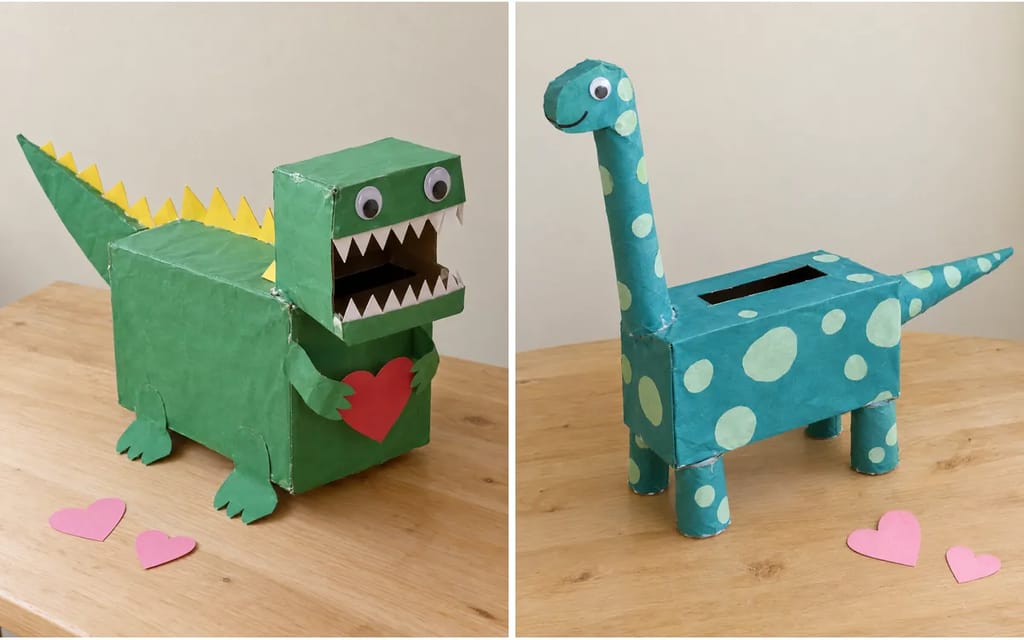
13. T. rex. Ages 5-9 · 1 hour · shoebox plus a small box Lay the shoebox flat for the body and glue a smaller box to one end, standing up, for the head. A grown-up cuts a wide mouth into the head and a matching hole into the body behind it, so cards dropped in the mouth fall through. Paper teeth go around the mouth, a long paper tail at the back, and the two tiny arms hold a red heart, which is the joke every T. rex box needs.
14. Long-neck dinosaur. Ages 5-9 · 1 hour · shoebox plus paper tubes The box is the body, four toilet-paper tubes are the legs, and a paper-towel tube is the neck. Cut a hole in the top corner of the lid for the neck, push the tube in at an angle and tape it from inside, then glue a small paper head on top. Keep all four feet flat and the tail straight out behind: long-necked dinosaurs like Diplodocus walked on four legs and held their tails off the ground.
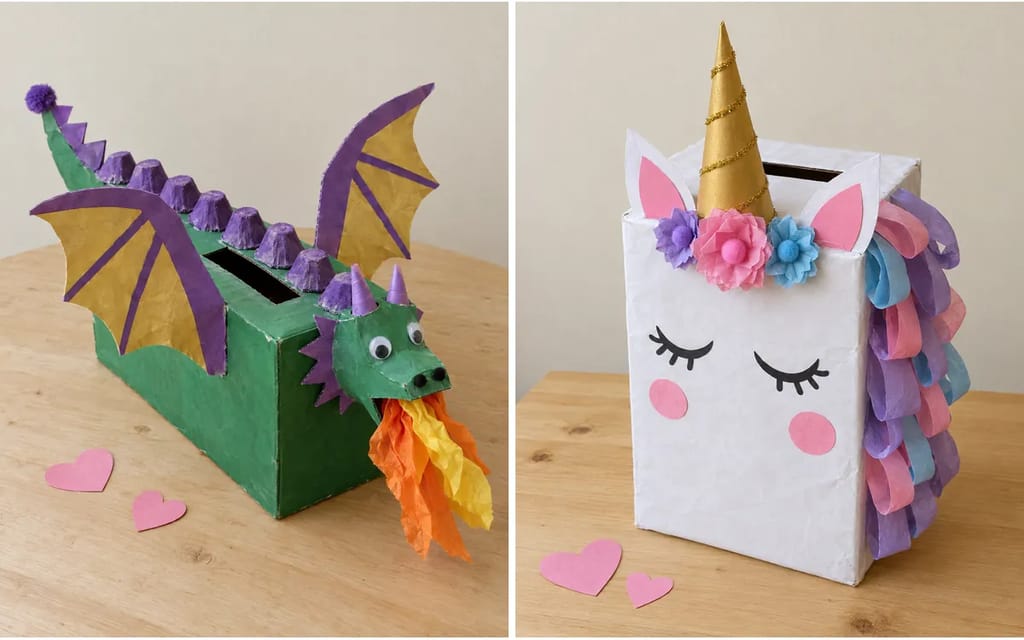
15. Dragon. Ages 6-10 · 1.5 hours · shoebox plus an egg carton Cut the cups from a cardboard egg carton, paint them, and glue them down the middle of the lid as spikes. Wings come from cereal-box cardboard folded at the base to make a tab, with tissue-paper flames coming out of the mouth. Cut the slot between the wings before the spikes go on, so nobody has to cut around them.
16. Unicorn. Ages 4-8 · 45 minutes · shoebox, standing on its end Stand the box up and cover it in white paper. Roll gold card stock into a cone for the horn and glue it to the top, then build a mane from loops of pink, purple and blue tissue paper running down one side. Two curved lines for closed, sleepy eyes are easier for small hands than round eyes, and they look calmer. The slot goes across the top behind the horn.
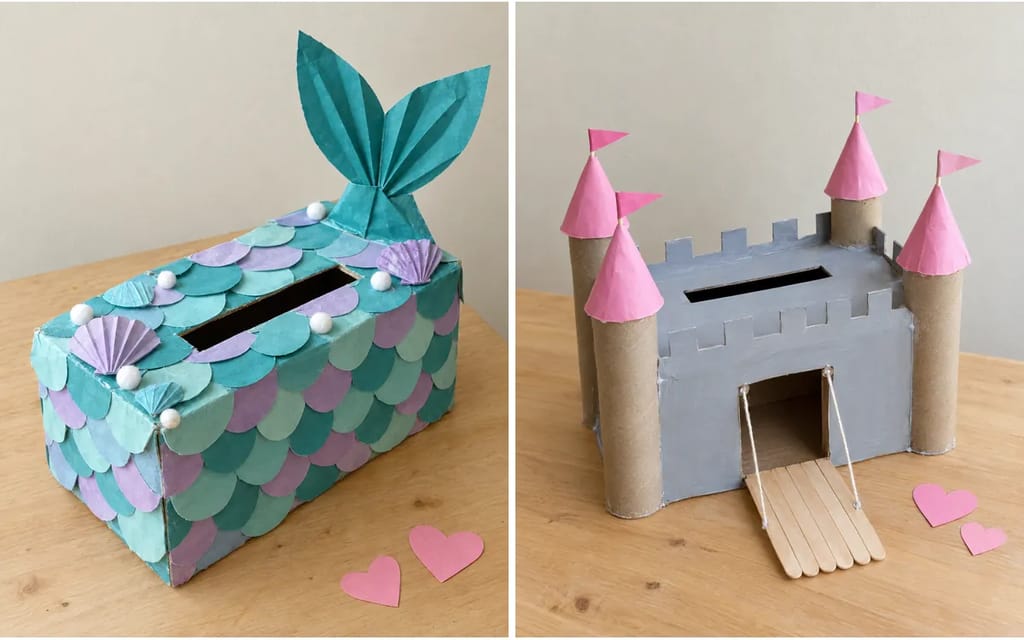
17. Mermaid tail. Ages 5-9 · 1 hour · shoebox Trace around a cup to cut dozens of half-circle scales from teal, aqua and lavender paper, then glue them in rows starting at the tail end, each row overlapping the last, the way fish scales sit. A tail fin cut from card stock stands up at one end. Paper shells and white pom-pom "pearls" go along the lid around the slot.
18. Castle. Ages 6-10 · 1.5 hours · shoebox plus four paper tubes Stand the box on its long side and paint it gray. Glue a paper-towel tube at each corner, top each one with a pink paper cone, and cut square notches along the top edge for battlements. The drawbridge is a row of craft sticks glued to a strip of card, hung from two strings that a grown-up threads through small holes. The slot goes in the courtyard, on top.
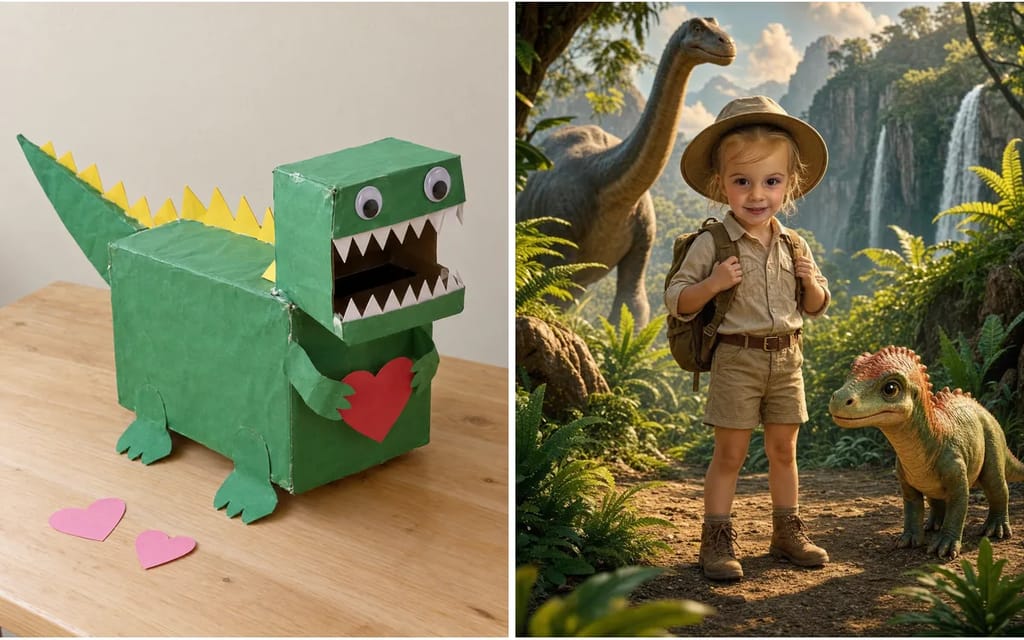
A box shaped like their favorite thing usually says who they are this year. If it's dinosaurs, Dino Expedition paints them as an explorer on a jungle trail among them, and the same goes for Unicorn Meadow, Dragon Kingdom and Mermaid Lagoon.
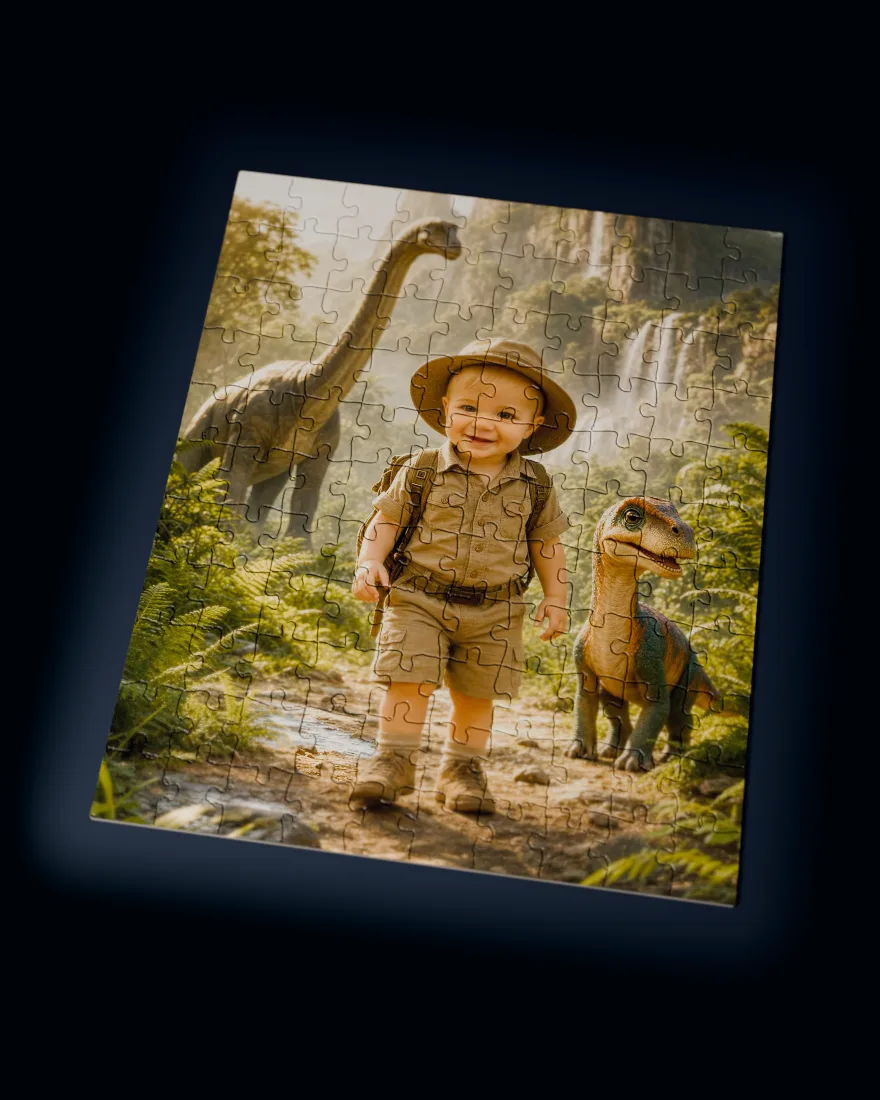
Put them in the world they built a box for
Upload one photo and we'll paint your child as a dinosaur explorer, or into the world that matches their box: space, pirates, fire trucks, race cars, sports and more. You approve a free, watermarked proof before anything prints.
Space and robot valentine boxes
Foil, bottle caps and paper plates do most of the work here, so these are good boxes for using up the recycling. The robot and the astronaut suit children who like buttons; the saucer and the planet suit children who like round things.
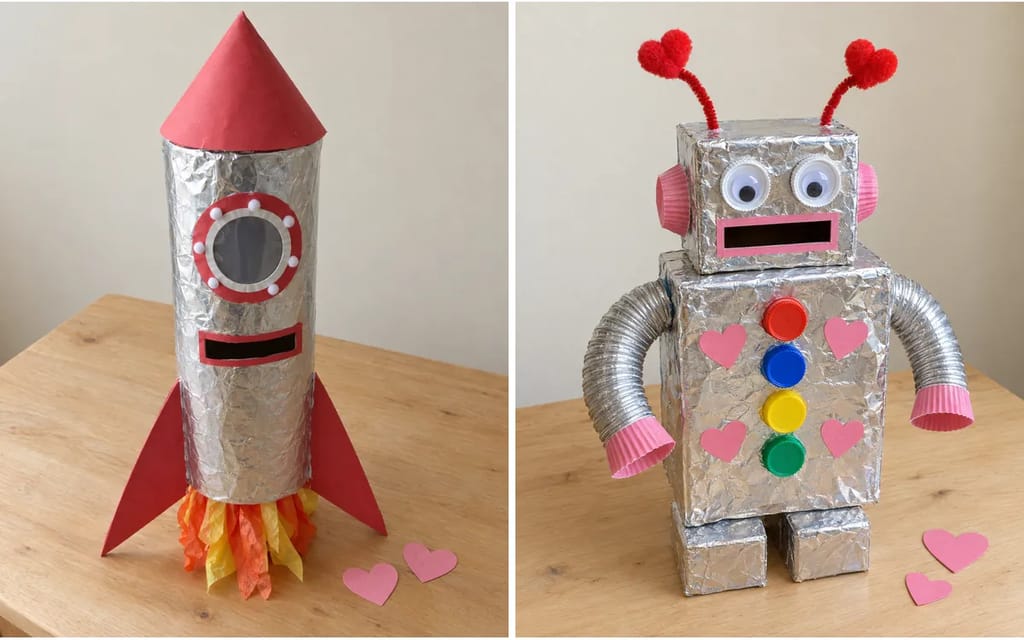
19. Rocket. Ages 5-8 · 45 minutes · round oatmeal canister Wrap the canister in silver paper or foil, roll a red card-stock cone for the nose, and glue on three fins so it stands up by itself. Tissue-paper flames hang from the bottom. A grown-up cuts the slot in the side, below a round paper porthole, because a craft knife slips easily on a curved surface.
20. Robot. Ages 5-9 · 1 hour · shoebox plus a small box Stand the shoebox up, wrap it and a smaller box (the head) in aluminum foil, and glue on bottle caps as eyes and chest buttons. The arms are offcuts of flexible foil ducting or accordion-folded strips of paper, and the antennae are pipe cleaners. Cut the mouth as the slot. Foil tears where it folds over a corner, so tape it inside the box rather than gluing the edge.
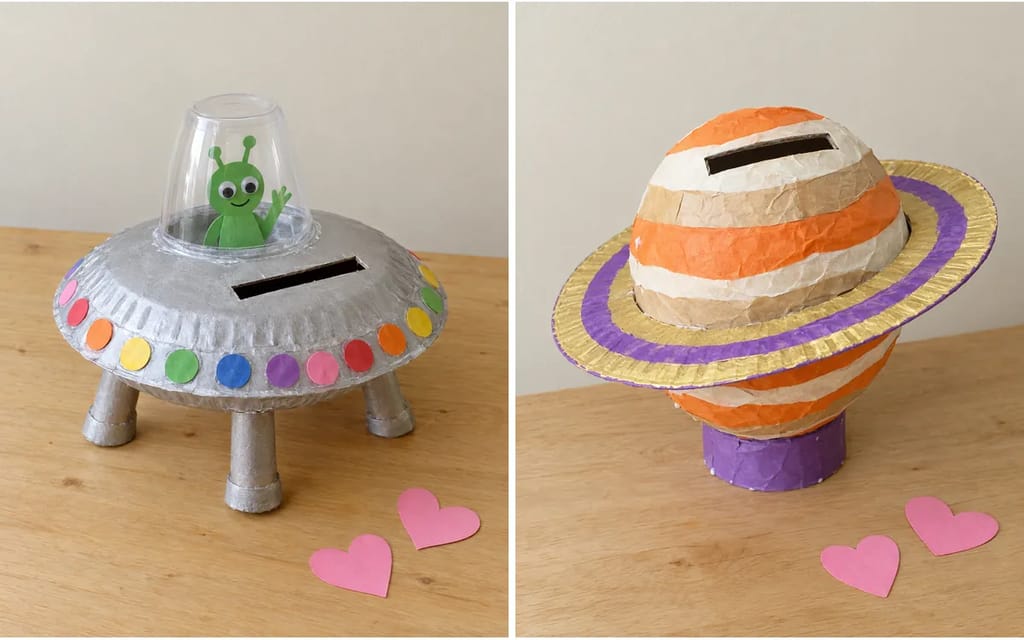
21. Flying saucer. Ages 5-9 · 45 minutes · two paper plates Glue two paper plates rim to rim, paint them silver, and glue a clear plastic cup upside down on top with a small paper alien inside. Paper dots around the rim are the lights. The slot goes in the top plate beside the dome. The inside is shallow, so it holds flat cards but not lollipops or pencils.
22. Ringed planet. Ages 6-10 · 1 hour, plus drying · balloon and paper-mache Cover a blown-up balloon in three or four layers of paper-mache strips, let it dry hard, then pop the balloon, pull it out and throw the pieces away at once (see the note on balloons). Paint the ball in bands of orange, cream and tan, cut the middle out of a large paper plate for the ring, and slide the ring on at a tilt. A short cardboard tube keeps it from rolling. Saturn's axis is tilted about 27 degrees, which is a good angle to copy.
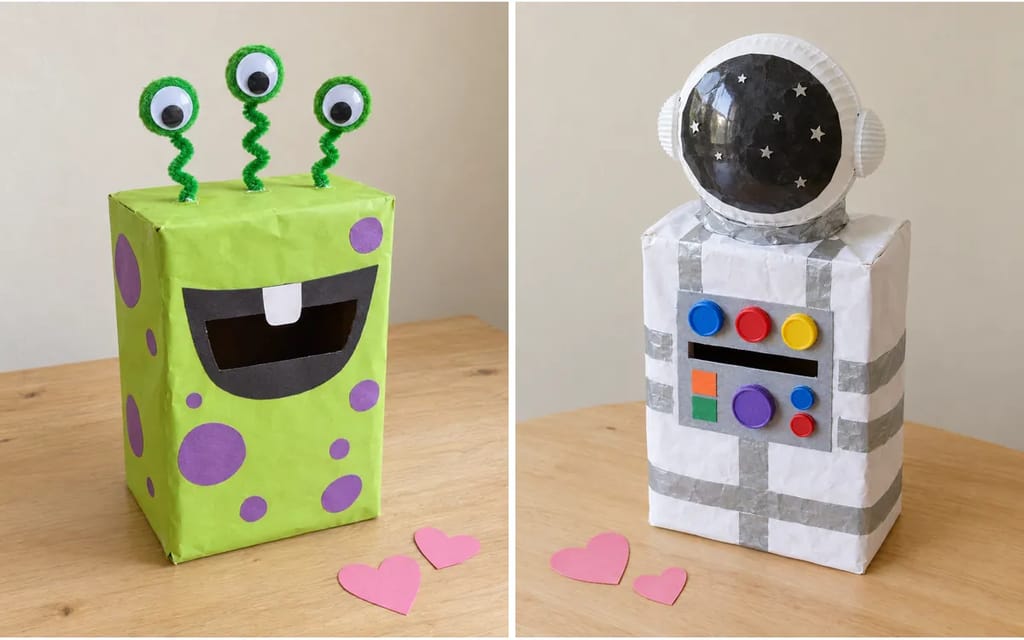
23. Alien. Ages 4-7 · 30 minutes · shoebox, standing on its end Cover the box in green paper, poke three holes in the top, and push in pipe cleaners with googly eyes glued to the ends so the eyes wobble. A big paper mouth with one tooth goes on the front, and the mouth is the slot. Any color works: nobody can tell you what an alien looks like.
24. Astronaut. Ages 6-10 · 1 hour · shoebox plus a paper bowl Stand the box up and cover it in white paper so it reads as the chest of a spacesuit. Glue a control panel of bottle caps and paper squares to the front, add silver tape stripes, and turn a white paper bowl upside down on top as the helmet, with a dark paper visor. The slot runs across the control panel.
Valentine boxes that go: trucks, trains, ships and planes
Every one of these starts with a shoebox lying flat, which is already the right shape for a vehicle. Paper-plate wheels are the trick: paint them black, glue a smaller circle in the middle, and they read as wheels from across a room.
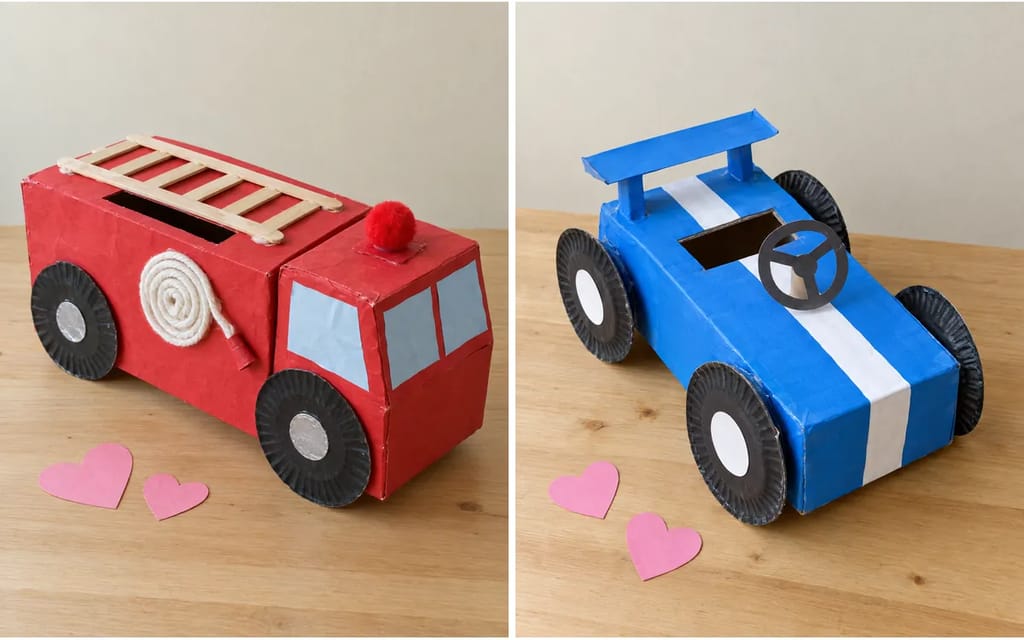
25. Fire truck. Ages 5-8 · 1 hour · shoebox plus a small box Lay the shoebox flat, glue a small box to the front as the cab, and cover both in red paper. Paper-plate wheels painted black, a craft-stick ladder glued along the top and a coil of white yarn for the hose make it a fire truck. A red pom-pom on the cab roof is the light. Cut the slot behind the ladder.
26. Race car. Ages 5-8 · 45 minutes · shoebox Paint the box one bright color with a stripe down the middle, add four paper-plate wheels and a folded paper spoiler at the back. The slot is the cockpit: cut a rounded rectangle in the top where the driver would sit and glue a paper steering wheel at the front edge of it.
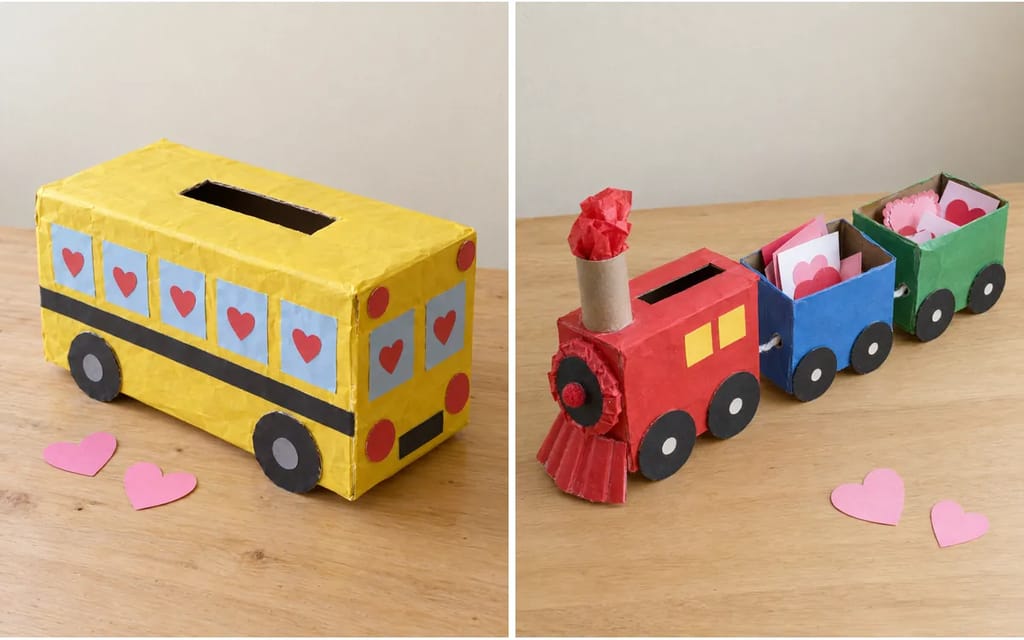
27. School bus. Ages 5-8 · 45 minutes · shoebox Cover the box in yellow paper and glue a row of square windows along each side, with a small paper heart in every window. A black stripe along the side, black wheels and red lights at the corners finish it. The slot goes in the roof.
28. Train. Ages 5-9 · 1 hour · three small boxes Three small boxes (tea, cracker or gift boxes) become an engine and two open cars, joined by short loops of string a grown-up threads through small holes. The engine gets a paper-tube chimney and a slot in its roof. The open cars carry anything too fat for the slot, like pencils or bookmarks.
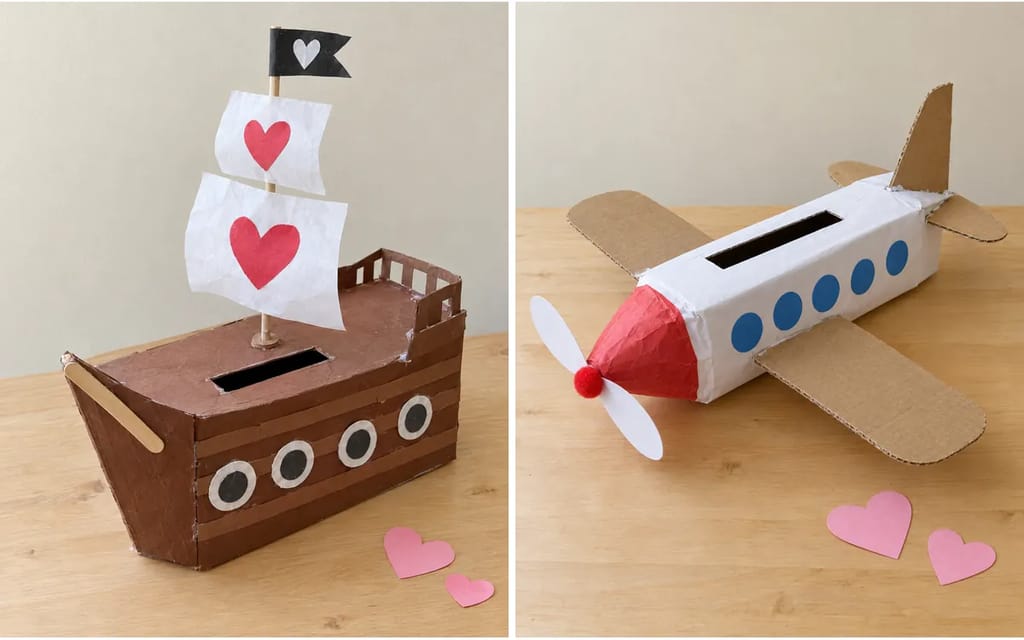
29. Pirate ship. Ages 6-10 · 1.5 hours · shoebox plus a dowel Paint the box brown, glue on paper planks and round portholes, and stand a wooden dowel in a hole in the lid as the mast, taped firmly from inside. White paper sails get a red heart, and the flag gets a heart instead of a skull. The slot goes in the deck beside the mast.
30. Airplane. Ages 6-10 · 1 hour · shoebox plus cardboard Cover the box in white paper with a red nose. Cut long, flat wings from a cereal box or a corrugated box, slide them through slits cut in both sides of the shoebox, and glue a tail fin to the back. A row of round blue windows and a paper propeller finish it. The slot runs along the top.
Machine valentine boxes: gumball, vending, claw and more
The first three are for 8- to 12-year-olds who want to build something that looks like it works. They take an afternoon, they need clear plastic from the recycling, and a grown-up does the window cutting. The mailbox, camera and TV are simpler and suit children from about 5. None of them needs batteries or lights to look good (the section on lights explains why to skip the button-battery kind).
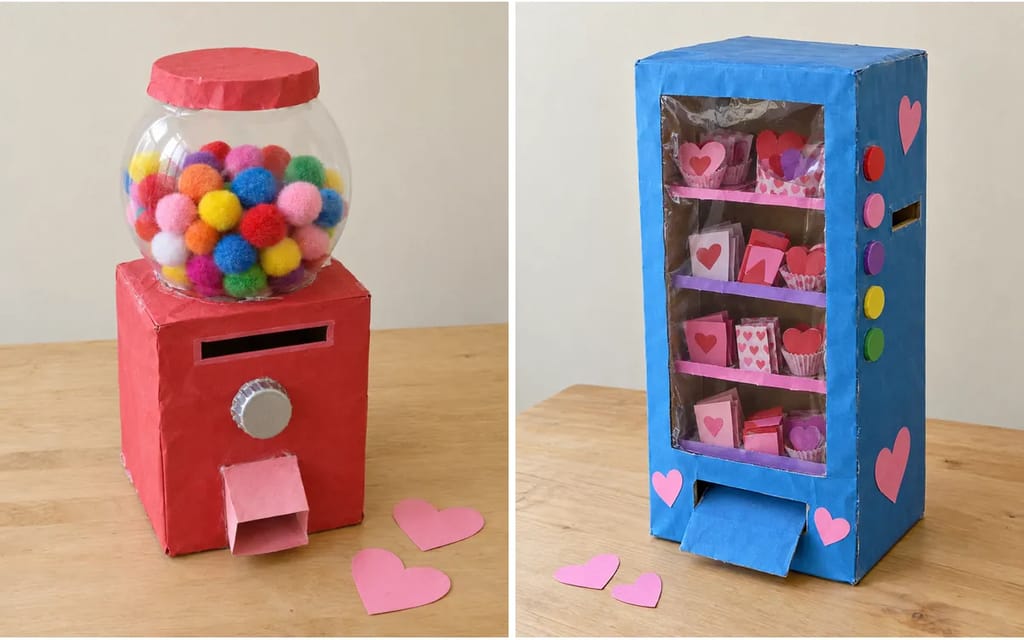
31. Gumball machine. Ages 7-12 · 2 hours · small box plus a clear plastic tub Glue a clear plastic container (a deli tub or a clear plastic bowl, never glass) upside down on top of a small red box, and fill it with bright pom-poms before you close it. A bottle cap on the front is the knob and a paper flap under it is the chute. The slot is cut in the front of the red base, so the "gumballs" stay sealed.
32. Vending machine. Ages 8-12 · 2 hours · tall box Stand a tall box up, cut a window in the front, and tape a sheet of clear plastic from packaging behind it. Shelves of card stock inside hold tiny paper hearts and folded mini valentines, and a side panel of paper buttons hides the slot where a coin would go. A flap at the bottom finishes it. Cut the window and fit the shelves before you close the box.
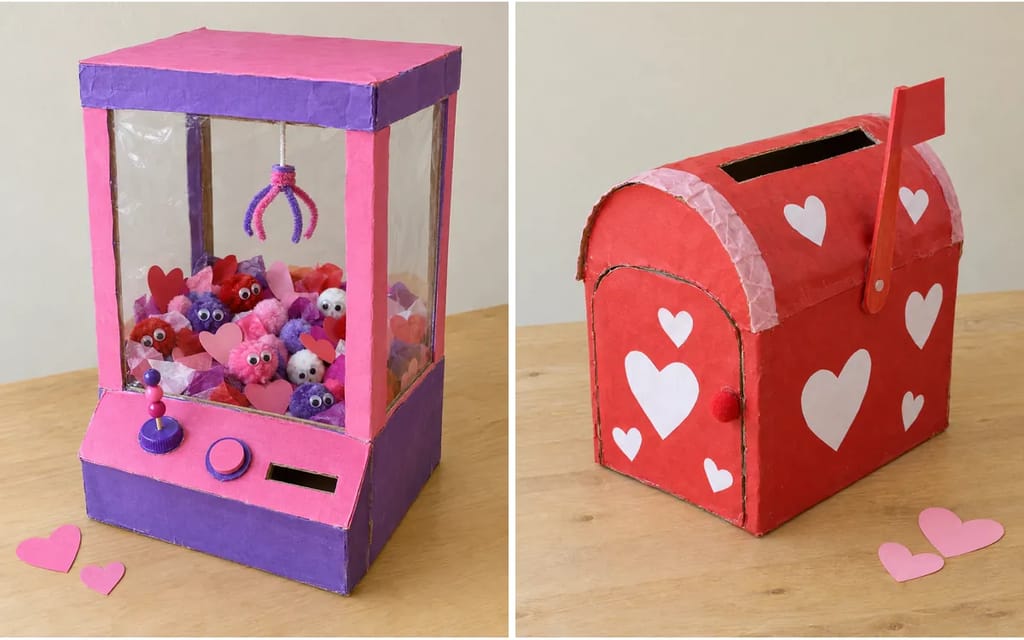
33. Claw machine. Ages 8-12 · 2.5 hours · tall box The hardest box here, and the slowest. Cut windows in three sides, back them with clear plastic, and fill the bottom with pom-pom creatures and paper hearts. A claw bent from pipe cleaners hangs on a string from the ceiling, and a ledge on the front holds a bead joystick, a button and the slot.
34. Mailbox with a flag. Ages 5-9 · 1 hour · shoebox Tape a curved strip of card over the top of the box to make the rounded roof of a country mailbox, paint it red, and dot it with white hearts. A craft stick and a paper flag, fixed to the side with a paper fastener so it swings up, is the flag. Cut a front door that opens and the slot along the roof. Keep paper fasteners away from children under three: they're small enough to choke on.
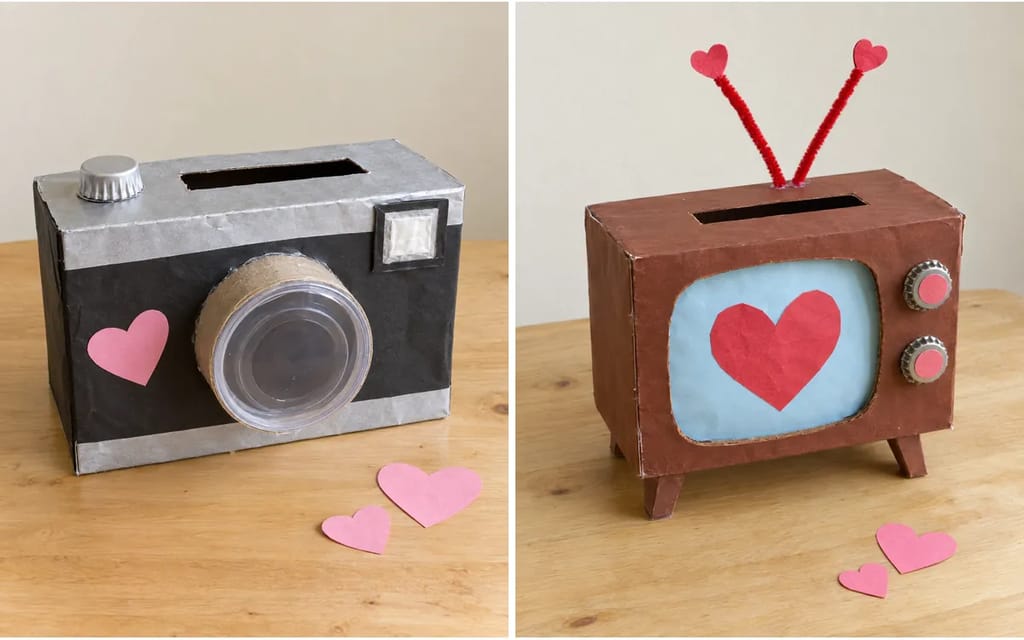
35. Camera. Ages 6-10 · 45 minutes · shoebox Lay the box flat and cover it in black and silver paper. A short section of paper-towel tube capped with a clear plastic lid is the lens, a bottle cap on top is the shutter button, and a small silver square is the flash. The slot goes in the top.
36. Old-style TV. Ages 6-10 · 1 hour · shoebox, on its side Turn the box on its side, paint it wood-brown, and cut a rounded screen in the front. Glue pale blue paper behind it with a red heart "on screen". Two bottle-cap knobs, short legs, and pipe-cleaner "rabbit ears" with hearts on the ends complete it. The slot goes in the top.
Food valentine boxes
Food boxes are bright, round and forgiving, so they suit younger builders. Two of them are made from paper plates and hold flat cards only, so check whether your class swaps lollipop or pencil valentines before you pick one.
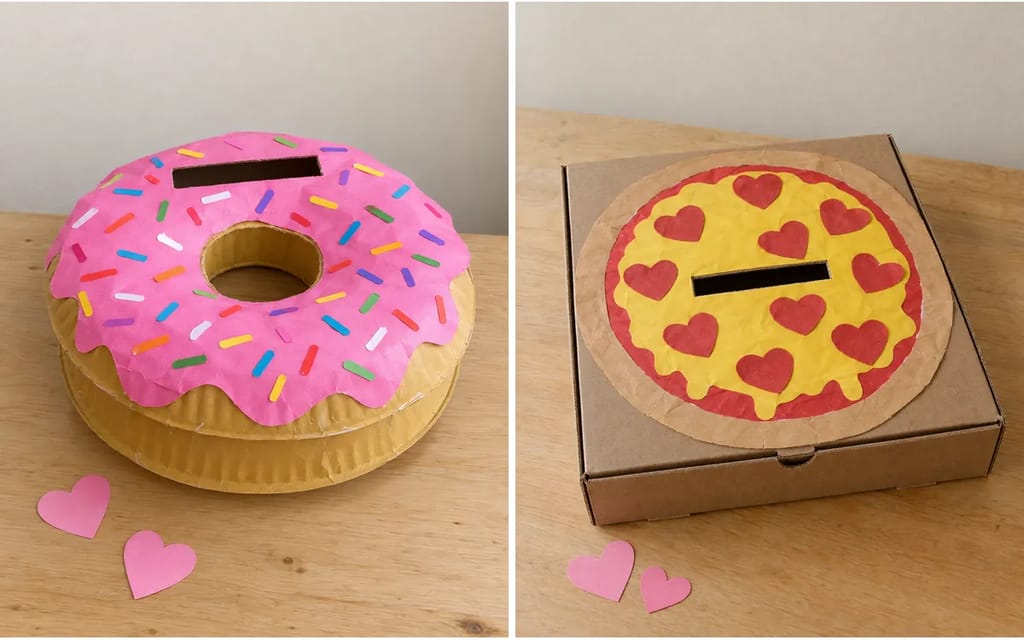
37. Donut. Ages 4-8 · 40 minutes · two paper plates Cut the middle out of two paper plates, then join their outer rims with a strip of card so you have a hollow ring. Paint it golden brown, glue on pink paper icing with a wavy edge, and scatter paper sprinkles. The slot goes in the icing. Like the saucer, it holds flat cards, not lollipops.
38. Pizza. Ages 5-9 · 45 minutes · new pizza box Ask a pizzeria for a clean, unused box, so it isn't greasy. Decorate the lid as a whole pizza seen from above: tan crust, red sauce, yellow cheese, and pepperoni cut into hearts. The slot goes through the lid, and the box opens flat to read the cards.
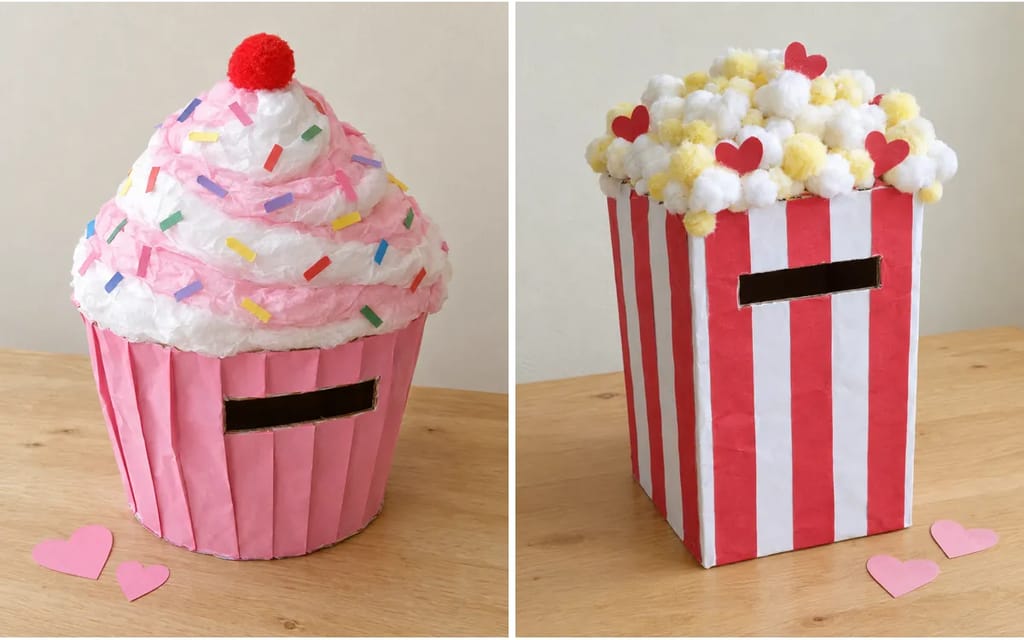
39. Cupcake. Ages 4-8 · 40 minutes · round container Wrap a round container in pleated pink paper (fold it back and forth like a fan) so it looks like a cupcake liner. Pile cotton wool on top as frosting, add paper sprinkles and a red pom-pom cherry. The slot goes in the side of the liner, because the frosting sits on the lid.
40. Popcorn box. Ages 4-7 · 25 minutes · tall box Cover a tall box in red and white vertical stripes, then glue white and pale yellow pom-poms and cotton balls along the top edge until it looks like it's overflowing. A few small red hearts mixed in finish it. The slot goes in the front, below the popcorn.
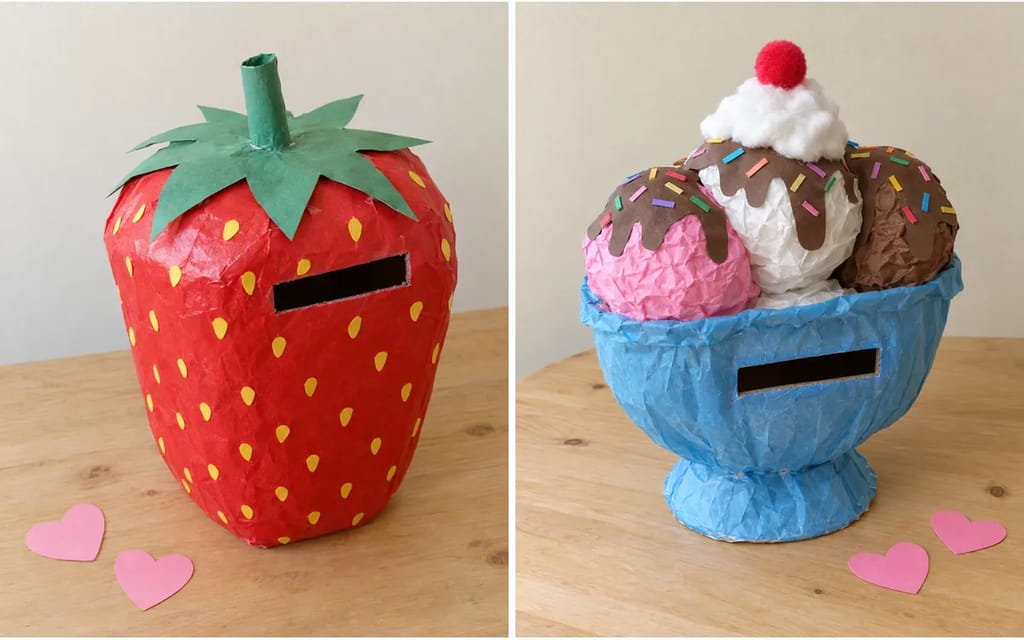
41. Strawberry. Ages 5-8 · 45 minutes · rounded box Cover a rounded box in shiny red paper, dot it with small yellow paper seeds, and glue a crown of pointed green leaves and a short stem on top. A medium strawberry has about 200 of those "seeds" (botanists call them achenes), so the more dots the better.
42. Ice cream sundae. Ages 5-9 · 45 minutes · round container Cover a round container in pale blue paper as the dish. Crumpled tissue-paper balls in pink, white and brown are the scoops, brown paper drips are the sauce, and cotton wool, paper sprinkles and a pom-pom cherry go on top. The slot goes in the side of the dish.
Sports and music valentine boxes
The best of these make dropping a card into a little game: shooting it through a hoop, scoring it into a net or slipping it between guitar strings. Pick the sport they play, not the one on television.
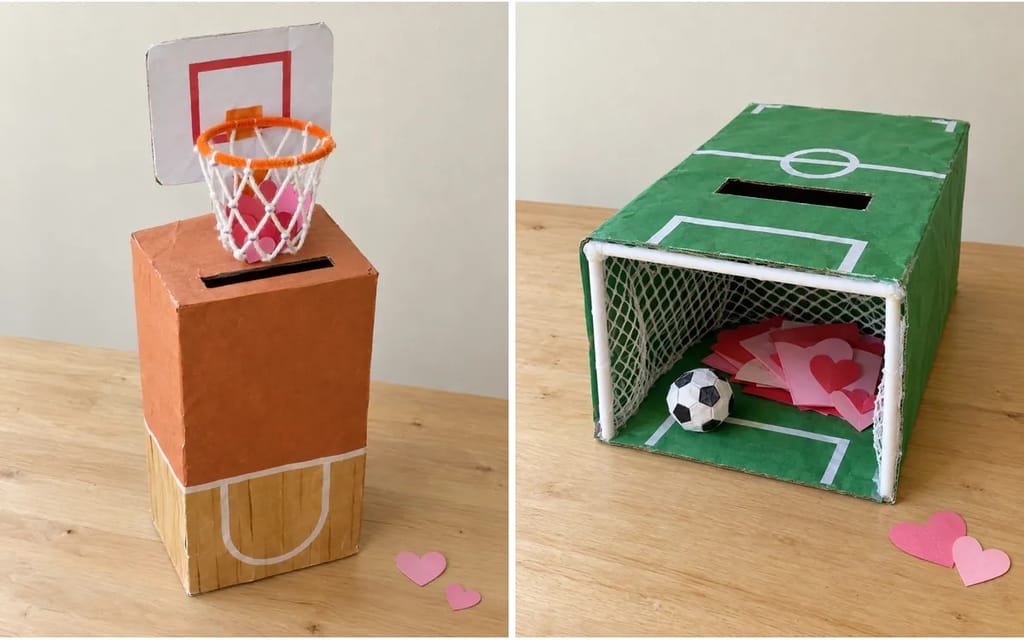
43. Basketball hoop. Ages 6-10 · 1 hour · shoebox, standing on its end Glue a white card backboard to the top of the standing box, bend an orange pipe cleaner into a hoop, and hang a yarn net from it. Cut the slot in the top of the box under the net, so every card has to be "shot" through the hoop to get in.
44. Soccer goal. Ages 6-10 · 1 hour · shoebox, on its side Turn the box on its side with the open front facing out, paint it green, and add white paper field lines. A goal frame of white straws and a net cut from a mesh produce bag go across the opening, and cards are "scored" into the net. An open front spills on the way home, so tape a paper flap over the goal after the party.
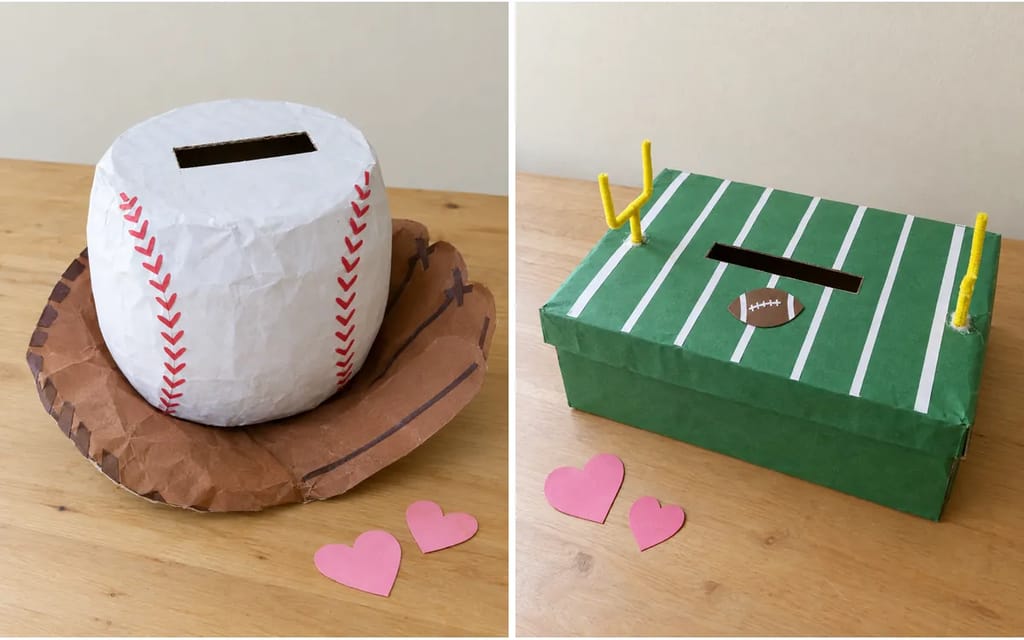
45. Baseball. Ages 5-9 · 40 minutes · round container Cover a round container in white paper and draw two curving rows of small red V marks for the stitching. Set it on a paper glove cut from brown paper. The slot goes in the top. A real baseball has 108 double stitches, which is more than anyone should draw on a valentine box.
46. Football field. Ages 6-10 · 1 hour · shoebox Cover the lid in green paper with white paper yard lines, bend yellow pipe cleaners into goalposts at each end, and glue a small brown paper football in the middle. The slot runs across the 50-yard line.
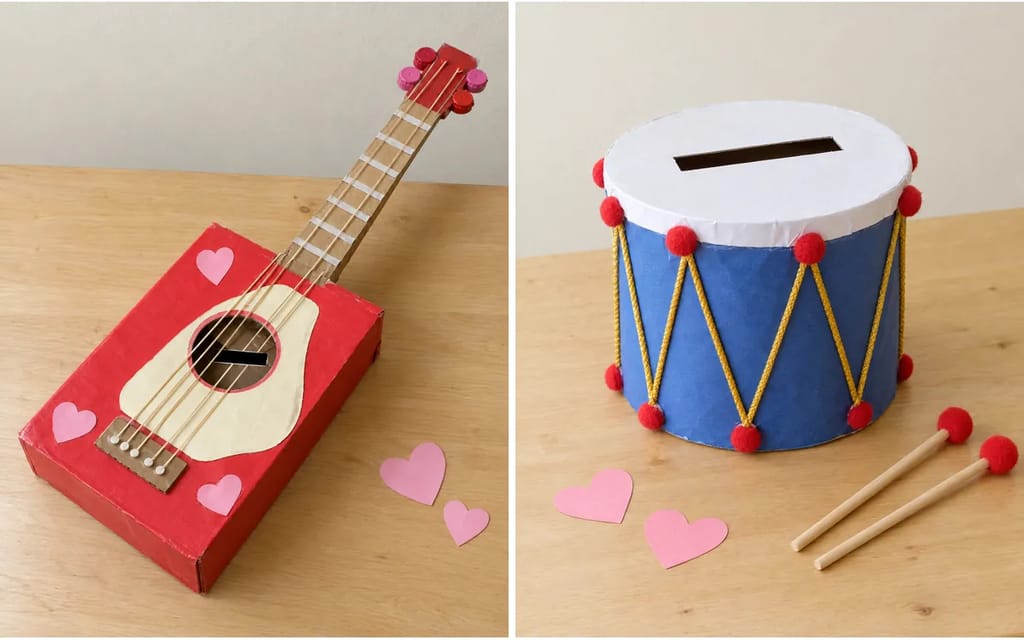
47. Guitar. Ages 6-10 · 1 hour · shoebox plus cardboard Paint the box as the guitar body, glue a long strip of cardboard to one end as the neck, and stretch six rubber bands across the box. The round sound hole under the strings is the slot, so cards slip between the strings to get in. The rubber bands really twang, which is the point.
48. Drum. Ages 4-8 · 35 minutes · round oatmeal canister Cover the canister in a bright color, zigzag gold cord or yarn around the sides, and glue white paper over the lid as the drum head. Two wooden dowels with pom-poms glued on the ends are the drumsticks. The slot goes in the drum head.
What do schools ask for in a valentine box?
Read the teacher's note first, because the rules differ from school to school. The letters we found ask for a valentine for every child in the class, the child's own name signed on each card, a box ready a few days before the party, and often no candy at all.
A few real examples show the range. An Ohio elementary school asked families to "send in a valentine for every student" and to call the office for a class count. Another Ohio elementary wanted boxes in on the Monday for a Wednesday party, any candy individually wrapped and sealed, and promised a box for any child who couldn't make one, and the same district's 4th and 5th grades asked for boxes that "easily fit on your child's lap on the bus". In 2021 a California school told families to sign only the child's name and leave the "to" line blank, which saves a 5-year-old writing 25 names.
Why do so many schools say no candy?
Because food allergies are common in a classroom. The CDC found that 5.3% of US children had a diagnosed food allergy in 2024, about 1 in 20, and its guidance for teachers says that in a typical class of 25 at least two students are likely to be affected, and to use nonfood items for celebrations. FARE, the food allergy charity, suggests non-food treats such as stickers, pencils, bubbles and bookmarks. Schools in Seattle and Chicago ask for no candy at all, and another Chicago school kept candy, cookies and soda out of its 2025 parties. If your class swaps non-food valentines, our Valentine coloring pages include color-in cards and bookmarks to print, and our Valentine jokes for kids have puns short enough to write on a card.
Is a glue gun safe for kids?
A low-temperature glue gun is fine for a grown-up to use on a valentine box, and older children can use one with a grown-up beside them. The CPSC's art and craft safety guide says children up to 12 should avoid high-temperature glue guns and use low-temperature models.
The difference is real. Surebonder, a glue-gun maker, lists its high-temperature guns at about 380°F, low-temperature at about 300°F and its ultra-low "Cool Shot" guns at about 250°F, and the American Burn Association notes that a liquid at 140°F can cause a serious burn in five seconds or less, deeper in a child's thinner skin. If melted glue lands on skin, the American Academy of Pediatrics says to run cool water over the burn for about five minutes, with no ice and no popping blisters, and to see a doctor right away for a burn on the hand or face, or a blistering burn bigger than the child's hand.
The craft knife is the other grown-up tool. The AAP's advice for pumpkins, children decorate and adults carve, fits a valentine box well.
Should a valentine box have lights?
Skip lights that run on coin batteries. Poison Control lists tea lights and flameless candles among the items to check, because 20 mm lithium coin cells cause most serious swallowing cases, and a battery stuck in the throat can do severe damage in as little as two hours. Under Reese's Law, products made since late 2023 with these batteries need a compartment that takes a tool or two separate hand movements to open, but a light glued to a box at a class party gets handled by many hands. If a child may have swallowed one, go to the emergency room right away and call the National Battery Ingestion Hotline at 1-800-498-8666.
What about younger brothers and sisters?
Googly eyes, pom-poms, beads and paper fasteners are small enough to choke a child under 3. The CPSC defines a small part as anything that fits inside a cylinder 1.25 inches across, and in 2019 a plush toy was recalled because its googly eyes could come off. The AAP notes that older siblings often hand small objects to babies, so glue those parts on firmly and keep the box out of reach at home. Balloons used for paper-mache are a hazard too: CPSC's required balloon label says children under 8 can choke on uninflated or broken balloons, and to throw broken ones away at once.
For handprints, use a paint labeled safe for skin. The CPSC's guide gives "don't use standard paint for skin-painting" as its example of using a material the wrong way, and Poison Control says to never use an art product on skin unless the label says it's safe. For glitter, the American Academy of Ophthalmology says glitter in an eye can scratch the cornea: rinse it out with saline or eyewash rather than rubbing.
Where did valentine boxes come from?
American schoolchildren have dropped cards into a class valentine box since at least the 1890s. On February 14, 1897, the Omaha Daily Bee reported that at the school in Benson, Nebraska, each room had a valentine box, filled by 2 p.m. and then handed out to the children.
The cards came first. The American Antiquarian Society says sending valentines became fashionable in America in the 1840s, when more than 30,000 passed through the New York City post office on February 14, 1846 alone. Esther Howland of Worcester, Massachusetts, began making lace-paper valentines at home in 1849 and built what the Smithsonian's National Postal Museum calls the first major commercial valentine producer in the US, the look the paper lace box above copies. In 1902 a teachers' weekly, the Journal of Education, ran an article on "The Valentine Box" telling classes to send valentines not just to friends but to classmates with fewer friends and to sick classmates, the early form of today's "one for everyone" rule. A historian at the University of Nevada, Las Vegas, told the AP that around 1917 was "the beginning of an organized practice of exchanging Valentines in school", and by 1951 a Georgia paper described a kindergarten where every child made their own valentine mailbox.
The link between February 14 and love is older still. Medievalist Jack Oruch concluded that Chaucer was apparently the first to connect St. Valentine's Day with love, in the Parliament of Fowls, a poem about birds choosing their mates.
When is Valentine's Day 2027?
Valentine's Day 2027 is on Sunday, February 14, and Presidents' Day is the next day, Monday, February 15. So class parties will land on a school day before the weekend, and in some districts that Friday is a day off too.
That makes the real deadline earlier than it looks. In a district that's closed on Friday, February 12, the last school day before Valentine's Day is Thursday the 11th, and some teachers collect boxes days before the party: one Ohio elementary wanted boxes in on the Monday for a Wednesday party. Count back from the teacher's due date, not from the 14th, and leave room for drying. White glue needs at least overnight and washable paint 1 to 2 hours a coat, so a box finished the weekend of February 6 and 7 is ready whatever the school decides.
| Date | What's happening |
|---|---|
| Mon, Feb 8 | A good day to have the box finished, so glue and paint are dry |
| Fri, Feb 12 | A day off in some districts: Bethlehem, Pennsylvania and Prospect Heights, Illinois are closed, and Nutley, New Jersey has a single-session day |
| Sun, Feb 14 | Valentine's Day |
| Mon, Feb 15 | Presidents' Day (Washington's Birthday), a federal holiday |
Check your own school's calendar and the teacher's note for the box due date.
What do most valentine box lists get wrong?
Mostly what they leave out: who holds the hot tools, how big the slot should be, and which age each box suits. Here's the usual advice next to what the sources say.
| What you'll read | What's true |
|---|---|
| Make it with the kids using a glue gun and a craft knife (no word on who holds them) | The CPSC says low-temperature guns only for children up to 12; a grown-up does the knife work |
| Cut a slot in the top, with no size given | About 5 in long fits every boxed valentine and an A2 envelope; 1 in wide fits taped-on pencils |
| Boxes built around licensed characters | A generic dinosaur, robot or unicorn lets the child decide what it looks like, and nobody else brings the same one |
| Every box is perfect for all ages | Scissor skills build from about 2 to 7 (AOTA children and youth section), so the right box depends on the age |
| Fill it with candy for everyone | Many schools allow no food at all; FARE suggests non-food treats |
| Valentine boxes and romantic gift boxes are the same thing | A school valentine box is a mailbox for a class card exchange, a custom dating to the 1890s |
What should you do with the box after the party?
Read the cards together the same day, then keep the few that matter: the one from a best friend, the one the teacher wrote, the one with a drawing. Take a photo of the box with your child holding it before it goes in the recycling, because a shoebox rarely survives until next February.
If the box was a dinosaur, a unicorn or a rocket because that's who your child is this year, that's worth keeping in a form that lasts. A child's own drawings can become keepsakes that get used, and the world they built a box for can become a portrait of them in it.
Turn this year's box into a portrait
Dinosaurs, unicorns, dragons, mermaids, space, pirates, fire trucks, race cars and sports: pick the world that matches the box, upload one photo, and see three versions of your child in it. You approve a free, watermarked proof before anything prints.
Frequently asked questions
How do you make a valentine box for school?
+
Start with a shoebox. A grown-up cuts a slot about 5 inches long and half an inch wide in the lid, then cover the box and the lid separately in paper so the lid still lifts off. Add a shape such as a head, wings or wheels, decorate it, write your child's name on the outside, and test the slot with a real valentine. Allow a few days for glue and paint to dry.
What can I use instead of a shoebox?
+
A cube tissue box (the hole is already cut), a round oatmeal canister, a family-size cereal box, a clean pizza box, two paper plates glued rim to rim, or a paper lunch bag if the teacher allows bags. Paper plate boxes are shallow, so they only hold flat cards.
How big should the hole in a valentine box be?
+
About 5 inches long and half an inch wide takes every boxed classroom valentine and a homemade card in an A2 envelope. Make it about an inch wide if classmates tape on pencils, erasers or lollipops, and 6¼ inches long for oversized 6 by 8 inch cards.
How long does it take to make a valentine box?
+
From 15 minutes for a sticker-covered shoebox or a tissue-box monster to two hours or more for a gumball or claw machine. Add drying time: white glue needs at least overnight to set, and washable paint 1 to 2 hours a coat, so start about a week before the party.
What are easy valentine box ideas for kindergarten?
+
A heart sticker box, a handprint heart box, a tissue-box monster, a paper bag owl, a rainbow box or a paper lace box. Each takes 15 to 20 minutes, a grown-up does any cutting, and the child does the sticking, painting and choosing.
Are there valentine box ideas for boys and for girls?
+
Every box here works for any child. Pick by what they love: dinosaurs, unicorns, dragons, trucks, space, food or sport. A box that matches their favorite thing is the one they'll be proud to carry in.
What if my child can't make a valentine box?
+
Ask the teacher. Some schools provide a plain box for any child who doesn't bring one, and some boxed classroom valentine sets include a pop-up mailbox. The 15-minute boxes here can also be made the night before.
When is Valentine's Day 2027?
+
Sunday, February 14, 2027. Presidents' Day is Monday, February 15, so class parties will fall on a school day before that weekend, and some districts are also closed on Friday, February 12. Check your school's calendar.