
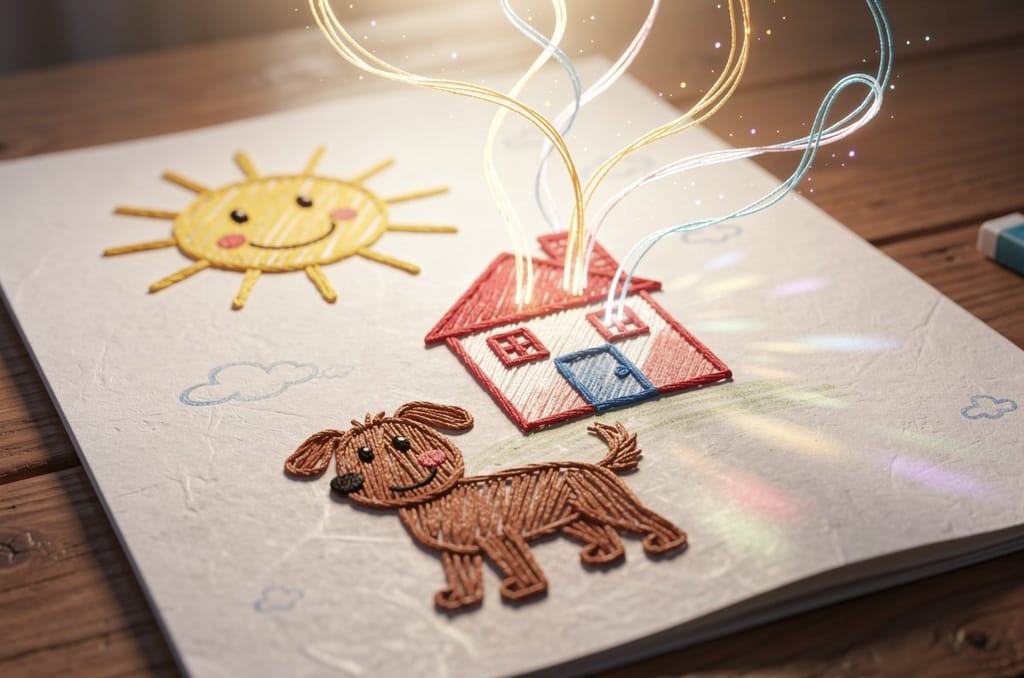
Every parent ends up with the same problem. The drawings arrive faster than the walls can hold them, the best ones get photographed and filed somewhere, and by the following spring nobody can find the one with the six-legged dog. Turning a drawing into an object is the fix, and the good news is that it no longer requires a craft cupboard.
In short
The best children's artwork gifts move one drawing out of the archive and into daily use, on something the recipient wears, sleeps under, or walks past. Choose a drawing with bold, closed lines rather than faint pencil, then match it to a material that can actually reproduce it: thread simplifies a drawing to six solid colors, while a print reproduces every pencil line exactly as drawn.
What counts as a children's artwork gift?
A children's artwork gift is any object that carries a child's own drawing, made for someone else to keep. It splits cleanly into two families. The first is do-it-yourself: transferring art onto coasters, tea towels, or pillowcases with a home heat press or transfer medium. The second is made-to-order, where you send the drawing to a producer who reproduces it on a finished product and ships it.
What decides durability is the method, not which family it belongs to. Sublimation, including Cricut's Infusible Ink, bonds the design into the fibers, and Cricut states plainly that the transfers are permanent and will not crack, peel, or flake. Adhesive-backed heat transfer vinyl sits on top of the fabric instead. Paint-on photo transfer mediums fade with washing, which is why the tutorials using them recommend treating the result as decorative. Embroidery is durable for the same reason sublimation is: the artwork is in the material rather than on it.
Why do most saved drawings never get seen again?
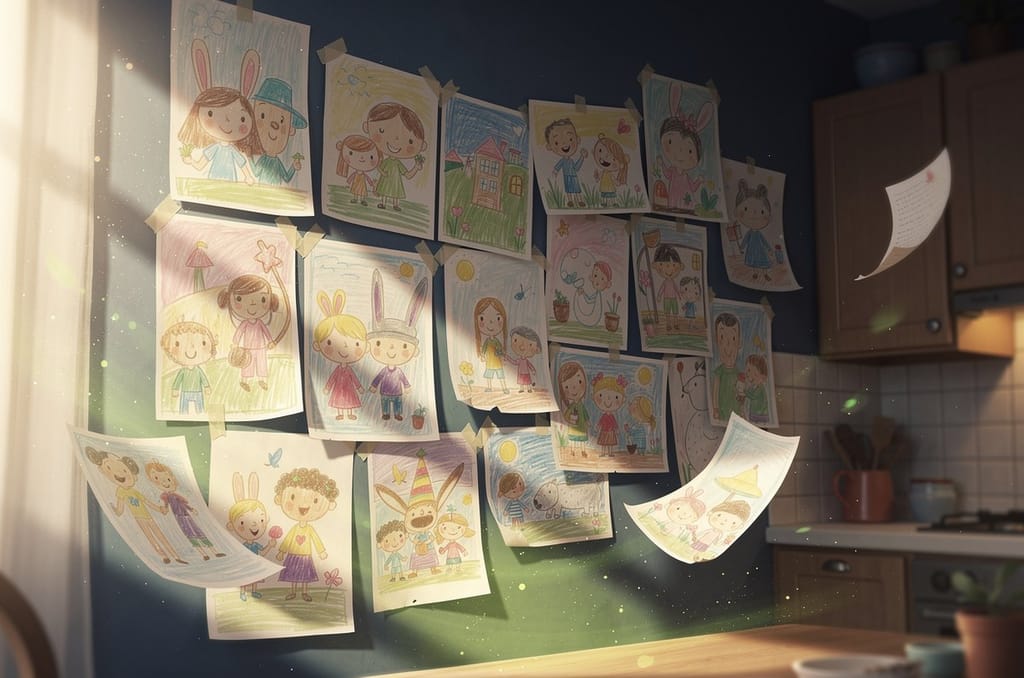
Because saving and seeing are different things, and almost everyone solves only the first. A 2026 study presented at the ACM CHI conference surveyed 327 parents of children aged 3 to 12 and found a median influx of 6 to 12 pieces of artwork per week. Some 74% of those families photograph or scan the art monthly, yet only 29% of the children ever look at the resulting albums. The researchers called the space between those numbers the preservation gap.
The same study found 59% of parents admitted discarding artwork without telling the child, and 47% reported high guilt about it. A separate survey of 113 Canadian families, run by McMaster University's Research Shop, named the two dominant barriers: among parents who did save artwork, 63% cited being too busy and 62% cited a lack of space.
Why this changes the gift
A scan solves storage. It does not solve presence. The measurable failure in the CHI data is not that art gets lost, it is that digitized art stops being encountered. A gift that puts one drawing somewhere it gets seen every week is doing the job the folder on the phone is not.
Which drawing should you choose?
Pick for reproducibility first and sentiment second, because a drawing that cannot survive the material will not carry the sentiment either. Bold marker and crayon reproduce well. Faint pencil, pale colored pencil, and heavy shading do not. If two drawings mean the same to you, choose the one drawn with the thicker pen.
Age is a genuine signal here, not a nicety. Developmental research describes a well-documented sequence: the first recognizable human figures, known as tadpole forms, appear at around age 3, and conventional figures with a distinct body between head and legs arrive at around age 5. A study in the Journal of Experimental Child Psychology tested 50 children aged 40 to 64 months and found inhibitory control predicted a child's drawing stage even after age was accounted for. The year a child crosses that line produces drawings worth choosing deliberately.
Marker, crayon, and thick paint hold their shape in every medium. Faint pencil has to be thickened before it can be reproduced, which changes the drawing.
A tadpole person or a family group reads instantly on a chest-sized area. An abstract full-page scribble loses its scale when it shrinks.
Lay the paper down in even light, keep your shadow off the page, and fill the frame. A skewed phone photo of a taped-up drawing loses the corners.
What can each material actually reproduce?
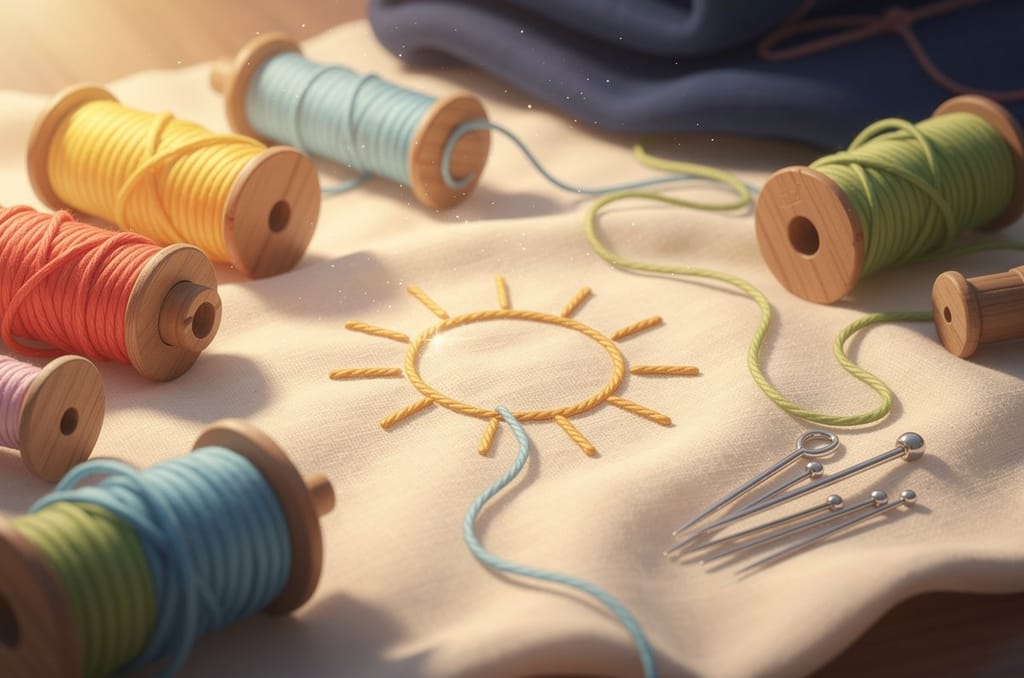
This is the question no gift guide answers, and it is the one that decides whether the finished object looks like the drawing. Every material has hard physical limits, and commercial embroidery publishes its own. The specifications our garments are stitched to set a minimum line thickness of 0.05 inches, roughly 1.3mm, a minimum text height of 0.25 inches, and a ceiling of six thread colors per design. Gradients cannot be stitched at all, because thread is a solid color with no half shade between two spools. Anything finer than those minimums is thickened before it reaches the machine, or it stitches as a blob.
Printing has the opposite profile. It reproduces every pencil line and every watercolor wash, but it sits flat and reads as a copy. Neither is better in the abstract. They are better for different drawings.
| Format | Handles fine pencil | Handles color blends | Best drawing for it |
|---|---|---|---|
| Embroidered sweatshirt | ✕ thickened to 1.3mm | ✕ six solid threads | Bold marker figures |
| Canvas or framed print | ✓ reproduced as drawn | ✓ full color range | Painting, wash, detail |
| Jigsaw puzzle | ✓ reproduced as drawn | ✓ full color range | Busy, full-page scenes |
| Home transfer craft | ~ varies by method | ~ varies by method | Anything, if decorative |
Embroidery limits are the published artwork requirements for the commercial machines that stitch our garments. Home craft varies because the method does: sublimation is permanent, adhesive vinyl and paint-on transfers are not.
Is a DIY artwork gift or a made-to-order one better?
Both are legitimate, and the honest answer depends on who the gift is for and how much of your December you want back. The DIY route is genuinely cheaper, and the child can take part in making it, which is worth something no supplier can reproduce. The made-to-order route wins on consistency and on the two things most parents are actually short of, which the McMaster survey measured as the top barriers to keeping artwork at all: time first, then space.
Go DIY when
- The child wants to help make it
- You already own the press or transfer medium
- The gift is decorative, not something that gets washed weekly
- You are making several small gifts at once
Go made-to-order when
- It needs to survive real use and laundry
- You want it to look deliberate rather than homemade
- You have no spare evenings before the occasion
- The recipient already has every ornament and mug they need
If embroidery is the route, our step-by-step on how to turn a drawing into embroidery covers both: stitching it by hand, and previewing a machine-stitched version on screen, adjusting the threads until it looks right, before you pay.
Grandparents are a common recipient for both routes, and they are also the hardest audience for a conventional present. Our guide to keepsake gifts for grandkids covers the wider question of what survives past the first month, and the same logic drives our roundup of non-toy gifts for kids.
What they cost and how long they take
Price tracks the blank, not the drawing. Magnets, keychains, and socks are the cheap end of the category because the object costs little before anyone decorates it. Apparel and wall pieces cost more for the same reason.
Our own embroidery made from a child's drawing starts at $49 on a garment-dyed Comfort Colors t-shirt, or $69 on the sweatshirt or a fleece hoodie, in sizes S through 3XL, though not every colour is made in every size. US shipping is included. The timeline is the part worth planning around. The stitch path is digitized first, taking up to 36 hours, then the garment is stitched in 2 to 5 business days, and US standard shipping adds another 2 to 5 business days. The clock starts when you approve the stitching and payment confirms, not when you upload.
Watch their drawing become thread
Photograph the drawing, see it turned into stitchable artwork on screen, and change any color before you commit. Nothing is stitched until you approve it.
If the drawing you love is a full-page painting rather than a bold figure, a print holds it better than thread will. The same upload flow that starts a custom portrait keepsake covers canvas and framed formats, and our guide on how to pick the best photo applies just as well to photographing a piece of paper.
Frequently asked questions
What is the best gift to make from a child's drawing?
+
For a gift that gets used rather than stored, a wearable or a wall piece beats a small desk object, because it is encountered daily. Match the drawing to the material: bold marker figures suit embroidery, while paintings and blended color suit a canvas or framed print. The CHI 2026 research on family archiving found that digitized artwork is rarely revisited, so the deciding factor is whether the finished object puts the drawing somewhere it will actually be seen.
Can any drawing be embroidered?
+
Not exactly as drawn. Embroidery machines have published physical limits: lines below roughly 1.3mm cannot form a clean stitch and are thickened, text below 0.25 inches tall loses legibility, and gradients cannot be stitched because thread has no half shade. A design is limited to six thread colors. Bold crayon and marker drawings survive this almost untouched. Faint pencil work and shaded color blends will be simplified.
How much do children's artwork gifts cost?
+
Price is set by the object more than by the artwork. Small pressed items such as magnets, keychains, and socks are the least expensive, while apparel and framed wall pieces cost more because the blank itself costs more before it is decorated. Our embroidery from a child's drawing starts at $49 on a t-shirt and $69 on a sweatshirt or hoodie, with US shipping included and a small uplift at 2XL and 3XL.
How long does a custom artwork gift take to arrive?
+
For an embroidered piece, budget up to 36 hours for digitizing the stitch path, then 2 to 5 business days to stitch, then 2 to 5 business days for US standard shipping. That is roughly one to two weeks in total from approval, not from upload. Order well ahead of a fixed date, because made-to-order production cannot be compressed the way a stocked item's shipping can.
What happens to the photo of my child's drawing?
+
On our embroidery flow the photo is sent once, purely to read the drawing off the paper, and it is not kept. Only the finished thread artwork you approve is stored. The drawing is never used to train any model. If you are using another supplier, ask the same two questions before uploading: whether the source image is retained, and whether it is used for training.
Should I use the original drawing or a copy?
+
Always keep the original and work from a photograph. Lay the paper flat in even light, keep your shadow off the page, and fill the frame with the drawing. There is no need to cut, trim, or post the original artwork to anyone. If the first photo does not read well, retake it. Nothing is committed until you approve what you see on screen.