In short
The best family photo ideas are decided before anyone poses. Light comes first: shoot in the hour after sunrise or the hour before sunset, when the sun sits low and the color runs warm rather than flat. Outfits come second, and the rule is coordinate, never match. Poses come last, and the ones that hold up are the ones with a task in them. Plan for young children to fade fast, shoot far more frames than you need, and decide in advance where the photo will end up, because a picture nobody prints is a picture nobody sees.
Search for family photo ideas and you will get poses. Stand here, sit there, walk toward the camera holding hands. The poses are fine. They are also the least important decision you will make, which is why so many families follow the list carefully and still end up with pictures that feel like a school portrait with better scenery. What actually separates a photo you hang from a photo you scroll past is settled earlier, in three choices made before anyone is standing anywhere.
What makes a family photo actually work?
Three things, in this order: light, palette, and connection. Light decides whether faces read as soft or squinting, and it is the only one of the three you cannot fix afterwards. Palette decides whether the group reads as a family or as a lineup of separate outfits, because the eye groups by color long before it reads a face. Connection decides whether the picture has any feeling in it, and it comes from people doing something together rather than aiming at a lens.
Poses sit underneath all three. A perfectly executed pose in harsh noon light, with one person in a loud print, photographs worse than a messy candid at sunset in a shared palette. That is the whole reason this guide runs in the order it does, and it is the part most shot lists skip.
When is the best time of day for family photos?
The hour after sunrise or the hour before sunset. This is golden hour, and it is not a style preference. When the sun sits low, its light travels through much more atmosphere, which scatters the harsh blue out and softens the shadows. The measurable difference is color temperature: light runs around 3,500K during golden hour against roughly 5,500K at midday, which is why the same family looks warm at seven and washed out at noon.
The name is generous about the duration. Golden hour runs roughly an hour after sunrise and an hour before sunset, and it shortens as you approach the equator, so treat it as a window that closes rather than a whole evening. Look up your sunset time, arrive thirty minutes before your window opens, and have everyone dressed in the car. Overcast days are the useful exception: cloud spreads light evenly, so a gray afternoon is workable when a bright one is not.
What should everyone wear for family pictures?
Coordinate, do not match. Identical outfits flatten a family into a uniform and date the photo the moment the trend turns. Coordinating means everyone draws from one small palette while wearing their own clothes, so the group holds together and each person still looks like themselves.
Build it from one person outward. Pick the hardest-to-dress family member first, usually a toddler or a teenager with opinions, choose their outfit, then pull two or three colors from it for everyone else. Keep patterns to one person, and let everyone else carry solids or the quietest possible texture. Avoid logos, slogans and anything with a character on it, which pulls the eye straight to itself. Dress for the actual temperature rather than the photo, because a cold child stops cooperating faster than any pose can rescue.
What color schemes work best for family photos?
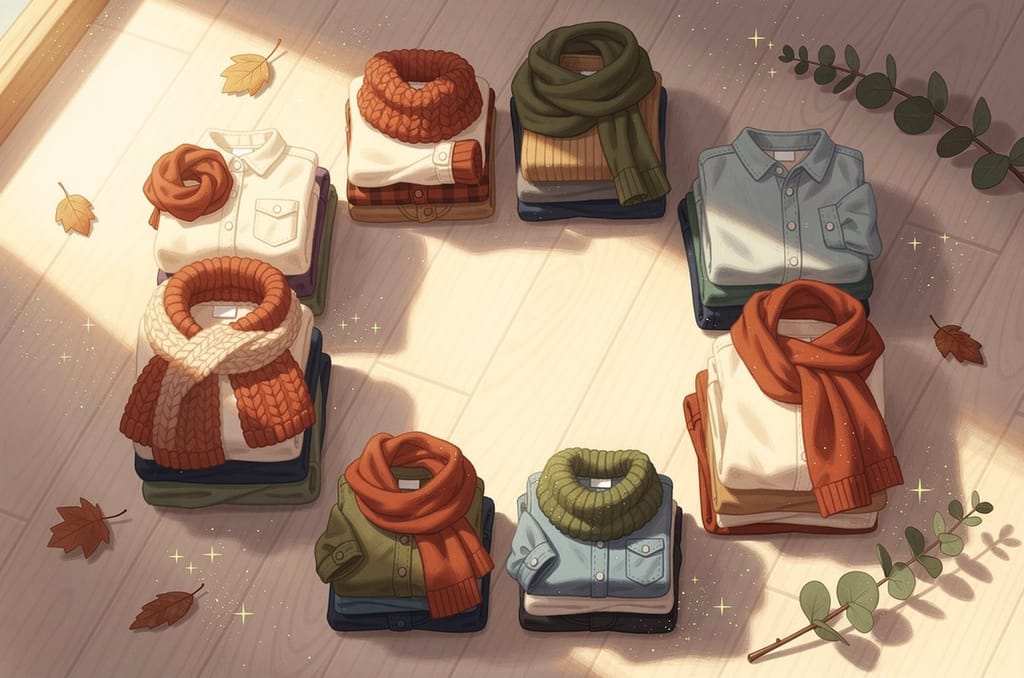
Pick three colors and let one of them dominate. A working palette is usually one neutral to carry most of the group, one muted mid-tone, and one accent that appears on no more than two people. Anything past three colors starts to read as noise in a wide shot, which is exactly where family photos live.
Cream, oatmeal, camel and soft brown. The safest palette in any season, and the one that ages best on a wall because it borrows nothing from a trend.
Rust, olive, mustard and clay. Built for autumn foliage and golden light, since it sits beside those colors instead of fighting them.
Denim, slate, dusty blue and stone. Best against water, snow and open sky, and forgiving on people who never wear color.
Forest, plum, navy and burgundy. The winter palette, strong enough for indoor light and holiday cards without turning into a costume.
The one rule that matters more than the palette: check it assembled. Lay every outfit on a bed together before the day, stand back, and photograph the pile with your phone. Problems that are invisible on hangers are obvious in a single flat frame.
What are the best fall family photo outfits?
Fall is the busiest family photo season, and the most commonly botched, because people dress for the leaves rather than against them. Autumn foliage is already saturated orange and red. Dress the family in the same range and everyone dissolves into the background.
Go one step quieter than the trees. Cream, oatmeal, olive, denim and soft gray all separate cleanly from a red maple, while a rust sweater on one person picks the season up without competing with it. Chunky knits and corduroy earn their place here, since texture reads as depth in soft light where a flat fabric reads as a block of color. Layers solve the real problem, which is that a fall shoot happens at the coldest hour of a cold day: a jacket that comes off for six frames and goes back on is worth more than any outfit nobody can stand still in.
Family photo poses that do not look posed
Every pose that survives has a task inside it. People told to look natural do the opposite; people given something to do forget the camera and become photographable. Give the instruction, then keep shooting for several seconds after it ends, because the frame you want is usually the one just after the laughing starts.
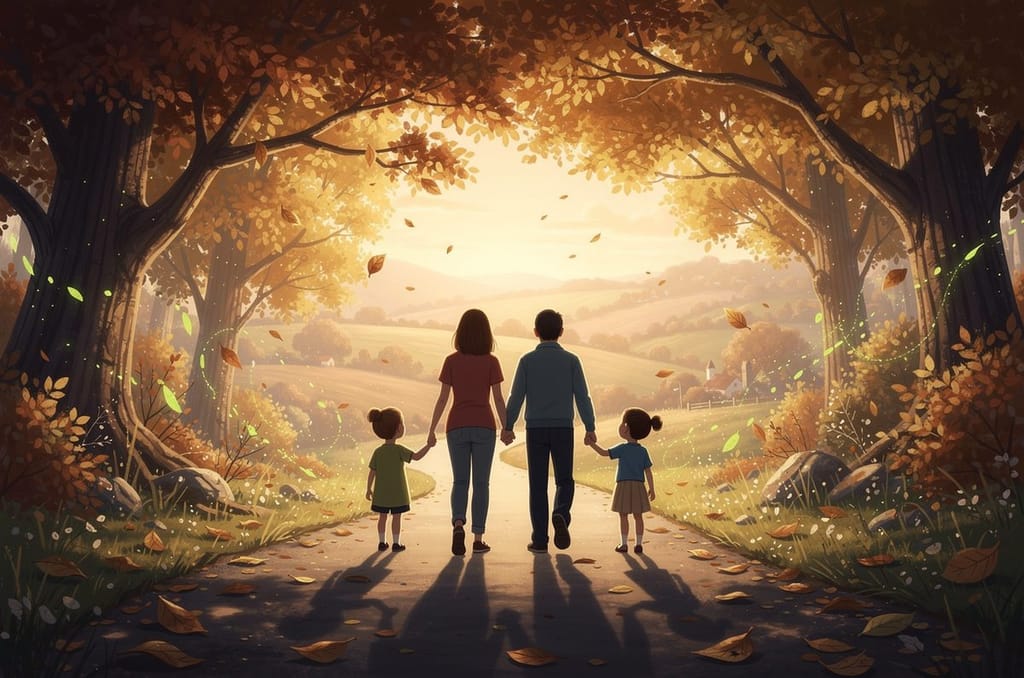
Hold hands and walk slowly at the lens, talking to each other. The movement handles the arms, which is what people never know what to do with.
Everyone leans in until shoulders touch and looks at the smallest person, not the camera. Works for a family of four and for twenty at a reunion.
A blanket, everyone piled on. Height differences vanish, small children stay put, and the whole group relaxes because nobody is standing to attention.
One parent swings a child up. The child laughs for real, and everyone else watches them rather than the lens, which is the shot.
Take the parents out of frame. Sibling photo ideas work best with a shared prop or a secret to whisper, since the dynamic does the posing.
The frame most families forget entirely, then wish they had. Two minutes at the end, while the children are already running around.
For a large family group, build in rows by height and shoot from slightly above, which closes the gaps that make big groups look scattered.
How do you get young children to cooperate?
You do not, and planning around that is the trick. Sustained attention is still being built at this age. Researchers tracking the same children found it grows measurably between age two and age four and a half, which means a three-year-old who is done after ten minutes is not being difficult. They are at the edge of what they have.
So front-load. Take the whole-family frame first, while everyone is fresh, rather than saving it as the finale nobody has energy for. Keep the total shoot under thirty minutes with young children. Feed them beforehand, because hunger arrives as a mood rather than a request. Skip the word "smile" entirely and ask a question instead, or name something ridiculous for them to shout, since a real reaction photographs differently from a held expression. And shoot in bursts. The difference between families who get the picture and families who do not is usually just the number of frames.
Where should you take outdoor family photos?
Somewhere the family already goes. Outdoor family photo ideas tend to send people to a scenic spot an hour away, where everyone arrives tense and nobody is comfortable. A park you walk to, your own front steps, the beach at the end of the usual road: the familiar location buys you relaxed subjects, which is worth more than the backdrop.
Look for open shade with light in front of it, such as the edge of a treeline, the shadow side of a building, or a porch facing the garden. Those spots give soft light on faces and a bright background without anyone squinting. Avoid dappled light under a canopy, which drops hard spots across faces that no editing fixes. If you are shooting into the sun for that glow, put a person between the lens and the sun to block the direct beam, then tap to expose for the face.
How do you take family photos on a phone?
Most family photos are taken on a phone, and most guidance quietly assumes a camera. Four settings do nearly all the work. Tap the face you care about to set focus and exposure, then drag to pull the brightness down slightly, since phones routinely overexpose skin against a bright sky. Use portrait mode only for groups on one plane, because it blurs anyone standing a step behind. Hold the shutter for a burst on anything moving, which is every frame with a child in it. And avoid the zoom, since it crops rather than magnifies on most phones; step closer instead.
One more, easily missed: clean the lens. A phone that has lived in a pocket all day photographs everything through a soft haze, and it is the single most common reason a shot looks flat.
What should you do with the photo afterwards?
Decide this before the shoot, because it changes what you take. A photo destined for a wall needs vertical frames and room around the group. A photo destined for a card needs space for text. Every guide on this subject stops at the shutter, which is how a good session becomes a folder nobody opens.
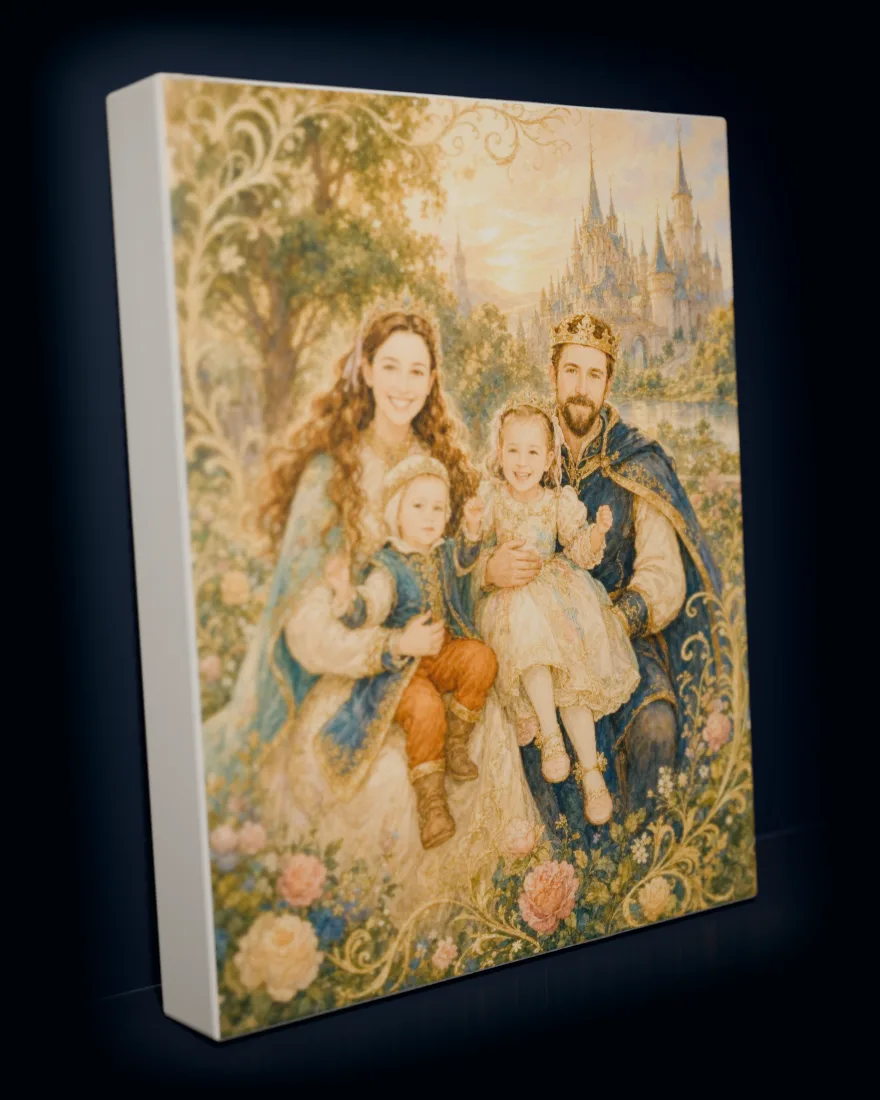
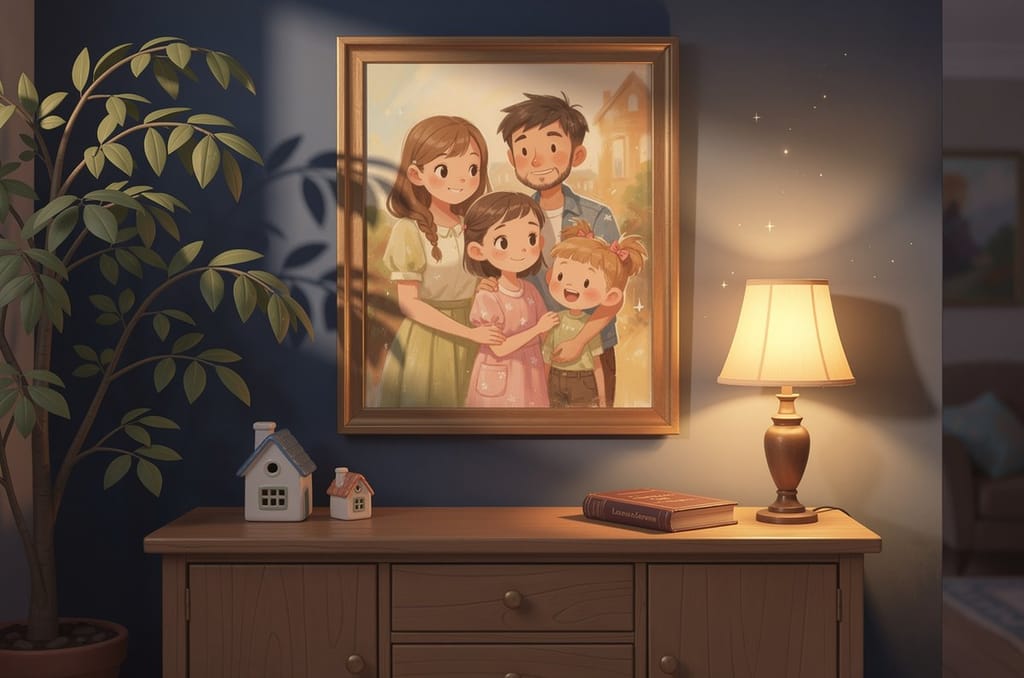
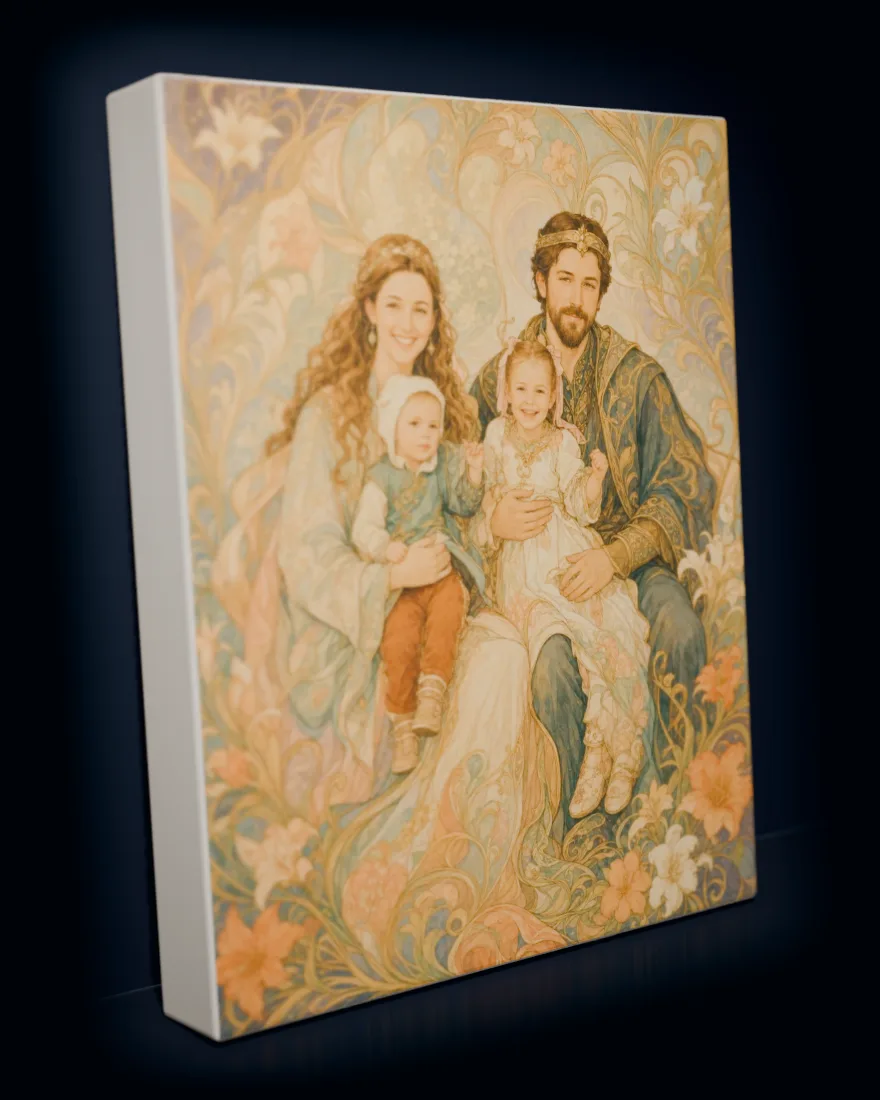
At The Curious Thing the answer to that last step is to make it art rather than a print. You upload one family photo, choose a style, and we repaint the family in it: real faces preserved, painted as an Art Nouveau court panel, a golden-age storybook plate, a woven tapestry, a cut-paper garden or a needle-felted wool scene. It arrives as a gallery canvas from $59, a framed canvas from $79, or a fleece blanket from $59. You approve a watermarked proof before anything prints, and the original photo is deleted within 24 hours.
Once you have the photo
Turn your family photo into a painted portrait, on canvas, framed canvas or a blanket. Nothing prints until you approve the proof.
If you would rather see the range of finished pieces before you shoot, our guide to custom family portraits covers the styles and sizes, and hanging personalized art in a child's room has the height and sizing math for the wall itself. If the children are the whole point of the picture, each of them can also be painted alone as the hero of a magical world. And for picking which frame from the session to actually use, how to pick the best photo covers what makes a photo hold up when it is enlarged.
Frequently asked questions
What is the best time of day for family photos?
+
The hour after sunrise or the hour before sunset. The sun sits low, the light runs warm at roughly 3,500K against 5,500K at midday, and shadows stay soft. Golden hour lasts about an hour and shortens nearer the equator, so arrive early. An overcast day works too, since cloud spreads the light evenly.
Should family photo outfits match?
+
No. Coordinate instead. Everyone draws from one palette of about three colors while wearing their own clothes, with patterns limited to one person and the rest in solids. Matching outfits flatten the group into a uniform and tie the photo to whatever was in style that year.
What colors should you avoid in family pictures?
+
Avoid logos, slogans and character prints, which pull the eye off faces. Avoid more than one strong pattern in the group. In autumn, avoid dressing everyone in the same oranges and reds as the foliage, since the family disappears into the background instead of standing out from it.
How long should a family photo session last with young kids?
+
Under thirty minutes with children under five, and take the whole-family frame first rather than last. Sustained attention is still developing through the preschool years, growing measurably between age two and four and a half, so a toddler running out of patience quickly is developmentally normal rather than a behavior problem to solve.
How do you pose a large family for photos?
+
Build in rows by height, close every gap so shoulders touch, and shoot from slightly above to tighten the group. Then break it into smaller units: each family separately, all the grandchildren together, the grandparents alone. The small groupings are usually the frames people ask for later.
What can you do with family photos besides printing them?
+
Turn one into art. From a single family photo we repaint everyone in a chosen style, faces preserved, and print it as a gallery canvas from $59, a framed canvas from $79, or a fleece blanket from $59. You approve a watermarked proof before anything prints, and the original photo is deleted within 24 hours.