
In short
The Old Farmer's Almanac list, the one most US sites copy, gives these birth flowers: January carnation, February violet, March daffodil, April daisy, May lily of the valley, June rose, July larkspur, August gladiolus, September aster, October marigold, November chrysanthemum and December narcissus. Most months also have a second flower. There is no official list: US florists, UK florists and the old books all disagree, and the earliest list printed as "birth flowers" that we found, from 1907, shares a first flower with today's list in only three months.
We read the birth flower pages that rank on Google before writing this one. They give a flower and a meaning for each month, almost none of them say where the meaning comes from, and several repeat that the custom goes back to ancient Rome. We couldn't find a source for Rome. The flower lists also disagree from site to site, which is why a search for "February birth flower" can turn up violet, primrose or iris.
So we went to the sources. The meanings below come from five 19th-century flower dictionaries, all free to read online, and where the books disagree we say so. The lists come from the Old Farmer's Almanac, the Society of American Florists and the UK florist Interflora. Pet safety comes from the ASPCA plant list, and botany from the NC State Extension plant database.
The five flower books we checked
- Kate Greenaway, Language of Flowers (1884)
- John Ingram, Flora Symbolica (1869)
- Henrietta Dumont, The Floral Offering (Philadelphia, 1851)
- Sarah Josepha Hale, Flora's Interpreter (enlarged edition of 1848, read in an 1856 printing)
- Frederic Shoberl, The Language of Flowers (third American edition, 1836)
They are not five independent voices. Dumont repeats whole passages of Shoberl nearly word for word, and Ingram's word list matches Greenaway's for most flowers.
Birth flowers by month: the chart
This is the Old Farmer's Almanac list, the one most US pages copy, with the meaning Greenaway's 1884 dictionary gives each flower and what the ASPCA says about pets. The month sections below give every book's meaning and the alternate flowers other lists use.
| Month | Birth flowers | Victorian meaning (Greenaway, 1884) | Pets |
|---|---|---|---|
| January | Carnation, snowdrop | Woman's love (pink carnation); hope | ✗ both toxic |
| February | Violet, primrose | Faithfulness (blue violet); early youth | ~ primrose toxic, violet not listed |
| March | Daffodil, jonquil | Regard; I desire a return of affection | ✗ both toxic |
| April | Daisy, sweet pea | Innocence; departure | ~ see April |
| May | Lily of the valley, hawthorn | Return of happiness; hope | ~ hawthorn non-toxic, lily of the valley toxic |
| June | Rose, honeysuckle | Love; generous and devoted affection | ~ rose non-toxic, honeysuckle not listed |
| July | Larkspur, water lily | Lightness, levity; purity of heart | ✗ larkspur seriously toxic |
| August | Gladiolus, poppy | Not in Greenaway; consolation (red poppy) | ✗ both toxic |
| September | Aster, morning glory | Variety, afterthought; affectation | ~ aster non-toxic, morning glory toxic |
| October | Marigold, cosmos | Grief; cosmos not in any of the books | ~ pot marigold non-toxic |
| November | Chrysanthemum | Truth (white), I love (red) | ✗ toxic |
| December | Narcissus, holly | Egotism; foresight | ✗ both toxic |
Pets: the ASPCA's verdict for dogs and cats, or the Pet Poison Helpline's where the ASPCA has no entry. "Not listed" means no source we found says either way, which is not the same as safe.
Where do birth flowers come from?
Birth flowers come from 19th-century flower symbolism, and we found no evidence for the ancient Rome story. The meanings were collected in 19th-century flower dictionaries, lists giving each month a flower appeared in print in the 1890s, and the earliest list we found that calls them "birth flowers" was printed in 1907. The list has changed more than once since. Here is what we could document:
- 1825. Henry Phillips's Floral Emblems gives an emblem for each calendar month (snowdrops for February, holly with mistletoe for December). His preface says he devised them himself, to let people "record dates by floral symbols".
- Around 1848. Sarah Josepha Hale's Flora's Interpreter includes a "Fortuna Flora" that gives every birth month a "flower of destiny": almond for January, larkspur for March, holly for September, rosemary for November. Only June's rose and October's marigold match today's list.
- 1893. The Funk & Wagnalls Standard Dictionary prints a color plate of twelve "Flowers of the Year, with the Month to which Each is Appropriate", per the Hunt Institute's catalogue.
- 1901. Among Flowers and Trees with the Poets prints the same twelve as "Flowers of the Months", with meanings.
- 1907. Dame Curtsey's Book of Novel Entertainments prints a list it calls "birth flowers", for a party game. It is the earliest use of the phrase we found.
That 1907 list runs snowdrop, primrose, violet, daisy, hawthorn, rose, poppy, water lily, morning glory, hop vine or aster, chrysanthemum and holly. Carnation, daffodil, lily of the valley, larkspur, gladiolus and marigold appear in none of these early lists, and we couldn't find when the modern US list replaced them. The Library of Congress only added "Birthflowers" as a subject heading in 1997.
The same 1907 book also says "it is an olden custom to wear one's birth flower", fresh or as dried petals sewn into a little silk bag and worn around the neck "to ward off evil spirits". It gives no source for that either.
Why do some months have two birth flowers?
Because nobody keeps an official list, publishers have added and swapped flowers for over a century, and the second flower is usually one that dropped from first place. The Old Farmer's Almanac labels each month's first and second flower and calls its list the standard one. The Society of American Florists lists flowers per month with no ranking, and adds iris for February, peonies for April and poinsettia for December. UK florists put delphinium where the US has larkspur. Here are four lists side by side:
| Month | Old Farmer's Almanac (US) | Society of American Florists (US) | Interflora (UK) | 1907 "birth flowers" |
|---|---|---|---|---|
| Jan | Carnation, snowdrop | Carnation | Carnation, snowdrop | Snowdrop |
| Feb | Violet, primrose | Iris, violet | Violet, iris | Primrose |
| Mar | Daffodil, jonquil | Daffodil | Daffodil, jonquil | Violet |
| Apr | Daisy, sweet pea | Daisy, peonies | Daisy, sweet pea | Daisy |
| May | Lily of the valley, hawthorn | Lily, lily of the valley | Lily of the valley, hawthorn | Hawthorn |
| Jun | Rose, honeysuckle | Rose | Rose, honeysuckle | Rose |
| Jul | Larkspur, water lily | Delphinium | Delphinium, water lily | Poppy |
| Aug | Gladiolus, poppy | Dahlia, gladiolus | Gladiolus, poppy | Water lily |
| Sep | Aster, morning glory | Aster, forget-me-not | Aster, morning glory | Morning glory or goldenrod |
| Oct | Marigold, cosmos | Calendula (marigold) | Marigold, cosmos | Hop vine or aster |
| Nov | Chrysanthemum | Chrysanthemum | Chrysanthemum | Chrysanthemum |
| Dec | Narcissus, holly | Poinsettia, holly, narcissus, paperwhite | Narcissus, holly | Holly |
Sources: Old Farmer's Almanac, Society of American Florists, Interflora month index, Dame Curtsey's Book of Novel Entertainments (1907).
Even US university extension handouts split. Illinois Extension follows the florists' list, while West Virginia University Extension gives a single flower per month, including sweet pea for April and holly for December. If a birth flower is going on something permanent, pick the list first.
January birth flower: carnation and snowdrop
Carnation (Dianthus caryophyllus). Garden carnations bloom in midsummer, NC State Extension notes, so a January carnation is a cut flower and most likely an imported one: a March 2026 USDA report puts imports at nearly 80% of the flowers sold in the US, and carnations are Colombia's second-largest flower export after roses. The Victorian books split it by color. Greenaway and Ingram give deep red "Alas! for my poor heart", striped "refusal", yellow "disdain", and pink "woman's love". Hale gives "pride and beauty". The ASPCA lists carnation as mildly toxic to dogs and cats.
Snowdrop (Galanthus nivalis) is the January flower closest to its real season: it flowers from late winter into early spring, often with snow still on the ground. Greenaway, Shoberl and Dumont all give it "hope"; Hale gives "friendship in adversity". The Pet Poison Helpline lists snowdrops as toxic to pets, mostly in the bulb.
February birth flower: violet and primrose
Violet (Viola odorata, "scented" in Latin) is a spring bloomer whose flowers and leaves are edible. Shoberl and Dumont give it "modesty". Greenaway splits it by kind: blue violet "faithfulness", sweet violet "modesty", yellow violet "rural happiness". We couldn't find a pet verdict for true violets; the ASPCA's "violet" entries are unrelated houseplants such as the African violet.
Primrose (Primula vulgaris) usually peaks in April, though NC State shows garden cultivars flowering in February in mild areas. The books disagree more than usual: Greenaway "early youth", Shoberl "childhood", Ingram "early youth and sadness", Hale "have confidence in me", and Dumont contradicts herself between "early grief" and "childhood". The ASPCA lists primrose as toxic to dogs and cats, with mild vomiting.
UK florists and the Society of American Florists name iris for February too.
March birth flower: daffodil and jonquil
Daffodil is the genus Narcissus, and each plant flowers for two to three weeks somewhere between late winter and late spring, so March birthdays get their flower in season. The Victorian meanings are mixed: Greenaway "regard", Ingram "regard, unrequited love", Hale "uncertainty", while Shoberl and Dumont file it with narcissus under "self-love". Every part of the plant is toxic to pets and people, the bulb most of all. Poison control notes that a daffodil bulb looks like an onion but has no onion smell, and the ASPCA lists it as toxic to dogs and cats.
Jonquil is a kind of narcissus too, and it has the most consistent meaning on the whole list: Greenaway, Ingram and Hale all give "I desire a return of affection", and Shoberl and Dumont shorten it to "desire".
April birth flower: daisy and sweet pea
Daisy is the one flower all five books agree on: "innocence" (Hale says "beauty and innocence"). The English daisy is Bellis perennis, from a Latin root meaning "pretty", and it blooms from spring into early summer. For pets it is unclear: the ASPCA's page called "Daisy" is actually chrysanthemum, which is toxic, it has no entry for the English daisy, and NC State says the ox-eye daisy is toxic to cats and dogs if eaten.
Sweet pea (Lathyrus odoratus, "fragrant") has two meanings in the same book: Greenaway prints both "departure" and "delicate pleasures". Hale gives "departure", and a plate in Dumont pairs sweet pea, "I depart", with pansy, "think on me". The seeds are the poisonous part, which NC State rates low severity. The ASPCA's sweet pea page covers the everlasting pea, a different plant, which it lists as non-toxic to dogs and cats.
May birth flower: lily of the valley and hawthorn
Lily of the valley (Convallaria majalis) means "return of happiness" in Greenaway, Shoberl and Ingram; Hale gives "delicate simplicity". The ASPCA lists it as toxic to dogs and cats, affecting the heart. For people, MedlinePlus says the flowers, fruit and leaves are poisonous and symptoms can last one to three days, though "death is unlikely".
Hawthorn (Crataegus) is a thorny hedgerow shrub. The English hawthorn blooms April to May, and the name comes from Anglo-Saxon haguthorn, a fence with thorns. All five books give it "hope", and it is one of the few birth flowers on the ASPCA's non-toxic list.
June birth flower: rose and honeysuckle
Rose (Rosa) means "love" in Greenaway, Shoberl and Dumont, and the colors change it. Greenaway gives white "I am worthy of you" and yellow "decrease of love, jealousy"; Dumont gives white "silence" and yellow "infidelity". So a yellow rose read as bad news to a Victorian. Ingram's sample messages include "a red rose, I love you". June is the one month where the 1907 list, Hale's 1848 list and today's list all agree. Roses are non-toxic to dogs and cats, though the ASPCA warns to check mixed bouquets for lilies.
Honeysuckle (Lonicera) means "generous and devoted affection" in four of the five books. The native trumpet honeysuckle is pollinated by hummingbirds, while the Japanese honeysuckle is invasive in the US. The ASPCA has no entry for it. NC State rates the berries of Japanese honeysuckle medium severity for people, and says the nectar can be sucked from the flowers without harm.
July birth flower: larkspur and water lily
Larkspur (Consolida ajacis, once filed under Delphinium) means "lightness, levity" in Greenaway and Ingram, pink larkspur "fickleness" and purple "haughtiness". Hale's own month list puts it in March, under "haughtiness". It is the most dangerous flower on the list. The ASPCA lists it as toxic to dogs and cats, and NC State rates delphinium high severity for people, the only birth flower it rates that high. UK lists use delphinium for July.
Water lily (Nymphaea) means "purity of heart" in Greenaway, Ingram and Hale, and "purity" in Dumont. The most common native North American species is the fragrant N. odorata, and water lilies flower from July through October, so July is the start of the season. We found no pet or human toxicity data for it.
August birth flower: gladiolus and poppy
Gladiolus takes its name from Latin gladius, a sword, for its blade-shaped leaves; it is also called the sword lily. It blooms from late summer into fall, right on time. Four of the five books don't mention it at all, and the fifth, Ingram, gives it "ready armed". Any other meaning you read for gladiolus is modern. The ASPCA lists it as toxic to dogs and cats, the corms most of all.
Poppy means "consolation" in Shoberl, Dumont and Ingram, and red poppy "consolation" in Greenaway, whose white poppy is "sleep, my bane, my antidote". The corn poppy's blooms last a single day, and it became a First World War symbol long after these books. The Pet Poison Helpline lists poppies as toxic to pets.
September birth flower: aster and morning glory
Aster in North America is now mostly the genus Symphyotrichum. The name Michaelmas daisy comes from the feast of St. Michael, which falls on September 29. The China aster means "variety" or "afterthought" in Greenaway, Shoberl, Dumont and Ingram, and Dumont explains it: the aster blooms late, "like an afterthought of Flora's, who smiles at leaving us". Hale gives "love of variety". Asters are on the ASPCA's non-toxic list.
Morning glory (Ipomoea purpurea) is native to Mexico and Central America and blooms summer into fall. Greenaway and Ingram give it "affectation", which is hard to put on a birthday card; Dumont's entry for Ipomaea is kinder: "I attach myself to you". The ASPCA lists it as toxic to dogs and cats, especially the seeds.
October birth flower: marigold and cosmos
Marigold covers two different plants. The bright orange bedding marigold is Tagetes, from the Americas; the pot marigold is Calendula, which is the one the Society of American Florists names for October. The word is short for "Mary's gold". Many pages say it means passion or creativity. Greenaway, Shoberl, Dumont and Ingram all say "grief", and Hale gives yellow marigold "sacred affections". Pot marigold is non-toxic to dogs and cats; Tagetes is mildly toxic, and its sap can irritate skin in sunlight.
Cosmos (Cosmos bipinnatus) came to the US from Mexico and blooms all season, so October is still in season. It appears in none of the five books, so the "order and peace" meaning you'll see elsewhere has no Victorian source. We found no pet toxicity data for it.
November birth flower: chrysanthemum
Chrysanthemum (Chrysanthemum × morifolium) is a hybrid of Chinese species that flowers only in autumn, which makes November the best-timed month on the list. Greenaway and Ingram give it by color: red "I love", white "truth", yellow "slighted love", and the Chinese chrysanthemum "cheerfulness under adversity". Shoberl, Dumont and Hale have no entry. The ASPCA lists it as toxic to dogs and cats.
The Old Farmer's Almanac gives November no second flower. The separate Farmers' Almanac adds peony, which blooms May to early June, about as far from November as a flower gets. Greenaway gives peony "shame, bashfulness", and Dumont and Hale give "anger". It is toxic to dogs and cats.
December birth flower: narcissus, holly and poinsettia
Narcissus, for December, means paperwhites, a narcissus that needs no cold spell and can be forced indoors to flower from Thanksgiving to late March. Its Victorian meaning is the least flattering on the list: "egotism" in Greenaway and Ingram, "self-love" in Shoberl and Dumont. It is toxic to pets, like every narcissus.
Holly is the older December flower. It is the December entry in the 1893 plate, the 1901 list and the 1907 list, and it means "foresight" in four of the books; Hale gives "domestic happiness". Holly flowers in spring, and only female plants bear berries. The ASPCA lists it as toxic to dogs and cats, and the berries are the part to keep from toddlers.
Poinsettia is on the florists' list. Its red "petals" are bracts, modified leaves, around tiny yellow flowers. It is named for Joel Poinsett, and National Poinsettia Day, December 12, marks the day he died in 1851, set by a 2002 House resolution. It is not deadly: poison control found no poisonous dose even at 500 to 600 leaves, and the ASPCA calls it "generally over-rated in toxicity".
Which birth flowers are safe around pets and small children?
Only four birth flowers are on the ASPCA's non-toxic list for dogs and cats: rose, hawthorn, aster and pot marigold (Calendula). Most of the rest are listed as toxic, from mild stomach upset (carnation, primrose, holly) to serious (lily of the valley, larkspur). Several, including violet, water lily, cosmos and honeysuckle, have no ASPCA entry at all, and the ASPCA says its list is not meant to be all-inclusive, so unlisted does not mean safe.
On the ASPCA non-toxic list
- Rose (June)
- Hawthorn (May)
- Aster (September)
- Pot marigold, Calendula (October)
Keep out of reach
- Larkspur and delphinium (July), rated high severity for people
- Lily of the valley (May)
- Daffodil, jonquil and paperwhite bulbs
- Holly berries (December)
For people, NC State rates most of them low severity, meaning an upset stomach if a child eats a lot. Larkspur is the exception. If a child or pet does eat part of a plant, Poison Control is on 1-800-222-1222, free and around the clock, and ASPCA Animal Poison Control is on (888) 426-4435, where a consultation fee may apply.
How do you make a family birth flower bouquet?
A family birth flower bouquet uses one stem for each person's birth month, and florists sell it that way: Interflora suggests mixing months for family bouquets or couples. Three things make it easier:
- Use either of the month's flowers. Both count, so pick whichever the florist has. In December that means holly or paperwhites.
- Check each stem against the pet list above if it's going on a low table.
- Dry one of each. The 1907 party book's silk bag of dried petals is an easy keepsake for a baby's first year.
The same idea is the most requested birth flower tattoo. Tattoo artists interviewed by the flower site Thursd say the family bouquet, one stem per family member, is the version they are asked for most, and that most people choose the month of a mother, grandmother, sister or child rather than their own.
Wear it without the needle
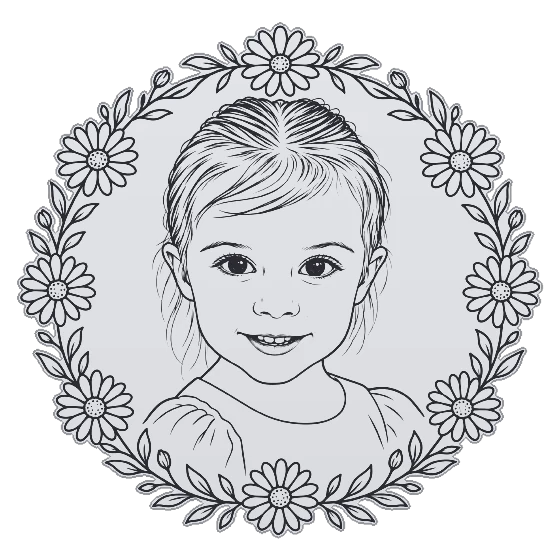
Our engraved portrait necklace has a birth-flower wreath style: pick a month and it draws a portrait from your photo inside a ring of that month's flower, using the first flower on the Old Farmer's Almanac list. The pendant is about an inch tall, cut to the shape of the design and engraved in stainless steel, gold plate or sterling silver.
Is there an official birth flower list?
No. The Old Farmer's Almanac calls its list the one "usually accepted", and it is the most copied, but the Society of American Florists, UK florists and university extension offices each publish different flowers for several months. The disagreements are concentrated in February (violet, primrose or iris), July (larkspur or delphinium, and water lily), November (a second flower or not) and December (narcissus, holly or poinsettia). The oldest lists disagree with all of them: Hale's 1848 "Fortuna Flora" matches today's list only in June and October, and the 1907 "birth flowers" list only in April, June and November. For something permanent, like a tattoo, an engraving or a baby's name, most people use the Almanac's first flower and mention the second, and there is nothing wrong with choosing the one you like better. The Almanac's editors say they know of no authoritative list for the Southern Hemisphere, where the months fall in opposite seasons, and recommend their standard list there too.
Their portrait in their birth flowers
Add one photo, pick their birth month, and see the wreath drawn around their face before you pay. Cut to its shape and engraved in steel, gold or sterling.
A birth flower also works in words. If the flower is going in a card rather than a vase, our birthday wishes for a granddaughter and Christmas card messages are sorted by recipient. And if what you want to keep is something a child drew, the necklace can also engrave their own drawing, cut to its outline.
Frequently asked questions
What is my birth flower?
+
On the Old Farmer's Almanac list, the one most US sites copy: January carnation, February violet, March daffodil, April daisy, May lily of the valley, June rose, July larkspur, August gladiolus, September aster, October marigold, November chrysanthemum and December narcissus. Most months also have a second flower, such as snowdrop for January or holly for December.
Why are there two birth flowers for each month?
+
Because there is no official list. Publishers and florists have added and swapped flowers since the first lists were printed around 1900, and the second flower is often one that used to be first. The 1907 list, for example, gave January to the snowdrop, which is now January's second flower.
Do birth flowers really come from ancient Rome?
+
We found no source for that. The flower meanings come from 19th-century language-of-flowers books, a list of flowers for each month appears in print in the 1890s, and the phrase "birth flowers" appears in a 1907 party book. Even florists that repeat the Rome story say nobody is sure where the idea began.
What is the birth flower for December?
+
Narcissus, usually paperwhites, with holly as the second flower. Holly is the older choice: it is December's flower on the lists from 1893, 1901 and 1907. The Society of American Florists also lists poinsettia.
Which birth flowers are safe for cats and dogs?
+
Rose, hawthorn, aster and pot marigold (Calendula) are on the ASPCA's non-toxic list. Most other birth flowers are listed as toxic, and larkspur and lily of the valley are among the most dangerous. Several, like violet and cosmos, are not listed at all, which the ASPCA says does not mean they are safe.
What if I was born in the Southern Hemisphere?
+
The Old Farmer's Almanac's editors say they know of no authoritative Southern Hemisphere list and recommend the standard one. Since the lists were built around Northern Hemisphere seasons, some people pick the flower in bloom in their birth month instead.