
The short answer
To frame a puzzle, secure the pieces first (glue on the front, adhesive sheets or tape on the back, or nothing at all if the frame clamps tightly), flip it between two stiff boards, then fit it into a frame sized to the puzzle rather than to the box. The step almost every guide skips is the measuring: a finished puzzle is a nonstandard size, so an off-the-shelf frame will not match it. Plan for a mat, a custom frame, or a puzzle whose finished size is already a standard one.
Framing a finished puzzle looks like a two-step job: glue it, frame it. In practice there are three places it goes wrong, and they go wrong in a fixed order. The pieces shift when you lift it. The puzzle buckles when the glue dries on one side. And then the frame you bought does not fit, because a puzzle is not a standard size and the number on the box is not the number you need. Here is the whole sequence, with the measurements, so you only do it once.
Do you need to glue a puzzle before framing it?
No, and for some puzzles you actively should not. Glue is permanent: once a puzzle is sealed you cannot take it apart, resell it, or rebuild it. Ravensburger's own framing guidance draws the line by size and value. Glue is worth it for puzzles of 1,000 pieces or more, which are heavier and more prone to sagging and splitting once they are vertical, and for any frame that does not clamp the puzzle tightly between the backing board and the glass. Skip the glue if the puzzle is collectable, valuable, or wooden, or if you might want to rebuild it later. The glue-free method is fully reversible, so if you are undecided, start there. You can always seal it later; you cannot unseal it.
How do you glue a puzzle without ruining the picture?
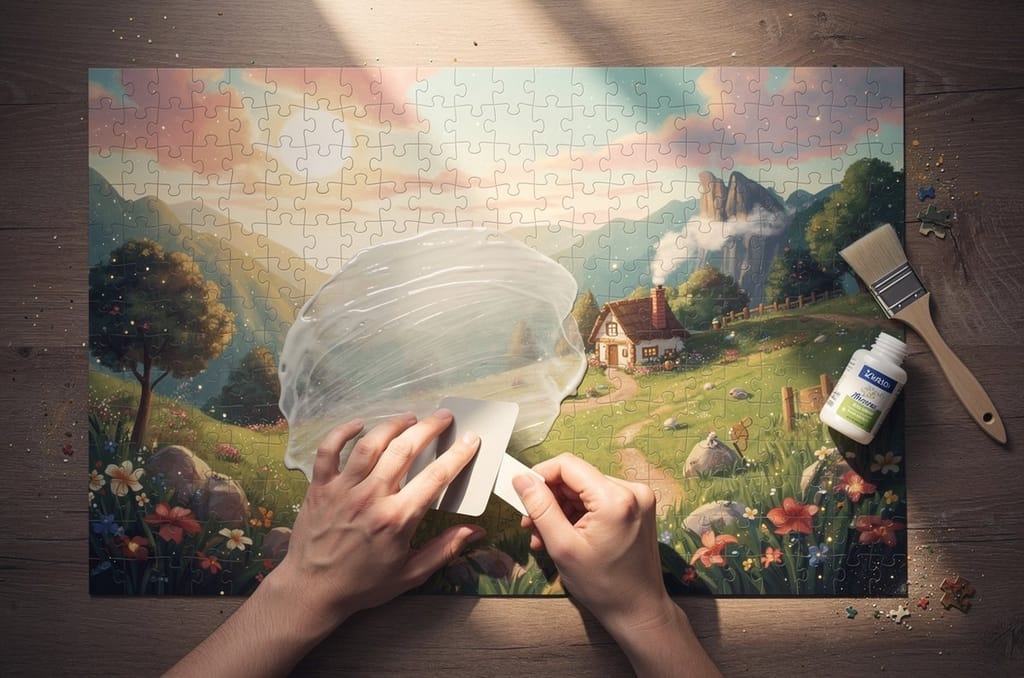
Work from the front, in thin coats, with the right applicator. Puzzle glue is a water-based acrylic sealer, so the enemy is oversaturation: too much liquid soaks the cardboard and the puzzle curls. Choose a glue that is acid-free and low in water content. Mod Podge Puzzle Saver, the most common brand, dries to the touch in 15 to 20 minutes and costs about $6 for a 2 ounce bottle.
- Slide a sheet of wax or parchment paper under the puzzle so the glue that seeps through the cracks does not bond it to your table.
- Pour a line of glue along one edge, then spread it across the surface with a plastic card or a foam brush, pushing it down into the gaps between pieces. Never use a bristle paintbrush: it leaves visible strokes in the dried finish that you cannot sand out.
- Let the first coat dry, keeping it thin enough that the cardboard does not swell. A light first coat is only there to lock the pieces so the puzzle can be moved safely.
- Add a second coat once the first is dry, spreading it into any cracks the first coat missed.
- Turn it over and glue the back once the front is fully set. This is what pulls a curling sheet flat again as it dries, so do not skip it on anything larger than a few hundred pieces.
How long does puzzle glue take to dry?
Fifteen to twenty minutes to the touch, and roughly 28 days to cure completely. Those two numbers are not the same thing and the gap catches people out. Touch-dry is enough to move the puzzle to the next step or add another coat; cured is when the sealer has finished hardening all the way through. Mod Podge's own guidance puts full cure at about four weeks, and the finish is not waterproof even then. In practice this means you can glue on a Saturday and hang it on a Sunday, but treat the surface gently for the first few weeks: keep it out of a damp room, do not stack anything on top of it, and wait before wiping it with anything wet.
How do you flip a puzzle without it falling apart?
This is the step that ruins puzzles, and it is the one most guides wave past. If you are using adhesive sheets or tape, the adhesive goes on the back, which means the puzzle has to be turned over while it is still loose. Do not lift it. Sandwich it and rotate the whole sandwich.
Cut the boards close
Use two pieces of stiff cardboard or foam board trimmed to barely more than the puzzle. Extra room lets the middle sag and gap open mid-turn.
Clamp the edges
Binder clips or tape along all four edges hold the sandwich shut. This is the difference between a flip and a spill.
Flatten it first
Press any raised pieces down with a rolling pin, or weight the puzzle for a few hours, before it goes anywhere near a board.
Use two people
One person per end, turning in one continuous motion. Then a rolling pin over the adhesive sheets for even pressure.
Better still, avoid the flip entirely: assemble the puzzle on the frame's own backing board from the start. Ravensburger puts this first in its own instructions for a reason, since it removes the riskiest move in the process before you have made it.
Why will your puzzle not fit a standard frame?
Because puzzle sizes and frame sizes come from two different industries that never agreed on anything. Standard US frames are sold at 8x10, 11x14, 16x20, 18x24, and 24x36 inches, with 14x18, 20x24, and 22x28 available if you hunt. Finished puzzles land between those numbers. A standard Ravensburger 500-piece measures 19.5 by 14.25 inches, and a 1,000-piece measures about 27 by 19.5 inches. Neither is a frame size. Measure the puzzle yourself rather than trusting the box, because printed dimensions are approximate and a puzzle built from 36 pieces along one edge accumulates real tolerance.
| Puzzle | Finished size | Nearest standard frame | What you will need |
|---|---|---|---|
| Ravensburger 500 pieces | 19.5″ x 14.25″ | 16″ x 20″ (landscape) | A mat cut to size. It fits inside with about half an inch of total slack across the width and nearly two inches across the height, so the margins are uneven. |
| Ravensburger 1,000 pieces | about 27″ x 19.5″ | 22″ x 28″ (landscape) | A less common standard size, plus a mat. A 24x36 leaves gaps too wide to look deliberate. |
| Our 110-piece keepsake | 8″ x 10″ | 8″ x 10″ | Nothing. It is already a standard frame size. |
| Our 520-piece keepsake | 16″ x 20″ | 16″ x 20″ | Nothing. Precut 16x20 glass and mats are stocked everywhere. |
Do you need a mat to frame a puzzle?
Only if the puzzle is not already a frame size, which is most of the time. The mat is not a decorative choice here, it is the fix for a size mismatch, and it works because the window is cut slightly smaller than the artwork rather than larger. Framers trim it between an eighth and a quarter of an inch tighter on each side so the mat overlaps the edges and holds the piece in place, then the visible border around it typically runs about two inches wide. That is how a 16 by 20 inch frame with a 10.5 by 13.5 inch opening displays an 11x14 print. Apply the same logic in reverse for a puzzle: pick the stock frame your puzzle fits inside, then have the window cut to the puzzle's real measurements rather than to a standard print size.
Glued, taped, or floated: which method fits your puzzle?
The three approaches differ in permanence, cost, and how much they forgive a sizing mistake. Depth matters as much as width: a puzzle is only about 2 millimeters thick, but add a backing board and glass and a shallow frame will not close. Framebridge, one of the larger mail-in framing services, caps float mounting at half an inch of total thickness and will not frame a puzzle larger than 32 by 40 inches, which is a useful ceiling to know before you build something bigger.
| Method | Reversible | Best for | Watch out for |
|---|---|---|---|
| Glue the front | No | 1,000 pieces and up, loose-fitting frames, anything going on a wall for years | Curling from oversaturation; a gloss finish that reflects; the 28-day cure |
| Adhesive sheets or tape on the back | Mostly | Keeping the printed surface untouched and matte | You have to flip the puzzle while it is still loose |
| No adhesive, clamped in the frame | Yes | Smaller puzzles, collectables, wooden puzzles, anything you may rebuild | Needs an exact-size frame with no gap; large puzzles flex and drop apart |
What does it cost to frame a puzzle?
Less than you fear on the materials, more than you expect on the frame. A bottle of puzzle glue runs about $6, and acid-free backing board is a few dollars more, so securing the puzzle is genuinely cheap. The cost lands on the frame, and it lands there precisely because of the sizing problem above. A ready-made 16x20 frame is inexpensive because the glass and mats are precut in volume. A frame cut to 19.5 by 14.25 inches is a custom job, priced accordingly, and a custom mat on top of it adds more. Professional puzzle framing services exist and will do the whole thing, but you are paying bespoke rates on an object whose value is sentimental. For comparison, a ready-to-hang framed canvas from us runs $79 to $149 depending on size, which is often less than custom-framing a puzzle you already own.
Should you frame a child's puzzle?
Frame it if the image is worth looking at every day, and keep the pieces if the point was the building. Those are different goals and a single puzzle rarely serves both. A stock 300-piece of a rainforest is worth rebuilding; sealing it permanently ends the thing that made it good. A puzzle showing your own child, or your family, or the dog, is the opposite: the assembly is a one-time event and the picture is the keepsake. That is the case for framing, and the practical argument for choosing a puzzle whose finished dimensions are already a standard frame size before you glue anything. If you are weighing whether the puzzle itself is doing developmental work, our post on the benefits of puzzles for kids covers piece counts by age, and our guide to what makes a good custom photo puzzle covers print quality and piece fit.
How to skip the glue entirely
There is a version of this project with no glue, no flip, and no custom mat, and it is worth knowing before you commit to a bottle of sealer. Our keepsake puzzles are printed at finished sizes that include 8 by 10, 11 by 14, and 16 by 20 inches, all three of which are off-the-shelf frame sizes. Order the 110-piece at $55 or the 520-piece at $89, build it, and it drops into a stocked frame with precut glass. If the wall is the whole point and the building never was, the same portrait is available as a framed canvas that arrives ready to hang, from $79. Either way the artwork starts as one photo: you upload it on the create page, pick a magical world or an art style, and approve a watermarked proof before anything prints.
Make one worth framing
Turn one photo into an artful portrait, then choose the puzzle that fits a standard frame or the canvas that arrives already framed.
Frequently asked questions
What is the easiest way to frame a puzzle?
+
Assemble the puzzle directly on the backing board of the frame you intend to use, then close the frame so the glass and backing clamp the pieces in place. No glue, no flipping, and no adhesive to buy. This works best on smaller puzzles and requires a frame whose internal dimensions match the puzzle closely, because an unglued puzzle settles to the bottom and any size difference shows as a gap at the top.
Do you have to glue a puzzle before framing it?
+
No. Glue is optional and permanent. It is recommended for puzzles of 1,000 pieces or more, which sag and split under their own weight once hung, and for frames that do not hold the puzzle tightly. Avoid it for collectable, valuable, or wooden puzzles, and for any puzzle you might want to rebuild, since a sealed puzzle cannot be taken apart again. Adhesive sheets applied to the back are a middle option that leaves the printed surface untouched.
How do you frame a puzzle that is already assembled?
+
Flatten any raised pieces with a rolling pin, then either glue the front in thin coats or slide the puzzle between two stiff boards trimmed close to its size, clip the edges shut, turn the whole sandwich over, and apply adhesive sheets to the back. Measure the finished puzzle yourself afterward rather than relying on the box, then choose a frame it fits inside and have a mat window cut to those measurements.
Will a 1,000-piece puzzle fit a standard frame?
+
Not exactly. A standard 1,000-piece puzzle finishes at roughly 27 by 19.5 inches, which falls between common US frame sizes. The closest stocked option is 22 by 28 inches, which needs a mat cut to fill the uneven margins; a 24 by 36 frame leaves gaps too large to look intentional. The alternatives are a custom frame or choosing a puzzle whose finished size is already standard, such as 16 by 20 inches.
Can you frame a puzzle without glue?
+
Yes, and it is the only reversible method. Sandwich the finished puzzle between the frame's backing board and its glass and let the pressure hold everything in place. The frame's internal dimensions need to match the puzzle closely, and the frame must close with no gap between backing and glass. This suits smaller puzzles well; larger ones flex enough in a vertical frame that pieces can work loose and drop.