
In short
The best Christmas party games are the ones that fit your crowd: charades, a jigsaw puzzle race and a gift exchange work for almost any mix of ages, while families with toddlers do better with simple cooperative games and adults and coworkers with word games and icebreakers. Below are 68 games sorted into nine groups (young kids, the whole family, adults, office, gift exchanges, classroom, quiet table games, outdoor games and video calls). Every game lists how many people can play, the youngest age it suits, how long it takes and what you need, with safety notes for the ones that put candy or small pieces near small children.
We read ten of the pages that rank highest for Christmas party games before writing this one. None of them gives a recommended age for every game. None mentions that their most popular challenges put hard candy, marshmallows or balloons in reach of toddlers, which pediatricians flag as choking hazards. Most build their charades and trivia around holiday films and borrow the names of TV shows and boxed games.
So every game here has its numbers on one line: players, ages, minutes and supplies. The names are traditional, descriptive or our own themed versions, the charades prompts use carols and stories old enough to be in the public domain, and the oldest games link to the old books that describe them, including the four games played at Fred's party in A Christmas Carol.
What are the best Christmas party games?
Pick by crowd, not by what's popular. A party with three-year-olds and grandparents needs different games from an office party, and the wrong one stalls the room. These are the first games we'd reach for in each situation; the full rules are further down.
| Your party | Play this first | Why it works |
|---|---|---|
| Toddlers and preschoolers | Freeze dance with carols (#3) | No rules to learn, ages 2+, five minutes |
| Kids to grandparents | Christmas charades (#9) | Teams can mix ages; nothing but paper slips and a timer |
| A room that doesn't know each other | Holiday traditions bingo (#33) | Everyone has to talk to someone new |
| Adults at the table | The hat game (#23) | Three rounds from one bowl of slips, 30-45 minutes |
| Coworkers | Two truths and a lie (#31) | Zero prep, nobody has to perform |
| Gift exchange | White elephant (#39) | The steal rule turns opening gifts into a game |
| A classroom | Seven up (#46) | Quiet, no supplies, works for 14-35 kids |
| A snowy yard | Snowman-building contest (#57) | Teams of any age, judged in categories |
| Family on a video call | At-home scavenger hunt (#65) | Ages 3+, nothing to mail ahead |
Numbers match the full list below. Ages are our recommendations based on how each game plays.
How many games do you need for a two-hour party?
Plan three to five full games for a two-hour party (or a dozen short rounds, as in the 12 games tournament below) and expect each to take 15 to 30 minutes, including the time it takes to explain the rules and form teams. Start with something that needs no skill and gets people moving or talking, put the longest game in the middle, and save the gift exchange for last so nobody leaves before their turn.
People do want games. In a Harris Poll of 1,238 employed US adults in November 2024, 46% said they would like themed holiday parties with interactive elements such as games, rising to 53% of millennials. At home the audience is even wider: in a 2013 Pew Research Center survey, 86% of US adults planned to gather with extended family or friends on Christmas or Christmas Eve.
A rhythm that holds a mixed room: a loud game, then a seated one, then a loud one. Give younger children a job (dealing cards, ringing the bell that ends a round) during the games that are too old for them, and keep a pile of drawing paper on hand for anyone who wants out.
Christmas party games for families with young kids
Most of these eight games work from age two or three (the toilet-paper snowman from five), need almost no reading and finish in 20 minutes or less, which is about as long as a room of preschoolers will stay with one thing. The American Academy of Pediatrics notes that from about age three, children start playing with each other rather than just alongside, learning to take turns in small groups with adult help.
Lean cooperative where you can. In a study of 70 children aged 4 and 5, cooperative games increased cooperative behavior and reduced aggression, while competitive games were followed by more aggression, effects that carried into free play afterward.
1. Pin the nose on the reindeer. 3-15 players · ages 3+ · 10-20 min · a reindeer drawn on poster paper, red paper circles, tape or sticky putty, a soft scarf for a blindfold. Tape the drawing to the wall at child height. Each player in turn is blindfolded, turned gently once or twice, and walks forward to stick the nose where they think it goes. Write initials next to each attempt; the closest wins. Use tape or putty rather than the push pins of the classic donkey version, and clear the walking path.
2. Santa says. 4-30 players · ages 3+ · 5-15 min · nothing (a Santa hat for the leader is optional). Santa calls out actions such as "jingle like a bell" or "waddle like a penguin," and players copy only when the call starts with "Santa says." Move on a call without it and you sit out. The last player standing is the next Santa.
3. Freeze dance with carols. 4-30 players · ages 2+ · 5-15 min · a speaker and an upbeat carol playlist. Everyone dances while the music plays and freezes when it stops. Anyone who moves or giggles during the silence is out, and the last dancer standing wins. For the youngest, skip the outs and just play: freezing is the fun. Clear toys, cords and gift boxes off the floor first.
4. Candy cane hunt. 2-20 players · ages 3+ · 10-20 min · candy canes or paper cutouts, a bag for each child. While the children wait in another room, hide the canes low and obvious for little ones and trickier for older kids. On "go" everyone searches, with a cap per child so the youngest still find some. For children under four, hide paper or plastic canes and swap them for a treat they can eat safely afterward: the AAP advises keeping hard candy away from children until age 4 or older.
5. Pass the present. 5-20 players · ages 3+ · 10-20 min · one prize wrapped in about one layer per player, small treats between layers, music. Players sit in a circle and pass the parcel while the music plays. When it stops, the holder tears off one layer and keeps whatever is underneath. The last layer reveals the prize. Whoever runs the music can quietly make sure every child gets a turn. For under-fours, put stickers or toys too big for the small-parts test between the layers instead of candy.
6. I spy on the tree. 2-10 players · ages 3+ · 5-15 min · a decorated tree. One player picks something on the tree and says "I spy with my little eye something..." plus its color (for pre-readers) or first letter. Whoever guesses right picks next. It works while the cocoa is being poured, and it gets kids looking at the ornaments instead of pulling them.
7. Find the pickle ornament. 2-15 players · ages 3+ · 5-15 min · a pickle-shaped ornament (or any odd one), a small prize. An adult tucks the ornament deep in the branches while the kids are out of the room. The first to spot it wins a small prize or opens the first gift. For a big group, hide several odd ornaments and hand out a checklist. Despite the packaging, nine in ten Germans have never heard of it (see the myths table below). Hang shatterproof ornaments on the low branches.
8. Toilet-paper snowman. teams of 3-4 · ages 5+ · 5-10 min · one or two rolls of toilet paper per team, paper hats, scarves or paper buttons. Each team picks one player to be the snowman. When the timer starts (two or three minutes), the others wrap that person from the shoulders down and add a scarf and buttons. Judges pick the best snowman, or the first team to use up a full roll wins. Keep the paper off faces and wrap loosely so the snowman can't trip.
Christmas games for the whole family, kids to grandparents
Most of these 14 games hold a seven-year-old and a seventy-year-old at the same time, and most score better when teams mix ages. Dickens wrote that the guests at Fred's party in A Christmas Carol "might have been twenty people there, young and old, but they all played" (Project Gutenberg). Three of these games are on the list they played.
9. Christmas charades. 4-30 players in two teams · ages 6+ (picture prompts for younger kids) · 20-45 min · prompt slips, a bowl, a timer. On each turn, one player draws a prompt and acts it out without speaking while their own team guesses, using the usual signals for number of words and "sounds like." Teams get 60 to 90 seconds and a point for each correct guess. For a team round, the whole team acts out the prompt while one player guesses. Our list of charades ideas below sticks to carols, stories and winter scenes.
10. Sketch-and-guess. 4-20 players in two teams · ages 6+ · 20-40 min · a whiteboard or big paper pad, markers, prompt slips, a timer. One player draws a holiday prompt (a snow globe, sleigh bells, mittens) while teammates shout guesses. No letters, numbers or talking. A turn lasts 60 seconds. In the relay version, artists from both teams draw the same prompt at once and the first team to guess takes the point.
11. Christmas bingo. 4-100+ players · ages 4+ with picture cards, 7+ with word cards · 15-30 min · 5x5 cards with holiday pictures or words (each one different), call slips, dabbers or paper squares. The caller draws slips and announces each item; players mark matches. The first to complete a row, column or diagonal calls bingo. Play extra rounds for four corners or a full card. With toddlers at the table, use dabbers or large paper squares, never small candies or buttons.
12. Guess the carol. 4-40 players in teams · ages 6+ · 15-30 min · a playlist, a speaker, answer sheets. Play the first few seconds of a carol, or hum the opening. Teams write the title for a point and earn a bonus for the first line. In the finish-the-lyric version, stop mid-line and let teams complete it. Traditional carols such as "Deck the Halls" and "Jingle Bells" keep printed answer sheets free of copyright worries.
13. Twelve days memory game. 3-15 players · ages 6+ · 10-20 min · nothing (tokens for forfeits are optional). Sit in a circle. The leader says the first day's line and each player repeats it. The leader adds the second day, everyone repeats both, and so on to twelve. A player who slips hands over a token and earns it back at the end by singing a line. For a sillier round, the group invents its own twelve gifts.
14. Sleigh ride. 6-20 players · ages 5+ · 10-15 min · a chair for everyone but the storyteller. Adapted from Stage Coach in Cassell's Book of In-door Amusements, a Victorian games book. Give each of the other players the name of something on a sleigh: a runner, a bell, the reins, a reindeer, the sack, a passenger. The storyteller makes up a ridiculous account of the sleigh's trip. When your thing is named, stand up, turn around and sit down. When the storyteller says "sleigh," everyone, storyteller included, scrambles for a new seat, and whoever is left standing tells the next story.
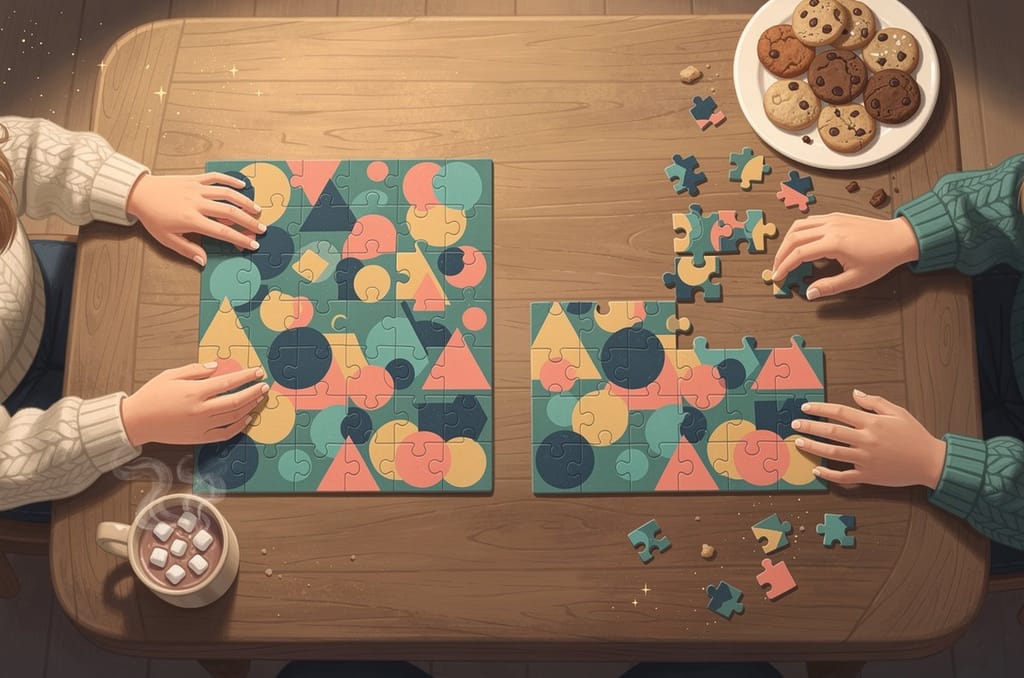
15. Jigsaw puzzle race. teams of 2-4, 2-10 teams · ages 5+ · 15-60 min · one identical sealed puzzle per team, a table each, a timer. Every team gets the same puzzle, unopened so nobody sees the picture early. On "go" teams open and build; the first to place its last piece and raise their hands wins. If time runs out, rank teams by pieces left. Pick the piece count for your youngest team: about 30 for kids under 6, around 100 for family teams, 250 or so for adult teams with 45 minutes. For scale, at the World Jigsaw Puzzle Championship, solo competitors get 90 minutes for a 500-piece puzzle in the first round. Keep loose pieces away from children under three.
16. Christmas trivia. 4-100 players in teams of 3-6 · ages 8+ (add a kids' round) · 30-60 min · question rounds, answer sheets, a scoreboard. Teams pick a name, the quizmaster reads four to six rounds of eight to ten questions, and teams confer quietly and write their answers. Swap sheets to mark after each round. Our Christmas trivia questions come in 14 rounds, tagged Easy, Medium or Hard, with every answer linked to its source.
17. Musical chairs, carol edition. 5-20 players · ages 4+ · 10-20 min · sturdy chairs (one fewer than players), carols. Line up the chairs facing alternate directions. Everyone walks around them while the music plays and sits when it stops. Whoever is left standing is out, a chair is removed, and play goes on until one player remains. In the cooperative version nobody is out: chairs keep disappearing and everyone has to share the ones that are left, which is the version to choose with preschoolers.
18. Blind man's buff. 6-20 players · ages 6+ · 10-20 min · a soft blindfold and a cleared room. One player is blindfolded and turned gently. The others move around a cleared area, with no hiding behind furniture. The seeker tags someone and, in the parlor version, has to guess who it is by voice or by touching a sleeve. A right guess makes that player the next seeker. Walk, don't run, and have a spotter steer the seeker away from the stairs, the fireplace and the tree.
19. Yes and No. 3-20 players · ages 6+ · 10-20 min · nothing. One player thinks of something Christmassy: an object, an animal, a tradition or a person in the room. Everyone else asks questions, and the answer can only be "yes" or "no." If the group gets it within 20 questions, they win; otherwise the answerer picks again. This is the game Fred's party plays in Stave Three, where the answer turns out to be Scrooge.
20. How, When and Where. 4-15 players · ages 9+ · 10-20 min · nothing. One player leaves the room while the others choose a word with more than one meaning, such as bow (on a gift, or bending at the waist) or sleigh and slay. The guesser comes back and asks each player "How do you like it?", then "When do you like it?", then "Where do you like it?", until the word gives itself away. An 1895 parlor-game manual uses rain, reign and rein as its example. Scrooge's niece, Dickens tells us, "was very great" at it.
21. Gift-wrap race. 2-20 players, solo or in pairs · ages 7+ · 5-15 min · identical boxes or awkward objects (a ball, a mug), paper, tape, ribbon. Everyone wraps the same item with the same supplies. The first finished wins for speed and a judge picks the neatest. For a harder round, partners wrap together using one hand each. For children, pre-cut the paper and tape so nobody rushes with scissors.
22. Gingerbread decorating contest. 2-30 players, solo or in teams of 2-4 · ages 4+ · 30-60 min · gingerbread cookies, kits or graham crackers, icing in piping bags, a shared toppings table. Everyone starts with the same base and shares the candy table. Set a time limit and categories such as most festive, funniest and best engineering (the tallest house still standing after 60 seconds). Vote by secret ballot. Check allergen labels, and keep hard candy and whole nuts off the table when under-fours are decorating.
Race on a puzzle of your own family
Turn one family photo into a painted portrait, printed as a jigsaw in sizes from 30 chunky pieces for small hands to 1,000 for the keen puzzlers. Order one for a beat-the-clock round with the whole room, or one per team for a race. You approve a watermarked proof before anything prints.
Christmas party games for adults
These eight games run on talk and bluffing rather than running around, and they suit teenagers as well as adults. None of them needs alcohol; where a drinks round fits, there's an alcohol-free version alongside. If you'd rather spend part of the night just talking, our Curious Questions deck is 100 conversation questions for ages 14 and up, $39 shipped, and it ships around December 7.
23. The hat game. 6-20 players in two teams · ages 12+ · 30-45 min · paper slips, a hat or bowl, a timer. Everyone writes three to five holiday names or things that the whole room will know (traditions, foods, carols, famous people) and drops them in the hat. Teams take one-minute turns in which a clue-giver gets their team to guess as many slips as possible without saying the words. Replay the same slips in round two with one-word clues, then in round three as charades. Highest total wins. Teenagers can carry a team.
24. The dictionary game. 4-10 players · ages 12+ · 20-40 min · a big dictionary, paper slips, pens. The selector finds an obscure word (old winter words work well) and reads and spells it. Everyone writes a convincing fake definition while the selector copies the real one. The selector reads them all aloud, shuffled, and players vote for the real one. You score for picking it and for every vote your fake attracts. The selector role rotates.
25. Humbug. 6-25 players · ages 10+ · 5-10 min a round · a deck of cards. Count out one card per player, including the queen of spades, shuffle them and deal one each, face down. Whoever gets the queen of spades is the secret Humbug, who knocks players out by winking at them. A player who is winked at waits a few seconds, then faints dramatically out of the game. Everyone else tries to unmask the Humbug, and a wrong accusation knocks the accuser out. It's the old parlor game wink murder, renamed for Scrooge's favorite word.
26. Throwing light. 5-15 players · ages 12+ · 15-30 min · nothing. Two players secretly agree on a word with several meanings or a sound-alike, such as Claus and claws, or bough and bow. They talk about it aloud, slipping between the meanings to confuse everyone. Other players join the conversation as soon as they think they know the word, and drop back out if a remark shows they guessed wrong. It's another one from Cassell's.
27. Christmas categories. 2-12 players · ages 10+ · 15-30 min · paper, pens, a timer, a way to draw random letters. Agree on eight to ten holiday categories: a cookie, a carol, something in a stocking, winter clothing. Draw a letter, and everyone has two or three minutes to write one answer per category starting with it. Swap sheets to score: an answer nobody else wrote is worth 2 points, a shared one 1.
28. Naughty elves. 7-20 players · ages 12+ · 20-45 min · role cards, a moderator. A hidden-role game. The moderator secretly deals one to three naughty elves, one of Santa's helpers, and villagers. At "night" everyone closes their eyes; the elves silently choose a player to send to the naughty list, and the helper points at one player to learn whether they're an elf. By "day," everyone argues and votes to expel a suspect. Villagers win when every elf is out; the elves win once they equal the villagers.
29. Blind taste test. 3-20 players · ages 8+ (drinks rounds for adults) · 15-30 min · five to eight numbered samples, scorecards. Number the samples (cookies, peppermint treats, hot cocoa, mulled cider) and hide the packaging. Tasters guess what each one is, or whether it's homemade or store-bought. For adults, serve eggnog or mulled cider with and without spirits, and never make drinking the penalty. Ask about allergies before anyone tastes.
30. Draw-and-pass telephone. 4-12 players · ages 8+ · 15-30 min · a stack of paper slips per player, pens. Each player writes a holiday phrase on their top slip and passes the stack. The next player draws that phrase, hides the words and passes it on. The player after that writes what they think the drawing shows and hides the drawing. Alternate writing and drawing until every stack comes home, then reveal the chains.
Office Christmas party games
Office games have a different job: they should get coworkers talking without making anyone perform. Most workplaces still celebrate. In Challenger, Gray & Christmas's 2024 survey of 173 HR and business leaders, 64% of companies planned holiday celebrations. But in the same Harris Poll, 46% of workers whose company holds a party said they felt pressured to attend, and the top worry was awkward conversations with colleagues (30%).
Employment lawyers quoted by SHRM advise making attendance voluntary and framing the party as a celebration of employees rather than of one holiday, and a second SHRM article suggests making it about more than drinking, with activities such as games and contests. These eight games are opt-in by design.
31. Two truths and a lie, holiday edition. 4-30 players · ages 10+ · 10-20 min · nothing. Each person shares three short holiday statements (a family tradition, a memorable gift, a dinner disaster), two true and one false. The group votes on the lie before the reveal. In the best-gift, worst-gift variant, everyone writes two real and two invented gifts they've received and the group sorts real from fake.
32. Ugly sweater contest. 5-200 players · all ages · 15-30 min · guests' own sweaters, an optional decorating table (felt, pom-poms, tinsel, safety pins), ballot slips. Run a quick catwalk with music, then collect anonymous ballots in categories such as most festive, best handmade and best use of lights. The decorating table and a "festive hat or scarf" category mean nobody who skipped the sweater is left out.
33. Holiday traditions bingo. 15-80 players · ages 10+ · 15-20 min · bingo grids with squares like "has built a gingerbread house," "has a tradition from another country," "celebrates more than one winter holiday," pens. Everyone mingles, looking for a different person to match each square and writing their name in it. Each person can sign a given card only once. The first full line, or the most squares in 15 minutes, wins. It's the best mixer on this list for a room of strangers.
34. Points-board trivia. 6-60 players in 2-6 teams · ages 12+ · 30-45 min · a 5x5 grid of categories and point values on a screen or whiteboard, questions. Teams take turns picking a category and a value, with harder questions worth more. A missed question can be stolen by any team that raises a hand first. In the final round, each team secretly wagers part of its score on one last question. These are house rules, so change them freely.
35. Childhood holiday photo match. 8-60 players · adults · 20-30 min · childhood holiday photos sent in ahead (opt-in), numbered on a slideshow or wall, answer sheets. Display the numbered photos during the party while guests match each one to a coworker. Reveal the answers at the end; the most correct matches wins. Make it clearly optional so nobody feels obliged to share family photos.
36. Cookie-face race. 2-20 players, heats of 3-4 · ages 6+ · one-minute heats · small sandwich cookies or gingerbread cookies, wipes. Each player tilts their head back and balances a cookie on their forehead. On "go," using only face muscles, they work it down into their mouth, resetting it if it falls. The first to eat it wins the heat. The CDC lists cookies among choking hazards for young children, so this one is for older kids and adults.
37. Candy cane hook race. 2-10 players per heat · ages 8+ · one-minute heats · wrapped candy canes (one each to hold, plus a bowl of extras), a plate per player. Each player holds a wrapped candy cane by its straight end in their mouth and, with no hands, uses the hook to lift canes out of the bowl onto their own plate. The most canes moved in 60 seconds wins. Keep every cane wrapped, give each player their own, and don't walk around with one in your mouth.
38. This or that. 4-100 players · all ages · 10-20 min · a list of two-option questions. The host reads a choice such as "real tree or artificial?" or "snowy cabin or beach?" and players move to that side of the room (or vote by hand). One person on each side defends their pick in a sentence. "Neither" and "both" aren't allowed.
Christmas gift exchange games
A gift exchange is a game in itself once you add a rule that lets people steal, swap or lose what they've opened. These seven cover the classic steal game, a no-steal option for families who'd rather keep the peace, and two that put a prize in the middle.

39. White elephant. 6-30 players · ages 10+ · 30-60 min · one wrapped gift per person within a set budget, numbered slips. Everyone brings one wrapped gift, and numbers set the turn order. Player 1 opens a gift. Each later player either opens a new one or steals one already opened; whoever loses a gift opens a new one or steals in turn. A gift is frozen after it has been stolen two or three times. When everyone has a gift, player 1 gets one final swap. Also called a Yankee swap.
40. Secret Santa. 4-100 players · ages 6+ · 15-30 min at the party (names drawn 1-3 weeks before) · names in a hat or a random draw, a budget, optional wish lists. Each person secretly draws the name of the person they'll buy for and buys one gift within the budget. At the party, gifts are handed out and givers either stay anonymous or reveal themselves. In the clue version, each recipient gets three hint cards and tries to guess their Santa.
41. Left-right story pass. 6-30 players · ages 5+ · 10-15 min · one wrapped gift per person, a story full of the words "left" and "right." Everyone sits in a circle holding a wrapped gift. A reader tells a story packed with "left" and "right," and every time one is spoken, everyone passes their gift that way. When the story ends, you open whatever you're holding. Use our story below or write your own.
42. Dice gift swap. 6-20 players · ages 8+ · 20-30 min · one die, one wrapped gift per person, a timer. Put all the gifts in the middle and take turns rolling. In round one, a 6 lets you take a gift from the pile if you don't have one yet, and the round ends when everyone has a gift. Round two runs on a 5 to 10 minute timer: a 6 lets you swap gifts with anyone, a 1 means swap with a neighbor, and a 3 means everyone passes one gift left. When the timer goes off, everyone opens what they hold.
43. Ornament exchange. 6-30 players · ages 8+ · 20-40 min · one wrapped ornament per guest within a budget, numbered slips. Play white elephant rules with ornaments only: draw numbers, open or steal, and freeze an ornament after two steals. For a gentler version, run it as a Secret Santa. Either way, everyone goes home with something for their tree. Wrap glass ornaments well and choose shatterproof ones when small children are around.
44. Oven-mitt unwrap. 4-12 players · ages 6+ · 15-30 min · one die, oven mitts, a hat and a scarf, a prize wrapped in many taped layers. Players sit around a table and take turns rolling. Whoever rolls a 6 puts on the hat, scarf and mitts and starts unwrapping the prize. When someone else rolls a 6, the gear and the half-opened parcel pass to them. Whoever gets it open keeps it. In the chocolate version the prize is a bar of chocolate eaten with a fork and spoon, and the game ends when it's gone.
45. Plastic-wrap ball. 4-20 players · ages 8+ · 15-30 min · one or two big rolls of plastic wrap, small prizes, a bigger prize for the center, two dice. Build the ball ahead of time by wrapping the center prize and adding more prizes every few layers. Players sit in a circle; the holder unwraps as fast as they can (in oven mitts, if you're feeling mean) while the player on their left rolls the dice. On doubles, the ball moves to the roller. You keep whatever falls out while you're holding it. Bag the used wrap right away and keep it away from babies.
Classroom Christmas party games
Classroom parties have a fixed time slot, a room full of desks and usually a no-food or allergy policy, so these six games need little space and no candy. Check the school's rules before bringing treats for any of them.
46. Seven up. 14-35 players · ages 5-11 · 10-20 min · nothing. Also called heads down, thumbs up. Seven children come to the front. Everyone else puts their head down, eyes closed, one thumb up. Each picker quietly presses one thumb down and returns to the front. On "heads up, seven up," the children whose thumbs were pressed stand and guess who picked them. A right guess swaps places with that picker.
47. Gingerbread man hunt. 15-30 players · ages 4-7 · 20-40 min · the Gingerbread Man tale, paper gingerbread cutouts, clue cards placed around the school. Read the tale aloud, then take the class out of the room. When you come back, the gingerbread men have "run away" and left a clue. Follow the clue cards to the library, the office and the gym, where staff hand over the next clue, until the class finds them back in the classroom.
48. Paper snowflake contest. 5-35 players · ages 6+ · 15-30 min · square paper or coffee filters, child-safe scissors, string or tape. Show the class how to fold a square into a triangle and then into thirds, and how to cut shapes along the folds. Each child cuts one to three snowflakes. Hang them as a class blizzard and give awards for most lacy, most surprising and most even, or skip the awards and fill the windows.
49. Whisper down the chimney. 8-30 players · ages 5+ · 5-15 min · nothing. The classic game of telephone. Players sit in a line or circle. The first whispers a holiday sentence once to the next, and each passes on what they heard with no repeats. The last player says it aloud and the first reveals the original.
50. Roll-a-snowman. 2-30 players · ages 4-9 · 10-20 min · a die per table, paper, crayons, a chart (1 body, 2 head, 3 eyes, 4 carrot nose, 5 arms, 6 hat or scarf). Children take turns rolling and drawing the matching part. The body has to come before the head. The first finished snowman wins, or everyone keeps rolling until they're done and the class compares results.
51. Snowball bucket toss. 4-30 players in teams · ages 3+ · 10-20 min · soft "snowballs" (rolled socks, crumpled paper or cotton balls), buckets, tape for a throwing line. Each child throws five snowballs at the buckets and scores a point for each one that lands in. Move the line back for older kids. In the relay version, each player throws and runs to the back of their team's line.
Quiet Christmas games for the table
The best quiet Christmas games are consequences, a memory tray and I packed Santa's sleigh: all three work seated, need nothing more than paper or a tray of small objects, and take 10 to 20 minutes. These five suit the end of a meal, a room with a sleeping baby, or grandparents who'd rather stay seated.
52. Consequences. 3-12 players · ages 8+ · 10-20 min · paper and pens. Everyone writes the start of a story at the top of a sheet (an adjective and a name), folds it over to hide the writing, and passes it on. Keep going: a second name, where they met, what one said, what the other said, what happened, and what the world said about it. Then unfold and read the stories aloud. Cassell's calls it "the old-fashioned game of Consequences."
53. I packed Santa's sleigh. 3-15 players · ages 5+ · 10-15 min · nothing. The first player says "I packed Santa's sleigh and in it I put..." and names an item. The next repeats the whole list in order and adds one. Forget an item or get the order wrong and you're out. For younger kids, add items in alphabetical order.
54. Spoons, candy cane edition. 3-13 players · ages 8+ · 15-30 min · a deck of cards, wrapped candy canes or spoons (one fewer than players). Pull one set of four matching cards per player (four aces, four kings and so on), shuffle just those, deal four each and put the canes in the middle. Everyone passes one unwanted card left at the same time, trying to collect four of a kind. The first to get four quietly takes a cane, and then everyone grabs. Whoever is left without one gets a letter, and spelling S-P-O-O-N-S puts you out.
55. Christmas tray memory game. 2-20 players · ages 5+ · 10-15 min · a tray, 15-20 small holiday objects (a bell, a pine cone, a cookie cutter, a mitten), a towel, paper. Show the tray for one minute, then cover it. Players list every object they remember, and the longest correct list wins. In the variant, take one object away and ask what's missing. It's Kim's game, named for the memory game in Kipling's novel Kim (1901). Keep the small objects away from children under three.
56. Folded snowman drawing. 3 players per sheet · ages 5+ · 10-15 min · paper folded into three bands, markers. The first player draws a head (a snowman, an elf, a reindeer, anything) in the top band, extends the neck lines just past the fold, and folds it out of sight. The second draws a body without seeing the head, the third adds legs. Unfold for the reveal. The surrealists called it cadavre exquis, or exquisite corpse.
Outdoor and active Christmas games
For a snowy yard, start with a snowman-building contest; with no snow, run a reindeer relay or garland limbo indoors. These seven games suit a yard, a park or a big room where kids need to burn off energy. Dress for the weather, agree on the boundaries before anyone starts, and run sled races one rider at a time.
57. Snowman-building contest. 2-30 players in teams of 2-4 · ages 3+ · 30-60 min · packable snow, scarves, hats, buttons, carrots, sticks, waterproof gloves. Each team builds a snowman within a set time. Judges award categories such as tallest, most creative, best dressed and most lifelike, and the winners get first pick of the cocoa. Keep the build area well away from roads and driveways.
58. Sled race. 2-20 players · ages 4+ (5 and under ride with an adult) · 30-60 min · sleds, a safe hill, start and finish markers, a stopwatch, helmets. Run it as timed runs, one rider at a time, and the fastest time wins. KidsHealth advises that everyone go down one at a time, one person per sled except adults with young kids, sitting up and facing forward, and that hills ending near streets, ponds, trees or fences are off-limits.
59. Snowball target toss. 2-20 players · ages 4+ · 15-30 min · snow, targets (buckets, a bullseye on a fence, a hat on a snowman), a throwing line. Take turns throwing from the line and score a point for each hit. In the team version, each team builds a low wall with a stack of snow "presents" behind it and tries to knock over the other team's stack. Loose snow only, and nobody aims at people.
60. Christmas lights scavenger hunt. 2-30 players in teams, on foot or by car · ages 3+ · 30-90 min · the same checklist for each team (a lit reindeer, an all-blue house, a star on a roof), pencils, flashlights. Spot and photograph each display from the sidewalk or the car and come back by a set time. The first full card, or the most finds, wins. Stay on sidewalks, wear something reflective, and let passengers do the spotting.
61. Reindeer relay. 6-40 players in teams of 3-6 · ages 4+ · 15-30 min · pillowcases or sacks, spoons, shatterproof ornaments, scarves to tie ankles, cones. A three-leg relay: hop in a sack to the cone, carry an ornament on a spoon back, then pair up for a three-legged dash with ankles tied by a scarf. Each teammate finishes their leg before tagging the next. Run it on grass or snow, not pavement.
62. Sardines. 5-20 players · ages 5+ · 15-30 min · nothing (a flashlight for a dim indoor round). Hide-and-seek in reverse. One person hides while everyone counts. When a seeker finds the hider, they quietly squeeze into the hiding place too. The last seeker to find the growing group hides next. Agree on off-limits areas first, including anything that latches from outside, and count heads at the end of every round.
63. Garland limbo. 4-25 players · ages 4+ · 10-15 min · a tinsel garland, ribbon or wrapping-paper tube, two holders, music. Two holders hold the bar at chest height. Players pass under it leaning backward, without touching the bar or putting a hand on the floor. The bar drops a notch each round; touch it or fall and you're out. Never use a lit or plugged-in light string as the bar.
Virtual Christmas games for families far apart
The easiest Christmas game on a video call is an at-home scavenger hunt: it works from age three and nothing has to be mailed ahead. These five games suit grandparents, cousins or a remote team; send answers privately to the host so the loudest household doesn't win by default. In Challenger's survey, 4.5% of companies planned virtual holiday events in 2024.
64. Video-call Christmas trivia. 4-100 players across households · ages 8+ · 30-60 min · a video call, question slides, a private way to send answers to the host. The host shares slides round by round, and each household sends its answers privately within a time limit. After each round the host reveals answers and shows the scores. Mute everyone but the host while questions are read.
65. At-home scavenger hunt. 2-50 players · ages 3+ · 15-30 min · a video call and a list of items. The host calls out an item: something red and green, the oldest ornament you own, one mitten. The first player to show it on camera scores. Finish with a story round in which everyone tells the story behind one thing they fetched. Remind kids to walk, not run.
66. Virtual white elephant. 6-25 players · ages 12+ · 30-60 min · one wrapped gift per person kept at home (budget includes shipping), a video call, a number draw. Each player shows their wrapped box on camera. Draw numbers and play white elephant rules: pick any unopened gift and have its owner open it on camera, or steal one already opened, freezing a gift after two steals. After the call, each gift is mailed to whoever ended up with it.
67. Guess whose ornament. 4-40 players · ages 6+ · 15-30 min · photos of each person's favorite ornament sent to the host ahead (opt-in), a slideshow. The host shows the ornaments one at a time and players guess whose each is. Then the owner tells its story. One point per correct guess.
68. Mailed jigsaw race. 2-10 households of 1-4 people · ages 6+ · 20-60 min · identical sealed puzzles sent to each household ahead of time, a video call, a timer. Everyone opens at the same moment and builds. The first household to finish holds it up to the camera, and the rest are ranked by pieces left when time runs out.
What are the 12 games of Christmas?
"The 12 games of Christmas" isn't one fixed list; the phrase usually means a family tournament of twelve short rounds. Here is a two-hour version drawn from the games above. Split into two or three teams that mix ages, score 3 points for first place in each round, 2 for second and 1 for third, and hand the winning team the last pick of the leftover cookies. Between rounds, read a few of our Christmas jokes for kids while the next game is set up.
| Round | Game | Minutes |
|---|---|---|
| 1 | Santa says (#2) | 5 |
| 2 | Toilet-paper snowman (#8) | 5 |
| 3 | Christmas charades (#9) | 15 |
| 4 | Twelve days memory game (#13) | 10 |
| 5 | Cookie-face race (#36) | 5 |
| 6 | Sketch-and-guess (#10) | 10 |
| 7 | Christmas tray memory game (#55) | 5 |
| 8 | Guess the carol (#12) | 10 |
| 9 | Gift-wrap race (#21) | 10 |
| 10 | Jigsaw puzzle race (#15) | 20 |
| 11 | Freeze dance with carols (#3) | 5 |
| 12 | Left-right story pass (#41), unscored finale | 10 |
Times include explaining the rules. Swap any round for one that suits your youngest player.
Christmas charades ideas with no movie titles
These prompts work for charades, sketch-and-guess and the hat game. They use carols and stories old enough to be in the public domain, plus winter scenes everyone has lived through, so you can print them and share them freely.
Easy (ages 6+): building a snowman, a snow angel, ice skating, sledding, hanging a stocking, putting the star on the tree, wrapping a present, shaking a snow globe, a reindeer, a penguin, a candy cane, mittens, hot cocoa, a gingerbread man, Santa coming down the chimney, opening a present, ringing a bell, shoveling snow.
Medium (ages 9+): untangling the lights, a snowball fight, baking cookies, writing a letter to Santa, falling asleep waiting for Santa, caroling door to door, roasting chestnuts, a nutcracker, wrapping a present that's shaped like a bicycle, getting a sweater you don't like, the last cookie, "Jingle Bells," "Deck the Halls," "Silent Night," "Up on the Housetop," "We Wish You a Merry Christmas."
Hard (ages 12+): "The Twelve Days of Christmas," "Good King Wenceslas," "O Little Town of Bethlehem," "Here We Come A-Wassailing," A Christmas Carol, The Gift of the Magi, The Nutcracker, "A Visit from St. Nicholas," Scrooge counting his money, the Ghost of Christmas Yet to Come, a partridge in a pear tree, a fruitcake nobody eats, assembling a toy at 2 a.m., the Christmas Eve gift-wrapping marathon.
A left-right story to read aloud
Read this slowly for the left-right story pass (#41). Every time you say LEFT or RIGHT, everyone passes their gift that way. The last word passes too, and then everyone opens what they hold.
On Christmas Eve, Grandma Bea stood in the kitchen and counted the cookie tins. Two sat on the LEFT side of the stove and one on the RIGHT. "That isn't RIGHT," she said. "There were four."
She LEFT the kitchen and went RIGHT into the living room, where the dog lay under the tree with crumbs on his nose. "You're not the only suspect," she told him, and turned LEFT toward the stairs.
Halfway up she found a trail of sprinkles. It went LEFT past the bathroom, then RIGHT into the room where the cousins were supposed to be asleep. Not one of them was LEFT in bed.
Giggling came from the closet on the RIGHT. Grandma Bea opened the door: four cousins, one tin, and nothing LEFT in it but a gingerbread man with no feet.
"Who here is RIGHT-handed?" she asked. Three hands went up. "And who is LEFT-handed?" One small hand went up, still holding a cookie.
"The RIGHT thing to do," said Grandma Bea, "is bake more." So they marched downstairs, took the flour off the shelf on the LEFT and the sugar off the shelf on the RIGHT, and baked until midnight.
When the last tray came out, there was exactly one cookie LEFT for Santa, and everyone agreed that was just RIGHT. Merry Christmas, and whatever you're holding RIGHT now is yours to keep!
How do you make a gift exchange more fun?
Agree on the rules before the first gift is opened: a budget, a steal limit and what happens at the end. Most arguments at a white elephant come from a rule nobody stated. In a 2019 Harris Poll of 2,029 US adults commissioned by the retailer Wish, 58% had played white elephant, 64% said the ideal price limit is $25 or less, and the average ideal group was 11 players. Just 38% of past players said they got a gift they wanted the last time they played, which is why a steal rule matters.
House rules that prevent arguments
- Set one price limit and say whether regifts count.
- Freeze a gift after its second or third steal (in the Wish poll, 45% wanted a cap, and the average suggested cap was three).
- No stealing back the gift that was just taken from you.
- Player 1 gets a final swap at the end, since they had no choice at the start.
- For a mixed group, run kids and adults as separate exchanges.
Theme the exchange and the gifts get better: an ornament-only swap (#43), a book swap, or a cookie swap where everyone leaves with a plate.
Where do Christmas party games come from?
Blind man's buff is the oldest game on this list: Merriam-Webster dates the name to 1574, and its older name, hoodman-blind, to 1565. By 1732 blind-man's buff and forfeits were standard Christmas-evening games in England, and in 1843 Dickens put four parlor games into a single party scene. Some classics are younger than they feel: musical chairs is dated to 1877, pass the parcel to 1925 and Secret Santa to 1986. The sources below are all free to read online.
Which games do they play in A Christmas Carol?
At Fred's party in Stave Three of A Christmas Carol (1843), the guests play forfeits ("for it is good to be children sometimes"), blind-man's buff, How, When and Where, and a guessing game called Yes and No, in which the thing being guessed turns out to be Scrooge. When the niece "loved her love to admiration with all the letters of the alphabet," Dickens is pointing at an alphabet forfeit game that an 1895 American manual calls "I love my love." Earlier, at old Fezziwig's Christmas Eve ball in Stave Two, there are dances, forfeits, cake and mince pies.
How old are the other classics?
Merriam-Webster dates "blindman's buff" to 1574 and its older name, hoodman-blind, to 1565, and Hamlet uses it as a metaphor when he confronts his mother. A 1732 tract, Round about our Coal-Fire: or, Christmas Entertainments, lists blind-man's buff, puss in the corner and forfeits among indoor Christmas games. Goldsmith's The Vicar of Wakefield (1766) has a party play hunt the slipper. "Charade" is recorded in English from 1776, first for a word riddle, and Thackeray's Vanity Fair says acting charades "had come among us from France." Musical chairs is dated to 1877, and the earliest newspaper mention of pass the parcel found so far is from 1925. The first "white elephant party" yet found is a 1907 joke in a Nebraska newspaper, and "Secret Santa" is dated to 1986.
One game we left off the list on purpose: snapdragon. An 1811 slang dictionary calls it "a Christmas gambol": raisins in a bowl of brandy, the lights out, the brandy set on fire, and everyone snatching raisins out of the flames. It's a piece of history, not a party plan.
Christmas party game myths
Party-game pages repeat a handful of origin stories that don't hold up. Here is what the sources say.
| The claim | What the evidence says |
|---|---|
| White elephant gift swaps are named for a King of Siam who gave white elephants to courtiers he wanted to ruin. | No recorded instance exists. A peer-reviewed article calls the story "a complete fabrication": Siamese kings treated white elephants as signs of royal virtue and didn't give them away. Merriam-Webster presents it only as "one story." |
| "Yankee swap" comes from Civil War prisoner exchanges. | Walt Whitman listed "the Yankee swap" in his 1855 preface to Leaves of Grass, six years before the war began. A word historian ties it to Yankees' reputation as traders. |
| The Christmas pickle is an old German tradition. | In a 2016 YouGov poll of 2,057 people in Germany, 91% didn't know the custom and 2% practiced it. |
| A choirmaster bent the first candy canes into shepherd's crooks, or they were shaped as a J for Jesus. | Smithsonian finds no evidence for the choirmaster and calls the J story untrue. Red-and-white stripes appear around 1900. |
| Tom Smith invented the Christmas cracker after hearing a log crackle. | The log story is a legend. Smith sold candies wrapped with mottoes and made the cracker a hit, but snapping "Waterloo crackers" were recorded by 1834. |
| Charades is a Victorian invention. | The word is recorded in English from 1776, Austen's Emma (1815) has a written charade, and Vanity Fair places the acted version before Victoria's reign. |
| Poinsettias are deadly, so keep them away from party games. | Poison Control calls this wrong: the plant can irritate the mouth, stomach or skin, but no poisonous dose has been found. |
| A child's attention span is 2 to 3 minutes per year of age. | We couldn't find a study behind this rule of thumb, and versions disagree on the number. How long a child stays with a game depends on the game and the child. |
| Laughing at a party floods your brain with endorphins. | Overstated. The evidence is real but small and partly indirect: see the next section. |
| Jigsaw puzzles prevent dementia. | In a randomized trial of 100 adults aged 50+, 30 days of daily puzzling improved puzzle skill but not overall visuospatial thinking. |
Why do party games bring people closer?
Laughing together seems to be part of it, though the evidence is smaller than the headlines. In Dunbar and colleagues' 2012 experiments, people's pain thresholds rose after laughing at comedy, which the authors read as a sign of endorphin release and a possible route to social bonding. A 2017 brain-scan study of just 12 men found that 30 minutes of laughing with close friends triggered the brain's own opioid release.
Children laugh far more in company. In a 2018 study of 20 preschoolers watching cartoons, children laughed eight times as much with others as alone, and one companion was enough.
Family play shows up in the research too. In a study of 179 families, how much leisure parents shared with their children, from board games at home to trips out, was the strongest predictor of the parents' satisfaction with family life, though the study can't show that the time together caused it. Among 1,091 Scots born in 1936, playing non-digital games more often went with better thinking skills at 70 and less decline afterward, an association rather than proof.
Which party games are safe for toddlers?
Most of the games here are fine with a toddler in the room if you swap the risky supplies. The common problems are hard candy, balloons and small loose pieces, and the federal and pediatric guidance on each is specific.
| Hazard | The guidance | What to do |
|---|---|---|
| Hard candy, marshmallows, popcorn, nuts | The AAP advises keeping them from children until age 4 or older. | Paper or plastic canes for hunts; no candy in the mouth for under-fours |
| Balloons | CPSC warns that children under 8 can choke or suffocate on uninflated or broken balloons. | Adults inflate; pick up broken pieces at once |
| Small pieces (tokens, bells, puzzle pieces) | Toys for under-threes can't have any part that fits entirely inside a 1.25-inch-wide test cylinder. | Keep loose pieces and mini prizes off the floor |
| Button batteries in toys, cards and flameless candles | Poison Control: a swallowed battery means the emergency room. | Check battery doors on prizes; Poison Help is 1-800-222-1222 |
| Holly and mistletoe berries | Poison Control says holly berries can cause vomiting and mistletoe can upset the stomach. | Keep real greenery out of reach and out of the games |
Wrap an ornament they'll keep
For the ornament exchange, or as the prize at the end of the night: a ceramic ornament about three inches across, printed with a painted portrait of a child, a pet or the whole family. $29, or $19 for each extra in the same order, and you see the finished design before you pay.
Frequently asked questions
What is the best game to play at a Christmas party?
+
Charades is the safest single pick for a mixed crowd: it works from about age six, needs nothing but paper slips and a timer, and teams can mix kids and grandparents. For toddlers, choose freeze dance; for coworkers, two truths and a lie; for a gift swap, white elephant.
What Christmas games need no supplies?
+
Ten games on this list need nothing at all: Santa says, the twelve days memory game, Yes and No, How When and Where, throwing light, two truths and a lie, seven up, whisper down the chimney, I packed Santa's sleigh and sardines.
What are the 12 games of Christmas?
+
It isn't one fixed list. The phrase usually means a family tournament of twelve short rounds, scored 3, 2 and 1 for the top three teams in each. A two-hour version might run from Santa says and charades through a jigsaw puzzle race to a left-right story gift pass at the end.
How do you make a gift exchange more fun?
+
Add a steal rule, a steal limit and a theme. Agree on a budget (in a 2019 Harris Poll for Wish, 64% said $25 or less is ideal), freeze each gift after two or three steals, and give player 1 a final swap. A theme such as ornaments or books makes the gifts better.
How do you make an office Christmas party fun?
+
Make the games opt-in and low-pressure: a mixer like holiday traditions bingo, then a team game such as points-board trivia, and a gift exchange at the end. Experts quoted by SHRM recommend voluntary attendance and a party that's about more than drinking, framed as celebrating employees rather than one holiday.
What Christmas games work for all ages?
+
Charades, sketch-and-guess, Christmas bingo with picture cards, guess the carol, a jigsaw puzzle race with teams that mix ages, cooperative musical chairs and the left-right story gift pass all hold a young child and a grandparent at the same time.
How many games should you plan for a Christmas party?
+
Three to five games for a two-hour party, at 15 to 30 minutes each including explaining the rules. Open with something easy, put the longest game in the middle and finish with the gift exchange.
Are candy cane games safe for small children?
+
Not with real candy for children under four. The American Academy of Pediatrics advises keeping hard candy away from children until age 4 or older, so use paper or plastic canes for hunts and save the candy cane hook race for older kids and adults.