In short
Here are 48 easy space drawings for kids, each shown in four crayon steps and sorted by the shapes a child can usually copy. Two- and three-year-olds get the Sun, the Moon, planets and aliens built from circles, dots and lines, because most children copy a circle at about three. Four- and five-year-olds add the squares and triangles that rockets, robots and satellites need. Six- and seven-year-olds get drawings with many parts, like a whole astronaut, Saturn with its rings in front and behind, and the solar system in order. Under every drawing is one real space fact, linked to NASA or another primary source.
We read the space drawing pages that come up when you search for this before we drew a line. The big ones are lists of links, each idea sending you off to its own tutorial, and the pages that show steps on the page cover a handful of drawings each. Only one of the pages we read gave ages with a reason, and the few space facts we found were unsourced, with at least one wrong about why Uranus is tipped over.
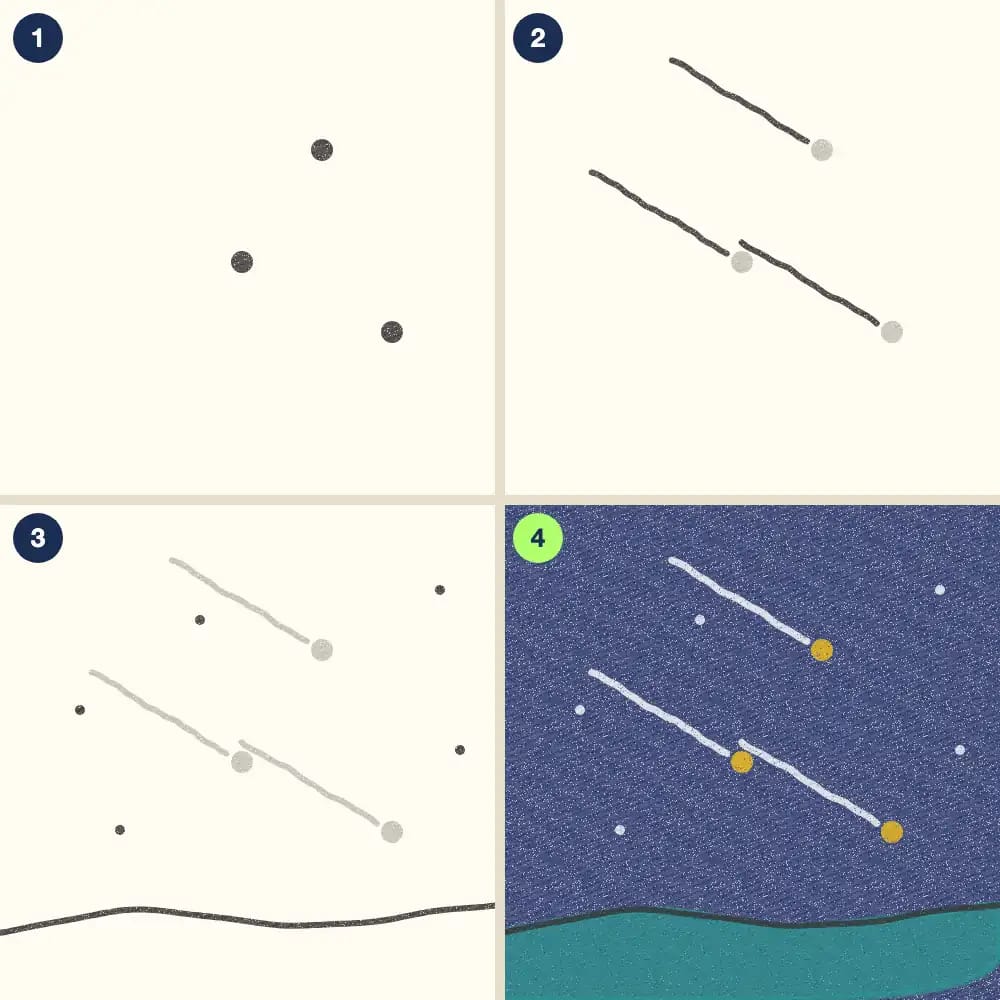
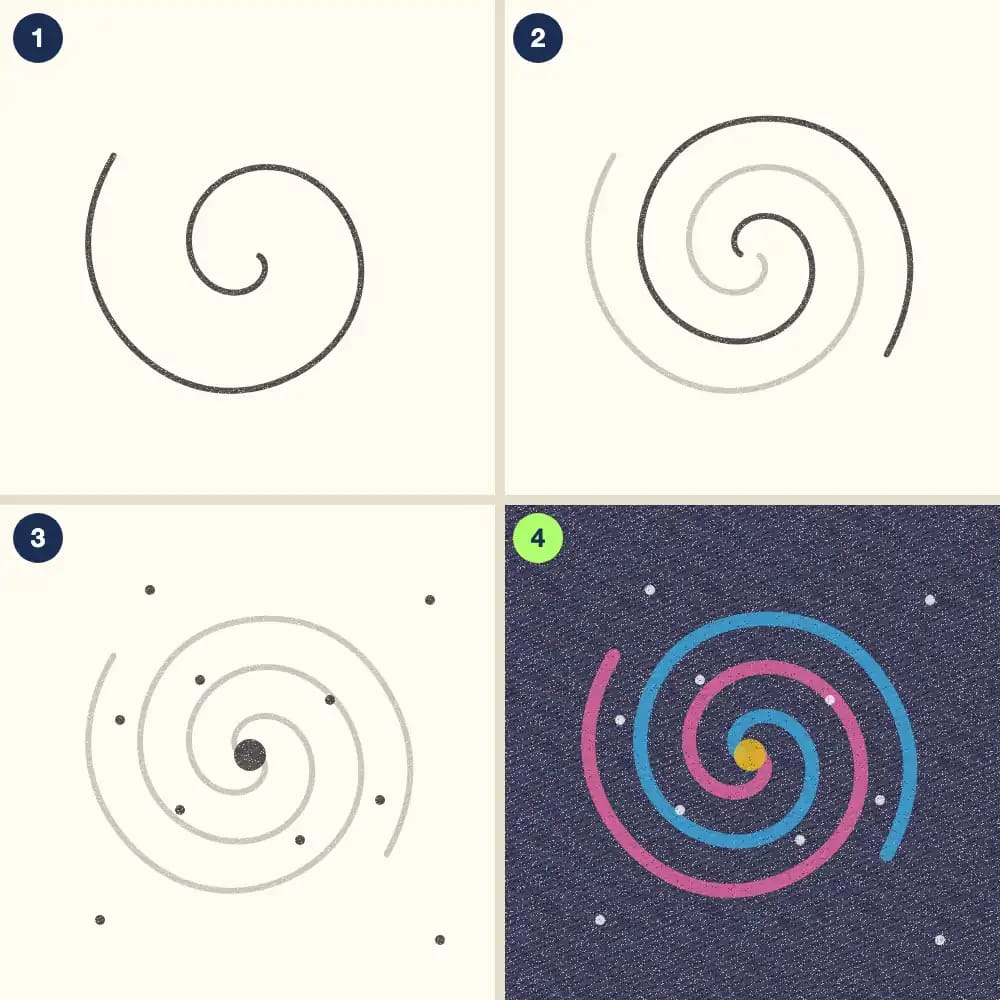
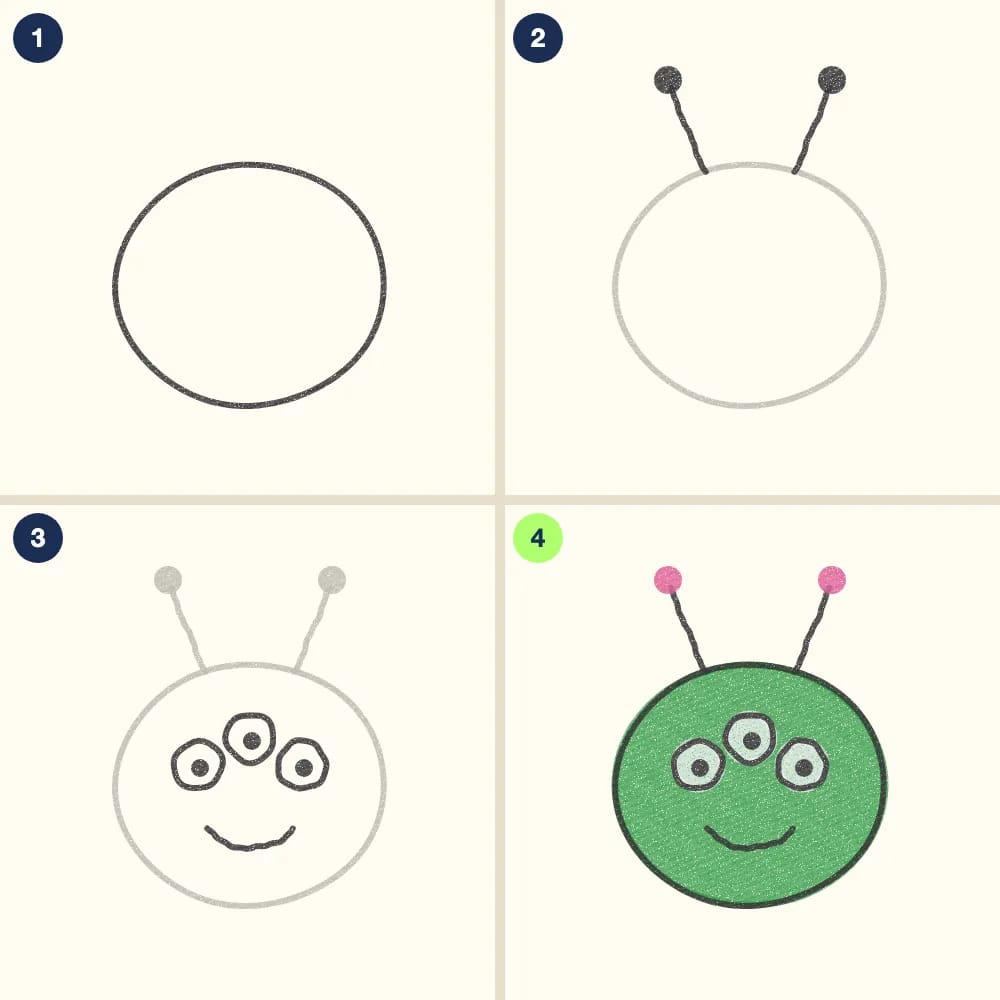
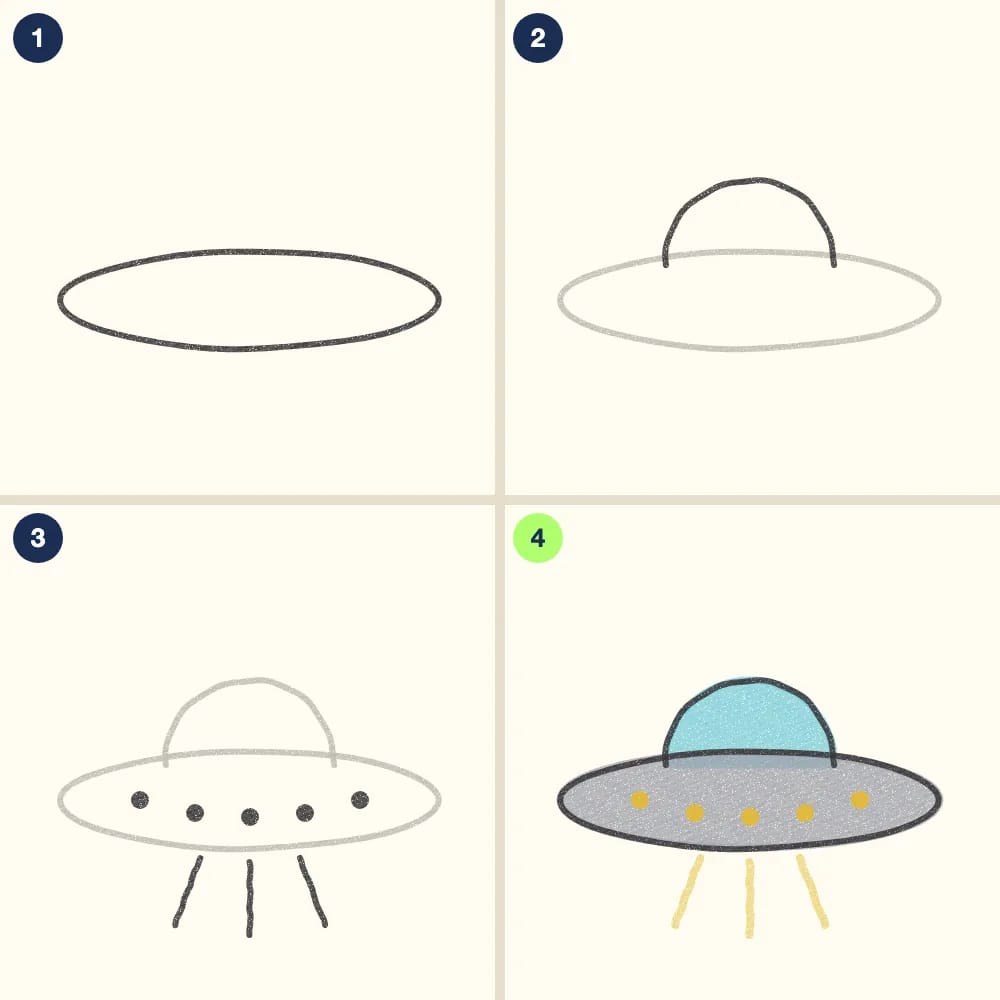
So every drawing here is on this page, in four steps, drawn in crayon the way a child would draw it, and sorted by the shapes it needs. In steps 1 to 3 the new lines are black and the earlier ones gray, and step 4 is the drawing colored in. Under each one is a space fact your child can say out loud while they color, with a link to where it comes from. Children vary a lot, so treat the ages as a starting point: a confident three-year-old can try the next group, and a seven-year-old who wants a quick win can go back to the Sun.
What space drawings can a child do at each age?
A child can usually draw a shape straight after watching you draw it before they can copy it from a picture. Vancouver Coastal Health's pediatric therapists call the first imitating and the second copying, and imitating comes first. Copying then arrives in a well-studied order. The classic Gesell ages, listed in Columbia University's pediatric milestones table, are a vertical line at two and a half, a circle at three, a cross at four, a square at four and a half, a triangle at five and a diamond at six to seven. The Beery visual-motor test puts the triangle at five years and three months (Taylor, 2001, citing Beery), and MedlinePlus has children drawing a circle at about three, a square at about four and a triangle at about five.
| Shape | Usually copied at | What it lets them draw |
|---|---|---|
| Straight lines, after watching you | 2 to 2½ | Sun rays, comet tails, antennae |
| Circle | 3 | The Sun, the Moon, planets, helmets |
| Cross | 4 | A four-point star, satellite panels |
| Square | 4 to 4½ | Robot, satellite, Moon lander |
| Triangle | 5 | A rocket's nose and fins |
| Diamond | 6 to 7 | Webb's sunshield (number 43) |
| Hexagon | No agreed age | Webb's mirror (number 43) |
Ages are typical, from the Gesell and Beery norms, MedlinePlus, and NHS occupational therapy leaflets from York and Solihull. Sources differ by up to half a year, so treat them as soft edges. None of the norms we read gives an age for a hexagon.
What do young children's space drawings look like?
What a drawing looks like changes with age as well. One theory, from the researcher Rhoda Kellogg, has scribbles at two or younger, simple shapes at two to three, designs such as suns and mandalas at three to four, and pictures of people, animals and buildings by about five, though not every expert agrees with her stages (Eric Carle Museum). The first person most children draw is a tadpole, a circle with legs coming straight out of it. In Cox and Parkin's 1986 study tadpoles appeared at an average age of three years and one month, and the American Academy of Pediatrics notes that at four and five a figure may still have no body. A three-year-old's astronaut with arms growing out of the helmet is right on time.
How do you help a child draw without taking over?
Draw alongside them rather than for them: show one step at a time on your own paper, describe what you see instead of asking what it is, let the drawing change, and start with chunky crayons. These four habits come from early childhood teachers, therapists and researchers, not from art lessons.
- Show one step at a time, on your own paper. Imitating comes before copying, so for the youngest, draw step 1 on your sheet and let them do it on theirs. A NAEYC handout for families suggests showing a technique but not making a complete model, and one preschool teacher, writing in NAEYC's magazine, stopped drawing for two- and three-year-olds because the children saw their own work as worse. For under-fours, keep the finished step 4 out of sight.
- Say what you see. Robert Schirrmacher's classic advice on talking with young children about art is to skip "What is it?" and the all-purpose "nice", pause, and talk about the colors, lines and shapes instead. With a rocket, that might be "you gave it a really big flame."
- Let it change. If the alien grows a fourth eye, it is their alien. The steps are a way in, not a test.
- Start with chunky crayons. NHS therapists in Dorset note that large, chubby pencils are easier to grasp at first. Grip takes years: in one study, 48% of children aged three to three and a half used a mature grip, against 90% of those aged between six and a half and seven.
Easy space drawings for ages 2 and 3
These 16 are built almost entirely from circles, dots, curves and straight lines. At this age most children can draw a line straight after watching you draw one, and a circle on their own at around three, so draw each step on your own paper first and let them copy it. The trickier curves, like the crescent Moon and the swirl of the galaxy, can be yours. Tracing a hand is a grown-up job too, and it makes the hand-traced alien one of the easiest drawings here. For more in the same four steps, our easy Christmas drawings and easy unicorn drawings are sorted the same way.
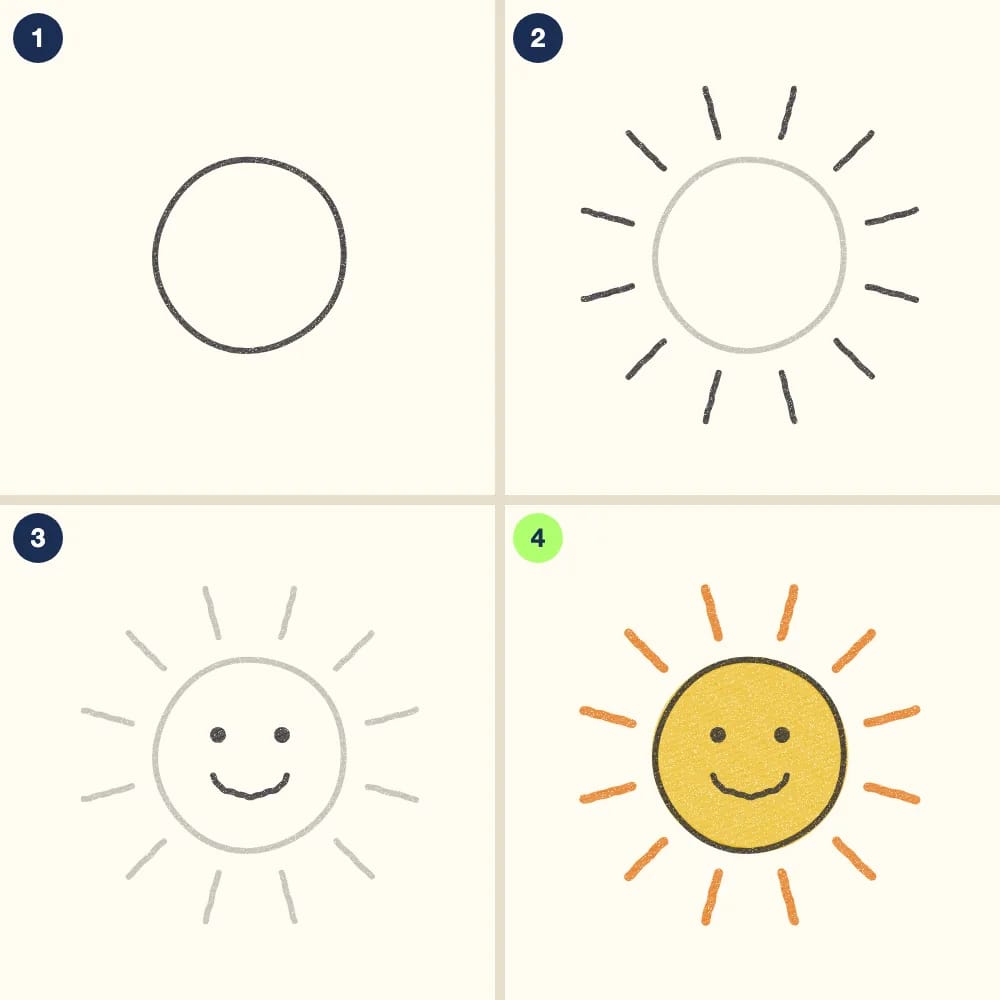
1. Sun. Shapes: a circle, straight lines, dots. Draw a big circle. Add short straight lines all the way around it for the rays. Give it two dot eyes and a smile. Color the Sun yellow and the rays orange.
Space fact: The Sun is so big that about 1.3 million Earths could fit inside it (NASA).
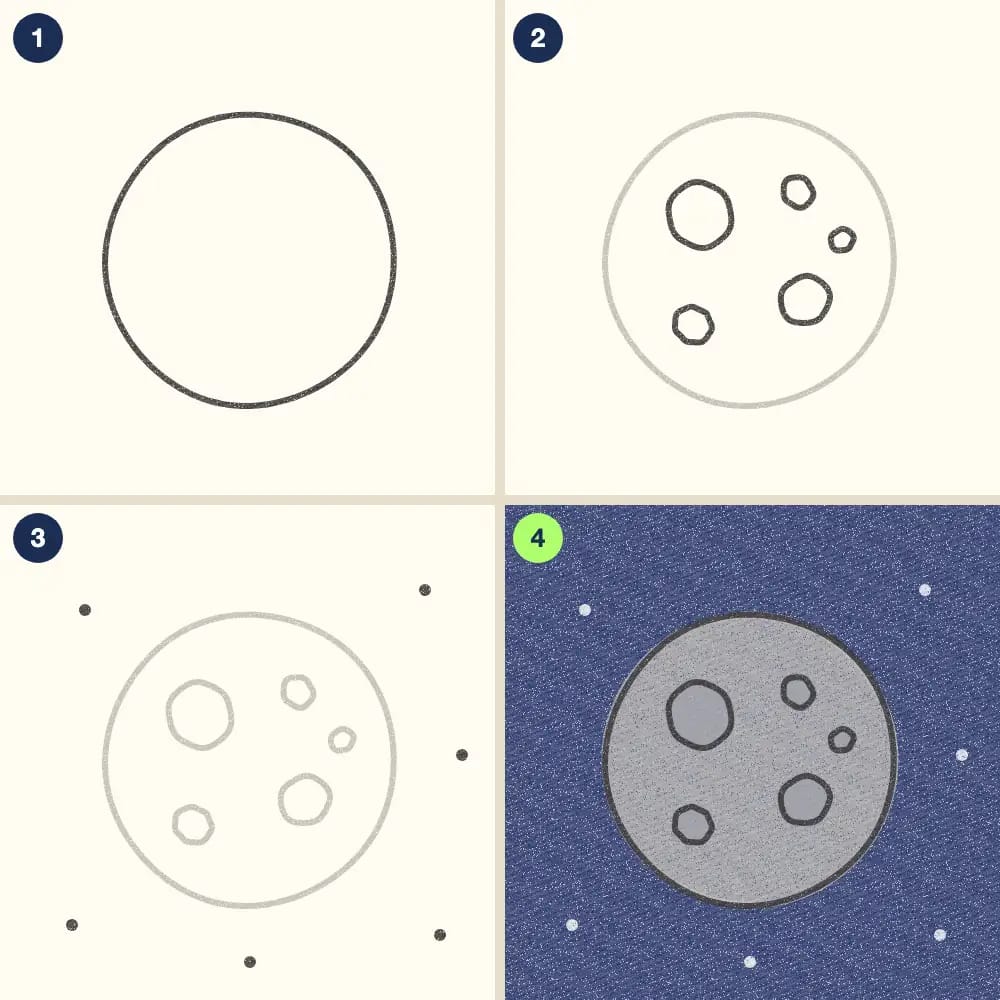
2. Full Moon. Shapes: circles, dots. Draw a big circle. Add five smaller circles inside it for craters. Put a few dots around it for stars. Color the sky dark blue, the Moon light gray, the craters darker gray and the stars white.
Space fact: The Moon's craters were made by asteroids, meteorites and comets crashing into it, and many have lasted for billions of years (NASA).
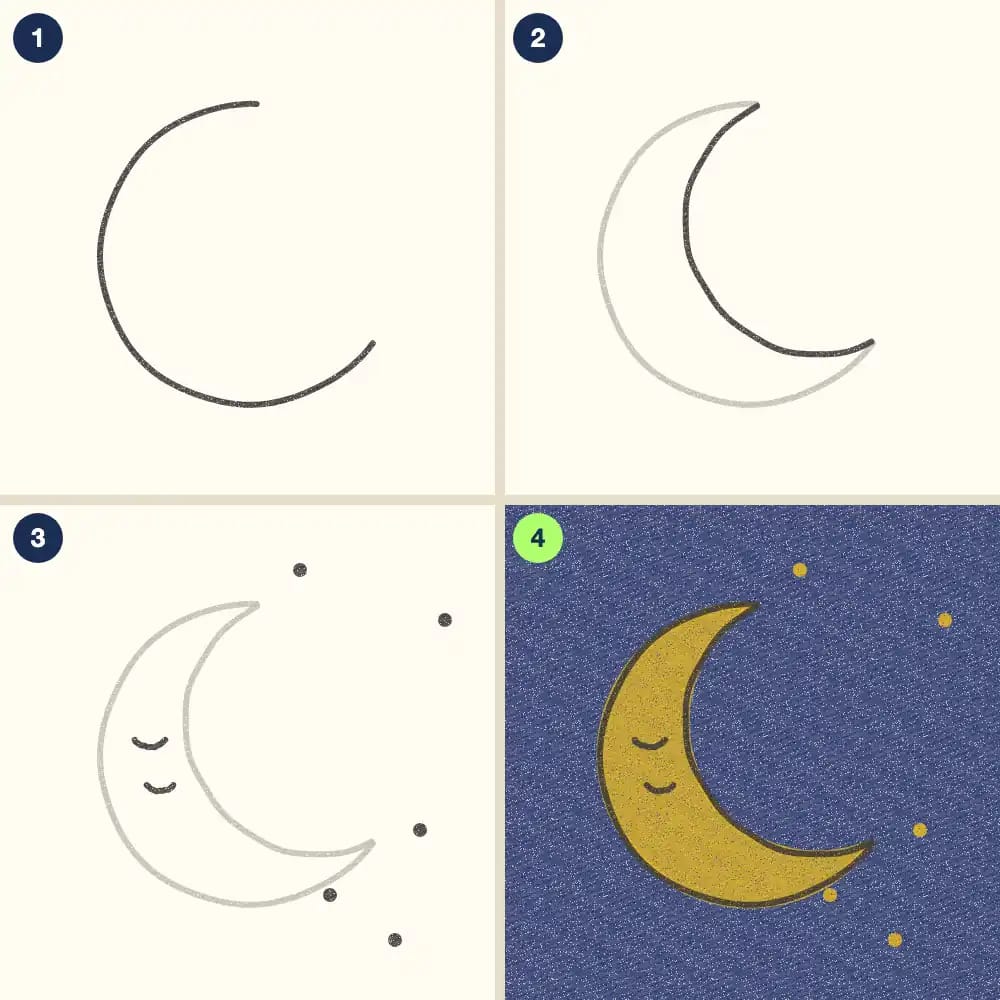
3. Crescent Moon. Shapes: two curves, dots. Draw a big curve shaped like a letter C. Join its two ends with a smaller curve on the inside to make the crescent. Add a sleepy eye, a little smile and some dot stars. Color the Moon and the stars yellow and the sky dark blue.
Space fact: The Moon makes no light of its own: moonlight is sunlight bouncing off it, and a crescent is the thin sunlit sliver we can see (NASA).
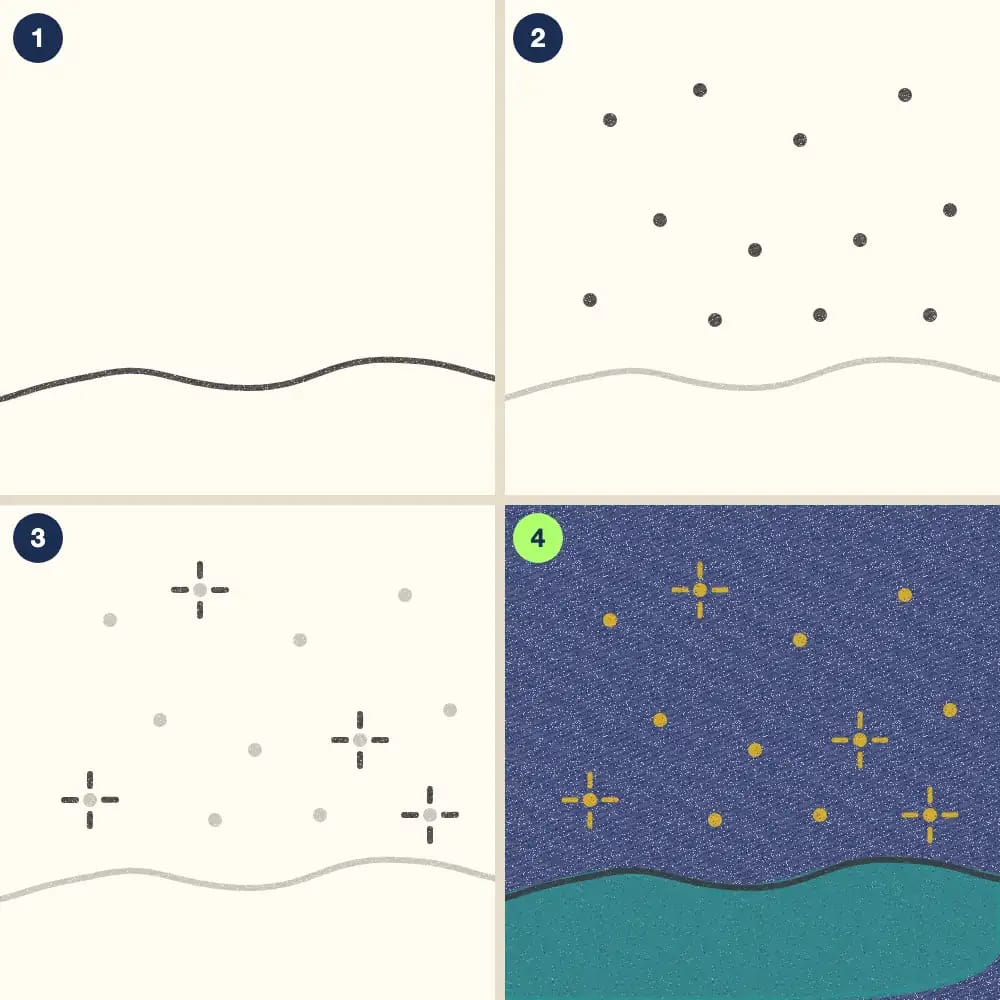
4. Starry night. Shapes: a wavy line, dots, short lines. Draw a wavy line across the bottom for the hills. Fill the sky with dots for stars. Add four short lines around a few of the dots to make them twinkle. Color the sky dark blue, the hills green and the stars yellow.
Space fact: Stars twinkle because moving air in Earth's atmosphere bends their light on its way to us, and stars near the horizon twinkle more (NASA Goddard).
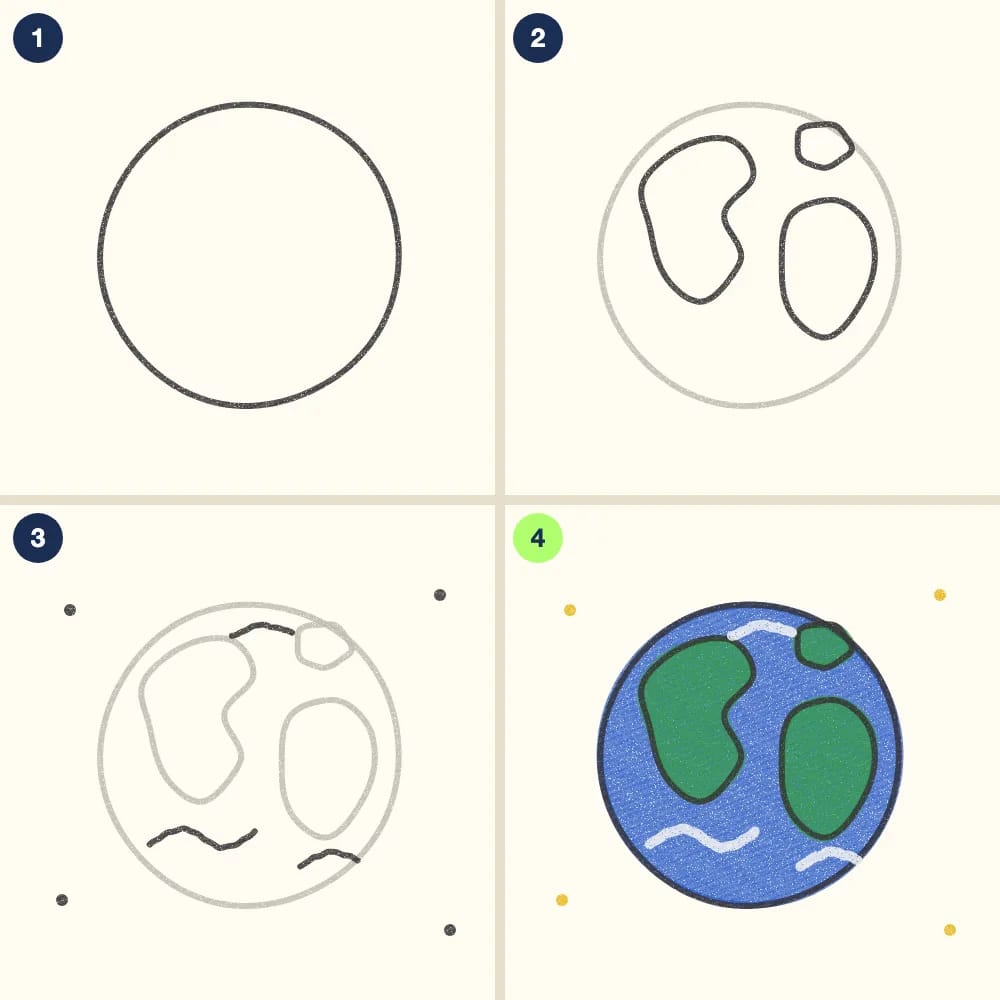
5. Earth. Shapes: a circle, blobs, wavy lines. Draw a big circle. Add three bumpy blobs inside it for the land. Draw three short wavy lines for clouds and a few dot stars outside. Color the sea blue, the land green and the clouds white.
Space fact: Earth is the only planet in our solar system with liquid water on its surface, and its ocean covers about 71% of it (NASA).
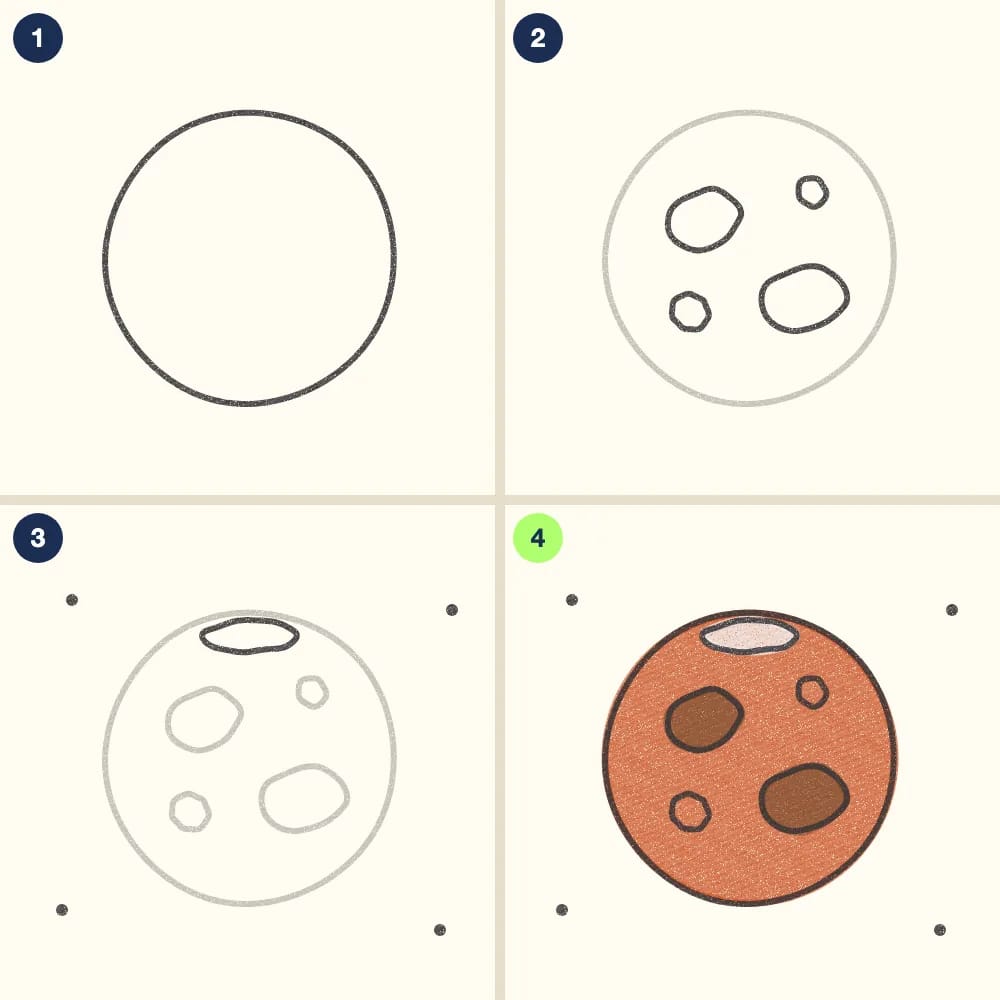
6. Mars. Shapes: a circle, blobs, small circles. Draw a big circle. Add two patches and two small craters. Draw a small cap at the top for the ice, and a few dot stars around it. Color Mars red-orange, the patches brown and the ice cap white.
Space fact: Mars looks red because the iron in its rocks and dust has rusted, which is why people call it the Red Planet (NASA).
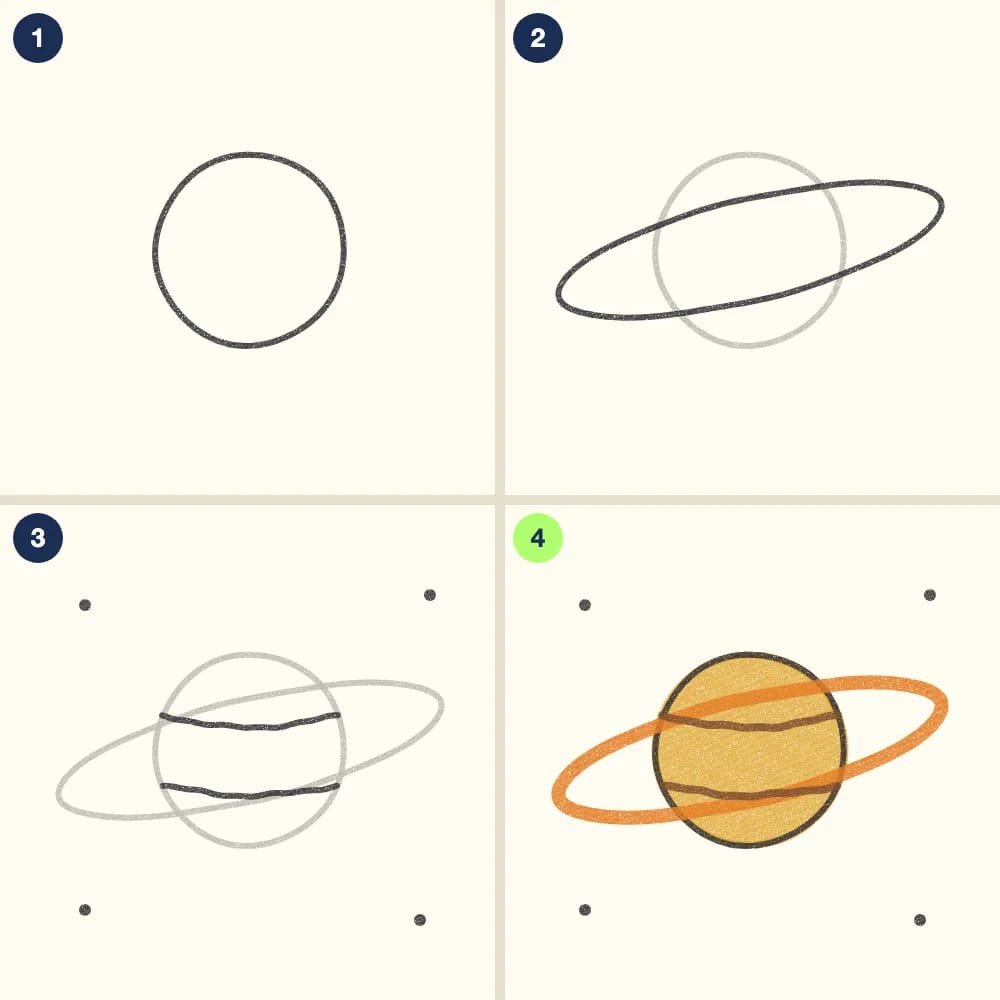
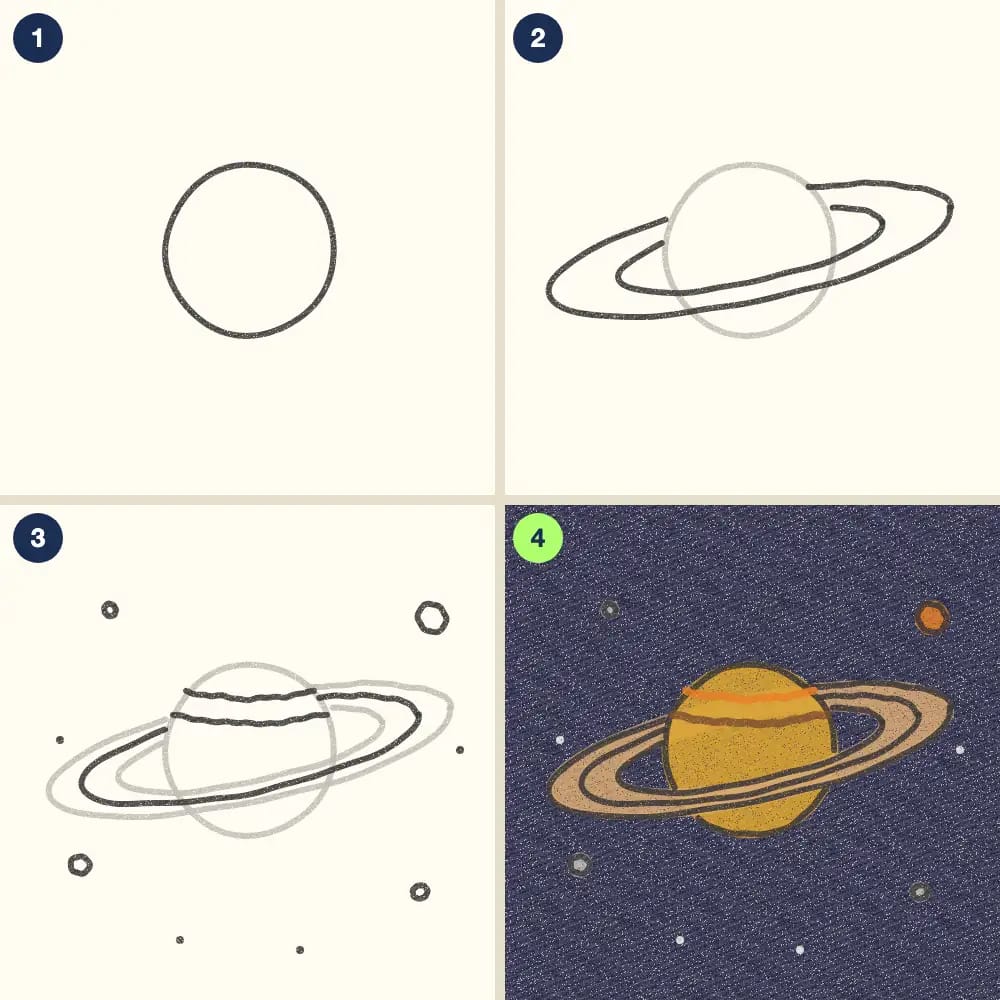
7. Saturn. Shapes: a circle, an oval, curved lines. Draw a circle. Draw a long, flat oval right across it for the ring. Add two curved stripes across the planet and a few dot stars. Color Saturn gold, the ring orange and the stripes brown.
Space fact: Saturn's rings are made of billions of chunks of ice and rock, from tiny grains to pieces as big as a house (NASA).
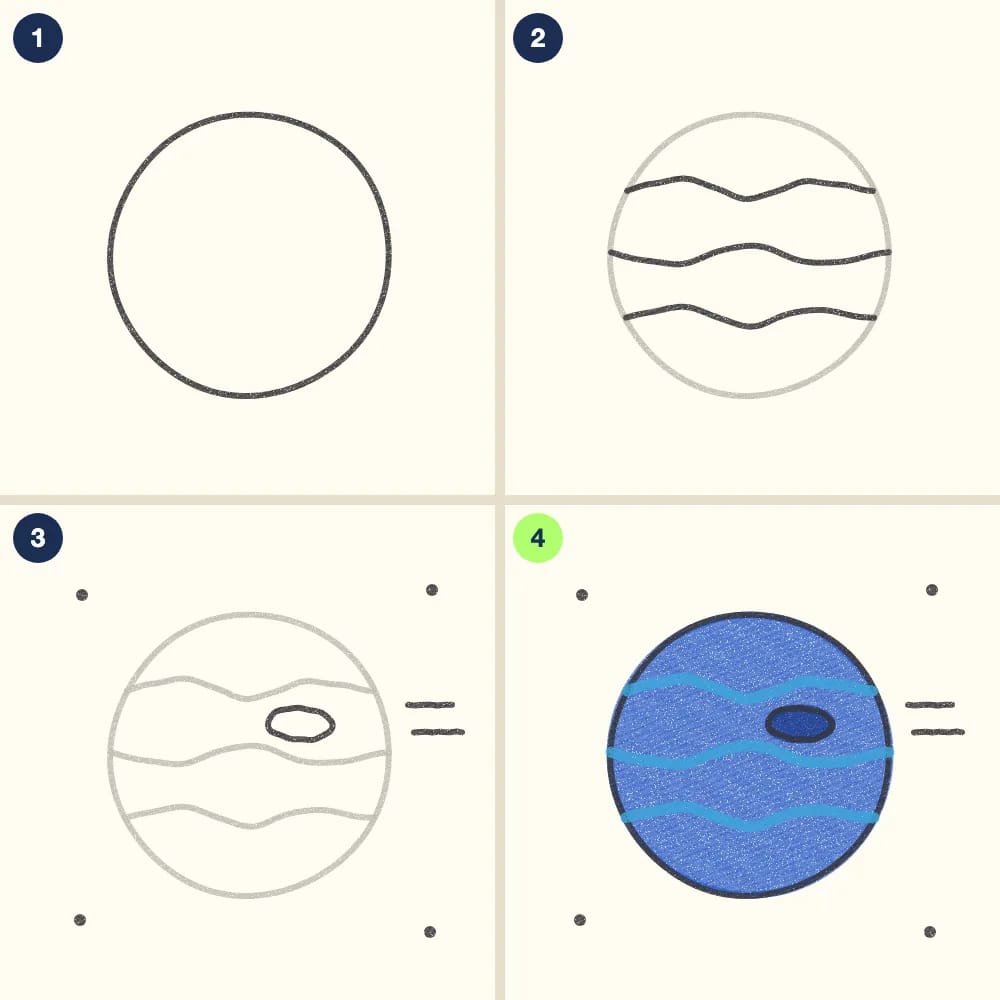
8. Neptune. Shapes: a circle, wavy lines, an oval. Draw a big circle. Add three wavy lines across it. Draw a small oval for a storm, two short lines at the side for the wind and a few dot stars. Color Neptune blue, the wavy lines light blue and the storm dark blue.
Space fact: One year on Neptune lasts about 165 Earth years, so since it was discovered in 1846, it has gone around the Sun just once (NASA).
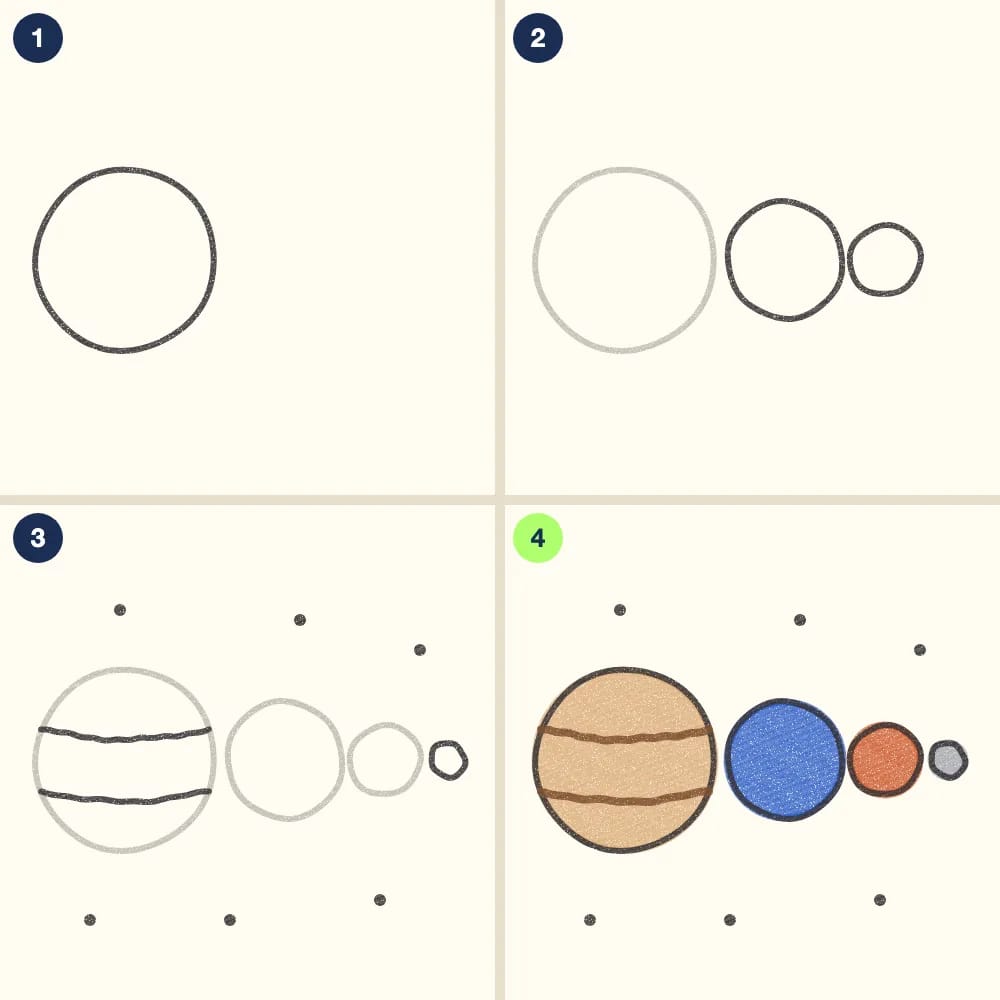
9. A row of planets. Shapes: circles of different sizes. Draw one big circle. Next to it, draw a middle-sized circle and a small one. Add a tiny circle at the end, two stripes on the big planet and some dot stars. Color the big one tan with brown stripes, then blue, red and gray.
Space fact: Jupiter, the biggest planet, is 11 times wider than Earth: if Earth were a grape, Jupiter would be about as big as a basketball (NASA).
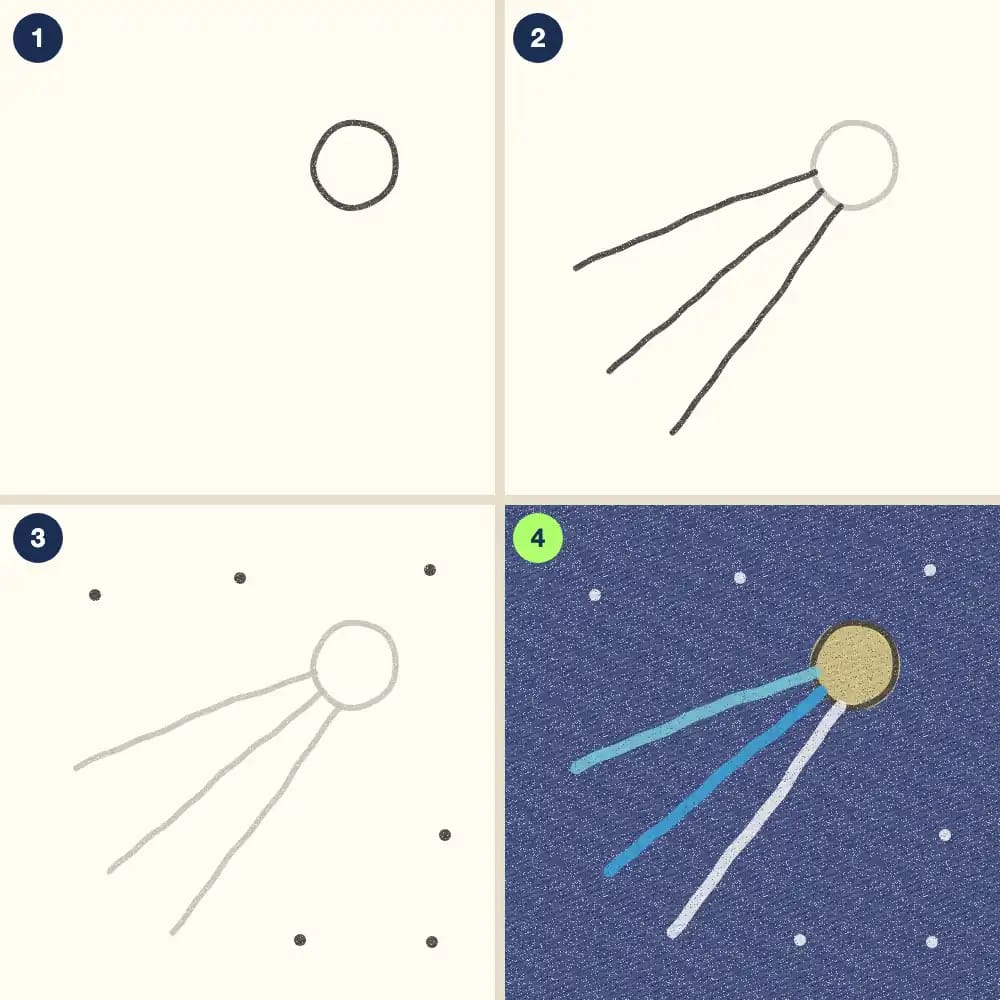
10. Comet. Shapes: a circle, long curved lines, dots. Draw a circle near the top corner. Draw three long curved lines streaming away from it for the tail. Add some dot stars. Color the head pale yellow, the tail light blue and white, and the sky dark blue.
Space fact: A comet's tail points away from the Sun, because sunlight and the solar wind blow its dust and gas outward into a long, bright trail (NASA).
11. Shooting stars. Shapes: dots, straight lines. Draw three big dots. Give each one a long straight line trailing up behind it. Draw a gentle hill along the bottom and a few small dots. Color the shooting stars yellow, the trails white, the sky dark blue and the hill green.
Space fact: A shooting star is a bit of space rock burning up in our air, and most meteor shower bits are no bigger than a pea (NASA).
12. Swirly galaxy. Shapes: spirals, dots. Draw a spiral, starting in the middle and swirling out. Draw a second spiral starting from the middle on the other side. Add a big dot in the center and lots of little dots. Color the sky very dark blue, one arm pink, the other light blue and the center yellow.
Space fact: Our galaxy, the Milky Way, is a spiral, and our Sun lies near one of its small arms, called the Orion Spur (NASA).
13. Alien face. Shapes: an oval, lines, circles. Draw a big round head. Add two antennae with a dot on each end. Give it three round eyes with dot pupils and a big smile. Color the head green, the eyes white and the antenna tips pink.
Space fact: To look for life beyond Earth, NASA scientists "follow the water," because anywhere you find water on Earth, you find life (NASA).
14. Flying saucer. Shapes: an oval, a half circle, dots, lines. Draw a long, flat oval. Add a dome on top. Put a row of dots along the middle for lights and three lines underneath for a beam. Color the saucer gray, the dome light blue, the lights yellow and the beam pale yellow.
Space fact: The words "flying saucer" caught on in 1947, after pilot Kenneth Arnold reported nine shiny objects near Mount Rainier and newspapers spread his story (Smithsonian).
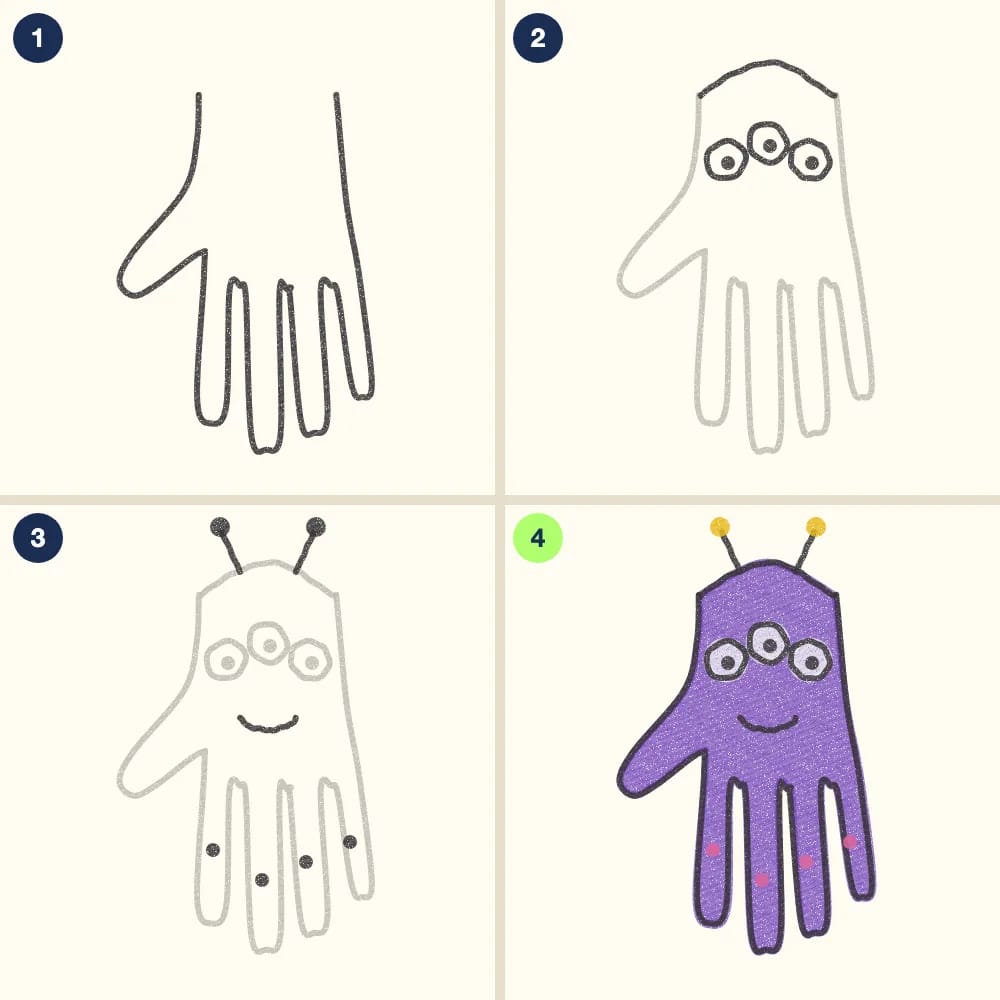
15. Hand-traced alien. Shapes: a traced hand, circles, lines. A grown-up traces your child's hand with the fingers pointing down. Close the top with a curve and add three eyes. Give it a smile, two antennae and a spot on each finger. Color it purple with white eyes and pink spots.
Space fact: Tiny animals called water bears, or tardigrades, rode into space in 2007 and became the first animals known to survive exposure to open space (ESA).
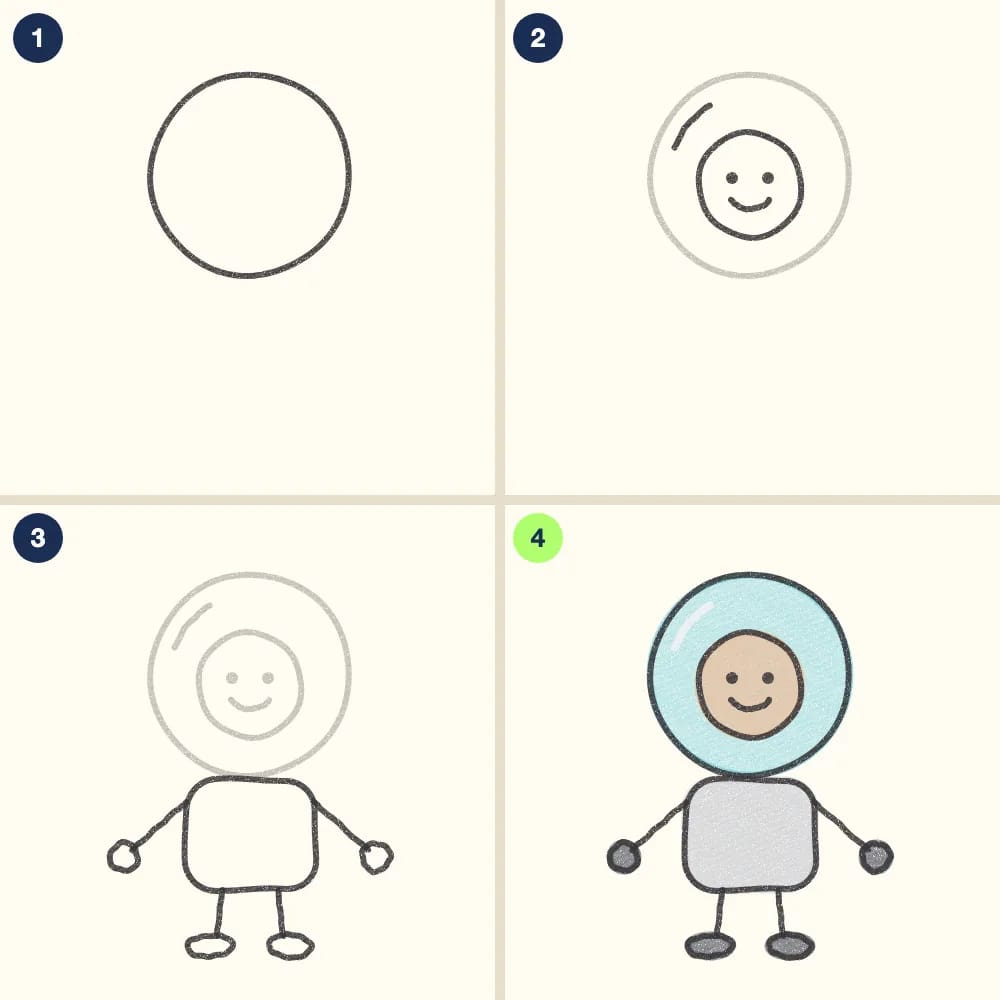
16. Astronaut in a bubble helmet. Shapes: circles, a rounded square, lines. Draw a big circle for the helmet. Inside it, draw a smaller circle for the face, with two dot eyes, a smile and a curve for the shine. Add a rounded square body, stick arms and legs, round mittens and oval boots. Color the helmet light blue, the face peach and the suit gray.
Space fact: A spacewalker's helmet has a sun visor with a special gold coating that works like sunglasses, protecting them from the Sun's strong rays (NASA).
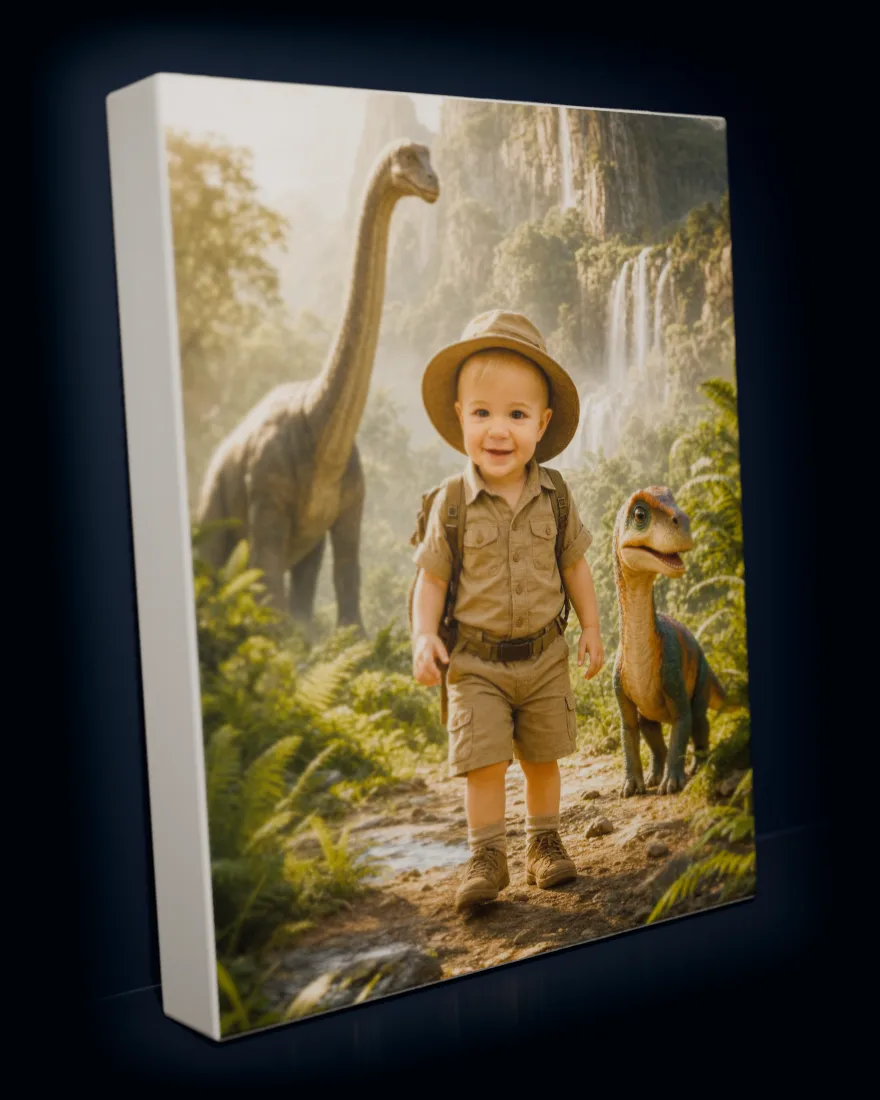
See their drawing made real
Upload a photo of the drawing and see the character come back three ways, free and watermarked, before anything prints.
Space drawings for ages 4 and 5
Most children copy a cross at about four, a square at four to four and a half and a triangle at about five (Columbia's Gesell table), and those three shapes build most of the machines people have sent into space. A rocket is a rectangle and three triangles, a satellite is a square with two long rectangles, and a robot is squares all the way down. The Big Dipper is the gentlest start here, because it is seven dots and the straight lines between them. If a triangle is still wobbly, draw the rocket's nose yourself and let your child add the window, the fins and the flame.
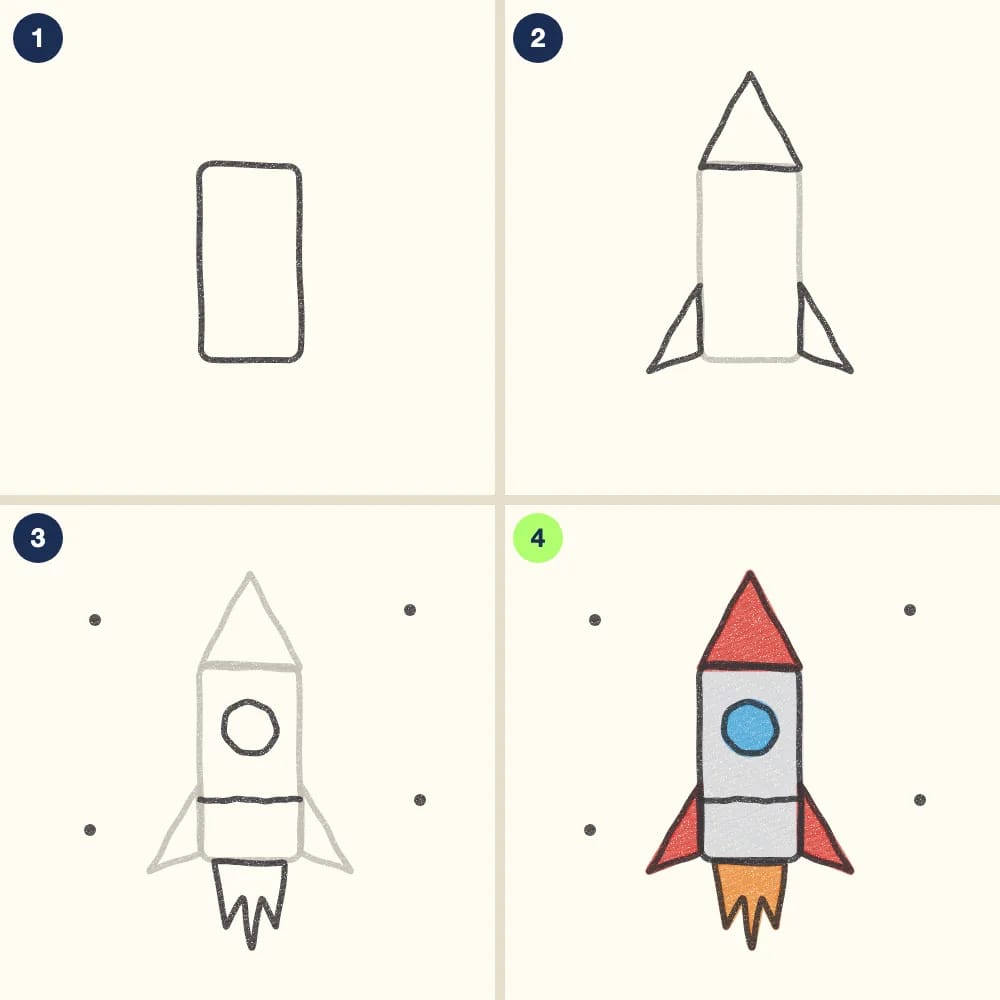
17. Rocket. Shapes: a rectangle, triangles, a circle, a zigzag. Draw a tall rectangle. Add a triangle on top for the nose and a triangle fin on each side. Draw a round window, a line across the body and a zigzag flame at the bottom. Color the body gray, the nose and fins red, the window blue and the flame orange.
Space fact: A rocket works like a balloon you let go of: gas rushes out the back, and that push sends the rocket the opposite way (NASA Glenn).
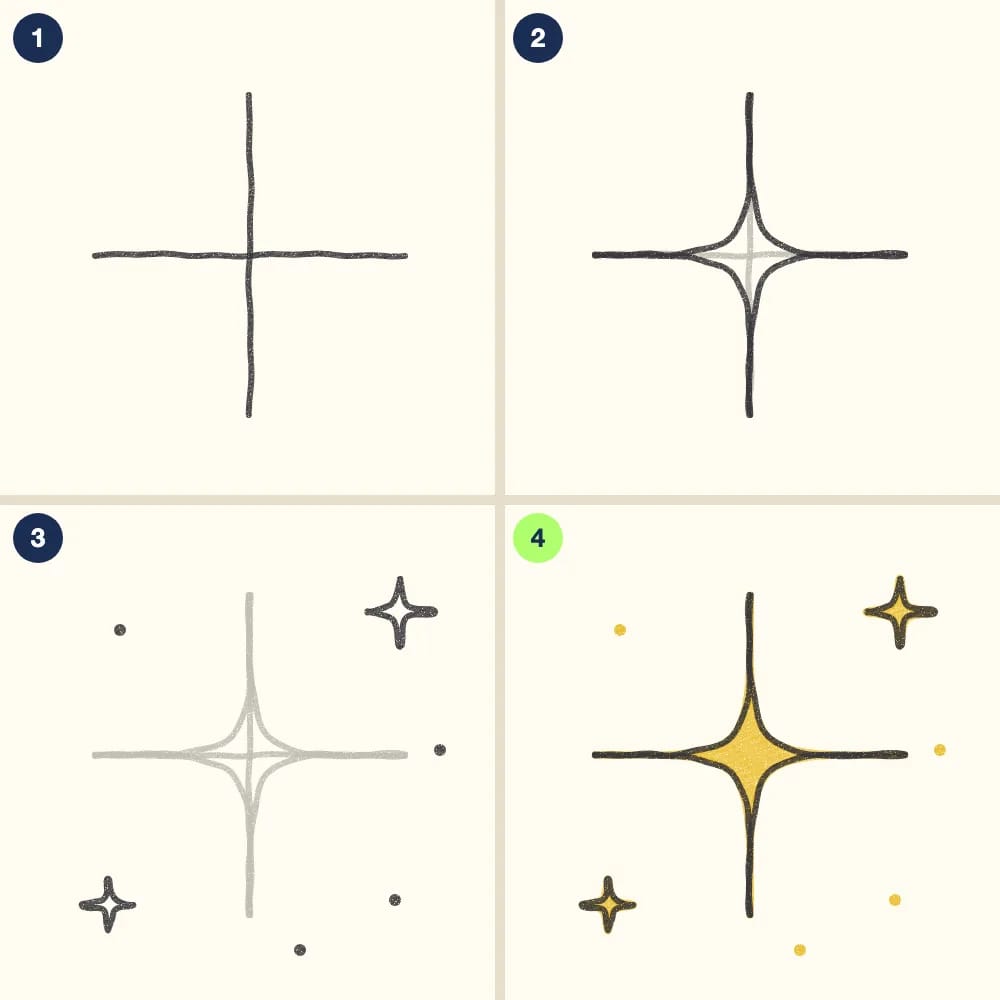
18. Four-point star. Shapes: a cross, curved lines. Draw a big plus sign lightly, as a guide. Join its four ends with lines that curve in toward the middle. Add two little stars and some dots. Color over the guide and make all the stars yellow.
Space fact: After the Sun, the closest star to us is Proxima Centauri, 4.24 light-years away, so its light takes over four years to reach Earth (NASA).
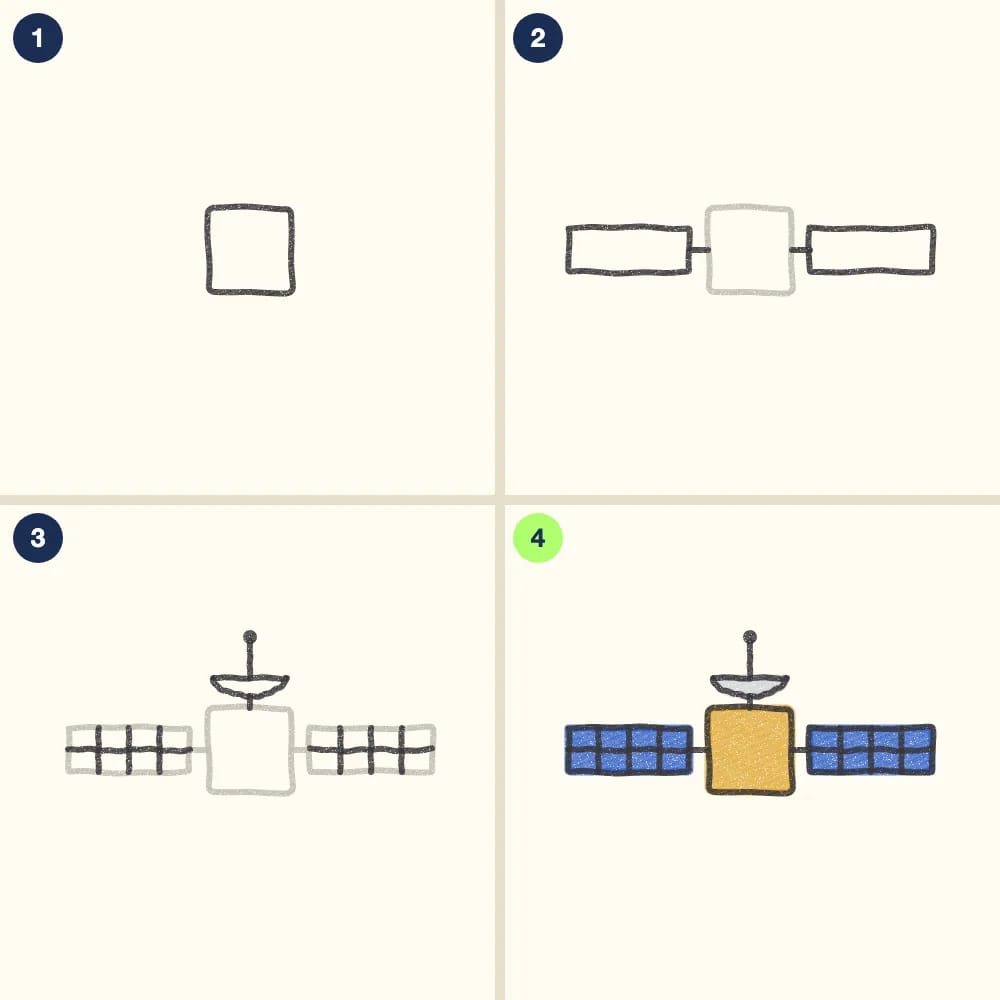
19. Satellite. Shapes: a square, rectangles, a cross pattern, a half circle. Draw a square for the body. Add a long rectangle on each side for the solar panels, joined on with short lines. Divide each panel into squares, and put a small dish and an antenna on top. Color the body gold, the panels blue and the dish gray.
Space fact: Sputnik 1, the first human-made satellite, launched October 4, 1957: it was about the size of a beach ball (NASA).
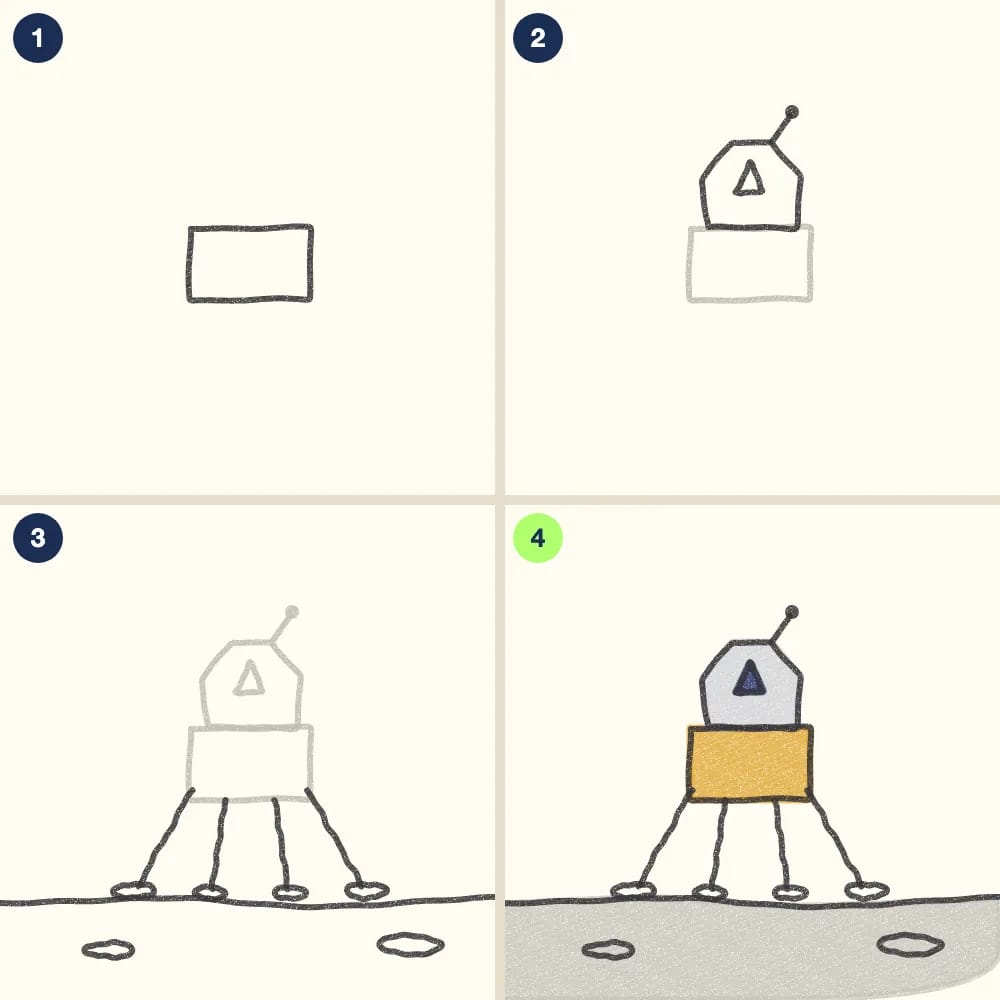
20. Moon lander. Shapes: a rectangle, a shape with slanted sides, a triangle, slanted lines. Draw a wide rectangle. Put a cabin with slanted sides on top, with a triangle window and an antenna. Add four slanted legs with flat feet, a line for the ground and two craters. Color the bottom gold, the cabin gray and the ground light gray.
Space fact: On July 20, 1969, Apollo 11's lunar module, named Eagle, landed on the Moon, and Neil Armstrong radioed, "The Eagle has landed" (NASA).
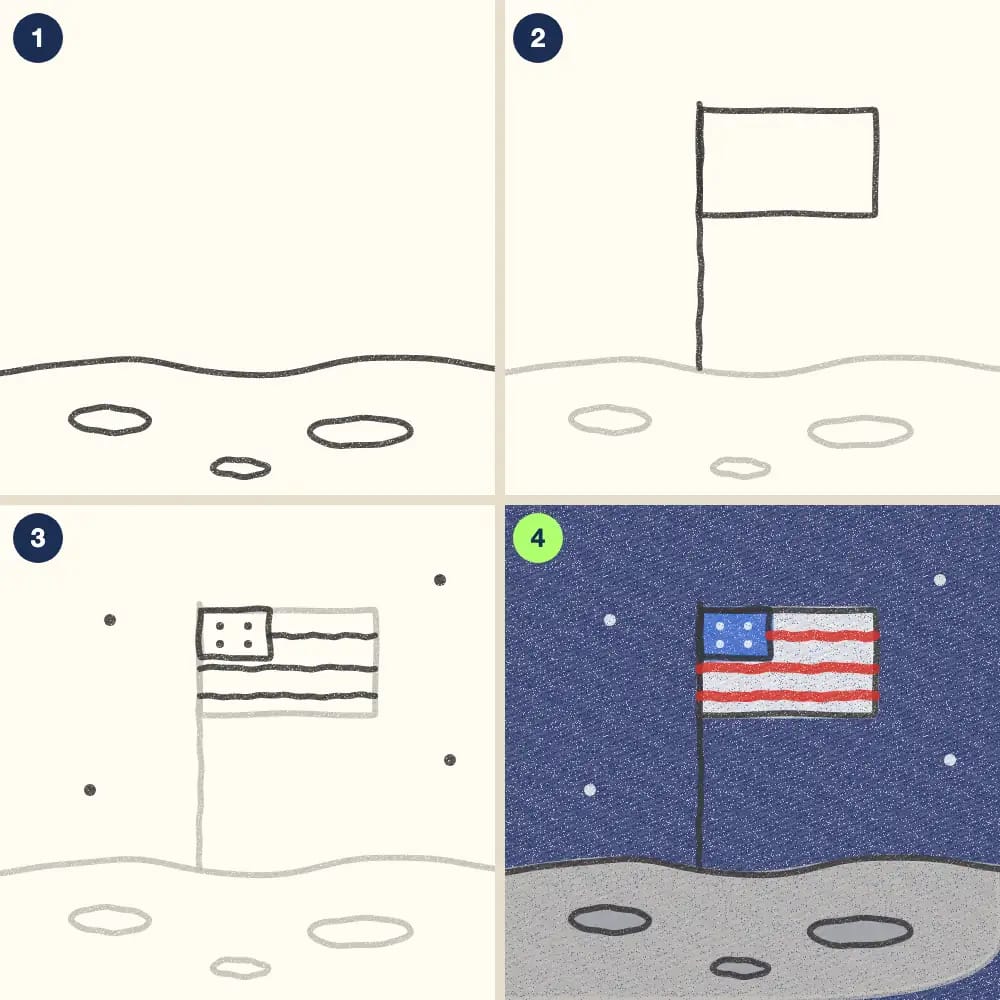
21. Flag on the Moon. Shapes: a wavy line, ovals, rectangles, lines. Draw a wavy line for the Moon's ground and three flat ovals for craters. Draw a tall pole with a rectangle flag at the top. Add a small rectangle in the corner with dots, three stripes and a few stars. Color the sky dark blue, the ground gray, the stripes red and the corner blue.
Space fact: Apollo astronauts left six American flags on the Moon, and the first one had a metal rod through its top edge to hold it out, since there's no wind (NASA).
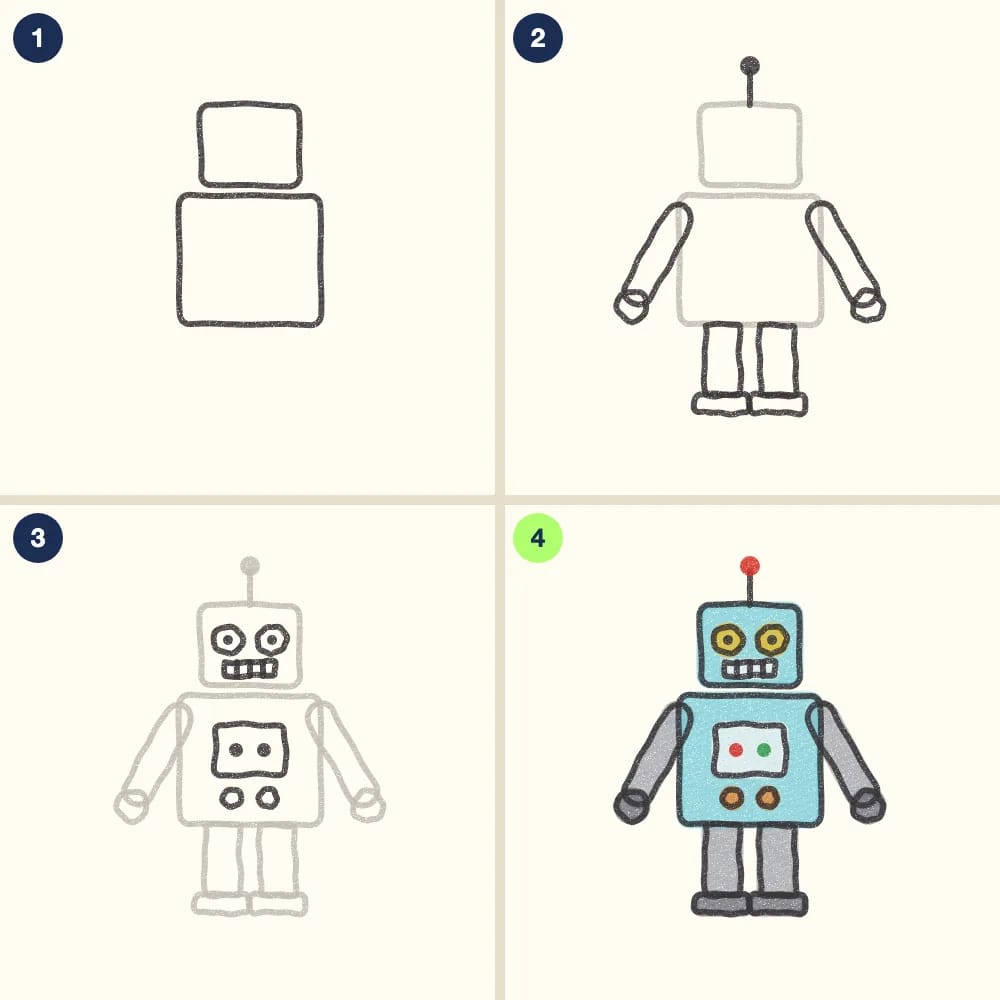
22. Space robot. Shapes: squares, rectangles, circles. Draw a square head on top of a bigger square body. Add an antenna, two arms with round hands, two legs and two feet. Give it round eyes, a mouth with lines in it, a panel with two buttons and two dials. Color it light blue with gray arms and legs and yellow eyes.
Space fact: The first robot rover to drive on Mars was Sojourner, which landed with NASA's Mars Pathfinder on July 4, 1997 (NASA).
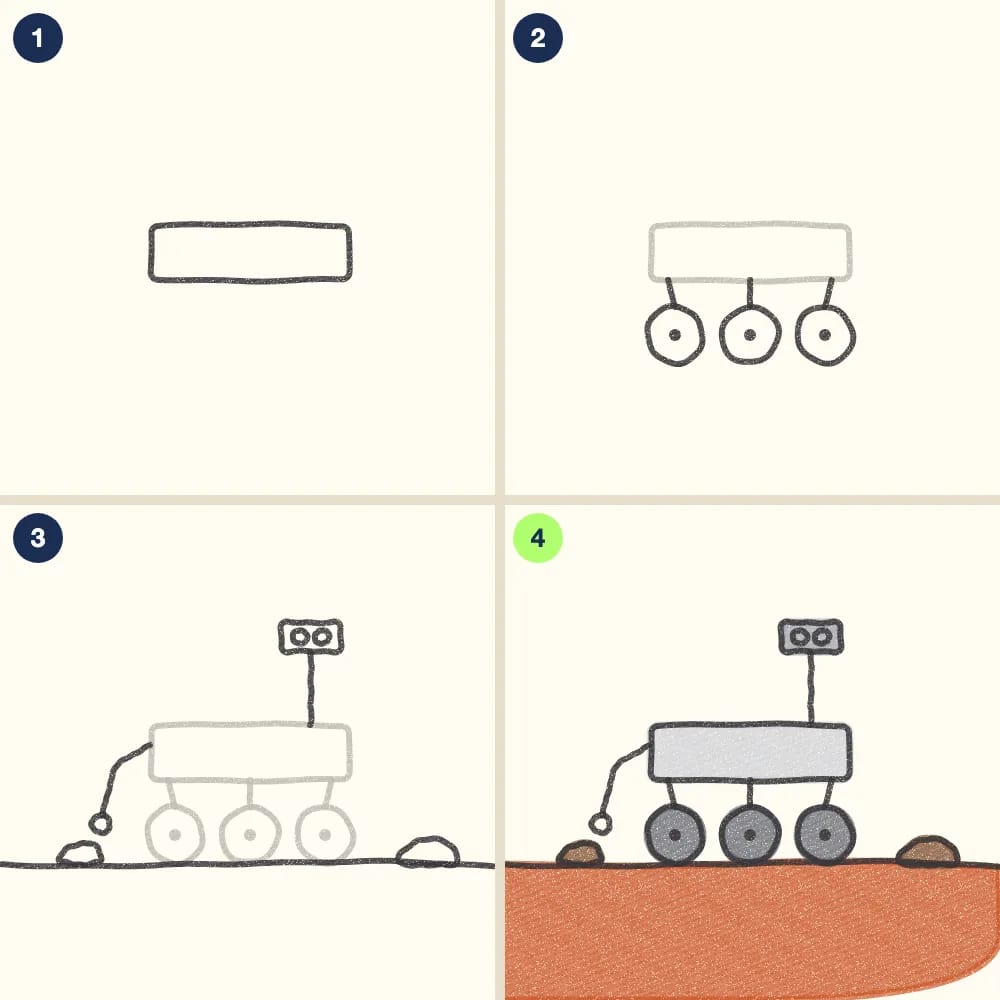
23. Mars rover. Shapes: a rectangle, circles, lines. Draw a long rectangle for the body. Add three round wheels underneath, joined to the body with short lines. Draw a tall mast with a camera head, an arm at the front, the ground and two rocks. Color the ground red-orange, the rover gray and the wheels dark gray.
Space fact: NASA's Perseverance rover landed on Mars on February 18, 2021, and it collects rock samples while searching for signs of ancient life (NASA).
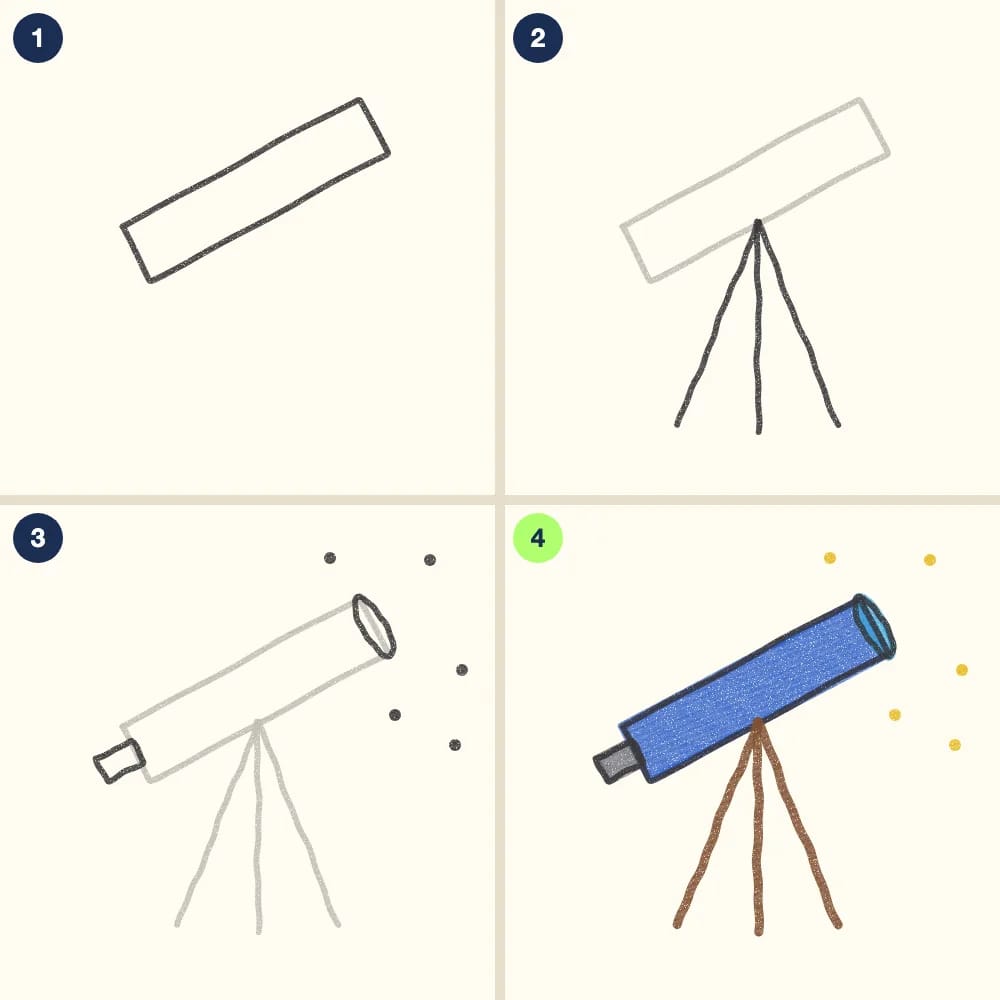
24. Telescope. Shapes: a slanted rectangle, lines, an oval. Draw a long rectangle tilted up toward one corner. Draw three straight legs from the middle down to the ground. Add an oval lens at the top end, a small eyepiece at the bottom end and some dot stars. Color the tube blue, the legs brown and the stars yellow.
Space fact: In 1610, Galileo used an early telescope to discover the four biggest moons of Jupiter, now called the Galilean moons (NASA).
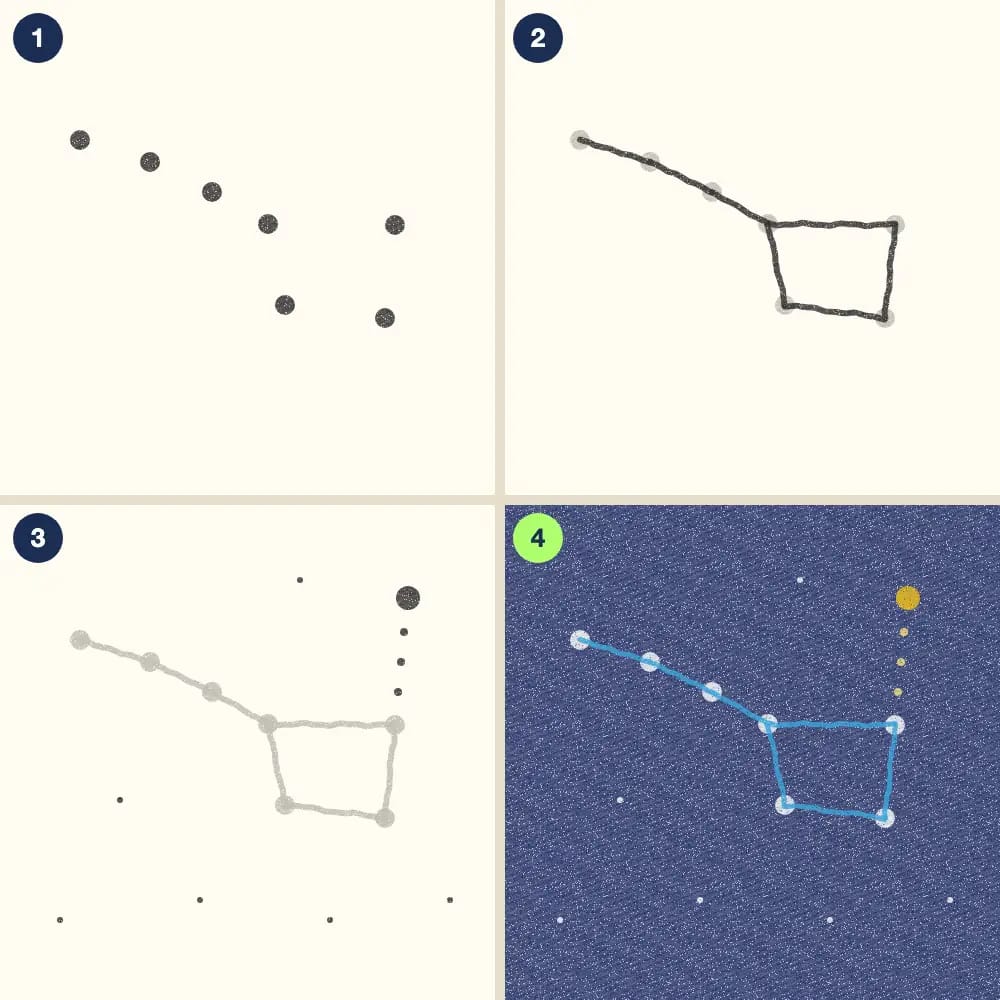
25. Big Dipper. Shapes: dots, straight lines. Draw seven dots: three in a curving line for the handle and four in a box shape for the bowl. Join them with straight lines. From the two stars at the far end of the bowl, draw a line of small dots up to one bright star, the North Star. Color the sky dark blue and the stars white.
Space fact: The Big Dipper isn't a constellation: it's an asterism, a star pattern whose stars belong to the constellation Ursa Major, the Great Bear (NASA).
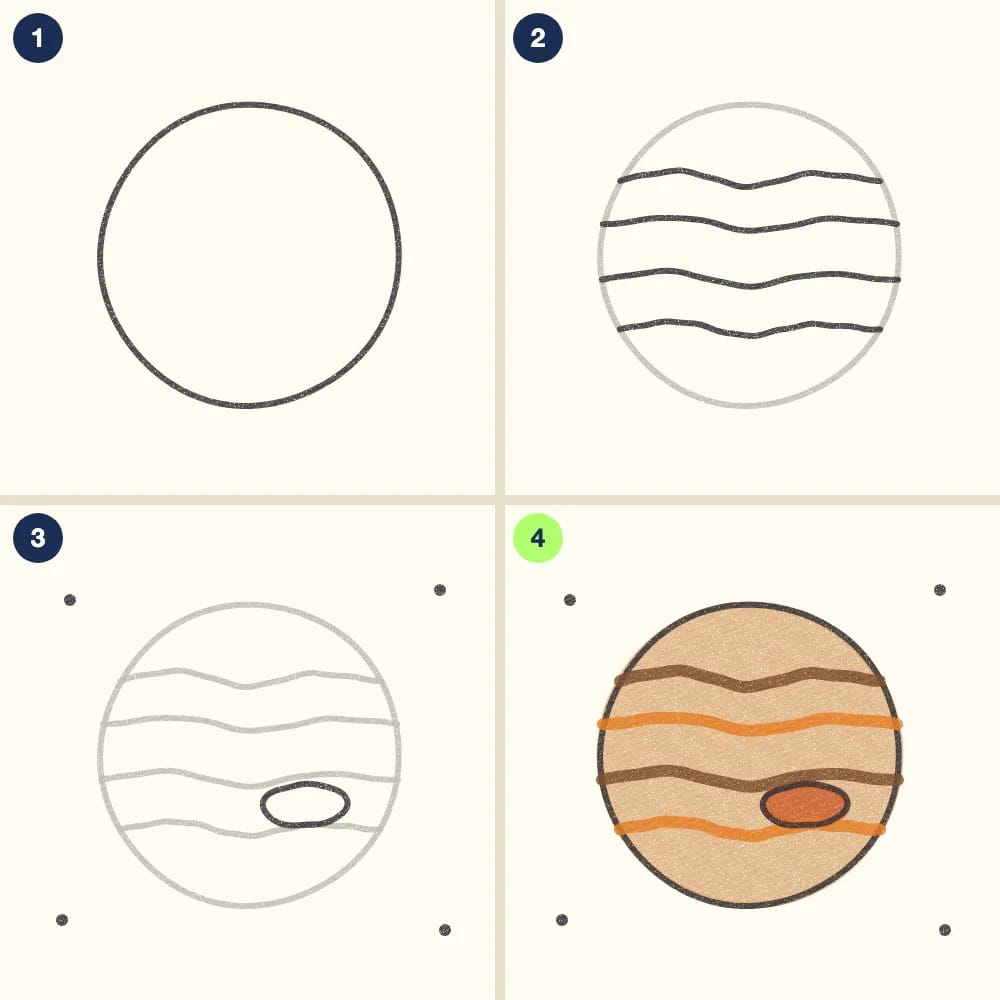
26. Jupiter. Shapes: a circle, wavy lines, an oval. Draw a big circle. Add four wavy stripes across it. Draw an oval below the middle for the Great Red Spot, and a few dot stars outside. Color Jupiter tan, the stripes brown and orange, and the spot red-orange.
Space fact: Jupiter's Great Red Spot is a giant storm bigger than Earth, and it has been swirling for hundreds of years (NASA).
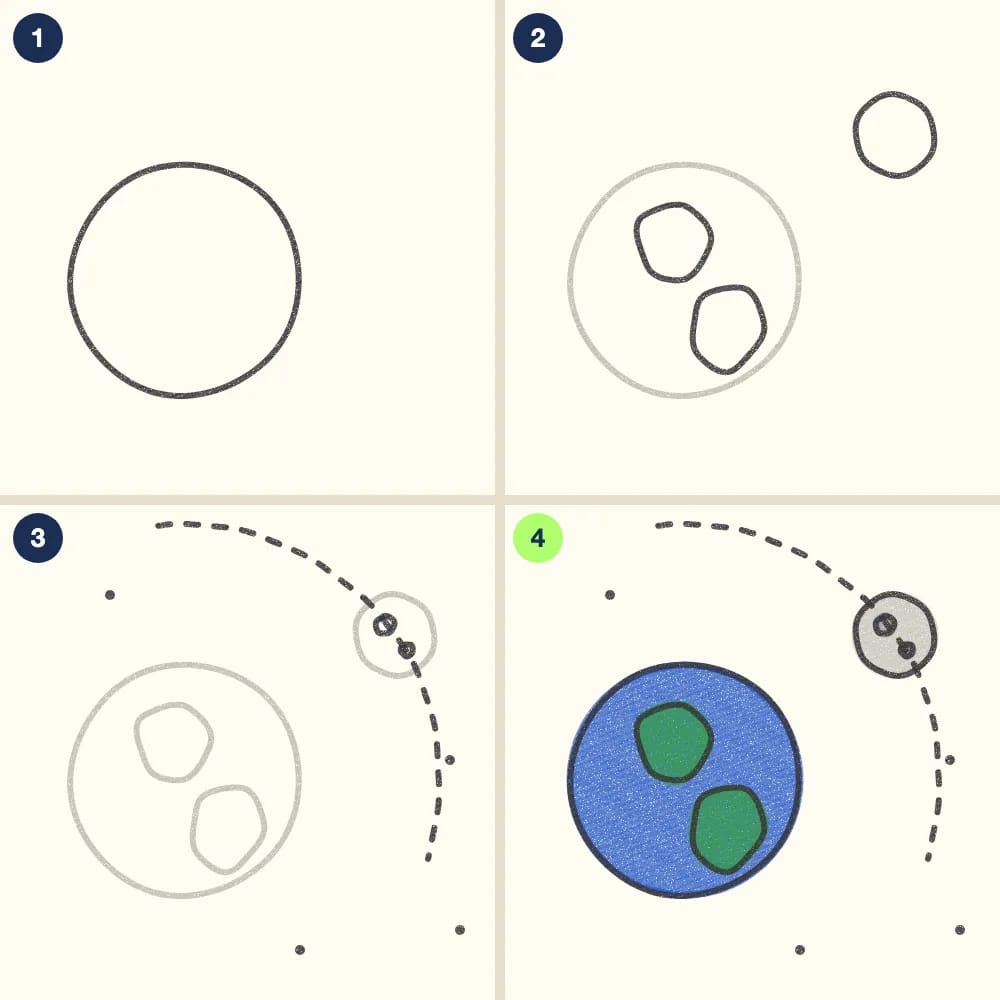
27. Earth and the Moon. Shapes: circles, blobs, a dashed curve. Draw a big circle for Earth. Add a small circle up in the corner for the Moon, and two blobs of land on Earth. Draw a dashed curve for the Moon's path, two craters on the Moon and a few dots. Color Earth blue and green and the Moon gray.
Space fact: The Moon is an average of 238,855 miles from Earth, enough space to line up 30 Earth-sized planets in between (NASA).
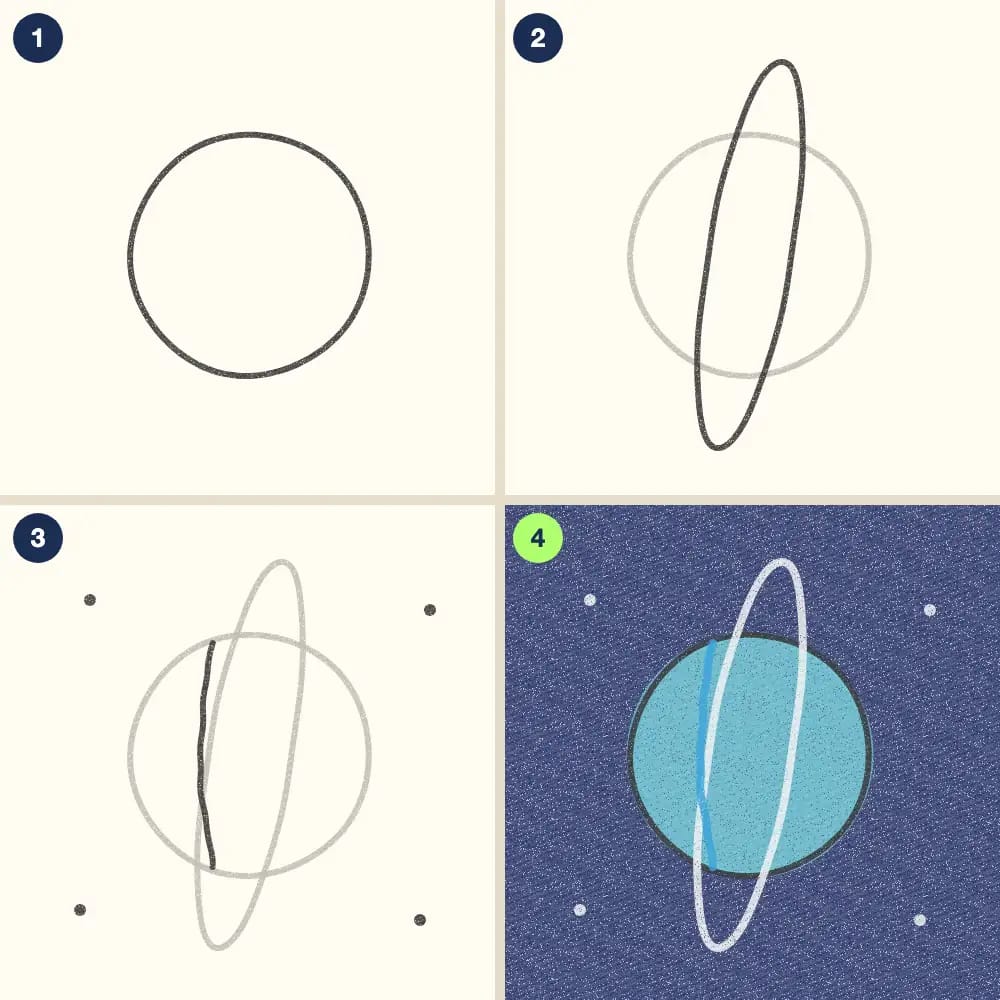
28. Uranus. Shapes: a circle, a tall oval, a curve. Draw a circle. Draw a tall, thin oval standing up through it for the ring. Add a curved band down one side and some dot stars. Color the sky dark blue, Uranus pale blue-green and the ring white.
Space fact: Uranus is tipped over on its side, so it travels around the Sun like a rolling ball (NASA).
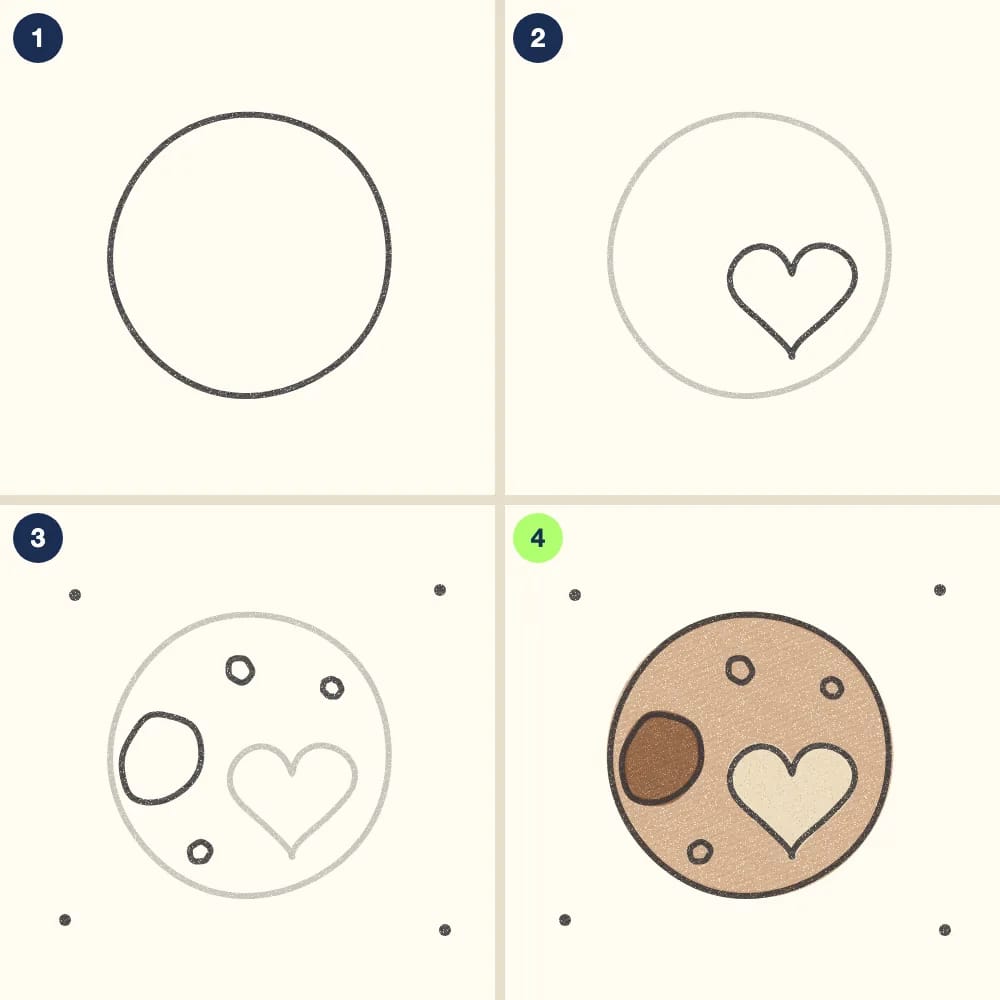
29. Pluto. Shapes: a circle, a heart, blobs. Draw a big circle. Draw a heart in the lower part. Add a patch on the left, three small craters and some dot stars. Color Pluto light brown, the heart cream and the patch dark brown.
Space fact: Pluto was reclassified as a dwarf planet in 2006, and in 2015 NASA's New Horizons spacecraft photographed a heart shape on its surface (NASA).
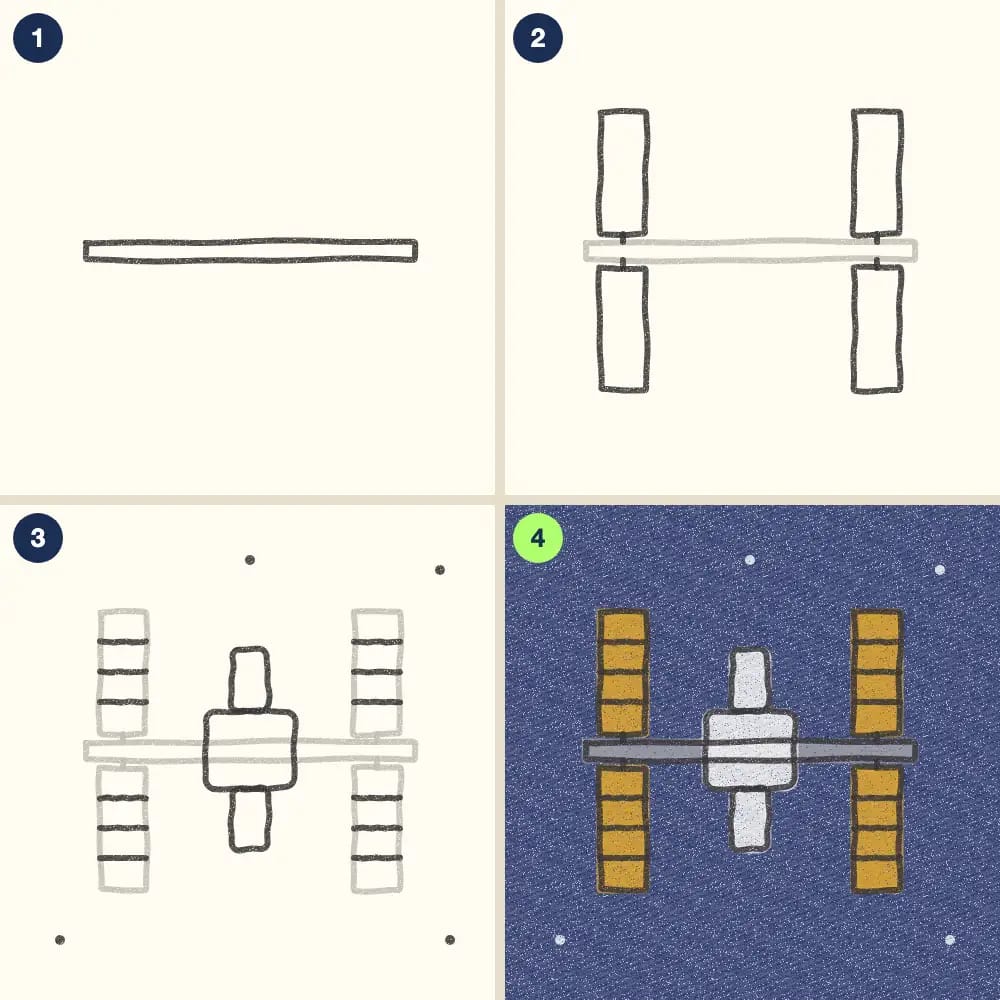
30. Space station. Shapes: rectangles, lines. Draw a long, thin rectangle across the middle. Add four tall rectangles for solar panels, two at each end, one above and one below. Draw the modules in the middle as a cross of rounded rectangles, and three lines across each panel. Color the sky dark blue, the panels gold and the modules white.
Space fact: The space station circles Earth 16 times a day, so its crew sees 16 sunrises and sunsets, and it has had people aboard nonstop since November 2000 (NASA).
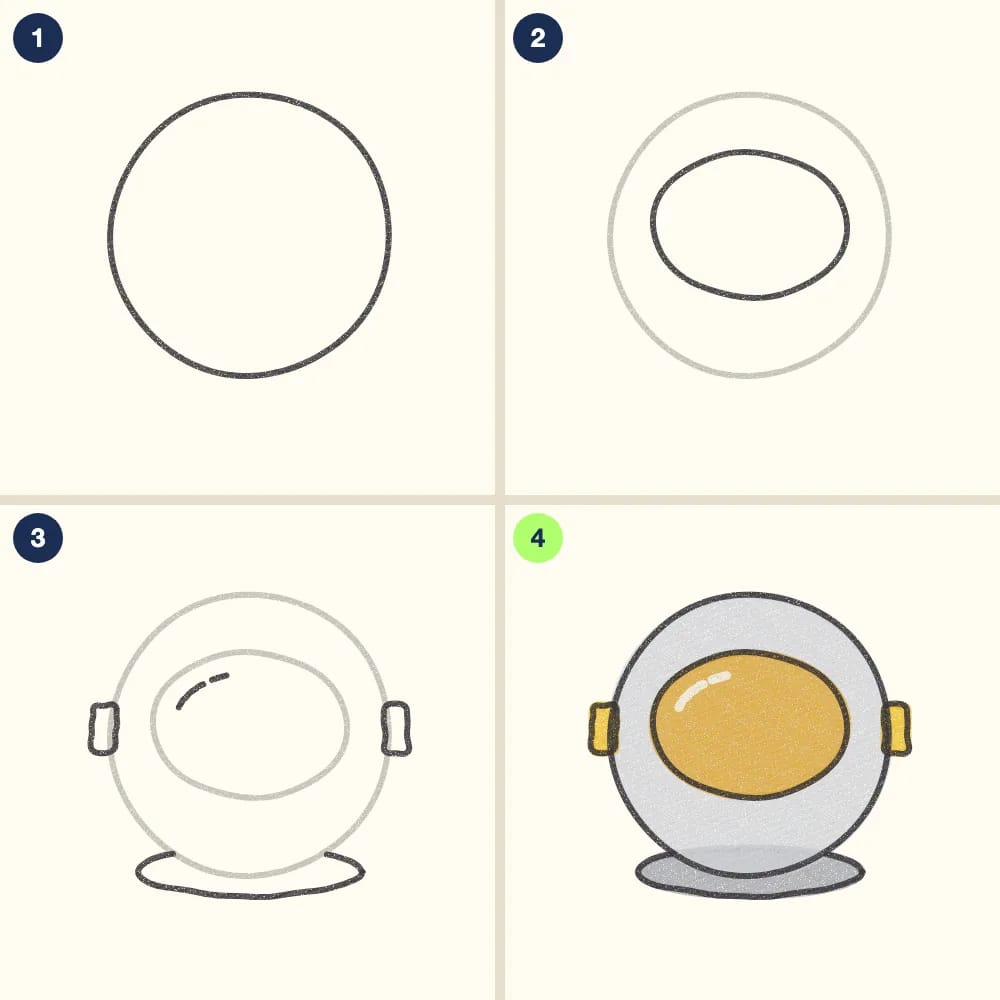
31. Astronaut helmet. Shapes: a circle, an oval, small rectangles. Draw a big circle. Draw a wide oval inside it for the visor. Add a neck ring under the helmet, a light on each side and two short curves for the shine. Color the helmet light gray, the visor gold and the lights yellow.
Space fact: Spacewalk helmets have a small foam block inside, so astronauts can scratch an itchy nose (NASA).
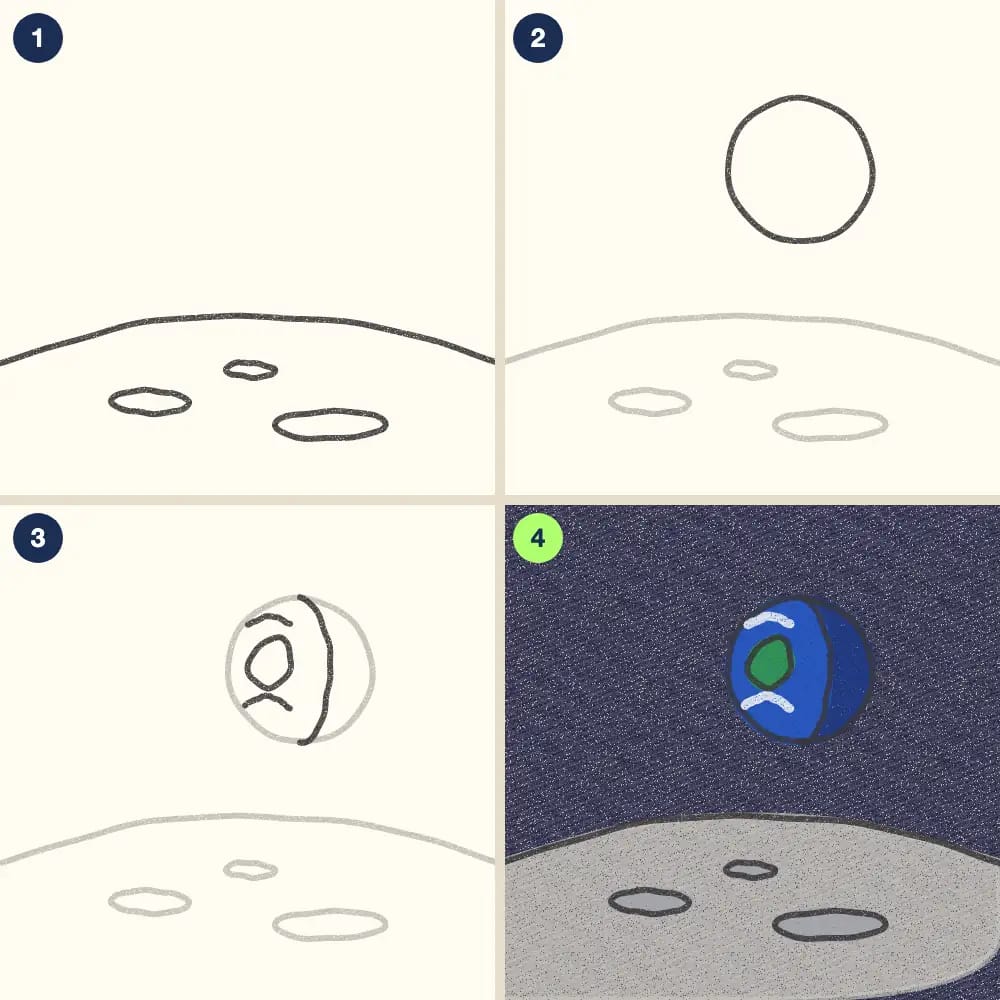
32. Earthrise. Shapes: a curved line, ovals, a circle, a curve. Draw a low curved hill for the Moon's surface and three flat craters. Draw a circle above it for Earth. Draw a curve down Earth to split the sunny side from the dark side, then add land and clouds. Color the sky very dark blue, the Moon gray and Earth blue and green, with the dark side darker blue.
Space fact: On December 24, 1968, Apollo 8 astronaut Bill Anders photographed Earth rising over the Moon, a sight no human had seen before (NASA).
Can a space drawing be turned into something real?
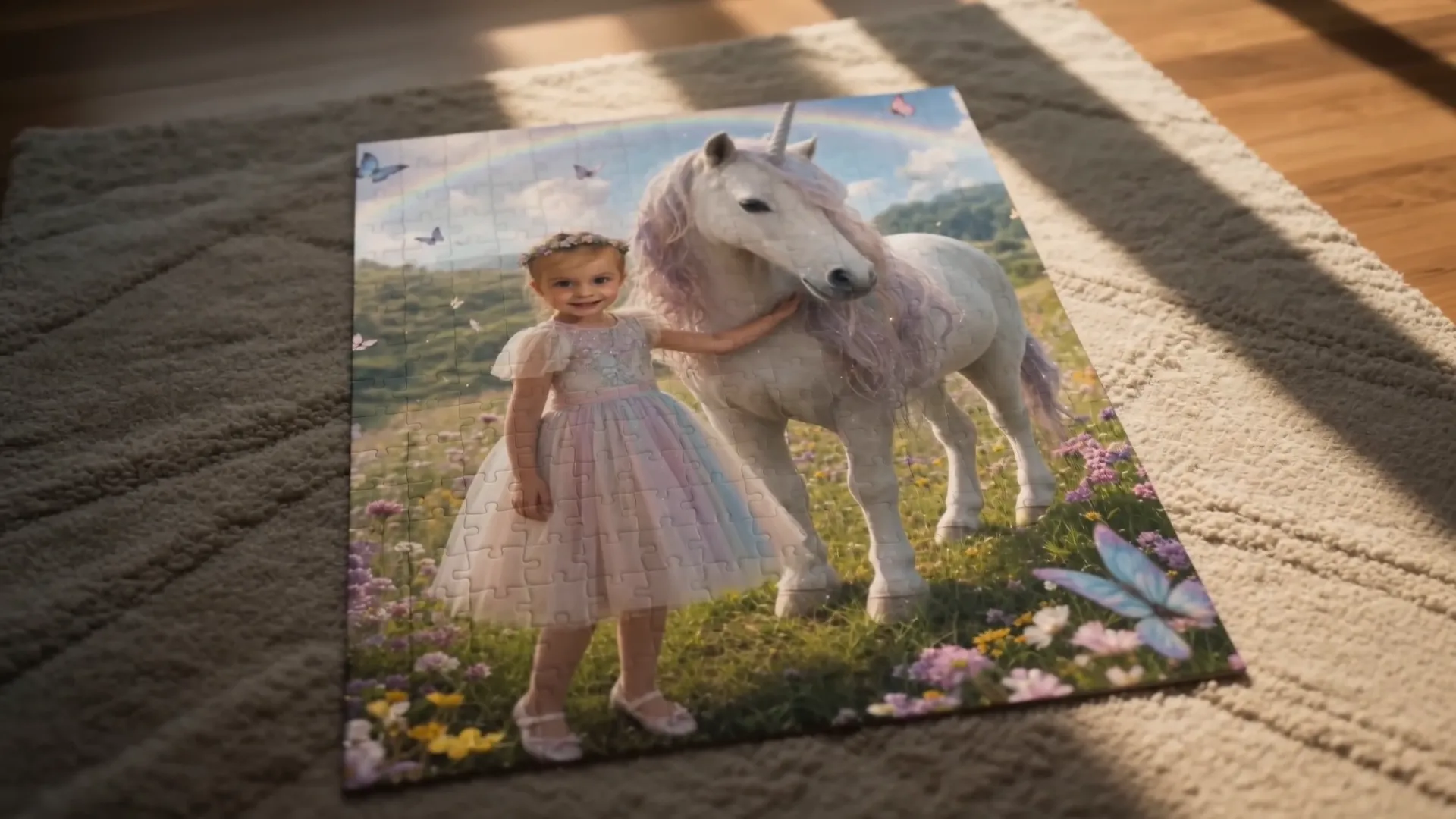
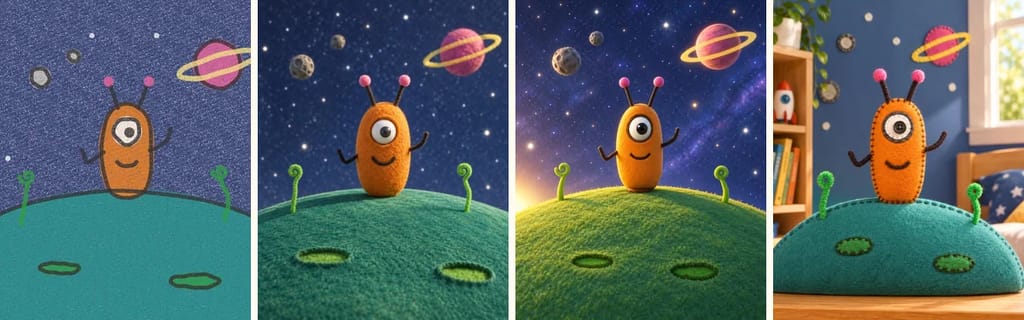
Yes. Photograph the finished drawing, and our Drawing Made Real studio brings the character back three ways at once: as a real-life photograph, as a still from an animated film and as a plush toy. We tried it on our own crayon alien from number 40 below. The one eye, the two pink-tipped antennae, the curly plants and the ringed planet all came back as drawn, because the studio is built to keep a child's design rather than tidy it up. You see all three versions free and watermarked, usually within a couple of minutes, and nothing prints until you choose one. A jigsaw puzzle, canvas or fleece blanket starts at $59 and a framed canvas at $79, with free US shipping, or the high-resolution file alone is $5. The photo is deleted within 24 hours and never used to train AI.
Space drawings for ages 6 and 7
Copying a diamond comes at around six to seven, and by five most children can draw a person with ten parts (Columbia's Gesell table), so a whole astronaut with a helmet, gloves and boots is now within reach. These drawings have more parts, shapes that overlap and one real trick: showing what is in front and what is behind, as Saturn's rings do in number 41. The NHS York leaflet puts copying a star at six and up, and the hexagons in Webb's mirror take the same steady hand. Number 48 is the one to finish on, because the face in the rocket window is your child's own.
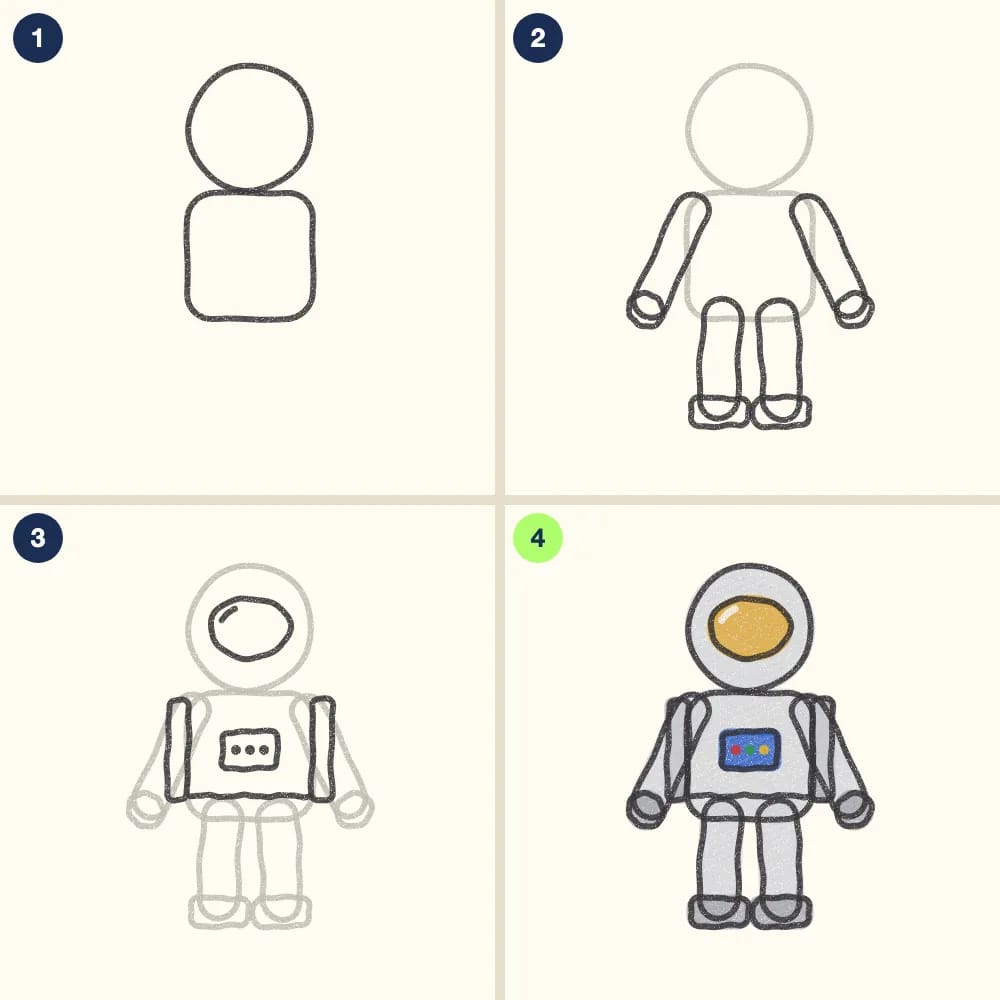
33. Astronaut. Shapes: a circle, rounded rectangles, tubes. Draw a circle helmet on top of a rounded body. Add puffy tube arms with round gloves and tube legs with boots. Draw the visor, a chest box with three buttons, a belt line and the edges of the backpack showing at the sides. Color the suit light gray, the visor gold and the chest box blue.
Space fact: A spacewalk suit is really a person-shaped spacecraft, and NASA's space station suit, with its life-support backpack and a small rescue jetpack, weighs about 319 pounds on Earth (NASA).
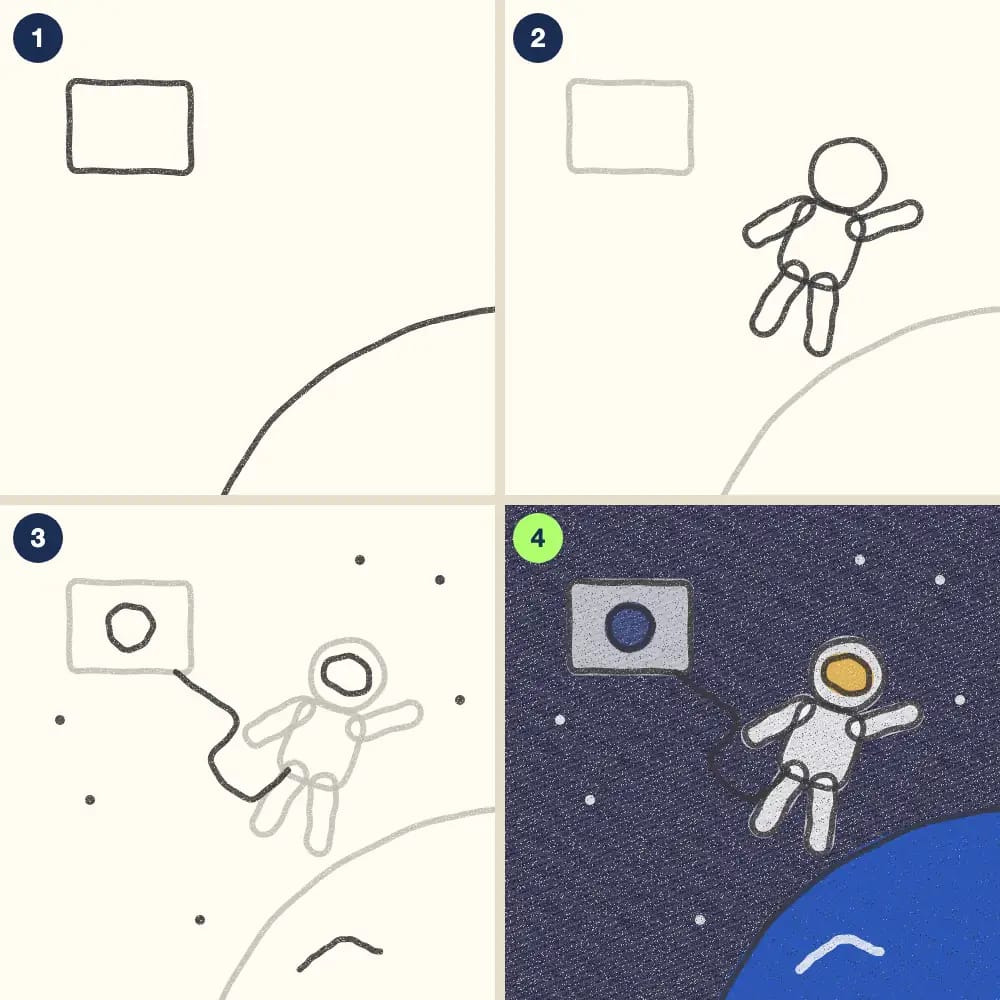
34. Spacewalk. Shapes: a big curve, a rectangle, tubes, a curly line. Draw a big curve in the bottom corner for Earth and a rounded rectangle in the top corner for the spacecraft. Draw an astronaut floating at a tilt, with one arm waving. Add the visor, a round hatch window, a curly safety line from the astronaut back to the spacecraft, a cloud and stars. Color space very dark blue, Earth blue and the astronaut white.
Space fact: In 1965, Alexei Leonov made the first spacewalk, and his suit puffed up so much he had to let air out to squeeze back in (ESA).
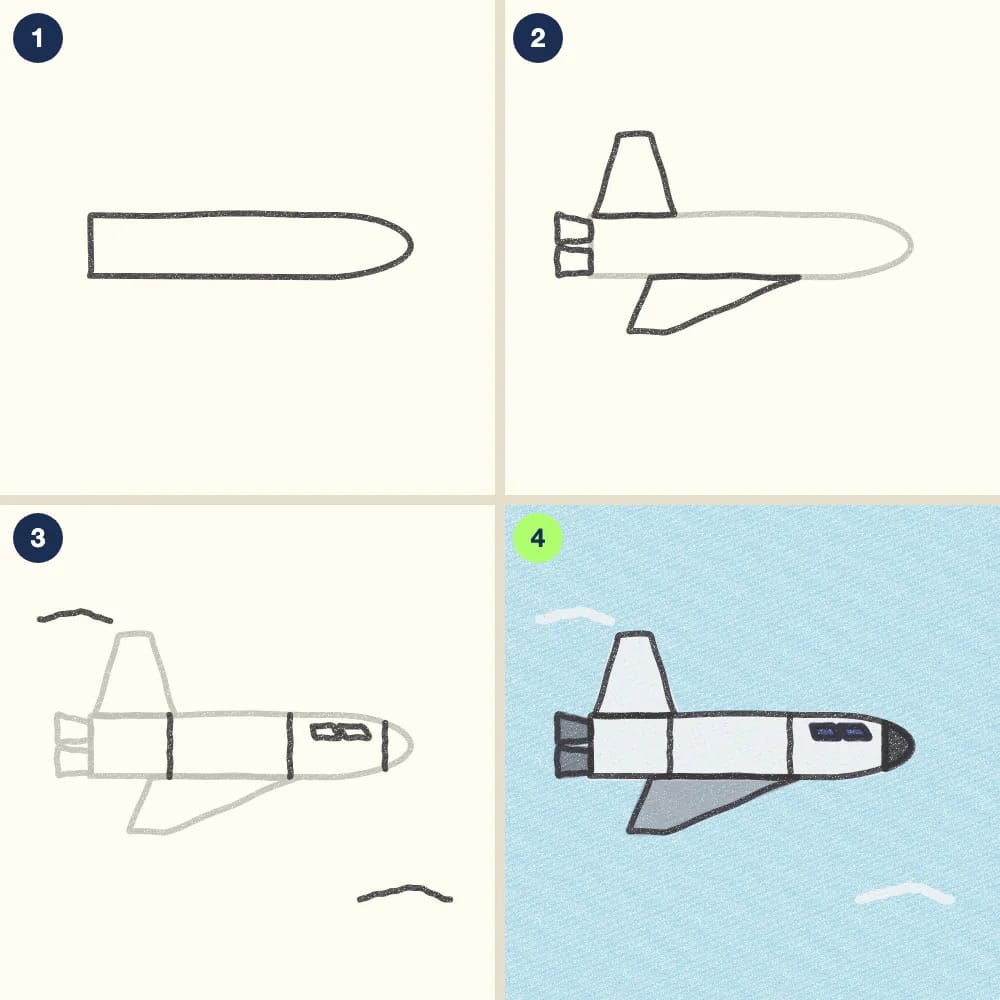
35. Space shuttle. Shapes: a long rounded shape, triangles, small trapezoids. Draw a long body with a rounded nose. Add a wing underneath, a tail fin on top at the back and two engine bells. Draw two windows near the nose, a line across the nose, two lines for the cargo doors and a couple of clouds. Color the sky light blue, the shuttle white, the nose tip black and the wing gray.
Space fact: NASA's space shuttles flew 135 missions, from the first launch on April 12, 1981, to the last landing on July 21, 2011 (NASA).
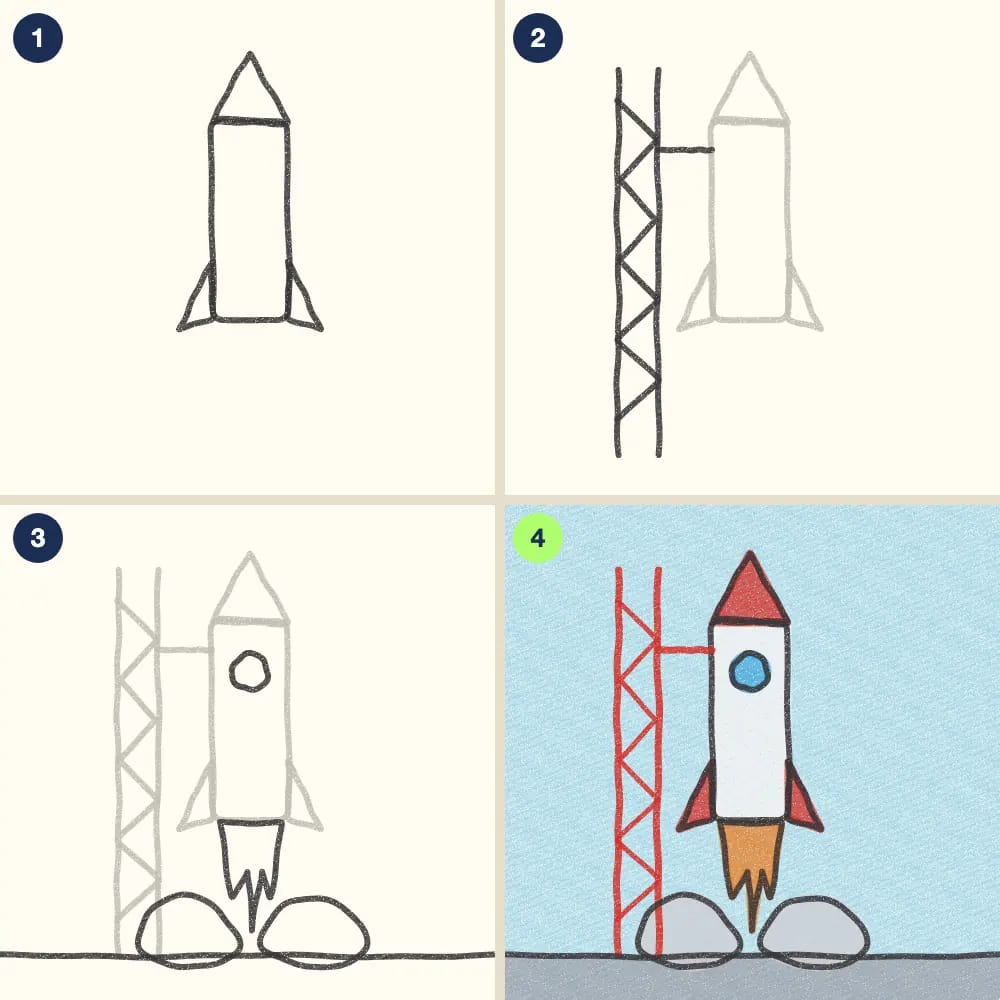
36. Rocket launch. Shapes: a rectangle, triangles, zigzags, bumpy clouds. Draw a tall rocket with a pointed nose and two fins. Draw the launch tower beside it: two tall lines with a zigzag between them and an arm reaching across. Add a window, a big flame, two puffs of smoke and the ground. Color the tower red, the rocket white with red fins, the flame orange and the smoke gray.
Space fact: At liftoff, the 363-foot Saturn V Moon rocket made more power than 85 Hoover Dams (NASA).
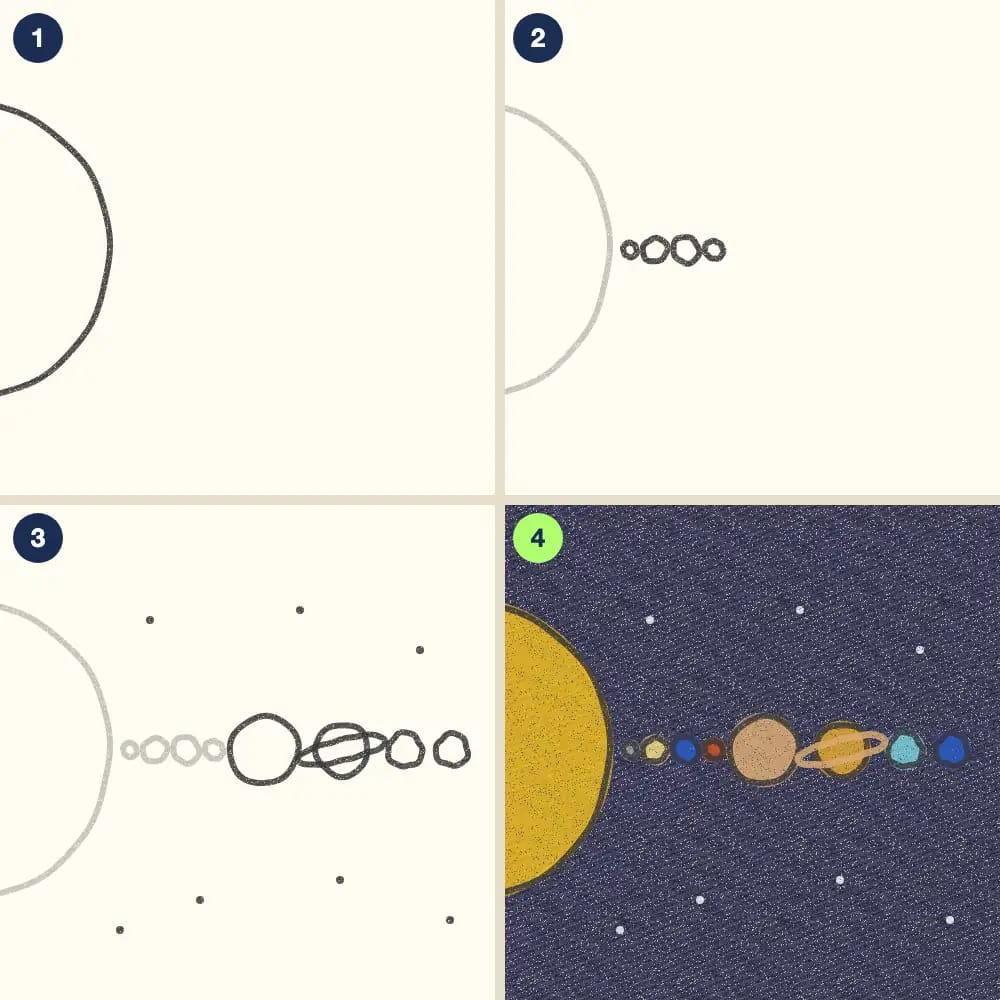
37. Solar system. Shapes: a big curve, circles of different sizes, an oval. Draw a big curve on the left edge for the Sun. Add four small planets in a row: Mercury, Venus, Earth and Mars. Then draw the four big ones: Jupiter, Saturn with its ring, Uranus and Neptune, and some stars. Color the Sun yellow, then the planets gray, pale yellow, blue, red, tan, gold, pale blue-green and blue.
Space fact: In 2006, astronomers agreed our solar system has eight planets: Mercury, Venus, Earth, Mars, Jupiter, Saturn, Uranus and Neptune (NASA JPL).
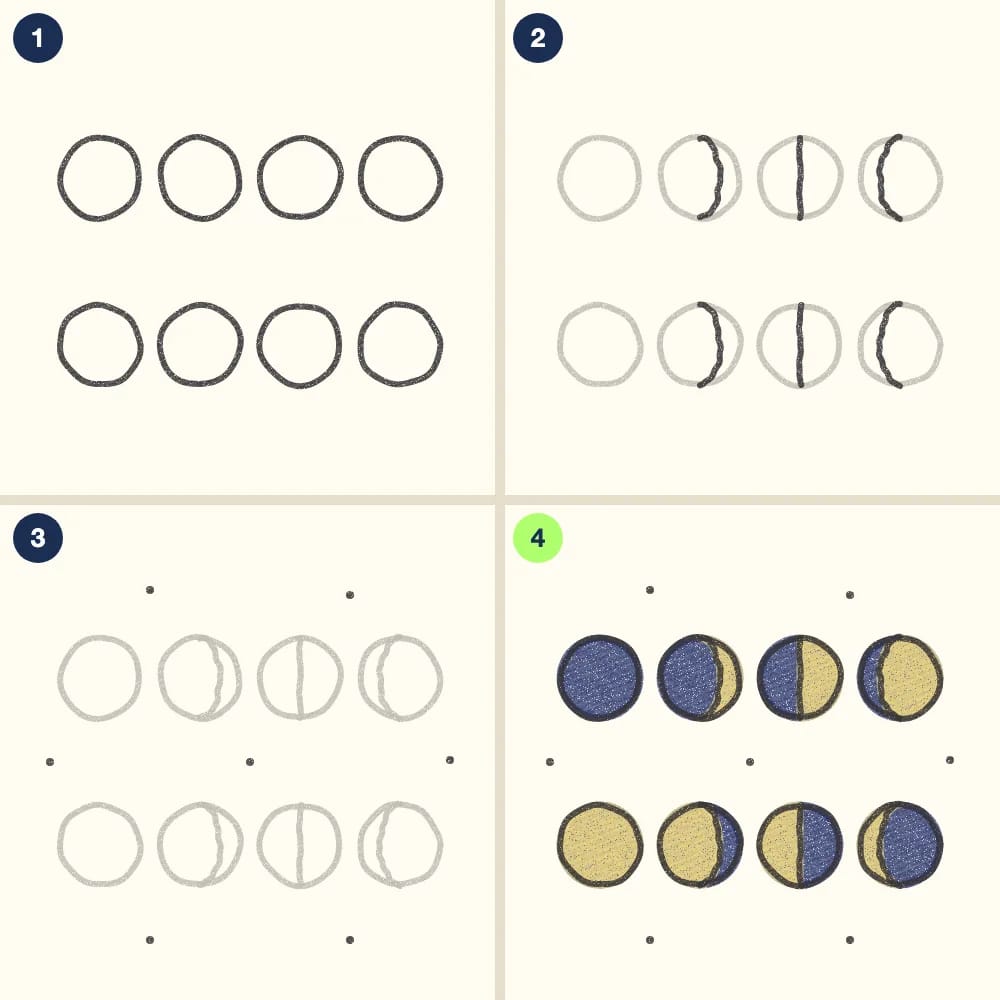
38. Moon phases. Shapes: circles, curves, straight lines. Draw two rows of four circles. Inside six of them, draw the line between the sunny and dark parts: curves for the crescents and the fat gibbous moons, straight lines for the half moons. Add a few stars. Color the dark parts dark blue and the sunny parts pale yellow: the first circle stays all dark for the new Moon and the fifth is all yellow for the full Moon.
Space fact: The Moon goes through all its phases, from new Moon to full and back again, about every 29.5 days (NASA).
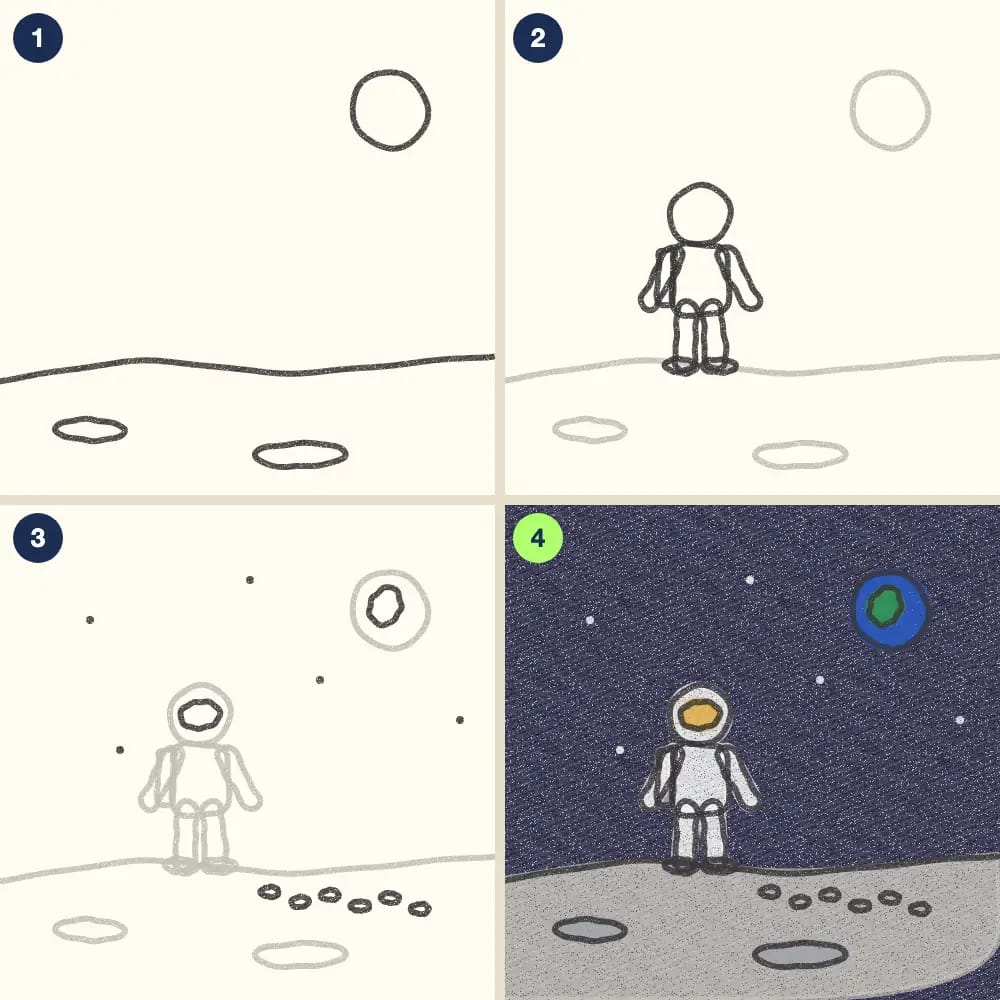
39. Astronaut on the Moon. Shapes: a wavy line, ovals, a circle, tubes. Draw the Moon's ground with two craters, and Earth as a circle up in the sky. Draw a standing astronaut with a backpack, puffy arms and legs and boots. Add the visor, a trail of footprints, land on Earth and a few stars. Color the sky very dark blue, the ground gray, the astronaut white and Earth blue and green.
Space fact: Twelve astronauts walked on the Moon during NASA's Apollo missions, between 1969 and 1972 (NASA).
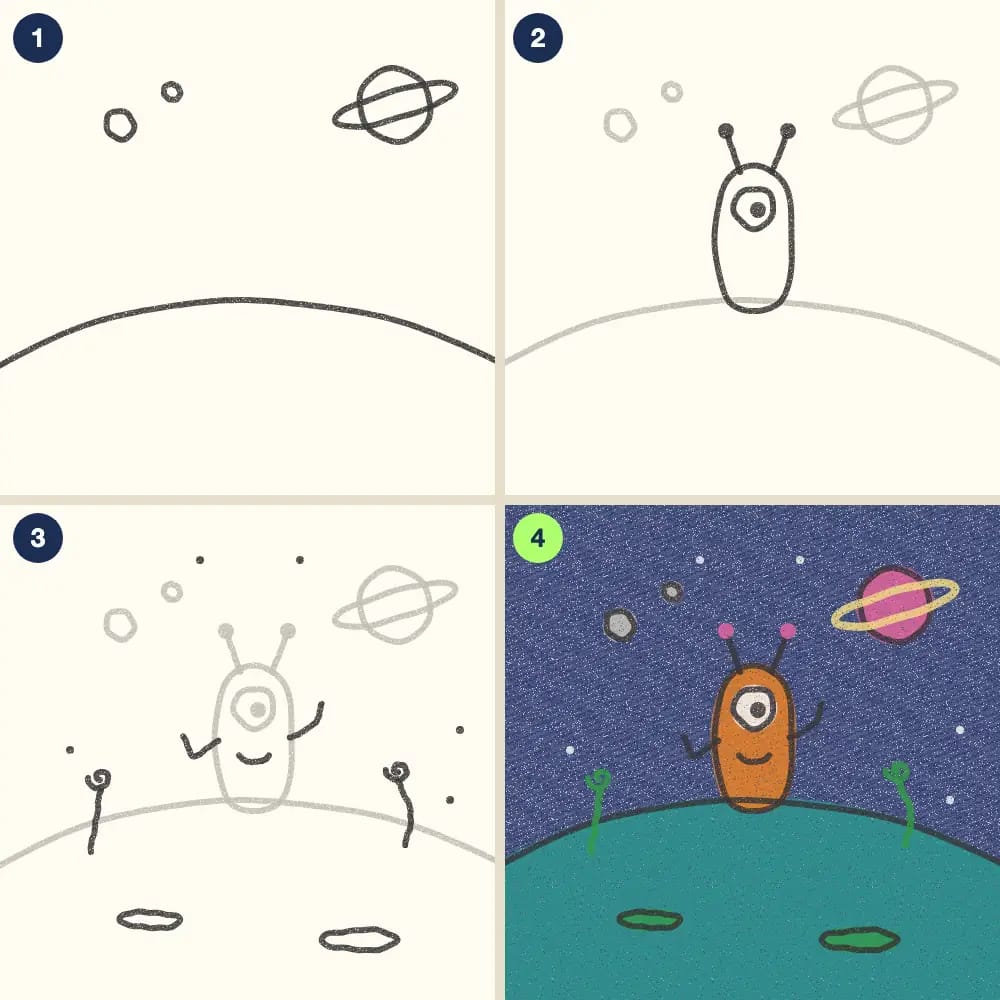
40. Alien on its planet. Shapes: a big curve, a bean shape, circles, spirals. Draw a big curve for the planet's ground, a ringed planet in the sky and two small moons. Draw a bean-shaped alien with one big eye and two antennae. Add waving arms, a smile, two curly plants, two craters and some stars. Color the sky dark blue, the ground teal, the alien orange and the ringed planet pink.
Space fact: Planets circle other stars too: in September 2025, NASA's count of confirmed planets beyond our solar system reached 6,000 (NASA).
41. Saturn and its moons. Shapes: a circle, ovals, small circles. Draw a circle lightly. Draw two wide ovals around it for the edges of the rings, leaving out the part of each oval that goes behind the planet, and rub out the planet's outline where the rings cross in front of it. Add a third oval in between, two stripes and four moons. Color the planet gold, the rings tan and one moon orange.
Space fact: As of August 2026, Saturn has 293 confirmed moons, more than any other planet in our solar system (NASA).
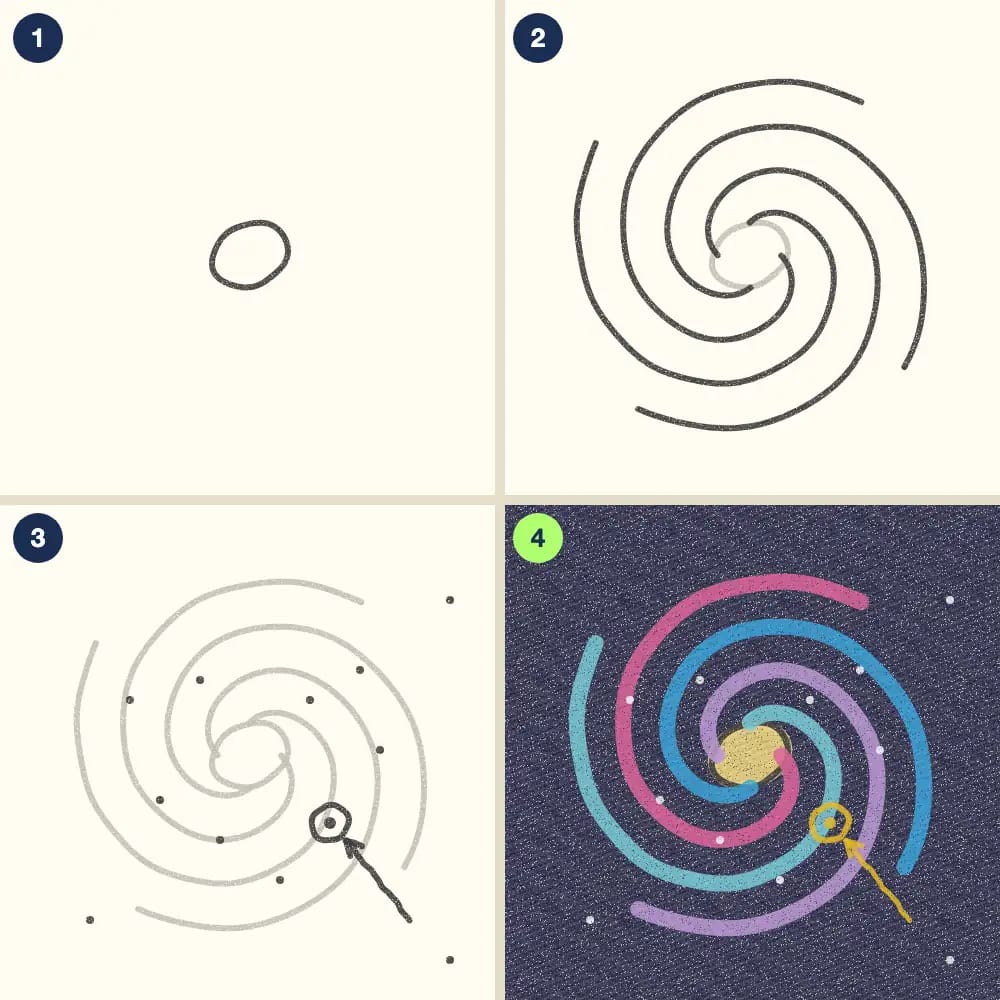
42. Spiral galaxy, with you are here. Shapes: an oval, spirals, a circle, an arrow. Draw a small oval in the middle. Draw four curved arms swirling out from it. Put a small circle with a dot on one arm, about halfway out, with an arrow pointing to it: that is roughly where our Sun is. Add lots of dots. Color the center pale yellow and each arm a different color.
Space fact: The Milky Way is about 100,000 light-years across, so a beam of light would need about 100,000 years to cross it (NASA).
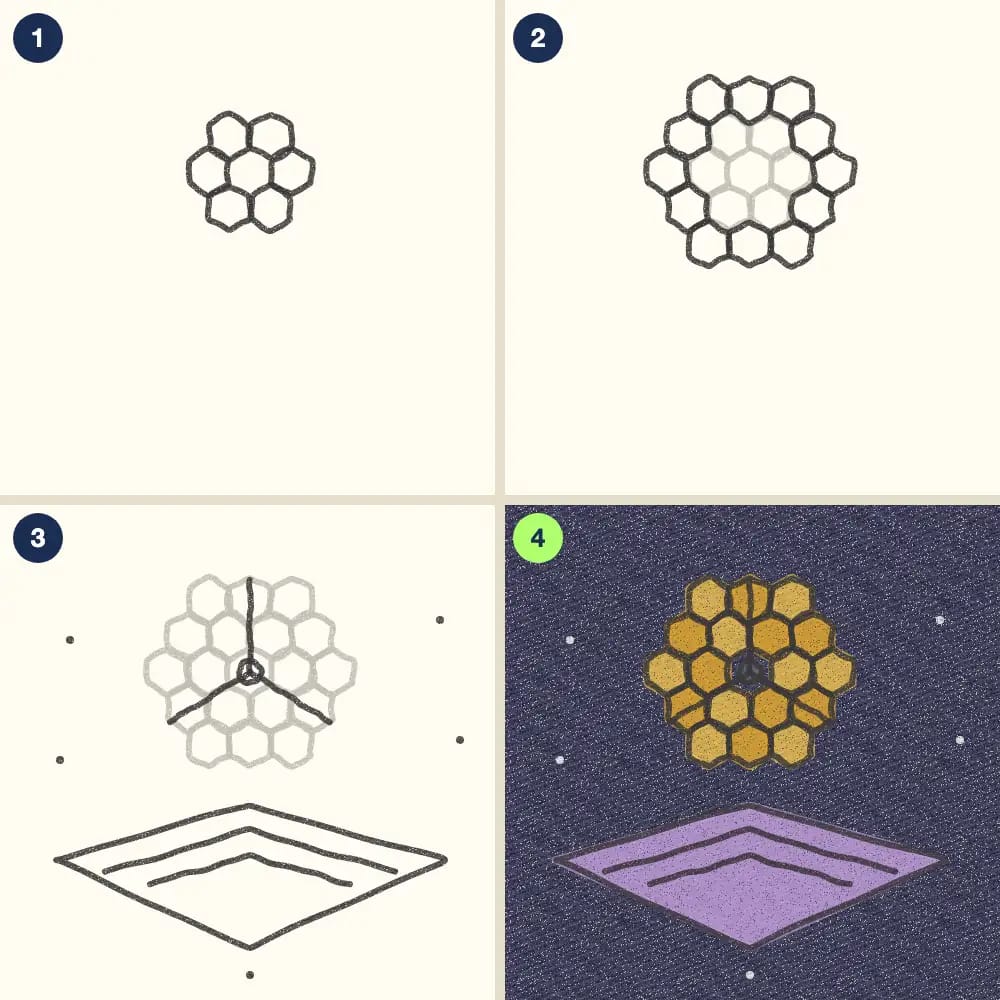
43. James Webb Space Telescope. Shapes: hexagons, lines, a diamond. Draw six hexagons in a ring, leaving a gap in the middle. Draw twelve more around them to make the big mirror. Add three struts meeting at a small circle in the middle, then a big diamond-shaped sunshield underneath with two lines for its layers. Color the mirror gold and the sunshield lilac.
Space fact: Webb's main mirror is made of 18 six-sided pieces, each with a very thin coat of gold that helps it reflect infrared light (NASA).
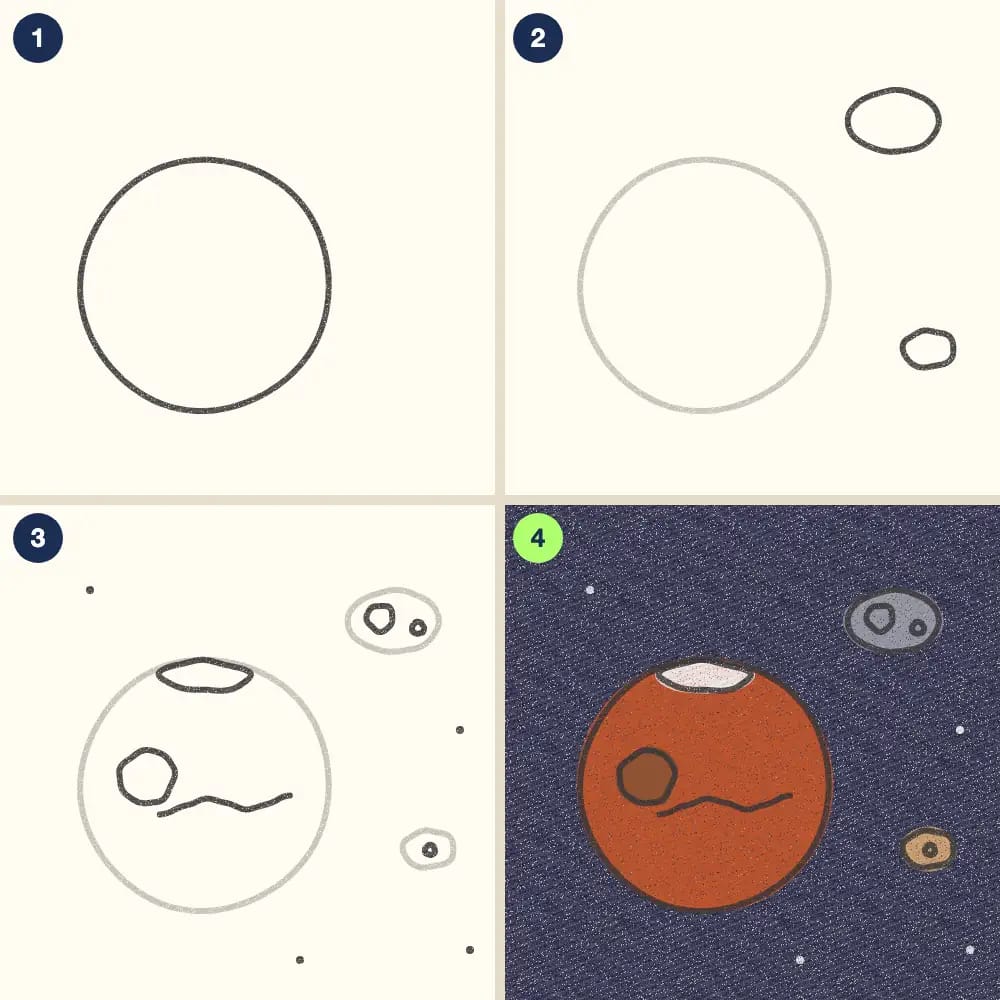
44. Mars and its two moons. Shapes: a circle, lumpy shapes, curves. Draw a big circle for Mars. Draw two lumpy potato shapes for its moons, one bigger than the other. Add an ice cap, a patch, a long wavy canyon and craters on the moons. Color Mars red-orange, the ice cap white, the big moon gray and the small one tan.
Space fact: Mars has two small, potato-shaped moons, Phobos and Deimos, and in about 50 million years Phobos will crash into Mars or break apart (NASA).
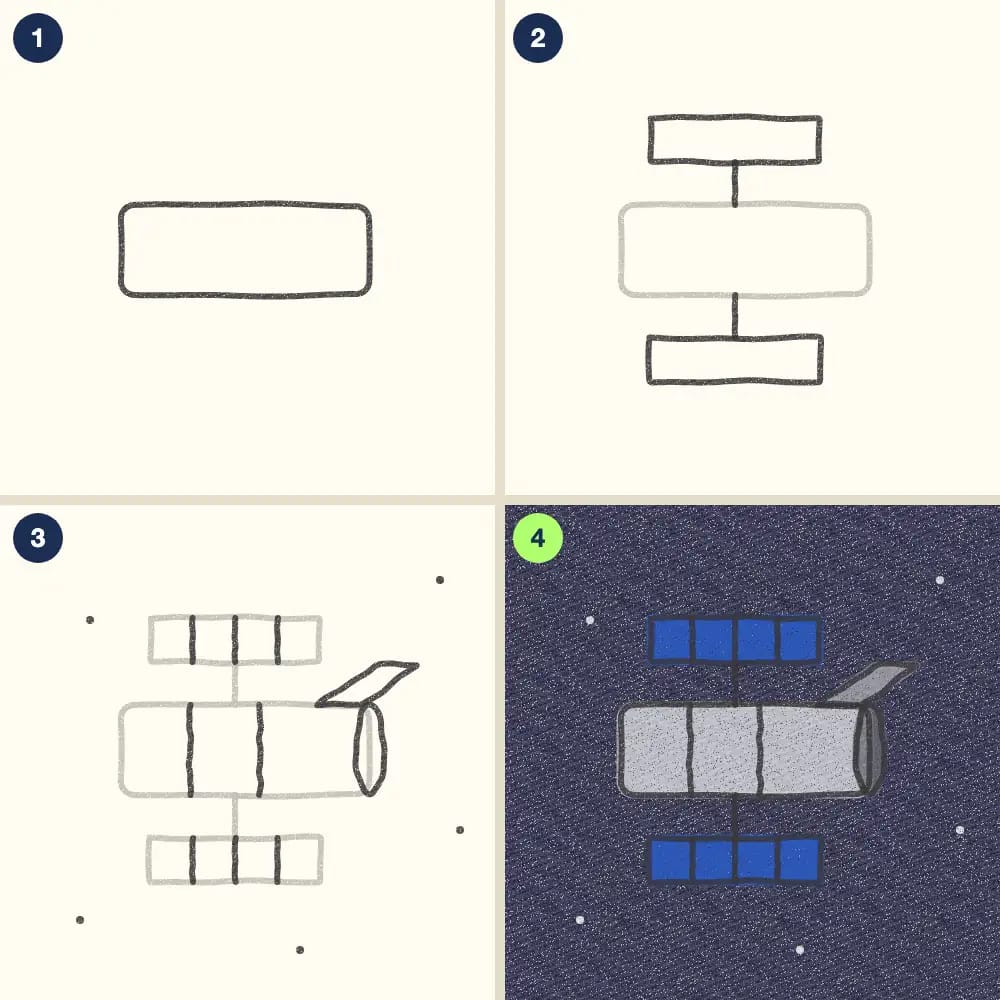
45. Hubble Space Telescope. Shapes: rectangles, lines, an oval. Draw a long rounded rectangle for the tube. Add a solar panel above it and one below, each on a short pole. Draw two bands across the tube, an oval opening at one end with its lid tipped open, and lines across the panels. Color the tube silver-gray and the panels blue.
Space fact: The Hubble Space Telescope was launched by the space shuttle Discovery in 1990, and astronauts visited it five times to repair and upgrade it (NASA).
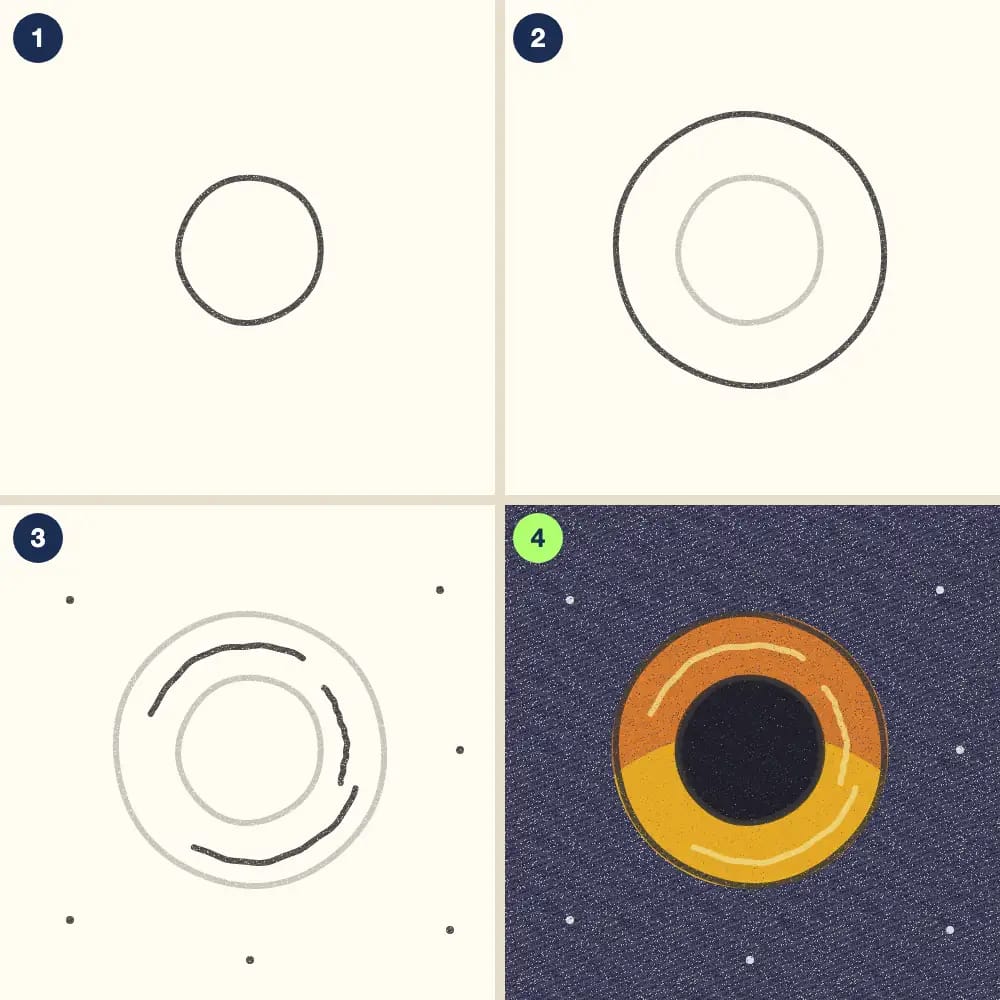
46. Black hole. Shapes: circles, curved lines. Draw a circle. Draw a much bigger circle around it to make a ring. Add three curved lines in the ring for the swirling glow, and some stars. Color the middle black, the ring orange with yellow along the bottom, and space very dark blue.
Space fact: In April 2019, eight radio telescopes linked into one Earth-sized telescope shared the first picture of a black hole, at the heart of galaxy M87 (Event Horizon Telescope).
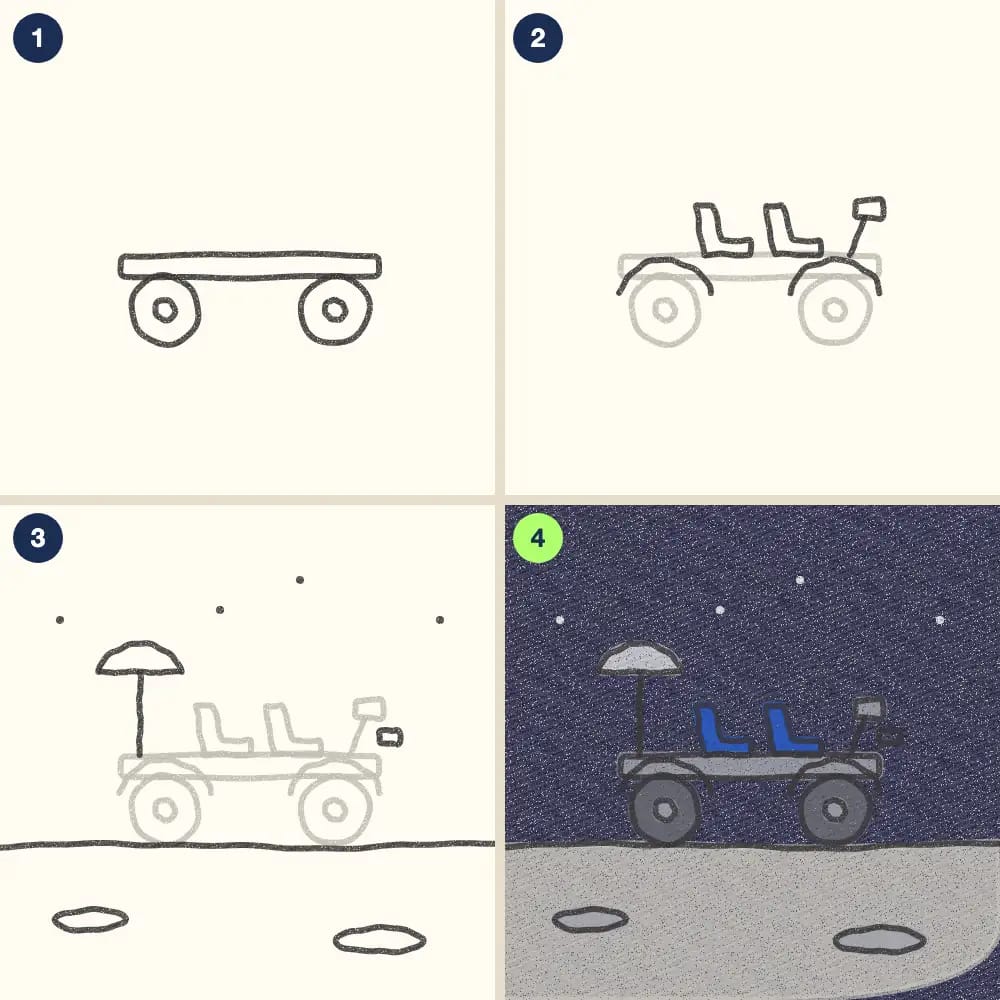
47. Moon buggy. Shapes: a long rectangle, circles, arcs. Draw a long, flat rectangle with two big wheels under it. Add a curved fender over each wheel, two seats and a small control box on a pole. Draw an umbrella-shaped antenna on a pole at the back, a camera at the front, the ground and two craters. Color the seats blue, the buggy gray and the ground light gray.
Space fact: Astronauts first drove a moon buggy on Apollo 15 in 1971, and all three buggies used on the Moon were left there (National Archives).
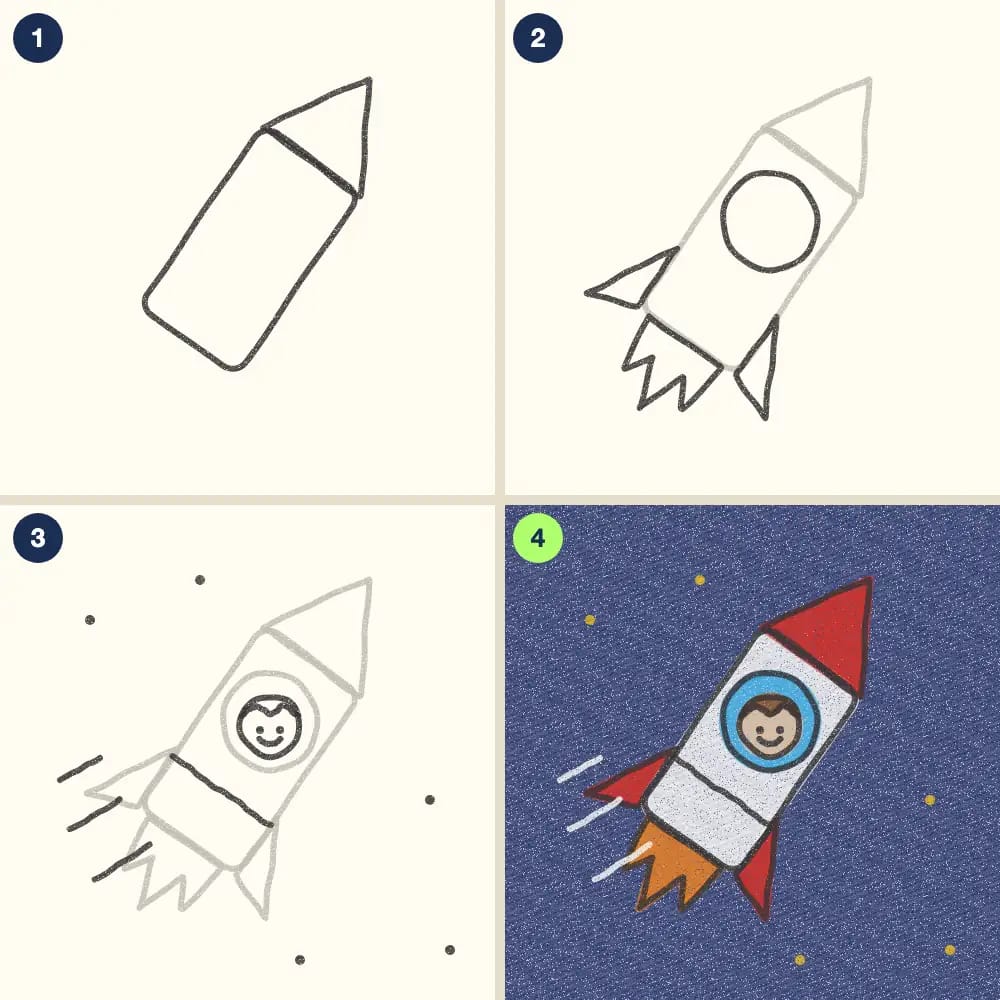
48. You in a rocket. Shapes: a rectangle, triangles, a circle, zigzags. Draw a tilted rocket body with a pointed nose. Add two fins, a big round window and a zigzag flame. Draw your child's own face in the window, a stripe on the rocket, three speed lines and some stars. Color the rocket white and red, the window light blue and the flame orange.
Space fact: Pluto got its name from a kid: in 1930, 11-year-old Venetia Burney of England suggested it, and the name was chosen (NASA).
What order do the planets go in a space drawing?
From the Sun outward, the planets go Mercury, Venus, Earth, Mars, Jupiter, Saturn, Uranus and Neptune. In August 2006, astronomers at the International Astronomical Union voted on a definition of a planet that leaves these eight, which is when Pluto became a dwarf planet (NASA JPL). One memory trick is "My Very Educated Mother Just Served Us Nachos", one word for each planet in order. The sizes in a child's drawing will not be to scale, and true sizes are hard to fit on one sheet. Using NASA's own size ratios, if Earth is a dot half an inch wide, Jupiter is more than five and a half inches across, and the four giant planets side by side come to about 14 inches, wider than a sheet of letter paper turned sideways. So number 37 keeps the order and lets the sizes squeeze.
| Order | Planet | How wide, if Earth is 1 | A crayon that works |
|---|---|---|---|
| 1 | Mercury | 0.38 | Gray |
| 2 | Venus | 0.95 | Pale yellow |
| 3 | Earth | 1 | Blue and green |
| 4 | Mars | 0.53 | Red-orange |
| 5 | Jupiter | 11.21 | Tan, with brown and orange stripes |
| 6 | Saturn | 9.45 | Gold, with a tan ring |
| 7 | Uranus | 4.01 | Pale blue-green |
| 8 | Neptune | 3.88 | Blue |
Widths are diameters compared with Earth's, from NASA's planetary fact sheet. Pluto, now a dwarf planet, would be 0.19.
What do children think Earth looks like?
Many young children picture Earth as flat in some way, even after they have learned that it is round. In a well-known study, the psychologists Stella Vosniadou and William Brewer asked 60 children in Illinois to answer questions and draw the Earth, then mark where people live (Vosniadou and Brewer, 1992). Only 3 of the 20 first graders, aged about six to seven, kept to a round Earth throughout. Some drew a "dual earth", a round planet up in the sky and a flat ground where people live, and others a hollow ball with people living on flat ground inside it. Even among the fifth graders, only 12 of 20 held the round model. So when a six-year-old draws Earth as a ball and then the house beside it on flat ground, they are not being careless: they are working out a hard idea. Ask them to draw Earth with people standing all the way around it, and see what happens.
Does drawing space help children learn it?
For children of five and six, there is some evidence that drawing helps them remember. In one study, five- and six-year-olds who drew while describing an event a day later reported more about it than children who only talked, and were just as accurate. The same benefit did not show up in three- and four-year-olds after a month (Butler, Gross and Hayne, 1995). After a museum visit, five- and six-year-olds who drew while talking a day or two later reported more facts and more of the story (Gross, Hayne and Drury, 2009). That is memory for an event, not a lesson in astronomy, so take it as a nudge rather than a promise. In the Next Generation Science Standards, which many US states use, first grade is when children look for patterns in the Sun, the Moon and the stars (NGSS 1-ESS1-1). Drawing the Moon on each night you can see it for a month, then matching the shapes to number 38, puts that standard on paper.
Can kids copy real NASA pictures?
Yes, for drawing at home or at school. NASA's images are generally not copyrighted in the United States, and its media guidelines say they may be used for educational or informational purposes, as long as NASA is credited and nothing suggests NASA endorses a product. The NASA logos and insignia are a separate matter and are not free to use. Webb and Hubble pictures published by the European Space Agency are released under a Creative Commons license that asks for the full credit line next to the image (ESA/Webb, ESA/Hubble). Good pictures to draw from are the Earthrise photograph from Apollo 8, the Pillars of Creation, Jupiter's stripes and Saturn's rings. Copying a real photo is harder than our four steps, which is the point for a seven-year-old: put the picture beside the paper and draw the big shapes first, the way the steps here do.
What can you do with a space drawing once it's done?
Photograph the best ones flat in daylight before they fade, then play with them, make one real or keep it on something you will use. Most drawings get a day on the fridge, which is fine, but a few are worth more than that.
- Photograph it before it fades. Lay it flat by a window in daylight and shoot from straight above, so the edges stay square. A photo is also what every keepsake service works from.
- Watch it come to life. In the Curious Theatre, the drawing becomes a paper puppet your child plays with the keyboard or by tapping, and the show can be saved as a short video. It is free, and the drawing stays on your device.
- Make it real. Our Drawing Made Real studio turns the character into a real-life photo, an animated film still and a plush toy, free to see, and prints the one you pick on a puzzle, canvas or blanket from $59.
- Keep it in thread or metal. We stitch a child's drawing in real thread on a sweatshirt, hoodie or tee, with a tee or a kids' sweatshirt from $49, and you approve the stitching before anything is sewn. Or it can go on a necklace cut to the drawing's own shape, from $59.
- Put them in the spacesuit. If your child would rather be the astronaut than draw one, our Space Explorer world paints them as one from a single photo. For more ways to keep children's art, see our guide to children's artwork gifts.
Frequently asked questions
What are some easy space drawings for kids?
+
For two- and three-year-olds, the Sun, a full Moon, Earth, Saturn and an alien face, all made from circles, dots and lines. For four- and five-year-olds, a rocket, a satellite, a robot, a Mars rover and the Big Dipper. For six- and seven-year-olds, a whole astronaut, the solar system in order, the phases of the Moon and Saturn with its rings in front and behind.
What is the easiest space thing to draw?
+
The Sun. It is one circle, a ring of short straight lines and a face, and most children can copy a circle by about three. A full Moon is just as easy: one big circle with a few small circles inside it for craters.
What space drawings can a 3-year-old do?
+
Drawings built from circles, dots and straight lines: the Sun, a full Moon, Earth, Mars, a row of planets, a comet, shooting stars or an alien face. Draw each step first on your own paper and let them copy it. A grown-up can also trace their hand to make an alien. Expect an astronaut with arms coming out of the helmet: that is normal at three.
How do you draw a rocket step by step?
+
Draw a tall rectangle for the body. Add a triangle on top for the nose and a triangle fin on each side at the bottom. Draw a round window near the top, a line across the body and a zigzag flame underneath, then color the nose and fins red and the flame orange. Most children can copy the triangle it needs at about five.
How do you draw Saturn's rings so they look real?
+
Draw the planet as a circle, then draw the rings as wide, flat ovals around it. Leave out the part of each oval that would be behind the planet, and rub out the planet's outline where the rings pass in front of it. For younger children, one flat oval straight across the circle is fine.
What order do the planets go in?
+
From the Sun outward: Mercury, Venus, Earth, Mars, Jupiter, Saturn, Uranus and Neptune. A common memory trick is "My Very Educated Mother Just Served Us Nachos". Astronomers agreed on these eight in 2006.
Is Pluto a planet?
+
No. Pluto was reclassified as a dwarf planet in 2006, so it does not go in a drawing of the eight planets. It is still worth drawing on its own, because of the heart shape NASA's New Horizons spacecraft photographed on it in 2015. Its name came from an 11-year-old, Venetia Burney, in 1930.
Can my child's space drawing be turned into something real?
+
Yes. Photograph the drawing and our Drawing Made Real studio shows the character three ways, as a real-life photo, an animated film still and a plush toy, free and watermarked. If you love one, it prints on a puzzle, canvas or blanket from $59 or a framed canvas from $79, with free US shipping. The photo is deleted within 24 hours.