
The short answer
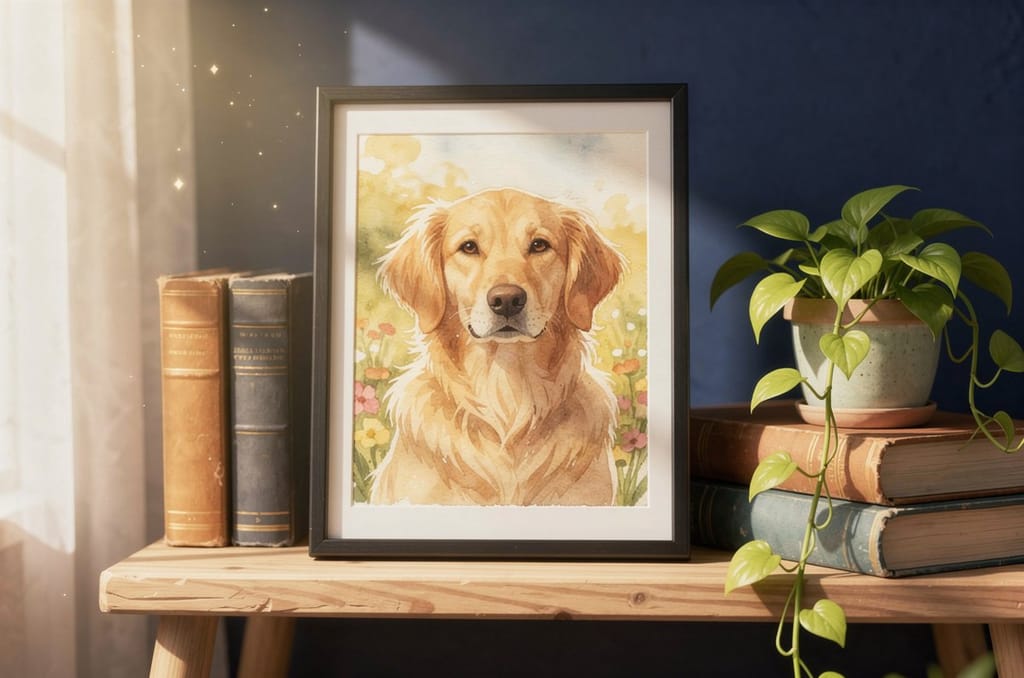
The best pet memorial gift is rarely the one that arrives fastest. Condolences flood in during the first day or two, then stop, and the gift does its real work in the quiet that follows. Send a card immediately if you want, then send the keepsake a week or a month later, when the person is alone with it. A portrait of the animal, a donation in their name, a tree, or a paw print all last. What matters more than the object is that you used the pet's name and did not try to fix anything.
Search for pet memorial gifts and you get urns, wind chimes, garden stones, and a great many suncatchers. What those lists rarely cover is the part people actually get wrong. Almost none of them say when to send it. Almost none separate the two very different situations hiding behind the same search, one person memorializing their own animal and another trying to comfort a friend. And almost none mention that the passage quoted on countless sympathy cards in this category has an author who went uncredited for more than sixty years. This guide covers all three, and then the keepsakes themselves.
When should you send a pet memorial gift?
Not in the first two days. That is when the messages arrive, and when the person receiving them can least take anything in. The useful window opens after that, once everyone else has gone quiet.
Veterinary practices are taught to send a card or memento within about three days, and Amanda Donnelly, writing in Today's Veterinary Business in 2024, is specific that it must carry a personal message rather than a row of signatures. Veterinary grief counselor Michele Pich describes the same pattern from the other side: support pours in for a day or two, then people assume the worst has passed and stop asking. Pich suggests checking in on the third or fourth day, and again a month later. She also names the dates that reopen it: the pet's birthday, the day they came home, the first holidays without them.
A memorial gift does its best work in that second window.
What do you say when someone's pet dies?
Use the animal's name, say you are sorry, and resist the urge to fix it. The most common mistake is not saying the wrong thing. It is saying nothing, which reads as though the loss did not register.
Pich is blunt about the phrases that do damage. Telling someone it is not like they lost a person, she says, does not merely invalidate the grief, it tells them they are silly for it. Skip any sentence starting with "at least." Skip "you can always get another one," which quietly treats the animal as interchangeable. Skip promises about time healing everything, and skip afterlife language unless you know they share the belief.
Guilt sits underneath most pet loss. Annalisa de Carteret, who manages pet bereavement support at the UK charity Blue Cross, says owners replay what they might have done differently, and that this is normal. You do not have to argue them out of it. You have to stay.
Which pet memorial gifts actually get kept?
The ones tied to the specific animal rather than to the general fact of grief. A stock sympathy item says someone noticed. A keepsake with that particular face on it says someone remembered. Here are the categories that hold up, only one of which we make.
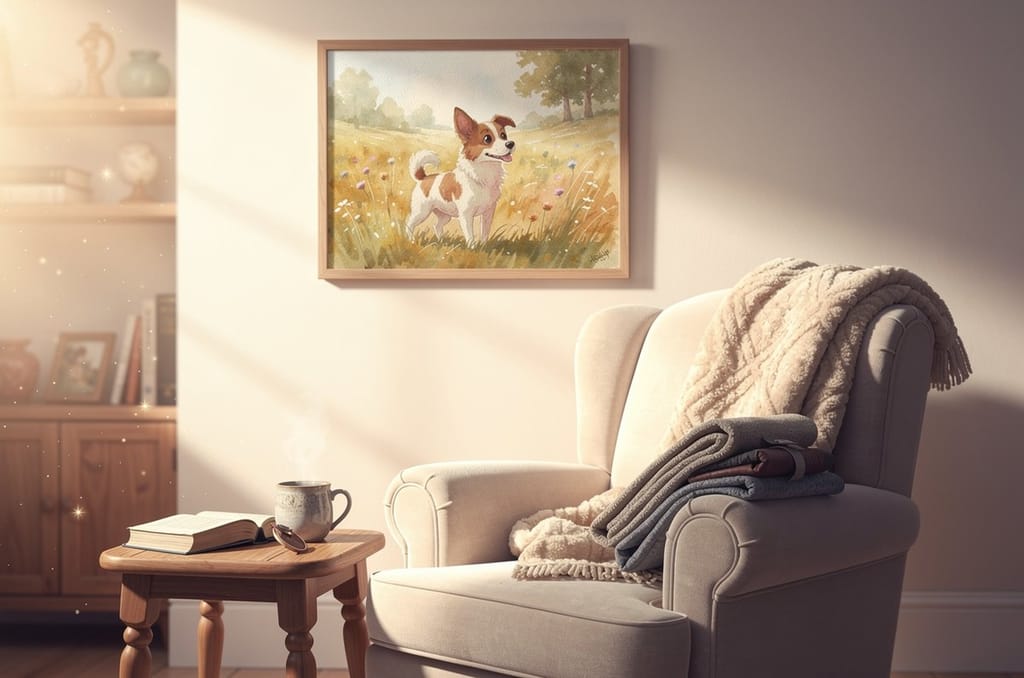
The most-kept option, because it is the only one that carries the face. Works whether you have a great photo or a slightly blurry phone shot, and it goes on a wall rather than into a drawer.
A shelter or rescue gift in the animal's name, with the acknowledgment card sent to the owner. Costs whatever you choose and turns the loss outward. Many shelters and rescues run memorial giving programs built for exactly this.
Often taken by the veterinary practice at the end, sometimes not. If the family has one, a small frame or shadow box for it is a kinder gift than another object they now have to find room for.
For anyone with outdoor space, a planted tree or an engraved stone gives grief somewhere to go. It also ages, which most memorial objects do not, and that turns out to matter.
Everything is already on their phone and none of it is anywhere else. A printed album of a few dozen pictures is unglamorous and quietly one of the most-used things you can give.
Not a gift, and often the best one. Boxing up food and bedding for donation, canceling the subscriptions, or walking the surviving dog. Offer a specific task rather than "let me know if you need anything."
Is grief over a pet really like grief over a person?
Close enough that researchers keep failing to find much of a gap, which is precisely why "it was only a dog" lands the way it does.
The largest direct comparison, published by Lizabeth Eckerd and colleagues in Death Studies in 2016, surveyed 211 college students who had lost a pet and 146 who had lost a person within the previous two years. The human loss group did report higher grief severity, but the effect sizes were small, in the range of 0.28 to 0.30. What predicted grief far better than species was closeness to the one who died. Once closeness entered the model, most other predictors dropped out entirely.
Two later studies found no significant difference at all: a smaller Australian comparison by Lavorgna and Hutton in 2019, and a Danish sample of 366 people reported by Aalborg University researchers in 2022, where pet-bereaved and human-bereaved participants scored effectively the same.
The Rainbow Bridge has an author, and almost nobody credits her
Her name is Edna Clyne-Rekhy. She wrote it in Scotland in 1959, as a teenager, the day after her dog Major died, on a sheet of paper torn from a notebook. She never published it and never put her name on it, and she still has the original.
The text reached a mass American audience in 1994, when the advice column Dear Abby printed it in full and unattributed. From there it spread through veterinary offices, sympathy cards, and headstones with no author attached, and several people claimed it over the decades. In February 2023 the historian Paul Koudounaris worked back through the claimants one at a time, found Clyne-Rekhy, and published the answer in National Geographic with her handwritten manuscript as proof.
If you are putting those words on a card, put her name underneath them. It costs nothing, and after more than sixty years of anonymity it is a small thing to fix.
Whose loss is it, and how does that change the gift?
The same search covers two people with opposite needs. Someone memorializing their own animal is choosing something to live with for years and can take as long as they like. Someone comforting a friend is trying to be present without being intrusive, and is working against a clock that is shorter than it looks.
| When | If it was your own pet | If you are the friend |
|---|---|---|
| The first week | Nothing at all. Decisions made now are usually remade later. | ✓ A card with the pet's name in it, and one specific offer of help. |
| Weeks two to six | ✓ The keepsake. A portrait, a print, a place for the paw print. | ✓ The keepsake, or a donation in the animal's name. |
| Anniversaries after | ✓ Whatever you were not ready for the first time. | ✓ A message on the date. Almost nobody else will send one. |
How does a memorial pet portrait work?
You upload one clear photo and it comes back as a painting of that animal. In Loving Memory is the tribute version we make: a soft watercolor in warm garden light, your pet's real face and markings kept intact, with an optional and very quiet Rainbow Bridge motif if you want one. It is deliberately understated. Nothing about it is festive.
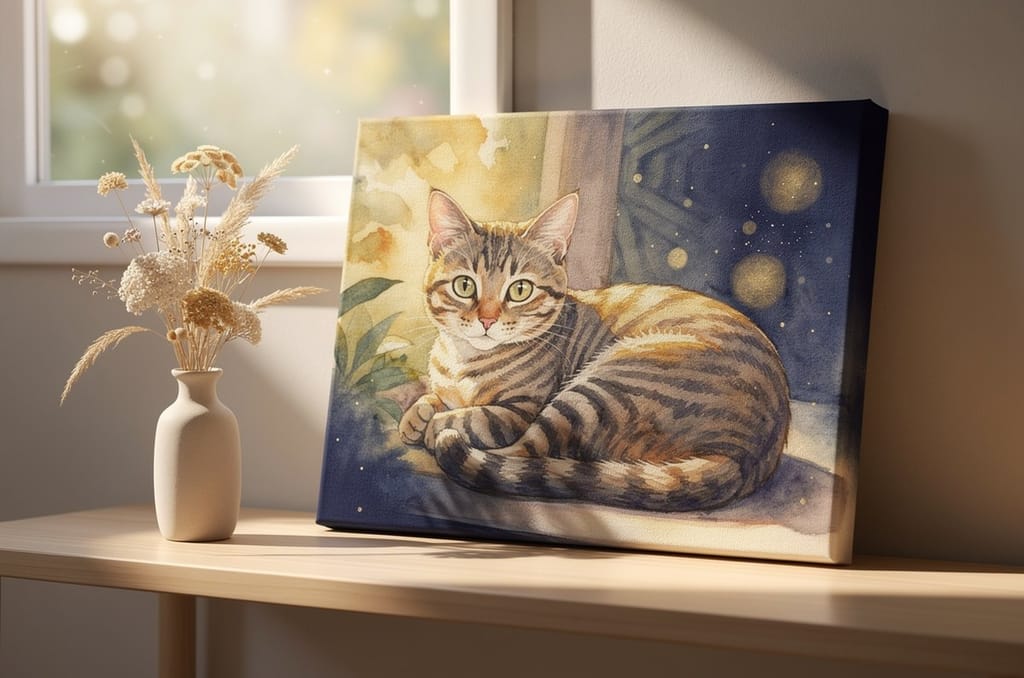
You see a private, watermarked proof before anything is made, and nothing prints until you approve it. There is no time limit on that, so a proof can sit untouched for as long as you need. The tribute prints as a gallery canvas from $59, a framed canvas from $89, a fleece blanket from $59, or a keepsake puzzle from $55. A high-resolution digital copy is included free with every physical order, and can also be bought on its own for $5.
Orders arrive within 5 to 10 business days of approval, printed in the US with free standard shipping. The photo you upload is permanently deleted within 24 hours, and is never used to train AI models.
Whenever you are ready
Upload one photo of your pet and see a private, watermarked proof of the watercolor tribute. Nothing prints until you say so, and there is no time limit.
Where can someone get help for free?
From a veterinary school, in most cases, and this is the part gift guides rarely include. The first pet loss support hotline opened at the University of California, Davis in 1989, and several universities have run them ever since, staffed by trained volunteers, most of them veterinary students. They are free.
Cornell University's College of Veterinary Medicine runs one on 607-218-7457, with hours that shift by season, so check their page before calling. The Cummings School at Tufts runs a helpline on 508-839-7966, staffed Monday to Thursday from 6pm to 9pm Eastern, with a 24-hour voicemail that gets returned on the next shift. The Chicago Veterinary Medical Association takes voicemail on 630-325-1600.
These are pet loss lines, not mental health services. If someone is in crisis rather than grieving, in the US the 988 Suicide and Crisis Lifeline is the number to call.
Frequently asked questions
What is the best pet memorial gift?
+
A keepsake tied to that specific animal rather than to grief in general, which in practice usually means a portrait, a donation in the pet's name, or a frame for a paw print. The Curious Thing turns one photo into a soft watercolor tribute called In Loving Memory, printed as a gallery canvas from $59, a framed canvas from $89, a fleece blanket from $59, or a keepsake puzzle from $55. You approve a private watermarked proof before anything prints.
When should you give someone a pet memorial gift?
+
A week or more after the loss, rather than immediately. Veterinary grief counselor Michele Pich describes support arriving in a flood for the first day or two and then stopping, which leaves the person alone exactly when it starts to sink in. Send a card straight away if you want to, then send the keepsake into that gap. Anniversaries, the pet's birthday, and the first holidays without them are also good moments, because almost nobody else remembers.
What should you not say when someone's pet dies?
+
Avoid anything starting with "at least," avoid "you can always get another one," and avoid comparing the loss to losing a person. Michele Pich notes that telling someone their grief is not like losing a human does not only invalidate it, it implies they are silly for feeling it. Skip assurances that time heals everything, and skip afterlife language unless you know they share the belief. Saying nothing at all is worse than saying something imperfect.
Is it normal to grieve a pet as much as a person?
+
Yes, and the research supports it. A 2016 study in Death Studies by Eckerd and colleagues compared 211 pet-bereaved and 146 human-bereaved people and found higher grief after human loss, but with small effect sizes of roughly 0.28 to 0.30. Closeness to the one who died predicted grief far better than whether they were a person or an animal. Later studies in Australia in 2019 and Denmark in 2022 found no significant difference at all.
Who wrote the Rainbow Bridge?
+
Edna Clyne-Rekhy, a Scottish artist, who wrote it as a teenager in 1959 the day after her dog Major died. It circulated anonymously for decades, reaching a wide American audience when Dear Abby printed it unattributed in 1994. The historian Paul Koudounaris identified her and published the finding in National Geographic in February 2023, with her original handwritten manuscript as evidence. If you use the words on a card, credit her.
Can you make a memorial portrait from an old or blurry photo?
+
Usually, yes. The clearer the face in the photo, the closer the likeness, but the last photo of an old pet is rarely a studio portrait and that is expected. You see a private watermarked proof before anything is printed, so you can judge the likeness yourself and ask for another attempt or walk away. Nothing prints until you approve it, and there is no deadline on that decision.
If you would rather celebrate an animal who is still curled up next to you, our dog mom gift guide covers the same portraits in a much cheerier register, and the full range of pet portrait personas runs from crowned monarchs to stained glass. If you want to understand how a photo becomes a painting before you upload anything, how AI portrait gifts work walks through the whole process.