
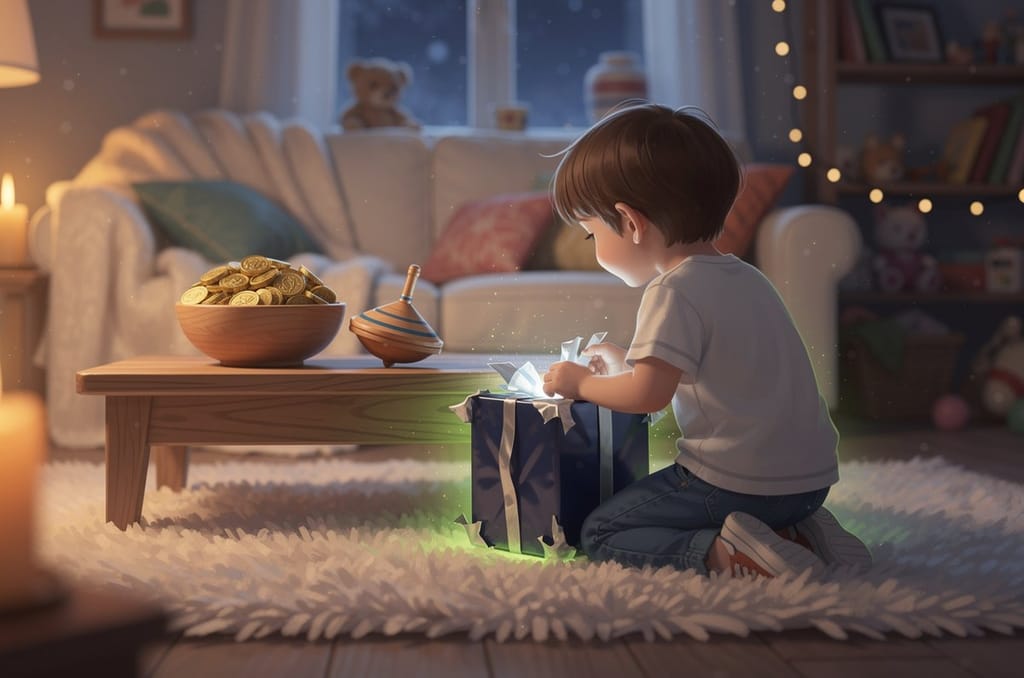
Most Hanukkah gift guides hand you a list and leave out the two things that actually decide how the holiday goes: when it falls this year, and how late you can leave it. In 2026 both answers are unusual. The holiday lands early, and if you want something made rather than picked off a shelf, your deadline arrives before the Black Friday sales do.
In short
Hanukkah 2026 begins at sundown on Friday, December 4 and ends on Saturday, December 12, which is ten days earlier than 2025. Anything made to order has to be bought by mid November to arrive before the first candle, over three weeks ahead of the equivalent Christmas deadline. The custom that predates eight nights of presents is one gift on one night, so most families do better spending the budget once.
When is Hanukkah in 2026?
Hanukkah 2026 begins at sundown on Friday, December 4 and runs through Saturday, December 12. The holiday always starts on 25 Kislev in the Hebrew calendar, and because that calendar is lunisolar, the Gregorian date moves by up to a month from year to year. Hebcal's calendar for 5787 puts the first candle on December 4 and the eighth day on December 12, and My Jewish Learning's multi-year list agrees.
The swing is wide enough to matter. Hanukkah 2025 ran December 14 to 22. Hanukkah 2027 does not start until December 24. Sitting between them, 2026 is the early one, and a holiday calendar you built on last year's dates will be ten days wrong.
One more wrinkle: the first night falls on a Friday, so it is also the start of Shabbat. Hebcal notes the first candle is lit before sundown that evening rather than after nightfall, which pulls the real moment of the gift earlier still.
Why an early Hanukkah changes the shopping calendar
Nothing about the date matters if you are buying off a shelf. It matters enormously if you are buying something that has to be made first.
Work the chain backwards. A made-to-order item is printed or assembled after you pay, then shipped. Our own production runs two to five business days and standard US transit runs another two to five, so the honest window is five to ten business days, and December is when both ends of that range get tested. Add a small peak-season buffer, count only working days, drop Thanksgiving and the dark Friday after it, and the last safe order date for a December 3 arrival is Friday, November 13.
Compare that to the same arithmetic run against Christmas Eve and the gap is stark.
| Occasion | Needs to arrive | Order by |
|---|---|---|
| Hanukkah, first night | Thursday, December 3 | ✓ Friday, November 13 |
| Christmas | Thursday, December 24 | ✓ Monday, December 7 |
Twenty-four days apart. Black Friday 2026 is November 27 and Cyber Monday is November 30, so both sale days fall after the Hanukkah cutoff for anything made to order.
That last line is the part nobody prints. If your plan is to wait for the discounts and then order something personalized for the first night, the plan does not work in 2026.
Do you have to give a gift every night?
No, and the pressure to is newer than most people assume. Historian Dianne Ashton, who wrote Hanukkah in America, describes the shift as something immigrant families did to show their children were becoming American while staying Jewish. The intent was explicit at the time. Cincinnati rabbi Max Lilienthal wrote in 1876 that children "shall have a grand and glorious Chanukah festival nicer than any Christmas festival".
What came before was gelt. History.com traces it to 16th century collections that clothed poor pupils, then to 19th century Eastern European parents handing coins straight to their children. It was not nightly. The earliest known account of a child receiving it, a memoir by Paulina Wengerov from around 1832, describes coins given on the fifth night alone, and Chabad communities still concentrate gelt on the fourth or fifth night today.
The eight-presents version is the recent import. One good night is the older shape.
What belongs on the one night that counts
Give one real gift instead of eight small ones and the budget consolidates, which changes the calculation. You are no longer looking for something that survives the evening, but for something still in the house in five years.
That is the case for a keepsake with the child in it. Upload one photo, pick a world, and we repaint your child as its hero: their real face, in a scene they chose. It prints as a jigsaw puzzle from $55 to $115 depending on piece count, a gallery-wrap canvas from $59 to $105, a framed canvas from $79 to $149, or a fleece blanket at $59 or $89. US shipping is free on all of them.
Worth noting for a Hanukkah gift specifically: nothing about it is holiday-branded. It is a portrait of your child in a world like Storybook Land or any other in the full catalog, which means it stays on the wall in February.
Built together over the eight nights, then framed. The 30-piece chunky size suits ages three to five.
Arrives ready to hang, which makes it the one that works as a gift to a grandparent rather than to the child.
The one that gets used daily rather than admired. Good for a child who already owns enough objects.
What about the other seven nights?
Fill them cheaply and deliberately. The gelt tradition is the model here: small, repeatable, and not really about the object. Chocolate coins, a book, a night that is a board game instead of a parcel, a night given to tzedakah where the child picks who receives it.
This is also where the anti-clutter case is strongest. If seven of the eight nights are consumable, experiential, or edible, nothing accumulates and the one keepsake keeps its weight. We wrote a longer piece on non-toy gifts for kids that works well as a seven-night list, and if you are shopping for grandchildren rather than your own, the keepsake gifts for grandkids guide covers the distance problem specifically.
One practical note if you also celebrate Christmas or buy for family who do: our personalized Christmas gifts for kids piece covers the other end of the same December, and that deadline sits a full three weeks later than this one.

How late can you order and still make night one?
Friday, November 13 is the safe date for a printed keepsake arriving before sundown on December 4. That figure is worst case on purpose: it assumes the slow end of production, the slow end of transit, and a buffer on top. Order sooner and it simply arrives sooner.
Miss it and the honest answer changes rather than disappears. There are two workable routes after November 13, and only one of them involves gambling on a carrier.
Order by November 13
- Printed keepsake, in hand before the first candle
- Free US shipping, no rush fee
- Room to re-roll the portrait if the first one misses
After November 13
- A print may still make it, but we will not promise the date
- Better: buy the digital portrait at $5 from the proof page and print or frame it locally
- Or aim the physical gift at a later night, the eighth is December 12
That middle option is a genuine out rather than a consolation. Every order produces a watermarked proof you approve before anything prints, and from that proof page you can take just the digital file for $5 and download it immediately. The eight-night structure also gives you slack no single-day holiday has: a gift that misses night one still has seven nights to land in.
See the portrait before you commit
Upload one photo, choose a world, and approve a free watermarked proof. Nothing prints until you say so.
Frequently asked questions
When does Hanukkah start in 2026?
+
Hanukkah 2026 begins at sundown on Friday, December 4 and ends on Saturday, December 12. It always starts on 25 Kislev, which moves against the Gregorian calendar each year. For comparison, Hanukkah 2025 ran December 14 to 22 and Hanukkah 2027 starts December 24.
What is the last day to order a personalized Hanukkah gift in 2026?
+
Friday, November 13 for a made-to-order item that has to arrive before the first candle. That works back from a December 3 delivery using worst-case production of five business days, worst-case transit of five business days, a peak-season buffer, and the Thanksgiving shutdown. It is twenty-four days earlier than the equivalent Christmas deadline.
Do you have to give eight Hanukkah gifts?
+
No. Nightly gift giving is an American Jewish custom that took hold from the 1880s onward alongside Christmas gifting, not a religious requirement. The older practice was Hanukkah gelt, and the earliest accounts describe coins given on a single night, commonly the fifth. One meaningful gift plus seven small or non-material nights is closer to the original shape.
Is a personalized portrait an appropriate Hanukkah gift?
+
It is not a religious object and carries no holiday branding, which is part of why it works. It is a portrait of your child as the hero of a world they chose, printed as a puzzle, canvas, framed canvas or blanket. It stays relevant after the candles come down rather than going into a December box.
What if I miss the November 13 deadline?
+
Take the digital portrait instead. Every order gives you a watermarked proof to approve, and from that page you can buy just the digital file for $5 and download it straight away, then print or frame it locally. You can also aim a physical gift at a later night, since Hanukkah 2026 runs through December 12.