
In short
Name a cat for its coat and you can go literal (Marmalade for an orange cat, Midnight for a black one), borrow a word for the color from another language (Kuro is Japanese for black, Shiro for white, Rua is Irish for red), or reach for myth and old books (Graymalkin is the witch's cat in Macbeth, Pluto is the black cat in Poe's 1843 story). Below are 192 names sorted by coat, each with its real meaning and a link to the dictionary, name database or original text we checked it against, plus the genetics that make each coat.
We read the cat name lists that rank on Google for orange, gray, white, black and calico cats before writing this one. None of them links a single meaning to a source, and the meanings they do give tend to drift. Nero turns up as "the Roman emperor, means black", when the emperor's Roman name, a cognomen, probably meant "strong, vigorous" (Behind the Name) and only the separate Italian word nero means black. Callie is said to mean "beautiful", though Behind the Name lists it only as a short form of Caroline or other Cal- names. One calico page says the X chromosome carries the genes for both orange and black. Only the orange gene sits on the X, in an orange or a non-orange version, and that is why calicos are almost always female; the black comes from genes on other chromosomes (Kaelin et al., 2025).
So every name here links to where its meaning comes from: Behind the Name for given names, Wiktionary, Jisho and SpanishDict for words, Theoi for Greek myth, and Project Gutenberg for the books. Every coat fact links to the research behind it. We left out cartoon, film and game characters on purpose: those names belong to someone else, and you'll find them on every other list anyway.
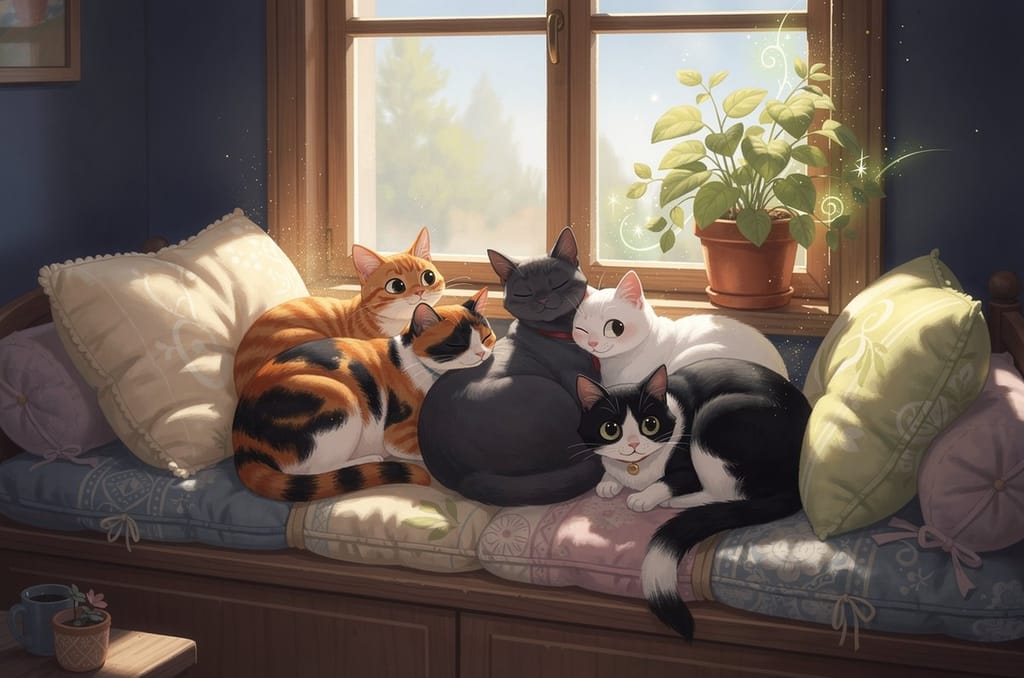
Which cat name fits which coat?
Start with the coat. These three names per color are a good first shortlist, and the column in the middle is the one-line reason the coat looks the way it does.
| Coat | What makes the color | Three to start with |
|---|---|---|
| Orange | An orange gene on the X chromosome, found in 2025 | Rufus, Marmalade, Arcturus |
| Calico | One orange X, one non-orange X, plus white spotting | Mike, Patchwork, Scraps |
| Tortoiseshell | The calico mix without the white | Tortie, Bekko, Umber |
| Black | A tiny deletion in the agouti (ASIP) gene | Pluto, Nyx, Kuro |
| Tuxedo | A black cat with white spotting from the KIT gene | Domino, Spats, Phileas |
| Gray (blue) | Black pigment diluted by a recessive MLPH mutation | Graymalkin, Lloyd, Nimbus |
| White | Dominant White (KIT), which hides every other color | Blanche, Snowdrop, Yuki |
| Tabby | The original wild-type pattern; Taqpep sets stripes or blotches | Selima, Tabitha, Tora |
| Siamese | A heat-sensitive pigment gene (TYR) that colors the cool parts | Siam, Sapphire, Mali |
Orange cat names
Orange cats got their scientific answer only in 2025. In 2025 two teams publishing side by side in Current Biology, one at Stanford and one at Kyushu University in Japan, found the orange gene: a deletion of about 5,000 DNA letters on the X chromosome that switches on a gene called ARHGAP36 in pigment cells, where it is normally silent, and pushes them to make reddish-yellow pigment instead of black-brown (Kaelin et al., 2025). The same deletion turns up in orange cats around the world, which both teams read as a single origin, and 12th-century paintings of calico cats show the mutation is more than 800 years old (Stanford Medicine).
Why are most orange cats male?
Because the gene sits on the X chromosome. A male (XY) needs one copy to be orange, a female (XX) needs two. Cats Protection, the UK's largest cat charity, puts it at roughly two in three orange cats being male. And every orange cat shows tabby markings to some degree, because orange overrides the gene that makes other cats solid (Schmidt-Küntzel et al., 2009): on an orange coat the tabby markings simply come out a darker orange instead of black.
Orange cat names that mean red
Given names built on old words for red, plus the metals and resins the coat resembles. Rufus was a Roman nickname for a redhead, and William II of England carried it for the same reason.
- Rufus. Roman cognomen meaning "red-haired" in Latin; William II of England was nicknamed Rufus for his red hair. Behind the Name
- Rory. Anglicized form of Irish Ruaidhrí, from Old Irish rúad "red" + rí "king": "red king". Behind the Name
- Flynn. Irish surname Ó Floinn, from the byname Flann, which means "blood red" in Irish. Behind the Name
- Rowan. From Irish Rúadán, Old Irish rúad "red" plus a diminutive: roughly "little red one". Behind the Name
- Russell. Norman surname meaning "little red one", a diminutive of Old French rous "red". Behind the Name
- Roy. Anglicized Gaelic ruadh "red", a nickname for redheads; Rob Roy MacGregor was Raibeart Ruadh. Behind the Name
- Copper. From Late Latin cuprum, short for aes Cyprium, "metal of Cyprus", the island that supplied it in the Bronze Age. Wiktionary
- Amber. From Arabic ʿanbar, which meant ambergris (the whale substance) before the word passed to the golden fossil resin. Wiktionary
Fruit, spice and food names for orange cats
The kitchen is full of orange cat names, and a few of the etymologies are surprises: butterscotch has nothing to do with Scotland, and marmalade was a quince jam before it was an orange one.
- Ginger. Traced via Latin zingiber and Prakrit siṃgivera back to Old Tamil iñcivēr, "ginger root". Wiktionary
- Marmalade. From Portuguese marmelada "quince jam" (marmelo "quince"); it was a quince preserve before it was an orange one. Wiktionary
- Saffron. Via Old French safran and Medieval Latin safranum from Arabic zaʿfarān. Wiktionary
- Tangerine. Named after Tangier, Morocco. Wiktionary
- Clementine. Fruit named after French missionary Clément Rodier (1839-1904), who is said to have first bred it. Wiktionary
- Apricot. Ultimately from Latin praecoquum, "early-ripening" fruit, the same root as "precocious". Wiktionary
- Mango. Via Portuguese manga from Malayalam/Tamil words for the fruit (Dravidian mām-kāy). Wiktionary
- Pumpkin. From older pompion, via Latin pepo from Greek pépōn, "large melon", from a word meaning "ripe". Wiktionary
- Butterscotch. The "scotch" comes from Middle English scocchen "to score or cut", from scoring the candy so it breaks cleanly, not from Scotland. Wiktionary
- Kumquat. From Cantonese gam1 gwat1, literally "golden tangerine". Wiktionary
- Persimmon. From a Powhatan word (pichamins, pasimenan) meaning "dried fruit". Wiktionary
- Marigold. Middle English marigolde: Mary (the Virgin Mary) + golde, the old English name for the flower itself. Wiktionary
Orange cat names from myth, stars and books
Sun gods, the orange giant stars you can find on a clear night, and the nickname a boy gave a red-haired girl in 1908.
- Helios. Greek Titan god of the sun (the Roman Sol), who drove the sun's chariot across the sky. Theoi
- Eos. Greek goddess of the dawn, Homer's "rosy-fingered" Eos (the Roman Aurora). Theoi
- Phoenix. Mythical red-gold bird that lived 500 years and rose again from its own death. Theoi
- Arcturus. Brightest star of the northern sky, a classic orange K-type giant that shines with a soft orange light. Jim Kaler, Stars
- Aldebaran. Arabic "the Follower" (it trails the Pleiades); the orange K giant that marks the eye of Taurus. Jim Kaler, Stars
- Antares. Greek "Ant-Ares": the red supergiant in Scorpius, named because its color resembles Mars (Ares). Jim Kaler, Stars
- Sol. Means "sun" in Spanish and Portuguese. Behind the Name
- Carrots. What Gilbert Blythe calls red-haired Anne in L. M. Montgomery's Anne of Green Gables (1908), before she breaks her slate over his head. Project Gutenberg
Words for orange and red in other languages
Rua is Irish for red or red-haired, naranja is Spanish and arancia Italian for orange, and a mikan is the Japanese mandarin orange. Kitsune, the Japanese fox, rounds out the five.
- Naranja. Spanish for "orange", both the fruit and the color. SpanishDict
- Mikan. Japanese (蜜柑) for the mandarin orange, especially the satsuma. Jisho
- Rua. Irish for "red" or "red-haired", also russet or copper brown. Wiktionary
- Arancia. Italian for "orange", from Arabic nāranj, via Persian, from Sanskrit nāraṅga. Wiktionary
- Kitsune. Japanese (狐) for "fox", and in Japanese folklore a shape-shifting fox spirit. Wiktionary
Calico cat names
A calico is a female with one orange X chromosome and one non-orange X. Early in development each cell switches one X off at random, so the coat grows in patches of orange and black, and separate white-spotting genetics add the white (Stanford Medicine; David et al., 2014). The same researchers found no matching orange gene in any other mammal, which is why there are no calico dogs or mice (Kaelin et al., 2025).
Can a calico cat be male?
Yes, but rarely, and usually because he has an extra X chromosome. In a review of 25 male tortoiseshell or calico cats, 16 carried an XXY chromosome set, and almost all were sterile (Centerwall and Benirschke, 1975).
Calico names: patchwork, myth and Japanese
Calicos get the patchwork words, the many-colored goddesses, and the Japanese name for the coat itself. In Japan a calico is a mikeneko, a "three-fur cat", and the beckoning cat figurine in shop windows is traditionally one.
- Calico. Named for the cotton cloth from Calicut (now Kozhikode) on India's Malabar coast, not Calcutta. Wiktionary
- Callie. A short form of Caroline, or sometimes of names beginning with Cal-. Behind the Name
- Patchwork. Many colors and shapes of cloth sewn together into one whole, like a calico's coat. Wiktionary
- Motley. From Anglo-Norman motteley, "parti-colored", the mixed cloth of the jester's coat. Wiktionary
- Confetti. Italian for "confections": the sugared almonds thrown at carnivals and weddings, later paper bits. Wiktionary
- Spumoni. Layered Italian ice cream; from spuma, "foam". Wiktionary
- Neapolitan. Named for Naples (Greek Neápolis, "new city"); the three-flavor ice cream may take the name from an early green, white and red version in the colors of the Italian flag, or from ice-cream makers who came from Naples. Wiktionary
- Opal. The gem with a play of many colors; from Sanskrit upala, "gem, stone". Wiktionary
- Harlequin. The patchwork-costumed servant of commedia dell'arte, a name that goes back to Old French Hellequin, a demon who led the Wild Hunt. Wiktionary
- Iris. Greek goddess of the rainbow and messenger of the gods. Theoi
- Freya. Norse goddess (Freyja) who "drives in a car drawn by two cats" in the Prose Edda (Rasmus B. Anderson's 1880 translation). Project Gutenberg
- Calliope. Greek Kalliope, "beautiful voice": the Muse of epic poetry. Behind the Name
- Scraps. The Patchwork Girl in L. Frank Baum's The Patchwork Girl of Oz (1913), stitched from a many-colored patchwork quilt. Project Gutenberg
- Mike. Japanese (say MEE-keh): calicos are mikeneko (三毛猫), written with the characters for three, fur and cat. Jisho
- Maneki. Japanese: from maneki-neko (招き猫), the "beckoning cat" figurine. Wiktionary
- Lapjes. Dutch: a calico is a lapjeskat, a compound of lapje (a little patch) + kat. Wiktionary
Tortoiseshell cat names
A tortoiseshell is the calico mix without the white: a mottled blend of orange and black, almost always female for the same two-X reason (Kyushu University). Torties are a textbook case in genetics, too. Cats were part of the evidence behind Mary Lyon's 1961 theory of how female mammals silence one X chromosome (Kaelin et al., 2025). Tortie names lean on the browns: pigments, spices, coffee and the shell the coat is named for.
- Tortie. Informal short form of tortoiseshell: a cat with black, brown and yellow fur, named for the mottled shell of the hawksbill turtle. Wiktionary
- Sienna. The earth pigment, from Italian terra di Siena, "earth of Siena". Wiktionary
- Umber. The dark brown pigment: Middle French terre d'ombre, from Latin umbra, "shade". Wiktionary
- Ember. A glowing coal; Old English ǣmyrġe, from a root meaning "to burn". Wiktionary
- Cinder. From Old English sinder, "slag, dross", the leftovers of metalwork. Wiktionary
- Hazel. From the hazel tree and its light brown color (Old English hæsel); coined as a given name in the 19th century. Behind the Name
- Mocha. Named for Mocha, Yemen, the Red Sea port that was a major coffee market. Wiktionary
- Truffle. Via French truffe and Old Occitan trufa from Latin tūber. Wiktionary
- Tamarind. From Arabic tamr hindī, literally "Indian date". Wiktionary
- Nutmeg. Partial translation of Medieval Latin nux muscata, "musky nut". Wiktionary
- Chelone. Greek nymph ("tortoise") whom Hermes turned into a tortoise after she refused to attend the wedding of Zeus and Hera. Theoi
- Bekko. Japanese (鼈甲, bekkō) for tortoiseshell, the material from the hawksbill turtle. Jisho
- Carey. Spanish carey (kah-REY): tortoiseshell, and the sea turtle it comes from. SpanishDict
- Tortuga. Spanish for "turtle" or "tortoise". SpanishDict
See your cat as a duchess
Upload one photo of your cat and see it painted as a Renaissance duchess in pearls and lace, a knight or a sorcerer. Nothing prints until you approve the proof.
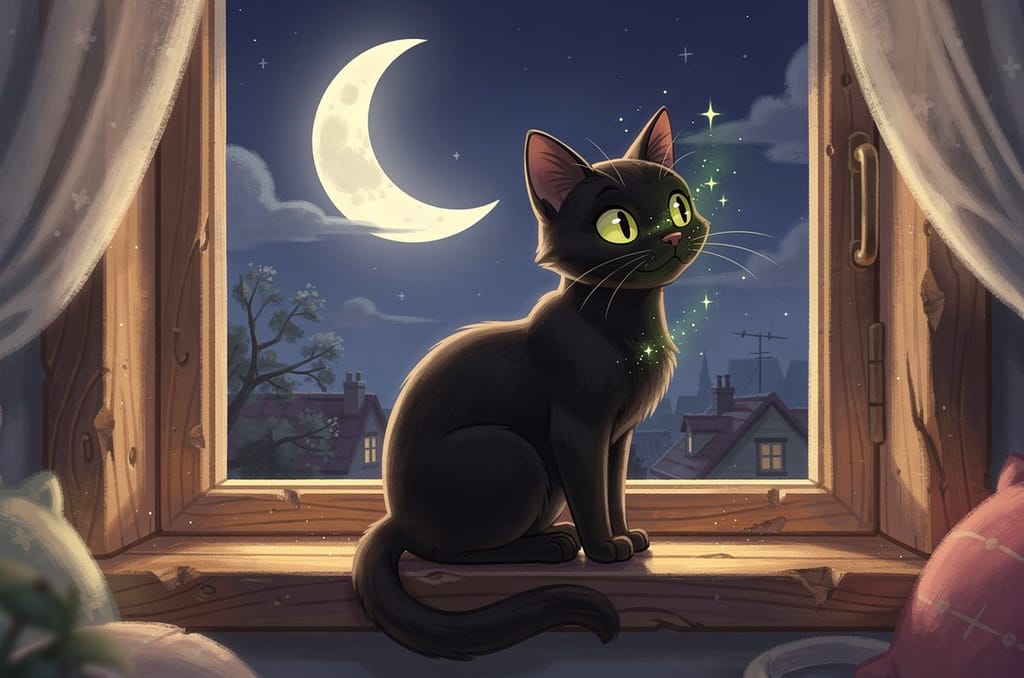
Black cat names
A black cat's coat comes down to a two-letter deletion in the ASIP (agouti) gene (Eizirik et al., 2003). The same study found black forms in 11 of 37 cat species and showed black coloring evolved at least four separate times across the cat family. The Bombay was bred to look like a miniature panther, and its breed standard asks for a coat black to the roots (CFA).
Whether a black cat is lucky depends on where you live. In Japan and the UK a black cat crossing your path is traditionally good luck, while bad luck is the belief in the US and some other countries (Cats Protection).
Are black cats adopted less?
In some shelters, yes, though the evidence is mixed. At a Kentucky public shelter, 10.0% of black cats were adopted versus 18.8% of white cats, a significant gap, though the authors call the overall evidence for "black cat bias" weak (Carini et al., 2020). A Colorado State University study of two shelters found adult black cats took about three more days to be adopted than tuxedo cats (Kogan et al., 2013), while at a New York no-kill shelter the adult orange cats stayed longest of all (Brown and Morgan, 2015). A 2026 survey of 1,004 US participants found people rated black cats in shelter photos as less adoptable and read them as fearful or angry more often; superstition did not explain the gap, and the authors suggest black cats' expressions are harder to read in a photo (Villarreal et al., 2026). Cats Protection started what became National Black Cat Day on October 27, 2011, after finding black cats in its care took about a week longer to find a home (Cats Protection).
Black cat names from words and food
Gemstones, ink, ravens and the dark foods in the pantry.
- Onyx. Banded black gemstone; the name comes from Greek onyx, "nail". Wiktionary
- Jet. Hard black form of coal used in jewelry, named via Greek Gagates for Gagas, a town and river in Lycia. Wiktionary
- Ebony. Dense black wood; the word traces through Greek ebenos to Egyptian hbnj. Wiktionary
- Midnight. From Old English midniht, the middle of the night. Wiktionary
- Sable. The heraldic word for black, named after the dark fur of the sable marten (ultimately a Slavic word). Wiktionary
- Shadow. From Old English sceadu, "shadow, shade, darkness". Wiktionary
- Inky. Means "black as ink," from ink + -y. Wiktionary
- Raven. From Old English hraefn, the large all-black bird Corvus corax. Wiktionary
- Panther. A "black panther" is not a separate species but a melanistic leopard or jaguar. Wiktionary
- Obsidian. Black volcanic glass, named via Latin obsidianus for Obsidius, who according to Pliny found the stone in Ethiopia. Wiktionary
- Blake. English surname from Old English blaec "black" OR blac "pale"; nobody knows which. Behind the Name
- Licorice. From Greek glykyrrhiza, "sweet root". Wiktionary
- Espresso. Italian caffe espresso, "pressed-out coffee". Wiktionary
- Pepper. Via Latin piper and Greek peperi from an Indo-Aryan source; compare Sanskrit pippali, "long pepper". Wiktionary
- Nori. Japanese word for the dark seaweed (laver) pressed into sheets for sushi. Wiktionary
Black cat names from myth, stars and Poe
Night goddesses, the dark part of an eclipse, and the name Edgar Allan Poe gave the black cat in his 1843 story.
- Nyx. Greek primordial goddess of the night (Roman Nox). Theoi
- Erebus. Greek primordial god of darkness, brother and consort of Nyx. Theoi
- Hecate. Greek goddess of witchcraft, magic and ghosts. Theoi
- Bastet. Egyptian goddess of cats, often shown with a she-cat's head; name read as "she of the ointment jar". Wiktionary
- Morrigan. Irish goddess of war and death who often took the form of a crow; name means "great queen" or "demon queen". Behind the Name
- Nox. Latin for "night"; Nox was also the Roman goddess of night, the counterpart of the Greek Nyx. Wiktionary
- Eclipse. From Greek ekleipsis, from a verb meaning "to abandon, go missing, vanish". Wiktionary
- Umbra. Latin "shadow"; in astronomy, the darkest, fully shaded inner part of an eclipse shadow. Wiktionary
- Corvus. Southern-sky constellation of the crow (Latin corvus, "raven, crow"). Wiktionary
- Pluto. The black cat's name in Edgar Allan Poe's story "The Black Cat" (1843). Project Gutenberg
- Nevermore. The one word the raven repeats in Poe's poem "The Raven" (1845). Project Gutenberg
- Poe. For Edgar Allan Poe, author of "The Black Cat" and "The Raven". Project Gutenberg
How do you say black in other languages?
Black is kuro in Japanese, noir in French, nero in Italian and kara in Turkish, and each makes a short cat name. The rest are given names built on old words for black, dark or raven, such as Kieran, Melanie, Douglas and Bran.
- Kuro. Japanese 黒 (kuro), "black". Jisho
- Noir. French for "black," from Latin nigrum. Wiktionary
- Nero. Italian word nero means "black" (the Italian name is also a short form of Raniero). Behind the Name
- Kara. Turkish for "black, dark"; Ottoman officials used it as a byname meaning "courageous". Behind the Name
- Melanie. From Greek melaina, "black, dark", via Latin Melania and French Mélanie. Behind the Name
- Kieran. Anglicized Ciarán, a diminutive of Ciar, from Irish ciar "black". Behind the Name
- Corbin. French surname from corbeau, "raven," first given to people with dark hair. Behind the Name
- Bran. Welsh for "raven"; Bran the Blessed is a giant king in the Mabinogi. Behind the Name
- Sombra. Spanish for "shadow, shade". SpanishDict
- Douglas. "Dark river," from Gaelic dubh "dark" + glais "water, river". Behind the Name
Tuxedo cat names
Tuxedo is a coat pattern, not a breed: a black cat with white on the chest, paws and face. The white spotting traces to a retrovirus-derived stretch of DNA inserted in the KIT gene, which a survey of 270 cats from 30 breeds linked to white spotting (David et al., 2014). Tuxedo names come from formalwear, the black-and-white animals, the piano keyboard, and two well-dressed gentlemen from old novels.
- Tuxedo. The suit takes its name from Tuxedo Park, New York, which likely comes from a Lenape name meaning "crooked water". Wiktionary
- Domino. Black-and-white game tile; the word first meant a hooded garment, from Latin dominus "lord". Wiktionary
- Dapper. From Middle English daper, "pretty, neat", from Middle Dutch dapper "stalwart". Wiktionary
- Spats. Short for spatterdash, a covering worn over the shoe; a tuxedo cat's white paws look like a pair of spats. Wiktionary
- Piano. Black-and-white keys; short for pianoforte, Italian piano "soft" + forte "strong". Wiktionary
- Magpie. Black-and-white bird; Mag (a nickname for Margaret, used for a chatterer) + pie, the old word for magpie. Wiktionary
- Penguin. Origin uncertain; first used in the 1500s for the northern great auk, and possibly from Welsh pen gwyn "white head" or Latin pinguis "fat". Wiktionary
- Puffin. Black-and-white seabird; from Middle English poffin, perhaps puff + -ing. Wiktionary
- Orca. The killer whale, known for its distinctive black-and-white body. NOAA Fisheries
- Panda. Black-and-white bear; scientists aren't sure why it has that coat, and camouflage is one theory. Smithsonian's National Zoo
- Badger. Probably from badge, after the white blaze (badge-like stripe) on the animal's face. Wiktionary
- Yin Yang. Chinese yin (dark) and yang (bright), the paired forces of Chinese philosophy. Wiktionary
- Phileas. Phileas Fogg, the exacting English gentleman in Jules Verne's Around the World in Eighty Days (1872). Project Gutenberg
- Gatsby. Jay Gatsby, host of lavish parties in F. Scott Fitzgerald's The Great Gatsby (1925), public domain in the US since 2021. Project Gutenberg
- Shirokuro. Japanese 白黒, "black and white" (literally white-black). Jisho
Gray cat names
A gray (or grey) cat is, genetically, a diluted black cat, which is why breeders call the color "blue". A recessive mutation in the MLPH gene, which normally spreads pigment granules evenly through the hair, lightens the coat so black looks gray and orange looks cream. A cat needs two copies to be dilute, and the same single mutation turned up in 97 unrelated dilute cats from 26 breeds as well as random-bred cats (Ishida et al., 2006).
Which cat breeds are gray?
Three breeds are known for the color (CFA Russian Blue, CFA Chartreux). The Russian Blue is believed to come from the Archangel Isles of northern Russia, the Chartreux standard allows any shade of blue-gray, and the Korat is a silver-tipped blue cat from Thailand, traditionally given to brides for luck (CFA). The CFA says the Korat appears in the Thai Cat-Book of Poems from the Ayutthaya period (1350 to 1767), which illustrates 17 good-luck cats.
Gray cat names from words and nature
Stone, metal, smoke and storm clouds, plus one tea that is named after a man, not the color.
- Grimalkin. Old word for a cat, especially an elderly female one; from gray + malkin, literally "gray-haired cat." Wiktionary
- Ash. A short form of Ashley; can also come straight from the English word for the tree or the residue of fire. Behind the Name
- Pewter. A dull gray alloy, mostly tin, from Old French peautre, of uncertain origin. Wiktionary
- Smoky. Smoke + -y; one sense is a color or color pattern similar to smoke. Wiktionary
- Azure. Clear sky blue; via Arabic from Persian lājward, "lapis lazuli," with the l dropped as if it were French l'. Wiktionary
- Slate. A fine-grained gray rock that splits into thin layers, once used for roof tiles and school writing slates. Wiktionary
- Flint. Hard quartz used to strike sparks; from an Indo-European root meaning "to split." Wiktionary
- Earl Grey. Bergamot-flavored black tea, reputedly named after Charles Grey, 2nd Earl Grey, not after the color. Wiktionary
- Pebble. A small stone rounded by water; from Old English papol-stān, of unknown origin. Wiktionary
- Nimbus. Latin for "dark cloud"; in meteorology, a gray rain cloud, a sense coined by Luke Howard. Wiktionary
Gray cat names from myth, stars and Shakespeare
Shakespeare named the First Witch's cat in Macbeth Graymalkin, from grimalkin, an old word for a cat built from gray + malkin; a cat called Grimalkin turns up even earlier, in William Baldwin's Beware the Cat (1553).
- Graymalkin. The First Witch's familiar in Shakespeare's Macbeth (c. 1606), in the opening scene: "I come, Graymalkin!" Project Gutenberg
- Selene. The Greek Titan goddess of the moon; her name means "Moon" (Roman Luna). Theoi
- Nephele. Greek for "cloud"; in myth, the cloud Zeus shaped to look like Hera, and the mother of the Centaurs. Theoi
- Graea. One of the Graeae, Greek sea hags whose name means "gray" or "old women"; they were gray-haired from birth. Theoi
- Glaucus. A Greek fisherman turned sea god after eating a magic herb; Theoi translates his name as sea-gray. Theoi
- Cobalt. A silver-gray metal named from German Kobold, "goblin," a miners' word for ore that made them ill. Wiktionary
- Nebula. A cloud of gas or dust in space; from Latin nebula, "little cloud, mist." Wiktionary
- Sterling. The word behind sterling silver; named for a star emblem on Norman coins, from Old English for "little star." Behind the Name
Words for gray and blue in other languages
Gray is gris in Spanish, grigio in Italian and liath in Irish, and the Welsh llwyd is where the name Lloyd comes from. In Japanese, nezumi-iro, "mouse color", is a word for slate gray, and ao means blue.
- Lloyd. From a Welsh surname derived from llwyd, meaning "gray." Behind the Name
- Liath. Irish for "gray," also "light blue" and "gray-haired." Wiktionary
- Glas. Welsh for "blue"; in older use also pale blue-green or slate-colored (Irish glas means green or gray). Wiktionary
- Gris. Spanish for "gray." SpanishDict
- Grigio. Italian for "gray," borrowed through Old French or Old Occitan from a Frankish word *grīs. Wiktionary
- Nezumi. Japanese for "mouse"; nezumi-iro (鼠色, "mouse color") is the word for dark or slate gray. Jisho
- Kumo. Japanese for "cloud" (雲). Jisho
- Ceniza. Spanish for "ash"; as an adjective, "ashen." SpanishDict
- Cinza. Portuguese for "gray" and "ash," from Latin cinis, "cold ashes." Wiktionary
- Ao. Japanese 青, meaning "blue; azure," and traditionally also green. Jisho
White cat names
Solid white comes from the Dominant White form of the KIT gene, which always removes coat color and only sometimes brings blue eyes and deafness (David et al., 2014). Underneath, a white cat still carries genes for another color; the white simply hides them.
Are white cats deaf?
Most aren't. In a UK study of 132 solid white purebred kittens, 30.3% were born deaf in one or both ears. The rate was 22.2% in kittens without blue eyes, 44.4% with one blue eye and 50% with two, and none of their colored littermates was deaf (Mari et al., 2019). If you're naming a white kitten with blue eyes, ask your vet about a hearing check before you lean on the name to call it.
White cat names from words and food
Snow, frost, pearls and the white foods. If you want a white cat in thread, it works: on our custom pet embroidery, white fur is sewn in white thread, so a white chest or muzzle still shows on a dark garment.
- Blanche. From a medieval French nickname meaning "white, fair-colored." Behind the Name
- Ivory. A creamy white; via Latin ebur from Egyptian ꜣbw, "elephant, ivory." Wiktionary
- Mochi. Japanese 餅, a small rice cake made from glutinous rice. Jisho
- Marshmallow. Named for the marsh mallow plant (Althaea officinalis); the sweet was originally made from it. Wiktionary
- Meringue. Beaten egg whites and sugar; the old story that it was named for Meiringen, Switzerland, is now doubted. Wiktionary
- Frost. A coating of tiny ice crystals; from Old English forst. Wiktionary
- Blizzard. Origin unknown; first printed for a snowstorm (as "blizard") in an Estherville, Iowa, newspaper in 1870. Wiktionary
- Tofu. From Japanese, from Chinese 豆腐, "curdled bean." Wiktionary
- Magnolia. A flowering tree named after the French botanist Pierre Magnol (1638-1715). Wiktionary
- Pearl. A lustrous gem formed in shellfish; from Old French perle, of uncertain origin, probably from Latin perna. Wiktionary
White cat names from myth, stars and books
Fair-haired heroes, a milk-white sea nymph, the brightest star in the sky, and Alice's own white kitten.
- Fionn. From Old Irish finn, "white, blessed"; Fionn mac Cumhaill, hero of the Fenian Cycle, earned it for his fair hair. Behind the Name
- Guinevere. King Arthur's queen; from Welsh Gwenhwyfar, "white phantom." Behind the Name
- Chione. From Greek chion, "snow"; in myth a daughter of Boreas, the north wind. Behind the Name
- Galatea. A Nereid and goddess of calm seas; Theoi translates her name as "Calm-Goddess, Milk-White." Theoi
- Leuce. An Oceanid nymph whose name means "white poplar" (Greek leukê). Theoi
- Sirius. The brightest star in the night sky (Sirius A is a white main-sequence star); from Greek seirios, usually taken as "scorching." Wiktionary
- Vega. The brightest star in Lyra; from the Arabic phrase for "the falling (swooping) eagle." Wiktionary
- Snowdrop. Alice's White Kitten in Lewis Carroll's Through the Looking-Glass (1871). Project Gutenberg
- Moby. From Herman Melville's Moby-Dick (1851), whose Chapter 42 is "The Whiteness of the Whale." Project Gutenberg
How do you say white in other languages?
White is shiro in Japanese, and snow is yuki in Japanese, neve in Italian, nieve in Spanish and lumi in Finnish. Gwen and Bianca are given names built on the Welsh and Italian words for white.
- Bianca. The Italian form of Blanche ("white"); Shakespeare used it in The Taming of the Shrew and Othello. Behind the Name
- Gwen. From Welsh gwen, the feminine form of gwyn, "white, blessed." Behind the Name
- Neve. Italian for "snow," from Latin nix/nivem. Wiktionary
- Yuki. Japanese; written 雪 it means "snow," written 幸 it means "happiness." Behind the Name
- Shiro. Japanese 白, "white." Jisho
- Nieve. Spanish for "snow." SpanishDict
- Lumi. Finnish for "snow." Wiktionary
Tabby cat names
In a sense every cat is a tabby. The original cat coat is the striped "mackerel" tabby; solid cats carry a gene that hides the pattern, and a solid cat in bright sun will often show faint stripes (Cats Protection). Whether a tabby gets stripes or bold blotches comes down to a gene called Taqpep, and a change in the same gene turns a cheetah's spots into the blotches and stripes of the rare king cheetah (Kaelin et al., 2012). The word tabby itself started as a waved silk.
- Tabby. Originally a waved silk named after a quarter of Baghdad (al-'Attābiyya); a brindled cat is a later sense. Wiktionary
- Tabitha. Aramaic for "gazelle," translated into Greek as Dorcas; a New Testament name whose English pet form is Tabby. Behind the Name
- Tiger. Via Latin and Greek from an Iranian source related to Avestan for "arrow"; ultimately from a root meaning "sharp." Wiktionary
- Tweed. A coarse wool cloth, attested from the 1830s; probably from Scots tweedling, related to twill. Wiktionary
- Marble. Via Latin marmor from Greek marmaros, perhaps related to a word for "gleaming." Wiktionary
- Bramble. A thorny Rubus shrub, including the blackberry; from Old English bræmbel. Wiktionary
- Selima. Horace Walpole's cat, who drowned in a goldfish bowl and is mourned in Thomas Gray's 1747 ode as "Demurest of the tabby kind"; the same poem gives her a "coat that with the tortoise vies," so she was probably a tortoiseshell. Wikisource
- Tora. Japanese 虎, "tiger." Jisho
- Tigre. Spanish for "tiger." SpanishDict
- Sher. Hindi शेर, from Persian; means "lion," colloquially "tiger," and is also a male given name. Wiktionary
- Hickory. Shortened from pawcohiccora, a word in Powhatan, an Algonquian language, first recorded in 1608. Wiktionary
- Ocelot. A spotted American wild cat; the word was formed by Buffon from Nahuatl ōcēlōtl, "jaguar." Wiktionary
Siamese cat names
Siamese points come from a temperature-sensitive mutation in the tyrosinase (TYR) gene, which lets pigment form mainly on the cooler parts of the body: the ears, the face mask, the paws and the tail. The Burmese coat comes from a different change in the same gene that is less sensitive to temperature, so a Burmese carries more color across its body (Lyons et al., 2005). The first Siamese known in the United States was a cat named Siam, sent to President Rutherford B. Hayes by the American consul in Bangkok in 1878 (CFA). Siamese names lean on Thai words, the coffee and cocoa shades of the points, and those blue eyes.
- Siam. The historical name of Thailand, where the Siamese cat comes from; borrowed through Portuguese Sciam from Thai สยาม. Wiktionary
- Sapphire. A deep blue gem; via Greek sappheiros from a Semitic word for "lapis lazuli." Wiktionary
- Latte. Short for Italian caffè latte, "milk coffee," ultimately from Latin lac, "milk." Wiktionary
- Cappuccino. From Viennese Kapuziner (Capuchin), because the drink's brown matched the friars' habits. Wiktionary
- Cocoa. From Spanish cacao (Nahuatl cacahuatl); the spelling cocoa came from confusion with coco, spread by Samuel Johnson's dictionary. Wiktionary
- Sepia. Latin sēpia, "cuttlefish"; the brown pigment was made from its ink. Wiktionary
- Lilac. A flowering shrub and pale purple color; from obsolete French lilac, from Arabic. Wiktionary
- Dao. Thai ดาว, "star." Wiktionary
- Ayutthaya. The old Siamese kingdom and capital, named after Sanskrit Ayodhya, "the unconquerable citadel." Wiktionary
- Mali. Thai มะลิ, "Arabian jasmine" (Jasminum sambac). Wiktionary
- Chai. Hindi/Urdu for "tea," via Persian, ultimately from Chinese 茶 chá. Wiktionary
Which cat coat myths are wrong?
The same handful of coat myths travels from list to list. Here is what the sources say.
| Myth | What the sources say |
|---|---|
| All orange cats are male | Most are, not all. Cats Protection puts it at about two in three, so roughly one orange cat in three is female. Cats Protection |
| Male calicos don't exist | They do, rarely. 16 of 25 male calico or tortoiseshell cats in one review were XXY, and almost all were sterile. Centerwall and Benirschke, 1975 |
| All white cats are deaf | 30.3% of solid white kittens in a UK study were deaf in one or both ears; 50% of those with two blue eyes. Mari et al., 2019 |
| The X chromosome carries black and orange | Only the orange gene is on the X, in an orange or non-orange version. Solid black comes from the agouti (ASIP) gene, which sits on an ordinary chromosome and is not sex-linked. UC Davis VGL |
| Orange cats act differently because of the color gene | There's no evidence for it. The 2025 Stanford team found no expression difference in the kidney, heart, brain or adrenal gland, and noted there are few studies of orange cats' personality. Stanford Medicine |
| Black cats are bad luck everywhere | In Japan and the UK, one crossing your path is traditionally good luck. Cats Protection |
| Shelters must stop adopting out black cats at Halloween | Evidence of Halloween-linked mistreatment does not appear to be commonplace, and the Humane Society of the United States now suggests black-cat adoption events instead. Carini et al., 2020 |
| Gray "blue" cats are a rare color only some breeds have | Blue is diluted black from one recessive gene, found in dilute cats from 26 breeds and in random-bred cats. Ishida et al., 2006 |
| Tuxedo, calico and tabby are breeds | They are coat patterns that turn up in many breeds and in mixed cats. David et al., 2014 |
Do cats know their names?
They can tell their own name from other words. In a 2019 study in Scientific Reports, Atsuko Saito's team played cats a list of four ordinary words of the same length and stress followed by the cat's own name, and the cats reacted to their name more than to the words, even when a stranger said it (Saito et al., 2019). Cats in ordinary multi-cat homes also told their own name from their housemates' names; only cats from a cat café, where many visitors call many cats, did not. So once you've picked a name, use it the same way every time, and in a multi-cat home call each cat by its own name rather than all of them at once.
If you're also choosing names for the rest of the household, our fairy names list has more sourced names that suit a small, quick animal, and the dog quotes post ends with 22 cat quotes, each traced to who said them. Shopping for a cat person instead? Start with gifts for cat lovers.
Give the name a portrait
Upload one photo of your cat, pick a look, from a duchess to a starry-night painting, and see the proof before you decide anything. Then choose a puzzle, canvas, framed print or blanket.
Frequently asked questions
What is a good name for an orange cat?
+
Rufus (Latin for red-haired), Rory (Irish for red king), Marmalade, Saffron, Clementine and Arcturus, the orange giant star, all fit an orange coat. Rua is Irish for red and Naranja is Spanish for orange if you want a word from another language.
Why are most orange cats male?
+
The orange gene is on the X chromosome. A male has one X, so one copy makes him orange; a female has two and needs the gene on both. Cats Protection puts it at about two in three orange cats being male.
Can a calico cat be male?
+
Yes, but rarely. Male calicos and tortoiseshells usually have an extra X chromosome (XXY). In one review of 25 male calico or tortoiseshell cats, 16 were XXY and almost all were sterile.
What is the difference between a calico and a tortoiseshell cat?
+
White. A calico has patches of orange, black and white. A tortoiseshell has the same orange and black mix with little or no white. Both are almost always female, because the pattern needs one orange X chromosome and one non-orange X.
What is a good name for a black cat?
+
Pluto is the black cat in Poe's 1843 story, Nyx is the Greek goddess of night, and Kuro is Japanese for black. Onyx, Sable, Jet, Raven and Midnight are the classic word names, and Bran is Welsh for raven.
Why are gray cats called blue?
+
A gray cat is a diluted black cat. A recessive mutation in the MLPH gene lightens black pigment to a blue-gray, and breeders have long called that shade blue. The same mutation lightens orange to cream.
Are all white cats deaf?
+
No. In a UK study of 132 solid white kittens, 30.3% were deaf in one or both ears. The risk rose with blue eyes, to 50% for kittens with two blue eyes, and fell to 22.2% for kittens without blue eyes.
Do cats recognize their own names?
+
Yes. A 2019 study in Scientific Reports found cats reacted more to their own name than to ordinary words of the same length and stress, even when a stranger said it. Cats in ordinary multi-cat homes could also pick their own name out from their housemates' names; only cats from a busy cat café could not.