
Your parents are not hard to buy for because they are picky. They are hard to buy for because they have quietly stopped wanting objects, and nobody has updated the gift list.
The short answer
The best gift for parents who ask for nothing is not another object for the house. It is something that carries the people they miss seeing: their grandchildren, or the whole family, made into one thing they can hang, use, or build. Research on aging finds that as people's sense of remaining time narrows, they shift from collecting new experiences to holding onto meaningful ones, and a survey of parents of adult children found that photos are the one thing almost all of them kept.
Why are parents so hard to buy for?
Because their priorities changed and the gift list did not. Socioemotional selectivity theory, set out by Laura Carstensen and colleagues in American Psychologist, holds that people pursue two broad kinds of goal: acquiring knowledge and new experience, or regulating emotion. When time feels open-ended, the knowledge goals win. When time feels limited, and age is the most reliable way that happens, emotional goals take over. Your parents are not being difficult when they say "we don't need anything." They are telling you accurately that novelty has stopped paying them what it used to.
That is why the standard list fails them. A tumbler, a chile oil, a pair of slippers: each is a small bet on novelty, aimed at someone who has quietly stopped placing that bet. The gift that lands has to pay in the other currency.
What does the research say goes wrong?
Gift mismatch is measurable, and it gets worse across a gap. Economist Joel Waldfogel's study in the American Economic Review asked recipients what they would have paid for the holiday gifts they received, and found that gift-giving destroyed between 10 percent and a third of the value of those gifts. The spread mattered more than the average: gifts from friends and partners came closest to their price, while noncash gifts from extended family were the least efficient, losing about a third.
The sample was Yale undergraduates rating what they got, so it is not a direct measurement of what your parents think of your present. What it does measure is how quickly a gift loses value when the giver is guessing across a gap in age and daily life. Buying for a parent is exactly that gap, in the other direction.
What do parents actually keep?
Photographs, overwhelmingly. A YouGov survey of 1,162 US adults, conducted May 3-6, 2024, asked parents of adult children what they had kept from their kids' childhood and still had somewhere in the house. Photos came first at 95 percent. Their children's art followed at 74 percent, awards and certificates at 70 percent, videos and report cards at 57 percent each. Toys sat at 45 percent, baby clothes at 35 percent.
Then the line that should decide your shopping: 35 percent said they wished they had kept more, and only 6 percent wished they had kept less. Your parents are not short of stuff. They are, by their own account, short of the two categories they never regret owning: the photographs and the drawings. Almost no gift guide acts on either. A portrait made from a photo answers the first. A grandchild's own drawing stitched in real thread onto a sweatshirt, from $49 for a t-shirt or $69 for a sweatshirt or hoodie, answers the second.
The gift most lists miss
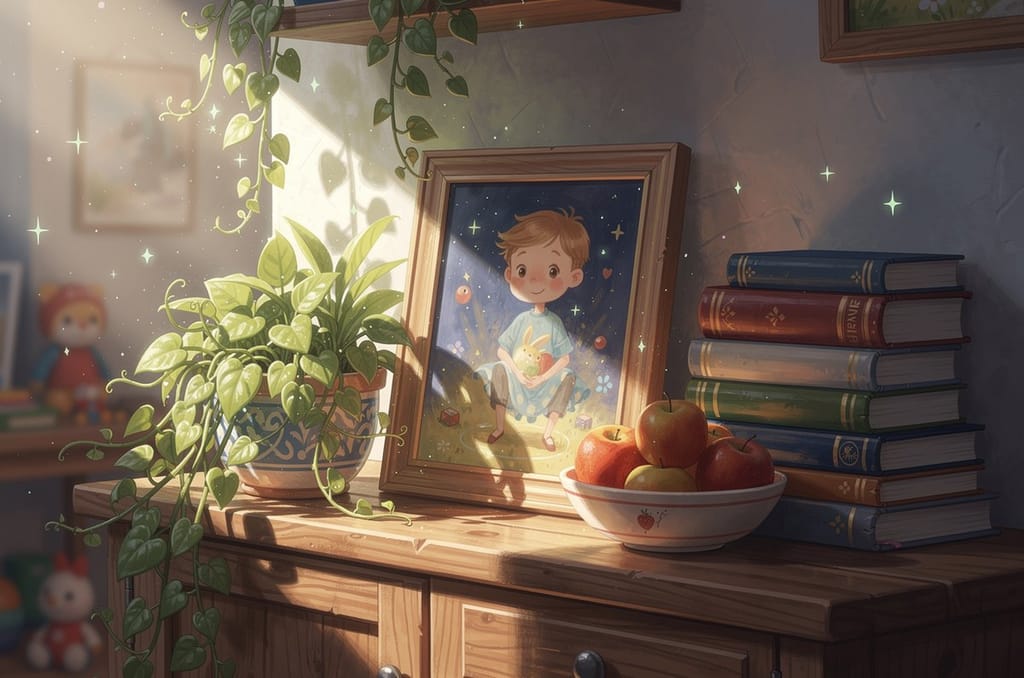
The obvious answer, and the one almost every list of gifts for parents skips because it cannot be affiliate-linked: a portrait of the people they do not see enough of. Not a phone snapshot dropped into a frame, but one photo repainted into an actual piece of art, then printed on something with a life of its own.
The distinction matters more than it sounds. A printed snapshot is the same image your parents already have on their phone, at a larger size. A repainted portrait keeps the real face, hair and skin tone but puts that person somewhere: a snowy village, a coral reef, a deep-space horizon, or an art style like cut paper or claymation. It stops being a record of a day and starts being a thing on its own terms, which is why it survives the move to the hallway instead of the drawer. Three subjects account for almost every version of this gift that works.
One grandchild painted as the star of a world they picked themselves, from deep space to a snowy village. It reads as a gift from the child, not from you.
Two to six people from one photo, repainted in an art style you choose. See how a family portrait comes together before you pick the style.
For the parents whose group chat is mostly photos of the dog, the pet is the honest subject. Same process, same proof step.
What should you spend, and on what?
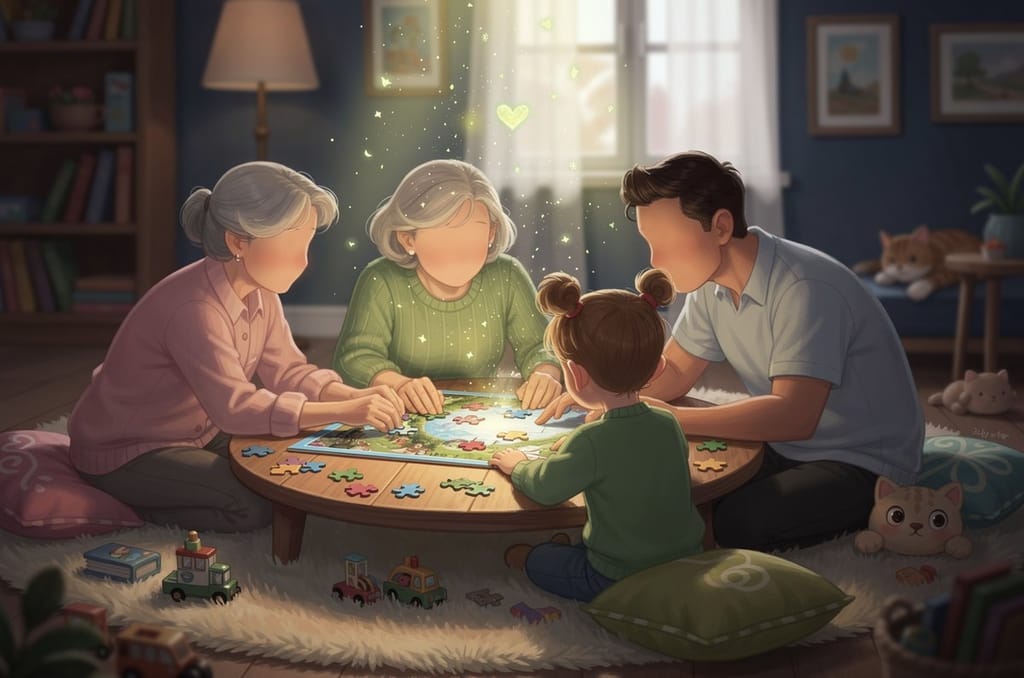
Between $59 and $149 covers every sensible version of this, and the format matters far more than the number. A gallery canvas suits a parent with wall space and a hook already in it. A framed canvas suits the parent who will never get around to framing anything, which is most parents. A fleece blanket suits the one who lives in the armchair. A puzzle suits the grandparent who wants an afternoon with a grandchild rather than a decoration.
On sizing, the common error is going too small. An 8×10 reads as a desk piece and disappears on a wall. Over a sideboard or a bed, 16×20 is the size that looks deliberate rather than apologetic. Buy the smaller size only when it is going on a shelf, a bookcase or a narrow hallway wall where nothing larger fits.
| Format | Sizes | Price | Best for |
|---|---|---|---|
| Gallery canvas | 8×10, 11×14, 16×20 in | $59-$105 | ✓ a wall that is already hung |
| Framed canvas | 8×10, 11×14, 16×20 in | $79-$149 | ✓ ready to hang the day it lands |
| Fleece blanket | 30×40, 50×60 in | $59-$89 | ✓ the armchair, the sofa, the car |
| Keepsake puzzle | five sizes, 30 to 1,014 pieces | $55-$115 | ✓ an afternoon with a grandchild |
| Digital download | print file | $5 | ✓ included free with every physical order |
Prices are per item, with free US shipping. The 30-piece chunky puzzle is sized for ages 3-5, so it works when a young grandchild is meant to build it too.
Which format suits which parent?
Match the object to how they actually live now, not to how their house looked in your memory of it. The single most common mistake is buying wall art for a parent who is quietly trying to get things off the walls.
Two questions settle it. First, when did they last hang something new, and is there an obvious gap for it? If you cannot picture the spot, the answer is not wall art. Second, would they rather look at the grandchildren or do something with them? A parent who answers "do" wants the puzzle, and a parent who answers "look" wants it framed and ready to hang. Everything else, including the price, follows from those two answers rather than leading them. If both answers come back unclear, the fleece blanket is the safe default: it needs no wall, no hook and no decision about where it goes, and it is the one format nobody has to find room for.
Go with wall art
- They still hang things, and there is a gap over the sideboard
- They have moved recently and the walls are bare
- They ask for photos of the grandchildren by text, constantly
- You want it to be the first thing a visitor sees
Go with a blanket or puzzle instead
- They are downsizing and every new object is a decision
- Their walls are full and they like them that way
- They would rather do something with a grandchild than look at one
- They are renting, or moving again soon
What about parents who are downsizing?
Give them fewer things, not smaller ones. In the 25th Annual Transamerica Retirement Survey, 63 percent of retirees were still in the home they lived in before retiring, and among the 37 percent who had moved, the most cited reason was moving closer to family and friends, at 36 percent. Downsizing into a smaller home came next at 28 percent. Both of those tell you the same thing about a gift: proximity to family is the goal, and floor space is the constraint.
There is a cost to getting that wrong. In a study of 60 dual-income spouses published in Personality and Social Psychology Bulletin, wives who described their homes with more clutter language showed flatter daily cortisol slopes and more depressed mood across the day. That sample was working parents rather than retirees, so read it as a caution and not a diagnosis. The practical version is simple: one object that earns its place beats three that need somewhere to go.
How do you coordinate with your siblings?
Decide who is buying the object and who is buying the day, before anyone opens a browser tab. The predictable failure with parents is that two or three adult children shop independently, each lands on a similar mid-range item, and the pile ends up bigger than the affection it represents. Waldfogel's point about value lost across a gap gets worse, not better, when three people guess at once.
A workable split: one sibling handles the single keepsake, everyone contributes to it, and the others take the parts that cannot be wrapped, a lunch, a repair job, a weekend. If a portrait is the keepsake, agree on the photo first, because that is the only decision that cannot be changed later. Group the grandchildren by household if there are several, or put everyone in one family portrait so no branch of the family is missing from the wall.
When do you need to order?
For Christmas 2026, order by Monday, December 7. Anything made to order has two clocks running: production, which takes 2-5 business days, and US transit, which takes another 2-5, plus a buffer because December slows both down. Work back from a December 24 arrival and the first week of December is where the deadline actually falls, not the third week where most people start.
Outside the holidays the same math gives a comfortable two weeks. If a birthday or an anniversary is inside ten days, choose the digital download and print it locally, or give a card with the portrait in it and let the physical piece arrive after. The order is approved before anything is printed, so nothing goes to production while you are still deciding on the photo. For gifts aimed specifically at a grandmother, our guide to personalized gifts for grandma walks through the same choices at more length.
How it works, and what happens to the photo
You upload one clear photo, pick the subject and the format, and we repaint it into the world or art style you chose. Before anything prints, you approve a watermarked proof, so the version on your screen is the version that goes to production and nothing prints until you say so. If the likeness is not right, you can try again.
The photo itself is deleted within 24 hours of fulfillment. It is never used to train AI models, and a child's name is never sent to the image model, only appearance descriptors. US shipping is free. If it arrives damaged, tell us within 14 days of delivery and we reprint and reship it at no charge. For a broader look at the problem this post started with, our post on gifts for people who have everything covers the same instinct applied to anyone on your list, not just parents.
Frequently asked questions
What is the best gift for parents who say they don't want anything?
+
Something that carries the people they miss, rather than another object for the house. In a YouGov survey of parents of adult children, 95 percent still had photos from their kids' childhood and 35 percent wished they had kept more, against 6 percent who wished they had kept less. A portrait of the grandchildren or the whole family acts on that directly.
How much should I spend on a gift for my parents?
+
For a keepsake, $59 to $149 covers every format worth choosing: a gallery canvas from $59, a framed canvas from $89, a fleece blanket from $59, a puzzle from $55. Price is a weak predictor of how a gift lands, so put the extra effort into the photo and the format rather than the number.
Is a portrait of the grandchildren a good gift for grandparents?
+
It is the strongest option for most grandparents, because it reads as a gift from the grandchild rather than from you. It works best framed and ready to hang, since many grandparents will never get around to framing something themselves. A puzzle is the better pick if they would rather build it with the grandchild than hang it.
When do I need to order a made-to-order gift for Christmas?
+
Order by Monday, December 7 for Christmas 2026. Production runs 2-5 business days and US transit another 2-5, with a buffer for December congestion. Outside the holidays, allow about two weeks.
What happens to the photo I upload?
+
It is deleted within 24 hours of fulfillment and is never used to train AI models. You approve a watermarked proof before anything is printed, and a child's name is never sent to the image model, only appearance descriptors.