
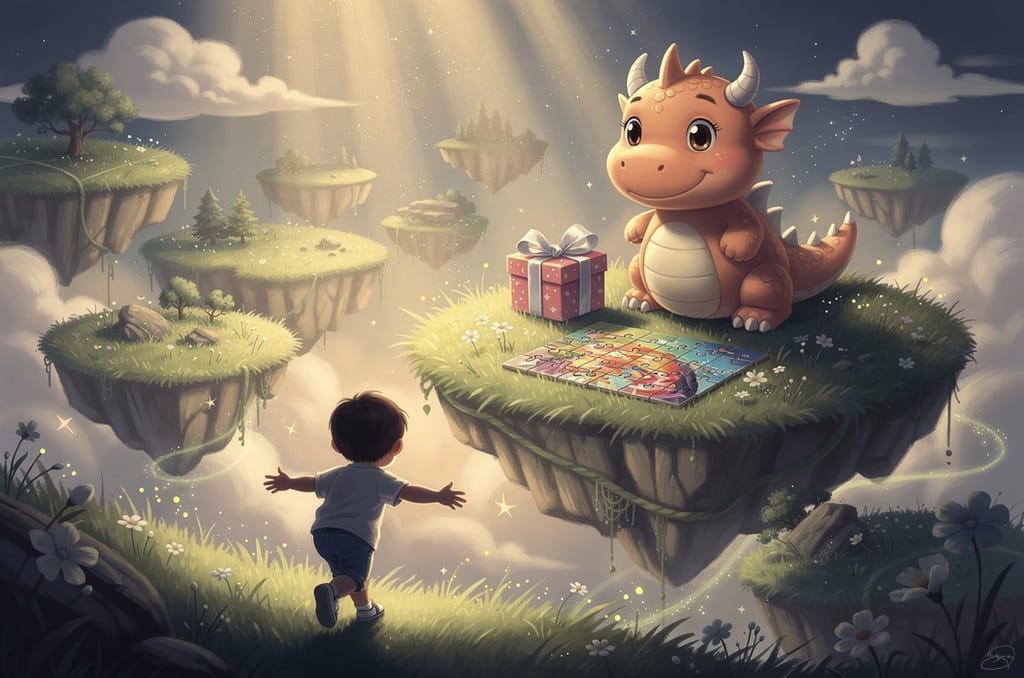
Somewhere around the third birthday, the gift problem changes. A 3-year-old has opinions now, a favorite everything, and a toy box that is already too full. The best gifts for a 3-year-old are not the loudest ones on the shelf. They are the open-ended toys a child returns to, and the keepsake that is still around long after this year's plastic favorite has been quietly donated.
There is research behind that instinct. When toddlers were given fewer toys, they played about twice as long with each one and in more inventive ways (Dauch et al., 2018). So this guide does two things most gift lists skip: it matches the gift to what a 3-year-old can actually do, and it spells out the toy-safety rules that decide what is safe to hand them.
The short answer
The best gifts for a 3-year-old are open-ended, screen-free, and built to last: pretend-play sets, building and magnetic tiles, art supplies, a scooter or balance bike, and a keepsake they keep, like a personalized puzzle where they are the hero. Match the gift to the child rather than the age printed on the box, and read the choking-hazard label before you buy.
| If you want | Give | Good to know |
|---|---|---|
| One keepsake that lasts | A personalized hero puzzle | From $59, doubles as framed wall art |
| The best all-rounder | Magnetic tiles or building blocks | Open-ended, still loved at 5 or 6 |
| For a cautious 3-year-old | Pretend-play set or art supplies | Calm, with no pressure to "win" |
| For an adventurous almost-4 | Scooter or balance bike | Burns energy, builds balance |
| On a budget, under $20 | Picture books or chunky crayons | Screen-free, always welcome |
| A quiet-time pick | A large-piece jigsaw puzzle | 12 to 24 big pieces suits age 3 |
What is a 3-year-old actually like right now?
At 3, most children hold a back-and-forth conversation, ask why about everything, and pretend constantly, but they are only just starting the fine-motor work many gifts assume. So buy for the child in front of you, not the number on the box. By their third birthday most kids can stack a tower of more than nine blocks, copy a circle, count a few objects, string large beads, and speak in short sentences (CDC and MedlinePlus milestones). Pretend and fantasy play is the headline of this age: a 3-year-old plays Mom or Dad, invents whole worlds, and often cannot yet tell fantasy from real (American Academy of Pediatrics). Counting and matching are emerging, not mastered. One practical finding shapes every pick below: 3-year-olds focus about twice as long on an activity they chose themselves than on one an adult hands them (DiCarlo and Ota, 2025), so the gift that fits their current obsession is the gift that gets used.
What makes a good gift for a 3-year-old?
The gifts that last at this age share four traits: they are open-ended, screen-free, made to grow with the child, and simple enough that a grown-up can play too. Pediatricians consistently recommend books, puzzles, and art supplies over electronic gadgets (Atrium Health), and the American Academy of Pediatrics caps screen time at about an hour a day of high-quality, co-viewed content for ages 2 to 5 (a 2026 update keeps that ceiling while focusing more on what and how than on the exact minutes). Fewer and better beats a bigger pile: in a University of Toledo study, the toddlers studied owned about 87 toys on average, yet those given just four at a time instead of sixteen played longer and more creatively with each (University of Toledo). And because a young child's memory is still forming, a 3-year-old draws more lasting happiness from a tangible keepsake than from a one-off outing (Chaplin et al., 2020), which is why the keepsake below earns its place.
No single right way to play, so it stays interesting well past this birthday.
Hands and imagination, not a battery or an app demanding attention.
Useful at 3 and still loved at 5, not outgrown by spring.
A grown-up can get on the floor and play too, which is where the magic is.
The everyday-play gifts, one pick per category
These are the toys that earn their keep at 3: open-ended favorites a child grows into rather than out of. Pick by your child's current obsession, and check the age label and small-parts note before you buy.
A play kitchen, tool bench, or doctor kit feeds the pretend play that defines this age. Ages 3+.
The best all-rounder: open-ended building still loved at 5 or 6. Ages 3+; check for high-powered magnets.
Chunky crayons, washable paint, and big paper. A 3-year-old can copy a circle and loves to. Ages 3+.
For the child who cannot sit still; builds balance and burns energy. Ages 3+ with a helmet.
Read-aloud favorites never miss and never clutter. The budget pick that always lands. All ages.
Large, chunky pieces of a scene they love, kept long after the toy box clears. Ages 3 to 5.
The keepsake gift: one they keep long after the toy box
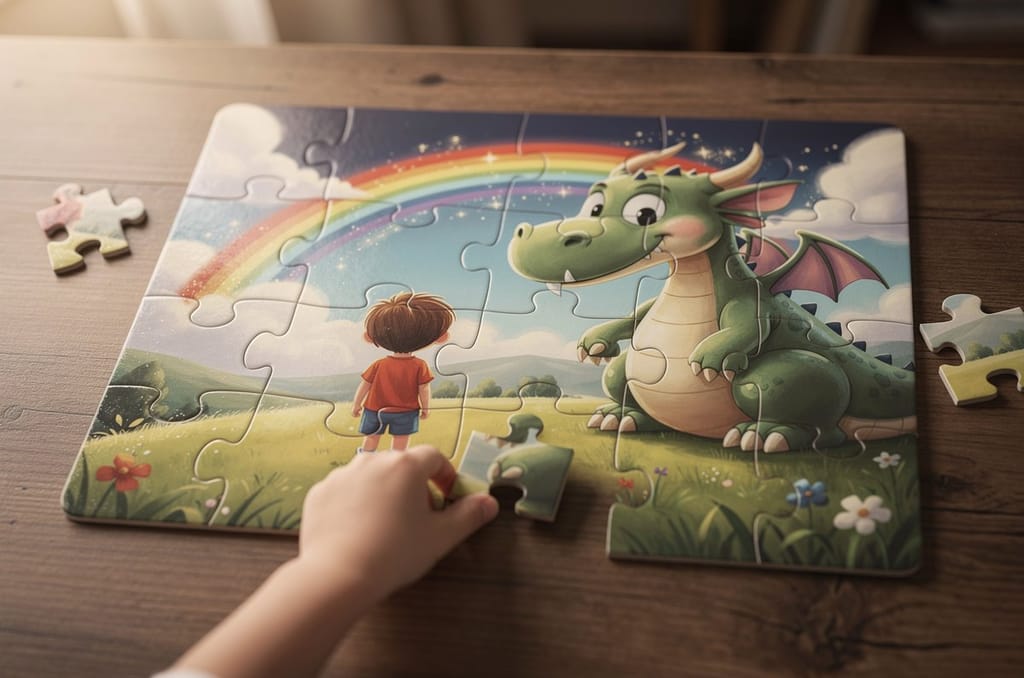
The gift no other list names is a one-of-a-kind keepsake made for this exact child. With The Curious Thing, you upload one photo, pick a magical world, and your child becomes the hero of their own illustrated puzzle, a knight, an astronaut, a deep-sea explorer, whoever they are this year. It solves the problem every gift guide complains about. A mass-market toy is the same one a dozen other kids unwrap; a personalized portrait is theirs alone, and it doubles as framed wall art once the pieces are built. That matters more at 3 than most people realize: because a young child's memory is still forming, a tangible keepsake delivers a repeatable lift of happiness that an over-and-done outing cannot (Chaplin et al., 2020). A fantasy portrait also meets a 3-year-old exactly where their imagination already lives, whether they are obsessed with dinosaurs or unicorns. And you approve a watermarked proof before a single piece is printed, so it arrives exactly as you pictured.
At three there is a second keepsake worth knowing about, and the child makes it. Their own drawing can be stitched in real thread onto a t-shirt or sweatshirt they wear, which gets the scribble stage off the fridge and into use. Send one drawn with bold, closed lines, because thread simplifies a drawing to six solid colors.
Why it lasts
The kids' size is 30 large, chunky pieces built for ages 3 to 5, from $59. You approve a watermarked proof before we print a single piece, it ships free in the US in about 5 to 10 business days, and a defect reprint is free. Your uploaded photo is deleted within 24 hours of fulfillment and is never used to train AI.
Make them the hero of their own puzzle
Upload one photo, pick a magical world, and approve a free, watermarked proof before we print a single piece.
Is a jigsaw puzzle a good gift for a 3-year-old?
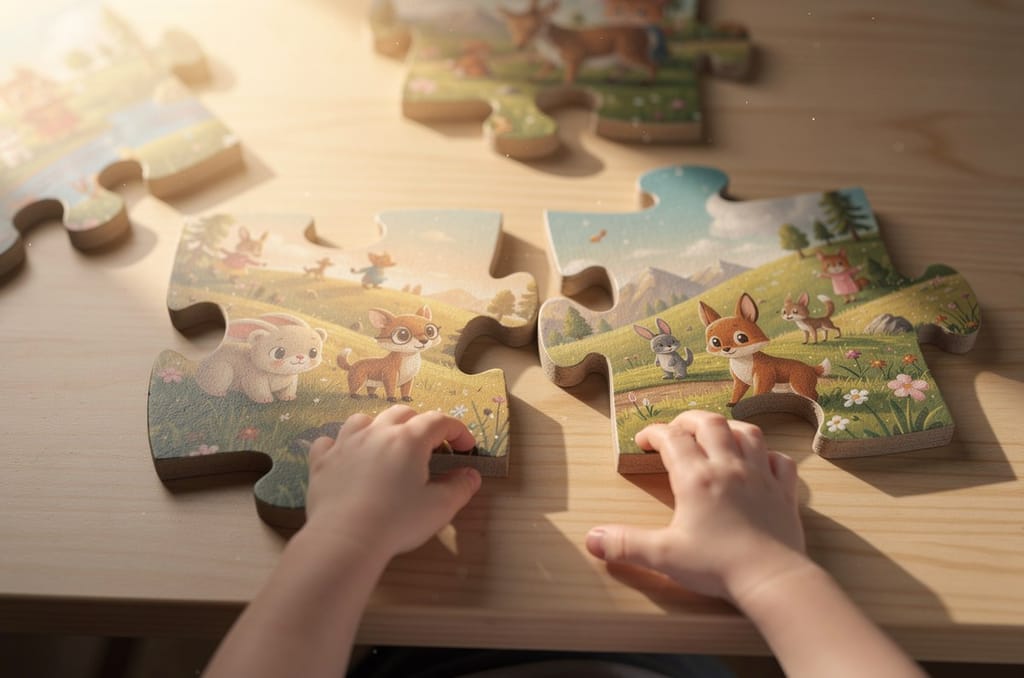
Yes, with the right pieces. Age 3 is exactly when real interlocking jigsaw puzzles start to click, and they are genuinely good for a child this age: the CDC lists simple puzzles as a recommended activity, and a long-term study found that children who did puzzles between about 2 and 4 had measurably better spatial skills by 4.5 (Levine et al., 2012). The trick is the piece count. Occupational therapists put the starting range for a 3-year-old at roughly 12 to 24 large, chunky pieces, scaling up as they approach 4. A picture they recognize helps too, since kids focus longer on what they care about. Our kids' puzzle is 30 large pieces, an easy build for an older 3 or almost-4 with a grown-up, and a frame-it-now, build-it-at-4 keepsake for a younger one. For how piece counts map to ages, see our companion guide to puzzles for 3-year-olds.
Toy safety for 3-year-olds, the part most gift guides skip
The single most useful thing to know: an Ages 3+ label is a federal choking-hazard warning, not a difficulty rating. It does not mean the toy is too advanced for your child; it means the toy has a small part that is unsafe for a child under 3 (U.S. Consumer Product Safety Commission). Under that rule, a toy with small parts made for under-3s is banned, while a toy for ages 3 to 6 must instead carry the warning "CHOKING HAZARD: Small parts. Not for children under 3 yrs." A small part is anything that fits, in any orientation, into a test cylinder about 1.25 inches across, roughly the size of a young child's throat. As a quick home check, if a toy slips through an empty toilet-paper tube, treat it as a choking risk; the tube runs a bit wider, so it stays on the safe side. Those bans exist because choking on small parts, small balls, and latex balloons has caused deaths in young children. Two dangers most gift lists skip: button batteries and high-powered magnets, which can cause serious internal injuries if swallowed, separate from ordinary choking; and if a younger sibling is at home, keep small-part toys up out of reach. For how we handle a child's photo and the proof step, see our guide on whether photo puzzles are safe for kids.
Gifts for a 3-year-old boy or girl: does it matter?
Less than the toy aisle suggests. At 3, the things that drive play are the same across the board: pretend and fantasy play, a growing vocabulary, fine-motor skills like stacking and drawing, and the wish to be the hero of the story. None of the developmental milestones for this age are gendered. The most reliable way to choose is to follow the individual child's current obsession, dinosaurs, mermaids, diggers, or space, rather than a pink or blue shelf, because kids focus far longer on what they actually chose. This is also where a personalized gift quietly wins: a portrait puzzle makes your child the hero either way, so it is the honest answer to both the "gifts for a 3-year-old boy" and the "gifts for a 3-year-old girl" search. Pick the world they love, and the gift fits the kid rather than the category.
Buying for someone else's child?
If you are a grandparent or buying from a distance and you are not sure what the child is into this month, a personalized keepsake removes the guesswork. It is made for them specifically, so it can never be the toy they already have, and it will not pile onto an already-crowded toy box. Because it captures a moment, it gives a far-away giver something a gift card cannot: a one-of-a-kind gift the family keeps and frames. A parent uploads the photo and approves the proof, and it ships straight to the child anywhere in the US. For more keepsake ideas matched to what a child loves, see our guide to personalized gifts for kids by obsession.
Frequently asked questions
How many toys does a 3-year-old need?
+
Fewer than most homes have. In a University of Toledo study, the toddlers studied owned about 87 toys on average, yet those given four toys instead of sixteen played about twice as long with each and in more inventive ways. For a 3-year-old, a smaller set of open-ended favorites, rotated occasionally, beats a crowded toy box, and one well-chosen keepsake often does more than several quick toys.
What do you give the 3-year-old who has everything?
+
Give a one-of-a-kind keepsake instead of more stuff. A personalized gift like a portrait puzzle where the child is the hero cannot be duplicated, so it is never the toy they already own, and it does not add to the clutter. Because a young child draws lasting happiness from a tangible keepsake (Chaplin et al., 2020), it earns its spot on the shelf long after this year's plastic favorite is gone.
Are puzzles good for 3-year-olds?
+
Yes. Age 3 is when interlocking jigsaw puzzles start to click, and they build fine-motor and spatial skills: a long-term study found children who did puzzles between about 2 and 4 had better spatial skills by age 4.5 (Levine et al., 2012), and the CDC lists simple puzzles as a recommended activity. Choose large, chunky pieces and a low count so the puzzle stays fun rather than frustrating.
How many puzzle pieces are right for a 3-year-old?
+
Start low and large. Occupational therapists put the typical range for a 3-year-old at roughly 12 to 24 big, chunky pieces, scaling up as the child nears 4. A picture the child recognizes helps them stay focused. A 30-piece set works for an older 3 or almost-4 with a grown-up's help, and makes a frame-it-now keepsake for a younger child to grow into.
Is an "Ages 3+" toy safe for my 3-year-old?
+
Yes. An Ages 3+ label is a federal choking-hazard warning, not a sign the toy is too advanced. It means the toy contains a small part that is unsafe for a child under 3, so it is appropriate for a 3-year-old (U.S. Consumer Product Safety Commission). The one caution: if a younger sibling is in the house, keep small-part toys up out of reach.
Are toys or experiences better for a 3-year-old?
+
At this age, a tangible gift often wins. Unlike adults, young children draw more lasting happiness from a material keepsake than from a one-off outing, because their memory is still forming (Chaplin et al., 2020). If you give an experience, pair it with a small physical keepsake to open, so there is something to hold on the day and a memory to revisit.
Picks reflect our editorial view as of June 2026, and prices for third-party gift types vary, so confirm with each maker. The Curious Thing is our own product, and we have kept this list honest and useful. See also our guide to what makes a good custom photo puzzle.